1 913 résultats
1957français In-8 de 159 pp.; cartonné toile satinée de l'éditeur. Collection des Fermiers Généraux. Illustrations de Gavarni. Edition hors commerce, un des 6000 exemplaires sur offset blanc, celui-ci n° 878. Un nom manuscrit en troisième garde.
1980réf. 180102Hamburg: Hans Christians, 1980. 321 S., überwiegend Ill. (z.T. farb.), 33 cm. Leinen, gebundene Ausgabe, SU.
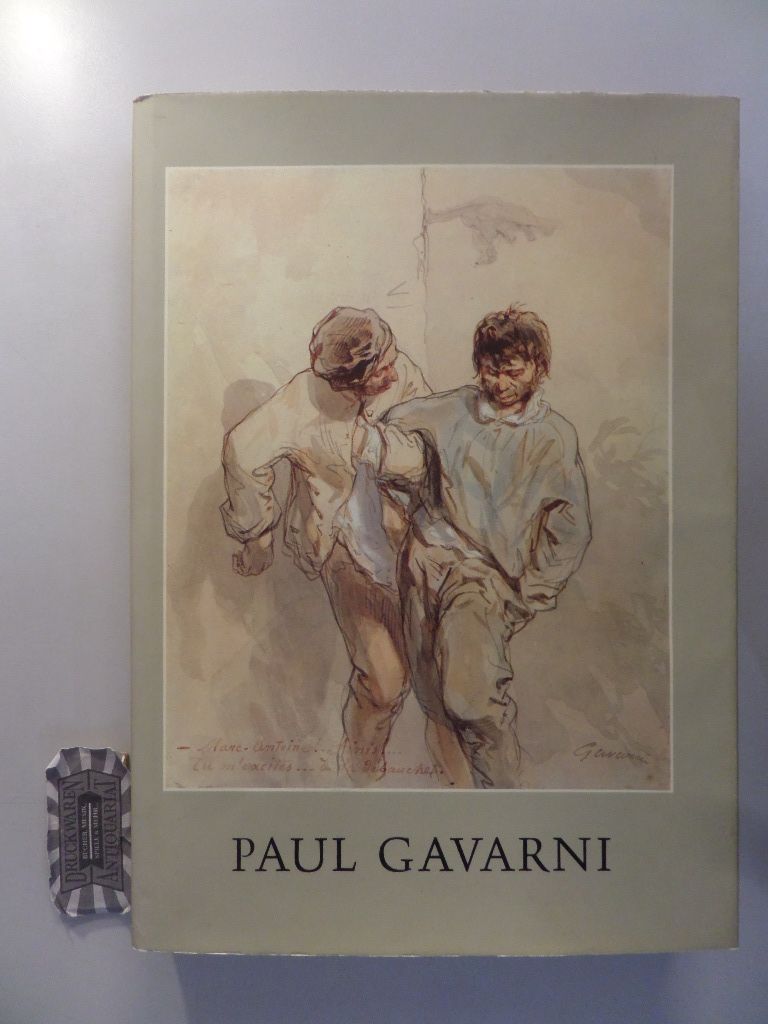
grand in-8°, 250 pages, front., broché, couv. Bel exemplaire [GD8-8] Illustrations de Gavarni, Henry Monnier, Tony Johannot, etc.
Hardback in-8, XXIV-252 pages, nombreuses illustrations, reliure demi basane rouge a coins, titre dore. Bel exemplaire. [HA-8]
in-8, 380 pages, illustrations en noir et blanc de Gavarni, broche, couv. Textes de G. Sand, Stahl, Gozlan, Pascal, Fr. Soulié, Ch. Nodier, Briffault, Balzac, A. Karr .... Précédée d"uune histoire de Paris par Th. Gautier.- Illustrations par Gavarni, vignettes de Bertall. Bon etat. [NV-31] Bon etat.
1980LONGANESI 1980, COLLANA I TASCABILI DEL BIBLIOFILO RIPRODUZIONE DELLE TAVOLE DI DAUMIER STESSO, PREFAZIONE DI NATALIA ASPESI PERFETTO COME NUOVO ASSOLUTAMENTE PERFETTO.
IL GALLO D'OROJUAN RULFOEditori RiunitiI? Edizione 1982132 pagine - formato 13x20 cm circain buono stato salvo ultima pagina bianca lievemente danneggiata (285 g) E22267
1918réf. 601818Berlin, Hyperion, (1918). M. 107 Taf u. 36 Abb. OHlwdbde (Rücken gering lichtspurig).
1971réf. V33575Hamburg (Chrisitans) 1971 (= Erste Ausgabe). 8°, illustrierte Originalbroschur (Paperback ) ohne Pagination, Bildtafeln 1
1953réf. 5472Affoltern, Ähren-Verlag, 1953. 4°, nicht paginiert (9 Seiten Text, Titelbild und 76 Tafeln). Orig.Leinen mit OSU.
1925réf. 501568Paris, Fasquelle, 1925. M. 32 Taf. 267 S.
1862réf. 1310746Paris, Morizot, 1862. 2 Bl., 428 S. Mit Frontispiz, Titelvignette, 4 Holzstich-Tafeln von Gavarni. Blindgeprägter OLwdbd m. figürlicher Vorder- u. Hinterdeckel- sowie Rückenvergoldung u. allseitigem Goldschnitt (Rücken u. Ränder verblaßt, Kapitale u. Ecken bestoßen, Bibl.-Stempel auf Innendeckel vorn, Vordergelenk gelockert, meist gering, teils jedoch stärker braunfleckig).
1848réf. 49512Paris: J. Hetzel 1848. With notes by Theophile Gauthier. Paul Gavarni was the pseudonym of Sulpice Guillaume Chevalier a popular illustrator and carto . Paris: J. Hetzel 1845-1848. With notes by Theophile Gauthier. Paul Gavarni was the pseudonym of Sulpice Guillaume Chevalier a popular illustrator and cartoonist. In this series each story has its own illustrated title page and an introduction by Gautier. The stories themselves consist of full-page illustrations with narrative captions. Contents include "les Enfants Terribles 1845" "les Actrices 1845" "les Lorettes" "Traduction en Langue Vulgaire 1845" "Fourberies de Femmes en Matiere de Sentiment 1846" "Clichy" "Paris le Soir" "le Carnival a PAris 1847" "Paris le Matin 1847" "les Etudiants 1846" "la Vie de Jeune Homme 1848" and "les Degardeurs." 19th century Parisian life in all its glory absurdity and strangeness. Four volumes bound in 1/4 crimson calf over marbled boards. Raised bands and gold spine lettering. A few spots on calf backstrips but a very good set overall. Four volumes 26 cm. Unpaginated about 150 pp. each b/w fill page plates throughout. . J. Hetzel hardcover books
1846réf. 3650Paris: J. Hetzel 1846. First edition. Two large octavo volumes 10 3/8 x 6 7/8 inches; 263 x 175 mm. Contemporary half black hard-grain morocco ruled in gilt over black morocco-grain paper over boards. Smooth spines decoratively tooled in gilt and blind and lettered in gilt. Marbled edges and endpapers. Minor rubbing to extremities head of spine of Volume II expertly and almost invisibly repaired front hinge of Volume I cracked but sound. Minimal foxing and soiling. Small area of surface abrasion to upper blank margin of plate Artistes -6 facing page 160 in Volume II where it was once adhered to the facing page. Bookplate Bibliothèque de A. Vautrain on front pastedown of each volume. Collating 4 xxxii 380; 4 lxxx 364. Wood- engraved title vignette in each volume 212 wood-engraved plates 208 after Gavarni and four after Bertall with tissue guards and numerous wood-engraved head- and tail-pieces vignettes and initials. This copy with a duplicate of the plate facing in Volume I. Music. Overall an excellent copy. "The book appeared in part-issues at the rate of one or two a week between April of 1843 and December of 1845. The major attraction of Le diable à Paris resides in Gavarni's plates which are of even greater interest than the 320 wood engravings of his Oeuvres choisies 207. The engraving is superior for the most part and they are new conceptions not versions of his lithographs. He limits himself almost entirely to single figures or pairs evoked with his usual concentration and psychological subtlety. He had a free hand with his subjects since his designs are quite unrelated to Hetzel's text. As usual he arranged them as series some of which those devoted to writers and politicians for example are largely unprecedented in his previous repertory. He invaded Daumier's world with success in the fifteen plates of 'Bourgeois' exampled in the self-satisfied worthy reproduced II 328" Ray. Hiler 237. J. Hetzel unknown books
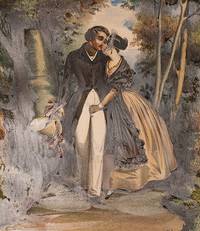
réf. 06725Paris: n.p. 1837. The Most Intimate of All Gavarni's Color-Plate Suites GAVARNI Paul pseudonym of Guillaume Sulpice Chevallier. Scènes de la Vie Intime. Paris: 1837. Folio 16 3/8 x 10 1/4 inches; 415 x 260 mm. Twelve superb hand colored lithographs all heightened with gum arabic. The actual plate size is ca. 182 x 144 mm. Bound ca. 1890 in half tan calf over marbled boards ruled in blind. Front cover with rectangular maroon leather label bordered and lettered in gilt decorative endpapers. A fine copy of this great rarity. The colors exceptionally bright and fresh throughout with the gum arabic heightening still retaining its original gloss and luminosity. Minor signs of handling only the plates clean and well preserved. Issued as a suite of twelve lithographs accompanied by a separate 'Titre de la couveture' which is not present Armelhault & Bocher. Scènes de la Vie Intime is one of the jewels of Gavarni's printed oeuvre and is certainly one of Gavarni's most appealing and elusive color-plate suites - capturing the wit elegance and quiet drama of everyday bourgeois life in Paris. Rather than relying on broad caricature Gavarni focused on subtle gestures fashionable costume and the complexities of domestic relationships qualities that made him one of the most admired social observers of the July Monarchy. His keen powers of observation coupled with an effortless draftsmanship place these scenes among the finest achievements of French lithography of the period. Excessively rare: OCLC/RLIN record just one example 8 uncolored plates only in libraries and institutions worldwide: Bibliotheque Nationale de France. The Plates: Plate I - Conversation Causerie Plate II - School Friendship Amitié de Pension Plate III - A Nest Among the Wheat Un Nid dans les Blés Plate IV - Distraction Plate V - The Dark Closet Le Cabinet Noir Plate VI - Prelude Plate VII - Before the Fall Avant le Péché Plate VIII - After the Fall Après le Péché Plate IX - The Lookout Le Guet-Apens Plate X - Landscape Lesson Leçon de Paysage Plate XI - Arm Above Arm Below Bras Dessus Bras Dessous Plate XII - The Painter's Wife La Femme du Peintre Armelhault & Bocher 2002-2013; Bobins II 527 this copy. Paris: n.p., 1837 unknown books
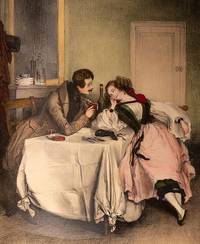
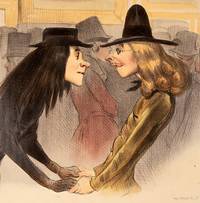
réf. 06687Paris: Chez Bauger 1834. Midnight in Paris - Gavarni and the Secret Theater of Carnival A Superb Hand-Colored Copy of Le Carnaval à Paris in the Original Publisher's Binding Together with the Very Rare and Complete Suite of Les Bals Masqués GAVARNI Paul pseudonym of Guillaume Sulpice Chevallier. Le Carnaval à Paris. February 1841 - February 1842. and Les Bals Masqués. Paris: Chez Bauger Rue du Croissant 16; variously printed by Aubert & Cie. and Kaeppelin February 1834. Folio 13 1/8 x 9 7/8 inches; 333 x 251 mm. A superb carnival album containing twenty-eight magnificent hand-colored lithographs heightened throughout with gum arabic including the complete suite of seven plates from Les Bals Masqués together with an additional related carnival plate "Bal Masqué No. 8" all bound after the first twenty hand-colored lithographs of Le Carnaval à Paris. Eight-page Aubert et Cie. catalog bound in at end. Publisher's quarter maroon calf over red patterned boards front cover decoratively lettered in gilt: "Le Carnaval à Paris" smooth spine. A remarkably fresh and well-preserved copy the plates with exceptionally bright contemporary hand-coloring and luminous gum-arabic heightening the binding with only minor wear at extremities. An unusually handsome survival. The Les Bals Masqués sequence forms a brilliant miniature drama of Parisian carnival life. 1. C'est toi mauvais sujet! "It's you you wicked creature!" A masked reveler in dazzling Oriental costume leans intimately toward a richly dressed young woman whose expression balances amusement and suspicion amid the crowded ballroom. 2. T'en souviens tu friponne. "Do you remember you little minx" This plate captures a moment of flirtatious accusation between a masked cavalier dressed in vivid blue and his companion the theatrical gesture and conspiratorial proximity perfectly conveying the coded language of carnival seduction. 3. Vois mon mari derrière! "Look - my husband is behind us!" Gavarni brilliantly stages bourgeois panic and comic intrigue as a masked woman urgently warns her companion while curious revelers peer from the theater box above. 4. Les apprêts du bal. "Preparations for the Ball" shifts backstage to the private preparations before the festivities two young women dressing in Pierrot-inspired white costumes beneath heavy green drapery the quiet intimacy contrasting sharply with the social theater of the ballroom itself. 5. Un cabinet chez Pétron. "A Private Room at Pétron's" - the mood darkens delightfully when an exhausted young woman reclines dreamily in a private dining cabinet while her companion smokes and pours wine after the night's excesses. 6. Un souper de carnaval. "A Carnival Supper" - a masked beauty bends toward her seated admirer in a dim attic interior littered with dishes and bottles one of Gavarni's most psychologically suggestive images of post-ball intimacy. 7. Le retour du bal masqué. "The Return from the Masked Ball" - this plate is from the series Fantaisies the emotional climax of the suite is undoubtedly portrayed where a pale and utterly exhausted reveler collapses into a chair while attendants remove her costume after the night's pleasures and deceptions have run their course. The theatricality fatigue and melancholy glamour of Carnival Paris are distilled here with extraordinary elegance and humanity. 8. The additional hand colored lithograph "Bal Masqué No. 8" C'est vieux et laid mon cher; tu es volè comme dans un bois. "It's old and ugly my dear! You've been robbed as if in a forest" - this plate is from the series Fantaisies and serves almost as an epilogue to the series: a weary bourgeois gentleman trapped between two masked women whose expressions suggest equal measures of intrigue manipulation and amusement. Framed within an elaborate ornamental border it possesses the sharp observational wit characteristic of Gavarni at his finest. A visually dazzling and socially revealing document of Parisian carnival life during the July Monarchy Le Carnaval à Paris ranks among the most evocative lithographic productions of the great age of French caricature. Combining theatricality fashion illustration social satire and romantic intrigue the plates capture the masked balls flirtations backstage preparations clandestine suppers exhausted dawn returns and coded erotic freedoms of carnival Paris with extraordinary wit and elegance. Paul Gavarni was among the supreme interpreters of nineteenth-century Parisian society standing beside Honoré Daumier and Grandville as one of the defining graphic artists of the period. Yet where Daumier's art often bites with political ferocity Gavarni's genius lay in psychological nuance gesture costume flirtation and the delicate ambiguities of urban social performance. His carnival subjects remain among the most sophisticated visual chronicles of Parisian pleasure culture produced during the nineteenth century. The present copy is especially desirable for its rich contemporary hand-coloring lavish gum-arabic enhancement and survival in the original binding. The gum arabic was applied to heighten reflective surfaces and luxurious fabrics producing a shimmering effect intended to imitate satin silk velvet candlelight and theatrical costume textures. Such deluxe issues were considerably more expensive than ordinary tinted or uncolored impressions and survive far less frequently today. A splendid and highly decorative survival from the golden age of Parisian lithography - simultaneously theatrical satirical elegant and deeply evocative of the secret life of Carnival Paris. Le Carnaval à Paris. February 1841 - February 1842. Plates 1-20. 1. Nèfie-loi Coquardeau! si tu ne finis pas de t'amuser comme ca on va te fich'au violon. "Watch it Coquardeau! If you don't stop carrying on like this they'll throw you in jail." 2. Rue Coquenard au cinquième; une porte jaune. Ton portier fait des chaufferettes et tu joues de la flûte ainsi! "Rue Coquenard fifth floor; a yellow door. Your porter makes foot-warmers and you play the flute - like this!" 3. -Il n'est pas ici! Madame. -Il y viendra! Madame. "He isn't here Madam. - He'll come Madam." 4. Qu'est-ce Les gens de Qualité se commettent-ils maintenant avec ceux de votre sorte Pandour! "What's this People of quality mix nowadays with people of your sort Scoundrel!" 5. -Jai un mal à la tète de chien! -C'est le champagne. -Ah! Dieu je ne bois jamais de vin; c'est le rhum. "I've got a splitting headache! It's the champagne. Oh God I never drink wine; it's the rum." 6. -Qui diable ca peut-il être -Voyons mon Oncle: ma cosine Claire. . . . a la migraine; Madame; Madame d'Asté est en deuil; ma sœur a horreur des bals masqués d'abord; Madame Debry. . . . Philippe défend à sa femme d'y venir; ma tante Clèmence. . . . - Ta tante est couchée. . . . Mais qui diable ca peut-il être "Who the devil can it be Let's see Uncle: my cousin Claire. has a migraine Madam; Madame d'Asté is in mourning; my sister detests masked balls anyway; Madame Debry. Philippe forbids his wife to come; my Aunt Clémence. Your aunt is in bed. But who the devil can it be" 7. -Parbleu! si vous deviez les èpouser toutes mauvais sujets! les oncles n'y suffiraient pas. -Ni les neveux non plus mon oncle. "Good heavens! If you had to marry all of them you rogues there wouldn't be enough uncles to go around! Nor nephews either Uncle." 8. -Tu vois bien la blonde d'henri là! qui parle à ce grand avec une barbe. . . . -Cà! . . . . c'est la femme de Clément. . . . -Éh! bien oui c'est cà. . . . tu vois elle va souper avec le petit Russe. . . . eh! bien mon Nini Chèvrier l'attend au café anglais. . . . un si brave garçon! . . . . -Cà c'est pas gentil. "You see Henri's blonde over there talking to that tall fellow with the beard. That one . that's Clément's wife. Well yes that's her. you see she's going to supper with the little Russian. and meanwhile my dear Nini Chèvrier is waiting for her at the Café Anglais. such a nice fellow too! That's really not nice." 9. "On désire cèder Monsieur avec tous les avantages y attachès Sàdresser à Monsieur." "Wanted to transfer Sir together with all attached advantages. Apply to Monsieur." 10. -Prête-moi vingt frances Guillemain j'ai le Domino rose à dèjeûner. -Je l'ai eu à souper mon pauvre bonhomme et je n'ai plus le sou. "Lend me twenty francs Guillemain; I've got the Pink Domino coming for breakfast.I had her for supper my poor fellow and I haven't a sou left." 11. -Les rats couchés nous sommes venus. -Et. . . . vos petits voisins de l'entresol. . . . vous ne les avez pas débauchés -Eux des poules comme çà! çà se couche à minuit en carnival et puis çà vient vous dire que le carnival est triste. -Epiciers! "Once the old rats were in bed we came out. And your little neighbors on the mezzanine. you didn't lead them astray Them Chickens like that! They go to bed at midnight during Carnival then come and tell you Carnival is dull. Grocers!" 12. Oh! hè! Dufrène oh! hè les pistons oh! èh! affûetz vos becs: faut de l'harmonie aux flambards de la chouette harmonie! "Hey! Dufrène! Hey there brass players! Sharpen your beaks - the torchbearers need music splendid owl-like music!" 13. Voilà la petite avec le brun qui l'amène toujours: le blond qui la remmène toujours va venir. "There's the little brunette with the dark-haired fellow who always brings her; the blond who always takes her home will be here soon." 14. -C'est donc comme çà que ça mène la joie les houzards de ce règiment là -Turlututu mon ange nous sortons d'en prendre et toi "So this is how the hussars of that regiment enjoy themselves Turlututu my angel we've just come from having a drink - and you" 15. -C'est un diplomate. . . -C'est un epicier. . . -Non! c'est un mari d'une femme agréable. -Non! Cabocher mon ami vous avez donc bu. . . que vous ne voyez pas que Mosieu est un jeune homme farceur comme tout déguise en un qui sembête à most. . . . le roué masque! "He's a diplomat. He's a grocer. No! He's the husband of an attractive woman. No Cabocher my friend you must be drunk. can't you see that the gentleman is just a practical joker disguised as one of those dreadfully boring fellows. the sly masked rogue!" 16. -Reflèchissez mon cher ange. . . .: une couchette de noyer toute neuve! et la commode. . . . et quatre belles petites chaises. . . . avec les rideaux jannes et la flèche. . . . cest un aveniur çá! -Je ne dis pas! Mosieu Coquardeau; mais jaime mieux Henri sans rien. "Think about it my dear angel. a brand-new walnut bed! And the chest of drawers. and four lovely little chairs. with yellow curtains and the canopy. that's a future for you! I'm not saying otherwise Monsieur Coquardeau; but I prefer Henri with nothing." 17. Veux-tu te Sauver Sauvage! "Get lost savage!" 18. Tenez Clara je suis contrairé comme tout! c'est ma bête de femme qui est partie avec le numéro de mon paletot et ma clef! à prèsent faut que j'attende le jour et que jáille aux Batignolles pour avior ma clef. . . . je suis contraire comme tout. "Look Clara I'm furious! My idiot wife went off with the number tag for my overcoat and my key! Now I have to wait until daylight and go all the way to Batignolles to get my key. I'm absolutely beside myself." 19. A sept heures ma fille se lève; le temps de faire ses quinze tours il est bien huit heures; faut travailler son piano; on déjeune à neuf; à dix c;est son anglais; ma fille chante sur les midi; et puis sa mère veut qu'elle couse qu'elle fasse un peu de cuisine un peu de tout: bon! la maitresse de paysage arrive à trois hèures; et puis nous avons des serins faut nettoyer çà les fleurs des pots n'importe quoi; les uns et les autres viennent: arrivent cing heures. Et le soir c'est Monsieu Marritou qui lui fait repasser son orthographe. . . . et après çà vous croyez qu'une jeunesse a beaucoup le temps de s'amuser vous! "At seven my daughter gets up; by the time she's done her fifteen turns it's already eight; then she must practice the piano; breakfast is at nine; at ten she has English lessons; around noon she sings; and then her mother wants her to sew do a little cooking a bit of everything; good! the landscape drawing teacher arrives at three; then we have canaries that need cleaning flowers in pots goodness knows what; visitors begin arriving around five. And in the evening Monsieur Marritou makes her review her spelling. and after all that you think young people have much time for amusement!" 20. . . . . Elle ètait donc censée garder sa tante Grayet qui tenait le lit. . .depuis le Rois pour ses dameuses coliques quand un soir je monte au Grand-Vainqueur pour voir un peu: qu'est-ce'que je vois . . . . mon èspouse en Garde-Française! ! ! !. . . . . ".So she was supposedly staying home to care for her Aunt Grayet who had been bedridden since Twelfth Night with dreadful colic when one evening I went up to the Grand-Vainqueur just to have a look: what do I see . my wife dressed as a French Guardsman!!!". Armelhault & Bocher 397-409 Le Carnaval a Paris; 2058 2057 2065 2060 2061 also see pp. 87/88 Les Bals Masques; & 1726 Fantaisies. Paris: Chez Bauger, 1834 unknown books
réf. 06347Paris: Caboche Grégoire 1837. One of Paul Gavarni's Rarest and Most Famous Series Thirty-Four Superb Lithographs. GAVARNI Paul pseudonym of Guillaume Sulpice Chevallier. La Boite aux Lettres. Paris: Caboche Grégoire et Cie Chez Arnauld de Vresse libraire éditeur 1837-1839. Folio 13 1/2 x 10 1/2 inches; 343 x 267 mm. Thirty-four superb lithograph plates with captions of the 'letters' printed below. Bound without the lithograph title-page. Bound by Pagnant ca. 1920 in quarter tan morocco over red patterned boards spine with five raised bands lettered in gilt in compartments cockerel endpapers. Joints expertly repaired some light to moderate foxing to several of the plates. Still an excellent example of this rare suite of lithographs. The first twelve lithographs were published by Caboche Grégoire et Cie. The following twenty-two lithographs were published by Aubert & Cie. and appeared in the journal Le Charivari between 7 November 1837 and 6 February 1839. According to OCLC there is just one copy with all thirty-four plates in libraries and institutions worldwide: The Clark Art Institute MA USA with all thirty-four plates- but lacking the lithographed title-page. Other than that example there are only three individual lithographs at The Getty CA USA numbers 4 8 & 14. The Getty also have a plain example of number 10. Paul Gavarni 1804-1866. "A French artist best known for his lithographs Paul Gavarni née Chevalier Suplice Guillaume was born in Paris on January 13 1804. Throughout his lifetime Gavarni produced over 4000 satirical prints for journals and fashion magazines. Both delicately witty and elegantly revealing of human behavior and character Gavarni's genre scenes made him one of the most important and popular nineteenth-century artists. He is often critically paired with Honoré Daumier with whom he and other young printmakers like Jean-Jacques Grandville and Joseph Traviés raised the status and importance of social lithography and printmaking as an art form. In the 1830s he began to work for L'Artiste La Caricature and most importantly Le Charivari. The latter was owned by Charles Philipon and became Gavarni's longest running contract and most important place of publication. Here Gavarni published some of his most famous series including Les Artistes La Boite aux Lettres Clichy inspired by his month-long stay in debtor's prison Les Coulisses Les Enfants Terribles Impressions de Ménage etc. etc." childsgallery.com "Gavarni as Sainte-Beuve puts it set to depicting and silhouetting society in all directions and from top to bottom: the high society the not so high society-all sorts of societies capturing the life of his time. He grabbed modern life by every available handhold imitating no one looking for nothing else swimming in open water and taking us in his wake amidst the stream of the manners of the time. He was Gavarni with an inexhaustible wit who at the bottom of a graceful drawing always interesting thanks to rational observation would write a caption full of subtle humor. It would sometimes unfold like a short comedy or be condensed like a geometrical axiom. Amusing and light-hearted when taken separately Gavarni's captions showed their true color of skeptical melancholy and of deep and powerful meaning when considered as a whole. He could through the accuracy of faces careful rendering of clothes and the precision of poses and bearing unmistakably express the age quality occupation habits manners and ridiculous ways of the characters he depicted. He made them speak a language that was stunning with original exactness feeling and novelty. Gavarni-and that's why he is great-created two genres at once: the pencil-drawn comedy of manners and the caption. His reputation became huge. True enough much of his audience only saw the funny aspect of the genre and called his drawings "caricatures" without noticing any difference with those of Daumier. But all sensitive souls were seduced by their elegance and subtlety and easily perceived their uniqueness." oldbookillustrations.com. Armelhault & Bocher pp. 88-95 11 unnumbered 348-368. Not mentioned in Ray. Paris: Caboche, Grégoire , 1837 unknown books
réf. 06349Paris: Chez Aubert 1841. Love is their business and they drive hard bargains They are as luxurious and idle as they are beautiful Their lives are a tissue of deception and hypocrisy" GAVARNI Paul pseudonym of Guillaume Sulpice Chevallier. Les Lorettes. Paris: Chez Aubert June 1841-December 1843. Folio 13 1/2 x 9 3/4 inches; 342 x 248 mm. Seventy-six of seventy-nine lithograph plates. All plates mounted on stubs. The three missing plates nos. 68 69 & 70 are supplied with the illustrations that appeared in Charivari with text on verso. In addition there are duplicates of plate nos. 47 48 63 & 73 on "chine applique". Late nineteenth century marbled boards with original maroon morocco label lettered and bordered in gilt expertly rebacked and re-cornered with blue cloth spine with black morocco label lettered and ruled in gilt new endpapers. One of the rarest of all the Gavarni albums. Originally published from June 1841-December 1843 by Aubert et Cie. with just twenty lithographs. These lithographs represent the complete thematic cycle Gavarni created around the "lorette"-the semi-independent fashionable demimondaine of July Monarchy Paris. OCLC locates just one example in libraries & institutions worldwide: Clark Art Institute MA US. There have been just four complete copies at auction since 1901. A second series titled Les Lorettes Vieillies appeared in the 1860's. This second series contained thirty hand colored lithographs. OCLC locates just two copies of this rare work - they do not state that the plates are colored: University of Miami FL US & Northwestern University Library IL US. "Les Lorettes. This is the most masterly of Gavarni's earlier series. Ladies of the evening of a certain standing had come to be called lorettes because they often lived in the handsome new buildings of the Rue Notre Dame de Lorette. No subject could have been better suited to Gavarni's talents. Indeed Paul de Saint Victor observed preface to D'Après nature II 2 that "the lorette is for him what the actress of the Italian Comedy was for Watteau." Gavarni shows them without malice and without indulgence exactly as they were. The grisette of Les étudiants de Paris was an ingratiating figure; not so the lorette. Love is their business and they drive hard bargains. They are as luxurious and idle as they are beautiful. Their lives are a tissue of deception and hypocrisy. Among themselves their conversation is cynical to the point of brutality. Their men usually twice their age also cut a poor figure. At best these gentlemen command a wry irony which derives from their awareness of being dupes. Gavarni presents these brittle and glittering creatures with great deftness. The packed and subtle dialogue of the legends would not be amiss in a novel by Stendhal. It is difficult to select from his remarkable compositions but one cannot overlook. no. 27 in which a lorette in her bath indulges in a rare moment of speculative conversation with a friend." Ray The Art of the French Illustrated Book pp. 223-224. Note. Gordon Ray's copy had 73 of the 79 hand colored lithographs - missing nos. 19-24. "Lorette was a colloquialism for a new type of prostitute who was kept in relative luxury in the apartment buildings that had been constructed in the Notre-Dame-de-Lorette church. Gavarni's sharp-eyed observations of Parisian society in works like these demonstrate his value as a documentarian of his times." Bobins V p. 64 #1541. "In 1837 Gavarni began his connection with Le charivari which did not conclude until 1848. In all he drew 1054 lithographs for his journal.Most of these appeared in series some twenty-five of which extend to ten or more plates and were afterwards published by Aubert in albums. Perhaps the best of these collections are Fourberies de femmes en matière de sentiment Les étudiants de Paris Les débardeurs and Les lorettes; but some of the rest are of hardly inferior interest. Still further series contributed to periodicals other than Le charivari were also issued as albums. Baudelaire had this part of Gavarni's work particularly in mind when he wrote.that 'the true glory and the true mission of Gavarni and Daumier has been to complete Balzac.' Certainly the pictures of Parisian society provided by the two artists perfectly complement each other. Daumier's preoccupation was the working middle class with faces and figures heavily marked by life. Gavarni remained for the most part outside the humdrum bourgeois round. He preferred to show 'youth at the prow and pleasure at the helm.' His pretty girls and sleek young men are bent on enjoyment. They live lives of graceful dissipation with love intrigues and balls on the one hand and pawnbrokers' shops and debtors' prisons on the other.In 1846 Gavarni returned to Le charivari to which he had hardly contributed since 1843. He wished to call the series that ensued Choses de Paris but was persuaded instead to employ the general title Oeuvres nouvelles. Its major albums were Carnaval; Impressions de ménage deuxième série thirty-nine lithographs 1846-1847; and Baliverneries parisiens twenty-four lithographs 1847" Ray The Art of the French Illustrated Book pp. 217-218. Armelhault & Bocher 763-841; Beraldi VII p.51 # 107; Bobins V 1541. Paris: Chez Aubert, 1841 unknown books
réf. 06466Paris: Aubert et Cie. 1839. The Fine Shades of Feeling: Gavarni and the Comedy of Modern Emotion GAVARNI Paul pseudonym of Guillaume-Sulpice Chevallier. Nuances du Sentiment. Paris: Aubert et Cie. 1839-1840. First edition. Folio 13 1/4 x 10 inches; 336 x 254 mm. Twenty-five lithograph plates. Plate no. 20 with contemporary hand-coloring heightened with gum arabic. Plate no. 10 misnumbered "9" as noted by Armelhault. Plate no. 15 slightly shorter 3/8 inch at lower margin. Some occasional light marginal foxing - most noticeable on plate 1. Early twentieth-century blue cloth covers decoratively bordered in blind front cover lettered in gilt expertly rebacked spine lettered in gilt. Aside from the occasional light marginal foxing this is a near fine copy. A charming and unusually appealing complete set from one of Gavarni's most perceptive and elegant social suites Nuances du Sentiment turns its attention to the delicate gradations of emotion courtship vanity hesitation disappointment and self-dramatization that animate Parisian life. Few artists of the July Monarchy were better equipped than Gavarni to capture these fleeting psychological states. With his incomparable economy of line and his gift for registering gesture pose and expression he transforms small moments of social comedy into scenes of remarkable acuity. The title itself is characteristic: these are not grand passions but subtleties - shades of feeling observed in drawing rooms promenades and private exchanges. Gavarni was among the supreme illustrators of modern manners and in suites such as this one he stands beside Daumier as one of the great visual chroniclers of nineteenth-century French urban life. Yet where Daumier often bites Gavarni more often insinuates; his satire is lighter cooler and at times almost tender though no less exact. Particularly attractive is the contemporary hand-coloring of plate 20 heightened with gum arabic a feature that lends that sheet a more finished and decorative quality and offers an appealing reminder of the close relationship between the lithographic satire and the luxury print market of the period. The mis-numbering of plate 10 as "9" recorded by Armelhault is present as expected. A quietly sophisticated and genuinely scarce Gavarni suite - and a reminder that the most revealing chronicles of nineteenth-century Paris are often found not in its grand narratives but in its smallest gestures. Rare: We have handles over fifty different titles illustrated by Gavarni - we have never seen nor heard of this title before. Armelhault and Bocher 877-901. Paris: Aubert et Cie., 1839 unknown books
réf. 06172Paris: Chez Bauger and Chez Aubert 1839. Paris in the Morning" and "Paris at Night" GAVARNI pseudonym of Guillaume Sulpice Chevallier. Paris le matin. Paris: Au Bureau du Charivari n.d. 1839. Twelve numbered lithographed plates depicting Parisian life in the morning. Plates printed by Aubert & Cie. and Paris le soir. Paris: Chez Bauger and Chez Aubert n.d. 1840. Twenty-five numbered lithographed plates depicting Parisian life at night. Plates printed by Aubert & Cie. Large quarto 13 3/8 x 10 1/2 inches; 340 x 267 mm. Thirty-seven fine lithographed plates complete. A few plates with light foxing to blank margins. Bound by Thierry sc. de Petit-Simier stamp-signed in late nineteenth century quarter red diced calf over marbled boards smooth spine decoratively tooled and lettered in gilt marbled endpapers. Joints expertly repaired. A fine example. "In 1837 Gavarni began his connection with Le charivari which did not conclude until 1848. In all he drew 1054 lithographs for his journal.Most of these appeared in series some twenty-five of which extend to ten or more plates and were afterwards published by Aubert in albums. Perhaps the best of these collections are Fourberies de femmes en matière de sentiment Les étudiants de Paris Les débardeurs and Les lorettes; but some of the rest are of hardly inferior interest. Still further series contributed to periodicals other than Le charivari were also issued as albums. Baudelaire had this part of Gavarni's work particularly in mind when he wrote.that 'the true glory and the true mission of Gavarni and Daumier has been to complete Balzac.' Certainly the pictures of Parisian society provided by the two artists perfectly complement each other. Daumier's preoccupation was the working middle class with faces and figures heavily marked by life. Gavarni remained for the most part outside the humdrum bourgeois round. He preferred to show 'youth at the prow and pleasure at the helm.' His pretty girls and sleek young men are bent on enjoyment. They live lives of graceful dissipation" Ray The Art of the French Illustrated Book p. 217. Armelhault & Bocher 902-913 & 914-933. Paris: Chez Bauger [and] Chez Aubert, 1839 unknown books
réf. 06246Paris: Chez Aubert 1840. Sixty Superb Hand Colored Lithographs from three of Gavarni's Most Celebrated Series GAVARNI Paul pseudonym of Guillaume Sulpice Chevallier. Les Étudiants de Paris & Le Carnaval à Paris & Les Débardeurs. Paris: Chez Aubert 1840-1842. Folio 13 × 9 in.; 330 × 250 mm. An exceptional compilation of sixty hand-colored lithographs each heightened with gum arabic all by Paul Gavarni. A few plates with minor foxing to blank margins. Contemporary quarter black diced calf over patterned black paper-covered boards extremities a little rubbed. A striking and well-assembled album - sixty vivid gum-arabic-heightened lithographs by Gavarni drawn from three of his most celebrated series. Together they offer a lively social commentary and a cohesive survey of the artist's sharp eye for character and nuance realized in brilliantly hand-colored lithographs of great visual appeal and presence. Contents: Les Étudiants de Paris 1839-40: 16 plates of 60 - nos. 2 3 4 6 7 9 10 15 16 18 20 21 22 25 stained at top blank fore-margin just touching image 30 31. Le Carnaval à Paris 1841-42: 16 plates of 30 - nos. 1 2 4 5 7 8 11 12 13 14 17 19 20 22 23 27. Les Débardeurs 1840-42: 28 plates of 66 - nos. 1 2 3 4 5 6 7 8 9 10 11 12 15 18 19 20 22 27 33 34 43 45 47 slightly worn at fore-margin 53 54 55 56 slightly worn at fore-margin 63. Les Étudiants de Paris captures the comedic sometimes absurd university life of Paris's law and medical students-a defining early Gavarni series. Le Carnaval à Paris explores the flamboyant masked festivities of Parisian carnival blending costume satire and street theater-these sixteen plates suggest sequential extraction from the original issue. Les Débardeurs offers spirited depictions of carnival dock-working women-humorous lively and deeply grounded in Gavarni's keen observational style. Armelhault & Bocher: "Les Étudiants de Paris" nos. 626-657; "Le Carnaval à Paris" nos. 729-755; "Les Débardeurs" nos. 800-866. Colas: 1292 Étudiants 1295 Carnaval 1298 Débardeurs; Lipperheide: Lc 2312 Étudiants Lc 2315 Carnaval Lc 2317 Débardeurs. Paris: Chez Aubert, 1840 unknown books
réf. 05964Paris: Chez Aubert 1839. With 150 Hand-Colored Lithographs including Forty-Five by Honoré Daumier and Forty-Two by Gavarni DAUMIER Honoré Gavarni and others illustrators. ALHOY Maurice Louis Huart and Charles Philipon editors. Le Musée pour rire. Dessins par tous les caricaturistes de Paris; Texte par MM. Maurice Alhoy Louis Huart et Ch. Philipon. Paris: Chez Aubert Editeur des Cent-et-Un Robert-Macaire 1839-1840. Three quarto volumes 10 3/16 x 7 15/16 inches; 259 x 202 mm. 2 half-title 2 title 200 2 "Table" 4 publisher's advertisements; 2 half-title 2 title 200 2 "Table; 2 half-title 2 title 200 2 "Table 4 publisher's advertisements pp. With 150 numbered hand-colored lithographs heightened with gum arabic by Honoré Daumier forty-five Gavarni forty-two Frédéric Bouchot twenty-two Victor Adam ten Platier seven Benjamin i.e. Benjamin Roubaud four Bourdet three Pruche three Platel two Grandville two Edme-Jean Pigal two Alophe Menut two Charles Vernier two Charles-Joseph Traviès one and others. Early twentieth-century half red scored calf ruled in gilt over marbled boards by Adolphe Cuzin stamp-signed in gilt at foot of spine. Smooth spines decoratively tooled and lettered in gilt all edges gilt marbled endpapers. Expert and almost invisible minor restoration to corners and spine extremities. Occasional light foxing and/or browning. A wonderful copy. "The house of Aubert was ingenious in marketing its products. Its lithographs.were published one by one in periodicals like Le charivari and together in suites by the same artist without letterpress. Still a third form of publication was in albums made up of lithographs by several artists with accompanying texts. These collections most commonly took the form of volumes with the generic title Paris comique which consisted of twenty colored lithographs accompanied by quite unrelated texts. Aubert remarked that the resulting hodgepodge had 'a plan that is easy to follow for it consists in not having any' and in fact this was indeed a frugal procedure for reusing old texts and already published plates. The interest of the various volumes of Paris comique resides entirely in the lithographs they happen to contain. It can be considerable however since Daumier and Gavarni are the predominant artists. Le musée pour rire represents a more considerable effort on the part of Aubert. To accompany 150 lithographs including forty-five by Daumier among them twenty-seven from Croquis d'expressions and eight from La galerie physionomique and forty-two by Gavarni new commentaries were commissioned on each plate all except two by Alhoy and Huart. Daumier's lithographs were trimmed slightly and their captions were relettered. The designs of the other artists were provided with decorative frames. The whole was then published in three handsome volumes and in copies with expert contemporary coloring like this one Le musée pour rire is among the freshest and most attractive of romantic illustrated books" Ray The Art of the French Illustrated Book. Le Musée pour Rire "contained 150 lithographs by Daumier Gavarni Bouchot Traviès etc. These are re-impressions some of them in mirror image which had previously already been used for publication in Le Charivari. Most prints of the series 'Croquis d'expressions' are contained in the book. The name of the series is missing and the texts were printed in a different type than in the original Charivari version. We do not consider these prints original lithographies but rather prints 'after Daumier'" The Daumier Register at http://www.daumier-register.org. Ray The Art of the French Illustrated Book 164. Paris: Chez Aubert, 1839 unknown books
réf. 06082Paris: Aubert & Cie. 1848. A Superb Hand-Colored Anthology of French Romantic Caricature Twenty Magnificent Lithographs by Daumier Gavarni Bouchot Pruche & Platier from Aubert's Celebrated Étrennes Comiques BOUCHOT Frédéric. PRUCHE Clément. GAVARNI Paul. PLATIER Jules & DAUMIER Honoré. Étrennes Comiques par les Principaux Dessinateurs du Journal pour Rire du Charivari du Musée Philipon et de la maison Aubert. Paris: Aubert & Cie. ca. 1848. Folio 13 1/8 x 9 7/8 inches; 333 x 251 mm. Pictorial lithographic title-page and twenty magnificent hand-colored lithographs all heightened with gum arabic. The plates comprise works by Frédéric Bouchot 6 Clément Pruche 5 Paul Gavarni 4 Jules Platier 3 and Honoré Daumier 2. Title-page neatly strengthened at the inner margin without loss. One Daumier plate with a neatly repaired marginal tear just touching the image; one Pruche plate with repaired and strengthened outer blank margin. Early twentieth-century light brown cloth over boards front cover lettered in gilt. An exceptionally handsome publisher's anthology celebrating the golden age of French Romantic caricature. Issued as an étrennes - a luxurious New Year's gift volume - Aubert assembled a selection of hand-colored impressions by the principal artists associated with Le Charivari the Journal pour rire the Musée Philipon and the publishing house itself. Rather than presenting the work of a single artist the volume offers a carefully balanced survey of the finest comic lithography of the 1830s and 1840s bringing together the distinctive artistic personalities of Daumier Gavarni Bouchot Platier and Pruche within a single album. The album is distinguished not only by the importance of its contributors but also by the exceptional quality of its hand-coloring. Executed in delicate transparent washes and frequently heightened with gum arabic the coloring preserves the richness and subtlety of the original lithographic crayon while imparting remarkable brilliance to costume interiors architecture and landscape. The impressions are uniformly fresh and well preserved and are introduced by Aubert's splendid pictorial title-page - a spirited composition crowded with comic figures that serves as both an engaging frontispiece and a visual advertisement for the publishing house that dominated French satirical lithography during the July Monarchy. The variety of subjects is one of the volume's greatest attractions. Daumier contributes two penetrating social satires of characteristic psychological insight; Gavarni observes fashionable Parisian society with his unrivalled elegance and wit; Bouchot supplies a series of charming domestic comedies drawn from Soins Tyranniques and Trop Tôt; Platier contributes fashionable figures together with scenes from La Famille Bas-Bleu; while Pruche provides lively political caricatures humorous urban incidents and comic coaching scenes. Collectively the plates present an engaging panorama of Parisian life fashion domestic manners politics travel and social aspiration during the closing years of the July Monarchy. The present volume is of particular bibliographical interest. We have previously handled another copy bearing the identical engraved title-page but containing an entirely different selection of hand-colored lithographs by Daumier Vernier Traviès Gavarni Platier and Bouchot. This strongly suggests that Aubert assembled these luxurious Étrennes Comiques albums from changing stocks of hand-colored impressions rather than issuing them in a fixed format. Each surviving copy is therefore effectively unique preserving not only a delightful anthology of French Romantic caricature but also important evidence of Aubert's publishing and marketing practices during the great flowering of nineteenth-century French satirical lithography. Paris: Aubert & Cie.,, 1848 unknown books
réf. 06216Paris : Au Bureau du Charivari 1846. The Gossip of Paris as depicted by Gavarni GAVARNI Paul pseudonym of Guillaume Sulpice Chevallier. Baliverneries Parisiennes Parisian Gossip. Paris: Au Bureau du Charivari 1848. First edition complete. Folio 13 x 10 inches; 330 x 254 mm. Twenty-four fine lithograph plates. Publisher's yellow wrappers printed in dark brown. Some plates a little foxed one short 7/8 inch tear to outer margin of front wrapper otherwise near fine. Baliverneries Parisiennes is a series of lithographs originally issued in the journal Le Charivari between 14 August 1846 and 22 October 1847. The fine plates depict humorous and satirical scenes of everyday life in Paris particularly the city's working class and the social commentary of the time. Rare: OCLC/KVK locates just one complete example in libraries and institutions worldwide: The Morgan Library and Museum NY US. Armelhault & Bocher 1004-1023 & 1680-1683. Paris : Au Bureau du Charivari, 1846 unknown books
réf. 06217Paris: Chez Aubert 1846. Three Complete Series by Paul Gavarni GAVARNI Paul pseudonym of Guillaume Sulpice Chevallier. Affiches Illustrèes & Gentilhommes Bourgeois & Des Mères de Famille. Paris: Chez Aubert 1846-1848. Three complete series bound in one folio volume 13 5/8 x 10 3/8 inches; 345 x 268 mm. Fourteen fine lithograph plates. All plates mounted on stubs and interleaved. The last six plates with a light waterstain on the top blank margin not affecting image. Bound by Pagnant ca. 1925 in three-quarter red straight-grain morocco over red diced cloth ruled in gilt. Smooth spine decoratively tooled and lettered in gilt marbled endpapers top edge gilt. Rear cover with waterstain at top. The three series are: Affiches Illustrèes Illustrated Posters 6 plates complete: Armelhault & Bocher 998-1003 25 June 1844 - 28 May 1846 Gentilhommes Bourgeois Bourgeois Gentlemen 3 plates complete: Armelhault & Bocher 1087-1089 9 August 1846 - 3 October 1846 Des Mères de Famille Mothers of the Family 5 plates complete: Armelhault & Bocher 1076-1080 24 November 1847 - 5 February 1848 Rare: OCLC/KVL locate just one example of Affiches Illustrèes The Morgan Library & Museum NY US. No examples of Gentilhommes Bourgeois and just one example of Des Mères de Famille Ohio State Univ. OH US Armelhault & Bocher 998-1003; 1087-1089 and 1076-1080. Paris: Chez Aubert, 1846 unknown books