1 911 résultats
réf. 05942Paris: Au Bureau du Journal Amusant & du Petit Journal pour Rire 1840. One Hundred and Twenty-Two Hand Colored Lithographed Plates by Paul Gavarni Including the "Stevedores" at the Carnival of Paris Le Carnaval a Paris 1e Série & Le Carnaval a Paris GAVARNI pseudonym of Guillaume Sulpice Chevallier. Oeuvres de Garvarni. Les Debardeurs: Le Carnaval: Le Carnaval a Paris. Paris: Chez Aubert 1838-1843. Folio. All plates measuring 13 3/8 x 10 1/8 inches; 339 x 257 mm. Contents: Les Debardeurs. A complete series of sixty-six hand colored lithographs of which nine first appeared in other journals eight in La Caricature plates 21 23 and 24 under the title "Souvenirs du Carnaval" and 32 44 49 54 and 61 under the title "Les Débardeurs" and one plate 58 in La Mode prior to the publication of the entire series in Le Charivari from 19 January 1840 to 5 February 1842. and: Le Carnaval 1e. Série. Paris: Chez Auberrt 1838-1839. First series complete. Twenty-seven superb hand colored lithograph plates all with printed captions. Armelhault & Bocher 375-397. and: Le Carnaval a Paris. Paris: Chez Aubert 1841-1843. 29 0f 40 hand colored lithograph plates missing plate nos. 1 4 5 6 15 21 22 23 24 25 & 32. A total of 122 superb hand colored lithographs all heightened with gum arabic. Housed together in the original quarter scored calf over mottled blue boards clamshell case with original blue cloth ties. "In Les Débardeurs.a series of sixty-six lithographs published in Le Charivari between 1840 and 1843 Gavarni depicts a variation on the most famous of the costumes he designed for the masquerade balls the débardeur stevedore. The braided wig loose shirt black velvet trousers fastened with brass buttons and tied with a fringed sash are derived from the working costume of the longshoreman or stevedore who unloaded the barges that traveled up the Seine to Paris. As Nancy Olsen points out in Gavarni: The Carnival Lithographs the majority of Gavarni's carnival lithographs reflect his interest in the small groups that drift away from the crowd as a consequence of the romantic liaisons that preoccupied many of the participants at a masked ball. Intrigue was the name of the gave and the information being conveyed in this scene comes in all probability from an agent provocateur" Beatrice Farwell The Charged Image: French Lithographic Caricature 1816-1848 p. 88. "This is the most considerable of the several series of lithographs devoted by Gavarni to the balls which were a passion with him. He was an organizer and patron of the more elegant and he found the popular balls at the Opera and elsewhere an attractive subject for his designs. Théophile Gautier who believed that at this period Parisian balls had virtually 'effaced the former carnival of Venice' called Gavarni 'their depicter and historian.' As dancers throw themselves into their round of pleasure 'a man stands with his back against a pillar; he watches he listens he observes.' And the following day on stone 'he lends his own wit to all the masks perhaps stupid in themselves; he sums up in a profound word the chit-chat of the foyer; he translates into a pleasant legend the hoarse excitement of the hall.' Quoted by Lemoisne I 120" Ray The Art of the French Illustrated Book. Such elements have made Gavarni's carnival lithographs among his finest most famous and desired works of art. There was another similar title by Gavarni Le Carnaval. Paris: Chez Aubert 1838-39 which had twenty-seven completely different plates This series of plates by Gavarni is quite rare; only three copies are listed in OCLC and it has not sold at auction in the last forty-two years. In the nineteenth century the Paris carnival was the most extravagant among the European carnivals. It would last for several days and consist of masked balls both private and public street processions and feasting during which vibrant street scenes costumes and decorated floats would be on display. Armelhault & Bocher Les Debardeurs 486-542 307-309 plates 21 23 and 24 259-263 plates 44 49 32 54 and 61 and 1223 plate 58; Le Carnaval 375-397; Le Carnaval a Paris 251-257 398-422 1232 1709-1711. Ray The Art of the French Illustrated Book 154. Paris: Au Bureau du Journal Amusant & du Petit Journal pour Rire, 1840 unknown books
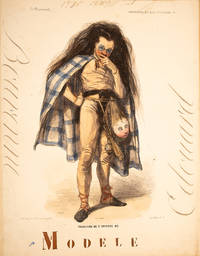
réf. 05960Paris: Bauger & Cie. 1839. A Unique Copy of Gavarni's Classic Featuring The Colorist's Models GAVARNI pseudonym of Guillaume Sulpice Chevallier. Souvenirs du Bal Chicard. Paris: Bauger & Cie. n.d. 1839-1843. A unique copy comprised of colorist Edouard Bouvenne's models. Large quarto 13 1/2 x 10 1/2 in; 341 x 266 mm. A suite of twenty hand colored lithographs representing the travesties of men and women commissioned for Le Charivari. Printed by Aubertet et Cie. All plates mounted on stubs. Fourteen plates have "Modele" stenciled in color at foot; five have "Modele" inked in Bouvenne's hand and Bouvenne has boldly signed and dated thirteen plates; only the first plate is unmarked by Bouvenne in any way. The plates are captioned: 1. "Chicard;" 2. "Un Covage Civilizé;" 3. "Balochard;" 4. "Mr. Floumann;" 5. "Pétrin;" 6. "Commissaire de Marine;" 7. "Général Étranger;" 8. "Insulaire de n'importe où;" 9. "Troubadour;" 10. "Titi;" 11. "Agréable;" 12. "Cacique;" 13. "Emir;" 14. "Andalouse;" 15. "Triton;" 16. "Garde Champêtre;" 17. "Bourguemestre;" 18. "Robinson;" 19. "Minon-Minard;" and 20. "Pistolet." Imprints vary slightly. Plates 1 2 3 4 5 and 20 have no publisher's imprint; plate 6 has imprint: "Chez Bauger R. du Croissant 16;" plate 8 has imprint: "Chez Bauger & Cie. R. du Croissant 16;" plates 17 18 and 19 have both imprints: "Chez Bauger R. du Croissant 16" and "Chez Aubert Place de la Bourse;" plates 7 and 9-16 have imprint at foot: "Se Vend chez Bauger & Cie. Editeurs des Dessins de la Caricature du Figaro et du Charivari Rue du Croissant 16" plates 9 10 14 15 and 16 have additional imprint: "Chez Aubert gal. Véro-Dodat". Early twentieth century green cloth front cover with maroon morocco label bordered and lettered in gilt spine with maroon morocco label lettered in gilt. A few plates with light foxing. Eighteen of twenty plates with Bouvenne's ink and/or color smudges at margins demonstrating their work-plate status. Second only to Daumier as the greatest social commentator and satirical artist of nineteenth century France Gavarni produced the work under notice during his first period whence he confined himself to the study of Parisian manners particularly those of the city's youth. Souvenirs du Bal Chicard Memories of the Chicard Ball dates from when he was in charge of the journal Le Charivari and was a regular at Paris's most prestigious balls for which he often designed many costumes. During this time many of his finest lithographic sets drew their subject matter from these costume balls including Souvenirs du Bal Chicard . "Costume balls had been a part of carnival celebrations in France since the fifteenth century but their popularity was unprecedented during the period of the July Monarchy. At first private and aristocratic they became increasingly popular among the new bourgeoisie and the aspiring lower classes when they could afford them. One of the more exclusive expensive fifteen francs and licentious of these bal masqués was also one of the most popular. The Bal Chicard was given by a prosperous businessman Alexandre Lévêque who was called by the nickname Chicard. Gavarni was a friend of Chicard's and as a result was one of those regularly in attendance. In this image "Chicard" from Souvenirs du Bal Chicard a series of twenty lithographs published in Le Charivari between 1839 and 1843 we see one of the parodies of the earlier historic costumes of the bal masqué made famous at the Bal Chichard along with some wilder forms of dancing" Beatrice Farwell The Charged Image: French Lithographic Caricature 1816-1848 p. 86. " In another image "Troubadour" from the same series.Gavarni depicts an uninhibited dancer whose cap rests temporarily on the bottle of wine on the floor behind him. Gavarni's intention here has obviously been to capture the character of the wild dancing for which the Bal Chicard was noted. In a pentimento he has disguised a previously drawn extended arm by incorporating it into the drapery that flies off at the left but it remains easy to visualize the figure with three arms. Gavarni not only drew the costumes he saw at the balls but also designed costumes for use there. This troubadour's costume purports to be a version of the late medieval doublet and hose with anachronistic modifications frequently seen at the Bal Chicard here emphasized by the pipe in the reveler's mouth" Beatrice Farwell The Charged Image: French Lithographic Caricature 1816-1848 p. 88. Armelhaut and Boucher L'Oeuvre de Gavarni pp. 253 524 and nos. 257 "Chicard" and 2280 "Troubadour". Paris: Bauger & Cie., 1839 unknown books
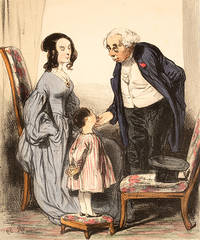
réf. 05982Paris: Bauger et Cie. 1838-42. Gavarni's "Terrible Children" Fifty Superb Hand Colored Lithographs Including the Pictorial Title-Page GAVARNI Paul pseudonym of Guillaume Sulpice Chevallier. Les Enfans terribles. Paris: Bauger et Cie. n.d. 1838-1842. First edition. Large quarto 13 11/16 x 10 1/2 inches; 345 x 267 mm. Pictorial hand-colored lithograph title-page and forty-nine numbered hand-colored lithographed plates printed by Aubert & Cie. Imprints vary plate 1 has imprint: Edite par le Charivari; plates 2-5 have imprint: Au Bureau du Charivari; plates 6-13 15-24 and 38-43 have imprint: Chez Bauger; plates 14 and 44-49 have imprint: Chez Bauger & Cie.; plates 25-37 have imprint: Se vend chez Bauger & Cie. Editeurs des Dessins de la Caricature du Figaro et du Charivari; plates 11 44 47 and 49 have additional imprint: Chez Aubert; and plate 25 has no imprint. Bound in at the end is a leaf of advertisement Des Modes Parisiennes verso blank and the sixteen page Aubert et Cie. Livres et Albums. Mid-twentieth century quarter dark blue cloth over blue imitation leather boards covers decoratively stamped in blind front cover decoratively lettered in gilt. Smooth spine lettered horizontally in gilt. The superb hand-colored lithographs bright and colorful. "Gavarni's conception of the enfant terrible has passed into a proverb. For all their apparent ingenuousness his appealing children are preternaturally sharp. They see and hear everything in their little world and they are infallible in announcing their discoveries where they will cause the most embarrassment. So a little boy asks a visitor: 'Sir who is it that invented gunpowder.since Papa says it isn't you' no. 10; or a little girl informs a suitor: 'Aunt Amelia says that you are very nice; but it's a pity that you are too stupid' no. 32" Ray The Art of the French Illustrated Book. "The forty-nine prints in Gavarni's series Les enfants terribles are among his most popular and well-known works legendary for their witty and memorable captions. Gavarni's enfants terribles are social landmines "holy terrors" who wittingly or unwittingly reveal the pettiness and duplicity of their parents. An illustrator of children's books Gavarni was the father of two children of his own to whom he was very attached. Gavarni loved the spontaneous poses and gestures of children and admired them for their disarming honesty. The term enfants terribles originally reserved for terrifyingly candid children who embarrass their parents came to be used to describe unconventional or unorthodox artists and writers-like Baudelaire and Flaubert-whose works reveal harsh truths about society that are embarrassing to guardians of the status quo." Allen Memorial Art Museum. "As the historical antecedent to Dennis the Menace and Calvin and Hobbes Les Enfans terribles was far more incisive and revealing in its social commentary. In its images Gavarni regularly uses the quasi-innocent questions or remarks of children to put the world of the adults around them in disarray. The subject is more often than not the marital or extra-marital situations of the grown-ups" Beatrice Farwell The Charged Image p. 91. According to OCLC there is just one example in libraries & institutions worldwide: The Gordon Ray copy at The Morgan Library & Museum NY USA - also apparently without the pictorial hand colored title-page. Paul Gavarni 1804-1866. "A French artist best known for his lithographs Paul Gavarni née Chevalier Suplice Guillaume was born in Paris on January 13 1804. Throughout his lifetime Gavarni produced over 4000 satirical prints for journals and fashion magazines. Both delicately witty and elegantly revealing of human behavior and character Gavarni's genre scenes made him one of the most important and popular nineteenth-century artists. He is often critically paired with Honoré Daumier with whom he and other young printmakers like Jean-Jacques Grandville and Joseph Traviés raised the status and importance of social lithography and printmaking as an art form. The Plates: 1. J'ai assez vu mon Cousin moi! M'man viens tu t'en 2. Adieu Madame à bientôt puisque vous permettez que je vienne amsi vous ennuyer quelquefois. 3. Petit Chérubin j'ai apporté du bonbon pour vous: Je vous le donnerai quand je m'en irai. 4. Monsieur! N'est - ce pas que ça n'est pas vrai quevous n'avez pas les Cheveux peints 5. Oh! c'est vrai! T'as les yeux comme les lanternes de ton cabriolet.ah bien!. 6. Grand Papa sa fiche de petite maman parceque petite Maman s'est fait des tetais avec du coton na! 7. Mère! Est-ce que c'est le crevè de ce matin que t'as dit que ça serit toujours assez bon pour lui 8. Petit amour comment s'appelle Madame votre maman. 9. Maman v avenir pas tout de suite: elle est avec Madame Pelet. Vous ne la connaissez pas Madame Pelet. 10. Qu'est-ce donc qui l'a inventée la poudres Monsieur.que papa dit que ce n'est pas vous. 11. Après diner Maman n'est ce pas j'ai été bien sage nous irons chez mon bon ami. 12. N'est-ce pas ma mère que c'est bien vilain de dire: vous m'embêtez Eh! bien ma bonne a dit tout-a-l'heure à mon Papa. 13. Quand Maman aime bien petit Papa elle appelle petit Papa "ma niniche". 14. La rose que vous avez donnée à Maman. Ah! oui oui!. que vous avez manque de vous casser le cou pour l'avoir. 15. N'est-ce pas Maman que le petit peigne à moustaches que Cornelie a trouvé ce matin dans ta chambre c'est pour moi 16. Maman! Maman! Ce Monsieur du Luxembourg que tu as dit tu sais bien que c'etait nn grand ami de Papa!. 17. Est-ce que c'est vrai Monsieur le Marquis que vous êtes toujours toujours oblige de regarder en Bourgogne si la Champagne brûle. 18. C'est vous qu'ètes le grand sec qui vient toujours pour diner. Monsieur Papa n'y est pas. 19. Ils t'on dit de jouer tant que tu voudras dans la salle à manger> et ta mère!. t'a donné!. 20. Voyons! Faites attention: Que doit on faire lorsqu'on a pêché. 21. Monsieur Albert C'est un monsieur du Jardin-des-Plantes qui vient tous les jours pour faire l'explication des bêtes à Maman. 22. Houp! Houp! Papa.ah! mais tu ne fais pas si bien le cheval que Janisset dam!. 23. Mais pourquoi donc Mosieu Bachu que tu viens toujours embêter Papa comme ça pour ta mécanique. 24. Le spectacle etait-ce bien Et à-t-il été raisonnable Lolo - Lolo! Ne m'en parle pas.je dis en entrant. 25. Ma bonne bisque va M'man de se lever comme ça de bonne heure depuis que l'es revenue. 26. Que tu es donc godiche Tomon de venir tous les matins comme ça pour que Papa te mette de l'argent dans ton affaire. 27. Maman c'est Mosieu.tu sais ce Mosieu qui a ce nez. 28. Maman dit que vous savez tous les secrets de Polichinelle Mosieu d'Alby: qu'est-ce qui peut donc lui avoir abime le nez comme ça.dites! 29. Tu mettras plus jamais ton chapeau qui sent la pipe n'est pas m'man 30. Je le dirai!.que t'as encore pris dans le petit pot du rouge que Maman se met. 31. Papa empèche donc Françoise de se moquer toujours de moi parceque je lui dis que Monsieur Ward a montré l'Anglais à Maman. 32. Ma tante mélie dit que t'es bien gentil; mais que c'et dommage!. 33. Tu ne sais pas Petite Papa.cet animal de Maurice il n'a fait que faire pleurer Maman ce matin. 34. Ma tante Aurélie qui disait l'autre jour à Maman qu'elle t'en ferait voir des grises sit u deviens son mari. 35. La canne que Papa a trouvée dans l'armoire de Maman le jour qu'il était si en colère elle était bien plus belle que ça!. 36. Tu ne sais pas ta leçon ta tante va venir: tu seras grondé!. 37. Est-ce que c'est vrai Mosieu d'Alby que tu couperais des liards en quatres. 38. Si tu touches encore à la bouteille du vin muscat tu seras bien attrapée parceque papa a fait une marque au bouchon etune marque au goulot. 39. Un petit de la pension qui disait que t'étais renégat; j'y ai fichu des giffles.n'est ce pas père que t'es catholique 40. Est-ce que vous payez des impositions comme papa Mosieu Pastorin pour être usurier 41. Mosieu on ne peut pas voir papa il es ten train de faire faillite. 42. Cette madame de Lieusaint est-elle bête! Puisque je suis Charles Dubourg et que tu es mon papa. 43. Dis-donc Miroux.dis-donc Miroux.dequoi donc que madame Miroux te fait porter 44. Papa voilà ton homme de paille! 45. Mosieu Belassis moi j'ai pas des jambes en manches de veste. 46. Décidément mon cher ami vous n'êtes pas de force au piquet: je vous enfonce. 47. M'man n'y est pas parceque tu rentres avant cinq heures puisque si t'etais pas revenue avant cinq heures. 48. N'est-ce pas Mosieu Prud homme qu'il ne faut pas mettre un H à omelette.là! vois-tu M'man! 49. Maman a écrit à mosieu Prosper et papa a vu la lettre. O il était joliment en colère papa.parceque maman avait fait une faute. Armelhault & Bocher 565-613; Bobins V 1538; Ray The Art of the French Illustrated Book 152. Paris: Bauger et Cie., 1838-42 unknown books
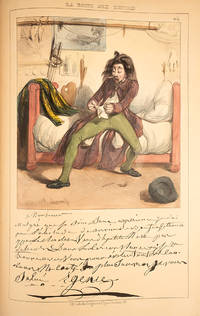
réf. 05959Paris: Caboche Gregoire / Chez Aubert 1838-1839. Two Incredibly Scarce Gavarni Albums Bound Together A Total of Forty-Three Marvelous Hand-Colored Lithographs GAVARNI pseudonym of Guillaume Sulpice Chevallier. Paris le Matin. Paris: Chez Aubert 1838-1839. bound with La Boite aux Lettres. Paris: Caboche Gregoire / Chez Aubert 1839. First editions. Folio 13 1/8 x 9 5/8 in; 334 x 245 mm. Paris le Matin with twelve and La Boite aux Lettres with thirty-one of thirty-four hand-colored lithographed plates; a total of forty-three plates most heightened with gum arabic. Bound to contemporary French style c. 1920 in quarter black morocco over marbled boards. Smooth spine ruled in blind and lettered in gilt marbled endpapers top edge gilt others uncut. A very fine copy of two extremely scarce Gavarni albums. ABPC Index 1923-present records no copies of Paris le Matin at auction within the last eighty-eight years. Only one copy of La Boite ux Lettres has come to auction within the last thirty-six years and it contained only fourteen of the called-for thirty-four plates. Only one copy of Paris le Matin is found in institutional collections worldwide at the Getty Research Library. OCLC records only five copies of La Boite aux Lettres in libraries throughout the world. Paris le Matin Paris Morning and La Boite aux Lettres Mailbox are typical - if exceedingly scarce - examples of Gavarni turning his satiric eye on the customs and manners of the French petit bourgeoisie. Paris le Matin limns the morning activities of Parisians; La Boite aux Lettres is a charmingly amusing survey of writing sending and receiving letters in Paris of the era. La Boite aux Lettres lacks the last three plates XXXI XXXIII and XXXIV. The institutional copies appear to be incomplete as well but it seems that the copy under notice is as complete as has ever been seen within our lifetime and is likely to remain so for many years to come. Armelhault & Bocher 902-913 Paris le Matin. Armelhault & Bocher p. 88 11 unnumbered 348-397. Paris: Caboche Gregoire / Chez Aubert, 1838-1839 unknown books
réf. 06002Paris: Bauger et Cie. 1838-42. Gavarni's "Terrible Children" Fifty Superb Hand Colored Lithographs Including the Pictorial Title-Page GAVARNI Paul pseudonym of Guillaume Sulpice Chevallier. Les Enfans terribles. Paris: Bauger et Cie. n.d. 1838-1842. First edition. Large quarto 13 11/16 x 10 1/2 inches; 345 x 267 mm. Pictorial lithograph title-page printed in black & blue and forty-nine numbered lithographed plates printed by Aubert & Cie. Imprints vary plate 1 has imprint: Edite par le Charivari; plates 2-5 have imprint: Au Bureau du Charivari; plates 6-13 15-24 and 38-43 have imprint: Chez Bauger; plates 14 and 44-49 have imprint: Chez Bauger & Cie.; plates 25-37 have imprint: Se vend chez Bauger & Cie. Editeurs des Dessins de la Caricature du Figaro et du Charivari; plates 11 44 47 and 49 have additional imprint: Chez Aubert; and plate 25 has no imprint. Bound in at the end is a leaf of advertisement Des Modes Parisiennes verso blank and the sixteen page Aubert et Cie. Livres et Albums. Some light foxing throughout. Late nineteenth century quarter red calf over red pebbled cloth boards. Smooth spine elaborately decorated and titled in gilt. Title-page neatly re-inserted with white archival tape. With the bookplates of Bernard Mamy and André Villet on front paste-down. A very good copy of a rare suite of plates. "Gavarni's conception of the enfant terrible has passed into a proverb. For all their apparent ingenuousness his appealing children are preternaturally sharp. They see and hear everything in their little world and they are infallible in announcing their discoveries where they will cause the most embarrassment. So a little boy asks a visitor: 'Sir who is it that invented gunpowder.since Papa says it isn't you' no. 10; or a little girl informs a suitor: 'Aunt Amelia says that you are very nice; but it's a pity that you are too stupid' no. 32" Ray The Art of the French Illustrated Book. "The forty-nine prints in Gavarni's series Les enfants terribles are among his most popular and well-known works legendary for their witty and memorable captions. Gavarni's enfants terribles are social landmines "holy terrors" who wittingly or unwittingly reveal the pettiness and duplicity of their parents. An illustrator of children's books Gavarni was the father of two children of his own to whom he was very attached. Gavarni loved the spontaneous poses and gestures of children and admired them for their disarming honesty. The term enfants terribles originally reserved for terrifyingly candid children who embarrass their parents came to be used to describe unconventional or unorthodox artists and writers-like Baudelaire and Flaubert-whose works reveal harsh truths about society that are embarrassing to guardians of the status quo." Allen Memorial Art Museum. "As the historical antecedent to Dennis the Menace and Calvin and Hobbes Les Enfans terribles was far more incisive and revealing in its social commentary. In its images Gavarni regularly uses the quasi-innocent questions or remarks of children to put the world of the adults around them in disarray. The subject is more often than not the marital or extra-marital situations of the grown-ups" Beatrice Farwell The Charged Image p. 91. According to OCLC there is just one example in libraries & institutions worldwide: The Gordon Ray copy at The Morgan Library & Museum NY USA - also apparently without the pictorial hand colored title-page. Paul Gavarni 1804-1866. "A French artist best known for his lithographs Paul Gavarni née Chevalier Suplice Guillaume was born in Paris on January 13 1804. Throughout his lifetime Gavarni produced over 4000 satirical prints for journals and fashion magazines. Both delicately witty and elegantly revealing of human behavior and character Gavarni's genre scenes made him one of the most important and popular nineteenth-century artists. He is often critically paired with Honoré Daumier with whom he and other young printmakers like Jean-Jacques Grandville and Joseph Traviés raised the status and importance of social lithography and printmaking as an art form. The Plates: 1. J'ai assez vu mon Cousin moi! M'man viens tu t'en 2. Adieu Madame à bientôt puisque vous permettez que je vienne amsi vous ennuyer quelquefois. 3. Petit Chérubin j'ai apporté du bonbon pour vous: Je vous le donnerai quand je m'en irai. 4. Monsieur! N'est - ce pas que ça n'est pas vrai quevous n'avez pas les Cheveux peints 5. Oh! c'est vrai! T'as les yeux comme les lanternes de ton cabriolet.ah bien!. 6. Grand Papa sa fiche de petite maman parceque petite Maman s'est fait des tetais avec du coton na! 7. Mère! Est-ce que c'est le crevè de ce matin que t'as dit que ça serit toujours assez bon pour lui 8. Petit amour comment s'appelle Madame votre maman. 9. Maman v avenir pas tout de suite: elle est avec Madame Pelet. Vous ne la connaissez pas Madame Pelet. 10. Qu'est-ce donc qui l'a inventée la poudres Monsieur.que papa dit que ce n'est pas vous. 11. Après diner Maman n'est ce pas j'ai été bien sage nous irons chez mon bon ami. 12. N'est-ce pas ma mère que c'est bien vilain de dire: vous m'embêtez Eh! bien ma bonne a dit tout-a-l'heure à mon Papa. 13. Quand Maman aime bien petit Papa elle appelle petit Papa "ma niniche". 14. La rose que vous avez donnée à Maman. Ah! oui oui!. que vous avez manque de vous casser le cou pour l'avoir. 15. N'est-ce pas Maman que le petit peigne à moustaches que Cornelie a trouvé ce matin dans ta chambre c'est pour moi 16. Maman! Maman! Ce Monsieur du Luxembourg que tu as dit tu sais bien que c'etait nn grand ami de Papa!. 17. Est-ce que c'est vrai Monsieur le Marquis que vous êtes toujours toujours oblige de regarder en Bourgogne si la Champagne brûle. 18. C'est vous qu'ètes le grand sec qui vient toujours pour diner. Monsieur Papa n'y est pas. 19. Ils t'on dit de jouer tant que tu voudras dans la salle à manger> et ta mère!. t'a donné!. 20. Voyons! Faites attention: Que doit on faire lorsqu'on a pêché. 21. Monsieur Albert C'est un monsieur du Jardin-des-Plantes qui vient tous les jours pour faire l'explication des bêtes à Maman. 22. Houp! Houp! Papa.ah! mais tu ne fais pas si bien le cheval que Janisset dam!. 23. Mais pourquoi donc Mosieu Bachu que tu viens toujours embêter Papa comme ça pour ta mécanique. 24. Le spectacle etait-ce bien Et à-t-il été raisonnable Lolo - Lolo! Ne m'en parle pas.je dis en entrant. 25. Ma bonne bisque va M'man de se lever comme ça de bonne heure depuis que l'es revenue. 26. Que tu es donc godiche Tomon de venir tous les matins comme ça pour que Papa te mette de l'argent dans ton affaire. 27. Maman c'est Mosieu.tu sais ce Mosieu qui a ce nez. 28. Maman dit que vous savez tous les secrets de Polichinelle Mosieu d'Alby: qu'est-ce qui peut donc lui avoir abime le nez comme ça.dites! 29. Tu mettras plus jamais ton chapeau qui sent la pipe n'est pas m'man 30. Je le dirai!.que t'as encore pris dans le petit pot du rouge que Maman se met. 31. Papa empèche donc Françoise de se moquer toujours de moi parceque je lui dis que Monsieur Ward a montré l'Anglais à Maman. 32. Ma tante mélie dit que t'es bien gentil; mais que c'et dommage!. 33. Tu ne sais pas Petite Papa.cet animal de Maurice il n'a fait que faire pleurer Maman ce matin. 34. Ma tante Aurélie qui disait l'autre jour à Maman qu'elle t'en ferait voir des grises sit u deviens son mari. 35. La canne que Papa a trouvée dans l'armoire de Maman le jour qu'il était si en colère elle était bien plus belle que ça!. 36. Tu ne sais pas ta leçon ta tante va venir: tu seras grondé!. 37. Est-ce que c'est vrai Mosieu d'Alby que tu couperais des liards en quatres. 38. Si tu touches encore à la bouteille du vin muscat tu seras bien attrapée parceque papa a fait une marque au bouchon etune marque au goulot. 39. Un petit de la pension qui disait que t'étais renégat; j'y ai fichu des giffles.n'est ce pas père que t'es catholique 40. Est-ce que vous payez des impositions comme papa Mosieu Pastorin pour être usurier 41. Mosieu on ne peut pas voir papa il es ten train de faire faillite. 42. Cette madame de Lieusaint est-elle bête! Puisque je suis Charles Dubourg et que tu es mon papa. 43. Dis-donc Miroux.dis-donc Miroux.dequoi donc que madame Miroux te fait porter 44. Papa voilà ton homme de paille! 45. Mosieu Belassis moi j'ai pas des jambes en manches de veste. 46. Décidément mon cher ami vous n'êtes pas de force au piquet: je vous enfonce. 47. M'man n'y est pas parceque tu rentres avant cinq heures puisque si t'etais pas revenue avant cinq heures. 48. N'est-ce pas Mosieu Prud homme qu'il ne faut pas mettre un H à omelette.là! vois-tu M'man! 49. Maman a écrit à mosieu Prosper et papa a vu la lettre. O il était joliment en colère papa.parceque maman avait fait une faute. Armelhault & Bocher 565-613; Bobins V 1538; Ray The Art of the French Illustrated Book 152. Paris: Bauger et Cie., 1838-42 unknown books
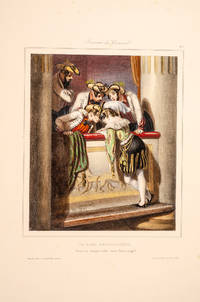
réf. 05611Paris: Rittner et Goupil 1837. French Society Enjoying the Foibles and Vices of Carnival as Depicted by Gavarni Six Exceptionally Rare Hand Colored Lithograph Plates GAVARNI Paul Sulpice Guillaume Chevallier. Souvenirs de Carnaval par Gavarni. Paris: Rittner et Goupil 1837. First edition first issue. Elephant folio 20 3/4 x 13 1/2 inches; 527 x 343 mm. Original front pink wrapper as title with small lithograph illustration by Gavarni. Six superb hand-colored lithograph plates all heightened with gum-arabic and all with the small oval marginal blind-stamp of the publishers. Some occasional light marginal foxing. Contemporary half red scored calf over red cloth boards. Front cover with rectangular red scored calf label bordered and lettered in gilt smooth spine. Some light wear to extremities still a very fine copy of this great rarity. Exceedingly rare suite of whimsical prints depicting French society enjoying the foibles and vices of carnival. Gavarni the pen name of Sulpice Guillaume Chevalier was a highly successful French illustrator and his work is accredited with capturing the essence of excess that enraptured Paris in the 19th century. Souvenirs de Carnaval is given the date '1837' based on the date inscribed on the stone on plate 5. The majority of Gavarni's later works centered around serious subject matter: they sought to unpack the failings of French familial life and directly and pointedly critiqued Parisian society. However his earlier published prints as seen with the present suite displayed a more whimsical and lighter satirical take on the popular pleasures of the Capital capturing the debauchery and decadence of high society life. Most of Gavarni's later works which became more serious were aimed at a different section of the public which had previously granted him so wide a popularity as did his works on Carnival of which this was one of the last. RBH only lists one copy at auction in the last 50 years this copy. OCLC & KVK locate just one uncolored example in libraries and institutions worldwide: The Gordon N. Ray copy at The Morgan Library & Museum NY US. That copy is uncolored and much smaller with a sheet size of just 13 7/8 x 10 5/8 inches; 352 x 270 mm. "Suite of nine lithographs six of which were previously published by Rittner and Goupil under the title: Souvenirs de Carnaval". Armelhault & Bocher p.74. The Plates: 1. L'ENTRÉE AU BAL. Ne perdez pas la tête mon cher! ENTRANCE TO THE BALL. Don't lose your head my dear! 2. UNE TOMBOLA. Le No. 43 a gagné.une chandelle! A RAFFLE. No. 43 won.a candle! 3. LE PLATEAU DES RAFRAICHISSEMENS. Pour les Dames Messieurs. THE REFRESHMENT TRAY. For ladies and gentlemen. 4. LE CORRIDOR DES LOGES. à Minuit. THE LODGING CORRIDOR. at midnight. 5. LA LOGE D'AVANT-SCÈNE. Veux-tu souper avec nous beau page! THE STAGE BOX. Do you want to have dinner with us handsome page! 6. UN DÉJEUNER. au petit Jour. A LUNCH. at dawn. Armelhault & Bocher 308; Beraldi VII 50; Bobins III 936; Not in Colas. Paris: Rittner et Goupil, 1837 unknown books
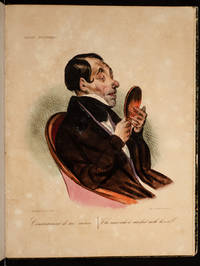
réf. 05538Paris: Chez Aubert 1837. Characteristic Expressions Love Letters and Law Students Twenty-Five Fine Hand Colored Lithographs by Daumier Gavarni and Cujas DAUMIER Honoré. La Galerie Physionomique The Physiognomic Gallery 5 plates 0f 25 1837; GAVARNI Paul. Au Boit Aux Lettres At the mailbox 11 plates of 34 1838; GAVARNI Paul. Les Coulisses Behind the scenes 1 plate of 31 1857; CUJAS. Cours de Droit Law courses 8 plates of 12 1838. Folio 13 1/2 x 10 1/8 inches; 343 x 257 mm. A fascinating collection of twenty-five hand colored lithograph plates by Daumier Gavarni & Cujas all heightened with gum arabic. Contemporary quarter dark green calf over green marbled boards. Smooth spine decoratively tooled in gilt plain endpapers. Extremities rubbed. 1. DAUMIER. La Galerie Physionomique No. 14. La loge grillée - The box grated DR 339 2. CUJAS. Cours de Droit No. 1. La Chaumière et ton coeur - The Cottage and your heart 3. CUJAS. Cours de Droit No. 2. Jus Romanum 4. CUJAS. Cours de Droit No. 4 Homme étonnant!!! Quel chique. 5. CUJAS. Cours de Droit No. 6. L'Etudiant a besoin de quelques distractions - The Student 6. CUJAS. Cours de Droit No. 8. Reflexion philosophique en morale de Mlle Fifine 7. CUJAS. Cours de Droit No. 9. Allons Gustine joue tout droit tu ne manqueras pas de touche. 8. CUJAS. Cours de Droit No. 10. Je ne me trompe pas d'etait bien mon B.! 9. GAVARNI. Les Coulisses No. 6. Le soldat romain Quinze sous par jour. A&H 454 10. CUJAS. Cours de Droit No. 12. Tiens! Ernest!. qu'es tu donc devenu 11. GAVARNI. La Boite Aux Lettres Sans No. Je prends la plume d'une main tremblante. A&H p. 88 12. GAVARNI. La Boite Aux Lettres No. 2. Vous avez le secret de ma vie. A&H 1685 13. GAVARNI. La Boite Aux Lettres No. 3. La lettre qu'on lit. A&H 1686 14. GAVARNI. La Boite Aux Lettres No. 4. J'ai ta lettre cherie a mon Ernest je la presse. A&H 348 15. GAVARNI. La Boite Aux Lettres Sans No. Je soussigné Roi des Batinolles. A&H p. 89 16. GAVARNI. La Boite Aux Lettres Sans No. Chère ange mon amour vous envoie sur l'aile. A&H p. 89 17. DAUMIER. La Galerie Physionomique No. 5. Le bon morceau - A Tidbit DR 330 18. GAVARNI. La Boite Aux Lettres No. 8. Sans No. Viens me prendre ce soir je suis sortie. A&H p. 89 19. GAVARNI. La Boite Aux Lettres No. 9. Sans No. Ma sière epouse je vous. A&H p. 89 20. DAUMIER. La Galerie Physionomique No. 18. Rien!.rien!. Je ne trouve rien - Nothing! nothing at all. DR 343 21. GAVARNI. La Boite Aux Lettres No. 11. Congé en partie double. A&H 1693 22. DAUMIER. La Galerie Physionomique No. 8. La bonne prise - A good pinch of snuff DR 333 23. GAVARNI. La Boite Aux Lettres No. 13. Monsieur malgré que je sois sans experience je n'ai. A&H 1695 24. GAVARNI. La Boite Aux Lettres No. 14. Ah! prenez pitié de l'etat cruel où me laisse mon attachement. A&H 349 25. DAUMIER. La Galerie Physionomique No. 20. Contentement de soi-meme - The man who is satisfied with himself DR 345 Daumier Register DR-330 DR-333 DR-339 DR-343 DR-345; Armelhault & Bocher 348 454 1685 1686 1693 1695 & pp. 88 & 89. Paris: Chez Aubert, 1837 unknown books
réf. 05549Paris: J. Hetzel 1846. A Remarkable Survival GAVARNI Paul illustrator. Oeuvres Choisies de Gavarni. Revues corrigées et nouvellemant classées par l'Auteur. Études de Moeurs Contemporaines. Paris: J. Hetzel 1846. First Collected Edition. Two octavo volumes 10 7/16 x 7 1/4 inches; 265 x 184 mm. Lithograph frontispiece xii 39 plates; iv 5 plates; iv 25 plates; iv 11 plates 2 list of plates. viii 48 plates; iv 19 plates; iv 13 plates 2 list of plates 2 advertisements. Each of the seven title pages with a vignette. A total of 160 wood engraved plates wood engraved frontispiece and 7 wood engraved vignette title-pages. Publisher's blue cloth covers ruled in blind and elaborately decorated in gilt spines with titles and elaborate gilt decoration yellow coated endpapers all edges gilt. Fine and untouched copies of the first two of four volumes of this first collected edition. Two further volumes were published two years later in 1848. Contents: Les Enfants Terribles; Traduction en Langue Vulgaire; Les Lorettes; Les Actrices and Fourberies de Femmes en Matière de Sentiment; Clichy; Paris le Soir. Paris: J. Hetzel, 1846 unknown books
réf. 05550Paris: Au Bureau du Charivari 1840. Sixty-Six Lithographed Plates by Gavarni "Stevedores" at the Carnival of Paris GAVARNI pseudonym of Guillaume Sulpice Chevallier. Les Débardeurs. Album Comique par Garvarni. Paris: Au Bureau du Journal Amusant & Petit Journal pour Rire. Chez Bauger 1840-1842. Three large quarto volumes 13 1/4 x 10 inches; 337 x 253 mm. Sixty-six numbered lithographed plates. Plates printed by Aubert & Cie. Mixed states of the plates as per Armelhault & Bocher. The first forty-four plates with some occasional marginal staining not affecting images some light foxing affecting just a few plates. Publisher's printed green paper wrappers with original glassine wrappers. Front wrappers of parts 1 & 2 with some minor discoloration on foredge. Overall an excellent example - the first that we have seen in the original printed wrappers. A series of sixty-six lithographs of which nine first appeared in other journals eight in La Caricature plates 21 23 and 24 under the title "Souvenirs du Carnaval" and 32 44 49 54 and 61 under the title "Les Débardeurs" and one plate 58 in La Mode prior to the publication of the entire series in Le Charivari from 19 January 1840 to 5 February 1842. "In Les Débardeurs.a series of sixty-six lithographs published in Le Charivari between 1840 and 1843 Gavarni depicts a variation on the most famous of the costumes he designed for the masquerade balls the débardeur stevedore. The braided wig loose shirt black velvet trousers fastened with brass buttons and tied with a fringed sash are derived from the working costume of the longshoreman or stevedore who unloaded the barges that traveled up the Seine to Paris. As Nancy Olsen points out in Gavarni: The Carnival Lithographs the majority of Gavarni's carnival lithographs reflect his interest in the small groups that drift away from the crowd as a consequence of the romantic liaisons that preoccupied many of the participants at a masked ball. Intrigue was the name of the gave and the information being conveyed in this scene comes in all probability from an agent provocateur" Beatrice Farwell The Charged Image: French Lithographic Caricature 1816-1848 p. 88. "This is the most considerable of the several series of lithographs devoted by Gavarni to the balls which were a passion with him. He was an organizer and patron of the more elegant and he found the popular balls at the Opera and elsewhere an attractive subject for his designs. Théophile Gautier who believed that at this period Parisian balls had virtually 'effaced the former carnival of Venice' called Gavarni 'their depicter and historian.' As dancers throw themselves into their round of pleasure 'a man stands with his back against a pillar; he watches he listens he observes.' And the following day on stone 'he lends his own wit to all the masks perhaps stupid in themselves; he sums up in a profound word the chit-chat of the foyer; he translates into a pleasant legend the hoarse excitement of the hall.' Quoted by Lemoisne I 120" Ray The Art of the French Illustrated Book. Such elements have made Gavarni's carnival lithographs among his finest most famous and desired works of art. Armelhault & Bocher nos. 486-542 307-309 plates 21 23 and 24 259-263 plates 44 49 32 54 and 61 and 1223 plate 58. Ray The Art of the French Illustrated Book 154. Paris: Au Bureau du Charivari, 1840 unknown books
réf. 05356Paris: Imp. Lemercier 57 R. de Seine 1852. The Harlequin Coat Twelve Lithographed Plates by Gavarni GAVARNI Paul pseudonym of Guillaume Sulpice Chevallier. Le Manteau d'Arlequin par Gavarni. Paris: Imp. Lemercier n.d. 1852. Large folio 14 9/16 x 10 1/2 inches; 370 x 267 mm. Twelve lithographed plates. Title from front cover. Publisher's dark blue pebble-grain cloth with covers decoratively stamped in blind and front cover lettered in gilt. Expertly and almost invisibly rebacked with the original spine laid down. Yellow coated endpapers all edges gilt. Minimal marginal foxing to a few plates otherwise a very fine copy. Scarce; no copies recorded by OCLC and no copies seen at auction since at least 1975. The plates are captioned: 1. ".oui mon chair Auguste Ge suis décidé arestée dan les queur tant que mon poliçon de direqueteur aura çelui demi laissée." 2. ".alors si vous permettez j'aurai l'honneur de vous envoyer ma voiture à onze heures.Ça me botte." 3. ".Ah! M'ame Ado'phe! M'ame Ado'phe!.je ne serais pas ce que je suis sans mon vieux serpent de mère!" 4. "-Qu'est-ce que tu dirais d'une bague comme ça toi qu'on donnerait à ton épouse-Je dirais que c'est du faux." 5. ".et je vas tout à l'heure être précipitée les quatre fers en l'air du sommet de la tour du nord!.tout ça Messeigneurs rapport à ma vertu." 6. "-Voyons chaste auteur de mes mots vous me faites un rôle.-Inouï!-Quel costume-Une mise indécente est de rigueur." 7. "-Eh! bien tu verras ma fille comme tu le seras toi dans tous tes états aux débuts de ta petite.C'est aux miens que fallait voir feue ma mère." 8. "LE MOSIEU DE LA DÉBUTANTE." 9. "LE MARI DE MA'M'SELLE CIGALE." 10. "-C'est ma drôlesse qu'est applaudie!.et qui qu'a l'mal" 11. "-Tenez M'ame Cabestan vous ne saisissez pas le poème.-Si mais qu'est-ce que nos petites font dans le dessous-Faut bien qu'on garde les vases sacrés!-C'est donc des manières de vestales-Sensé." 12. "-Si le parterre est gentil mon bonhomme y a de quoi.une fichue situation à nettoyer!.c'est fini: le Scélérat a déjà le pied sur la poitrine de l'autre qui n'en peut plus et à la vue de la Baronne sans=dessus=dessous le Sénéchal est comme imbécile.et on ne sait pas où est la clé!.sans compter que la nuit tombe et que le château brûle pendant que.tu ne donnerais pas deux sous de l'honneur de ma Dame!.me v'là et paf! ça y est.mais avec leur satané pistolet je m'abîme tout le doigt." Armelhaut & Bocher 1152-1163. Paris: Imp. Lemercier, 57 R. de Seine, 1852 unknown books
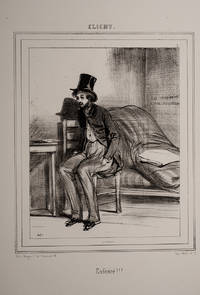
réf. 05405Paris: En vente Au Bureau du Journal Amusant.et au Bureau du Charivari 1840. Gavarni's Memories of his Time in the Debtors Prison 'Clichy' Depicted in Twenty-One Lithographed Plates GAVARNI pseudonym of Guillaume Sulpice Chevallier. Clichy. Album par Gavarni. Paris: Au Bureau du Charivari n.d. 1840-1841. Large quarto 13 3/4 x 10 1/2 inches; 349 x 267 mm. Publisher's yellow front wrapper with printed title. Twenty-one superb numbered lithographed plates. All plates in first printing second state with printed titles and "Chez Bauger" & "Imp. d'Aubert" with the exception of plates 17 & 19 which are in the third state. Modern quarter light blue cloth over light blue cockerel boards smooth spine lettered in gilt. Original yellow lithographed front wrapper bound in as title. These plates were initially published in Le Charivari with the exception of the nineteenth plate which was produced for La Caricature. "In 1835 Gavarni was arrested for debt and sent to Clichy. Far from being overwhelmed he saw this experience as a fresh opportunity for observation. Indeed he made a lithographic series from his memories: Clichy twenty-one lithographs 1840-1841" Ray The Art of the French Illustrated Book p. 217. "So assured did Gavarni's position seem at the end of 1833 that he began to publish the weekly Journal des gens du monde for which he also provided much of the text and illustrations. It failed after twenty numbers only eighteen of which were issued leaving him with obligations which were to embarass him for many years. In 1835 he was arrested for debt and sent to Clichy. Far from being overwhelmed he saw this experience as a fresh opportunity for observation. Indeed he made a lithographic series from his memories: Clichy twenty-one lithographs 1840-1841" Armelhault & Bocher p. 1-25 On the 23rd of July 1867 the French government abolished the ancient law decreeing imprisonment for debt. In Paris the ninety-seven inmates of the Clichy Debtor's Prison were promptly released. Exceptionally rare. According to OCLC & KVK there are no copies in libraries and institutions worldwide. We have been unable to locate any copies at auction over the past 100 years. Armelhault & Bocher nos. 429-448. The Plates: 1. Enfoncé!!!. Sunk!!!. 2. Je viens déjeuner chez toi. Ah! bon! Et diner chez toi. Ah! bah!! Et coucher chez toi! Ah! fichtre!!! I'm coming to have lunch with you. Ah! Well! And have dinner at home. Ah! bah!! And sleep at home! Ah! damn!!! 3. "Au moins un Dieu sourit encore à la jeunesse et lui rend enc e lieu de ces jours qu'on lui prend. Qui n'aurait pas pitiè des beaux ans qu'elle y laisse" "At least one God still smiles at youth and gives them back in place those days that are taken from them. Who would not pity the beautiful years she leaves there" 4. Vous le voyez le chagrin ne m'aigrit pas! Et je donnerai un conseil à mes créanciers dans leur intèrêt: s'ils veulent me tirer d'ici qu'ils se hâtent car on ne pourrait bientôt plus me passer par la porte. You see grief does not embitter me! And I will give advice to my creditors in their interest: if they want to get me out of here let them hurry because soon they won't be able to get me out the door. 5. Petit homme nous t'apportons ta casquette ta pipe d'ecume et ton Montaigne. Little man we bring you your cap your meerschaum pipe and your Montaigne. 6. Enfin à la fin je l'ai tant mijotè je l'ai tant mijotè qu'il a dit: eh! bien qu'il paye seulement les frais et j'accorderai du tems pour le reste. Et encore il a dit voyez-vous Mademoiselle c'est par consideration pour vous. Le vieux gueux!.j'espère bien que quand tu sortiras tu lui ficheras une pile soignée à celui-là! Finally at the end I simmered him so much I simmered him so much that he said: hey! Well let him just pay the cost and I'll allow time for the rest. And again he said you see Mademoiselle it's out of consideration for you. The old beggar!. I really hope that when you go out you'll give him a neat pile on that one! 7. L'amour est parti V'là l'amitiè. Love is gone That's friendship. 8. Dites donc l'ancien c'est aujourd'ui Dimanche. Ou'est-ce que ça te fait Tiens! Le Dimanche on se fiche du Garde-du-commerce: çà me fait que je pourrais aller me promener si je pouvais sortir. Say the old one is today Sunday. What does it do to you Here! On Sundays we don't care about the Garde-du-commerce: that makes me think I could go for a walk if I could go out. 9. Ne donnez pas d'acomptes! Voyez vous le créancier qu'on ne paye pas n'est qu'un créancier; le créancier qu'on paye est un tigre! Do not give deposits! You see the creditor who is not paid is only a creditor; the creditor one pays is a tiger! 10. Dites donc voisin on a peu boissonné chez vous hier! ça allait rondement! ça va bien ce matin Pas mal et vous Say neighbour we had a little drink at your house yesterday! it was going smoothly! how are you this morning Not bad and you 11. Le portrait du créancier. The portrait of the creditor. 12. Voyons! Pour aller à Tivoli ce soir il faudrait d'abord payer au greffe dix-huit-mille-cinq-cents francs pour le capital et onze-cent-vingt-neuf francs cinquante centimes de frais.et encore non je suis bête! Tivoli coûte trois francs d'entrée et je n'ai que quarante deux sous. Let's see! To go to Tivoli this evening you would first have to pay the clerk's office eighteen thousand five hundred francs for the capital and eleven hundred and twenty-nine francs fifty centimes for costs.and again no I'm silly! Tivoli costs three francs to go and I only have forty-two sous. 13. Aux Gardes-du-Commerce: que le bon Dieu les patafiole! At the Gardes-du-Commerce: may the good Lord spoil them! 14. Quand nous voulons danser Tivoli est là mon cher: Entre Tivoli et nous il n'y que deux murs et un coup de fusil. When we want to dance Tivoli is there my dear: Between Tivoli and us there are only two walls and a gunshot. 15. Mon cher Monsieur je vous laisse la guérite comme je l'ai prise et la consigne comme on me l'a donnée: "de l'amour sur la conscience et du champagne dessous".rien de bon comme ça pour les rhumes de chagrin. Courte et bonne! c'est le mot d'ordre ici comme ailleurs. My dear sir I leave you the sentry box as I took it and the instructions as they gave it to me: "love on your conscience and champagne underneath".nothing good like that for the colds of sorrow. Short and good! this is the watchword here as elsewhere. 16. Moi j'ai signé pour cinq cents francs et je n'en ai eu que trois cents et encore en vin de champagne.et on m'a repris le vin pour les frais. Ils auraient mieux fait de t'amener ici tout de suite; au moins nous aurions les fioles. I signed for five hundred francs and I only got three hundred and again in champagne wine.and they took the wine back from me for the expenses. They would have done better to bring you here straight away. after; at least we would have the vials. 17. Mias comment as-tu pu te laisser prendre comme ça Demande aux Canards sauvages comment ils se laissent prendre!. Il a tire sur moi le premier Mars on m'a ramassé le cinq Avril: voilà comme çà se fait. Mias how could you let yourself be taken like that Ask the Wild Ducks how they let themselves be caught!. He shot me on the first of March they picked me up on the fifth of April: that's how it is done. 18. Voilà un Tilbury Pamela qui nous a menés en moins de trois mois de la rue Saint Jacques à Clichy. Hein le bon cheval! Here is a Tilbury Pamela who took us in less than three months from rue Saint Jacques to Clichy. Hein the good horse! 19. Ici on ne peut pas faire de farce à sa Ninie: v'la ce qui vous chiffonne! Here you can't prank your Ninie: that's what's bugging you! 20. Entends tu; à Tivoli. Il y en a deux ici des cavaliers seuls et qui ne demanderaient pas mieux que de faire la chaîne des Dames. Do you hear; at Tivoli. There are two here single riders who would like nothing better than to make the chain of Ladies. 21. Sans le mur cette boule - là irait loin. Et ton camarade aussi. Without the wall this ball - there would go far. And your friend too. Paris: En vente Au Bureau du Journal Amusant...et au Bureau du Charivari, 1840 unknown books
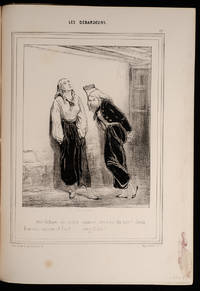
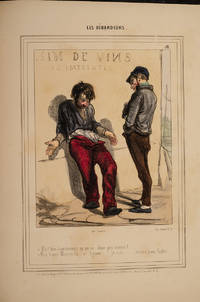
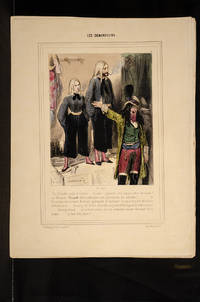
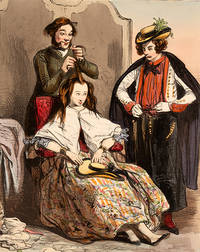
réf. 05386Paris: Au Bureau du Charivari 1840. Sixty-Six Magnificent Hand-Colored Lithographed Plates by Gavarni Depicting "The Stevedores" GAVARNI Paul pseudonym of Guillaume Sulpice Chevallier. Les Débardeurs. Paris: Au Bureau du Charivari n.d. 1840-1842. Folio 13 7/8 x 10 3/8 inches; 353 x 264 mm. Sixty-six superb numbered hand-colored lithographed plates heightened with gum arabic. Plates printed by Aubert & Cie. Plate numbers 316 29 32 33 39 43 51 & 52 a little shorter on outer margins. Plate number 52 with neat repairs to top and bottom blank margins. A few plates slightly toned still an excellent copy of this extremely rare Gavarni title. Modern blue cloth over boards front cover with dark green straight-grain morocco label bordered and lettered in gilt. An excellent example of this exceptionally rare and highly amusing book A series of sixty-six lithographs of which nine first appeared in other journals eight in La Caricature plates 21 23 and 24 under the title "Souvenirs du Carnaval" and 32 44 49 54 and 61 under the title "Les Débardeurs" and one plate 58 in La Mode prior to the publication of the entire series in Le Charivari from 19 January 1840 to 5 February 1842. Exceptionally Rare with OCLC locating just one complete colored copy in libraries and institutions worldwide: Morgan Library and Museum - the Gordon Ray copy NY US. OCLC also locates two other copies neither of which states 'color' plates: Yale University Library CT US and Clark Art Institute MA US. "In this work. from a series of sixty-six lithographs published in Le Charivari between 1840 and 1843 Gavarni depicts a variation on the most famous of the costumes he designed for the masquerade balls the débardeur the stevedore. The braided wig loose shirt black velvet trousers fastened with brass buttons and tied with a fringed sash are derived from the working costume of the longshoreman or stevedore who unloaded the barges that traveled up the Seine to Paris. As Nancy Olsen points out in Gavarni: The Carnival Lithographs the majority of Gavarni's carnival lithographs reflect his interest in the small groups that drift away from the crowd as a consequence of the romantic liaisons that preoccupied many of the participants at a masked ball. Intrigue was the name of the gave and the information being conveyed in this scene comes in all probability from an agent provocateur" Beatrice Farwell The Charged Image: French Lithographic Caricature 1816-1848 p. 88. Armelhault & Bocher nos. 486-542 307-309 plates 21 23 and 24 259-263 plates 44 49 32 54 and 61 and 1223 plate 58. Ray The Art of the French Illustrated Book 154. The Plates: 1. Le Débardeur mâle et femelle.vivants!. 2. Caporal on gele dans votre satanè violon!. 3. Amanda l'Ecuyer. Rue. 4. Qui Moi et Zélie Achille et toi. 5. Un amour de petit ménage; quoi! Ça se retire à la pointe du jour bien paisibles!. 6. On va pincer son petit cancan mais bien en douceur. 7. Le Vicomte Aime de Trois Etoiles et Dame Eloa de Tremblement. 8. Ah! qu'il est beau!. 9. Malheureuse enfant! Qu'as - tu fait de ton sexe. 10. Pauvre Elvire emportée aux flots du bal Musard. 11. C'est comme ça que tu les intrigues.merci! 12. En voulez-vous de la crevette.pas cher. 13. Va dire à ta mère qu'a te mouche. 14. Je vous dis que vous avez dansé d'une façon. 15. Comment Lili ne reconnait pas son Nini! 16. Y en-a-ti des femmes y'en a-t-i. 17. Allons Landerneau mon bonhomme!. 18. Ça ne te regarde pas de quoi te mèles-tu. 19. .être fichues au violon comme des rien du tout!. 20. Six pouces de jambes et le dos tout de suite!. 21. "L'Intolérance est fille des faux Dieux!". 22. Voyons Angelina as-tu assez fait poser Mosieu 23. Va donc!.Singulier masculin! 24. C'est mon Débardeur!. 25. C'est d'main matin qu'mon tendre époux va beugler. 26. Te v'la ici toi! C'est comme ça qu'tas ta migraine. 27. J'espère que tu vas te tenir Angélique. 28. Voilà un fénéant qui dort et qui laisse une pauv femme danser toute la nuit!. 29. .une douzaine d'huitres et mon coeur. 30. V'la qu'i fait jour: j'suis échigné moi dam! Et toi. 31. On rit avec vous et tut e faches.en voilà un drôle de pistolet! 32. Tais-toi moutard faut laisser jaser l'autorité!. 33. V'là un gueux de petit pékin qui se divertit au bal comme un grain de plomb dans du champagne. 34. .Et si Cornélie ne trouvait pas de voiture. 35. Toi je te repigerai! 36. Qu'est-ee que c'est Tu vous deranges pour ça et t'en voudrais déja p'us. 37. Le Débardeur - Ne me parlez pas des femmes en Carnaval pour s'amuser!. 38. Ils vont venir: écoute Hortense! Sur le coup de minuit minuit et demi vois-tu. 39. V'là qu'elles ont des mots!.Fameux!. 40. Et ton Epouse. 41. Est-ce que vous n'en avez pas bientot assez Angélina du Carnaval. 42. As-tu vu M'ame Alexandre et l'ancienne à Paul qui sont à se peigner en bas pour ce Paltoquet d'Eugène!. 43. Aurai-je l'honneur de danser un galop ávec Mosieu le Baron. 44. P'us que ça de bouillon! Merci. 45. J'te parie mon Alezan doré contre ta Vicomtesse que j'emporte ce soir le petit rat du Baron. 46. Ton Alfred est un gueux: il est ici avec l'autre. 47. Qu'est-ce que t'as mon vieux Auguste - Rien!. 48. Eh! b'en Landerneau ça ne vas donc pas mieux. 49. Allons! allons Mazuzi! Tiens-toi allons!. 50. Mon cher le municipal a emporté le petit muf'e avec qui je dansais parcequ'I voulait pincer son Cancan. 51. Ah! ça décidément Caroline est folle du petit Anglais. 52. J'i ai dit! J i dit Madame si vous vous permettez de fich. 53. As tu vu M'ame Chose et le petit Baron qui ne peuvent pas se voir. 54. Monter à cheval sur le cou d'un homme qu'on ne connait pas t'appelle çà plaisanter toi! 55. Je f'avertis Milord.sit u dines demain avec cette Andalouse-lá. 56. Qu'est que t'as la Mômignarde. 57. Çà! C;est pas la perruque à Jules!. 58. Un honnête Domino! Des airs décents. 59. Avec l'agrément de cet agréable muf'e là pourraît-on Madame pincer avec toi le prochain rigodon 60. Voyez-vous mon petit Larrims j'ai de l'amitié pour vous tout plein tout plein! Mais. 61. Tu danseras Coquardeau!. 62. Doux Jésus! Où que je vas me sauver. 63. Agathe et toi mon vieux Ferdinand ça ne sera pas long. 64. V'là trois heures Titine; filons! Faut que je sois levé au petit jour. 65. Voyons sit u te souviens!.Numéro. 66. Oh! Hé! Viens-tu souper la Gustine! Paris: Au Bureau du Charivari, 1840 unknown books
réf. 05232Paris: Au Bureau du Charivari 1840. Sixty-Four of Sixty-Six Hand-Colored Lithographed Plates by Gavarni Depicting "The Stevedores" GAVARNI Paul pseudonym of Guillaume Sulpice Chevallier. Les Débardeurs. Album par Garvarni. Paris: Au Bureau du Charivari n.d. 1840-1842. Large quarto 14 1/2 x 11 1/4 inches; 367 x 285 mm. Sixty-four of sixty-six superb numbered hand-colored lithographed plates heightened with gum arabic loose as issued. Plates printed by Aubert & Cie. The two missing plates are numbers 59 & 65. A few plates with some light foxing to blank margins only plates 14 29 43 & 51 with small marginal tears not affecting images otherwise a remarkably fine and clean suite of these wonderful plates. A series of sixty-six lithographs of which nine first appeared in other journals eight in La Caricature plates 21 23 and 24 under the title "Souvenirs du Carnaval" and 32 44 49 54 and 61 under the title "Les Débardeurs" and one plate 58 in La Mode prior to the publication of the entire series in Le Charivari from 19 January 1840 to 5 February 1842. "This is the most considerable of the several series of lithographs devoted by Gavarni to the balls which were a passion with him. He was an organizer and patron of the more elegant and he found the popular balls at the Opera and elsewhere an attractive subject for his designs. Théophile Gautier who believed that at this period Parisian balls had virtually 'effaced the former carnival of Venice' called Gavarni 'their depicter and historian.' As dancers throw themselves into their round of pleasure 'a man stands with his back against a pillar; he watches he listens he observes.' And the following day on stone 'he lends his own wit to all the masks perhaps stupid in themselves; he sums up in a profound word the chit-chat of the foyer; he translates into a pleasant legend the hoarse excitement of the hall.' Quoted by Lemoisne I 120" Ray The Art of the French Illustrated Book. "In this work "Ton Alfred est un gueux: il est ici avec l'autre.calme-toi!" from a series of sixty-six lithographs published in Le Charivari between 1840 and 1843 Gavarni depicts a variation on the most famous of the costumes he designed for the masquerade balls the débardeur the stevedore. The braided wig loose shirt black velvet trousers fastened with brass buttons and tied with a fringed sash are derived from the working costume of the longshoreman or stevedore who unloaded the barges that traveled up the Seine to Paris. As Nancy Olsen points out in Gavarni: The Carnival Lithographs the majority of Gavarni's carnival lithographs reflect his interest in the small groups that drift away from the crowd as a consequence of the romantic liaisons that preoccupied many of the participants at a masked ball. Intrigue was the name of the gave and the information being conveyed in this scene comes in all probability from an agent provocateur" Beatrice Farwell The Charged Image: French Lithographic Caricature 1816-1848 p. 88. Armelhault & Bocher nos. 486-542 307-309 plates 21 23 and 24 259-263 plates 44 49 32 54 and 61 and 1223 plate 58. Ray The Art of the French Illustrated Book 154. The Plates: 1. Le Débardeur mâle et femelle.vivants!. 2. Caporal on gele dans votre satanè violon!. 3. Amanda l'Ecuyer. Rue. 4. Qui Moi et Zélie Achille et toi. 5. Un amour de petit ménage; quoi! Ça se retire à la pointe du jour bien paisibles!. 6. On va pincer son petit cancan mais bien en douceur. 7. Le Vicomte Aime de Trois Etoiles et Dame Eloa de Tremblement. 8. Ah! qu'il est beau!. 9. Malheureuse enfant! Qu'as - tu fait de ton sexe. 10. Pauvre Elvire emportée aux flots du bal Musard. 11. C'est comme ça que tu les intrigues.merci! 12. En voulez-vous de la crevette.pas cher. 13. Va dire à ta mère qu'a te mouche. 14. Je vous dis que vous avez dansé d'une façon. 15. Comment Lili ne reconnait pas son Nini! 16. Y en-a-ti des femmes y'en a-t-i. 17. Allons Landerneau mon bonhomme!. 18. Ça ne te regarde pas de quoi te mèles-tu. 19. .être fichues au violon comme des rien du tout!. 20. Six pouces de jambes et le dos tout de suite!. 21. "L'Intolérance est fille des faux Dieux!". 22. Voyons Angelina as-tu assez fait poser Mosieu 23. Va donc!.Singulier masculin! 24. C'est mon Débardeur!. 25. C'est d'main matin qu'mon tendre époux va beugler. 26. Te v'la ici toi! C'est comme ça qu'tas ta migraine. 27. J'espère que tu vas te tenir Angélique. 28. Voilà un fénéant qui dort et qui laisse une pauv femme danser toute la nuit!. 29. .une douzaine d'huitres et mon coeur. 30. V'la qu'i fait jour: j'suis échigné moi dam! Et toi. 31. On rit avec vous et tut e faches.en voilà un drôle de pistolet! 32. Tais-toi moutard faut laisser jaser l'autorité!. 33. V'là un gueux de petit pékin qui se divertit au bal comme un grain de plomb dans du champagne. 34. .Et si Cornélie ne trouvait pas de voiture. 35. Toi je te repigerai! 36. Qu'est-ee que c'est Tu vous deranges pour ça et t'en voudrais déja p'us. 37. Le Débardeur - Ne me parlez pas des femmes en Carnaval pour s'amuser!. 38. Ils vont venir: écoute Hortense! Sur le coup de minuit minuit et demi vois-tu. 39. V'là qu'elles ont des mots!.Fameux!. 40. Et ton Epouse. 41. Est-ce que vous n'en avez pas bientot assez Angélina du Carnaval. 42. As-tu vu M'ame Alexandre et l'ancienne à Paul qui sont à se peigner en bas pour ce Paltoquet d'Eugène!. 43. Aurai-je l'honneur de danser un galop ávec Mosieu le Baron. 44. P'us que ça de bouillon! Merci. 45. J'te parie mon Alezan doré contre ta Vicomtesse que j'emporte ce soir le petit rat du Baron. 46. Ton Alfred est un gueux: il est ici avec l'autre. 47. Qu'est-ce que t'as mon vieux Auguste - Rien!. 48. Eh! b'en Landerneau ça ne vas donc pas mieux. 49. Allons! allons Mazuzi! Tiens-toi allons!. 50. Mon cher le municipal a emporté le petit muf'e avec qui je dansais parcequ'I voulait pincer son Cancan. 51. Ah! ça décidément Caroline est folle du petit Anglais. 52. J'i ai dit! J i dit Madame si vous vous permettez de fich. 53. As tu vu M'ame Chose et le petit Baron qui ne peuvent pas se voir. 54. Monter à cheval sur le cou d'un homme qu'on ne connait pas t'appelle çà plaisanter toi! 55. Je f'avertis Milord.sit u dines demain avec cette Andalouse-lá. 56. Qu'est que t'as la Mômignarde. 57. Çà! C;est pas la perruque à Jules!. 58. Un honnête Domino! Des airs décents. 60. Voyez-vous mon petit Larrims j'ai de l'amitié pour vous tout plein tout plein! Mais. 61. Tu danseras Coquardeau!. 62. Doux Jésus! Où que je vas me sauver. 63. Agathe et toi mon vieux Ferdinand ça ne sera pas long. 64. V'là trois heures Titine; filons! Faut que je sois levé au petit jour. 66. Oh! Hé! Viens-tu souper la Gustine! Paris: Au Bureau du Charivari, 1840 unknown books
réf. 04829Paris: Chez Aubert 1839. With 50 Hand-Colored Lithographs including Nine by Honoré Daumier and Fifteen by Gavarni DAUMIER Honoré Gavarni and others illustrators. ALHOY Maurice Louis Huart and Charles Philipon editors. Le Musée pour rire. Dessins par tous les caricaturistes de Paris; Texte par MM. Maurice Alhoy Louis Huart et Ch. Philipon. Paris: Chez Aubert Editeur des Cent-et-Un Robert-Macaire 1839 Volume II only of 3. First edition. Quarto 10 3/8 x 8 1/8 inches; 265 x 207 mm. i-ii half-title verso blank iii-iv title verso blank v-vi Table 200 pp. With 50 numbered 51-100 hand-colored lithographs heightened with gum arabic by Honoré Daumier nine Gavarni fifteen Frédéric Bouchot seventeen Benjamin i.e. Benjamin Roubaud four Bourdet three Grandville one and Edme-Jean Pigal one. Heavy spotting in places but mainly to text leaves. Plates generally clean. Publisher's silk patterned paper over boards covers decoratively stamped in gilt smooth spine decoratively stamped and titled in gilt. Rebacked with the original spine laid down. With the engraved bookplate of author and collector Jaques Robiquet on front paste-down. A reasonably priced album containing fine hand-colored lithographs of Bouchot Daumier & Gavarni etc. etc. "The house of Aubert was ingenious in marketing its products. Its lithographs.were published one by one in periodicals like Le charivari and together in suites by the same artist without letterpress. Still a third form of publication was in albums made up of lithographs by several artists with accompanying texts. These collections most commonly took the form of volumes with the generic title Paris comique which consisted of twenty colored lithographs accompanied by quite unrelated texts. Aubert remarked that the resulting hodgepodge had 'a plan that is easy to follow for it consists in not having any' and in fact this was indeed a frugal procedure for reusing old texts and already published plates. The interest of the various volumes of Paris comique resides entirely in the lithographs they happen to contain. It can be considerable however since Daumier and Gavarni are the predominant artists. Le musée pour rire represents a more considerable effort on the part of Aubert. To accompany 150 lithographs including forty-five by Daumier among them twenty-seven from Croquis d'expressions and eight from La galerie physionomique and forty-two by Gavarni new commentaries were commissioned on each plate all except two by Alhoy and Huart. Daumier's lithographs were trimmed slightly and their captions were relettered. The designs of the other artists were provided with decorative frames. The whole was then published in three handsome volumes and in copies with expert contemporary coloring like this one Le musée pour rire is among the freshest and most attractive of romantic illustrated books" Ray The Art of the French Illustrated Book. Le Musée pour Rire "contained 150 lithographs by Daumier Gavarni Bouchot Traviès etc. These are re-impressions some of them in mirror image which had previously already been used for publication in Le Charivari. Most prints of the series 'Croquis d'expressions' are contained in the book. The name of the series is missing and the texts were printed in a different type than in the original Charivari version. We do not consider these prints original lithographies but rather prints 'after Daumier'". Ray The Art of the French Illustrated Book 164. Paris: Chez Aubert, 1839 unknown books
1846réf. 3650Paris: J. Hetzel 1846. First edition. Two large octavo volumes 10 3/8 x 6 7/8 inches; 263 x 175 mm. Contemporary half black hard-grain morocco ruled in gilt over black morocco-grain paper over boards. Smooth spines decoratively tooled in gilt and blind and lettered in gilt. Marbled edges and endpapers. Minor rubbing to extremities head of spine of Volume II expertly and almost invisibly repaired front hinge of Volume I cracked but sound. Minimal foxing and soiling. Small area of surface abrasion to upper blank margin of plate Artistes -6 facing page 160 in Volume II where it was once adhered to the facing page. Bookplate Bibliothèque de A. Vautrain on front pastedown of each volume. Collating 4 xxxii 380; 4 lxxx 364. Wood- engraved title vignette in each volume 212 wood-engraved plates 208 after Gavarni and four after Bertall with tissue guards and numerous wood-engraved head- and tail-pieces vignettes and initials. This copy with a duplicate of the plate facing in Volume I. Music. Overall an excellent copy. "The book appeared in part-issues at the rate of one or two a week between April of 1843 and December of 1845. The major attraction of Le diable à Paris resides in Gavarni's plates which are of even greater interest than the 320 wood engravings of his Oeuvres choisies 207. The engraving is superior for the most part and they are new conceptions not versions of his lithographs. He limits himself almost entirely to single figures or pairs evoked with his usual concentration and psychological subtlety. He had a free hand with his subjects since his designs are quite unrelated to Hetzel's text. As usual he arranged them as series some of which those devoted to writers and politicians for example are largely unprecedented in his previous repertory. He invaded Daumier's world with success in the fifteen plates of 'Bourgeois' exampled in the self-satisfied worthy reproduced II 328" Ray. Hiler 237. J. Hetzel unknown books
1849réf. 007768London: David Bogue 1849. Book. Very Good. Hardcover. First Edition. 4to - over 9¾" - 12" tall. "The illustrations designed and drawn on wood by Gavarni and engraved by Henry Vizetelly". Contains extra pictorial illuminated portrait title page plus 23 other tissue-protected illustrations each at the head of a chapte except for the frontispiece. With armorial bookplate of William L. Scott to front pastedown along with smaller bookplate from the Virginia Warren Collection of Old London Street Cries. Very Good bound in contemporay half calf over marbled boards back with five raised bands black leather label with gilt lettering marbled end pages boards a bit rubbed at edges small chip to board rear cover. Subjects illustrated include Acrobats Thieves The Barmaid The Opera The Casino and The Orange-Girl. The illustrations and interior quite clean and lovely a handsome copy. David Bogue Hardcover books
réf. 02253Paris: Chez Aubert 1839. With 150 Hand-Colored Lithographs including Forty-Five by Honoré Daumier and Forty-Two by Gavarni DAUMIER Honoré Gavarni and others illustrators. ALHOY Maurice Louis Huart and Charles Philipon editors. Le Musée pour rire. Dessins par tous les caricaturistes de Paris; Texte par MM. Maurice Alhoy Louis Huart et Ch. Philipon. Paris: Chez Aubert Editeur des Cent-et-Un Robert-Macaire 1839-1840. First edition. Three quarto volumes bound in one 10 x 7 5/8 in; 251 x 193 mm. 1 half-title 2 title 600 pp. With 150 numbered hand-colored lithographs heightened with gum arabic by Honoré Daumier forty-five Gavarni forty-two Frédéric Bouchot twenty-two Victor Adam ten Platier seven Benjamin i.e. Benjamin Roubaud four Bourdet three Pruche three Platel two Grandville two Edme-Jean Pigal two Alophe Menut two Charles Vernier two Charles-Joseph Traviès one and others. Bound ca. 1886-1890 by James Screeton of Hull with label to rear pastedown half black pebbled morocco over gray-brown cloth. Elaborately gilt tooled compartments gilt-rolled raised bands. All edges gilt. Some foxing and toning throughout but still a very good copy. "The house of Aubert was ingenious in marketing its products. Its lithographs.were published one by one in periodicals like Le charivari and together in suites by the same artist without letterpress. Still a third form of publication was in albums made up of lithographs by several artists with accompanying texts. These collections most commonly took the form of volumes with the generic title Paris comique which consisted of twenty colored lithographs accompanied by quite unrelated texts. Aubert remarked that the resulting hodgepodge had 'a plan that is easy to follow for it consists in not having any' and in fact this was indeed a frugal procedure for reusing old texts and already published plates. The interest of the various volumes of Paris comique resides entirely in the lithographs they happen to contain. It can be considerable however since Daumier and Gavarni are the predominant artists. Le musée pour rire represents a more considerable effort on the part of Aubert. To accompany 150 lithographs including forty-five by Daumier among them twenty-seven from Croquis d'expressions and eight from La galerie physionomique and forty-two by Gavarni new commentaries were commissioned on each plate all except two by Alhoy and Huart. Daumier's lithographs were trimmed slightly and their captions were relettered. The designs of the other artists were provided with decorative frames. The whole was then published in three handsome volumes and in copies with expert contemporary coloring like this one Le musée pour rire is among the freshest and most attractive of romantic illustrated books" Ray The Art of the French Illustrated Book. Le Musée pour Rire "contained 150 lithographs by Daumier Gavarni Bouchot Traviès etc. These are re-impressions some of them in mirror image which had previously already been used for publication in Le Charivari. Most prints of the series 'Croquis d'expressions' are contained in the book. The name of the series is missing and the texts were printed in a different type than in the original Charivari version. We do not consider these prints original lithographies but rather prints 'after Daumier'". James Screeton was the son of bookbinder William Screeton of Hull. It appears that he was partner of binder William Wardell until opened his own shop in 1886. Ray The Art of the French Illustrated Book 164. Paris: Chez Aubert, 1839 unknown books
1850réf. 5995Paris: Beauger et Cie; Lith Coulon et Cie n.d. about 1850. Acceptable. 35 cm; Lithographed title page and 40 full-page lithographed plates with captions. Bound in plain black morocco with leather backstrip decorated in gilt. Head and tail worn with loss. Corners and edges worn with some fraying. Light scattered foxing. One of the great masters of lithography" says Gordon N. Ray. Beauger et Cie; Lith Coulon et Cie hardcover books
1857réf. 308856Paris: Paulin et Lechevalier 1857. hardcover. very good. Paul Gavarni. Text in French. With small b/w woodcut illustrations throughout. 270 pages. 8vo rebound in modern navy cloth with part of original cover mounted. Paris: Paulin et Lechevalier 1857. Inner hinges re-enforced still a very good copy with light scuffing and fading to original front wrapper. Paulin et Lechevalier unknown books
1944réf. 45985Paris 1944. paperback. very good. 96 plates. 27pp. of text. Large 8vo original printed wrapperssoiled corner torn; internally fine pages are uncut & unopened. Paris 1944. Very good. One of a limited numbered edition printed on Velin Blanc de Rives. unknown books
1845réf. 169114Paris: Hetzel 1845. hardcover. very good. Paris et les Parisiens. 2 volumes 380pp 363pp numerous text vignettes and full page woodcut illustrations scattered foxing original 1/2 black calf ornately gilt spine marbled boards rubbed and endpapers. Paris: J. Hetzel 1845-6. First Edition. Very Good. The texts made up of stories and dialogues with Parisian subjects are by well known writers including Balzac Gautier de Musset and Georges Sand. Hetzel unknown books
1857réf. 91052Paris: Paulin et Lechevalier 1857. First Edition. hardcover. near fine. Frontispiece portrait fully illustrated in black and white 267pp. slim 8vo 1/2 green morocco pebbled green cloth gilt-stamped raised bands ornately gilt spine a.e.g. Paris: Paulin et Lechevalier 1857. Near fine. Paulin et Lechevalier unknown books
réf. 193Lithograph. 1854. Dated in the plate. Image: 13¾ x 8¾. Margins: 15¼ x 10. unknown books
1839réf. 5976Paris: Chez Aubert 1839-40. First edition. 27 cm; 3 volumes in two. 150 lithographs including 45 by Daumier among them 27 from "Croquis d'expression" and 42 by Gavarni. Half titles present. Plates not colored in. Bound in recent green crushed morocco over marbled boards ruled in gilt; spines titled in gilt. Marbled edges. Endleaves foxed; some scattered toning. Overall a clean copy. References: Ray #164 "one of the freshest and most attractive of romantic illustrated books"; Carteret III 426-27. The great Parisian caricaturists of the mid-19th-century: Daumier Gavarni Grandville Travies and others represented with original lithographs illustrating short prose pieces by Alhoy Huart and Philipon. Chez Aubert hardcover books
1856réf. 15810Paris: Au Bureau du Journal les Modes Parisiennes 1856. Softcover. g. Folio. Unpaginated. Original wrappers with gold lettering on cover. 12 stunning color steel-plate engravings by A. Portier. The plates show females with costumes worn in Paris in the 1850's. Each plate is protected by a tissue guard. The author Paul Gavarni 1804-1866 also known as Sulpice-Guillaume Chevalier Gavarni was a French Realist engraver. Staining creasing and abrasion to wrappers. Minor waterstaining to part of tope edge on 4 pages not affecting plates. Text in French. Wraps in good- interior in very good condition. Rare. Au Bureau du Journal les Modes Parisiennes unknown books