[Japan Cinema World War II]Biblio.com

1941réf. 43024Japan 1941. Loose in a black clamshell box. Very good copies with slight curl; some with small edge or corner tears; 23 have the name of the film or featured actors/actresses rubber-stamped on the back in Japanese. 47 b/w photos. Approximately 6 x 4 inches. One duplicate. Most are group scenes from dramas a few portraits a few without characters; subject matter ranges from early historical dramas to contemporary scenes to the war and its effects. The dates have been verified on a few and all fall during the years of the Pacific War including Tadashi Imai's Tanjiko-mura 1940 "Hanagoyomi hasshojin" 1940 based on the 19th century novel "Josei hongan" 1940 made in the same year as the novel by Kan Kikuchi Yasuki Chiba's "Kuso buraku" 1939. The balance of the stills appear to date within approximately the same period. unknown
1941réf. 43024Japan 1941. Loose in a black clamshell box. Very good copies with slight curl; some with small edge or corner tears; 23 have the name of the film or featured actors/actresses rubber-stamped on the back in Japanese. 47 b/w photos. Approximately 6 x 4 inches. One duplicate. Most are group scenes from dramas a few portraits a few without characters; subject matter ranges from early historical dramas to contemporary scenes to the war and its effects. The dates have been verified on a few and all fall during the years of the Pacific War including Tadashi Imai's Tanjiko-mura 1940 "Hanagoyomi hasshojin" 1940 based on the 19th century novel "Josei hongan" 1940 made in the same year as the novel by Kan Kikuchi Yasuki Chiba's "Kuso buraku" 1939. The balance of the stills appear to date within approximately the same period. unknown books
1920réf. 157265N.p.: N.p. 1920. Vintage reference photograph from the 1926 film. Photograph shot at high film speed showing a roadster jumping a train crossing with the train approaching seconds before possible impact. The astute viewer will note that the guard rail has not yet been broken. With a lengthy annotation in manuscript pencil on the verso regarding guerilla production techniques taken by Poverty Row studios during the 1920s. An stunning photograph capturing a split-second moment from a common trope of early action cinema - motorists escaping capture by deftly crossing train tracks narrowly avoiding collision with an oncoming train. The production number in the bottom left of the photograph "4296" matches known photographs from the lost 1925 action serial film "The Scarlet Streak" directed by Henry MacRae and starring Jack Dougherty and Lola Todd. Just as fascinating is the extensive annotation on the verso: "Poverty Row crews were accustomed to film stories in the 1920s streets. The city of Los Angeles becoming inured to the novelty a license costing $400 was required for shooting on public thoroughfares. Camera crews were trained to set up fast complete the street scenes quickly and vanish before the police arrived to check for a license. So grab shots were common. "The favorite action sequence was the transfer of an actor from an automobile to a moving train or crossing the road in front of the train and breaking the guard rails at the last moment. "The best place to film this was in Pasadena where the Santa Fe Railroad passed along the blocks of paved streets. A director or camera man boarded the train there carrying their heavy luggage to the observation car. As soon as the train moved out of the station they hauled a camera and tripod out of the bags. The motorcycle or automobile appeared at the designated spot where another cameraman was set up. As the actor made the daring transfer or split second crossing the camera cranked out the action. The conductor generally came along to toss the film makers off the train at the next stop but it was a marvel of economy for the novelty of early film making." 10.25 x 8 inches. Very Good plus with a small chip to the top left margin chipping to the bottom right margin with a minutae of image loss to the bottom right corner and edgewear and creasing to the right margin. N.p. unknown
1920réf. 157265N.p.: N.p. 1920. Vintage reference photograph from the 1926 film. Photograph shot at high film speed showing a roadster jumping a train crossing with the train approaching seconds before possible impact. The astute viewer will note that the guard rail has not yet been broken. With a lengthy annotation in manuscript pencil on the verso regarding guerilla production techniques taken by Poverty Row studios during the 1920s. An stunning photograph capturing a split-second moment from a common trope of early action cinema - motorists escaping capture by deftly crossing train tracks narrowly avoiding collision with an oncoming train. The production number in the bottom left of the photograph "4296" matches known photographs from the lost 1925 action serial film "The Scarlet Streak" directed by Henry MacRae and starring Jack Dougherty and Lola Todd. Just as fascinating is the extensive annotation on the verso: "Poverty Row crews were accustomed to film stories in the 1920s streets. The city of Los Angeles becoming inured to the novelty a license costing $400 was required for shooting on public thoroughfares. Camera crews were trained to set up fast complete the street scenes quickly and vanish before the police arrived to check for a license. So grab shots were common. "The favorite action sequence was the transfer of an actor from an automobile to a moving train or crossing the road in front of the train and breaking the guard rails at the last moment. "The best place to film this was in Pasadena where the Santa Fe Railroad passed along the blocks of paved streets. A director or camera man boarded the train there carrying their heavy luggage to the observation car. As soon as the train moved out of the station they hauled a camera and tripod out of the bags. The motorcycle or automobile appeared at the designated spot where another cameraman was set up. As the actor made the daring transfer or split second crossing the camera cranked out the action. The conductor generally came along to toss the film makers off the train at the next stop but it was a marvel of economy for the novelty of early film making." 10.25 x 8 inches. Very Good plus with a small chip to the top left margin chipping to the bottom right margin with a minutae of image loss to the bottom right corner and edgewear and creasing to the right margin. N.p. unknown books
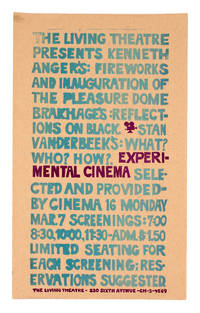
1960réf. 17742New York: Living Theatre 1960. Silkscreen poster 36 x 21.5 cm.; printed cyan and red on pink-flecked yellow sheet. Slight scuff to top left corner; otherwise Fine. Poster for a Living Theatre programme of experimental cinema as curated by Amos and Marcia Vogel's pioneering film society Cinema 16. Comprised of short films from Kenneth Anger Fireworks and Inauguration of the Pleasure Dome Stan Brakhage Reflections on black and Stan VanDerBeek What Who How. Hosted on March 7th 1960 at the Living Theatre loft at 14th and 6th. Living Theatre unknown
1990réf. 17044JBurbank: Jacmac Film March 26 1990. Original 113 page fifth draft screenplay. Bradbound in printed studio wrappers. Near fine very lightly handled copy New Jack City is a 1991 American crime action film directed by Mario Van Peebles in his feature film directorial debut and written by Thomas Lee Wright and Barry Michael Cooper based on a screenplay by Wright. The film stars Wesley Snipes Ice-T Allen Payne Chris Rock Judd Nelson Bill Cobbs Bill Nunn and Van Peebles. Its plot follows Nino Brown Wesley Snipes a drug lord in New York City during the crack epidemic and Scotty Appleton Ice-T an NYPD detective who vows to end Nino's rise to power by going undercover to work for Nino's gang. New Jack City premiered at the Sundance Film Festival on January 17 1991 and was released in the United States by Warner Bros. Pictures on March 8 1991. The film initially premiered at the Sundance Film Festival on January 17 1991 before being released nationally on March 8 1991. The film produced with an estimated $8000000 budget grossed $7039622 during its opening weekend. It became the highest-grossing independent film of 1991 grossing a total of $47624253 domestically. Jacmac Film unknown
1954CARTELLA COMPLETA DI N. 15 LOCANDINE A COLORI, CM. 23 X 32, DEGLI ILLUSTRATORI CARLANTONIO LONGHI, AVERARDO CIRIELLO, ANGELO CESSELON, DONELLI, NICOLA SIMBARI, GIORGIO OLIVETTI, GIULIANO NISTRI, DANIELE MANNO. FILM: GIULIETTA E ROMEO, PIANURA ROSSA, IL PRIGIONIERO DELL'HAREM, AD OVEST DI ZANZIBAR, GIUBBA GLORIOSA, LA VALLE DEI MAORI, L'ISOLA DEL PARADISO, IL GRANDE FLAGELLO, IL FIGLIO CONTESO, SCANDALO DI NOTTE, IL MARCHIO DEL COBRA, I CONFINI DEL PROIBITO, L'IDOLO, 4 IN MEDICINA.
1990réf. 4118Editions Presses de la Cité 1956. In-12 broché de 218 pages au format 12 x 18,5 cm. Belle couverture photo. Plats et intérieur frais malgré d'infimes frottis aux coins. Dos resté carré avec d'infimes traces de pliure. Intérieur frais malgré des rousseurs en page de garde. Portrait photo " Harcourt " de l'auteur, pleine page, au 4 ème plat. Edition originale en bel état général. Coupure de presse sur la mort de Dora Doll jointe. Précieux exemplaire enrichi d'une double dédicace autographe datée et signée de Dora Doll et Georges Simenon : Pour Monsieur Galland vive sympathie, Dora Doll, en cordial hommage de Georges Simenon, avec !'espoir qu'il ne sera pas déçu. Coupure de presse sur la mort de Dora Doll jointe.Le roman fut adapté au cinéma par Claude Autant-Lara en 1958 et présenté en sélection officielle en compétition à la Mostra de Venise 1958. Le scénario est écrit par Pierre Bost, d'après le roman éponyme de Georges Simenon paru en 1956, avec adaptation et dialogues de Jean Aurenche et Claude Autant-Lara. On trouve dans les rôles principaux : Jean Gabin, Brigitte Bardot, Edwige Feuillère, Franco Interlenghi, Nicole Berger, etc.
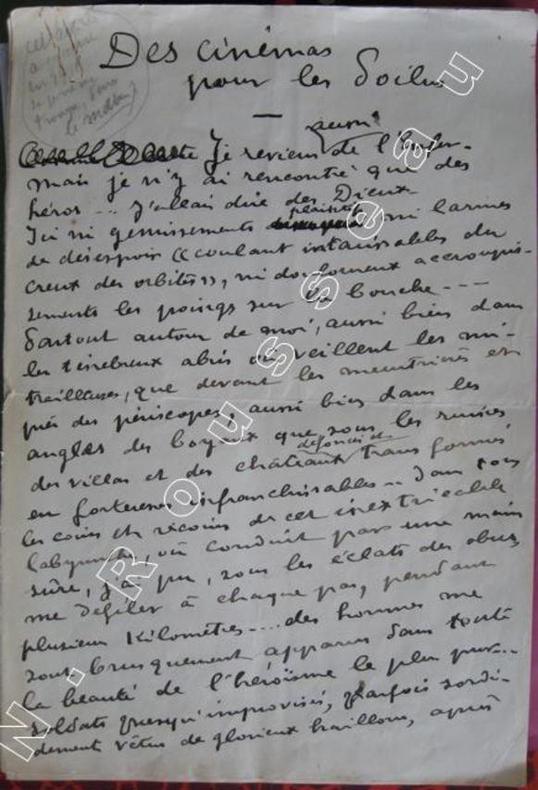
réf. 8674Manuscrit autographe signé de 6pp. grand in-4, ( rédigé au verso de 5 feuillets à l'en-tête du Ministre de l'Instruction Publique, sous-secrétariat d'Etat aux Beaux-arts ). Compte-rendu d'une visite sur le front., titré par l'auteur " Des cinémas pour les Poilus". Manuscrit à l'encre d'une plume large, plusieurs ratures, surcharges et ajouts . Armand Dayot, alors Inspecteur général des Beaux-arts, rend compte d'une visite dans les tranchées " Je reviens aussi de l'enfer, mais je n'y ai rencontré que des héros... J'allais dire des Dieux. Ici ni gémissements plaintifs, ni larmes de désespoir " coulant intarissables du creux des orbites"... Partout autour de moi.... dans tous les coins et recoins de cet inextricable labyrinthe... soldats presqu'improvisés, parfois sordidement vêtus de glorieux haillons, après tant de longs mois de souffrance et de combats , la barbe rude, le teint brulé mais les yeux pleins de flammes et le sourire aux lèvres, ce bon sourire français si près de la blague et de la chanson...". Il fait part de son émotion, voire " d'une vive commotion lorsque le premier obus de 150 éclata à une cinquantaine de mètres " ... Puis Dayot s'entretient avec l'officier " sous un abri casematé et blindé, que le bruit de la canonnade faisait trembler " qui l' interrroge sur les soldats : " ...que pensez-vous de nos poilus ?... Je pense que chacun d'entre eux mérite une statue ". L'interlocuteur de Dayot reconnait que ce serait " une excellente aubaine pour les sculpteurs ... mais ... assure... nos Poilus n'en demandent pas tant; Tachez seulement d'obtenir pour eux quelques ( rayé), un appareil cinématographique...". L' officier poursuit " tant que nos Poilus sont en première ligne, tout va bien. Devant la mort le moral est excellent... (le soldat) est immobile , comme un bronze....un braconnier à l'affut....Puis vient l'heure du repos, l'heure où tout danger disparait.. Alors les nerfs se détendent, les songes nostalgiques montent du fond de l'âme, et le Poilu loin de toute distraction , s'ennuie. C'est l'heure du cafard..." . Devant ce plaidoyer pour le cinéma , Dayot note de demander au Journal Le Matin de faire connaitre ce souhait " et je serai bien surpris que cette mesure salutaire ne se généralise pas bientot sur tous les fronts de bataille"... L' officier précise encore " Mais surtout pas de films tristes, pas de drames larmoyants, mais des histoires "bien rigolotes" avec de jolies petites femmes... Tuons le cafard pour mieux tuer le Boche...". Dayot revenu à l'arrière, prend des notes sur sa visite, il écrit son compte-rendu dans une chambre de la sous -préfecture (?) à tous vents, dans une ville où "le jardin est bouleversé par les obus", où les maisons s'écroulent. Il pourrait s'agir de Baccarat ( nom figurant à la fin de ses notes).
1821réf. 14767Dimensions : (297 x 214 mm).
Paris, Octobre 1928- 1929. 26 fascicules reliés en 1 volume in-folio, demi-toile noire, plat supérieur illustré et titré " Cinémonde. Les Beaux-Albums du Cinéma ", couvertures conservées. (2 coins de la reliure émoussés). Tête de collection de cette importante revue de cinéma. Le premier numéro, accompagnant l'arrivée du cinéma parlant, est sorti le 26 octobre 1928, sous la direction de Gaston Thierry, journaliste venu du magazine Tout-Paris-Ciné. " Cinémonde ", illustré de nombreuses photos, couvre largement l'actualité du cinéma, et compte alors, parmi ses collaborateurs, Charles Ford, Marcel Carné, Blaise Cendrars, Pierre Mac Orlan, Joseph Kessel et bien d'autres. Bel exemplaire.
réf. L11808Moscou. Mospoligraf, 1926. In-8 agrafé à l'italienne (15x23 cm). Texte en russe. Photomontage sur le premier plat et dans le texte. Plaquette publicitaire pour le film de Iakov Protazanov. Scénario tiré du roman Les trois voleurs du romancier italien Umberto Notari. E.O.
1831Prima edizione. Esemplare appartenuto al quadriumviro Cesare Maria De Vecchi, con ex-libris «Conte di Val Cismon», in gradevole legatura ottocentesca; qualche normale segno del tempo, ma ottimo esemplare ad ampi margini. Oltre a Foscolo, Monti e Pindemonte si trovano componimenti di Berchet, Saffi, Torti... «il [nome di Lorenzo Mascheroni], affiancato a quello del Monti, riappariva però [...] in una silloge di rime patriottiche, l’“Antologia repubblicana” del marzo 1831, che reca l’indicazione di Bologna [...]; ma anche in questo caso si dovrà pensare ad un’origine ticinese del volume. In quella raccolta, che aggiornava alle recenti insorgenze politiche la più importante delle miscellanee di inizio secolo, il “Parnasso [...]” del 1801, la mascheroniana “Canzone all’Italia” [...] si aggiunge a una dozzina di testi del Monti; il repertorio [...] ripercorre i momenti più alti dell’epopea [...] e ben rappresenta [...] il rilancio di quel bonapartismo patriottico e libertario, allegorico e classico, che allora alimentava molte speranze» (Spaggiari). Spaggiari, «Tipografie di frontiera» (in: Geografie letterarie, Milano 2015), p. 258-s; Motta, Le tipografie del Canton Ticino (Lugano 1964), p. 15; Agliati, Le edizioni Vannelli e Ruggia (Lugano 1988), p. 22 n. 12
Diciannove biglietti da visita del giornalista Fidenzio (Céncio) Pertile (al “Corriere della Sera” e al “Secolo-Sera“, negli anni 1943-’45; cfr. Laura E. G.- “L’immagine bugiarda” Pp. 188-196-266-277),di varia foggia e formato, in cui sono raccolti 41 autografi (alcuni con un rigo di dedica e data, relativi al periodo 1930-'33). Tra i nomi, non tutti decifrati, troviamo l’attrice teatrale W. Capodaglio, il capo-comico Uberto Palmarini, il divo del muto Febo Mari, la stella della rivista Isa Bluette, Lamberto Picasso, Margherita Bagni, Annibale Betrone, Paola Borboni, la soubrette Nanda Primavera, attrice cinematografica negli anni Sessanta grazie ad Alberto Sordi che la volle in molti suoi film, il commediografo Carlo Veneziani, la soubrette Nella Regini, Corrado Racca (v. n. 28), il giornalista Orio Vergani, gli attori: Giulio Stival, Olinto Cristina, Luigi e Giovanni Cimara, l’attrice e doppiatrice Tina Lattanzi, Marcello Giorda, Evy Maltagliati, Dora Menichelli, Gianfranco Giachetti. Ottimi esemplari.
1939réf. 218361939 Gouache et collage signé en haut à gauche, (1939), 32,5 x 46 cm., cadre en bois clair.
réf. 35504316San Francisco, Pisani Press, , 1965, 28 x 35 cm., Préservés dans une chemise illustrée. 1 f. de présentation et 6 estampes en noir. Portraits de W.C Fields, Laurel et Hardy, Charlie Chaplin, Buster Keaton, Harold Lloyd et Harry Langdon par le célèbre cartoonist de San Francisco, Bill Bates (1930-2009). Chemise légèrement salie, gravures bien fraîches.
1963réf. 32151Véritable originale Paris, Julliard, (8 janvier) 1963. 1 vol. (135 x 195 mm) de 265 p. et [3] f. Toile verte de l'éditeur estampée à froid. Edition originale. Elle paraît la veille de l’édition Julliard, datée du 9 janvier. Edition en cartonnage éditeur, numérotée (n° 703 N).
réf. 22459Robert Marin, 30 octobre 1948. In-8, broché, couverture blanche, à rabat, imprimée en deux tons, (noir et rouge), 106 pp, chemise dos en box rouge avec titre et auteur en lettres dorées, étui.
Robert Marin, 30 octobre 1948. In-8, broché, couverture blanche, à rabat, imprimée en deux tons, (noir et rouge), 106 pp, chemise dos en box rouge avec titre et auteur en lettres dorées, étui. Edition originale. Un des 2800 exemplaires numérotés sur vélin Hélio. Planches photographiques dans et hors-texte. Bel exemplaire.
1896Aimé Dupont - New York, 574 Fifth Avenue. Albumina su cartone originale. Formato cabinet portrait. (140x98 mm), supporto (165x111 mm). Parzialmente visibile (perché tagliato) il timbro del copyright su negativo. L’immagine fu realizzata nello studio del noto fotografo Dupont. Nato in Belgio, fu prima scultore e poi, dal 1904, fotografo ufficiale del Metropolitan. L’attrice era a New York in occasione della sua seconda tournée americana.
1926Prime edizioni. Ottiimi esemplari con i normali segni del tempo, e bella provenienza: tre volumi dalla biblioteca di Luigi Silvani (firma d’appartenenza), abbonato Gobetti e corrispondente sia dell’editore che di alcuni degli autori (tra i quali Dino Fiorelli), come testimoniato per esempio in Barbalato, L’archivio Piero Gobetti (Milano 2010), p. 292. Raccolta di scritti inediti (i primi due volumi) ed editi (il volume terzo, in due tomi) pubblicata a un anno dalla morte.
1832Edizione originale, prima emissione. Cfr. Glouzot, Guide, p. 88; Talvart - Place, Bibliographie des auteurs modernes de langue française, vol. IX p.22 nr. 30A. Esemplare con Ex Libris Antonii Thomas.
1950réf. 88181s. n. | s. l. s.d. (ca 1950) | 20.50 x 25.50 cm | broché
1985réf. 88185Studio B. Charlon | s. l. s.d. (ca 1985) | 10.50 x 15.50 cm | broché
1693réf. 135191693 un volume SEUL sur deux (manque le volume un), reliure plein veau brun moucheté in-douze (binding full calfskin duodecimo), dos à nerfs (spine with raised bands) décoré or (gilt decoration) filets or (gilt line) et filets à froid (blind-stamping line decoration) - entre-nerfs à fleuron au fer plein (between the raised bands floweret with full blocking stamp) - titre frappé or (gilt title) - tomaison (volume numbering) or - pièce de titre sur fond bordeaux foncé (label of title) avec filet et roulette or (label of title with fillets and gilt line), premier plat - légères épidermures (front cover with light scratches) - quatrième plat - légéres épidermures (back cover with light scratches) et coins écornés (corners dog-eared), roulettes sur les coupes (fillets on the cuts) avec manque de dorure (blurred gilding), tête lisse (top edge smooth), toutes tranches lisses (all smooth edges), jaspées rouges (all red marbled edges), ex-libris (book-plate) collège jésuite de Nice, orné de 7 gravures hors-texte gravées sur bois (engraving wood) en noir par Pierre Le Sueur + 2 gravures in-texte gravées sur bois (engraving wood) en noir (dont la Lanterne Magique ancètre du cinéma page 404) + 8 graphiques Esotériques in-texte gravés sur bois (engraving wood) en noir, de la page 323 à 610, 1693 Paris chez Jean Anisson Editeur,