52.479 Ergebnisse
Best.-Nr. DADAX0520077482New unknown
Best.-Nr. DADAX0520258568New unknown
Best.-Nr. DADAX0816629757New unknown
Best.-Nr. DADAX1846312027New unknown
Best.-Nr. DADAX1844574210New unknown
Best.-Nr. SONG207020541XUsed: Good unknown
Best.-Nr. SONG0802007759Used: Good unknown
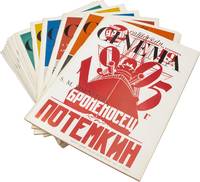
Best.-Nr. 170333Paris: Cahiers du Cinéma 2006. Collection of 393 issues Nos. 226 through 619 of the French film journal "Cahiers du Cinéma" representing the years 1971-2006. Text and titles in French. "Cahiers du Cinéma" was founded in 1951 by André Bazin Jacques Doniol-Valcroze and Joseph-Marie Lo Duca with writers including Jacques Rivette Jean-Luc Godard Claude Chabrol and François Truffaut. In the mid-1950s dissent started to develop between the journal's editors and its writers the latter group led by Truffaut who published an inflammatory article in January of 1954 denouncing the lack of creativity in French filmmaking and advocating for the "policy of the authors"-the origins of auteur theory. Founders Bazin and Lo Duca subsequently yielded editorial control of the journal to Doniol-Valcroze and Éric Rohmer resulting in a significantly changed format with a focus on directors deemed "auteurs." Rohmer would assume position as the journal's head editor in 1958 but by 1963 would be forced out by Godard Chabrol Rivette and others largely due to Rohmer's refusal to shift the journal's focus from Hollywood to the films of the French New Wave i.e. their own films. Now led by Rivette "Cahiers" tied its flag more openly to the political left and increasingly ignored Hollywood films in favor of avant-garde and experimental filmmakers. By the mid-1970s a review of "Jaws" 1975 marked the journal's return to more mainstream film criticism. In 1998 the journal would be acquired by press group Le Monde and was heavily redesigned the following year with significantly broadened focus on all visual arts. The journal remains in operation today under private ownership and continues to gain renown for its annual "top ten" film lists. Generally Near Fine or better. Housed in 33 custom maroon cloth clamshell boxes. Shipping billed at cost due to quantity and weight. Cahiers du Cinéma unknown
1915Best.-Nr. 171083Philadelphia: Philadelphia Department of Public Safety 1915. Vintage Philadelphia Department of Public Safety Operator's License "regulating the Operations of Moving Picture Machines" issued February 27 1915. License issued to a Frank C. Jobson with his passport-style photograph affixed to the upper right corner of the recto. Seal of the Philadelphia Department of Public Safety blindstamp at bottom left corner of the photograph. Signatory for the Director of the Department of Public Safety still visible below the date. 10.75 x 8.25 inches. Very Good plus with two previous vertical creases two tiny chips one to each of the right corners even toning and light overall soiling and two tiny pieces of cello tape one to the upper left and one to the bottom right of the recto. Philadelphia Department of Public Safety unknown
1968Best.-Nr. 161841N.p.: Charles Abrams Productions 1968. Vintage studio still photograph from the 1968 film here under the working title "How to . with Girls." Photograph with two provenance stamps on the verso. Obscure 1968 exploitation film released by Abrams and Parisi. We have been unable to identify either the filmmakers or actors involved in the production. Public relations man Bob hires call girls to help close a deal but signals get crossed and the girls aren't sure who to service. 8 x 10 inches. Very Good plus. Charles Abrams Productions unknown
Best.-Nr. 1607858932.Gpaperback. Good. Access codes and supplements are not guaranteed with used items. May be an ex-library book. paperback
1951Best.-Nr. 160480N.p.: N.p. 1951. Vintage promotional theater flyer for the Carver Theater in Alexandria Virginia circa 1951. Films promoted in this flyer include other films from 1951 including "The Frogmen" "Teresa" "Bad Men of Nevada" "The Golden Gloves Story" and the film noir "Fourteen Hours.". The flyer also includes advertisements for local businesses in Alexandria such as Rosenberg's Department Store and Thrift Auto & Appliance Store. 4.5 x 6 inches folded as issued. Near Fine. N.p. unknown
1950Best.-Nr. 160474N.p.: N.p. 1950. Vintage promotional flyer for screenings of the film noir "No Way Out" at the Carver Theater in Alexandria Virginia circa 1950. Films promoted in this flyer include "No Way Out" 1950 "The House Across the Street" 1949 and "If You Knew Susie" 1948. This flyer also includes advertisements for local business in Alexandria such as Rosenberg's Department Store and Cohen Bros a credit jewelry store. 4.5 x 6 inches folded as issued. Near Fine. Grant US. Selby US. Spicer US. N.p. unknown
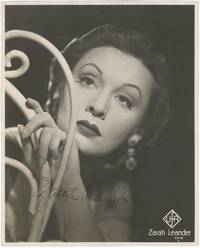
1940Best.-Nr. 157337Berlin: Universum Film UFA 1940. Vintage oversize photograph of Swedish singer and actress Zarah Leander. SIGNED by Leander near the bottom margin of the recto. Small mimeo snipe in French on the verso noting the photograph's production in Germany. Born Sara Stina Hedberg in Karlstad Sweden Leander began performing onstage at a young age joining an amateur touring cabaret and eventually making her first record in 1930. In 1936 after appearing in several Scandinavian films she signed a contract with UFA quickly becoming a leading film star in Germany. With UFA Leander made several films that are now associated with the Nazi propaganda machine although she never officially declared a political stance and did not affiliate with Nazi party officials. Leander returned to Sweden in 1943 hoping to revive her career in her home country but European audiences linked her with the Nazi regime and she never again managed to reach the same degree of popularity as a result. 8.75 x 11 inches. Near Fine. Universum Film [UFA] unknown
1920Best.-Nr. 157265N.p.: N.p. 1920. Vintage reference photograph from the 1926 film. Photograph shot at high film speed showing a roadster jumping a train crossing with the train approaching seconds before possible impact. The astute viewer will note that the guard rail has not yet been broken. With a lengthy annotation in manuscript pencil on the verso regarding guerilla production techniques taken by Poverty Row studios during the 1920s. An stunning photograph capturing a split-second moment from a common trope of early action cinema - motorists escaping capture by deftly crossing train tracks narrowly avoiding collision with an oncoming train. The production number in the bottom left of the photograph "4296" matches known photographs from the lost 1925 action serial film "The Scarlet Streak" directed by Henry MacRae and starring Jack Dougherty and Lola Todd. Just as fascinating is the extensive annotation on the verso: "Poverty Row crews were accustomed to film stories in the 1920s streets. The city of Los Angeles becoming inured to the novelty a license costing $400 was required for shooting on public thoroughfares. Camera crews were trained to set up fast complete the street scenes quickly and vanish before the police arrived to check for a license. So grab shots were common. "The favorite action sequence was the transfer of an actor from an automobile to a moving train or crossing the road in front of the train and breaking the guard rails at the last moment. "The best place to film this was in Pasadena where the Santa Fe Railroad passed along the blocks of paved streets. A director or camera man boarded the train there carrying their heavy luggage to the observation car. As soon as the train moved out of the station they hauled a camera and tripod out of the bags. The motorcycle or automobile appeared at the designated spot where another cameraman was set up. As the actor made the daring transfer or split second crossing the camera cranked out the action. The conductor generally came along to toss the film makers off the train at the next stop but it was a marvel of economy for the novelty of early film making." 10.25 x 8 inches. Very Good plus with a small chip to the top left margin chipping to the bottom right margin with a minutae of image loss to the bottom right corner and edgewear and creasing to the right margin. N.p. unknown
1934Best.-Nr. 155050Madrid: Cronica 1934. First Edition. First Edition. Issue VI No. 218 of the Spanish film periodical. Featuring a cover story on actress Grace Bradley. Text and titles in Spanish. 11 x 15 inches. 36 leaves side stapled. Very Good with moderate wear on the last leaf. Cronica unknown
1935Best.-Nr. 155053Various cities: Swiatowid 1935. First Edition. First Edition. Issue XI No. 45 of the Polish weekly film magazine. Text and titles in Polish. 11.5 x 15.75 inches. 23 pages. Very Good plus with moderate edgewear and toning. Swiatowid unknown
1937Best.-Nr. 155051Various cities: Swiatowid 1937. First Edition. First Edition. Issue XIV No. 12 of the Polish weekly film magazine. Text and titles in Polish. 11.5 x 15.75 inches. 23 pages. Very Good plus with moderate edgewear and toning. Swiatowid unknown
1936Best.-Nr. 155049Warsaw: Kino International 1936. First Edition. First Edition. Five issues of the long-running Polish film periodical including Issue III No. 7 Issue V No. 3 Issue VI No. 48 and Issue VII Nos. 19 and 41 Featuring cover stories on actress Pat Paterson and actor Fredric March. Text and titles in Polish. 9.75 x 14.75 inches. Approximately 15 pages. Issues Very Good plus to Very Good overall. Kino International unknown
Best.-Nr. 149497Mexico: Various 1975. Collection of 19 vintage Mexican posters for films released between 1961-1975. The posters feature full-color illustrations in a variety of styles as the films represented include Westerns comedies thrillers horror and action films. Directors whose films are represented in the collection include Rene Cardona Miguel M. Delgado and Roberto Rodriguez while actors featured include Julissa Antonio Aguilar Fernando Casanova Lucha Villa Sara Garcia and Sylvia Pinal. Most posters approximately 27 x 36 inches with minor variations in size. Posters generally Very Good with expected toning chipping and starting to folds. Folded as issued. For details please inquire. Various unknown
2000Best.-Nr. 134783Various cities: Various studios 2000. An archive of 7 lobby cards 10 pressbooks and 2 press kits from 15 contemporary films with prominent African American themes characters or cast members with the bulk of the material dating from the late 1970s. This archive includes lobby cards press kits and pressbooks from 15 films including "The Greatest" "The River Niger" "Mahogany" "Stir Crazy" and more with iconic African American stars Billy Dee Williams James Earl Jones Richard Pryor Bill Cosby and Michael Jackson. Pressbooks saddle stapled ranging from 8.5 x 14 inches to 12.5 x 15 inches. Press kits 9 x 12 inches. Lobby cards 14 x 11 inches. Very Good plus to about Fine condition. Various studios unknown
1936Best.-Nr. 63389London: Ivor Nicholson and Watson Ltd. 1936. Thick 8vo. vii 1 330 pp. Colour frontisp. numerous photo plates. Green cloth printed paper spine label extra label inserted at rear pastedown minor bumping to couple corners shelfwear light foxing to fore-edges slightly cocked w/ d.j. portrait of Madame Glyn minor shelfwear toning to spine still VG/VG copy. First edition 2nd printing July 1936 1 month after June 1st printing of this outspoken frank and often humorous author whose shocking “Three Weeks” 1907 bestseller titillated and attracted readers with her heroine seducing a younger man to conceive a child on a tiger skin rug; or her flapper era screenplay “It” which offered up Clara Bow as the quintessential sexually powerful Jazz Age heroine in 1927. She writes of defying her family as a young woman spurning suitors who were too old too fat or just didn’t appeal to her before they forced her exiled to Jersey where she would write columns on fashion and design clothing with her sister Lucy Duff-Gordon. The original British editions are surprisingly scarce and even more so in the original dustjacket predating the 1937 Dutton American edition. See: Erin Blakemore Before There Was ‘50 Shades’ . . . There Was Elinor Glyn’s ‘It” JSTOR Daily Feb. 20 2015; Denise Cummings & Annette Kuhn Elinor Glyn Women Film Pioneers Project 2013. Ivor Nicholson and Watson, Ltd,. hardcover
1920Best.-Nr. 63408Los Angeles CA: Palmer Photoplay Corporation 1920. 4to. 165 1 pp. Half-burgundy simulated calf over black cloth post-binder gilt lettering & lozenge stamped on front cover punch sewn at gutter margin w/ black braid as issued minor shelfwear rubbing slight scuffing still a VG copy w/ pencil manuscript at rear endpapers with extended quote from famed Hollywood screenplay writer Charles Gardner Sullivan 1884-1965. Revised and expanded edition of one of the most successful correspondence cars promising to prepare women and men for jobs in the ever-expanding and flourishing new movie industry Hollywood “Film Capital of the World.” This revised edition is significantly expanded by over 40 pages from the others issued before World War I and intended to offer the aspiring screenwriter not only a path to self-expression but a way to experience and appreciate this new art form. Palmer 1881-1961 himself had written silent film scripts for several movies released from 1911-1913 but proved to be far more successful in establishing his screenplay writer’s school whose advisory council included Cecil B. DeMille Lois Weber Thomas Ince and guest lectures by Sullivan himself. See: Anne Morey: ‘Have You the Power’ The Palmer Photoplay Corporation and the Film Viewer/Author in the 1920s Film History Vol. 9 No. 3 1997 pp. 300-319. Palmer Photoplay Corporation, hardcover
1988Best.-Nr. 63474Arlington Heights IL: Dark Harvest 1988. 8vo. 369 3 pp. Numerous illustrations. Burgundy-coloured textured publisher’s boards silver lettering on spine w/ d.j. cover art by Kevin Davies NF/NF copy. First trade edition of this anthology collecting 19 modern horror stories set against the backdrop of bizarre lives and deaths of men and women working in TV and film including such authors as F. Paul Wilson Robert Bloch Karl Edward Wagner Clive Barker Robert McCammon Richard Matheson and others. Dark Harvest, hardcover
1915Best.-Nr. 63112New York: Grosset & Dunlap ca. 1915. 8vo. 8 374 pp. Photo frontisp. 7 photo illust. Red cloth white lettering minor shelfwear faint tidemark wicked into fore-edges of plates at the very fore-edge w/ d.j. cover art with KKK rider on horseback next to heroine minor chipping head & foot of spine minor closed tears edgewear still G/VG- copy. First Photoplay edition of the notorious movie starring Lilian Gish Henry B. Walthall Mae Marsh Miriam Cooper Ralph Lewis George Siemann and others which steeped in the Confederacy’s Lost Cause mythos which had heavily influenced the misguided Dunning School’s interpretation of Reconstruction and significantly influenced Dixon and Woodrow Wilson. Directed by D.W. Griffith the movie was very successful but the racist overtones and blatant support of the Ku Klux Klan triggered widespread protests and it was banned in several cities. Very much like 21st-Century media Birth of a Nation’s portrayal of African-Americans created a justification for prejudice and discrimination which undermined Civil Rights for decades and reactivated the largely quiescent Ku Klux Klan movement and was the first film ever screened at the White House for President Wilson. See: Petaja Photoplay Edition p. 53; The Influence of “The Birth of a Nation” Facing History & Ourselves March 14 2016. Grosset & Dunlap, hardcover