9121 risultati
1931rif. 151422Beverly Hills CA: Metro-Goldwyn-Mayer MGM 1931. Draft script for the 1931 film with annotations in holograph pencil primarily in later half of script largely regarding dialogue but also setting and shots. A largely fictionalized account of the life of Mata Hari exotic dancer and courtesan who was executed by France for espionage during World War I. A sensation in the US and Europe it was Greta Garbo's most commercially successful film. The pre-Code Hollywood film was censored upon its reissue in 1936 which was the only version believed to exist until 2005 when an uncut French and Dutch subtitled version was screened at the Cinematheque Royale de Belgique in Brussels. Set in 1917 Paris shot on location in Agoura California. Tan titled wrappers with credits for screenwriters Benjamin Glazer and Leo Birinski and M-G-M label dated "Copied May 4 1931." Title page present with credits for screenwriters Benjamin Glazer and Leo Birinski. 172 leaves with last page of text numbered 169. Mimeograph duplication rectos only with six white revision pages dated June 5 1931. Pages Very Good plus with foxing and edgewear and stain to upper right of title page Wrapper Very Good with light soiling and chipping and closed tears to extremities and spine and upper right section cut from rear wrapper bound with two gold brads. Metro-Goldwyn-Mayer [MGM] unknown books
1931rif. 151422Beverly Hills CA: Metro-Goldwyn-Mayer MGM 1931. Draft script for the 1931 film with annotations in manuscript pencil primarily in later half of script largely regarding dialogue but also setting and shots. A largely fictionalized account of the life of Mata Hari exotic dancer and courtesan who was executed by France for espionage during World War I. A sensation in the US and Europe it was Greta Garbo's most commercially successful film. The pre-Code film was censored upon its reissue in 1936 which was the only version believed to exist until 2005 when an uncut French and Dutch subtitled version was screened at the Cinematheque Royale de Belgique in Brussels. Set in 1917 Paris shot on location in Agoura California. Tan titled wrappers with credits for screenwriters Benjamin Glazer and Leo Birinski and M-G-M label dated "Copied May 4 1931." Title page present with credits for screenwriters Benjamin Glazer and Leo Birinski. 172 leaves with last page of text numbered 169. Mimeograph duplication rectos only with six white revision pages dated June 5 1931. Pages Very Good plus with foxing and edgewear and stain to upper right of title page Wrapper Very Good with light soiling and chipping and closed tears to extremities and spine and upper right section cut from rear wrapper bound with two gold brads. Metro-Goldwyn-Mayer [MGM] unknown
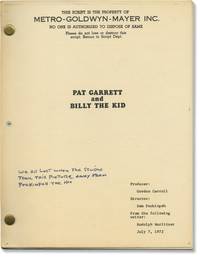
rif. 166485Beverly Hills CA: Metro-Goldwyn-Mayer MGM 1972. Draft script for the 1975 film. Annotation in manuscript ink on the front wrapper noting incorrectly we would argue "We all lost when the studio took this picture away from Peckinpah the hed" sic. A very nearly experimental Western made by Sam Peckinpah at his peak a highspot of genre revisionism. Comparable to "McCabe and Mrs. Miller" 1971 and "The Shooting" 1966 in terms of sheer impressionism being laid upon the genre with iconic imagery and super-stylization in every frame. Shot on location in Durango Mexico. Beige titled Metro-Goldwyn-Mayer front wrapper dated July 7 1972 with credits for Peckinpah and screenwriter Rudolph Wurlitzer. Missing rear wrapper. Title page integral with front wrapper. 125 leaves with last page of text numbered 134. Mimeograph duplication rectos only with blue and gray revision pages throughout dated variously between July 3 and 25 1972. Pages Very Good plus wrapper Very Good bound with two gold brads. Metro-Goldwyn-Mayer [MGM] unknown
1972rif. 149873London: Eon Productions 1972. Shooting script for the 1973 film. With a holograph ink annotation on the title page noting copy No. 56. Roger Moore's first turn as 007 and the eighth film in the franchise overall. Based on the 1954 novel by Ian Fleming which sees Bond go up against a Caribbean dictator moonlighting as a Harlem drug lord aided by a claw-handed henchman and a voodoo priest. One of the first Bond movies to explicitly address race most notably featuring the first African American Bond girl with whom 007 is romantically involved Rosie Carver played by Gloria Hendry. Filmed on location in New York Jamaica and Louisiana. Green titled Studio Duplicating Services wrappers with credits for novelist Ian Fleming on the front wrapper. Title page present dated October 2nd 1973 noted as Shooting Script with credits for novelist Ian Fleming and screenwriter Tom Mankiewicz. 121 leaves with last page of text numbered 120. Xerographic duplication rectos only. Pages Near Fine wrapper Very Good plus lightly worn and creased to the edges bound with two gold brads. Eon Productions unknown books
1934rif. 144598Culver City CA: RKO Radio Pictures 1934. Draft script for the 1935 film. In a custom quarter leather clamshell box. The second of two films based on Liam O'Flaherty's 1925 novel the first being Arthur Robison's 1929 British feature about a former Republic Army member during the Irish War of Independence who turns in one of his comrades to the British in order to use the bounty money to book passage to America for himself and his girlfriend who has been forced into prostitution. Winner of four Academy Awards including Best Adapted Screenplay Best Director and Best Actor for McLaglen nominated for two others including Best Picture. Screenwriter Dudley Nichols became the first person to decline an Academy Award when his refused his Oscar due to an ongoing dispute between the Screen Writers Guild and the Academy though he would eventually claim it three years later. Detached green wrappers noting the title screenwriter and director on the spine in holograph ink. Title page integral with first page of text with credits for screenwriter Nichols and novelist O'Flaherty. 105 leaves with last page of text numbered 105. Mimeograph duplication. Pages Near Fine wrapper Very Good side-stapled. National Film Registry. RKO Radio Pictures unknown books
1925rif. 143899Culver City CA: Metro-Goldwyn-Mayer MGM 1925. Draft script for the 1926 film. Based on the 1924 novel "Escape" by Alden Brooks. File copy rubber stamp to the front wrapper. Conrad Nagel and Renée Adoree star in this Silent film today lost originally directed by Josef von Sternberg. Midway into shooting Von Sternberg was fired by MGM and replaced by Phil Rosen. Rosen's many changes completely altered von Sternberg's version to the point that it was unrecognizable and in a bizarre twist MGM ultimately released both versions: the original one as "Exquisite Sinner" in 1926 credited to both Von Sternberg and Rosen running 60 minutes and Rosen's extensively reworked version as "Heaven on Earth" in 1927 runtime unknown. AFI Catalog notes that von Sternberg was replaced as director on January 17 1926 which would place this script dated in mid-December 1925 firmly within the time frame that von Sternberg was still the director. It is rumored that the Warner Brothers and Turner Entertainment archives hold a full print of this film but as of 2014 no print has surfaced. Only a few images promotional artwork and productions stills are currently known to exist. Set in France. Pale yellow titled wrappers rubber-stamped copy No. 2 and production No. 1510 dated Dec 19 1925 with credits for screenwriters Marion Orth and Harvey Gates. Title page integral with the first page of text dated Dec. 12 1925 with credits for screenwriters Orth and Gates. 128 leaves with last page of text unnumbered. Spirit duplication. Pages Near Fine wrapper Poor now encapsulated in archival mylar bound with two gold brads. Metro-Goldwyn-Mayer [MGM] unknown books
1970rif. 143123Talent Associates/N.S.I. / ABC Pictures 1970. Final Draft script for the 1971 film here under the working title and title of the source material "The Siege of Trencher's Farm." Based on Gordon M. Williams's 1969 novel. Director Sam Peckinpah and screenwriter David Z. Goodman kept only the central concept of the siege itself but completely altered the circumstances around it including the creation of the film's controversial rape scene. Nominated for an Academy Award. Set in Trencher's Farm in Dando Cornwall shot on location in Cornwall and Middlsex England. Maroon titled wrappers. Title page present dated 24th August 1970 noted as Final Draft with credits for screenwriters David Z. Goodman and Sam Peckinpah. 131 leaves with last page of text numbered 130. Mimeograph duplication. Pages Near Fine wrapper Very Good plus bound with two gold brads. Clover Men Women and Chainsaws. Criterion Collection 182. Grant US. Talent Associates/N.S.I. / ABC Pictures unknown books
1985rif. 139365London: Commies From Mars / Initial Pictures 1985. Third Draft script for the 1986 film "Sid and Nancy" here under the working title "Love Kills." INSCRIBED by Kate Simon in holograph ink on the verso of the last page of text. Simon was "a friend of Alex Cox's and she helped him vis a vis the fine details of the 'time of the Sex Pistols' in London in 1976 / To that end she showed him in London the pub where we hung out took sulphate the Roebuck and she also tried to set up a meeting with him and Johnny Thunders / Finally she is thanked at the end of 'Sid and Nancy' and she photographed him as he was writing the script there at the room in the Chelsea Hotel where Sid and Nancy lived / Kate Simon / 4-8-09." Brilliant but gritty biographical look at Sid Vicious Oldman bassist for the British punk band Sex Pistols and his girlfriend Nancy Webb. Their relationship is sprinkled with guilt sympathy and copious drug use implying Nancy introduced Sid to heroin when she traveled to London to have sex with the Sex Pistols. The two fall in love commit to a suicide pact and try to start a new solo career in New York after the breakup of the band. One night in a drug-induced stupor Sid announces his intention to quit heroin and move back to London prompting a suicidal Nancy to beg him to kill her. Perhaps unintentionally perhaps not Sid stabs Nancy and she dies in the bathroom. Set in London and New York shot there on location and in New Jersey California and France. The soundtrack boasts songs by Dan Wool The Pogues John Cale KC & The Sunshine Band and several Sex Pistols songs with the title track "Love Kills" by Joe Strummer. Illustrated titled self wrappers noted as 3RD DRAFT on the front wrapper dated 1985 with credits for screenwriters Cox and Wool. Title page integral with front wrapper. 113 leaves with last page of text numbered 107. Mechanical duplication. Very Good plus bound with three green twist ties in true punk fashion. Criterion Collection 20. Commies From Mars / Initial Pictures unknown books
1931rif. 134294Beverly Hills CA: Metro-Goldwyn-Mayer MGM 1931. Draft script for the 1932 film based loosely on Edgar Rice Burroughs' novel "Tarzan of the Apes." Two black and white reference photographs for the film also laid in. The first of Weissmuller's twelve Tarzan films and the first appearance of Cheeta Tarzan's chimpanzee friend. In this variation of the much-adapted Burroughs tale Tarzan and Jane fall in love and although Jane desires to take him back to England when Jane's father James Parker dies on the expedition Jane remains behind in the jungle instead. Set in Africa shot on location in California and Florida. Pale yellow titled wrappers rubber-stamped VAULT COPY and FILE COPY on the front wrapper and rubber-stamped copy No. 1871 and production No. 4608 dated Dec. 11/31 with credits for screenwriter Novello. Title page not present as issued. 116 leaves mimeograph duplication with white revision pages throughout dated variously between 11-20-31 and 12-16-31. Pages Near Fine. Front wrapper detached else wrappers Very Good bound with two gold brads. Photos both 8.25 x 10 inches Fine condition. Metro-Goldwyn-Mayer [MGM] unknown books
1936rif. 147033Burbank CA: Warner Brothers 1936. Collection of nine vintage oversize photographs from the 1936 film. Each with a mimeo snipe on the verso. Based on the 1930 Pulitzer Prize winning play by Marc Connelly itself based on "Ol' Man Adam an' His Chillun" a 1928 collection of pseudo African American folk tales by Roark Bradford. One of only a handful of films to feature an all-Black cast made by a major Hollywood studio during the Golden Age becoming the highest grossing such film and remaining so until surpassed by "Carmen Jones" in 1954. 14 x 11 inches. Very Good with light edgewear and light vertical creasing down the center. Warner Brothers unknown
1938rif. 163880N.p.: N.p. 1938. James Hilton's typescript draft screenplay for the 1939 film an adaptation of his own 1937 novel the only such adaptation he ever completed. With the author's profuse manuscript ink annotations as well as many pages executed entirely in manuscript ink throughout. Included is a privately commissioned essay by Hilton scholar Kurt Kausler detailing both the history of Hilton's work on the film an analysis and a breakdown of the manuscript. Almost certainly Hilton's first corrected manuscript screenplay for the film. After Jack Warner raised concerns about the script being too long screenwriter Milton Krims was employed to clean up and shorten it-though in the end Hilton received sole credit as screenwriter. A man hires an Austrian governess and both are suspected of murder when his wife is discovered to be dead. 123 leaves a gathering demonstrating the author's method his attention to detail and his extreme frugality with the use of paper the last most likely due to wartime shortages. The script consists of a ribbon copy typescript leaves on both onionskin and paper stock with manuscript emendations on virtually every page in many cases both recto and verso with some leaves executed on the versos of unrelated previous work by Hilton b leaves consisting entirely of text executed in manuscript ink c hand-cut partial leaves and d a handful of later Xerographically duplicated facsimiles of Hilton's original annotated typescript leaves. Included is a very detailed analysis of the manuscript as well as the events surrounding its creation along with a detailed breakdown of the manuscript elements. Hilton's manuscript leaves Very Good to Fine quite supple and well preserved. Housed in a modern white three-ring binder. Leaves individually held in modern mylar page protectors. N.p. unknown
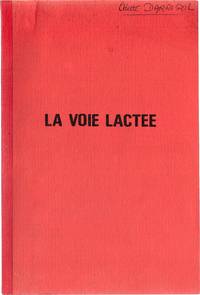
1969rif. 170400Paris: Greenwich Film Production 1969. Draft script for the 1969 French film. Copy belonging to production secretary Odette Darrigol with her name in manuscript ink on the front wrapper. Text in French. Included with the script are four pages of spirit duplication revision pages and eight gatherings of production documents including a shooting schedule and several crew contact lists. A surrealist comedy about a pair of vagrants who take a pilgrimage route from Paris to Santiago de Compostela. The first entry in Luis Buñuel's trilogy about what he called "the search for truth" followed by "The Discreet Charm of the Bourgeoisie" 1972 and "The Phantom of Liberty" 1974. Shot on location in France. Tall red titled wrappers. Title page present undated with credits for Buñuel and screenwriter Jean Claude Carrière and producer Serge Silberman. 115 leaves with last page of text numbered 114. Mimeograph duplication rectos only. Pages Near Fine wrapper Very Good plus perfect bound. Greenwich Film Production unknown
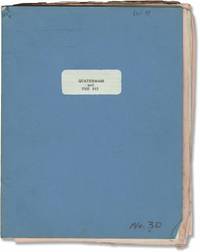
1967rif. 162979London: Hammer Film Productions 1967. Draft script for the 1967 film. Working script belonging to an unknown cast or crew member with annotations in manuscript pencil and ink throughout largely noting deletions. A gathering of ancient human remains and a mysterious metallic object are discovered buried beneath the site of a planned extension to the London Underground. Renowned scientist Bernard Quatermass is called in to investigate. Based on the successful 1950s British science fiction serial "The Quatermass Experiment" and a follow-up to the films "The Quatermass Xperiment" 1955 and "Quatermass 2" 1957. Blue untitled wrappers with a die-cut title window in the British style on the front wrapper. Title page present dated 25th January 1967 with credit for screenwriter Nigel Kneale. 154 leaves with last page of text numbered 131. Roneograph duplication on eye-rest green stock rectos only with undated pink and green revision pages mimeograph laid in throughout. Pages Good moderately worn with foxing on some revision fore-edges wrapper Very Good plus bound internally with two silver brads. Hammer Film Productions unknown
1943rif. 156715Beverly Hills CA: Metro-Goldwyn-Mayer MGM 1943. Draft script for the 1945 film. Copy belonging to an unknown crew member with their manuscript annotations in pencil on several pages. Based on the 1890 novel by Oscar Wilde about a man whose portrait magically takes on the ability to absorb the sins of his debauched life while he remains unaged. Nominated for three Academy Awards winning one for Best Cinematography. Set in London. Goldenrod studio wrappers rubber-stamped FILE COPY and COMPLETE on the front wrapper noted as copy No. 67 and production No. 5069 dated 11-5-43 with credits for director Albert Lewin. Title page integral with the first page of the text. 168 leaves with last page of text numbered 169. Mimeograph duplication rectos only with a single pink revision page dated 3-13-44. Pages about Near Fine wrapper Good only with a tear on the bottom right portion of the front wrapper and rear wrapper split from the binding bound with two gold brads. Selby US. Metro-Goldwyn-Mayer [MGM] unknown
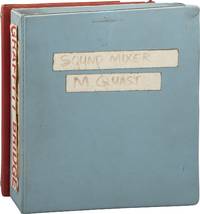
rif. 169944Chanhassen MN: Graffiti Bridge Inc 1990. Archive of two original scripts and over 100 pages of production documents from the 1990 film all belonging to Sound Mixer and Playback Operator Matthew Quast. The archive consists of: A Fourth Draft script dated February 1 1990 with manuscript ink annotations on the versos of two pages and the recto of a third housed in a large generic blue three-ring binder with the labels "Graffiti Bridge" on the spine and "Sound Mixer / M. Quast" on the front board. Bound in preceding the script are: 40 pages of song lyrics with manuscript ink and highlighter annotations noting timing of stanzas on nearly every page. Seven pages of employment applications agreements and memos. Sixteen pages of crew contact information. And thirteen pages of One-Line Schedules dated February 8 20 and 26 1990. An undated Revised Draft script lacking the first seven pages and title page housed in a narrow generic red three-ring binder. Bound in following the script is a six-page "Contact Suppliers List" an eight-page "Area Info" and four pages of maps and directions to Prince's Paisley Park studio. Laid in with the scripts are: Copies of Prince's wardrobe sketches on three pages and one half leaf. A four page Music List dated January 26 1990. Four Call Sheets dated 3/13/90 3/26/90 3/27/90 and 3/28/90 with a memo dated March 27 1990 stapled to the last call sheet. A three page One-Line Schedule dated March 20 1990. A copy of a handwritten page listing six scenes for "Thursday 3/8/90." And six "Graffiti Bridge" film reel labels and a blank Avalon Entertainment employee time and reimbursement submission form with the attached carbon copy. Prince's standalone sequel to his hit 1984 movie "Purple Rain" and his third and final film role following "Purple Rain" and the 1986 film "Under the Cherry Moon" Prince's directorial debut. Prince returns as "The Kid" now a club owner in a "West Side Story" style rivalry with competing club owner Morris Morris Day and puts his club on the line with a bet with Morris over who can write the best song. Set and shot on location in Eden Prairie and Minneapolis Minnesota. Fourth Draft script: Housed in a large blue generic three-ring binder. Title page present dated February 1 1990 noted as FOURTH DRAFT with credits for screenwriter Prince. 70 leaves with last page of text numbered 66. Xerographic duplication rectos only with blue and yellow revision pages throughout dated variously between 2/7/90 and 3/9/90. Pages Near Fine bound in a Very Good plus three-binder. Revised Draft script: Housed in a thin red generic three-ring binder. 56 leaves with last page of text numbered 60. Xerographic duplication rectos only with undated blue revision pages. Pages Near Fine bound in a Very Good plus three-ring binder. Other production documents 8.5 x 11 inches to 8.5 x 14 inches. Near Fine overall. Graffiti Bridge Inc unknown
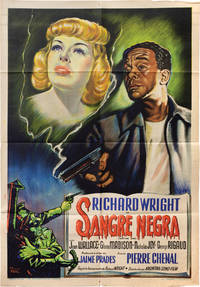
1950rif. 158441Buenos Aires: Industia Argentina 1950. Vintage one sheet poster for the Argentinean release of the 1951 film the film's country of origin and whose premiere preceded the US release by more than three months. Richard Wright accepted an offer to star as the leading man in the film adaptation of his own novel after initial choice Canada Lee was stuck in South African customs after shooting "Cry the Beloved Country" 1951. Lee had starred in Orson Welles' prior stage adaptation. Set in Chicago and shot on location in Chicago and Argentina. 29 x 43.25 inches folded as issued. With a few small closed tears and creases at the extremities else Near Fine. Bright and unfaded. Industia Argentina unknown
1948rif. 151350N.p.: N.p. 1948. Draft carbon typescript screenplay for an unproduced film. While hiding out from his wife and business associates at a seedy hotel a millionaire who has recently lost his fortune falls in love with a troubled young woman. Screenwriter Eliot Gibbons worked at Metro-Goldwyn-Mayer and Republic Studios for most of his career. He was best known for his aviation pictures most notably "Storm Over the Andes" 1935 "Flight at Midnight" 1939 and "Sky Raiders" 1941. Set in postwar Chicago and Los Angeles. Housed in a quarter-leather clamshell box. Green titled wrappers with the label of Paul Kohner Agency affixed to the front wrapper with credits for screenwriters Jean Renoir and Eliot Gibbons. Title page present undated with credits for screenwriters Jean Renoir and Eliot Gibbons. 144 leaves with last page of text numbered 143. Carbon typescript on onionskin stock rectos only. Pages Fine wrapper Very Good plus bound with three gold brads. N.p. unknown books
1932rif. 136754Culver City CA: RKO Radio Pictures 1932. Screenplay archive for the 1932 film. Archive consists of a Revised Final script and a typescript rewrite of the film's opening sequence onboard a yacht. The rewrite credits an unknown screenwriter named "Eliscu." Based on the Richard Connell short story first published in "Colliers" in 1924. A rare set of scripts for a groundbreaking film. A deranged millionaire living on an island arranges for a yacht to be shipwrecked on his shores whereupon he arranges for the survivors to be hunted. Decades ahead of its time and almost iconoclastic in the cynicism of its subtext Pichel and Schoedsack used ideas from their film "Gow the Headhunter 1931 and predicted their classic "King Kong" 1933 and dozens of other films that would follow using a theme of man being the hunted rather than the hunter. Revised Final script: Tan titled wrappers noted as REVISED FINAL SCRIPT on the front wrapper rubber-stamped PLEASE RETURN TO STORY DEPT. / RKO STUDIOS Inc. / WEST COAST" dated May 13 1932 with credits for story writer Conell and screenwriter Creelman. Title page integral with first page of text with credits for Connell and Creelman. 123 leaves with last page of text numbered 123. Mimeograph duplication on onionskin stock some leaves tan and others white. Pages Near Fine wrapper about Near Fine bound with three gold brads. Opening Yacht Sequence script: Blue titled wrappers noted as OPENING YACHT SEQUENCE on the front wrapper rubber stamped "Property of RKO STUDIOS Inc. / Return to Scenario Dept. Files" dated July 2 1932 with credits for story writer Conell and screenwriter Creelman further noted as ELISCU CHANGES / Ciopied by RKO Stenographic Dept." Title page integral with first page of text with credits for Connell and Creelman. 15 leaves with last leaf of text number 123. Typescript on onionskin stock. Pages Near Fine. A few small chips to the edges fragile wrapper else about Near Fine. Criterion Collection 46. RKO Radio Pictures unknown books
1936rif. 147033Burbank CA: Warner Brothers 1936. Collection of nine vintage oversize photographs from the 1936 film. Each with a mimeo snipe on the verso. Based on the 1930 Pulitzer Prize winning play by Marc Connelly itself based on "Ol' Man Adam an' His Chillun" a 1928 collection of pseudo African American folk tales by Roark Bradford. One of only a handful of films to feature an all-Black cast made by a major Hollywood studio during the Golden Age becoming the highest grossing such film and remaining so until surpassed by "Carmen Jones" in 1954. 14 x 11 inches. Very Good with light edgewear and light vertical creasing down the center. Complete collation details available on request. Warner Brothers unknown books
1939rif. 151485Hollywood: Paramount Pictures 1939. Master File script for the 1940 film "The Great McGinty" seen here under the working title "Down Went McGinty" corrected in red pencil to "The Great McGinty." This revision contains an appropriately unusual and rather whimsical foreword by Sturges with two earlier titles "Biography of a Bum" and "The Vagrant" cited on the second and fourth leaves respectively. Sturges had become a very successful Hollywood screenwriter by the late 1930s and with his screenplay for "The Biography of a Bum" wanted so much to direct the film that he offered to do the job for free. With very few exceptions notably Charlie Chaplin the notion of an established studio writer directing a film was nearly unheard of in Hollywood where writers were typically not even allowed on the set. Only the irresistible cheapness of Sturges' offer made it possible for the film to get made. Over the six year period during which the script remained unproduced the title changed to "The Vagrant" then "Down with McGinty" then finally just prior to production to "The Great McGinty." It was not only a success but won Sturges an Oscar for Best Screenwriter. More importantly he was allowed to continue as a writer-director with a magnificent career that included one classic after another including "Sullivan's Travels" "The Lady Eve" "Unfaithfully Yours" "The Palm Beach Story" and "Hail the Conquering Hero." Tall cream colored titled self wrappers rubber-stamped Production No. 672 MASTER FILE FILE COPY PRODUCED and PLEASE RETURN TO THE STORY DEPARTMENT / PARAMOUNT STUDIO - HOLLYWOOD. Dated April 28 1939. Title page present dated 1933 with credits for screenwriter Sturges and Sturges' name written in holograph pencil just above. 109 leaves mimeograph on cream colored stock. Pages Near Fine wrapper Very Good plus. Side stapled. Paramount Pictures unknown books
1986rif. 132794Universal City CA: Universal Pictures 1986. Archive of three title card maquettes hand lettered by Harold Adler for the 1963 film. Also included are two fascinating autograph letters both elaborately designed and executed in a calligraphic style from Adler to author illustrator and editor Fridolf Johnson relating to Adler's work with Hitchcock. Harold Adler was a calligrapher who created hand lettered titles on over 100 films worked frequently with Alfred Hitchcock and was a favorite of legendary title sequence designers Saul Bass and Pablo Ferro. In addition to "The Birds" 1963 his credits include "Comanche!" 1956 "The Man with the Golden Arm" 1955 "The Seven Year Itch" 1955 "Carmen Jones" 1954 "Psycho" 1960 "In the Heat of the Night" 1967 and "Justine" 1969. In 2012 an exhibition of Adler's work was organized by noted typographer and design historian Jill Bell at the American Advertising Federation Kansas City. In the first letter dated May 16 1986 Adler describes after touching on other topics meeting Hitchcock and then presenting him with layout ideas for the titles. He then goes into detail regarding his answer to a question about the techniques of artist Eric Gill stating that Hitchcock "was amazed" by this answer and after that would "request 'to be sure to bring that nice young man along" meaning Adler whenever he had a job for Adler's firm. The second letter dated June 10th 1986 focuses almost exclusively on Adler's work on "The Birds" going into some detail regarding both the creative and technical processes of producing hand lettered titles for films. He also describes Hitchcock as "an unusual person to work with. He was a master at what he did knew what he wanted and smoked the finest cigars." He then concludes the letter with some brief remarks on how his approach to title lettering evolved over the course of his career. The letters themselves are works of art executed in a variety of inks in Adler's detailed penmanship with Johnson's name on each in particular receiving full calligraphic treatment. Also included are draft title cards for the film stylistically similar to each other but much different from the titles used in the finished film. Two of the cards are marked as "camera ready" in holograph colored pencil with titles executed in white paint on black board. The third card photo stat on black paper which accompanied the June 10th letter has been annotated by Adler on both the recto and verso explaining the in more detail the technical process of putting the lettering on film. Overall a significant collection of material illuminating a little explored aspect of film design with a direct and significant connection to a seminal work by a director known for personally overseeing all aspects of production. Each letter 19 x 24 inches single leaf rectos only. May 16th letter folded twice for mailing June 10th letter folded. Two long diagonal creases to the May 16th letter else both are Fine. Original mailing envelope for the May 16th letter included. "Camera ready" title cards 22 x 14 inches. Lightly rubbed and about Near Fine. Third card 18 x 4 inches. Near Fine. Universal Pictures unknown books
1949rif. 143058Tokyo: Film Art Association 1949. First Draft script for the 1949 Japanese film noir. Manuscript ink and pencil annotations from production on two leaves. Text in Japanese. Generally considered to be the greatest film noir made in Japan and hugely influential on American film noir of the 1950s and 1960s. White titled wrappers. 96 leaves with last page of text numbered 96. Mechanical duplication. Toning due to aging throughout wrapper split at spine with mild foxing otherwise Good condition. BFI 534. Criterion Collection 233. Grant Japan. Selby Japan. Spicer Japan Classic Noir. Film Art Association unknown
1949rif. 143058Tokyo: Film Art Association 1949. First Draft script for the 1949 Japanese film noir. Holograph ink and pencil annotations on two leaves. Text in Japanese. Generally considered to be the greatest film noir made in Japan and hugely influential on American film noir of the 1950s and 1960s. White titled wrappers. 96 leaves with last page of text numbered 96. Mechanical duplication. Toning due to aging throughout wrapper split at spine with mild foxing otherwise Good condition. BFI 534. Criterion Collection 233. Grant Japan. Selby Japan. Spicer Japan Classic Noir. Film Art Association unknown books
1971rif. 147168Beverly Hills CA: E-K-Corporation / United Artists 1971. First draft script for the 1973 film written nine months before the production began. From the estate of film producer Elliott Kastner whose best known credits include "The Missouri Breaks" Arthur Penn 1976 and "Heat" Michael Mann 1996. Based on Chandler's 1953 novel the sixth and penultimate Philip Marlowe book. Screenwriter Leigh Brackett who also co-wrote the screenplay for "The Big Sleep" 1946 updated not just the setting from the 1950s to the 1970s but the attitudes themes and relationships as well. The result was less of a straight adaptation than it was a satire of the traditional detective story a New Hollywood classic. Shot on location in Los Angeles Malibu Hollywood and Mexico Black titled Studio Duplicating Service Inc. wrappers. Title page present dated September 1971 noted as First Draft with credits for screenwriter Leigh Brackett. 109 leaves with last page of text numbered 108. Mimeographed rectos only. Pages Near Fine wrapper Near Fine bound with two gold brads. Grant US. Hardy BFI Companion to Crime. Silver Classic Noir. Spicer US. E-K-Corporation / United Artists unknown books
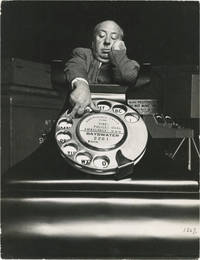
1954rif. 153634N.p.: N.p. 1954. Archive of five vintage borderless oversize photographs of director Alfred Hitchcock with various cast and crew members on the set of the 1954 film noir. Manuscript ink and pencil annotations to the verso including layout annotations "FILE" stamps and the stamp of photographer Sanford H. Roth. Four photographs with printed mimeo snipes affixed to the verso and four photographs with manuscript annotations noting their appearance in the May 24 1954 issue of Life magazine. Brooklyn-born photojournalist Sanford Roth was best known for his portrait photography capturing intimate and now iconic images of artists and actors throughout his decades-long career including Marc Chagall Joan Crawford Albert Einstein Henri Matisse and Elizabeth Taylor among many others. Based on the 1952 play by Frederick Knott who also wrote the screenplay about a tennis player who arranges to have his wife framed for murder after discovering her infidelity. The only Hitchcock film to be shot in 3D although the format would ultimately be discarded for theatrical release and the first of three Hitchcock films to feature actress Grace Kelly followed by "Rear Window" 1954 and "To Catch a Thief" 1955. One photograph features Hitchcock leaning over a giant rotary dial a prop made as a result of Warner Brothers' proprietary 3D camera rig. Hitchcock wanted the first shot of the film to feature a finger pressing the letter M on a rotary dial telephone but the specialized 3D camera was unable to focus the close-up correctly leading the director to order a giant finger made from wood and a proportionally large dial in order to achieve the effect. Four photographs 10 x 13.5 inches one photograph 9.5 x 13.5 inches. Lightly edgeworn else generally Near Fine. Grant US. Selby US. Spicer US. N.p. unknown