11 050 résultats
1980réf. 147426N.p.: N.p. 1980. Draft script for the 1982 film. Title page contains "#40" written in manuscript pencil on the upper right likely a copy number as well as several pages with annotations again in manuscript pencil commenting circling and striking scenes action and dialogue. From the estate of film producer Elliott Kastner whose best known credits include "The Long Goodbye" Robert Altman 1973 "The Missouri Breaks" Arthur Penn 1976 and "Heat" Michael Mann 1996. A year before Peter Billingsley would become the familiar face of Ralphie Parker in Bob Clark's 1983 "A Christmas Story" he was Billy a child coping with his parent's recent divorce flying to California with his mom Sally Catherine Hicks to meet her high school sweetheart Mike Paul Le Mat for a vacation in Death Valley. It isn't long before Billy comes across a killer's crime scene leading the killer to them and it is up to little Billy to outsmart him. Set in Death Valley California and New York shot on location in California Arizona and New York. Gray untitled wrappers. Title page present dated October 28 1980 with credits for screenwriter Richard Rothstein. 111 leaves with last page of text numbered 110. Xerographic duplication rectos only. Pages Near Fine wrapper Near Fine bound with two gold brads. N.p. unknown
2005réf. 148372N.p.: N.p. 2005. Draft script for the 2006 film. An intimate look at the British Royal family from May to September of 1997 following the death of Princess Diana on August 31 1977 and the struggle between Queen Elizabeth's Helen Mirren desire to treat it as a private affair and Prime Minister Tony Blair Michael Sheen and Prince Charles' Alex Jennings desire to quell the public's demand for a more overt and public expression of grief. Winner of the Academy Award for Best Actress for Mirren nominated for five others including Best Film Best Director and Best Screenplay. Set in and shot on location in England Scotland and France. Pink titled wrappers with credits for screenwriter Peter Morgan. Title page integral with first page with credits for screenwriter Peter Morgan. 106 leaves with last page of text numbered 106. Xerographic duplication rectos only. Pages Near Fine wrapper light creasing to top right else Near Fine bound with three gold brads. N.p. unknown
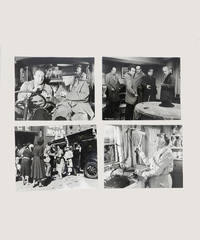
1965réf. 148894N.p.: N.p. 1965. Four vintage borderless photographs from the 1965 film. Two studio still photographs of Ursula Andress on production designer Piero Poletto's striking minimalist set and two compilation fashion photographs of Andress in costume bookending Costume Designer Giulio Coltellacci's concept drawings. Two photographs with "La Decima Victima" stamp on verso. An international cult classic based on the 1953 short story "Seventh Victim" by Robert Sheckley. Sheckley wrote the novelization of the film in 1956 and two sequels "Victim Prime" and "Victim" in 1987 and 1988 respectively. The worldwide officially sanctioned "Big Hunt" is the world's most popular television show giving those inclined to violence and those in search of celebrity a chance to act as "hunter" and "victim." The games top two assassins Caroline Meredith Andress and Macello Poletti Marcello Mastrianni who may be in love are pitted against each another. A descendant of Richard Connell's "The Most Dangerous Game" 1924 and the first of the televised death game films such as "The Gladiators" 1969 "Death Race 2000" 1975 "The Running Man" 1987 and "The Hunger Games" 2012. Shot on location in New York Rome Geneva and Vatican City. 2 - 9.5 x 7.25 inches 2- 8 x 10 inches. Light edgewear else Near Fine. N.p. unknown
1963réf. 149379N.p.: N.p. 1963. Vintage borderless reference photograph of Orson Welles from the 1963 film. Italian "ROGOPAG / LA RIOTTA" stamp on verso. An anthology film of four short films titled after the names of the four directors: "Illibatezza" directed by Roberto Rossellini "Il Nuovo Mondo" directed by Jean-Luc Godard "La Ricotta" directed by Pier Paolo Pasolini and "Il Pollo Ruspante" directed by Ugo Gregoretti Pasolini's scathing comic rebuke on social inequality and religious hypocrisy wherein a lavish film production of the crucifixion of Christ in a poor region outside Rome finds the extra playing the "good thief" Stracci Mario Cipriani quite literally starving during the production trying everything to get some food all while being berated by the bombastic insufferable director Orson Welles. The film resulted in Pasolini being convicted of blasphemy and the film being banned in Italy. Pasolini was sentenced to a four month prison term which he avoided by paying a fine. 9.5 x 7 inches. Near Fine. Rosenbaum 1000. Criterion Collection 236. N.p. unknown
1943réf. 149399N.p.: N.p. 1943. Vintage borderless reference photograph of Georg Wilhelm G.W. Pabst on the set of the 1943 German film. Production stamps on verso. Made to celebrate the 400th anniversary of the death of Paracelsus. Story of the 16th century Swiss physician/alchemist/astrologer Paracelsus Theophrastus Bombastus von Hohenheim played by Werner Krauss. Made under the auspices of the Third Reich Pabst's second film upon his forced return to Germany after a period in France Paracelsus took on a new vogue in early 1940s Germany attributing Nazi ideals and a hyper-Germanness to the Swiss alchemist and physician. After the collapse of the Third Reich Pabst would go on to forcefully denounce Nazism. Shot on location in Old Town Prague Czech Republic. 7 x 9.75 inches. Light creasing and edgewear else Near Fine. N.p. unknown
1970réf. 147269N.p.: N.p. 1970. First draft screenplay for an unproduced film from British director Clive Donner circa early 1970s. Ribbon copy typescript on onionskin stock with two small annotations one on page 16 of the word "ice" written into the dialogue in manuscript marker and the page number "100" underlined in manuscript ink at the top margin of that page. From the estate of film producer Elliott Kastner whose best known credits include "The Long Goodbye" Robert Altman 1973 "The Missouri Breaks" Arthur Penn 1976 and "Heat" Michael Mann 1996. Based on the 1971 novel by Donald MacKenzie the third entry in his Henry Chalice Mystery series preceded by "Salute from a Dead Man" 1966 and "Death is a Friend" 1967. Jewel thief Paul Henderson has had a run of bad luck when he is offered a job on a big heist from a career criminal he's worked with before but when he arrives in Switzerland for the crime he faces a double cross and a kidnapping. Blue untitled wrappers with die-cut title window in the British style. Title page present noted as FIRST DRAFT with credits for screenwriter Clive Donner and novelist Donald Mackenzie misspelled. 143 leaves with last page of text numbered 142. Ribbon copy typescript on onionskin stock rectos only. Tall Pages 8.5 x 11.75 inches with standard size wrappers 8.5 x 11 inches. Pages Very Good plus title page trimed about 1 1/4" from bottom wrapper Very Good plus two closed tears at top of die-cut window bound internally with two flat metal brads. N.p. unknown
1939réf. 147709Los Angeles: Paramount Pictures 1939. Draft script for the 1940 film with the name of uncredited screenwriter Leonard Lee in manuscript pencil over date on lower left. Paramount "File Copy" and "Master File" stamps and manuscript annotation in pencil on front wrapper. Script divided into sequences as was customary for the period. Paramount's 1940 Technicolor south seas adventure. Dea Dorothy Lamour is marooned on an isolated island since childhood with only the company of Koko the chimp when Skipper Joe Lynne Overman and Johnny Potter Robert Preston are marooned on the island by a mutinous crew. The three must battle angry natives and survive tidal waves a forest fire and the titular typhoon to survive. Nominated for an Academy Award. Set on a South Sea island and shot on location in Santa Catalina Island Los Angeles County Arboretum and Botanic Garden and Baldwin Dry Lake California. Self wrappers with front wrapper dated July 8 1939 rubber-stamped production No. 1908. 122 leaves with last page of text numbered E-31. Mimeograph duplication rectos only. Pages Near Fine bound with three gold brads. Paramount Pictures unknown
1950réf. 142292n.p.: N.p. 1950. First Draft script for an unproduced film. Copy belonging to Ben Colman credited for adding additional dialogue manuscript pencil signature on front wrapper. Manuscript ink and pencil annotations throughout. Based on the true story of John Wesley Powell's dangerous inaugural navigation of the Colorado River through the Grand Canyon. Creator of the Cosmos Club second director of the US Geological Survey and proponent of land preservation he was championed as an explorer and a great man notwithstanding his belief that the Native Americans were primitives with no civilized societal structure of course. Written by "Lone Ranger" screenwriter Herb Meadow. Set in Arizona. Yellow titled wrappers rubber-stamped copy No. 3 dated December 29 1949. Distribution page present with receipt intact. Title page present noted as FIRST DRAFT CONTINUITY with credits for screenwriters Meadow and Colman and author John Wesley Powell. 157 leaves with last page of text numbered 146. Mimeograph duplication with revision pages throughout dated variously between November 23 1949 and January 4 1950. Pages Very Good plus wrapper Very Good plus bound with two gold brads. N.p. unknown
1985réf. 141111N.p.: N.p. 1985. Revised Draft script for the 1985 play. Copy belonging to Peter Mark Richman who played the character of Lewis in this production with his name in manuscript ink on the front wrapper and annotations throughout in manuscript ink. The story of a screenwriter living in Los Angeles who can not seem to finish any screenplays and thus is haunted by his unfinished characters including Adolf Eichmann a gorilla and a blue-collar worker named "The Raincoat." Steve Shagan was a critically acclaimed novelist playwright and screenwriter who came to prominence working on the television series "Tarzan." Throughout his long career he was nominated for both Academy Awards and Emmy Awards. Set in Los Angeles. Tan untitled wrappers. Title page present noted as Revised Draft with credits for playwright Steve Shagan. 101 leaves with last page of text numbered 98. Mechanical duplication. Pages Near Fine wrapper Near Fine bound with two gold brads. N.p. unknown
1997réf. 138365N.p.: N.p. 1997. Archive of original and quite substantive correspondence ranging from personal to professional concerns between writer Larry Gelbart and director Robert Parrish all from the archive of Robert Parrish dating between 1979-1997. Archive includes: - Four Autograph Letters Signed from Gelbart to Parrish on Gelbart's personal debossed stationery. - Five Autograph Note Cards Signed from Gelbart to Parrish on Gelbart's personal stationery - One Printed Letter Signed from Gelbart to to Parrish on white office stock. - Two outgoing carbons and one printed letter from Parrish to Gelbart - One seven-page typescript of a humorous essay by Parrish essay titled "Beverly Hills Breakfast Briefing" featuring Gelbart and Parrish as the subjects. Also included are four pieces of vintage ephemera including: - Typescript of an address by Gelbart for the "New York Friars Club Tribute to Neil Simon" at the Waldorf Astoria Hotel's Grand Ballroom on April 25 1993. - Typescript of an address for "The Museum of Television and Radio Gala" at the Waldorf Astoria Hotel's Grand Ballroom on April 27 1993. - Typescript of an address for Joseph S. Kantor's Memorial Service on April 26 1993. - Typescript of an address for Jay Burton's Memorial Service on April 28 1993. - Photocopied excerpt from the Dramatists Guild Quarterly Spring 1992 issue an article regarding Gelbart Gelbart best known for having written "Tootsie" 1982 and for creating the television show "MASH" maintained a close friendship with director Robert Parrish "Body and Soul" "A Double Life" "All the King's Men" and his wife Kathleen as seen here via nearly twenty years of kind correspondence that touches upon the two men's writings careers and family lives. An uncommonly charming and frequently hilarious documentation of a close relationship both within and outside of the film industry. All material Very Good plus to Near Fine. N.p. unknown
1967réf. 135332France: N.p. 1967. Two vintage borderless black-and-white reference still photographs from the 1967 Italian-French-German film. From the archives of French film historian Maurice Bessy 1910-1993. Bessy's rubber stamp and name label on the verso of one still with brief annotations in manuscript ink on the versos of both stills. Featured in one still is director Duvivier and actor Sergio Fantoni both engaging in a spirited conversation. In the other Duvivier stands above a bandaged Alain Delon in his hospital bed surrounded by members of the crew. Based on the 1962 novel "Manie de la persecution" by Louis C. Thomas. After a near fatal car crash resulting in a coma Pierre Delon awakens to a new life. Attempting to search for his true identity after suffering amnesia coming ever closer to finding the truth and ever closer to unspeakable danger. Julian Duvivier's final film. One still 7 x 9.5 inches one 8 x 11.75 inches. About Near Fine overall. N.p. unknown
1929réf. 170375N.p.: N.p. 1929. Vintage reference photograph from the 1929 film showing director Robert Florey with Estelle Taylor Lilian Walker and others on the set. Printed mimeo snipes affixed to the verso. French-American actor and director Robert Florey was a director of B-films working with Metro-Goldwyn-Mayer Warner Brothers Paramount and Columbia over a Hollywood career spanning three decades. He is best remembered today for directing the first Marx Brothers film "The Cocoanuts" 1929 and the 1932 horror film "Murders in the Rue Morgue." His 1937 film "Daughter of Shanghai" was selected for inclusion in the National Film Registry. 10 x 8 inches. Very Good plus or better. N.p. unknown
réf. DADAX0367151510New unknown
1989réf. 149674N.p.: N.p. 1989. Two vintage reference photographs from the set of the 1989 film one showing director Peter Greenaway and actors Alan Howard the lover and Helen Mirren the wife the other showing Greenaway with actor Richard Bohringer the cook. Each photograph with a printed mimeo label describing it and with identifying numbers 1 and 5 respectively each affixed to the verso. Director Peter Greenaway's most successful and also most controversial film following a gangster's sophisticated wife as she begins a doomed affair with a patron of her husband's high-class restaurant aided by the genteel head cook. The film garnered attention at the time of its release for its stylish but graphic violence decadent cinematography which was as with many films in Greenaway's oeuvre inspired by Flemish Baroque painting and explicit depictions and notions of sexuality. Set in the UK. One photograph 8 x 10 inches one photograph 10 x 8 inches. Fine. N.p. unknown
1960réf. 155070N.p.: N.p. 1960. Collection of eleven vintage reference photographs from the 1960 film. One photograph with a printed mimeo snipe affixed to the verso. After nearly being lynched as a result of falsely being accused of sexual assault a Black jazz musician flees to a small game preserve off the Carolina coast where he befriends a teenage girl under the control of a predatory abusive game warden. A complex portrait of race in postwar America written by noted blacklisted screenwriter Hugo Butler and now considered one of director Luis Buñuel's most underrated films. Shot on location in Mexico. 10 x 8 inches. Near Fine. Rosenbaum 1000. N.p. unknown
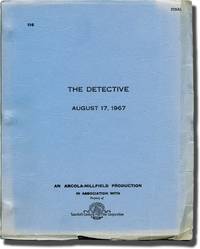
1967réf. 129268Los Angeles: Twentieth Century-Fox 1967. Final Draft script for the 1968 film. Based on the 1966 novel by Roderick Thorp about a brooding detective who becomes embroiled in a case that uncovers a deep vein of police corruption within the department. Frank Sinatra's fourth collaboration with director Gordon Douglas a box office success. One of the first mainstream Hollywood films to include explicit depictions of the lives of gay men including the violence suffered by the gay community due to the indifference of the police. In 1979 Thorp wrote a sequel to "The Detective" entitled "Nothing Lasts Forever" adapted in 1988 as "Die Hard." Although Sinatra had contractual rights to star in the sequel he wisely turned it down due to his age and action movie history-and Bruce Willis' career-were made. Set in New York and shot on location in New York and in California. Light blue titled wrappers noted as Final and production No. 116 on the front wrapper dated August 17 1967. Title page present dated August 17 1967 noted as Final with credits for screenwriter Abby Mann and writer Roderick Thorp. 161 leaves with last page of text numbered 160. Mimeograph duplication rectos only. Pages Fine wrapper Near Fine internally bound with three gold brads. Twentieth Century-Fox unknown
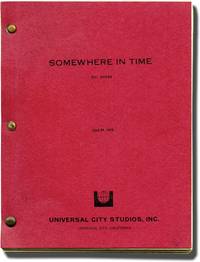
1979réf. 138668Universal City CA: Universal Pictures 1979. Final Draft script for the 1980 film. A blend of science fiction and romance that has over time become a beloved classic. Christopher Reeve portrays a melancholy playwright who becomes fascinated with the woman in a portrait hanging in a hotel and uses self-hypnosis to transport himself to her time. Nominated for an Academy Award. Nominated for an Academy Award. Red titled wrappers noted as production No. 00590 dated April 24 1979. Title page present noted as Final Draft with credit for screenwriter Matheson. 146 leaves mimeograph duplication. Pages Near Fine wrapper Near Fine bound with two gold brads. Universal Pictures unknown
1955réf. 15219London London: Rank Organisation 1955. 1955. Eight original borderless press photographs for the seminal 1955 Ealing Comedy. All eight with British press stamps and typed layout slips to the verso. The curtain call of the famous "Ealing Comedies" the Ladykillers was the last major masterpiece produced by the iconic Ealing Studios before the studio was sold to the BBC. Darkly macabre the film was deeply subversive at the time and satirised Britain's inability to move beyond its Empire past. William Rose famously purportedly dreamt the whole film and simply sat down wrote out the script from memory. London, London: Rank Organisation, 1955. unknown
réf. DADAX0367151588New unknown
1951réf. 059095Hollywood: House-Warven Publishers 1951. First Edition 1st Printing. Brown Cloth. Very Good/Good Dustjacket. 57 Illustrations By the Author. 360 Pp. Brown Cloth Gilt. Brown Endpapers. First Printing With 1951 Date On Title Page .Near Fine A Clean Solid Book Small Rubs At Corners. Dust Jacket Priced $5.50Some Wear At Edges With Small Losses And Lower 2 1/2' Of Spine Entirely Chipped Away. Inscribed By Author To Screenwriter Albert De Pina. Bookplate Of Southwest Museum Archaelogist Bruce Bryan House-Warven, Publishers hardcover
1978réf. 151234Burbank CA: Warner Brothers 1978. Vintage borderless studio still photograph of director Ulu Grosbard and actor Dustin Hoffman on location for the 1978 film. Based on Edward Bunker's 1972 novel about a recently paroled ex-con who struggles to adapt to the outside world written during Bunker's own time in prison in San Quentin. A masterful neo-noir and one of actor Dustin Hoffman's most underrated performances. Film debuts of both Gary Busey and Theresa Russell. Shot on location in California. 7.5 x 9.75 inches. Near Fine faintly toned. Grant US. Spicer US Neo-Noir. Warner Brothers unknown
1931réf. 1738Berlin: Nero-Film AG 1931. First Edition. Original Austrian premiere program for Fritz Lang's 1931 German film customized for the film's premiere at the Apollo Theater in Vienna - Lang's birthplace and home for the earlier part of his life. A highly influential pre-war film noir and masterpiece of world cinema ranking among the best of Lang's body of work. In addition to being Lang's first sound film 'M' also served as the vehicle for Peter Lorre's breakout role as child murderer Hans Beckert. The program is chiefly illustrated throughout with a series of photo-montages and gives the date of the premiere as 3 September 1931. A rare premiere program for one of Lang's most enduring films. Small folio 22.5cm; green and white photo-illustrated wrappers folded with the premiere information printed in red on front wrapper; 8pp; illus. Faint horizontal fold at center faint diagonal crease to upper right corner of front wrapper with a chip to lower left corner of rear wrapper and a few tiny tears; Very Good. Nero-Film AG unknown
réf. DADAX1933149051New unknown
1972réf. 171323Aurora: CVD Studios 1972. Final script for the 1973 Western comedy film. Working copy belonging to actor Lee Meriwether with her first name in manuscript ink to the top right corner of the front wrapper and her annotations on several script leaves marking dialogue. With three leaves relating to credits laid into the front of the script and a hand-drawn get-well card laid into the script's rear. Lee Meriwether is best remembered today for her performance as Catwoman in "Batman: The Movie" 1966 and for her recurring performance as Betty Jones in the 1970s crime television series "Barnaby Jones." She also made significant appearances in nearly 200 television series notably "Dr. Kildare" 1965 "The Time Tunnel" 1967 "Star Trek" 1969 and "Mission: Impossible" 1970. She also appeared in nearly three dozen feature films including "Angel in My Pocket" 1969 and "The Undefeated" 1969. Two brothers ride into a Colorado mining town searching for a quick buck only to discover the mines rich in molybdenum. Lee Meriwether is best remembered today for her performance as Catwoman in "Batman: The Movie" 1966 and for her recurring performance as Betty Jones in the 1970s crime television series "Barnaby Jones." Shot on location in Cañon City Colorado. Generic blue CVD Studios wrappers. Title page present noted as Final dated September 21 1972 with credit for screenwriter Marion Hargrove. 127 leaves with last page of text numbered 126. Mimeograph duplication rectos only with blue revision pages throughout dated September 29 1972. Pages Very Good plus wrapper Very Good plus bound with two gold brads. CVD Studios unknown
1973réf. 170446Beverly Hills CA: Metro-Goldwyn-Mayer MGM 1973. Collection of 18 vintage reference photographs from the 1975 film including 17 bordered photographs and one borderless double weight photograph. Eight with mimeo snipes on the verso. A very nearly experimental Western made by Sam Peckinpah at his peak sufficiently strange to have remained of interest only to the most intense fans of Western revisionism. Comparable only to "McCabe and Mrs. Miller" 1971 and "The Shooting" 1966 in terms of sheer impressionism being laid upon the genre with iconic imagery and super-stylization in every frame. Shot on location in Durango Mexico. 10 x 8 inches. Generally Very Good plus or better. Metro-Goldwyn-Mayer [MGM] unknown