3,277 results
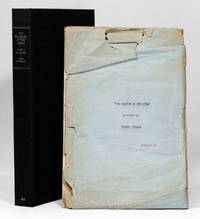
1935ref. 124528Beverly Hills CA: Metro-Goldwyn-Mayer MGM 1935. Dashiell Hammett's original submitted Treatment script for the first sequel to "The Thin Man" here referred to only as "Thin Man Sequel" and ultimately titled "After the Thin Man." With a single manuscript correction by Hammett and letter of provenance from Hammett's daughter Josephine Hammett Marshall regarding the discovery of the treatment in the family's estate. The first "Thin Man" film released in 1934 and based on Hammett's novel was a smash hit and is today a key film in the American screwball comedy cycle. Five sequels were made between 1936 and 1947 all starring the original acting team of William Powell and Myrna Loy and this previously unknown attempt at a sequel by Hammett was clearly commissioned by MGM but never produced making this script an entire unpublished Hammett work. The story is a completely original one never reworked for the other films very much written in Hammett's trademark style and reading a bit more like a story treatment i.e. a novel than a final screenplay which is likely as far as the story got on the road to production. The piece is dated Sept. 17 1935 at the lower right corner of the front panel along with Hammett's name and Hammett's name is noted in pencil next to the title label though not in Hammett's hand. There is only one single-word correction to the entire text at page 83 in Hammett's hand where the word "compact" is replaced with "cigarette case." Accompanying the screenplay is a typed letter signed from Hammett's daughter who edited a recently published collection of Hammett's letters on her personal stationery stating that the screenplay was discovered by Hammett's wife in 1980 and that it had been a part of the family's estate until that time. Probably one of only 2-3 copies that could have been produced and very possibly the only copy extant. To our knowledge no other copy of this story in any form has ever been recorded at auction or sold on the market. Light blue titled wrappers with the white MGM studio label present manuscript pencil notation of Hammett's name secretarial rubber-stamped COMPLETE dated September 17 1935 with a single credit for Hammett. 115 leaves mimeograph duplication. Pages and wrapper Very Good plus bound with two gold brads. In a custom clamshell box. Full pagination available upon request. Metro-Goldwyn-Mayer [MGM] unknown
1925ref. 3105California: Universal Pictures 1925. First edition. original wrappers. Good. AN EARLY WORKING DRAFT OF THE 1925 PHANTOM OF THE OPERA PRESERVING THE DARKER SCENARIO UNIVERSAL WROTE BEFORE ITS FRONT OFFICE ORDERED THE TERROR TONED DOWN AND INCLUDING AN ORIGIN STORY FOR THE PHANTOM THAT NEVER REACHED THE SCREEN. Lon Chaney's unmasking in The Phantom of the Opera remains one of the most famous moments in film history. The picture that audiences finally saw in 1925 though came out of a long and difficult production shaped by poorly received previews reshoots and repeated re-editing. Its story begins with Universal staff writer Elliott J. Clawson's adaptation of Gaston Leroux's 1910 novel. The present typescript records his scenario at an early stage before the studio's successive revisions reshaped it. THE PHANTOM'S LOST ORIGIN STORY: The most striking feature of the draft is a lengthy origin episode absent from every filmed version of the story. In it a Sultan condemns the Phantom to die on an anthill and the Persian who becomes his lifelong associate rescues him. Leroux's novel only alludes to its Phantom's past in Persia where a police official spared him from the Shah's death sentence. Clawson turned that background into a full dramatic sequence. The episode though was abandoned before filming began. Philip J. Riley mentions it in his narrative account of the production The Making of the Phantom of the Opera 1999 but the present manuscript preserves it as Clawson actually wrote it. Riley records that by the fifth revised shooting script most of the genuinely frightening scenes like the anthill death scene had been removed because the front office feared the original material would drive audiences out of the theater. RELATIONSHIP TO THE KNOWN RECORD: Riley's study draws on two principal script documents: an early Clawson draft which he quotes in places and the fifth revised shooting script which he reproduces in full. The present manuscript shares the general scope and character of the early draft yet it differs in both scene numbering and the wording of specific directions. At the bedchamber scene Riley's source is numbered 286; here the same scene is numbered 289. The three-scene offset indicates that this manuscript contains material Riley's source lacks at that point suggesting either an earlier compositional layer or a fuller parallel version. Riley does not say where his early draft is held so the relationship between the two documents remains open. Our comparison is limited to the passages Riley chose to quote and a full collation may well reveal further differences. THE ANNOTATIONS: Pencil annotations appear intermittently throughout. They are pointed and analytical raising questions of continuity pacing and plot logic. One asks how Christine could communicate with Raoul while held captive and another asks why certain developments do not occur earlier in a sequence. They suggest close review by a reader with editorial authority over the script. Note: Although the draft breaks off during the climactic rescue attempt by Raoul and Ledoux and does not include the full text as we've come to know the story the draft appears complete as it originally existed. There is no sign of removed pages - in fact the last page with type seems to be on a different stock and serves also as the rear wrapper - which is consistent with an unfinished working draft rather than later loss. RARITY: Universal silent-era screenplays rarely survive. Scripts were typed in small numbers on unstable pulp paper and much of the studio's early paper record was later discarded. This draft documents The Phantom of the Opera before commercial pressure and successive rewrites displaced Clawson's original conception. It preserves a version of the film that Universal chose not to make. Typescript working draft. Universal City California: Universal Pictures ca. 1925. More than 200 pages typed on 8.5 x 13 inch legal-size pulp stock; original blue wrapper; pale toned rear wrapper. Pencil annotations throughout. Front wrapper present but detached; leaves brittle with edge chipping creases foxing marginal staining and small losses as is typical of Universal scripts of the period. Housed in custom archival presentation box. Universal Pictures unknown