7,440 results
1962ref. 135663Universal City CA: Universal Pictures 1962. Original Pacific Title hand painted artwork for the original trailer advertising the classic 1962 film. In the final trailer Gregory Peck's name as the lead actor preceded this card making this a slightly alternate draft of the design. 14 x 20 inches. White gouache on stiff black illustration board. Very Good plus overall with mounting pinholes at the corners and brief tape remnants on edges. Minor edge bumping and creasing on the lower edge not affecting the artwork. Universal Pictures unknown books
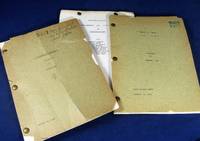
1940ref. 131332Los Angeles: Self published 1940. First Draft script for an unproduced film titled "And Now Goodbye" an adaptation of his 1931 novel. Included are three typed letters signed by Hilton. Each letter is from Hilton to producer Lester Cowan on Warner Bros. Columbia Pictures and RKO Radio Pictures letterhead dated October 24 1939 May 14 1940 and May 22 1940 respectively. In the letters Hilton discusses his negotiations with Laurence Olivier about the project having lunch with Mrs. Hitchcock and giving her the script hoping she'd impress her husband with it how the war has affected show business his book writing and his transfer from Columbia to RKO. Hilton began writing the script 15 days after the release of "Lights Out in Europe" a short war documentary he wrote commentary for six months before the release of Hitchcock's "Foreign Correspondent" with dialogue from Hilton. Set in and around the dilapidated fictional town of Browdley. Blue titled wrappers noted as First Draft on the front wrapper dated April 29 1940 with credits for screenwriter Hamilton. Title page present dated April 29 1940 noted as FIRST DRAFT with credits for screenwriter Hamilton. 128 leaves carbon typescript on onionskin stock. Pages Good plus wrapper Poor now encapsulated in archival mylar bound with two gold brads. Self published unknown books
1965ref. 135614Neuilly-sur-Seine France: Societe Nouvelle de Cinematographie SNC 1965. Vintage oversize double weight photograph of director Jean-Luc Godard behind the camera on the set of the 1965 film. Shot by photographer Georges Dudognon in the summer of 1965 with his stamp on the verso. In a custom museum-quality frame archivally mounted with UV glass. 9 x 12 inches. Near Fine. Criterion Collection 421. Godard Histoires de cinema. Societe Nouvelle de Cinematographie [SNC] unknown books
1969ref. 141375New York: Two Faces / New Yorker Films 1969. Vintage poster for the 1969 film an experimental mix of documentary and fiction. Poster designed by Robert Frank. Director Robert Frank's first feature film in which he follows poet Peter Orlvosky and his mentally ill brother Julius as they move through the late 1960s Beat scene while Peter tries to care for his mostly catatonic brother. When Julius wanders off he is replaced in the film by actor Joseph Chaikin. The film examines the boundaries of reality and sanity and features the screenwriting debut of Sam Shepard and the first feature film appearance of Christopher Walken. The film was restored and released by Steidl in 2007 along with a book publication outlining the film. From the Steidl book: "Frank's feature debut was first screened in 1968 at the Venice Film Festival. Everything which had defined Frank's art up to that point turns up in this film - the look at America 'from the outside' the poetic libertinage of the Beats the marginal in a central role. It celebrates the return of the poetic essay as assemblage the affirmation of the underground as a wild cinematic analysis in the form of a collage and skillfully weaves together opposites plays counterfeits against the authentic pornography against poetry acting against being Beat cynicism against hippie romanticism monochrome against colored. The story contains bizarre twists and turns and appears to be a rather artless-film-within-a-film being shown at a rundown movie theater." 26.75 x 20.75 inches. Near Fine. Two Faces / New Yorker Films unknown books
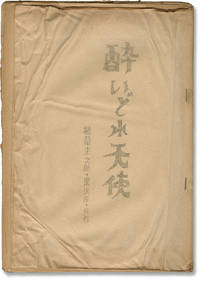
1959ref. 141457Tokyo: Nikkatsu 1959. Draft script for the 1959 film. Text in Japanese. With a single notation in holograph pencil. Small-time deliquent criminals greatly enjoy robbing other people but fall into big trouble when they accidentally rob the Yakuza. Brown titled perfect bound wrappers. Title page present. 84 leaves with last page of text numbered 18. Mechanical duplication. Pages Near Fine wrapper Near Fine. Nikkatsu unknown books
1959ref. 141461Tokyo: Nikkatsu 1959. Draft script for the 1959 film. Text in Japanese. Based on Sueko Yasumoto's novel and one of the first examples of media dealing with the plight of zainchi or ethnically Korean Japanese citizens and their identity and struggles. One man has always worked faithfully for the Toho Company and another man is working for an underworld boss trying to scam Toho. They find each other again when one begins trailing and investigating the other. White titled perfect bound wrappers. Title page present. 177 leaves with last page of text numbered 16. Mechanical duplication. Pages Very Good plus wrapper Very Good plus bound with two staples. Nikkatsu unknown books
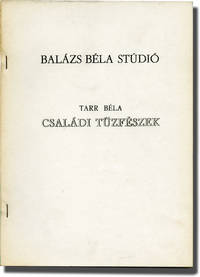
ref. 145506Budapest: Balsz Bela Studio 1977. Vintage post-production promotional script for the 1977 Hungarian film. Includes a prose narrative describing the film story reviews quotes and critical essays. Text in Hungarian. Easily the most rigidly philosophical promotional script ever issued with the narrative portion being essentially one long run-on sentence wherein Tarr describes his intentions for his first film. It would be 30 years before the rest of the world caught on to his genius and he would retire just 10 years after that. He passed away in 2026 at the age of 70. Off-white titled card wrappers saddle stapled. Title page present followed by a cast and credits list dated 1977. 56 leaves with last page of text numbered 54. Mimeograph front wrapper printed with offset duplication. Rectos only. Pages and wrapper about Near Fine with light toning at the edges of the wrappers. Balsz Bela Studio unknown
1924ref. 141664Berlin: Film-Kurier 1924. Vintage German programs for the two-part film series "Die Nibelungen" including one for "Die Nibelungen: Siegfried" and one for "Die Nibelungen: Kriemhild's Revenge" produced by German film magazine "Film-Kurier." Text in German. Based on the thirteenth century epic poem "Nibelungenlied." "Film-Kurier" was the first German film journal published daily beginning in 1919. The journal's classic era lasted until 1933 when its publisher Alfred Weiner had to flee Germany due to his Jewish origins. The issues from this era remain striking to this day because they were printed using a gravure reproduction process. Each day's issue would focus on a single film. 9 x 11.75 inches. Each program six pages folded loose leaves as issued. Very Good plus with a horizontal fold tiny pinholes to the corners and an occasional short closed tear. Masters of Cinema 46. Film-Kurier unknown
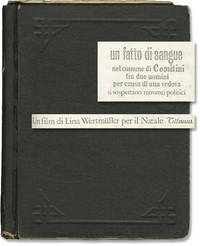
ref. 148341London: Lord Grade 1978. Draft script for the 1978 film here under the working title "Titoli di Testa." Copy belonging to script supervisor Franca Invernizzi with her extensive manuscript annotations on nearly every page and many page versos regarding camera shots takes timing and dialogue. Bound in after the script is an annotated list of scenes and several handwritten pages of Invernizzi's notes. Text in Italian. In 1920s Sicily a capitalist and a socialist vie for the affections of a grief-stricken woman whose husband was killed by a fascist mafioso. The follow-up to director Lina Wertmuller's Oscar-nominated 1976 film "Seven Beauties" and a lyrical formidable film in its own right. Set and shot on location in Sicily. Script: Black faux-leather untitled wrappers. Title page present with credits for director Lina Wertmuller. 326 leaves with last page of text numbered 301. Xerographic duplication rectos only with white undated revision pages throughout. Pages Very Good with some revision pages lightly worn and toned to the edges wrapper Very Good lightly edgeworn with several tape repairs to the spine with perfect binding. List of scenes: 10 leaves with last page numbered 10. Xerographic duplication rectos only. Pages Very Good plus with light edgewear. Lord Grade unknown
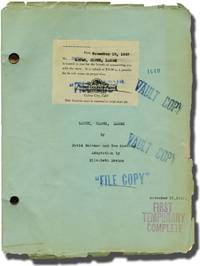
1927ref. 134524Beverly Hills CA: Metro-Goldwyn-Mayer MGM 1927. Shooting script for the 1928 film. Metro-Goldwyn-Mayer file copy with rubber stamps on the front wrapper indicating such. Carbon typescript with descriptive text and intertitles in black type. A few typeovers and annotations in manuscript pencil throughout. A rare example of a silent film screenplay. Based on the 1923 stage adaptation by David Belasco and Tom Cushing about professional clowns Tito Chaney and Simon Siegel who take in an abandoned child and name her Simonetta Young who was 15 at the time. When Simonetta is older she joins the circus and meets Count Luigi Ravelli Asther who becomes infatuated with her. Ravelli consults a doctor about his fits of uncontrollable laughter and there he meets Tito who has come to seek help for his fits of uncontrollable weeping. The two decide to help each other but soon find they are both vying for Simonetta's love. Nominated for an Academy Award in 1929 for Best Title Writing the only year for that category. Set in Italy shot on location in Elysian Park a suburb of Los Angeles California. Blue studio wrappers noted as FIRST TEMPORARY INCOMPLETE on the front wrapper rubber-stamped production No. 1640 and copy No. 5236 dated November 19 1927 with credits for playwrights Belasco and Cushing and screenwriter Meehan. 72 leaves carbon typescript on watermarked onionskin stock. Pages Near Fine wrapper Very Good now encapsulated in mylar bound with two gold brads. Blake 2001 US. Metro-Goldwyn-Mayer [MGM] unknown
1960ref. 143342Tokyo: Toho Company 1960. Draft script for the 1960 film. With the stamp of cast/crew member Takahashi Toshihiro to the page edges and manuscript ink annotations to the rear wrapper. Text and titles in Japanese. A film that bought depictions of modern life into Japanese films of the 1960s particularly with respect to the idea of the independent woman. A young widowed bar hostess finds herself torn between a conventional life and potential financial independence when she must decide to either remarry or open her own bar. Set in Tokyo's Ginza district shot on location in Tokyo. White titled wrappers noted as 2 on the front wrapper. Title page present. 94 leaves with last page of text numbered f-31. Mimeograph duplication printed on rectos and versos. Pages Near Fine wrapper Good with foxing wear to the binding and light soil overall. With perfect binding. BFI 694. Criterion Collection 377. Toho Company unknown
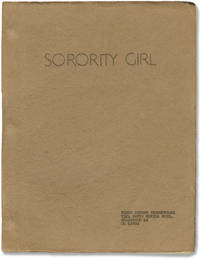
1957ref. 154176Hollywood: Roger Corman Productions 1957. Draft script for the 1957 film. Copy belonging to actor Dick Miller who had a sizable role in the film with his name to the title page and his manuscript pencil and ink annotations throughout. The finished film runs a little over an hour so the script at 127 pages was cut down substantially in the filming and editing process leaving a remarkable amount of content for study. An alienated wealthy coed at an all-girls boarding school inflicts increasing cruelties on the other students until her manipulation goes too far. An early role for Miller who appeared in 14 films directed by legendary independent filmmaker Roger Corman between 1955 and 1961 and would continue to work with Corman throughout his career. Brown titled wrappers. Title page present undated with credits for screenwriter Ed Waters. 128 leaves with last page of text numbered 127. Mimeograph duplication rectos only. Pages and wrapper Near Fine bound internally with three silver brads. Roger Corman Productions unknown
1958ref. 141439Tokyo: Nikkatsu 1958. Draft script for the 1958 film. Text in Japanese. The first film to be credited to Suzuki by his assumed name a man released from prison needs money and goes to retrieve diamonds sought after by fellow yakuza members. White titled perfect-bound wrappers. Title page present. 107 leaves with last page of text numbered 12. Mechanical duplication. Pages Very Good plus wrapper Very Good plus. Nikkatsu unknown
1958ref. 141434Tokyo: Nikkatsu 1958. Draft script for the 1958 film. Text in Japanese. Based on a novel by Shinju Fujiwara. Five people assemble ten years after the end of the Pacific War at a military station to uncover a stash of morphine worth a fortune now whcih was buried by the medical officer Mashimoto at the abdication of the Emperor. One of members of the group does not belong there. Orange titled perfect-bound wrappers. Title page present. 131 leaves with last page of text numbered 46. Mechanical duplication. Pages Near Fine wrapper Near Fine bound with two gold brads. Nikkatsu unknown
1958ref. 141432Tokyo: Nikkatsu 1958. Draft script for the 1958 film. Text in Japanese. Title based on a song popularized by the leading actor Frank Nagai. A comedy featuring a drugstore owner who begins an extramarital affair when his wife and child go on vacation. White illustrated titled perfect-bound wrappers. Title page present. 95 leaves with last page of text numbered 18. Mechanical duplication. Pages Near Fine wrapper Near Fine. Nikkatsu unknown
1956ref. 141458Tokyo: Nikkatsu 1956. Draft script for the 1956 film. Text in Japanese. A yakuza boss and his right hand man escape from prison and examine their relationship both matters of loyalty and betrayal as well as the scams and crimes they pull in their criminal history. White titled perfect bound wrappers. Title page present. 41 leaves with last page of text numbered 37. Mechanical duplication. Pages Near Fine wrapper Near Fine. Nikkatsu unknown books
1966ref. 141426Tokyo: Nikkatsu 1966. Draft script for the 1966 film. Text in Japanese. Based on a novel by Takashi Suzuki a repressed Catholic young man living in a boardinghouse is infatuated with the landlady's daughter and when he cannot express his feelings he turns to violence. He joins a gang and begins a fighting routine exploiting the weakness of classmates. Set in Okayama shot on location in Japan. Red titled perfect bound wrappers. Title page present. 113 leaves with last page of text numbered 19. Mechanical duplication. Pages Near Fine wrapper Near Fine. Criterion Collection 269. Nikkatsu unknown books
1969ref. 143218Tokyo: Gendai Eigasha 1969. Draft script for the 1969 film. Front wrapper notes a date of 1969 and credit as a Gendai Eigasha production. The second page is a elegaic introduction to the film story: "On the erotology and insurrection of sugi Sakae who wrote of dancing as flowers strangled and left in spring and It Noe who lived her entire life in confused beauty-we the youth and you and I in our degenerate joy which reaches an unbalanced complicity are talking." Based on the life of anarchist Sakae sugi and his relationship with three women.It is the first film in Yoshida's trilogy of Japanese radicalism followed by "Heroic Purgatory" 1970 and "Coup d'Etat" 1973. Considered to be one of the most representative films from the Japanese New Wave movement. Set in and shot on location in Japan. White titled wrappers dated 1969. Title page present. 86 leaves with last page of text numbered d-44. Mechanical duplication. Pages Near Fine wrapper Very Good plus with mild foxing on rear wrapper title on spine. Gendai Eigasha unknown books
ref. 021032Graham Greene (1904-1991), écrivain, scénariste. L.A.S., Antibes, 17 octobre [années 70?], 1p 1/2 in-8. A son éditeur Robert Laffont (1916-2010), mentionnant ses traducteurs Georges Belmont (1909-2008) et Hortense Chabrier, les difficultés à les contacter par téléphone et une affaire pour laquelle il réfléchit (probablement la traduction d'une de ses oeuvres). « My dear Robert, Thank you very much for your letter & the enclosures. Please believe that nothing has been decided on my part & you must give me time for reflexion. Our friendship (even in absence) has been longer than my friendship with Georges & I hope I proved it in the affair of Julliard long ago. If only friendship were not mixed up with business. It's not only Marie who perhaps has misunderstood things, but I have found it on the telephone impossible to make contact with you - "unable tu speak" "in conference". It's true that the telephonist or secretary is inclined to say that no one is available - "Mme Chabrier is not in" when later one learns that she has been in all the time. I have had the impression of an office which cannot be bothered with a writer. Please leave me a little time to think. I am off to Switzerland on Monday, then I am tied up for the first week of November, but perhaps after that we can meet in Paris. Nothing in the meanwhile can happen or will happen. With affection. Graham » [515]
1960ref. 141447Tokyo: Shockiku Ofuna 1960. Draft script for the 1960 film. Text in Japanese. A young woman is hitchhiking when the driver who picks her up attempts to molest her. A young gangster comes to her aid and then leads her on a wild relationship through the Japanese underground towards the eventual destruction of both of them. White titled perfect bound wrappers. Title page present. 40 leaves with last page of text numbered 40. Mechanical duplication. Pages Near Fine wrapper Near Fine bound with two staples. Godard Histoires du cinema. Shockiku Ofuna unknown books
1948ref. 151633Tokyo: Toho Company 1948. Draft script for the 1948 Japanese film. Text and titles in Japanese. The first of sixteen film collaborations between director Akira Kurosawa and actor Toshiro Mifune. Kurosawa's seventh film saw him exploring the inter workings and motivations of the yakuza and machismo. Censorship was tight regarding the occupation forbidding American criticism leading Kurosawa to slip in references to the US presence in Japan satirizing jazz "pan pan" girls unlicensed prostitutes catering to American soldiers and Western clothing and hairstyles. Set in the slums of postwar Japan. White titled wrappers. Approximately 40 leaves with last page of text numbered 79. Mimeograph duplication printed on rectos and versos. Pages Very Good plus wrapper Very Good plus covered in a protective plastic wrapping from when the script was used during filming side stapled. BFI 638. Criterion Collection 413. Grant Japan. Toho Company unknown books
1946ref. 003013Los Angeles: Universal Studios 1946. Doyle A. Conan. DRESSED TO KILL here bearing the initial later discarded title "Prelude To Murder". Los Angeles: Universal Studios 1946. This unique film studio screenplay archive consists of THREE original screenplays. 1. A "First Revised Draft" dated January 3rd 1946 the screenwriter's original carbon copy typescript unannotated consisting of 94pp of onion-skin paper. Brad-bound in original drab brown Universal Studios covers which are a little brittle and chipped else Very Good bearing the stamped production number 7337. 2. Complete 78pp brad-bound shooting script consisting of a mix of original ribbon-copy typescript and studio-mimeographed white pages dated January 16th 1946 with production number 7337 stamped on the cover. This remarkable writer's draft contains extensive author-revised annotations emendations revisions and additions throughout. This is accomplished via a cut-and-paste the insertion of additional leaves and new dialogue and description scrawled on the versos an exceptional artifact which boldly captures the revision process of this last entry in the Sherlock Holmes' Universal Studios film series. The front cover has been neatly reinforced with tape and bears the original penciled filing notation indicating that this particular script is the copy from which the final draft was produced. 3. Dated April 25th 1946 the complete original studio-mimeographed self-wrapper final post-production dialogue continuity script bound with two brads at the top. In Very Good condition. The title DRESSED TO KILL refers to the film's wily femme fatale Hilda Courtney played by Patricia Morison an homage to Irene Adler from "A Scandal In Bohemia" complete with a familiar misdirection trick which Hilda uses to fool Watson into revealing a hidden location. The plot is an amalgam of several Holmes stories but also draws from other plots in the Universal Sherlock film canon: a convicted thief in Dartmoor Prison hides stolen Bank of England printing plates inside three music boxes -- leading to the murder or attempted murder of their owners using the central device of a secret code which of course only Holmes can brilliantly break. Starring Basil Rathbone and Nigel Bruce in their final film together DRESSED TO KILL opened on June 7th 1946 to excellent reviews but also to rumors that it was to be the last of the Universal Sherlock films; by October of that year Producer Roy William Neill truly the visionary of the film series died and that signaled the end of one of the most successful franchises in Universal Studios history. Unique. Please see the other Universal Sherlock scripts we have in stock. Signed. Original Wraps. Very Good. Script. Universal Studios Paperback books
1981ref. 143723Los Angeles: CBS Television Network 1981. Wardrobe breakdown pages and shooting schedule for the 1981 television film which originally aired on October 24 1981 on CBS. Archive belonging to an unknown crew member in the wardrobe department with holograph annotations on every page and 94 Polaroid photographs tipped onto pages throughout. A cult classic. Charles "Bubba" Ritter Larry Drake is wrongfully accused of attacking young Marylee Williams Tonya Crowe. He is murdered by a group of vigilantes while disguised as a scarecrow. The killers are tracked down and terrorized by a mysterious scarecrow after Bubba's innocence is revealed. Set in the American South. Shot on location in California. 100 leaves xerographically duplicated without wrappers as issued. Pages and photographs Very Good bound with two gold brads. CBS Television Network unknown books
1924ref. 141664Berlin: Film-Kurier 1924. Original German programs for duology "Die Nibelungen" one each for "Die Nibelungen: Siegfried" and "Die Nibelungen: Kriemhild's Revenge." Based on the thirteenth century epic poem "Nibelungenlied." Text in German. Film-Kurier was the first German film journal published daily beginning in 1919. Film-Kurier's classic era lasted until 1933 when its publisher Alfred Weiner had to flee Germany because of his Jewish origins. The issues from this era remain striking to this day because they were printed using a gravure reproduction process. Each day's issue would focus on a single film. 9 x 11.75 inches. Each program six pages folded loose leaves as issued. Very Good plus with a horizontal fold tiny pinholes to the corners and an occasional short closed tear. Masters of Cinema 46. Film-Kurier unknown books
1927ref. 134522Beverly Hills CA: Metro-Goldwyn-Mayer MGM 1927. Shooting script for the 1928 film. Original typescript with descriptive text in black type and intertitles in red type. Holograph ink and pencil annotations on the front wrapper noting starring performers draft type and crediting screenwriter Meehan. With a few annotations in holograph pencil throughout. Based on the 1923 Broadway play by David Belasco and Tom Cushing in turn an adaptation of the 1919 story "Ridi Pagliaccio" by Fausto Martini about two clowns who find an abandoned child. Years later one of the clowns falls in love with her and knowing that they can never be together performs a deadly stunt without safety protections. A partially lost film including an alternative happy ending. Nominated for an Academy Award in 1929 for Best Title Writing the only year for that category. Set in Italy shot on location in Elysian Park a suburb of Los Angeles California. Blue studio wrappers noted as FIRST TEMPORARY INCOMPLETE and struck through with Final Draft inscribed on the front wrapper rubber-stamped copy No. 1640 and production No. 5272 dated Nov. 19 1927 with credits for playwrights Belasco and Cushing and in ink screenwriter Meehan. 73 unnumbered leaves typescript on watermarked onionskin stock. Pages Near Fine wrapper Very Good split at the spine now encapsulated in mylar bound with two gold brads. Metro-Goldwyn-Mayer [MGM] unknown books