10,264 results
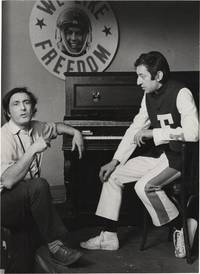
1968ref. 168093N.p.: N.p. 1968. Vintage oversize borderless reference photograph taken on the set of the 1968 film showing director William Klein talking with Serge Gainsbourg who appears in a cameo in the film. Annotations in manuscript ink and pencil on the verso. A satire of superhero films and American imperialism following the adventures of the eponymous Mr. Freedom a beer-swilling white nationalist cop who moonlights as an anticommunist vigilante superhero. Klein's second film following "Who Are You Polly Maggoo" 1966. 7.75 x 10.5 inches. Near Fine. Criterion Collection. Rosenbaum 1000. N.p. unknown
1968ref. 168093N.p.: N.p. 1968. Vintage oversize borderless reference photograph taken on the set of the 1968 film showing director William Klein talking with Serge Gainsbourg who appears in a cameo in the film. Annotations in manuscript ink and pencil on the verso. A satire of superhero films and American imperialism following the adventures of the eponymous Mr. Freedom a beer-swilling white nationalist cop who moonlights as an anticommunist vigilante superhero. Klein's second film following "Who Are You Polly Maggoo" 1966. 7.75 x 10.5 inches. Near Fine. Criterion Collection. Rosenbaum 1000. N.p. unknown books
1967ref. 152383N.p.: N.p. 1967. Collection of 21 vintage borderless double weight photographs from the 1967 film. Many with the stamp of still photographer Vincent Rossel on the verso one with the stamp of Globe Photos and one with a provenance stamp. Based on the 1897 novel by Georges Darien. After his inheritance is stolen by his uncle a young man embarks on a life of crime to win back what was taken from him. Set and shot on location in Paris. 10 x 8 inches. Near Fine. N.p. unknown
1967ref. 152383N.p.: N.p. 1967. Collection of 21 vintage borderless double weight photographs from the 1967 film. Many with the stamp of still photographer Vincent Rossel on the verso one with the stamp of Globe Photos and one with a provenance stamp. Based on the 1897 novel by Georges Darien. After his inheritance is stolen by his uncle a young man embarks on a life of crime to win back what was taken from him. Set and shot on location in Paris. 10 x 8 inches. Near Fine. N.p. unknown books
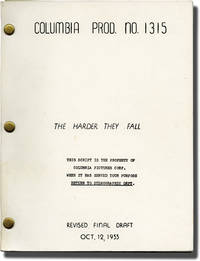
1955ref. 145319Culver City CA: Columbia Pictures 1955. Revised Final Draft script for the 1956 film with rainbow revisions. Released just two years after "On the Waterfront" 1954 the multi-award-winning collaboration between Elia Kazan and Budd Schulberg and based on Budd Schulberg's 1947 novel about a once respected sportswriter now forced to work for a crooked promoter who is taking advantage of a promising young fighter. Nominated for an Academy Award. Humphrey Bogart's final film. Shot on location in California Chicago and New York. White studio wrappers noted as REVISED FINAL DRAFT on the front wrapper production No. 1315 dated Oct. 12 1955. Title page present dated October 12 1955 noted as REVISED FINAL DRAFT with a credit for screenwriter Yordan. 160 leaves with last page of text numbered 141. Mimeograph on eye-rest green stock with yellow blue pink and eye-rest green revision pages throughout dated variously between 11/2/55 and 12/15/55. Pages and wrapper Near Fine bound with three gold brads. Grant US. Selby US. Silver Classic Noir. Spicer US. Columbia Pictures unknown
1955ref. 145319Culver City CA: Columbia Pictures 1955. Revised Final Draft script for the 1956 film with rainbow revisions. Released just two years after "On the Waterfront" 1954 the multi-award-winning collaboration between Elia Kazan and Budd Schulberg and based on Budd Schulberg's 1947 novel about a once respected sportswriter now forced to work for a crooked promoter who is taking advantage of a promising young fighter. Nominated for an Academy Award. Humphrey Bogart's final film. Shot on location in California Chicago and New York. White studio wrappers noted as REVISED FINAL DRAFT on the front wrapper production No. 1315 dated Oct. 12 1955. Title page present dated October 12 1955 noted as REVISED FINAL DRAFT with a credit for screenwriter Yordan. 160 leaves with last page of text numbered 141. Mimeograph on eye-rest green stock with yellow blue pink and eye-rest green revision pages throughout dated variously between 11/2/55 and 12/15/55. Pages and wrapper Near Fine bound with three gold brads. Grant US. Selby US. Silver Classic Noir. Spicer US. Columbia Pictures unknown books
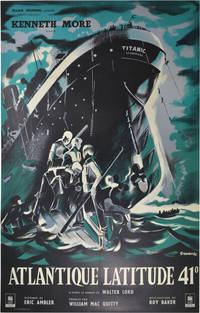
1958ref. 125081London: The Rank Organization 1958. Vintage French theatrical release poster for the seminal 1958 British docudrama "A Night to Remember" here under its French title "Atlantique Latitude 41 Degrees." Probably the most distinctive poster produced for the film. Novelist Ambler and director Baker set out to make a film that depicted the sinking of the Titanic as accurately as possible with no added fictional subplots. In addition to being massively entertaining the film is today held in high regard by "Titanic" historians compared to the more melodramatic and big-budget take by James Cameron in 1997. Director Baker noted in a 1991 interview "The whole purpose of making the film was to show a society that had persuaded itself that you could make a ship which could never to be sunk." 34 x 52 inches on archival linen Fine condition. Criterion Collection 7. McFarlane p. 51. The Rank Organization unknown
1958ref. 125081London: The Rank Organization 1958. Vintage French theatrical release poster for the seminal 1958 British docudrama "A Night to Remember" here under its French title "Atlantique Latitude 41 Degrees." Probably the most distinctive poster produced for the film. Novelist Ambler and director Baker set out to make a film that depicted the sinking of the Titanic as accurately as possible with no added fictional subplots. In addition to being massively entertaining the film is today held in high regard by "Titanic" historians compared to the more melodramatic and big-budget take by James Cameron in 1997. Director Baker noted in a 1991 interview "The whole purpose of making the film was to show a society that had persuaded itself that you could make a ship which could never to be sunk." 34 x 52 inches on archival linen Fine condition. Criterion Collection 7. McFarlane p. 51. The Rank Organization unknown books
ref. 133045Burbank CA: Walt Disney Pictures 1981. Revised script for the 1983 film. Written for the screen by Ray Bradbury based on his 1962 novel. After a carnival comes to Green Town the good citizens are compelled to follow their deepest desires caught under the spell of the malevolent Mr. Dark Jonathan Pryce who can grant those desires on one condition: that the grantees will forever join his freak show. In 1977 Bradbury sold the film rights to his novel to Paramount. He and director Jack Clayton whom Bradbury had previously worked with on Moby Dick produced a completed script. However production never began and the film was eventually put into turnaround. At the time Walt Disney Pictures was concentrating on films with more mature themes in an attempt to break free from their stereotype as an animation and family film studio. After the success of darker children's fantasy pictures by competing studios such as Time Bandits and The Dark Crystal Disney decided to purchase the adaptation's rights and hired Bradbury to produce a new script from scratch. .Set in Greentown Illinois but shot on location in Morrisville and Waterville Vermont. Gray titled wrappers noted as Revised on the front wrapper marked production No. 0233 dated 8/24/81 with credits for novelist and screenwriter Bradbury. Title page wit integral with the first page of the text dated 8/24/81. 127 leaves mechanical duplication with blue revision pages throughout dated 9/30/81. Pages about Fine wrapper Near Fine bound internally with three gold brads. Walt Disney Pictures unknown
ref. 133045Burbank CA: Walt Disney Pictures 1981. Revised script for the 1983 film. Written for the screen by Ray Bradbury based on his 1962 novel. After a carnival comes to Green Town the good citizens are compelled to follow their deepest desires caught under the spell of the malevolent Mr. Dark Jonathan Pryce who can grant those desires on one condition: that the grantees will forever join his freak show. In 1977 Bradbury sold the film rights to his novel to Paramount. He and director Jack Clayton whom Bradbury had previously worked with on Moby Dick produced a completed script. However production never began and the film was eventually put into turnaround. At the time Walt Disney Pictures was concentrating on films with more mature themes in an attempt to break free from their stereotype as an animation and family film studio. After the success of darker children's fantasy pictures by competing studios such as Time Bandits and The Dark Crystal Disney decided to purchase the adaptation's rights and hired Bradbury to produce a new script from scratch. .Set in Greentown Illinois but shot on location in Morrisville and Waterville Vermont. Gray titled wrappers noted as Revised on the front wrapper marked production No. 0233 dated 8/24/81 with credits for novelist and screenwriter Bradbury. Title page wit integral with the first page of the text dated 8/24/81. 127 leaves mechanical duplication with blue revision pages throughout dated 9/30/81. Pages about Fine wrapper Near Fine bound internally with three gold brads. Walt Disney Pictures unknown books
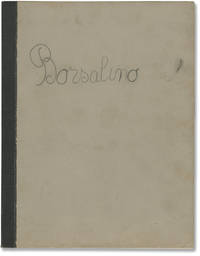
1969ref. 148989Paris: Adel Productions 1969. Draft script for the 1970 French film noir here under the working title "Marseille 1930." Text in French. Annotation on front wrapper of release title written large and boldly in cursive manuscript pencil with working title on title page. Erased annotations in manuscript pencil still visible on upper left of title page of names of actors "Alan Delon" and "Belmondo" with two other names illegible. A few annotations in manuscript pencil and ink on several pages circling characters or props and one noting the camera field of vision otherwise changes to scene numbers. Based on the 1959 history of Marseille gangsters "Bandits a Marseille" by Eugene Saccamano. Two small time gangsters Belmondo and Delon in 1930s Marseille join forces and go into business themselves vying for control against mob bosses. Director Jacques Deray released the sequel "Borsalino and Co" in 1974 starring Alain Delon and Riccardo Cucciolla. Set in and shot on location in Marseille and Paris. Gray untitled wrappers bound at the left in black cloth tape as issued. Title page present. Mimeograph duplication rectos only. Pages Near Fine with first two pages separating from binding near top wrapper with light soiling else Near Fine bound with binding tape. Grant France. Spicer France. Adel Productions unknown
1969ref. 148989Paris: Adel Productions 1969. Draft script for the 1970 French film noir here under the working title "Marseille 1930." Text in French. Annotation on front wrapper of release title written large and boldly in cursive manuscript pencil with working title on title page. Erased annotations in manuscript pencil still visible on upper left of title page of names of actors "Alan Delon" and "Belmondo" with two other names illegible. A few annotations in manuscript pencil and ink on several pages circling characters or props and one noting the camera field of vision otherwise changes to scene numbers. Based on the 1959 history of Marseille gangsters "Bandits a Marseille" by Eugene Saccamano. Two small time gangsters Belmondo and Delon in 1930s Marseille join forces and go into business themselves vying for control against mob bosses. Director Jacques Deray released the sequel "Borsalino and Co" in 1974 starring Alain Delon and Riccardo Cucciolla. Set in and shot on location in Marseille and Paris. Gray untitled wrappers bound at the left in black cloth tape as issued. Title page present. Mimeograph duplication rectos only. Pages Near Fine with first two pages separating from binding near top wrapper with light soiling else Near Fine bound with binding tape. Grant France. Spicer France. Adel Productions unknown books
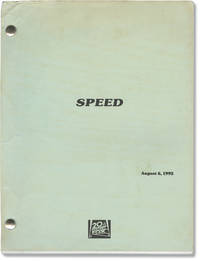
ref. 160843Los Angeles: Twentieth Century-Fox 1993. Revised Draft script for the 1994 film. Copy belonging to crew member Kevin E. Patterson credited as Cable Person with his name and signature in manuscript ink on the recto of the rear wrapper. One of the best action films of the 1990s launching the careers of both Sandra Bullock and Keanu Reeves. Director and screenwriter Joss Whedon went uncredited as the film's script doctor and screenwriter Graham Yost went on to create and write the acclaimed television series "Justified" 2010. Blue titled wrappers dated August 6 1993. Title page present dated August 6 1993 noted as Revised Draft with credits for screenwriter Graham Yost. 113 leaves with last page of text numbered 111. Xerographic duplication rectos only. Pages Near Fine wrapper Very Good plus bound with two silver brads. Twentieth Century-Fox unknown
ref. 160843Los Angeles: Twentieth Century-Fox 1993. Revised Draft script for the 1994 film. Copy belonging to crew member Kevin E. Patterson credited as Cable Person with his name and signature in manuscript ink on the recto of the rear wrapper. One of the best action films of the 1990s launching the careers of both Sandra Bullock and Keanu Reeves. Director and screenwriter Joss Whedon went uncredited as the film's script doctor and screenwriter Graham Yost went on to create and write the acclaimed television series "Justified" 2010. Blue titled wrappers dated August 6 1993. Title page present dated August 6 1993 noted as Revised Draft with credits for screenwriter Graham Yost. 113 leaves with last page of text numbered 111. Xerographic duplication rectos only. Pages Near Fine wrapper Very Good plus bound with two silver brads. Twentieth Century-Fox unknown books
1935ref. 146988Culver City CA: RKO Radio Pictures 1935. Two vintage oversize double weight photographs from the 1935 film. The second of two films based on Liam O'Flaherty's 1925 novel the first being Arthur Robison's 1929 British feature about a former Republic Army member during the Irish War of Independence who turns in one of his comrades to the British in order to use the bounty money to book passage to America for himself and his girlfriend who has been forced into prostitution. Winner of four Academy Awards including Best Adapted Screenplay Best Director and Best Actor for Victor McLaglen nominated for two others including Best Picture. Screenwriter Dudley Nichols became the first person to decline an Academy Award when his refused his Oscar due to an ongoing dispute between the Screen Writers Guild and the Academy though he would eventually claim it three years later. 11 x 14 inches with irregular margins. Near Fine. National Film Registry. RKO Radio Pictures unknown
1935ref. 146988Culver City CA: RKO Radio Pictures 1935. Two vintage oversize double weight photographs from the 1935 film. The second of two films based on Liam O'Flaherty's 1925 novel the first being Arthur Robison's 1929 British feature about a former Republic Army member during the Irish War of Independence who turns in one of his comrades to the British in order to use the bounty money to book passage to America for himself and his girlfriend who has been forced into prostitution. Winner of four Academy Awards including Best Adapted Screenplay Best Director and Best Actor for Victor McLaglen nominated for two others including Best Picture. Screenwriter Dudley Nichols became the first person to decline an Academy Award when his refused his Oscar due to an ongoing dispute between the Screen Writers Guild and the Academy though he would eventually claim it three years later. 11 x 14 inches with irregular margins. Near Fine. National Film Registry. RKO Radio Pictures unknown books
ref. 158711Beverly Hills CA: Metro-Goldwyn-Mayer MGM 1982. Small archive of material from the 1982 film including a Master Stencil Final Revised Draft screenplay with studio secretarial annotations throughout a press kit with eight studio still photographs and six gatherings of promotional material and a complete set of eight lobby cards. Based on John Steinbeck's novels "Cannery Row" 1945 and "Sweet Thursday" 1954. David S. Ward's directorial debut. In 1940s Monterey a self employed marine biologist and former baseball star befriends a drifter working at the local bordello. Set and shot on location in Monterey and San Diego California. Screenplay: Self wrappers. Title page present dated October 24 1980 noted as FINAL REVISED DRAFT with credits for screenwriter David S. Ward and novelist John Steinbeck. 140 leaves with last page of text numbered 136. Xerographic duplication rectos only with white revision pages throughout dated variously between 11/17/80 and 2/17/81. Pages Near Fine unbound. Lobby cards 14 x 11 inches. About Fine. Press folder photographs and promotional photographs Fine. Metro-Goldwyn-Mayer [MGM] unknown books
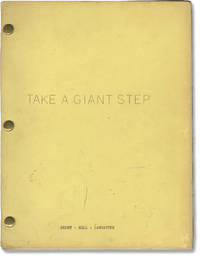
1958ref. 161198N.p.: N.p. 1958. Final Draft script for the 1959 film. Based on the first play on Broadway to have been written by an African American playwright about the challenges of a Black youth growing up in a predominantly white neighborhood. In 1991 "Jump Cut" magazine reassessed the play and subsequent screenplay calling it a pioneering work. Yellow titled wrappers with credits for production company Hecht-Hill-Lancaster along the bottom edge of the front wrapper. Title page present dated October 1 1958 noted as Final Draft with credits for screenwriters Julius Epstein and Louis Peterson. 119 leaves with last page of text numbered 108. Mimeograph duplication on eye-rest green stock pages dated variously between 10/1/58 and 10/2/58 rectos only with blue and eye-rest green revision pages throughout dated variously between 10/22/58 and 11/3/58. Pages Near Fine wrapper Near Fine bound with three gold brads. N.p. unknown
1958ref. 161198N.p.: N.p. 1958. Final Draft script for the 1959 film. Based on the first play on Broadway to have been written by an African American playwright about the challenges of a Black youth growing up in a predominantly white neighborhood. In 1991 "Jump Cut" magazine reassessed the play and subsequent screenplay calling it a pioneering work. Yellow titled wrappers with credits for production company Hecht-Hill-Lancaster along the bottom edge of the front wrapper. Title page present dated October 1 1958 noted as Final Draft with credits for screenwriters Julius Epstein and Louis Peterson. 119 leaves with last page of text numbered 108. Mimeograph duplication on eye-rest green stock pages dated variously between 10/1/58 and 10/2/58 rectos only with blue and eye-rest green revision pages throughout dated variously between 10/22/58 and 11/3/58. Pages Near Fine wrapper Near Fine bound with three gold brads. N.p. unknown books
ref. 131876Rome: C C. Champion 1972. Draft script for the 1972 film. Bound at the rear are an additional 11 pages that include a complete Cast List and Unit List. Filmed on location in Italy as "Che" the film also saw later release in the US as "Diary of Forbidden Dreams." A lesser known film in the director's oeuvre a comedic and highly sexualized homage to Alice in Wonderland starring Sydne Rome as an American hitchhiker who stumbles upon an increasingly bizarre and decadent party at an Italian villa. Blue wrappers as originally used. Title page present noted as copy No. 4 in pink manuscript ink with credits for screenwriters Brach and Polanski. 122 leaves mechanical duplication. Pages Near Fine wrapper Very Good bound internally with two gold brads. C C. Champion unknown
ref. 131876Rome: C C. Champion 1972. Draft script for the 1972 film. Bound at the rear are an additional 11 pages that include a complete Cast List and Unit List. Filmed on location in Italy as "Che" the film also saw later release in the US as "Diary of Forbidden Dreams." A lesser known film in the director's oeuvre a comedic and highly sexualized homage to Alice in Wonderland starring Sydne Rome as an American hitchhiker who stumbles upon an increasingly bizarre and decadent party at an Italian villa. Blue wrappers as originally used. Title page present noted as copy No. 4 in pink manuscript ink with credits for screenwriters Brach and Polanski. 122 leaves mechanical duplication. Pages Near Fine wrapper Very Good bound internally with two gold brads. C C. Champion unknown books
ref. 141462Tokyo: Imamura Productions 1980. Draft script for the 1981 film. Text in Japanese. A period drama featuring a man returning from exile in America during the Edo era and begins searching for his wife. He gets caught up in revolutionary fervor and his emotions get the best of him. Orange titled perfect-bound wrappers rubber stamped production number 133 dated 1980. Title page present. 201 leaves with last page of text numbered 192. Mechanical duplication. Pages Very Good plus wrapper Very Good plus. Imamura Productions unknown
ref. 141462Tokyo: Imamura Productions 1980. Draft script for the 1981 film. Text in Japanese. A period drama featuring a man returning from exile in America during the Edo era and begins searching for his wife. He gets caught up in revolutionary fervor and his emotions get the best of him. Orange titled perfect-bound wrappers rubber stamped production number 133 dated 1980. Title page present. 201 leaves with last page of text numbered 192. Mechanical duplication. Pages Very Good plus wrapper Very Good plus. Imamura Productions unknown books
1933ref. 138407Germany: Kinematrade 1933. Vintage US poster for the 1932 German communist propaganda film "Kuhle Wampe oder Wem gehort die Welt" The subtitle is seen here under the English translation "Whither Germany." Circa 1933 as identified by the name of the Philadelphia theatre on the poster. The last and arguably most important communist film of the Weimar era "Kuhle Wampe oder" is according to screenwriter Brecht a "Collective Presentation" that tells the tale of a family in early 1930s Berlin. After the son is prolongedly unemployed he commits suicide and the family is forced to relocate to a shantytown known as "Kuhle Wampe" or "Empty Stomach." Created under severely limited material conditions with filming constantly being broken up by the Weimar government's paramilitary SA agency the film attempts to depict archetypes of the times including an intellectual clash on a subway between members of the bourgeoisie and the proletariat. Banned first by the failing Weimar Republic and subsequently by the Nazi Reich the film was believed to have been lost until it reappeared over 20 years later in East Germany in 1958. This poster likely originates from screenings held in November 1933 by an unknown pro-communist organization in Philadelphia at the short-lived left-leaning Philkino theater. A US screening of this film dating before the film's disappearance and only just after the very beginnings of Hitler's rise to power makes this poster not only very scarce but one of significant historical value. The poster touting "Kuhle Wampe" as "The Film Hitler Burned" features an image of a man with a hammer and sickle attacking two snakes that form the Nazi swastika and touts the involvement of members of the "Labor Sports Union" in the film. 9.5 x 13 inches letterpress on pale faded pink stock. Very Good with expected moderate wear. Kinematrade unknown
1933ref. 138407Germany: Kinematrade 1933. Vintage US poster for the 1932 German communist propaganda film "Kuhle Wampe oder Wem gehort die Welt" The subtitle is seen here under the English translation "Whither Germany." Circa 1933 as identified by the name of the Philadelphia theatre on the poster. The last and arguably most important communist film of the Weimar era "Kuhle Wampe oder" is according to screenwriter Brecht a "Collective Presentation" that tells the tale of a family in early 1930s Berlin. After the son is prolongedly unemployed he commits suicide and the family is forced to relocate to a shantytown known as "Kuhle Wampe" or "Empty Stomach." Created under severely limited material conditions with filming constantly being broken up by the Weimar government's paramilitary SA agency the film attempts to depict archetypes of the times including an intellectual clash on a subway between members of the bourgeoisie and the proletariat. Banned first by the failing Weimar Republic and subsequently by the Nazi Reich the film was believed to have been lost until it reappeared over 20 years later in East Germany in 1958. This poster likely originates from screenings held in November 1933 by an unknown pro-communist organization in Philadelphia at the short-lived left-leaning Philkino theater. A US screening of this film dating before the film's disappearance and only just after the very beginnings of Hitler's rise to power makes this poster not only very scarce but one of significant historical value. The poster touting "Kuhle Wampe" as "The Film Hitler Burned" features an image of a man with a hammer and sickle attacking two snakes that form the Nazi swastika and touts the involvement of members of the "Labor Sports Union" in the film. 9.5 x 13 inches letterpress on pale faded pink stock. Very Good with expected moderate wear. Kinematrade unknown books