11,160 results
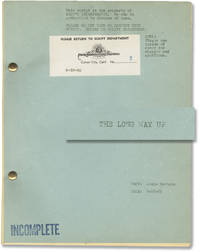
1952ref. 154485Culver City CA: Loew's Incorporated 1952. Treatment script for the 1953 film on yellow paper created by screenwriter Louis Morheim who received a story credit in the final film. With a single annotation in manuscript pencil changing the revision date on page five. Robert Aldrich's directorial debut wherein a baseball scout at a New York Giants training camp in Florida evaluates prospective hopefuls for a minor league contract. Starring Edward G. Robinson in his first major role after being threatened with blacklisting by the House Un-American Activities Committee HUAC. Shot on location in Melbourne Florida. Blue titled wrappers rubber-stamped copy No. 2 stamped "Incomplete" dated 6-18-52 with credits for screenwriter Louis Morheim. 42 leaves with last page of text numbered 42. Mimeograph duplication rectos only on yellow pages dated variously between 6-18-52 and 6-20-52. Pages Near Fine wrapper Near Fine bound with two gold brads. Loew's Incorporated unknown books
1970ref. 156306N.p.: N.p. 1970. Three vintage reference photographs taken on the set of the 1970 film two showing director Russ Meyer with actress Phyllis Davis between takes and one showing Meyer directing Dolly Read and Michael Blodgett. One photograph with a printed mimeo snipe affixed to the verso and all three photographs with library stamps and provenance labels on the versos. After nearly a decade as one of America's most successful independent filmmakers sexploitation auteur Russ Meyer first reached out for the brass ring of major studio success with this frantic and most entertaining cult favorite once described by Meyer and screenwriter Roger Ebert as "the first exploitation-horror-camp-musical." The film follows three members of an all-girl rock band called The Kelly Affair who relocate to Hollywood in search of fame and fortune. Their success comes at the price of their friendship and integrity however and the girls eventually succumb to a nonstop train of decadence drugs and betrayal. Featuring one-hit wonders the Strawberry Alarm Clock supporting performances by Meyer regulars Charles Napier and Haji and a bit part from future Blaxploitation icon Pam Grier the film proved to be Meyer's biggest box-office success. Set and shot on location in Hollywood. 8 x 10 inches. Near Fine. Criterion Collection 836. N.p. unknown
1970ref. 156306N.p.: N.p. 1970. Three vintage reference photographs taken on the set of the 1970 film two showing director Russ Meyer with actress Phyllis Davis between takes and one showing Meyer directing Dolly Read and Michael Blodgett. One photograph with a printed mimeo snipe affixed to the verso and all three photographs with library stamps and provenance labels on the versos. After nearly a decade as one of America's most successful independent filmmakers sexploitation auteur Russ Meyer first reached out for the brass ring of major studio success with this frantic and most entertaining cult favorite once described by Meyer and screenwriter Roger Ebert as "the first exploitation-horror-camp-musical." The film follows three members of an all-girl rock band called The Kelly Affair who relocate to Hollywood in search of fame and fortune. Their success comes at the price of their friendship and integrity however and the girls eventually succumb to a nonstop train of decadence drugs and betrayal. Featuring one-hit wonders the Strawberry Alarm Clock supporting performances by Meyer regulars Charles Napier and Haji and a bit part from future Blaxploitation icon Pam Grier the film proved to be Meyer's biggest box-office success. Set and shot on location in Hollywood. 8 x 10 inches. Near Fine. Criterion Collection 836. N.p. unknown books
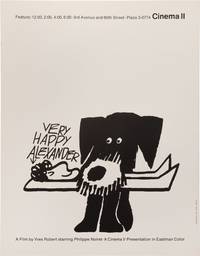
1969ref. 131243N.p.: Cinema V. 1969. Original silkscreen poster designed by legendary title and poster artist Saul Bass for the US release of the 1968 French film "Alexandre le bienheaureux." Printed at the Art Krebs Screen Studios in Los Angeles and used for the film's premiere at the legendary Cinema II Theater in New York City. Bass' initial design proposals were in general too radical for film studios to consider for advertisement and were invariably altered to suit commercial needs. He produced silkscreens of his original designs himself in non-numbered editions of 50 to 200. These posters were then given to fellow artists friends museums and design magazines and never offered directly for sale by Bass. 25 x 33 inches. About Fine with a light crease to the upper left corner. Cinema V. unknown
1969ref. 131243N.p.: Cinema V. 1969. Original silkscreen poster designed by legendary title and poster artist Saul Bass for the US release of the 1968 French film "Alexandre le bienheaureux." Printed at the Art Krebs Screen Studios in Los Angeles and used for the film's premiere at the legendary Cinema II Theater in New York City. Bass' initial design proposals were in general too radical for film studios to consider for advertisement and were invariably altered to suit commercial needs. He produced silkscreens of his original designs himself in non-numbered editions of 50 to 200. These posters were then given to fellow artists friends museums and design magazines and never offered directly for sale by Bass. 25 x 33 inches. About Fine with a light crease to the upper left corner. Cinema V. unknown books
1976ref. 161103N.p.: N.p. 1976. Four vintage oversize borderless double weight color reference photographs from the 1976 film. Gold labels specific to the film's French release affixed to the rectos as issued. A tomboyish waitress at a truck stop develops a crush on a gay garbage truck driver and in spite of all odds they begin a relationship. Serge Gainsbourg's directorial debut. 11.25 x 9 inches. Pinholes at the corners else about Near Fine. N.p. unknown
1976ref. 161103N.p.: N.p. 1976. Four vintage oversize borderless double weight color reference photographs from the 1976 film. Gold labels specific to the film's French release affixed to the rectos as issued. A tomboyish waitress at a truck stop develops a crush on a gay garbage truck driver and in spite of all odds they begin a relationship. Serge Gainsbourg's directorial debut. 11.25 x 9 inches. Pinholes at the corners else about Near Fine. N.p. unknown books
1963ref. 170476N.p.: Cinema V. 1963. Eight vintage studio still photographs from the 1963 film. Provenance labels on the versos. Based on the 1960 play by Warren Miller and Robert Rossen which was based on Miller's 1959 novel. The second feature to be directed by independent filmmaker Shirley Clarke following "The Connection" 1961. Both films were statements on the limitations of cinema verite and while appearing improvisational were in fact semi-documentaries with carefully scripted dialogue. Clarke aspired to make a non-judgmental film that resisted the moralizing prevalent in Hollywood "social issue" films. It was the first film to be produced by Frederick Wiseman who would go on to become a legendary documentary filmmaker and was scored by noted jazz composer and pianist Mal Waldron with performances by trumpeter Dizzy Gillespie. Set and shot on location in New York. 10 x 8 inches. Very Good plus to Near Fine. National Film Registry. Cinema V. unknown
1963ref. 170476N.p.: Cinema V. 1963. Eight vintage studio still photographs from the 1963 film. Provenance labels on the versos. Based on the 1960 play by Warren Miller and Robert Rossen which was based on Miller's 1959 novel. The second feature to be directed by independent filmmaker Shirley Clarke following "The Connection" 1961. Both films were statements on the limitations of cinema verite and while appearing improvisational were in fact semi-documentaries with carefully scripted dialogue. Clarke aspired to make a non-judgmental film that resisted the moralizing prevalent in Hollywood "social issue" films. It was the first film to be produced by Frederick Wiseman who would go on to become a legendary documentary filmmaker and was scored by noted jazz composer and pianist Mal Waldron with performances by trumpeter Dizzy Gillespie. Set and shot on location in New York. 10 x 8 inches. Very Good plus to Near Fine. National Film Registry. Cinema V. unknown books
1979ref. 162221N.p.: N.p. 1979. Six vintage oversize borderless color reference photographs from the 1979 film all showing actress Marina Pierro. An anthology film divided into three segments set in three different time periods Rome in 1520 France at the turn of the century and modern Paris and following three women who are driven to commit crimes of passion. Approximately 11.75 x 7.25 inches. About Fine. N.p. unknown
1979ref. 162221N.p.: N.p. 1979. Six vintage oversize borderless color reference photographs from the 1979 film all showing actress Marina Pierro. An anthology film divided into three segments set in three different time periods Rome in 1520 France at the turn of the century and modern Paris and following three women who are driven to commit crimes of passion. Approximately 11.75 x 7.25 inches. About Fine. N.p. unknown books
1947ref. 003375Universal City: Universal-International 1947. First Edition. Very good. Continuity and dialogue script here under the working title "Destiny of a Woman;" 11 x 8 1/2; textured yellow wraps bound at the top edge with two large brads; "Continuity and Dialogue / Master Copy / Prod. # 115125 / Charge # 563" to front wrap; several light penciled-in annotations throughout; mimeographed text to rectos only; a few minor spots to upper margin of front wrap; several leaves with creases to bottom corners; in very good condition. Based on playwright screenwriter and political activist Lillian Hellman's 1905 - 1984 1946 Broadway play of the same name and prequel to her "The Little Foxes" the drama took place in post-Civil War Alabama and centered around the wealthy ruthless racist Hubbard family. Vladimir Pozner 1905 - 1992 who would adapt Hellman's play for the future film was a French author of Russian-Jewish descent. His "Les etats desunis. Reportage" The Disunited States. A Reportage in essence - a leftist travelogue and one of his most famous works would document racism inequality everyday life and its characters the gangsters the starlets and the poor workers in the United States in the early 20th century. Universal-International paperback
1947ref. 003375Universal City: Universal-International 1947. First Edition. Very good. Continuity and dialogue script here under the working title "Destiny of a Woman;" 11 x 8 1/2; textured yellow wraps bound at the top edge with two large brads; "Continuity and Dialogue / Master Copy / Prod. # 115125 / Charge # 563" to front wrap; several light penciled-in annotations throughout; mimeographed text to rectos only; a few minor spots to upper margin of front wrap; several leaves with creases to bottom corners; in very good condition. Based on playwright screenwriter and political activist Lillian Hellman's 1905 - 1984 1946 Broadway play of the same name and prequel to her "The Little Foxes" the drama took place in post-Civil War Alabama and centered around the wealthy ruthless racist Hubbard family. Vladimir Pozner 1905 - 1992 who would adapt Hellman's play for the future film was a French author of Russian-Jewish descent. His "Les etats desunis. Reportage" The Disunited States. A Reportage in essence - a leftist travelogue and one of his most famous works would document racism inequality everyday life and its characters the gangsters the starlets and the poor workers in the United States in the early 20th century. Universal-International paperback books
1991ref. 167974N.p.: N.p. 1991. Draft script for the 1993 American-German-Dutch film. Single numeric annotation in manuscript pencil on the title page. Text in English. A struggling jazz musician provides music lessons to make ends meet although his students are ambivalent at best while maintaining a romance with a bartender at a local Irish bar. One of two feature films directed by Sara Driver known for producing the first two films of her longtime partner director Jim Jarmusch. Shot on location in Hamburg. Mylar front wrapper black rear wrapper. Title page present dated 1991 with credits for screenwriter Ray Dobbins and story writer Sara Driver. 91 leaves with last page of text numbered 90. Xerographic duplication rectos only. Pages Near Fine wrapper Very Good plus with a black Velo binding. N.p. unknown
1991ref. 167974N.p.: N.p. 1991. Draft script for the 1993 American-German-Dutch film. Single numeric annotation in manuscript pencil on the title page. Text in English. A struggling jazz musician provides music lessons to make ends meet although his students are ambivalent at best while maintaining a romance with a bartender at a local Irish bar. One of two feature films directed by Sara Driver known for producing the first two films of her longtime partner director Jim Jarmusch. Shot on location in Hamburg. Mylar front wrapper black rear wrapper. Title page present dated 1991 with credits for screenwriter Ray Dobbins and story writer Sara Driver. 91 leaves with last page of text numbered 90. Xerographic duplication rectos only. Pages Near Fine wrapper Very Good plus with a black Velo binding. N.p. unknown books
1959ref. 140805Neuilly-sur-Seine France: Argos Films 1959. Collection of eight vintage borderless reference photographs from the 1959 film. Four photographs with the stamp of production company Argos Films seven with a sticker noting they are from the collection of film historian collector and founder of the Tele Cine Documentation TCD cinema photo library Daniel Bouteiller one with both a sticker and stamp from the collection of film historian Maurice Bessy and all with manuscript annotations on the versos. A series of conversations about memory history and forgetfulness between a departing French actress and the married Japanese architect with whom she had a brief affair the film was a major catalyst for the Rive Gauche film movement. Screenwriter Marguerite Duras was nominated for an Academy Award and Alain Resnais received a Palme d'Or nomination at Cannes. 7 x 5 inches. Generally Near Fine. Criterion Collection 196. Rosenbaum 1000. Vogel Film as Subversive Art. Argos Films unknown
1959ref. 140805Neuilly-sur-Seine France: Argos Films 1959. Collection of eight vintage borderless reference photographs from the 1959 film. Four photographs with the stamp of production company Argos Films seven with a sticker noting they are from the collection of film historian collector and founder of the Tele Cine Documentation TCD cinema photo library Daniel Bouteiller one with both a sticker and stamp from the collection of film historian Maurice Bessy and all with manuscript annotations on the versos. A series of conversations about memory history and forgetfulness between a departing French actress and the married Japanese architect with whom she had a brief affair the film was a major catalyst for the Rive Gauche film movement. Screenwriter Marguerite Duras was nominated for an Academy Award and Alain Resnais received a Palme d'Or nomination at Cannes. 7 x 5 inches. Generally Near Fine. Criterion Collection 196. Rosenbaum 1000. Vogel Film as Subversive Art. Argos Films unknown books
1964ref. 150493Universal City: Universal Pictures 1964. Vintage studio still photograph from the set of the 1964 film showing director Alfred Hitchcock and a camera crew capturing a shot of actress Tippi Hedren at a desk in the publishing company office. With a printed mimeo snipe affixed to the verso along with the stamp of Culver Pictures and a stamp noting No. 75147. Based on Winston Graham's 1961 novel which follows a wealthy businessman's unwanted often cruel attempts to help a troubled young woman come to terms with her dark past. The production faced several setbacks in its development most relating to Hitchcock's insistence on including a rape scene present in the novel and the subsequent troubles in casting the lead role given the emotional complexity demanded for the character. Set and shot on location in California Pennsylvania New Jersey Virginia and Maryland. 10 x 8 inches. Near Fine. Godard Histoires du cinema. Grant US. Spicer US. Universal Pictures unknown
1964ref. 150493Universal City: Universal Pictures 1964. Vintage studio still photograph from the set of the 1964 film showing director Alfred Hitchcock and a camera crew capturing a shot of actress Tippi Hedren at a desk in the publishing company office. With a printed mimeo snipe affixed to the verso along with the stamp of Culver Pictures and a stamp noting No. 75147. Based on Winston Graham's 1961 novel which follows a wealthy businessman's unwanted often cruel attempts to help a troubled young woman come to terms with her dark past. The production faced several setbacks in its development most relating to Hitchcock's insistence on including a rape scene present in the novel and the subsequent troubles in casting the lead role given the emotional complexity demanded for the character. Set and shot on location in California Pennsylvania New Jersey Virginia and Maryland. 10 x 8 inches. Near Fine. Godard Histoires du cinema. Grant US. Spicer US. Universal Pictures unknown books
1956ref. 142890N.p.: N.p. 1956. Draft script for a 1956 student film. Front wrapper title in decorative manuscript black ink presumably by the screenwriter. Based on the 1890 story by Ambrose Bierce. 22 pages of storyboards corresponding with the script that follows all bound together. Decorative cast and crew invite to premiere and wrap party laid in. The second filmed version of Bierce's short story the first one titled "The Bridge" was made by Charles Vidor in 1929 virtually unknown preceding both the well known 1959 version filmed for the fifth season of Rod Serling's "The Twilight Zone" and the French version made in 1962 by Robert Enrico. According to the 1956-57 Film Review of Student Productions presented by Department of Cinema and Delta Kappa Alpha at the University of Southern California USC the film was part of the Productions of the Graduate Workshop in the fall of 1956. Laid in is an invitation to premiere screening held at CineManor where USC's California National Honorary Cinema Fraternity Delta Kappa Alpha hosted screenings and social events. Douglas W. Gallez served as President of the Alpha USC Chapter at the time. Not in IMDB. Presumably shot in Southern California. Set in Civil War era Alabama. Pale untitled wrapper with credits for screenwriter. Title page present with credits for story writer Ambrose Bierce and screenwriter Douglas W. Gallez. 45 leaves with last page of text numbered 22. Mimeograph both storyboards and script. Pages Near Fine wrapper Very Good plus bound with two gold brads. N.p. unknown
1956ref. 142890N.p.: N.p. 1956. Draft script for a 1956 student film. Front wrapper title in decorative manuscript black ink presumably by the screenwriter. Based on the 1890 story by Ambrose Bierce. 22 pages of storyboards corresponding with the script that follows all bound together. Decorative cast and crew invite to premiere and wrap party laid in. The second filmed version of Bierce's short story the first one titled "The Bridge" was made by Charles Vidor in 1929 virtually unknown preceding both the well known 1959 version filmed for the fifth season of Rod Serling's "The Twilight Zone" and the French version made in 1962 by Robert Enrico. According to the 1956-57 Film Review of Student Productions presented by Department of Cinema and Delta Kappa Alpha at the University of Southern California USC the film was part of the Productions of the Graduate Workshop in the fall of 1956. Laid in is an invitation to premiere screening held at CineManor where USC's California National Honorary Cinema Fraternity Delta Kappa Alpha hosted screenings and social events. Douglas W. Gallez served as President of the Alpha USC Chapter at the time. Not in IMDB. Presumably shot in Southern California. Set in Civil War era Alabama. Pale untitled wrapper with credits for screenwriter. Title page present with credits for story writer Ambrose Bierce and screenwriter Douglas W. Gallez. 45 leaves with last page of text numbered 22. Mimeograph both storyboards and script. Pages Near Fine wrapper Very Good plus bound with two gold brads. N.p. unknown books
1980ref. 129295Rome: Vides Cinematografica 1980. Set of 10 master typescripts for the ambitious 1982 television miniseries all dated June 1980 used as a master for printing the final scripts. Anthony Burgess was one of the series writers credited on the title page of each segment and Ennio Morricone composed the original score. Present are scripts for all 8 segments of the miniseries. Also included is a script for an unproduced segment titled "Ruby of Ceylon" and a separately bound "Series Outline." Screenwriters Burgess and Labella are present on the title page of all 8 produced segments though not on "The Ruby of Ceylon". An international co-production financed by the US Italy Japan and China. Shot on location in Beijing Inner Mongolia Italy and Morocco. Nominated for two Prime Time Emmys. Oversize volume shipping billed at cost. Series Outline: Yellow titled wrappers. Title page present noted as Outline with credits for screenwriters Burgess and Labella. 27 leaves mechanical duplication. Pages Fine wrapper Fine bound with two gold brads. Episode I Yellow titled wrappers. Title page present with credits for screenwriters Burgess and Labella. 37 leaves mechanical duplication. Pages Fine wrapper Fine bound with two gold brads. Episode II: Yellow titled wrappers. Title page present with credits for screenwriters Burgess and Labella. 35 leaves mechanical duplication. Pages Fine wrapper Fine bound with two gold brads. Episode III: Yellow titled wrappers. Title page present with credits for screenwriters Burgess and Labella. 31 leaves mechanical duplication. Pages Fine wrapper Fine bound with two gold brads. Episode IV: Yellow titled wrappers. Title page present with credits for screenwriters Burgess and Labella. 44 leaves mechanical duplication. Pages Fine wrapper Fine bound with two gold brads. Episode V: Yellow titled wrappers. Title page present with credits for screenwriters Burgess and Labella. 47 leaves mechanical duplication. Pages Fine wrapper Fine bound with two gold brads. Episode VI: Yellow titled wrappers. Title page present with credits for screenwriters Burgess and Labella. 38 leaves mechanical duplication. Pages Fine wrapper Fine bound with two gold brads. Episode VII: Yellow titled wrappers. Title page present with credits for screenwriters Burgess and Labella. 40 leaves mechanical duplication. Pages Fine wrapper Fine bound with two gold brads. Episode VIII: Yellow titled wrappers. Title page present with credits for screenwriters Burgess and Labella. 66 leaves mechanical duplication. Pages Fine wrapper Fine bound with two gold brads. The Ruby of Ceylon unfilmed: Yellow titled wrappers. Title page present with credits for screenwriters Burgess and Labella. 28 leaves mechanical duplication. Pages Fine wrapper Fine bound with two gold brads. Vides Cinematografica unknown
1980ref. 129295Rome: Vides Cinematografica 1980. Set of 10 master typescripts for the ambitious 1982 television miniseries all dated June 1980 used as a master for printing the final scripts. Anthony Burgess was one of the series writers credited on the title page of each segment and Ennio Morricone composed the original score. Present are scripts for all 8 segments of the miniseries. Also included is a script for an unproduced segment titled "Ruby of Ceylon" and a separately bound "Series Outline." Screenwriters Burgess and Labella are present on the title page of all 8 produced segments though not on "The Ruby of Ceylon". An international co-production financed by the US Italy Japan and China. Shot on location in Beijing Inner Mongolia Italy and Morocco. Nominated for two Prime Time Emmys. Oversize volume shipping billed at cost. Series Outline: Yellow titled wrappers. Title page present noted as Outline with credits for screenwriters Burgess and Labella. 27 leaves mechanical duplication. Pages Fine wrapper Fine bound with two gold brads. Episode I Yellow titled wrappers. Title page present with credits for screenwriters Burgess and Labella. 37 leaves mechanical duplication. Pages Fine wrapper Fine bound with two gold brads. Episode II: Yellow titled wrappers. Title page present with credits for screenwriters Burgess and Labella. 35 leaves mechanical duplication. Pages Fine wrapper Fine bound with two gold brads. Episode III: Yellow titled wrappers. Title page present with credits for screenwriters Burgess and Labella. 31 leaves mechanical duplication. Pages Fine wrapper Fine bound with two gold brads. Episode IV: Yellow titled wrappers. Title page present with credits for screenwriters Burgess and Labella. 44 leaves mechanical duplication. Pages Fine wrapper Fine bound with two gold brads. Episode V: Yellow titled wrappers. Title page present with credits for screenwriters Burgess and Labella. 47 leaves mechanical duplication. Pages Fine wrapper Fine bound with two gold brads. Episode VI: Yellow titled wrappers. Title page present with credits for screenwriters Burgess and Labella. 38 leaves mechanical duplication. Pages Fine wrapper Fine bound with two gold brads. Episode VII: Yellow titled wrappers. Title page present with credits for screenwriters Burgess and Labella. 40 leaves mechanical duplication. Pages Fine wrapper Fine bound with two gold brads. Episode VIII: Yellow titled wrappers. Title page present with credits for screenwriters Burgess and Labella. 66 leaves mechanical duplication. Pages Fine wrapper Fine bound with two gold brads. The Ruby of Ceylon unfilmed: Yellow titled wrappers. Title page present with credits for screenwriters Burgess and Labella. 28 leaves mechanical duplication. Pages Fine wrapper Fine bound with two gold brads. Vides Cinematografica unknown books
1963ref. 164219N.p.: N.p. 1963. Vintage banner poster for the US release of the 1961 Italian-Austrian film. Rare in this format. A series of murders begin at a reformatory for troubled girls following the arrival of a mysterious science teacher. 82 x 24 inches. Very Good plus with light overall rubbing and two vertical creases to the right side. N.p. unknown
1963ref. 164219N.p.: N.p. 1963. Vintage banner poster for the US release of the 1961 Italian-Austrian film. Rare in this format. A series of murders begin at a reformatory for troubled girls following the arrival of a mysterious science teacher. 82 x 24 inches. Very Good plus with light overall rubbing and two vertical creases to the right side. N.p. unknown books