4,909 results
1975ref. 117917N.p.: N.p. 1975. Draft script for an unproduced film. Vintage as assembled mostly from xerographically duplicated leaves with two leaves pp. 138 and 139 being ribbon copy. Written as a screenplay with dialogue and location information but lacking camera direction typical of a draft that is past the treatment stage but prior to the advanced draft screenplay stage. This would appear to have no relation to the later produced adaptation of the same novel director Stephen Fry's "Bright Young Things" 2003. Based on the 1930 novel by Evelyn Waugh about the dissolute lives of aristocrats and socialites living in postwar London. Pink wrappers with a die-cut title window in the British style. Title page present dated September 1975 noted as Amended first draft with credits for screenwriter John Wells and author Evelyn Waugh. 167 leaves with last page of text numbered 167. Xerographic duplication rectos only. Pages Very Good plus wrapper Very Good bound internally with two silver brads. N.p. unknown
1960ref. 125432Los Angeles: Twentieth Century-Fox 1960. Original pressbook for the 1960 film noir. Based on the novel "All the Way" by noted hard-boiled author Charles Williams. Edmond O'Brien is hired to impersonate a murdered businessman and dominates nearly every scene mostly on the phone as the "third voice" in this strange film post-noir entry. The first adaptation of a of Charles Williams novel and one of only a few American film adaptations of his work. One sheet folded twice as issued with one insert 13 x 16 inches. Very Good plus with a faint horizontal fold crease at the center of the wrapper and pages a few short closed tears and light rubbing. Spicer p. 424. Twentieth Century-Fox unknown
1966ref. 131621Hollywood: Paramount Pictures 1966. Three vintage black-and-white still photographs from the 1966 film. All are reference photographs featuring director John Frankenheimer on the set: the first from a scene at the beach with his shooting crew including James Wong Howe behind the camera the second in a social setting with the film's star Rock Hudson and the third showing Frankehimer working directly with Howe. Middle-aged banker Arthur Hamilton is given the opportunity to start a completely new life when he receives calls from his old friend Charlie. The only problem is that Charlie is supposed to be dead. Hamilton is eventually introduced to a firm that will fake his death and create an entirely new look and life for him. After undergoing physical reconstruction surgery and months of training and psychotherapy Hamilton returns to the world in the form of artist Tony Wilson. He has a nice house in Malibu and a manservant a company employee who is there to assist him with his adjustment. He finds that the life he had hoped for isn't quite what he expected and asks the company to go through the process with surprising results. 8 x 10 inches. Near Fine. Paramount Pictures unknown
1963ref. 130145Stockholm: Svensk Filmindustri 1963. Original Swedish photographic style poster for the 1963 film. The second entry in Bergman's legendary and highly personal "Faith" trilogy a series of films that launched a new and important phase in the director's career. "Winter Light" takes place in entirely within a three-hour period on a Sunday afternoon in November mixing the affections and repulsions of a pastor a parishioner who is a schoolteacher and a fisherman. A quiet relentless meditation on the nature of faith imperfection and beauty. 27.5 x 39.25 inches. Lightly restored linen-backed and rolled. Near Fine. Svensk Filmindustri unknown
1956ref. 130513London: Independent Film Producers / Distributor's Corporation of America 1956. Original British quad poster for the 1956 British film. The fourth of 7 screenplays written by Greene and his third adaptation of his own work. An unusual foray for the author a late screwball comedy in which a mild mannered assistant accountant in the midst of his honeymoon becomes tangled up in a mess involving a casino and two very canny businessmen. 30 x 40 inches. Near Fine. Phillips US. Independent Film Producers / Distributor's Corporation of America unknown
1957ref. 130511London: The Rank Organization 1957. Original British quad poster for the 1957 British film noir A low budget British film noir that brought Rod Steiger across the ocean in order to put his formidable character acting skills into what became a critically praised film. Shot in Spain but represented as Mexico "Across the Bridge" expands on Graham Greene's short story bringing more specifics to the author's intentionally empirical outline. Steiger plays a crooked businessman on the run who steals a man's passport in order to hide out in Mexico only to discover that the passport belongs to a wanted political assassin. 30 x 40 inches. Near Fine. Phillips US. Spicer US. The Rank Organization unknown
1961ref. 130113Stockholm: Svensk Filmindustri 1961. Original Swedish photographic style poster for the 1961 Swedish film. The first entry in Bergman's legendary and highly personal "Faith" trilogy which won the director his second Best Foreign Film Oscar and defined what came to be called his "chamber dramas." A young woman is released from a mental institution and moves to an island where her family resides to recover. But she finds little solace and no support from her father her husband or her brother. A landmark film in that it is not so much an examination into mental illness as a perspective of on a private world from a mind that has departed day to day concerns. 27.5 x 39.5 inches linen-backed. Lightly restored linen-backed and rolled. Near Fine. Svensk Filmindustri unknown
1943ref. 130866Universal City CA: Universal Pictures 1943. Revised Draft script for the 1944 film. The second of Universal's Technicolor fantasy adventures after "Arabian Nights" 1942 and "White Savage" 1943 loosely based on the classic Arabian Nights tales with a fitting score by Edward Ward to match Lubin's directorial flair. A fun but often overlooked desert romp. Gray titled wrappers noted as Revised and copy No. 113 on the front wrapper rubber-stamped production No. 7142 dated 5-20-43 with credit for screenwriter Hartmann. 114 leaves mimeograph duplication with annotations throughout. Pages Near Fine wrapper Poor with front wrapper starting bound with three gold brads. Weaver p. 565. Universal Pictures unknown
1963ref. 127345Rome: Titanus 1963. Vintage photograph from the set of the 1963 film. A shot of Visconti working with actress Ida Galli on the set the former with a bellows and the latter with a parasol. With provenance as to photograph's vintage on the verso: a rubber-stamped coat of arms made for the film the Pathe-Titanus productions stamp the film was an Italy-France co-production and a stamp for Parimage a French press agency. A lovely candid moment from Visconti's classic homage to the Sicilian aristocracy of the mid-nineteenth century. 9 x 7 inches. Fine. BFI 1087. Criterion Collection 235. Ebert II. Godard Histoires de cinema. Rosenbaum 1000. Schrader 22. Titanus unknown
1987ref. 129790Burbank CA: Warner Brothers 1987. Revised Final Draft script for the 1988 film based on the 1985 novel by Anne Tyler. Pink self-wrappers noted as Revised Final Draft on the front wrapper dated October 30 1987 with credits for screenwriter Kasdan and writer Tyler. 143 leaves on pink stock mechanical duplication. Pages Fine wrapper Near Fine bound with two gold brads. Warner Brothers unknown
1973ref. 130510London: Atlantic Productions 1973. Original UK Quad poster for the 1973 British film. Greene's novel was set in Stockholm and involved the internal deconstruction of a ne'er-do-well bodyguard Anthony Farrant who finds himself working for a dubious Swedish financier whose character is loosely inspired by Ivar Kreuger. The setting of the film version was changed to Nazi Germany during the Second World War. 30 x 40 inches. Fine. Phillips US. Atlantic Productions unknown
1949ref. 129324Berlin: Central Cinema Company Film CCC 1949. Draft script English translation for the 1950 German film noir. Likely a translation produced by the German film production company responsible for the film for purposes of US distribution and promotion made well prior to the commencement of film production. Blue titled wrappers. Title page present with credits for screenwriters Kautner and Stemmle. 136 leaves carbon typescript. Pages Near Fine wrapper Near Fine internally bound with three gold brads. Spicer p. 459. Central Cinema Company Film [CCC] unknown
1980ref. 129295Rome: Vides Cinematografica 1980. Set of 10 master typescripts for the ambitious 1982 television miniseries all dated June 1980 used as a master for printing the final scripts. Anthony Burgess was one of the series writers credited on the title page of each segment and Ennio Morricone composed the original score. Present are scripts for all 8 segments of the miniseries. Also included is a script for an unproduced segment titled "Ruby of Ceylon" and a separately bound "Series Outline." Screenwriters Burgess and Labella are present on the title page of all 8 produced segments though not on "The Ruby of Ceylon". An international co-production financed by the US Italy Japan and China. Shot on location in Beijing Inner Mongolia Italy and Morocco. Nominated for two Prime Time Emmys. Oversize volume shipping billed at cost. Series Outline: Yellow titled wrappers. Title page present noted as Outline with credits for screenwriters Burgess and Labella. 27 leaves mechanical duplication. Pages Fine wrapper Fine bound with two gold brads. Episode I Yellow titled wrappers. Title page present with credits for screenwriters Burgess and Labella. 37 leaves mechanical duplication. Pages Fine wrapper Fine bound with two gold brads. Episode II: Yellow titled wrappers. Title page present with credits for screenwriters Burgess and Labella. 35 leaves mechanical duplication. Pages Fine wrapper Fine bound with two gold brads. Episode III: Yellow titled wrappers. Title page present with credits for screenwriters Burgess and Labella. 31 leaves mechanical duplication. Pages Fine wrapper Fine bound with two gold brads. Episode IV: Yellow titled wrappers. Title page present with credits for screenwriters Burgess and Labella. 44 leaves mechanical duplication. Pages Fine wrapper Fine bound with two gold brads. Episode V: Yellow titled wrappers. Title page present with credits for screenwriters Burgess and Labella. 47 leaves mechanical duplication. Pages Fine wrapper Fine bound with two gold brads. Episode VI: Yellow titled wrappers. Title page present with credits for screenwriters Burgess and Labella. 38 leaves mechanical duplication. Pages Fine wrapper Fine bound with two gold brads. Episode VII: Yellow titled wrappers. Title page present with credits for screenwriters Burgess and Labella. 40 leaves mechanical duplication. Pages Fine wrapper Fine bound with two gold brads. Episode VIII: Yellow titled wrappers. Title page present with credits for screenwriters Burgess and Labella. 66 leaves mechanical duplication. Pages Fine wrapper Fine bound with two gold brads. The Ruby of Ceylon unfilmed: Yellow titled wrappers. Title page present with credits for screenwriters Burgess and Labella. 28 leaves mechanical duplication. Pages Fine wrapper Fine bound with two gold brads. Vides Cinematografica unknown
1972ref. 128339N.p.: New World Pictures 1972. Original US one sheet poster a variant size in a variant yellow color scheme for the 1972 Italian film. An early role for Vonetta McGee who would star in television shows like "L.A. Law" and "Bustin' Loose" and several other Blaxploitation films in the 1970s. The film poster here is the yellow variant also known to have been printed in red. 23 x 34.25 inches folded. Studio label on the verso. Very Good plus with a couple of short closed tears and a couple of light stains. Parish and Hill 14. New World Pictures unknown
1970ref. 128309N.p.: Trans American Films 1970. Original US one sheet poster for the 1970 British film. One of director Ford's tame films as he would eventually do more pornographic films in the late 1970s. Sex drugs and rock n' roll abound and the decade is well represented. Esme Johns' only film title as "Sally" the groupie and she is poignantly captured her in a green skirt atop her suitcases. 27 x 41 inches folded. Studio stamp on the verso. Very Good plus with a few pinholes closed tears and light creases. Trans American Films unknown
1970ref. 128362N.p.: Trans American Films 1970. Original US one sheet poster for the 1970 British film. Despite the subject matter a tame release from director Ford who would move into more explicit pornographic films in the late 1970s. Posters for the film are not often seen at auction. 27 x 41 inches folded. Studio stamp on the verso. Very Good plus with a couple of pinholes and tiny closed tears and a few faint tape ghosts to the verso. Trans American Films unknown
1967ref. 129528Hollywood: Paramount Pictures 1967. Original Pressbook for the 1936 film. Based on American minister Charles M. Sheldon's Christian novel "In His Steps" ultimately the films release title the film presents a dramatic vision of a couple forced to elope and the struggles they endure while in hiding. This is an example of a very early pressbook the publicity format witnessing its heyday between 1940-1970 with the advent of film noir exploitation films and later adult films. Early examples were simple black-and-white or subdued colors if any and from the late 1950s on saw the color palette more fully utilized expressing in greater array the adventure horror and science fiction film genres. 4 pages folded 12.75 X 1.5 inches. Black-and-white throughout. Very Good with a horizontal fold at the middle short closed tears at the edges and brief insect damage at the top edge and lower corner. Paramount Pictures unknown
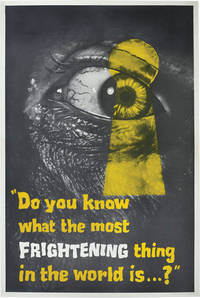
1960ref. 125095London: Michael Powell Theatre 1960. Vintage British Advance Poster for the classic 1960 film. The British Double Crown poster for the film turns up from time to time but this Advance issue which does not state the film's title is a rarity. Noted director Powell's most controversial film about a serial killer who films his female victims as they are dying. Reviled by critics on its release and today considered a masterpiece it is the second of three feature films director made after parting ways with his longtime filmmaking partner Emeric Pressburger. Ostensibly a film about a killer with serious Freudian issues but later reassessed as much more conceptual and complex. Roger Ebert pointed out famously in his 1999 review of the film that the audience is implicated as much as the killer."Movies make us into voyeurs. We sit in the dark watching other people's lives. It is the bargain the cinema strikes with us although most films are too well-behaved to mention it." Martin Scorsese is probably the most famous fan of the film and takes Ebert's argument further saying "I have always felt that "Peeping Tom" and "8 " say everything that can be said about filmmaking about the process of dealing with film the objectivity and subjectivity of it and the confusion between the two. "8 " captures the glamour and enjoyment of film-making while "Peeping Tom" shows the aggression of it how the camera violates. From studying them you can discover everything about people who make films or at least people who express themselves through films." 30 x 20 inches. About Near Fine on archival linen with some expert restoration at the top edge and folds. Archivally framed with an acid-free mat and UV plexi. Criterion Collection 58. Grant p. 495. Spicer p. 446. Michael Powell [Theatre] unknown
1958ref. 125081London: The Rank Organization 1958. Vintage French theatrical release poster for the seminal 1958 British docudrama "A Night to Remember" here under its French title "Atlantique Latitude 41 Degrees." Probably the most distinctive poster produced for the film. Novelist Ambler and director Baker set out to make a film that depicted the sinking of the Titanic as accurately as possible with no added fictional subplots. In addition to being massively entertaining the film is today held in high regard by "Titanic" historians compared to the more melodramatic and big-budget take by James Cameron in 1997. Director Baker noted in a 1991 interview "The whole purpose of making the film was to show a society that had persuaded itself that you could make a ship which could never to be sunk." 34 x 52 inches on archival linen Fine condition. Criterion Collection 7. McFarlane p. 51. The Rank Organization unknown
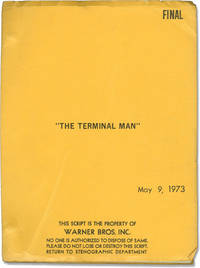
1973ref. 121469Burbank CA: Warner Brothers 1973. Final script for the 1973 film based on the 1972 novel by Michael Crichton. Noted director Mike Hodges' third film and first to be made in the US after "Get Carter" in 1971 and "Pulp" in 1972. An unusual and prescient sci-fi thriller that was poorly distributed in the US but over time counted Stanley Kubrick and Terrence Malick among its admirers. Segal in a serious against-type role is a scientist who agrees to an experimental treatment wherein a tiny computer is implanted in his head to help control violent tendencies. The computer malfunctions probably Windows-based and he becomes a psychotic killer. When Mike Kaplan a Warner Brothers international marketing executive attempted to override Warner Bros' decision not to release the film in Britain he sought Kubrick's help. After explaining the situation and how the film required a different marketing campaign Kubrick interrupted with "I've already seen it and it's terrific." The director Terrence Malick wrote to Hodges expressing how much he loved watching The Terminal Man saying "I have just come from seeing The Terminal Man and want you to know what a magnificent overwhelming picture it is. You achieve moods that I've never experienced in the movies before though it's only in hope of finding them that I keep going. Your images make me understand what an image is not a pretty picture but something that should pierce one through like an arrow and speak in a language all its own." Mustard yellow titled wrappers stamped FINAL on the front wrapper and dated May 9 1973. Distribution page present with receipt intact. Title page present with a credit for screenwriter Hodges. 108 leaves mechanical duplication eye-rest green stock. Pages Near Fine wrapper Very Good plus with a diagonal crease on the front panel internally bound with two gold brads. Warner Brothers unknown
1967ref. 119761Universal City CA: Universal City Studios 1967. Final script for the 1968 film. Prop master C.S. Chrisman's copy with his trademark manuscript ink initial on the front wrapper and profuse manuscript annotations throughout the text regarding scenes that will require props. Based on the 1966 novel "The Wrong Venus" by Charles Williams. An author on a European cruise is slacking on finishing her newest novel when her publisher sends someone to check in on her progress. The first of two screenplays Williams wrote in Hollywood. Williams was one of the most popular hard-boiled authors in the Gold Medal stable. Beginning in the early 1960s he found work as a screenwriter adapting his novel "All the Way" first adapted in 1960 in the US as an obscure late film noir "The 3rd Voice" as a comedy for French director Marcel Ophuls. Set in Europe. Red titled wrappers noted as Final draft on the front wrapper production No. 02000 dated February 6 1967. Title page present noted as Final draft with credits for author and screenwriter Charles Williams. 132 leaves with last page of text numbered 131. Mimeograph duplication rectos only. Pages Near Fine wrapper Near Fine bound with three gold brads. Universal City Studios unknown
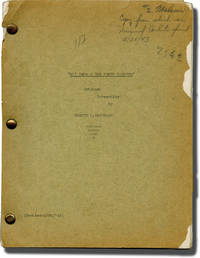
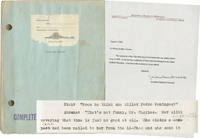
1935ref. 124528Beverly Hills CA: Metro-Goldwyn-Mayer MGM 1935. Dashiell Hammett's original submitted Treatment script for the first sequel to "The Thin Man" here referred to only as "Thin Man Sequel" and ultimately titled "After the Thin Man." With a single manuscript correction by Hammett and letter of provenance from Hammett's daughter Josephine Hammett Marshall regarding the discovery of the treatment in the family's estate. The first "Thin Man" film released in 1934 and based on Hammett's novel was a smash hit and is today a key film in the American screwball comedy cycle. Five sequels were made between 1936 and 1947 all starring the original acting team of William Powell and Myrna Loy and this previously unknown attempt at a sequel by Hammett was clearly commissioned by MGM but never produced making this script an entire unpublished Hammett work. The story is a completely original one never reworked for the other films very much written in Hammett's trademark style and reading a bit more like a story treatment i.e. a novel than a final screenplay which is likely as far as the story got on the road to production. The piece is dated Sept. 17 1935 at the lower right corner of the front panel along with Hammett's name and Hammett's name is noted in pencil next to the title label though not in Hammett's hand. There is only one single-word correction to the entire text at page 83 in Hammett's hand where the word "compact" is replaced with "cigarette case." Accompanying the screenplay is a typed letter signed from Hammett's daughter who edited a recently published collection of Hammett's letters on her personal stationery stating that the screenplay was discovered by Hammett's wife in 1980 and that it had been a part of the family's estate until that time. Probably one of only 2-3 copies that could have been produced and very possibly the only copy extant. To our knowledge no other copy of this story in any form has ever been recorded at auction or sold on the market. Light blue titled wrappers with the white MGM studio label present manuscript pencil notation of Hammett's name secretarial rubber-stamped COMPLETE dated September 17 1935 with a single credit for Hammett. 115 leaves mimeograph duplication. Pages and wrapper Very Good plus bound with two gold brads. In a custom clamshell box. Full pagination available upon request. Metro-Goldwyn-Mayer [MGM] unknown
1983ref. 118803Universal City CA: Universal City Studios 1983. Revised First Draft for the 1985 film. Costume designer Norman Salling's copy with his name in manuscript ink at the top of the front wrapper. SIGNED by novelist-screenwriter Elmore Leonard on the title page. An ex-car thief trying to turn his life around ends up witness to his friend's murder. While he wants to find love and spend more time with his daughter the men who killed his friend kidnap his daughter sending him on a mission to save his daughter and avenge his friend. One of only a few screenplays adapted by Leonard from one of his own novels made memorable in that it layers a surprisingly complex plot onto what by 1985 had become a pretty standard sub-genre: the Burt Reynolds revenge thriller. Shot on location in California and Florida. Green titled wrappers noted as Revised First Draft on the front wrapper production No. 02162 dated August 5 1983. Title page present dated August 5 1983 noted as Revised First Draft with credits for author and screenwriter Elmore Leonard. 109 leaves with last page of text numbered 106. Xerographic duplication on blue stock rectos only with blue revision pages throughout dated 9/15/1983. Pages Near Fine wrapper Very Good plus with some wear to the corners bound with three gold brads. Universal City Studios unknown
1986ref. 115890N.p.: N.p. 1986. Revised Draft script for the 1986 film. Production assistant Cynthia Jessen's copy with her name in manuscript ink on the title page numerous lines throughout the script circled and several dog-eared pages. Not to be confused with the 1994 film directed by Robert Benton and starring Paul Newman. A young woman who is tired of her life falls for a man in a traveling Shakespeare troupe. Shot on location in Prescott and Sedona AZ. Blue untitled wrappers. Title page present dated February 19 1986 noted as Revised Draft with credits for screenwriter Beth Henley. 109 leaves with last page of text numbered 104. Xerographic duplication rectos only with blue revision pages throughout dated March 3 1986. Pages Near Fine wrapper Near Fine bound with two gold brads. N.p. unknown
1969ref. 110611Studio City CA: Major Pictures Corporation 1969. Final Shooting script for the 1970 neo-noir film. Boldly SIGNED by lead actor Rod Taylor on the front wrapper. Based on the 1966 novel by John D. MacDonald featuring his series character Travis McGee. Notable as the only feature film adaptation of MacDonald's wildly popular Travis McGee series long unavailable on any kind of viewing format. Red titled wrappers noted as Final on the front wrapper dated 28 January 1969 with credits for screenwriter Ed Waters and novelist John D. MacDonald. 114 leaves with last page of text numbered 114. Mimeograph duplication rectos only. Pages Fine wrapper Fine bound with two gold brads. In a custom quarter-leather clamshell box. Grant US. Larson Warped and Faded. Major Pictures Corporation unknown