10,190 results
1970ref. 148876Beverly Hills CA: Metro-Goldwyn-Mayer MGM 1970. Vintage studio still photograph of Daria Halprin seemingly trapped in the middle of a mid-century modern glass vestibule from the 1970 film. Mimeo snipe on the verso. Antonioni's great American experiment and the only film the director ever made in the United States written for the screen by a young Sam Shepard. Though made from an Italian's perspective the film stands today as a great visual statement on the American West in the late 1960s rampant consumerism and the hippie zeitgeist. 8 x 10 inches with wide horizontal margins. Near Fine. Rosenbaum 1000. Godard Histoires du cinema. Metro-Goldwyn-Mayer [MGM] unknown
1970ref. 144970Beverly Hills CA: Metro-Goldwyn-Mayer MGM 1970. Near Fine. Godard Histoires du cinema. Rosenbaum 1000. Metro-Goldwyn-Mayer [MGM] unknown
1972ref. 150687N.p.: N.p. 1972. Vintage borderless reference photograph of Michelangelo Antonioni on the set of the 1972 film. Layout annotations in manuscript pencil and "Collection" stamp obscured struck with manuscript pencil on verso. In 1972 during China's Cultural Revolution Antonioni was invited by the People's Republic of China to direct a documentary on the "New China." The final film at 220 minutes was divided into three parts. The first focusing on Beijing the second Suzhou and the third Shanghai. In each section Antonioni focuses primarily on the faces of the people. Mao Zedong was reportedly so displeased with the film Antonioni was charged with being anti-Chinese and counterrevolutionary. Shot on location in Beijing Henan Jiangsu and Shanghai China. 6.75 x 10 inches. Very Good plus with very light creasing and a tiny bruise on mid right edge. N.p. unknown books
1970ref. 148876Beverly Hills CA: Metro-Goldwyn-Mayer MGM 1970. Vintage studio still photograph of Daria Halprin seemingly trapped in the middle of a mid-century modern glass vestibule from the 1970 film. Mimeo snipe on the verso. Antonioni's great American experiment and the only film the director ever made in the United States written for the screen by a young Sam Shepard. Though made from an Italian's perspective the film stands today as a great visual statement on the American West in the late 1960s rampant consumerism and the hippie zeitgeist. 8 x 10 inches with wide horizontal margins. Near Fine. Rosenbaum 1000. Godard Histoires du cinema. Metro-Goldwyn-Mayer [MGM] unknown books
1960ref. 150432N.p.: N.p. 1960. Vintage borderless reference photograph of director Michelangelo Antonioni on the set of the 1960 film. With the stamp of Promopress agency on the verso along with manuscript pencil annotations. A young woman disappears during a cruise in the Mediterranean leading her lover and best friend to search for her. The first film in Antonioni's famed trilogy followed by "La Notte" 1961 and "L'eclisse" 1962. Shot on location throughout Italy including in Rome the Aeolian Islands and Sicily. 7 x 9.5 inches. Very Good plus overall. Criterion Collection 98. Ebert I. Godard Histoires du cinema. Rosenbaum 1000. Scorsese My Voyage to Italy. Vogel Film as a Subversive Art. N.p. unknown books
1970ref. 144970Beverly Hills CA: Metro-Goldwyn-Mayer MGM 1970. Near Fine. Godard Histoires du cinema. Rosenbaum 1000. Metro-Goldwyn-Mayer [MGM] unknown books
1982ref. 148336Paris: G Darmon 1982. Two vintage French color lobby cards from the 1982 film. Antonioni's rarely discussed final feature and one of his greatest achievements. Niccolo Tomas Milian a recently divorced movie director pursues a new relationship with a younger woman Mavi Daniela Silverio who he imagines could play the leading role in his next film. She quickly vanishes and he embarks on a search to find her sparking up a series of romances with other women. Winner of the 35th Anniversary Prize at the 1982 Cannes Film Festival. Shot on location in Venice and Rome. 8.5 x 10.75 inches. Near Fine. Criterion Collection 585. G Darmon unknown books
1982ref. 149294Grunwald Germany: Concorde Film 1982. Three vintage borderless reference photographs from the German release of the 1982 Italian film. With mimeo snipes on the verso. Antonioni's rarely discussed final feature and one of his greatest achievements. A recently divorced director pursues a new relationship with a younger woman who he imagines could play the leading role in his next film. She quickly vanishes and he embarks on a search to find her sparking up a series of romances with other women. Winner of the 35th Anniversary Prize at the 1982 Cannes Film Festival. Shot on location in Venice and Rome. 9.5 x 7 inches. Near Fine. Criterion Collection 585. Concorde Film unknown books
1982ref. 144397Rome: Iterfilm 1982. Agency draft script in English for the 1982 Italian film. Antonioni's rarely discussed final feature but generally considered one of his greatest achievements. Niccolo Tomas Milian a recently divorced movie director pursues a new relationship with a younger woman Mavi Daniela Silverio who he imagines could play the leading role in his next film. She quickly vanishes and he embarks on a search to find her sparking up a series of romances with other women. Winner of the 35th Anniversary Prize at the 1982 Cannes Film Festival. Shot on location in Venice and Rome. Blue untitled agency wrappers. Title page present with credits for director Michelangelo Antonioni. 91 leaves with last page of text numbered 82. Xerographic duplication rectos only. Pages Near Fine wrapper Near Fine bound internally with three gold brads. Criterion Collection 585. Iterfilm unknown books
1966ref. 150834N.p.: N.p. 1966. Vintage borderless double weight photograph of Michelangelo Antonioni on the set of the 1966 film with provenance stamp of film scholar and author "J. P. Berthome" on verso. Inspired by the 1959 short story "Las Babas del Diablo" by Julio Cortazar. Michelangelo Antonioni's first English-language film marking the beginning of the final phase of his work co-produced by companies in Italy the United States and the United Kingdom and featuring an international cast. The director's brash use of color set design non-standard editing techniques and typical emphasis of atmosphere over plot would carry over into the two major films that followed "Zabriskie Point" 1970 and "The Passenger" 1975. In his 2009 essay on the film Danny Lyon notes "It is apt that through his established style Antonioni made a movie that is perhaps closest to communicating the myth of the swinging Sixties scene but also the confusion of the time. . Britain's new and very chaotic cultural revolution was perhaps most effectively captured by an Italian." Winner of the Palme d'Or. Nominated for two Academy Awards for Best Director and Best Screenplay. 10 x 8 inches. Light edgewear and creasing in far corners else Near Fine. Criterion Collection 865. Ebert I. Grant UK/Italy. N.p. unknown books
1975ref. 160516N.p.: N.p. 1975. Vintage borderless double weight reference photograph of director Michelangelo Antonioni talking with actors Jack Nicholson and Maria Schneider on the set of the 1975 Italian film. Annotations in manuscript ink on the verso relating to cropping as well as the stamp of Cinema International in London. A cynical war correspondent in northern Africa assumes the identity of a deceased arms dealer to gain information for his documentary. Antonioni's final film in a three picture contract with Metro-Goldwyn-Mayer following "Blowup" 1966 and "Zabriskie Point" 1970. Set in Chad shot on location in Germany Spain and England. 10 x 8 inches. Near Fine. Rosenbaum 1000. N.p. unknown books
1975ref. 152317N.p.: N.p. 1975. Vintage borderless reference photograph from the 1975 Italian film showing actors Jack Nicholson and Maria Schneider. A cynical war correspondent in northern Africa assumes the identity of a deceased arms dealer to gain information for his documentary. Antonioni's final film in a three picture contract with Metro-Goldwyn-Mayer following "Blowup" 1966 and "Zabriskie Point" 1970. Set in Chad shot on location in Germany Spain and England. 10 x 8 inches. Near Fine. Rosenbaum 1000. N.p. unknown books
1968ref. 167659N.p.: N.p. 1968. Vintage reference photograph from the 1970 film showing actors Mark Frechette and Daria Halprin talking with director Michelangelo Antonioni while on location in the desert. Annotations in manuscript pencil on the verso identifying subjects and crediting photographer Bruce Davidson with Magnum Photos. Antonioni's great American experiment and the only film the director ever made in the United States written for the screen by a young Sam Shepard. Though made from an Italian's perspective the film stands today as a great visual statement on the American West in the late 1960s rampant consumerism and the hippie zeitgeist. 8 x 10 inches with wide top and bottom margins. Fine. Godard Histoires du cinema. Rosenbaum 1000. N.p. unknown books
1962ref. 150414Rome: Cineriz 1962. Vintage borderless reference photograph of director Michelangelo Antonioni and actors Monica Vitti and Alain Delon during a cafe scene on the set of the 1962 film. With a mimeo snipe on the verso along with the stamps of Keystone Photo and Publifoto and a stamp noting No. 8710. A woman's newfound relationship with a power-hungry stockbroker gradually erodes as she becomes dissatisfied with his shallow interests. The final film in Antonioni's modernity trilogy all starring Vitti preceded by "L'avventura" 1960 and "La notte" 1961. Awarded the Jury Special Prize and nominated for the Palme d'Or at the 1961 Cannes Film Festival. Shot on location in Rome and Verona Italy. 10.5 x 8.5 inches. Near Fine. Criterion Collection 278. Rosenbaum 1000. Scorsese My Voyage to Italy. Vogel Film as a Subversive Art. Cineriz unknown books
1962ref. 153200Rome: Cineriz 1962. Vintage borderless reference photograph from the 1962 film showing actor Alain Delon leaning against a fence. With a mimeo snipe on the verso along with the stamps of Keystone Photo and Publifoto. A woman's newfound relationship with a power-hungry stockbroker gradually erodes as she becomes dissatisfied with his shallow interests. The final film in Michelangelo Antonioni's modernity trilogy preceded by "L'avventura" 1960 and "La notte" 1961. Shot on location in Rome and Verona Italy. 7.25 x 9.5 inches. Very Good plus with light creasing to the bottom left corner reinforced with white paper tape on the verso. Criterion Collection 278. Rosenbaum 1000. Scorsese My Voyage to Italy. Vogel Film as a Subversive Art. Cineriz unknown books
1962ref. 150683N.p.: N.p. 1962. Two vintage borderless reference photographs from the 1962 film one of Michelangelo Antonioni with Alain Delon and Monica Vitti and one of Antonioni and crew shooting a scene in Rome from scaffolding built in the water. One with French "L'Eclipse" stamp and provenance stamp of film historian "Maurice Bessy" on verso one with "P.I.P." and "Copyright" stamps on verso. A woman's newfound relationship with a power-hungry stockbroker gradually erodes as she becomes dissatisfied with his shallow interests. The final film in Antonioni's modernity trilogy all starring Vitti preceded by "L'avventura" 1960 and "La notte" 1961. Awarded the Jury Special Prize and nominated for the Palme d'Or at the 1961 Cannes Film Festival. Shot on location in Rome and Verona Italy. 6.75 x 9.25 inches and 9.5 x 7 inches. Very Good plus with light creasing and edgewear. Criterion Collection 278. Rosenbaum 1000. Scorsese My Voyage to Italy. Vogel Film as a Subversive Art. N.p. unknown books
1964ref. 152012Rome: Film Duemila 1964. Vintage borderless reference photograph of Monica Vitti and Richard Harris from the 1964 film. "Deserto Ross" stamp on verso. Antonioni's first color film and the last in a quartet of films made between 1959 and 1964 about women in modern culture preceded by "L'avventura" "La Notte" and L'Eclisse" and the lie of happiness and better living. This entry very much an antecedent to Todd Haynes' "Safe" 1995 focuses on Vitti a woman trying to survive in the modern world of cultural neurosis and existential doubt. Carlo Di Palma's cinematography remains legendary today for its stunningly colored industrial landscapes beautifully and yet indirectly evoking Vitti's unease alienation and vivid perceptions. Shot on location in Ravenna Sardinia and Rome Italy. 9.5 x 12 inches. Near Fine. BFI 1134. Criterion Collection 522. Godard Histoires du cinema. Rosenbaum 1000. Film Duemila unknown books
1965ref. 150399N.p.: N.p. 1965. Vintage borderless photograph of director Michelangelo Antonioni filming a scene with actress Soraya on the set of the 1965 Italian film. With a printed mimeo snipe specific to the film's German release affixed to the verso. An anthology film with three short episodes following the experiences of various women all played by Soraya directed by Antonioni Mauro Bolognini and Franco Indovina. Antonioni's contribution "Il Provino" "The Preface" features Soraya as a former Iranian princess turned actress posing for a screen test. Shot on location in Sardinia and Lazio Italy and Athens Greece. 9.5 x 7.25 inches. Very Good plus overall. N.p. unknown books
1959ref. 160052Neuilly-sur-Seine France: Gaumont / Ulysse Productions 1959. Four items including three vintage borderless reference photographs and one vintage reference photograph from the 1959 film. A small-town reporter helps a lawyer incriminate a wine-selling company revealing how the merchants target poor people and youth in their advertising campaigns. Shot on location in Paris and Yvelines France. One photograph 9.5 x 7.25 two photographs 7 x 5 inches one photograph 5.25 x 4 inches. Very good plus with some curling at the edges and one photograph with some foxing on the verso. Gaumont / Ulysse Productions unknown books
1959ref. 158235N.p.: N.p. 1959. Vintage borderless oversize reference photograph from the 1959 French film showing actress Michèle Morgan. A small-town reporter helps a lawyer incriminate a wine-selling company revealing how the merchants target poor people and youth in their advertising campaigns. Shot on location in Paris and Yvelines France. 9.25 x 12.25 inches. Very Good moderately foxed with a small closed tear at the bottom right corner. N.p. unknown books
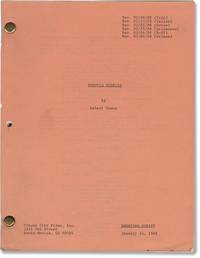
1988ref. 172338Santa Monica: Cinema City 1988. Shooting script for the 1988 film with rainbow revisions. A former drug dealer tries to quit his old habits but nevertheless finds himself caught in the crosshairs of a large-scale Drug Enforcement Administration investigation. The second film to be both written and directed by Robert Towne following "Personal Best" 1982. Nominated for an Academy Award for Best Cinematography. Set and shot on location in Manhattan Beach California. Self wrappers. Title page present dated January 14 1988 noted as SHOOTING SCRIPT with credit for Towne. 150 leaves with last page of text numbered 142. Xerographic duplication rectos only with rainbow revision pages throughout dated variously between February 8 and March 4 1988. Pages about Fine bound with two gold brads. Cinema City unknown
1988ref. 172338Santa Monica: Cinema City 1988. Shooting script for the 1988 film with rainbow revisions. A former drug dealer tries to quit his old habits but nevertheless finds himself caught in the crosshairs of a large-scale Drug Enforcement Administration investigation. The second film to be both written and directed by Robert Towne following "Personal Best" 1982. Nominated for an Academy Award for Best Cinematography. Set and shot on location in Manhattan Beach California. Self wrappers. Title page present dated January 14 1988 noted as SHOOTING SCRIPT with credit for Towne. 150 leaves with last page of text numbered 142. Xerographic duplication rectos only with rainbow revision pages throughout dated variously between February 8 and March 4 1988. Pages about Fine bound with two gold brads. Cinema City unknown books
1983ref. 152549N.p.: N.p. 1983. Revised Draft script for the 1984 film here under the working title "Tin Soldiers." With a single manuscript annotation to the verso of the final leaf noting No. 88. After the death of his mother a straitlaced cadet is taken out of his military academy by his alleged father a wild-spirited rock star. Shot on location in Arizona and California. Green titled wrappers. Title page present dated May 27 1983 noted as TAFT REVISION with credits for screenwriters Gene Taft and Len Jenkin and story credits to Jenkin and Michael Philip Jagger. 130 leaves with last page of text numbered 128. Xerographic duplication rectos only. Pages Very Good lightly foxed on the first and last leaves wrapper Near Fine bound with two gold brads. N.p. unknown books
1960ref. 168180Beverly Hills CA: Metro-Goldwyn-Mayer MGM 1960. Four vintage studio still photographs from the 1960 film. A man travels to a remote military academy to inquire about his son reported to have died in an unspecified accident only to learn that the boy's death was caused by a violent hazing ritual. 10 x 8 inches. Lightly toned else Near Fine. Metro-Goldwyn-Mayer [MGM] unknown
1955ref. 159013North Hollywood: Republic Pictures 1955. Vintage studio still photograph from the 1955 film. A new parson in a small town attempts to spread the word of God while battling the local saloon owner. Set in the fictional town of Lodestone. 10 x 8 inches. Near Fine. Pitts 4601. Republic Pictures unknown books