11,160 results
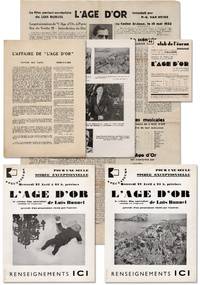
1932ref. 169144N.p.: N.p. 1932. A small archive of five vintage French pamphlets flyers and broadsides announcing 1931 and 1932 screenings of the banned 1930 surrealist film. All items are housed loose in a custom bound volume with a "L'Affaire de L'Age d'Or" label on the spine with each item laid in on separate leaves overlaid with heavy protective tissue housed in a custom slipcase. Rare. The archive includes: "L'Affaire de 'L'Age d'Or'" bi-fold pamphlet printed on rectos and versos with a satin-finish photo illustrated insert also printed on the recto and verso published by Nancy Cunard on the occasion of her January 1931 private screening of the film in London. The bi-fold includes the essay "Exposé des Faits" "Statement of Facts" describing the film's initial riotous reception "Extraits du Programme" "Excerpts from the Program" a "Questionnaire" regarding political and legal actions taken in response to the film and an extensive "Extraits de la Presse" "Excerpts from the Press" followed the names of signatories Maxime Alexandre Aragon André Breton René Char René Crevel Salvador Dali Paul Eluard Georges Malkine Benjamin Péret Man Ray Georges Sadoul Yves Tanguy André Thirion Tristan Tzara Pierre Unik and Albert Valentin. Two satin-finish variants of a flyer printed on rectos only for a screening of the film on April 27 1932 by Les Spectateurs de l'Avant-Garde at La Bellevilloise a workers' cooperative theatre with each flyer featuring a different image from the film. A second screening was later added on April 30 not noted on the flyers. The screenings were decidedly low-key private events with Buñuel insisting "No protests." French director Jean Vigo was reportedly among the participants of the screenings. And two items relating to a screening presented by Le Club de L'Ecran at Cine-Casino in Belgium on May 10 1932: A 4 x 5.5 inch announcement for the screening printed on the recto only noting the film as being presented by P.G. van Hecke Paul-Gustave Van Hecke followed by seating and ticket prices purchase locations and Club de L'Ecran membership prices. A large newsprint broadside printed on the recto and the verso for Le Club de L'Ecran announcing the May 10th screening with articles on the recto regarding the film club's activities and an excerpt from the Surrealist manifesto published upon the film's premiere with the verso dedicated entirely to numerous texts and articles on "L'Age d'Or" featuring two images from the film and a portrait of Buñuel. A key and archetypal work of Surrealist cinema alongside "Un Chien Andalou" 1929 also written by Buñuel and Dali and directed by Buñuel featuring a series of absurdist vignettes scathingly and sardonically rebuking the sexual hypocrisy of bourgeois society the Catholic Church and 20th century European society in general. The violence the uproar "L'Age d'Or" created remains as shocking as the film itself: days into the first screenings at Studio 28 on December 3 1930 the theatre was stormed by fascist youths enraged at the film's perceived anti-patriotic and anti-Christian message. Demonstrators threw ink at the screen shouted anti-Semitic death threats smashed the theatre windows and completely destroyed an exhibition of surrealist books and art in the foyer. In response the Board of Censors re-reviewed the film and on December 10 the film was banned from further public showings in France. The film's producers subsequently withdrew "L'Age d'or" from commercial distribution and public exhibition for more than 40 years although three years later in 1933 the film was privately exhibited at the Museum of Modern Art in New York. "L'Affaire de 'L'Age d'Or':" Bi-fold 7.5 x 10.5 inches. About Near Fine with a Very Good plus 7.5 x 10 inch insert with both items previously folded horizontally. Two Les Spectateurs April 27 Flyers: 8.25 x 10.5 inches. One Near Fine. One Very Good plus with light creasing faint toning and a .25 inch closed tear to the top edge. Le Club de L'Ecran Announcement: 4 x 5.5 inches. Near Fine. Le Club de L'Ecran Broadside: 14.25 x 21.75 inches folded as issued. About Near Fine with an additional lightly toned horizontal fold. Housed in a 9.25 x 12 inch custom bound Near Fine volume with a 9.5 x 12.25 inch Near Fine slipcase. BFI. Rosenbaum 1000. Vogel Film as a Subversive Art. N.p. unknown books
1930ref. 166622Paris: Studio 28 1930. Vintage review-program for Luis Buñuel's 1930 surrealist masterpiece created for the film's public premiere at Studio 28 cinema in Montmartre. Program in two parts bound dos-a-dos. Text in French. The first section of the review-program is dedicated to "L'Age d'or" presenting the film's scenario alongside subtitles and dialogue accompanied by a manifesto on surrealism and a catalog of 20 works by Max Ernst Salvador Dalí Man Ray and others which were exhibited alongside the film's screenings at Studio 28. The second part of the program is an overview of film programs at Studio 28 with stills from films by Epstein Ivens Melies and others. The violence of the uproar "L'Age d'Or" created remains almost as shocking as the film itself: days into the first screenings at Studio 28 on December 3 1930 the theatre was stormed by fascist youths enraged at the film's perceived anti-patriotic and anti-Christian message. Demonstrators threw ink at the screen shouted antisemitic death threats smashed the theatre windows and completely destroyed the exhibition of surrealist books and artwork in the foyer. In response the Board of Censors re-reviewed the film and on December 10 the film was banned from further public showings in France. The film's producers subsequently withdrew "L'Age d'or" from commercial distribution and public exhibition for more than 40 years although three years later in 1933 the film was privately exhibited at the Museum of Modern Art in New York. Page edges faintly foxed else about Near Fine in perfect-bound gold wrappers with a single annotation in manuscript ink censoring a line relating to one of the film's characters and Jesus Christ. Lacking the errata slip. Studio 28 unknown books
1932ref. 169144N.p.: N.p. 1932. A small archive of five vintage French pamphlets flyers and broadsides announcing 1931 and 1932 screenings of the banned 1930 surrealist film. All items are housed loose in a custom bound volume with a "L'Affaire de L'Age d'Or" label on the spine with each item laid in on separate leaves overlaid with heavy protective tissue housed in a custom slipcase. Rare. The archive includes: "L'Affaire de 'L'Age d'Or'" bi-fold pamphlet printed on rectos and versos with a satin-finish photo illustrated insert also printed on the recto and verso published by Nancy Cunard on the occasion of her January 1931 private screening of the film in London. The bi-fold includes the essay "Exposé des Faits" "Statement of Facts" describing the film's initial riotous reception "Extraits du Programme" "Excerpts from the Program" a "Questionnaire" regarding political and legal actions taken in response to the film and an extensive "Extraits de la Presse" "Excerpts from the Press" followed the names of signatories Maxime Alexandre Aragon André Breton René Char René Crevel Salvador Dali Paul Eluard Georges Malkine Benjamin Péret Man Ray Georges Sadoul Yves Tanguy André Thirion Tristan Tzara Pierre Unik and Albert Valentin. Two satin-finish variants of a flyer printed on rectos only for a screening of the film on April 27 1932 by Les Spectateurs de l'Avant-Garde at La Bellevilloise a workers' cooperative theatre with each flyer featuring a different image from the film. A second screening was later added on April 30 not noted on the flyers. The screenings were decidedly low-key private events with Buñuel insisting "No protests." French director Jean Vigo was reportedly among the participants of the screenings. And two items relating to a screening presented by Le Club de L'Ecran at Cine-Casino in Belgium on May 10 1932: A 4 x 5.5 inch announcement for the screening printed on the recto only noting the film as being presented by P.G. van Hecke Paul-Gustave Van Hecke followed by seating and ticket prices purchase locations and Club de L'Ecran membership prices. A large newsprint broadside printed on the recto and the verso for Le Club de L'Ecran announcing the May 10th screening with articles on the recto regarding the film club's activities and an excerpt from the Surrealist manifesto published upon the film's premiere with the verso dedicated entirely to numerous texts and articles on "L'Age d'Or" featuring two images from the film and a portrait of Buñuel. A key and archetypal work of Surrealist cinema alongside "Un Chien Andalou" 1929 also written by Buñuel and Dali and directed by Buñuel featuring a series of absurdist vignettes scathingly and sardonically rebuking the sexual hypocrisy of bourgeois society the Catholic Church and 20th century European society in general. The violence the uproar "L'Age d'Or" created remains as shocking as the film itself: days into the first screenings at Studio 28 on December 3 1930 the theatre was stormed by fascist youths enraged at the film's perceived anti-patriotic and anti-Christian message. Demonstrators threw ink at the screen shouted anti-Semitic death threats smashed the theatre windows and completely destroyed an exhibition of surrealist books and art in the foyer. In response the Board of Censors re-reviewed the film and on December 10 the film was banned from further public showings in France. The film's producers subsequently withdrew "L'Age d'or" from commercial distribution and public exhibition for more than 40 years although three years later in 1933 the film was privately exhibited at the Museum of Modern Art in New York. "L'Affaire de 'L'Age d'Or':" Bi-fold 7.5 x 10.5 inches. About Near Fine with a Very Good plus 7.5 x 10 inch insert with both items previously folded horizontally. Two Les Spectateurs April 27 Flyers: 8.25 x 10.5 inches. One Near Fine. One Very Good plus with light creasing faint toning and a .25 inch closed tear to the top edge. Le Club de L'Ecran Announcement: 4 x 5.5 inches. Near Fine. Le Club de L'Ecran Broadside: 14.25 x 21.75 inches folded as issued. About Near Fine with an additional lightly toned horizontal fold. Housed in a 9.25 x 12 inch custom bound Near Fine volume with a 9.5 x 12.25 inch Near Fine slipcase. BFI. Rosenbaum 1000. Vogel Film as a Subversive Art. N.p. unknown
1930ref. 166622Paris: Studio 28 1930. Vintage review-program for Luis Buñuel's 1930 surrealist masterpiece created for the film's public premiere at Studio 28 cinema in Montmartre. Program in two parts bound dos-a-dos. Text in French. The first section of the review-program is dedicated to "L'Age d'or" presenting the film's scenario alongside subtitles and dialogue accompanied by a manifesto on surrealism and a catalog of 20 works by Max Ernst Salvador Dalí Man Ray and others which were exhibited alongside the film's screenings at Studio 28. The second part of the program is an overview of film programs at Studio 28 with stills from films by Epstein Ivens Melies and others. The violence of the uproar "L'Age d'Or" created remains almost as shocking as the film itself: days into the first screenings at Studio 28 on December 3 1930 the theatre was stormed by fascist youths enraged at the film's perceived anti-patriotic and anti-Christian message. Demonstrators threw ink at the screen shouted antisemitic death threats smashed the theatre windows and completely destroyed the exhibition of surrealist books and artwork in the foyer. In response the Board of Censors re-reviewed the film and on December 10 the film was banned from further public showings in France. The film's producers subsequently withdrew "L'Age d'or" from commercial distribution and public exhibition for more than 40 years although three years later in 1933 the film was privately exhibited at the Museum of Modern Art in New York. Page edges faintly foxed else about Near Fine in perfect-bound gold wrappers with a single annotation in manuscript ink censoring a line relating to one of the film's characters and Jesus Christ. Lacking the errata slip. Studio 28 unknown
1970ref. 149528Paris: Les Grands Films Classiques 1970. Six oversize matte-finish double weight reference photographs from a re-release of the 1932 French comedy film. Label of Les Grands Films Classiques on the verso. A milliner and his salesman plan to kidnap a millionaire but accidentally kidnap the millionaire's bored young son who is thrilled to be part of an adventure. The feature film debut of noted surrealist poet and left-wing screenwriter Jacques Prevert. Shot on location in Joinville-le-Pont France. 9.25 x 11.5 inches. Very Good plus overall. Les Grands Films Classiques unknown books
1970ref. 149528Paris: Les Grands Films Classiques 1970. Six oversize matte-finish double weight reference photographs from a re-release of the 1932 French comedy film. Label of Les Grands Films Classiques on the verso. A milliner and his salesman plan to kidnap a millionaire but accidentally kidnap the millionaire's bored young son who is thrilled to be part of an adventure. The feature film debut of noted surrealist poet and left-wing screenwriter Jacques Prevert. Shot on location in Joinville-le-Pont France. 9.25 x 11.5 inches. Very Good plus overall. Les Grands Films Classiques unknown
1964ref. 158255N.p.: N.p. 1964. Vintage oversize reference photograph from the 1964 Japanese anthology film showing actor Katsuo Nakamura in the film's third segment "Miminashi H ichi no Hanashi" "Hoichi the Earless". Provenance stamps on the verso as well as a stamp of the film's title. Based on Lafcadio Hearn's 1904 collection of Japanese ghost tales "Kwaidan: Stories and Studies of Strange Things." Nominated for an Academy Award and the Palme d'Or. 11 x 9 inches. Very Good with wear on the finish and light creases at the corners. Criterion Collection 90. Eureka Masters of Cinema 228. N.p. unknown books
1964ref. 158255N.p.: N.p. 1964. Vintage oversize reference photograph from the 1964 Japanese anthology film showing actor Katsuo Nakamura in the film's third segment "Miminashi H ichi no Hanashi" "Hoichi the Earless". Provenance stamps on the verso as well as a stamp of the film's title. Based on Lafcadio Hearn's 1904 collection of Japanese ghost tales "Kwaidan: Stories and Studies of Strange Things." Nominated for an Academy Award and the Palme d'Or. 11 x 9 inches. Very Good with wear on the finish and light creases at the corners. Criterion Collection 90. Eureka Masters of Cinema 228. N.p. unknown
1933ref. 138407Germany: Kinematrade 1933. Vintage US poster for the 1932 German communist propaganda film "Kuhle Wampe oder Wem gehort die Welt" The subtitle is seen here under the English translation "Whither Germany." Circa 1933 as identified by the name of the Philadelphia theatre on the poster. The last and arguably most important communist film of the Weimar era "Kuhle Wampe oder" is according to screenwriter Brecht a "Collective Presentation" that tells the tale of a family in early 1930s Berlin. After the son is prolongedly unemployed he commits suicide and the family is forced to relocate to a shantytown known as "Kuhle Wampe" or "Empty Stomach." Created under severely limited material conditions with filming constantly being broken up by the Weimar government's paramilitary SA agency the film attempts to depict archetypes of the times including an intellectual clash on a subway between members of the bourgeoisie and the proletariat. Banned first by the failing Weimar Republic and subsequently by the Nazi Reich the film was believed to have been lost until it reappeared over 20 years later in East Germany in 1958. This poster likely originates from screenings held in November 1933 by an unknown pro-communist organization in Philadelphia at the short-lived left-leaning Philkino theater. A US screening of this film dating before the film's disappearance and only just after the very beginnings of Hitler's rise to power makes this poster not only very scarce but one of significant historical value. The poster touting "Kuhle Wampe" as "The Film Hitler Burned" features an image of a man with a hammer and sickle attacking two snakes that form the Nazi swastika and touts the involvement of members of the "Labor Sports Union" in the film. 9.5 x 13 inches letterpress on pale faded pink stock. Very Good with expected moderate wear. Kinematrade unknown books
1933ref. 138407Germany: Kinematrade 1933. Vintage US poster for the 1932 German communist propaganda film "Kuhle Wampe oder Wem gehort die Welt" The subtitle is seen here under the English translation "Whither Germany." Circa 1933 as identified by the name of the Philadelphia theatre on the poster. The last and arguably most important communist film of the Weimar era "Kuhle Wampe oder" is according to screenwriter Brecht a "Collective Presentation" that tells the tale of a family in early 1930s Berlin. After the son is prolongedly unemployed he commits suicide and the family is forced to relocate to a shantytown known as "Kuhle Wampe" or "Empty Stomach." Created under severely limited material conditions with filming constantly being broken up by the Weimar government's paramilitary SA agency the film attempts to depict archetypes of the times including an intellectual clash on a subway between members of the bourgeoisie and the proletariat. Banned first by the failing Weimar Republic and subsequently by the Nazi Reich the film was believed to have been lost until it reappeared over 20 years later in East Germany in 1958. This poster likely originates from screenings held in November 1933 by an unknown pro-communist organization in Philadelphia at the short-lived left-leaning Philkino theater. A US screening of this film dating before the film's disappearance and only just after the very beginnings of Hitler's rise to power makes this poster not only very scarce but one of significant historical value. The poster touting "Kuhle Wampe" as "The Film Hitler Burned" features an image of a man with a hammer and sickle attacking two snakes that form the Nazi swastika and touts the involvement of members of the "Labor Sports Union" in the film. 9.5 x 13 inches letterpress on pale faded pink stock. Very Good with expected moderate wear. Kinematrade unknown
1970ref. 141610N.p.: N.p. 1970. Draft script for an unproduced film. Based on Sigrid Undset's 1920 trilogy "Kristin Lavransdatter." The trilogy is the story of Kristin a Norwegian living during the Middle Ages the daughter of an affluent father who in difficult times often found solace in her Catholicism. The popularity as well as its accurate descriptions of Medieval life led to Undset being awarded the Nobel Prize for Literature in 1928. Set in Norway. Green titled wrappers. Title page present with credits for author Sigrid Undset and screenwriter Laurence W. Beilenson. 139 leaves with last page of text numbered 137. Mechanical duplication. Pages Near Fine wrapper Near Fine bound internally with three gold brads. N.p. unknown books
1970ref. 141610N.p.: N.p. 1970. Draft script for an unproduced film. Based on Sigrid Undset's 1920 trilogy "Kristin Lavransdatter." The trilogy is the story of Kristin a Norwegian living during the Middle Ages the daughter of an affluent father who in difficult times often found solace in her Catholicism. The popularity as well as its accurate descriptions of Medieval life led to Undset being awarded the Nobel Prize for Literature in 1928. Set in Norway. Green titled wrappers. Title page present with credits for author Sigrid Undset and screenwriter Laurence W. Beilenson. 139 leaves with last page of text numbered 137. Mechanical duplication. Pages Near Fine wrapper Near Fine bound internally with three gold brads. N.p. unknown
1979ref. 154325Culver City CA: Columbia Pictures 1979. Vintage reference photograph from the 1979 film showing actor Dustin Hoffman with child actor Justin Henry. Based on Avery Corman's 1977 novel about a divorced couple fighting a custody battle for their son. Nominated for nine Academy Awards winning five including Best Picture Best Screenplay Best Actor and Best Actress. Shot on location in New York. 10 x 8 inches. Very Good plus overall. Columbia Pictures unknown books
1975ref. 159222N.p.: Security Pictures 1975. Vintage reference photograph from the 1975 re-release of the 1968 film. With mimeo snipe advertising the film's television premiere on ABC on January 16 1976 affixed to the verso. A man tries to rescue a sunken cargo ship and its crew but a volcano on Krakatoa erupts near the wreckage. Set in Indonesia shot on location in Spain and Italy. 9 x 7 inches. Near Fine with some creasing to the mimeo snipe. Security Pictures unknown books
1958ref. 153663Burbank CA: National Broadcasting Company NBC 1958. Archive of six Revised Draft scripts for the 1958 three-part television episode originally aired on June 25 1958 on NBC. Collection includes three scripts noted as Acts I-III and one script duplicate of Act I only and two scripts compiling all three acts. Also included are two typescript pages noting story outlines for a proposed "87th Precinct" television series. Each script signed by screenwriter Larry Cohen and three scripts with manuscript pencil and ink annotations by Cohen throughout noting deletions and substantive revisions. "Kraft Theatre" was a dramatic anthology television series which aired on NBC from 1947 to 1958. In this episode loosely based on Ed McBain's "87th Precinct" novel series a solitary widow whose frequent calls to the police to report a burglar are usually ignored turns up dead in her apartment. An early venture for screenwriter Larry Cohen who would go on to write Blaxploitation films "Bone" 1972 "Black Caesar" 1973 and "Hell Up in Harlem" 1973 as well as several popular horror and science fiction films including "It's Alive" 1974 "God Told Me To" 1976 and "The Stuff" 1985. Set and shot on location in New York. Act I Revised Script with pencil annotation on the front wrapper: Self wrappers. Title page present noted as REVISED dated 6/17/58 with credits for screenwriter Larry Cohen. Title page integral with the front wrapper. 30 leaves with last page of text numbered I-24. Mimeograph duplication rectos only. Pages Very Good plus with the last leaf detached from the binding partially bound with a single staple to the top left corner. Act II Revised Script: Self wrappers. Title page present noted as REVISED dated 6/17/58 with credits for screenwriter Larry Cohen. Title page integral with the front wrapper. 43 leaves with last page of text numbered II-68. Mimeograph duplication rectos only. Pages Near Fine partially bound with a single staple to the top left corner. Act III Revised Script: Self wrappers. Title page present noted as REVISED dated 6/17/58 with credits for screenwriter Larry Cohen. Title page integral with the front wrapper. 34 leaves with last page of text numbered III-103. Mimeograph duplication rectos only. Pages Near Fine partially bound with a single staple to the top left corner. Act I Revised Script with no pencil annotation on the front wrapper: Self wrappers. Title page present noted as REVISED dated 6/17/58 with credits for screenwriter Larry Cohen. Title page integral with the front wrapper. 30 leaves with last page of text numbered I-24. Mimeograph duplication rectos only. Pages Near Fine partially bound with a single staple to the top left corner. Complete script: Lacking wrappers and title page possibly as issued. 144 leaves with last page of text numbered III-136. Mimeograph duplication rectos only. Pages Near Fine partially bound with a single staple to the top left corner. Revised complete script: Lacking and title page possibly as issued. 94 leaves with last page of text numbered III-87. Mimeograph duplication rectos only. Pages Near Fine partially bound with a single staple to the top left corner. National Broadcasting Company [NBC] unknown books
1958ref. 153669Burbank CA: National Broadcasting Company NBC 1958. Archive of material for the 1958 television episode originally aired on August 13 1958 on NBC including one Revised First Draft script a ten-page typescript treatment and approximately 70 unnumbered typescript draft leaves. Revised First Draft script treatment script and one draft page signed by screenwriter Larry Cohen with Cohen's manuscript annotations throughout all materials noting substantive revisions and deletions. "Kraft Theatre" was a dramatic anthology television series which aired on NBC from 1947 to 1958. In this installment based on William L. Stuart's 1948 novel a tough troubled cop is assigned to a homicide case and begins to use brutal tactics to force the lead suspect to confess. The television debut of actor Peter Falk. An early venture for screenwriter Larry Cohen who would go on to write Blaxploitation films "Bone" 1972 "Black Caesar" 1973 and "Hell Up in Harlem" 1973 as well as several popular horror and science fiction films including "It's Alive" 1974 "God Told Me To" 1976 and "The Stuff" 1985. Set and shot on location in New York. Revised First Draft: Self wrappers. Title page present dated 8/4/58 noted as 1ST REVISION with credits for screenwriter Larry Cohen. 103 leaves with last page of text numbered III-97. Mimeograph duplication rectos only. Pages Very Good plus with first and last leaves detached from the binding partially bound with a single staple to the top left corner. Treatment: Self wrappers. Title page present undated noted as OUTLINE with credits for screenwriter Larry Cohen and novelist William L. Stuart. 10 leaves not numbered. Typescript rectos only. Pages Near Fine partially bound with a single staple to the top left corner. Treatment and loose draft pages housed in a manila envelope. Pagination for typescript draft materials available upon request. National Broadcasting Company [NBC] unknown books
1958ref. 153663Burbank CA: National Broadcasting Company NBC 1958. Archive of six Revised Draft scripts for the 1958 three-part television episode originally aired on June 25 1958 on NBC. Collection includes three scripts noted as Acts I-III and one script duplicate of Act I only and two scripts compiling all three acts. Also included are two typescript pages noting story outlines for a proposed "87th Precinct" television series. Each script signed by screenwriter Larry Cohen and three scripts with manuscript pencil and ink annotations by Cohen throughout noting deletions and substantive revisions. "Kraft Theatre" was a dramatic anthology television series which aired on NBC from 1947 to 1958. In this episode loosely based on Ed McBain's "87th Precinct" novel series a solitary widow whose frequent calls to the police to report a burglar are usually ignored turns up dead in her apartment. An early venture for screenwriter Larry Cohen who would go on to write Blaxploitation films "Bone" 1972 "Black Caesar" 1973 and "Hell Up in Harlem" 1973 as well as several popular horror and science fiction films including "It's Alive" 1974 "God Told Me To" 1976 and "The Stuff" 1985. Set and shot on location in New York. Act I Revised Script with pencil annotation on the front wrapper: Self wrappers. Title page present noted as REVISED dated 6/17/58 with credits for screenwriter Larry Cohen. Title page integral with the front wrapper. 30 leaves with last page of text numbered I-24. Mimeograph duplication rectos only. Pages Very Good plus with the last leaf detached from the binding partially bound with a single staple to the top left corner. Act II Revised Script: Self wrappers. Title page present noted as REVISED dated 6/17/58 with credits for screenwriter Larry Cohen. Title page integral with the front wrapper. 43 leaves with last page of text numbered II-68. Mimeograph duplication rectos only. Pages Near Fine partially bound with a single staple to the top left corner. Act III Revised Script: Self wrappers. Title page present noted as REVISED dated 6/17/58 with credits for screenwriter Larry Cohen. Title page integral with the front wrapper. 34 leaves with last page of text numbered III-103. Mimeograph duplication rectos only. Pages Near Fine partially bound with a single staple to the top left corner. Act I Revised Script with no pencil annotation on the front wrapper: Self wrappers. Title page present noted as REVISED dated 6/17/58 with credits for screenwriter Larry Cohen. Title page integral with the front wrapper. 30 leaves with last page of text numbered I-24. Mimeograph duplication rectos only. Pages Near Fine partially bound with a single staple to the top left corner. Complete script: Lacking wrappers and title page possibly as issued. 144 leaves with last page of text numbered III-136. Mimeograph duplication rectos only. Pages Near Fine partially bound with a single staple to the top left corner. Revised complete script: Lacking and title page possibly as issued. 94 leaves with last page of text numbered III-87. Mimeograph duplication rectos only. Pages Near Fine partially bound with a single staple to the top left corner. National Broadcasting Company [NBC] unknown
1958ref. 153669Burbank CA: National Broadcasting Company NBC 1958. Archive of material for the 1958 television episode originally aired on August 13 1958 on NBC including one Revised First Draft script a ten-page typescript treatment and approximately 70 unnumbered typescript draft leaves. Revised First Draft script treatment script and one draft page signed by screenwriter Larry Cohen with Cohen's manuscript annotations throughout all materials noting substantive revisions and deletions. "Kraft Theatre" was a dramatic anthology television series which aired on NBC from 1947 to 1958. In this installment based on William L. Stuart's 1948 novel a tough troubled cop is assigned to a homicide case and begins to use brutal tactics to force the lead suspect to confess. The television debut of actor Peter Falk. An early venture for screenwriter Larry Cohen who would go on to write Blaxploitation films "Bone" 1972 "Black Caesar" 1973 and "Hell Up in Harlem" 1973 as well as several popular horror and science fiction films including "It's Alive" 1974 "God Told Me To" 1976 and "The Stuff" 1985. Set and shot on location in New York. Revised First Draft: Self wrappers. Title page present dated 8/4/58 noted as 1ST REVISION with credits for screenwriter Larry Cohen. 103 leaves with last page of text numbered III-97. Mimeograph duplication rectos only. Pages Very Good plus with first and last leaves detached from the binding partially bound with a single staple to the top left corner. Treatment: Self wrappers. Title page present undated noted as OUTLINE with credits for screenwriter Larry Cohen and novelist William L. Stuart. 10 leaves not numbered. Typescript rectos only. Pages Near Fine partially bound with a single staple to the top left corner. Treatment and loose draft pages housed in a manila envelope. Pagination for typescript draft materials available upon request. National Broadcasting Company [NBC] unknown
1980ref. 164088N.p.: N.p. 1980. Draft script for the pilot of an uproduced television series. Screenwriter Stephen Sustarsic wrote frequently for sitcom television throughout the 1980s and 1990s most memorably for the television series "Alice" 1976-1985 and "The Jeffersons" 1975-1985. Sustarsic was also one of the creators of the children's animated series "The Wild Thornberrys" 1998-2004. Bill Brenner a DJ from Crabapple Ohio begins his new job as a DJ at the Seattle talk radio station KPUK whose manager appears more concerned with the football game against radio station KZAP than the operations of the station. Clear mylar front wrapper black rear wrapper. Title page present with credits for screenwriter Stephen Thomas Sustarsic II. 39 leaves with last page of text numbered 38. Mimeograph duplication rectos only. Pages Near FIne wrapper Very Good plus bound internally with three metal brads. N.p. unknown books
1980ref. 164088N.p.: N.p. 1980. Draft script for the pilot of an uproduced television series. Screenwriter Stephen Sustarsic wrote frequently for sitcom television throughout the 1980s and 1990s most memorably for the television series "Alice" 1976-1985 and "The Jeffersons" 1975-1985. Sustarsic was also one of the creators of the children's animated series "The Wild Thornberrys" 1998-2004. Bill Brenner a DJ from Crabapple Ohio begins his new job as a DJ at the Seattle talk radio station KPUK whose manager appears more concerned with the football game against radio station KZAP than the operations of the station. Clear mylar front wrapper black rear wrapper. Title page present with credits for screenwriter Stephen Thomas Sustarsic II. 39 leaves with last page of text numbered 38. Mimeograph duplication rectos only. Pages Near FIne wrapper Very Good plus bound internally with three metal brads. N.p. unknown
1971ref. 139538Burbank CA: American Broadcasting Company ABC 1971. Vintage oversize double weight borderless still photograph of Walter Matthau and a fetching Deborah Winters from the 1971 film based on the 1965 novel by Katharine Topkins. Nominated four Academy Awards including a Best Actor nod for Matthau starring in his friend Jack Lemmon's first and only directorial effort. Although not indicated shot struck and mounted by the film's still photographer Bob Willoughby. Full provenance available. After studying with Saul Bass at the Kann Institute of Art in Los Angeles photographer Robert Willoughby began working for magazines such as "Life" "Look" and "Harper's Bazaar" in the late 1940s. He spent the next 20-plus years as a set photographer for every major studio and magazine with his images seen in print literally every week of his career. Willoughby's photographs are in the permanent collections of ten museums including The National Portrait Galleries in Washington DC and London the Bibliotheque Nationale de France The Museum of Modern Art and The Tate Modern. 9.25 x 13.5. Fine. American Broadcasting Company [ABC] unknown books
1971ref. 139538Burbank CA: American Broadcasting Company ABC 1971. Vintage oversize double weight borderless still photograph of Walter Matthau and a fetching Deborah Winters from the 1971 film based on the 1965 novel by Katharine Topkins. Nominated four Academy Awards including a Best Actor nod for Matthau starring in his friend Jack Lemmon's first and only directorial effort. Although not indicated shot struck and mounted by the film's still photographer Bob Willoughby. Full provenance available. After studying with Saul Bass at the Kann Institute of Art in Los Angeles photographer Robert Willoughby began working for magazines such as "Life" "Look" and "Harper's Bazaar" in the late 1940s. He spent the next 20-plus years as a set photographer for every major studio and magazine with his images seen in print literally every week of his career. Willoughby's photographs are in the permanent collections of ten museums including The National Portrait Galleries in Washington DC and London the Bibliotheque Nationale de France The Museum of Modern Art and The Tate Modern. 9.25 x 13.5. Fine. American Broadcasting Company [ABC] unknown
1990ref. 149920N.p.: N.p. 1990. Two vintage borderless reference photographs from the set of the 1990 Polish film one showing director Andrzej Wajda the other showing Wajda in conversation with actor Wojciech Pszoniak. The final days in the life of Polish-Jewish humanitarian author and educator Janusz Korczak who founded an orphanage in Warsaw for Jewish children and was eventually killed while attempting to protect the orphans during World War II. Set and shot on location in Lodz and Warsaw Poland. 5 x 7 inches. Near Fine. N.p. unknown books
1990ref. 149920N.p.: N.p. 1990. Two vintage borderless reference photographs from the set of the 1990 Polish film one showing director Andrzej Wajda the other showing Wajda in conversation with actor Wojciech Pszoniak. The final days in the life of Polish-Jewish humanitarian author and educator Janusz Korczak who founded an orphanage in Warsaw for Jewish children and was eventually killed while attempting to protect the orphans during World War II. Set and shot on location in Lodz and Warsaw Poland. 5 x 7 inches. Near Fine. N.p. unknown
1989ref. 159710San Francisco: Klub Komotion 1989. Vintage flyer for a 1989 film screening at San Francisco's Klub Komotion held on December 2 1989. In addition to the screening the flyer advertises poetry by Q.R. Hand accompanied by Lewis Jordan on sax and music by Fuzz Factor. Based on the 1950 French novel "La Rue Cases-Nègres" by Joseph Zobel. Set in 1930s Martinique a young boy José living in a shanty village succeeds in his studies allowing him to attend school in the capital but his scholarship only covers a fraction of the tuition. Set in and shot on location in Martinique France. Q.R. Hand Jr. was an acclaimed poet and community health worker in the Mission District of San Francisco. He published three books of poetry "I Speak to the Poet in Man" 1985 "How Sweet It Is" 1996 and Whose Really Blues" 2008. Lewis Jordan is a musician poet actor and playwright and a founding member of United Front a seminal San Francisco Bay Area Ensemble. Fuzz Factor was a marimba driven rock project active in the Bay Area in the late 190s and early 1990s. Klub Komotion was a popular punk and alternative San Francisco nightclub located at 2779 Sixteenth Street during the 1980s and 1990s. 8.5 x 14 inches. With a few pinholes to the far corners else Near Fine. Klub Komotion unknown books