2 034 résultats
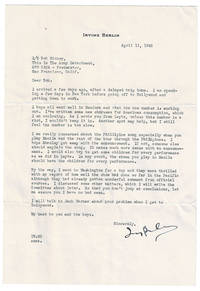
1945réf. 100362April 11 1945. 1945. Very good. - Over 250 words typed on his personal 10-1/2 inch high by 7-1/4 inch wide embossed watermarked linen stationery. Irving Berlin writes to Bob Sidney the choreographer of his important World War II musical "This Is the Army" concerning new music he created for the show's tour of the Philippines. He writes that "I hope all went well in Mendora Mindora and that the new number is working out.As I wrote you from Leyte unless this number is a riot I wouldn't keep it in. Another spot may help but I still feel the number is too slow." Berlin had introduced his new song "Heaven Watch the Philippines" during a ceremony in Leyte in March of 1945 singing the song with a chorus of Filipino girls and the cast of the play "This Is the Army". He wrote the song as a tribute to the Filipino people and their resilience during World War II. In his letter to Bob Sidney he expresses his concern that the song will be misunderstood. "I am really concerned about the Philippine song especially when you play Manila and the rest of the tour through the Philippines. I hope Shanley Pvt. Robert Shanley got away with the announcement. If not someone else should explain the song. It makes much more sense with an announcement. I would also try to get some children for every performance as we did in Leyte. In any event the shows you play in Manila should have the children for every performance." Signed in full "Irving Berlin". Folded for mailing with some light creases. Near fine. Originally composed as a Broadway Musical Irving Berlin's "This is the Army" was staged as a morale-boosting revue to raise money for the troops. The musical opened on Broadway on July 4 1942 during the Second World War with a cast consisting of 300 uniformed soldiers. The show was so successful that it was followed by a national and international tour playing in the European Far East and Pacific Theaters of War. Irving Berlin designed the show so that he could insert new songs depending on the location of the performances. "My British Buddy" was composed for the English performances and "Heaven Watch the Philippines" for Pacific Island shows. The song "Heaven Watch the Philippines" was written as a tribute to the Filipino people's resilience during the war and as a benefit to aid in the recovery following the war. Dedicated to General Douglas MacArthur Berlin sang the song with a chorus of Filipino girls and the cast of the musical in a presentation ceremony in Philippine city of Leyte in March 1945. He subsequently donated the song to the country with proceeds to go to the Boy & Girl Scouts of the Philippines. The Russian-born American composer and songwriter Irving Berlin 1888-1989 wrote an estimated 1500 songs including scores for 20 Broadway musicals and 15 Hollywood movies. His music forms a large part of the Great American Songbook. The American choreographer Robert Sidney 1909-2008 was self-taught as a dancer. He made his Broadway debut in "On Your Toes" in 1936 and appeared in George Balanchine's "Keep Off the Grass". Assigned to the Special Services Division during the Second World War he was the principal choreographer for Irving Berlin's musical "This Is The Army" and was later involved in the movie version starring Ronald Reagan. He choreographed many Broadway shows and worked with Bing Crosby Rita Hayworth Nancy Walker Jackie Gleason Cyd Charisse Debbie Reynolds and Mitzi Gaynor. He also went on to work in television choreographing for "The Dean Martin Show" television versions of musicals and 4 Academy Awards shows. April 11, 1945.
1922réf. 25341ELos Angeles 1922. Original Typed Letter Signed by Harold Lloyd to Hollywood producer William E. Keefe. Single sheet 7 inches by 10 1/8 inches. Signed “Harold Lloyd” in black fountain pen ink on his pictorial orange and silver Harold Lloyd letterhead dated “August 17 1922”. The letter reads in full: “My dear Mr. Keefe:- I want to offer you my sincere thanks for the very kind manner in which you handled GRANDMA’S BOY. It was indeed mighty nice of you and I deeply appreciate it. With my most sincere good wishes Harold Lloyd”. Very good with two old mailing folds and some minor soiling to the back side. At the time of this letter Lloyd had two films released: the first of which was his favorite film titled Grandma’s Boy directed by Fred C. Newmeyer written by Hal Roach Sam Taylor and Jean C. Havez with Mildred Davis and Anna Townsend and Dr. Jack with Mildred Davis and John T. Prince. Harold Lloyd was one of the biggest stars during Hollywood’s Golden Age of silent film comedy. Some of his most memorable films include Safety Last! 1923 Girl Shy 1924 The Freshman 1925 The Kid Brother 1927 and Speedy 1928. unknown
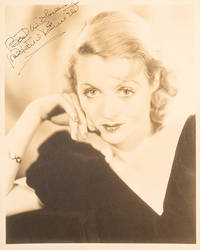
réf. 06014Various Places: 1930-2000. A Vivid Gallery of Hollywood History From Silent-Era Pioneers to Golden Age Stars HOLLYWOOD ICONS. A Collection of Twenty-Eight Original Signed and Inscribed Photographs. Various places various dates ca. 1930s-1970s. Twenty-eight black-and-white photographs sizes ranging from 5 x 7 in. to 10 x 8 in. each boldly signed or inscribed by leading actors actresses directors producers and musicians of Hollywood's Golden Age and beyond. All items in near-fine or better condition many with personalized inscriptions. A remarkable assembly of signed portraits representing the glamour and breadth of twentieth-century cinema and stage including Academy Award winners legendary directors pioneering producers and iconic performers. Together these images form a vivid gallery of Hollywood history: from silent-era pioneers Anna May Wong Raoul Walsh Fay Wray to Golden Age stars Tyrone Power Joan Fontaine Olivia de Havilland Janet Gaynor Rosalind Russell and from influential directors and producers John Ford William Wyler King Vidor Billy Wilder Otto Preminger Hal Wallis Joe Pasternak to cross-disciplinary figures such as Leonard Bernstein. The inscriptions many personalized add a layer of provenance and human connection to these iconic names. The Photographs: Constance Bennett - Signed 10 x 8 in. photograph. Joan Bennett - Signed 9½ x 8 in. photograph. Leonard Bernstein - Signed 10 x 8 in. portrait. Madeleine Carroll - Signed 7 x 5 in. photograph. Joan Fontaine - Signed 10 x 8 in. portrait. John Ford - Signed 9 x 8 in. photograph. Janet Gaynor - Inscribed 7 x 10 in. photograph dated 1937. Helen Hayes - Signed 10 x 8 in. portrait. Jennifer Jones - Signed 10 x 8 in. photograph. Elia Kazan - Signed 10 x 8 in. photograph. Herbert Marshall - Inscribed 10 x 8 in. photograph dated 1938. Mike Nichols - Signed 9 x 7 in. photograph. Olivia de Havilland - Signed 10 x 8 in. portrait dated August 1971. Joe Pasternak - Inscribed 9½ x 7 in. photograph. Tyrone Power - Signed 10 x 8 in. portrait. Otto Preminger - Signed 10 x 7 in. photograph dated 1972. Dolores del Río - Signed 10 x 8 in. photograph. Rosalind Russell - Signed 10 x 8 in. portrait. Budd Schulberg - Inscribed 10 x 8 in. photograph. Lupe Vélez - Signed 9½ x 7 in. photograph. Hal B. Wallis - Inscribed 10 x 8 in. portrait. Raoul Walsh - Inscribed 10 x 8 in. photograph. Billy Wilder - Signed 9¾ x 7¾ in. photograph. Anna May Wong - Inscribed 10 x 8 in. portrait with Chinese characters dated 1932. Fay Wray - Signed 7 x 5 in. photograph. William Wyler - Inscribed 10 x 8 in. photograph. King Vidor - Signed 10 x 8 in. photograph dated 1972. Loretta Young - Inscribed 9½ x 7¾ in. photograph. Various Places: , 1930-2000 unknown
réf. 06014Various Places: 1930-2000. A Vivid Gallery of Hollywood History From Silent-Era Pioneers to Golden Age Stars HOLLYWOOD ICONS. A Collection of Twenty-Eight Original Signed and Inscribed Photographs. Various places various dates ca. 1930s-1970s. Twenty-eight black-and-white photographs sizes ranging from 5 x 7 in. to 10 x 8 in. each boldly signed or inscribed by leading actors actresses directors producers and musicians of Hollywood's Golden Age and beyond. All items in near-fine or better condition many with personalized inscriptions. A remarkable assembly of signed portraits representing the glamour and breadth of twentieth-century cinema and stage including Academy Award winners legendary directors pioneering producers and iconic performers. Together these images form a vivid gallery of Hollywood history: from silent-era pioneers Anna May Wong Raoul Walsh Fay Wray to Golden Age stars Tyrone Power Joan Fontaine Olivia de Havilland Janet Gaynor Rosalind Russell and from influential directors and producers John Ford William Wyler King Vidor Billy Wilder Otto Preminger Hal Wallis Joe Pasternak to cross-disciplinary figures such as Leonard Bernstein. The inscriptions many personalized add a layer of provenance and human connection to these iconic names. The Photographs: Constance Bennett - Signed 10 x 8 in. photograph. Joan Bennett - Signed 9½ x 8 in. photograph. Leonard Bernstein - Signed 10 x 8 in. portrait. Madeleine Carroll - Signed 7 x 5 in. photograph. Joan Fontaine - Signed 10 x 8 in. portrait. John Ford - Signed 9 x 8 in. photograph. Janet Gaynor - Inscribed 7 x 10 in. photograph dated 1937. Helen Hayes - Signed 10 x 8 in. portrait. Jennifer Jones - Signed 10 x 8 in. photograph. Elia Kazan - Signed 10 x 8 in. photograph. Herbert Marshall - Inscribed 10 x 8 in. photograph dated 1938. Mike Nichols - Signed 9 x 7 in. photograph. Olivia de Havilland - Signed 10 x 8 in. portrait dated August 1971. Joe Pasternak - Inscribed 9½ x 7 in. photograph. Tyrone Power - Signed 10 x 8 in. portrait. Otto Preminger - Signed 10 x 7 in. photograph dated 1972. Dolores del Río - Signed 10 x 8 in. photograph. Rosalind Russell - Signed 10 x 8 in. portrait. Budd Schulberg - Inscribed 10 x 8 in. photograph. Lupe Vélez - Signed 9½ x 7 in. photograph. Hal B. Wallis - Inscribed 10 x 8 in. portrait. Raoul Walsh - Inscribed 10 x 8 in. photograph. Billy Wilder - Signed 9¾ x 7¾ in. photograph. Anna May Wong - Inscribed 10 x 8 in. portrait with Chinese characters dated 1932. Fay Wray - Signed 7 x 5 in. photograph. William Wyler - Inscribed 10 x 8 in. photograph. King Vidor - Signed 10 x 8 in. photograph dated 1972. Loretta Young - Inscribed 9½ x 7¾ in. photograph. Various Places: , 1930-2000 unknown books
1942réf. 267081942 SIGNED B/W Original Wedding Portrait Photograph 13 7/8 X 11 inchesProtected in Stiff Clear Plastic & BoardMinor Wear SIGNATURES GUARANTEED AUTHENTIC VG Quickly they Were Nicknamed Cash & Cary Signed photograph of them together is as Scarce as Hens Teeth Cary lived 1904-1986 & Hutton lived 1912-1979. Signed by Author. 1st Edition. Unbound. Very Good/No Jacket.
1930réf. 15984JNew York: Vanguard Press 1930. First Edition First Printing. Signed by the authors: "Carroll and Garrett Graham June 19 1930". On the front pastedown is the engraved theatrical scene bookplate of Fritz Tidden who was the Hollywood publicist for great silent film director Erich von Stroheim and is known to have been one of only 12 people at a special screening who was shown the complete Greed Von Stroheim’s 1924 massive uncut 42 reel film masterpiece before it was dramatically cut by the studio to only 10 reels. A few small stains to cloth otherwise very good in a very good dust jacket with a few small chips and tears with the words office file copy stamped in a blank space on the rear panel. The front cover colorful artwork depicts a scantily clad beautiful actress posed in recline on a film set with a director and film crew photographing her. Queer People is considered one of the true landmarks in the continuous evolution of the Hollywood novel. The novel’s take of the bizarre and seamy side of the life of Hollywood during its golden age is like no other work of fiction. In the 1976 reprint edition Budd Schulberg wrote “.in Queer People we have if not THE Hollywood novel - at least a truly seminal work on Hollywood in which may be found the seeds of at least three of the longer-lived Hollywood novels The Day of the Locust What Makes Sammy Run and The Last Tycoon.” The book was a scandalous sensation when published and went through numerous printings very quickly. At publication multi-millionaire film producer Howard Hughes bought the film rights to the novel. He hired Leo McCarey to direct and Ben Hecht to write the screenplay. Hughes biggest problem turned out to be that stars were extremely reluctant to appear in a film that attacked the Hollywood studio system. Hughes initially wanted to cast Jack Oakie and William Haines but Paramount and MGM refused to loan them out. Unable to secure a significant cast Hughes ended the production after spending over $100000 of 1930s dollars in its preparation. Vanguard Press hardcover
1944réf. 28504New York: Scribner's 1944. SIGNATURE GUARANTEED AUTHENTIC Personally SIGNED BY RAYMOND CHANDLER & DATED on Blank Endpapers Hollywood MARCH 30 1944 IN FRONT OF BOOK Written BY BEN HECHT A Guide for the Bedeviled Chandler also added "From // Dr. Sam Hirshfeld" on Endpapers BOOK Written BY BEN HECHT HARDBACK NODustjacket NOJACKET BK GOOD CONDITION 1944 SIGNED BY RAYMOND CHANDLER & DATED Hollywood MARCH 30 1944 IN FRONT OF BOOK BY BEN HECHT A Guide for the Bedeviled GREEN CLOTH LIGHT RUB WEAR Hirshfeld was a Hollywood physician active in the 1940's and a good friend of Hecht's & CHANDLER - he is mentioned in "Harpo Speaks" as attending a Marx dinner with Hecht and Hecht gave his funeral oratory. The cloth boards are worn and the dust jacket is missing. Interior sound. BOOK Written BY BEN HECHT . Signed by Author. Hard Cover. Good/No Jacket. New York: Scribner's hardcover
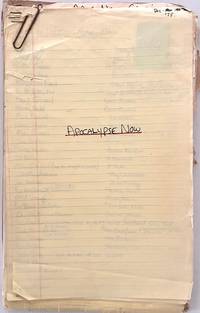
1960réf. 3108Hollywood: np 1960. First edition. nb. Very Good. An extensive archive of casting and production material from the files of Fred Roos casting director and Academy Award-winning producer spanning more than six decades of American filmmaking 1960s to 2023. Few people shaped New Hollywood as directly as Fred Roos. As a casting director and later as Francis Ford Coppola's longtime producing partner he helped identify the actors who would define American cinema from the late 1960s onward. His producing credits include The Conversation and Apocalypse Now and he shared the Academy Award for Best Picture for The Godfather Part II. This archive drawn from his working papers comprises over 4750 pages and roughly 1450 discrete objects in six banker boxes. We know of no more complete collection of his casting files. Major files cover The Godfather Trilogy American Graffiti Apocalypse Now and Raiders of the Lost Ark alongside Five Easy Pieces Zabriskie Point Harold and Maude and television work including The Andy Griffith Show and That Girl. The archive's great strength is how much it preserves of what never happened. A January 1971 page of Godfather casting notes written less than two months before filming lists Jack Nicholson Robert De Niro Martin Sheen and James Caan for Michael; Gene Hackman and Bruce Dern for Tom Hagen; and Anne Bancroft for Mama Corleone. A 1968 list for the minor role of "Boy" in Antonioni's Zabriskie Point includes Harrison Ford Al Pacino Sam Elliott Peter Fonda and Nicholson. An early Harold and Maude list includes Richard Dreyfuss and Rob Reiner. The Godfather Part II files make up about a quarter of the archive. They go well beyond casting to include production memoranda logistical planning and Roos's notes to Coppola on story structure character motivation and narrative coherence. Among the most remarkable material in these files is Roos's running commentary on the editing of The Godfather Part II. It opens with several pages headed "Fred Roos - Notes - on 'GF II' first cut July 13 '74." The notes are numbered and direct: "I don't quite believe that the young Vito escapes from Don Francesco's the way it is now cut"; "I worry that the audience will not clearly see that there are dead bodies throats cut in the stream after the machine-gunning." From there ten further pages of notes follow the film through successive screenings between July 27 and October 4 1974 as it was recut ahead of its December 1974 release. Most are headed with the date and place of a screening "Screening @ FFC Hs - Aug. 22 '74 - Run time 3:45 'sh" and many are addressed directly to Coppola and the film's editors. Read in order they show the film's central problems being worked out one cut at a time. Some problems run through all of it. In July Roos asks for the first shot of Fanucci to be lengthened "We must clearly get a fix on his face"; in September he is still asking. The intercutting of the Vito and Michael stories which became the film's defining structure is still being tested: an August 1 page is headed "New linear structure Old-New" and a July 30 note worries that audiences will take the Sicilian killings for flashbacks. Fredo's betrayal is not yet landing either: "I agree with people at screening who don't know what Fredo had done & why Michael says 'you've broken my heart' - Important that it be very clear that it was that Fredo had set up Michael for machine gunning." By October 4 the instruction is to "Examine 'Broke my Heart' cutting - for most wrenchingly effective moment - FFC try cutting it." Another note is simply: "I want to see Neri kill Fredo." In the finished film Fredo is killed by Al Neri. Other notes propose an intermission "after shootout & before Havana" ask for "Xmas music B. Crosby" under a scene and record preview audiences' reactions to the young Vito sequences. Running through it all are Roos's brief handwritten first impressions of actors often a few words jotted as a performer first came into view. Harrison Ford in 1968: "very interesting - blond - strong handsome face." Julia Roberts in The Godfather Part III files: "very sexy - red hair - sister of Eric Roberts." A 1989 letter to Coppola tracks Roberts's schedule on a film then titled 3000 released the following year as Pretty Woman. Notes from 2017 for Fairyland evaluate a young Sabrina Carpenter. Similar notes appear on George Clooney Reese Witherspoon Keanu Reeves Jim Carrey Natalie Portman and Jennifer Lawrence and on many other stars and supporting actors. Just as many of the names on these lists never broke through or had only brief careers. Their presence is part of the record showing the full field of actors in contention for a part before anyone knew which of them would last. Casting lists sit alongside script notes budgets schedules and correspondence annotated and reused across projects. Together they form a primary-source record of how films were actually assembled from the late studio era through New Hollywood and into the contemporary industry. The archive comprises over 4750 pages and approximately 1450 discrete objects preserved in six banker boxes. Please click on pdf below images for more information. Full description available upon request. np unknown
1960réf. 3108Hollywood: np 1960. First edition. nb. Very Good. An extensive archive of casting and production material from the files of Fred Roos casting director and Academy Award-winning producer spanning more than six decades of American filmmaking 1960s to 2023. Few people shaped New Hollywood as directly as Fred Roos. As a casting director and later as Francis Ford Coppola's longtime producing partner he helped identify the actors who would define American cinema from the late 1960s onward. His producing credits include The Conversation and Apocalypse Now and he shared the Academy Award for Best Picture for The Godfather Part II. This archive drawn from his working papers comprises over 4750 pages and roughly 1450 discrete objects in six banker boxes. We know of no more complete collection of his casting files. Major files cover The Godfather Trilogy American Graffiti Apocalypse Now and Raiders of the Lost Ark alongside Five Easy Pieces Zabriskie Point Harold and Maude and television work including The Andy Griffith Show and That Girl. The archive's great strength is how much it preserves of what never happened. A January 1971 page of Godfather casting notes written less than two months before filming lists Jack Nicholson Robert De Niro Martin Sheen and James Caan for Michael; Gene Hackman and Bruce Dern for Tom Hagen; and Anne Bancroft for Mama Corleone. A 1968 list for the minor role of "Boy" in Antonioni's Zabriskie Point includes Harrison Ford Al Pacino Sam Elliott Peter Fonda and Nicholson. An early Harold and Maude list includes Richard Dreyfuss and Rob Reiner. The Godfather Part II files make up about a quarter of the archive. They go well beyond casting to include production memoranda logistical planning and Roos's notes to Coppola on story structure character motivation and narrative coherence. Among the most remarkable material in these files is Roos's running commentary on the editing of The Godfather Part II. It opens with several pages headed "Fred Roos - Notes - on 'GF II' first cut July 13 '74." The notes are numbered and direct: "I don't quite believe that the young Vito escapes from Don Francesco's the way it is now cut"; "I worry that the audience will not clearly see that there are dead bodies throats cut in the stream after the machine-gunning." From there ten further pages of notes follow the film through successive screenings between July 27 and October 4 1974 as it was recut ahead of its December 1974 release. Most are headed with the date and place of a screening "Screening @ FFC Hs - Aug. 22 '74 - Run time 3:45 'sh" and many are addressed directly to Coppola and the film's editors. Read in order they show the film's central problems being worked out one cut at a time. Some problems run through all of it. In July Roos asks for the first shot of Fanucci to be lengthened "We must clearly get a fix on his face"; in September he is still asking. The intercutting of the Vito and Michael stories which became the film's defining structure is still being tested: an August 1 page is headed "New linear structure Old-New" and a July 30 note worries that audiences will take the Sicilian killings for flashbacks. Fredo's betrayal is not yet landing either: "I agree with people at screening who don't know what Fredo had done & why Michael says 'you've broken my heart' - Important that it be very clear that it was that Fredo had set up Michael for machine gunning." By October 4 the instruction is to "Examine 'Broke my Heart' cutting - for most wrenchingly effective moment - FFC try cutting it." Another note is simply: "I want to see Neri kill Fredo." In the finished film Fredo is killed by Al Neri. Other notes propose an intermission "after shootout & before Havana" ask for "Xmas music B. Crosby" under a scene and record preview audiences' reactions to the young Vito sequences. Running through it all are Roos's brief handwritten first impressions of actors often a few words jotted as a performer first came into view. Harrison Ford in 1968: "very interesting - blond - strong handsome face." Julia Roberts in The Godfather Part III files: "very sexy - red hair - sister of Eric Roberts." A 1989 letter to Coppola tracks Roberts's schedule on a film then titled 3000 released the following year as Pretty Woman. Notes from 2017 for Fairyland evaluate a young Sabrina Carpenter. Similar notes appear on George Clooney Reese Witherspoon Keanu Reeves Jim Carrey Natalie Portman and Jennifer Lawrence and on many other stars and supporting actors. Just as many of the names on these lists never broke through or had only brief careers. Their presence is part of the record showing the full field of actors in contention for a part before anyone knew which of them would last. Casting lists sit alongside script notes budgets schedules and correspondence annotated and reused across projects. Together they form a primary-source record of how films were actually assembled from the late studio era through New Hollywood and into the contemporary industry. The archive comprises over 4750 pages and approximately 1450 discrete objects preserved in six banker boxes. Please click on pdf below images for more information. Full description available upon request. np unknown books