8203 risultati
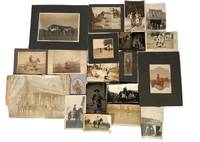
1880rif. 194771880. Western Americana Cowboy photograph archive documenting armed riders ranch labor rodeo culture and frontier mobility across the American West between the 1880s and 1920s. Images capture working cowboys on horseback cattle branding scenes and interactions with Native American families during the late frontier period when cattle ranching and horse culture formed the backbone of Western rural economies. These photographs provide visual documentation of occupational practices such as branding long distance riding and mounted travel through difficult terrain during the closing decades of the open range era and the early twentieth century transition toward modern ranching systems. Archive of twenty original photographs in multiple photographic formats including tintypes albumen prints and silver gelatin photographs. Images date approximately from the 1880s through the 1920s and depict cowboys riding horses working cattle participating in rodeo competitions and traveling across rugged Western landscapes. Several photographs show armed riders carrying pistols or rifles including one large albumen print showing a mounted cowboy with a rifle across his lap. One photograph depicts cowboys branding livestock with a caption reading "Brother Manzer Branding his Cow." A real photo postcard dated circa 1910 shows several cowboys on horseback crossing a large river with water rising to the horses' necks. Another image shows a cowboy with a Native American family wearing traditional clothing in rocky badlands terrain. Photographs illustrate the working environment and material culture of Western cattle operations including ranch yards feed lots and livery stables. Rodeo imagery reflects the transformation of working ranch skills into organized public competitions during the early twentieth century. Image sizes vary. Overall minor wear consistent with age. Very good condition. A cohesive visual record of cowboy labor frontier mobility and Western ranching culture across four decades of the American West. unknown books
1890rif. 202841890. Photographers unknown. African American cowboy photographs late 19th century. These images document Black participation in ranching and frontier life in the decades following emancipation when a significant proportion of working cowboys in the American West were African American. The photographs record both labor and self-presentation through an outdoor riding scene and a formal studio portrait providing evidence of how Black men and youth engaged with western occupations mobility and dress during a period when new economic opportunities emerged alongside persistent racial constraints. The material supports research into African American labor history western expansion and the social formation of Black life in the post-Civil War United States. Two photographs comprising one albumen print and one tintype each approximately 2.5 x 3.5 inches. The albumen image depicts a young African American boy mounted on a bucking horse holding a cowboy hat and riding crop dressed in a buttoned shirt trousers and lace-up boots; a tipi structure is visible in the background situating the scene within a western or plains environment. The tintype presents a studio portrait of a young African American man wearing a striped three-piece suit and a wide-brimmed hat associated with late nineteenth-century western fashion indicating the circulation of frontier dress within formal portrait settings. Together the images contrast lived outdoor activity with constructed studio identity documenting both labor and presentation. These photographs align with broader patterns of African American migration and employment in the American West after the American Civil War when formerly enslaved individuals sought work in ranching cattle driving and related trades. Historians have noted that a substantial number of cowboys in the late nineteenth century were Black though their presence has often been underrepresented in popular narratives of the West. Visual documentation of African American riders and western dress provides primary evidence for the study of labor identity and mobility in this period particularly in relation to how individuals navigated new economic roles following emancipation. Minor corrosion affecting a portion of one image primarily in a blank area; remaining details clear and legible. Overall very good condition. unknown books
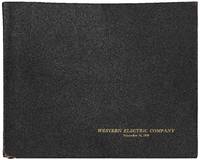
1928rif. 545041Cicero Illionis 1928. Hardcover. Very Good. Oblong folio 12 ½" x 10. A handsome presentation album consisting of three letterpress leaves followed by 27 gelatin silver prints neatly mounted on the rectos of thick card leaves each with a letterpress caption printed underneath. All but the first print measure 8" x 10". Screw-bound in flexible leather covers lettered in gold on the front cover. Head and tail of spine are torn the cardboard leaves are slightly bowed very good or better. The album was prepared "upon the occasion of a visit of city officials and business men of Baltimore to the Hawthorne Works of the Western Electric Company." It contains crisp professional views mostly of the Hawthorne factory complex at Cicero Illinois as well as a few views of other parts of the Company's operations such as the plant in Kearny New Jersey and the distribution houses in New York and Kansas City. Among the many visually striking views are "A three and one-half acre" interior the "Reel Yard operating by Floodlight" throngs of employees at a "Hawthorne-Club Open-Air Dance" and a final view of employees leaving the complex under a dramatic sunset "After the day's work." At the peak of its operations from 1905 through 1983 the Hawthorne Works employed upwards of 45000 people in the production of radio systems radar and telephone equipment and related consumer goods. Located in a suburb of Chicago the complex also gained notoriety for the term "Hawthorne effect" which "refers to the type of reactivity in which individuals modify an aspect of their behavior in response to their awareness of being observed." An early scarce promotional album dating from the heyday of Western Electric during the roaring twenties. hardcover books
1925rif. 178071925. Photograph and postcard archive circa 1910s-1940s documenting rodeo culture and competitive riding traditions across the American West with particular emphasis on organized events such as the Pendleton Round-Up and regional competitions in Oregon Montana and Nevada. The collection captures core rodeo practices including saddle bronc riding bull riding relay racing and bulldogging presenting visual evidence of both individual performers and large public gatherings. Identified riders such as Leonard Stroud Soapy Williams Milt Moe Frank Smith and Paddy Ryan appear in action situating the material within a period when rodeo emerged as a structured spectator sport tied to regional identity and western heritage. Images of grandstands filled with spectators Labor Day competitions and named championship events indicate the scale and institutionalization of rodeo culture in the early twentieth century while repeated depictions of high-risk maneuvers document the physical demands and performance conventions that defined the sport. Archive of 16 photographs and real photo postcards primarily measuring approximately 4.75 x 3 inches with one smaller photograph measuring approximately 1.75 x 2.5 inches. Most images are real photo postcards several bearing AZO and DOPS stamp boxes consistent with production dates between approximately 1925 and 1942 alongside earlier material including a copyrighted 1918 image and one example dating to 1904. Locations identified include Pendleton Oregon; Bozeman Montana; and Nevada. Several images carry printed or negative titles including "Leonard Stroud on Indian Tom wins championship at Cheyenne Wyo."; "Soapy Williams on Glasseye"; and "Milt Moe on Tea Trader." The archive includes multiple scenes from the Pendleton Round-Up featuring bulldogging by Frank Smith in 1923 relay racing during a 1925 Labor Day event and additional captioned scenes such as "They treat 'em rough at the Roundup." Other images depict riders thrown from horses bull riding sequences and staged or candid action views that emphasize the dynamic movement and risk inherent in rodeo performance. Sixteen photographs and postcards on cardstock mounts with a mix of black and white and sepia tones. Light wear consistent with handling including minor surface wear and occasional spotting; overall very good condition. A concentrated visual record of early twentieth-century rodeo culture in the American West documenting named competitors regional events and the development of rodeo as a public spectacle. unknown books
1887rif. 513254New York: Press of Fleming Brewster & Alley 1887. Softcover. Very Good. First edition. 16mo. 8pp. illustrated by H.R. Ward. Printed wrappers sewn with red cord as issued. Front cover is moderately dust soiled else very good. An epic poem issued by the Western and Atlantic railroad: "St. Valentine February Fourteenth 1887" in remembrance of the Battle of Kennesaw Mountain in Georgia between the armies of Johnston and Sherman. The poem is issued in holograph facsimile with two full-page illustrations. Uncommon. (Press of Fleming, Brewster & Alley) unknown books
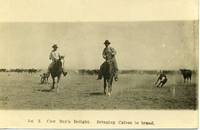
1910rif. 56461910. Reid Hal. No. 2. Cow Boy's Delight. Bringing Calves to Brand circa 1910 records the mounted labor involved in gathering cattle for branding on the western Kansas plains. The image supports research into ranch work livestock management cowboy occupational history and the visual construction of the American West during the early twentieth century. Rather than presenting a posed studio portrait the photograph captures working cowboys engaged in a specific stage of cattle handling preserving evidence of the horses ropes animals and open-range setting associated with regional ranching practice. Sepia-toned real photo postcard published by Hal Reid of Liberal Kansas measuring 5½ by 3½ inches. Two mounted cowboys occupy the foreground using ropes to bring calves away from a larger herd; an adult cow follows at the right while additional cattle extend across the background. The printed caption reads in full: "No. 2. Cow Boy's Delight. Bringing Calves to brand." An institutional description of another example identifies the same arrangement of two horsemen roped calves following cow and background herd while Fort Hays State University records Reid as a Liberal Kansas photographer responsible for a numbered series of western cattle scenes. Produced during a period when real photo postcards circulated localized images of western work to audiences beyond the communities depicted the postcard joins documentary observation with the popular imagery of cowboy life. Its emphasis on coordinated movement between riders horses calves and herd provides a compact visual record of ranch labor while the promotional title "Cow Boy's Delight" shows how such work was packaged for postcard consumers. Light expected handling wear; sepia toning remains clear and the printed caption is legible. Very good. A visually specific record of early twentieth-century cattle work and the commercial postcard culture through which western Kansas presented its ranching identity. unknown books
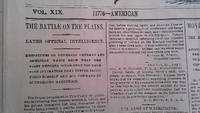
1876rif. 143791876. The Press July 7 1876 is a Philadelphia newspaper issue preserving early Eastern reporting on the Battle of the Little Bighorn and the death of George Armstrong Custer one of the most widely mythologized military defeats of the American Indian Wars. The issue appeared less than two weeks after the June 25 to 26 1876 battle along the Little Bighorn River where Lakota Northern Cheyenne and Arapaho warriors fought the U.S. Army's 7th Cavalry in south-central Montana. Its front-page account is significant as a contemporary record of how Custer's death was immediately framed for urban newspaper readers during the nation's Centennial summer emphasizing sacrifice military honor and shock rather than the Indigenous defense of land and sovereignty now central to historical interpretation. The Press. Philadelphia Pennsylvania. July 7 1876. Four pages present comprising pages 1 2 7 and 8 only. The front page is dominated by war-related reporting with the lead story addressing dispatches to Generals William T. Sherman and Philip Sheridan and stating that the first reports of Custer's defeat were "only too true." The article suggests "Custer sacrificed himself and his command by blundering hardihood" while also elevating him in memorial language: "The name Custer is a household word" and "Custer fell-fell at the head of his command; fell where Death's sickle cut close and sure." The surviving front-page spread offers a concentrated example of immediate post-battle newspaper rhetoric combining battlefield uncertainty military chain-of-command reporting and heroic commemoration before later national mythologies of "Custer's Last Stand" had fully hardened. The issue's timing gives it research value for the study of Reconstruction-era print culture U.S. military expansion Indigenous resistance and the formation of public memory around the Plains Wars. As a Philadelphia paper published days after the battle became national news it shows how eastern readers encountered the event through telegraphic dispatches and editorialized martial language during a year otherwise dominated by Centennial commemoration. Incomplete with only pages 1 2 7 and 8 present; slight wear and small tears around edges; otherwise well preserved very good. A strong contemporary newspaper survival centered on the first wave of public reaction to Custer's defeat and the national reframing of Little Bighorn in the summer of 1876. unknown books
1868rif. 167531868. Women's Education Movement. Western Female Seminary Catalog 1868-1869. Oxford OH. Western Female Seminary was founded in 1853 as a daughter school of Mount Holyoke College in South Hadley Massachusetts. Its first principal Helen Peabody and most of the early faculty had been students and teachers at Mount Holyoke. Mary Lyon Residence Hall on the Western campus is named for Mount Holyok's founder Mary Lyon. It later received a charter and became Western College an all-female institution. Women's colleges proliferated in the mid- to late- 19th century to fill the void created by their exclusion from most institutions of higher education. The prevailing notion that women were too delicate for a rigorous academic education was openly challenged when Elizabeth Cady Stanton spoke at the Seneca Falls Convention of 1848 "Man's intellectual superiority cannot be a question until woman has had a fair trial.When we shall have had our colleges our professions our trades for a century a comparison then may be justly instituted." Young women were quick to step up to the challenge; as quickly as female colleges opened they filled up. At the time that this description is being written no copies are recorded in American institutions. OCLC search results are at best an estimate and can vary over time. Women's Academy and Seminary Archive recording the first important movement of women into higher education in the United States seminary was synonymous with "academy" and did not have the religious connotation of today. In the 1800's the Female Academy and Seminary Movement transformed American educational norms allowing women the opportunity to receive secular non-religious college-level education. Women's colleges proliferated in the mid- to late- 19th century to fill the void created by their exclusion from most institutions of higher education. The prevailing notion that women were too delicate for a rigorous academic education was openly challenged when Elizabeth Cady Stanton spoke at the Seneca Falls Convention of 1848 "Man's intellectual superiority cannot be a question until woman has had a fair trial.When we shall have had our colleges our professions our trades for a century a comparison then may be justly instituted." Young women were quick to step up to the challenge; as quickly as female colleges opened they filled up. unknown books
1967rif. 167971967. Western Union International Inc. stock certificate 1967 documents the corporate financing of Western Union's international communications business during the transition from traditional telegraphy toward newer telecommunications technologies. Western Union had separated its international cable properties into Western Union International in 1963 and the company became publicly traded on the New York Stock Exchange in 1967. The certificate therefore dates to the year of that public listing and records the financial structure supporting an international communications enterprise descended from the nineteenth-century telegraph network. Western Union International Inc. Stock Certificate. 1967. Series N3669. Engraved and printed by the American Bank Note Company with an ornate orange border surrounding the principal text and a central vignette depicting two allegorical female figures among clouds. Printed facsimile signatures of the company's President and Secretary appear on the certificate. The document combines corporate ownership information with elaborate security engraving characteristic of American stock certificates preserving material evidence of Western Union International's capitalization in the year its shares entered public trading. Western Union's nineteenth-century telegraph network had transformed long-distance communication before telephone service increasingly displaced telegram traffic during the twentieth century. Its earlier confrontation with Bell over telephone patents ended with an 1879 settlement under which Western Union withdrew from the telephone business while telegraphy remained central to American commercial and social communication for decades afterward. By 1967 Western Union International belonged to a communications industry increasingly shaped by telephone cable microwave and other electronic transmission technologies making this certificate a dated corporate record of that technological transition. Condition not stated in the supplied description. unknown books
rif. 2852qsThe Marjorie Kinnan Rawlings Journal of Florida Literature 2009. Octavo paperbound stiff white illus. paper 143 pp. Quarter shaped tear to upper cover; otherwise Near-Fine. unknown books
rif. 2851qsThe Marjorie Kinnan Rawlings Journal of Florida Literature 2008. Octavo paperbound stiff white illus. paper 172 pp. Near-Fine. unknown books
rif. 2853qsThe Marjorie Kinnan Rawlings Journal of Florida Literature 2010. Octavo paperbound stiff white illus. paper 115 pp. Near-Fine. unknown books
1948rif. 90063scWestern Pennsylvania: A Friend of Pennsylvania 1948. Octavo stiff illus. stapled wrappers 32 pp. Near-Fine with slight age darkening to edges. Illustrated guide includes maps drawings of plants and wildlife of Western Pennsylvania. A Friend of Pennsylvania, 1948. unknown books
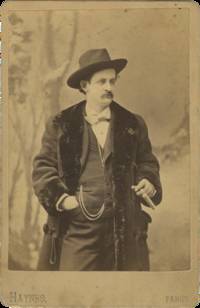
1879rif. Cat359Fargo Dakota Territory 1879. Cabinet card photograph measuring appx 4 x 5 ½ inches on larger mount. Very good plus. An early studio portrait by Frank Jay Haynes taken during his initial establishment in Fargo Dakota Territory shortly after his 1879 move from Moorhead. The mount—“Art Studio cor. 8th Ave. & Main St.”—appears to represent Haynes’s first likely short-lived location in the city set just off the main commercial corridor before he relocated his business to the more prominent Front Street Main Avenue. The sitter an affluent-looking man in a fur overcoat holds a cane. In 1879 the affluent class of Fargo consisted primarily of railroad officials tied to the Northern Pacific Railway for which Haynes would later become the official photographer land agents and speculators capitalizing on townsite expansion grain merchants and elevator operators profiting from the wheat boom and a small professional class. Haynes was the first major photographer in the area and would have a prolific output; this image represents an example of his early work before he was established in the city. unknown books
1946rif. 4326Denver: The Smith-Brooks Printing Company 1946. 42pp Oblong quarto 25 cm x 30.5 cm Gray printed wrappers with a photograph of the Upper Colorado on the front panel. Better than very good. 20 tinted plates 16.5 cm x 20 on white leaves with the facing page prints a paragraph description of the view. All images are sights that one could see riding the D&RGW through Colorado. Double-page plate at the center 21 cm 51 cm 'Colorado's Highest Mountains.' Double-page pictorial map at the end. The Smith-Brooks Printing Company unknown books
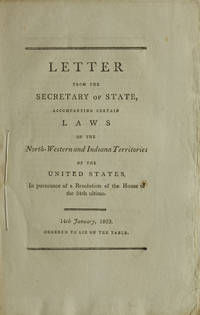
1802rif. 216710Washington D.C. 1802. First edition. 53 pp. 1 vols. 8vo. Sewn uncut. Fine. First edition. 53 pp. 1 vols. 8vo. Shaw and Shoemaker 3298 2 copies unknown books
1941rif. TB33750Washington DC: U.S. Department of the Interior National Park Service WPA and CCC 1941. First Edition. Both volumes of this complete two volume set are in very good and near fine conditions. Both are small quartos of 10 1/4 by 7 3/4 inches bound in adhesive bindings in light brown cloth covered boards with darker brown text on the spines and front boards. The cloth at the head and heel of volume I is rubbed and worn and the upper fore corners of the front and rear boards are bumped but professionally straightened and strengthened. Volume II shows only light wear to the cloth at the head of the spine and the text block for this volume was made from two-hole punched paper. Volume I is made from standard un-holed paper. Both volumes contain four index tabs each. In volume I: Northwest Inland States; Pacific States; Yellowstone; and Yosemite; Volume II: Central States Southwestern National Monuments; Southwestern States; and Territorial Parks and Monuments. These two volumes contain 664 pages of bibliographies on 79 national parks and national monuments each one with its own pagination. This bibliography is not listed in any of the WPA or American Guide resources held by Town's End Books. OCLC locates only five institutions owning the book version of this title. The forward contained in volume I mentions that this project started in 1936 with: where "much credit is due Mrs. Hazel Hunt Voth for originally laying out the program and directing it until her resignation in April 1939." Hazel Voth's other other major accomplishment was A Bibliography of Yellowstone National Park which is reprinted in this set. U.S. Department of the Interior, National Park Service, WPA and CCC hardcover books
1925rif. 3241N.p. 1925. Very good plus. Eight silver gelatin photographs 5.25 x 2.75 inches all with pencil annotations on verso. Mild edge wear. An intriguing collection of eight annotated vernacular photographs picturing construction and other work taking place at an unnamed western riverside fort. The manual labor for the project was performed by incarcerated men who are sometimes pictured. The annotations on the verso of each image provide valuable information on the activities and settings in the pictures. The images themselves show the stockade adjacent to the river the prisoners' dining hall the front part of the bunkhouse and dining tent an elevated view of the stockade showing sand and cement being hauled down a nearby road three young men preparing dinner "prisoners building a concrete wall" "prisoners working on the retaining walls" and "prisoners starting a wall in the side of a very bad slide." In the latter photograph the compiler of the photographs reveals his own involvement in the activities here: "You can see me R.B.A. standing with a gun on my shoulder." An interesting group of photographs documenting the long tradition in the United States of employing prison labor to perform back-breaking manual labor. unknown books
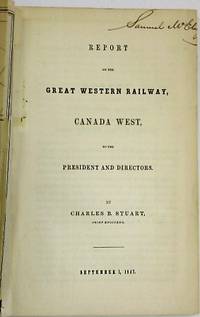
1847rif. 27881Ontario 1847. 47 1 blank pp plus two folding maps as issued: 'Map and Profile of the Great Western Railway Canada West' 48 1/2 cm x 32 cm; 'Map of the Route of the Great Western Railway Shewing its Connection with other Public Works' 35 1/2 cm x 29 cm. Versos with expertly repaired closed tears short margin tear else Very Good. The railroad is "on the precise ground that will enable it to control the trade and travel of such a vast portion of the Canadas and the prosperous American States." TPL 2850. Sabin 28478n. unknown books
1870rif. 58937Dublin: Midland Great Western Railway of Ireland n.d. 1870. Unaccomplished pro-forma folio broadside approx. 13¾" x 8¾" on gray paper; fine. Pro-forma contract for the purchase of rails and fish plates with blanks left for tons of rails date terms signature and date. "To be delivered free on any part of the wharves of the Royal Canal Docks at Dublin that may be pointed out by the engineer or into lighters in the docks at his option . With the rails sufficient fish plates ared provided . the rails and fish plates are to correspond accurately with the annexed drawings" not present. Unlocated. Midland Great Western Railway of Ireland, n.d. unknown books
1900rif. 51798Chicago: Curt Teich & Co. for the Van Noy Inter-State Co 1900. Oblong 4to unpaginated; 25 full-pg illustrations in color and mounted two pages of text containing illustration descriptions; tan pictorial wrappers lettered in black & gilt color illustration mounted on upper cover ribbon-bound; covers a bit toned at edges corners creased illustrations clean & bright overall very good. A picturesque view-book of "the most interesting views seen along the route" of Utah Nevada and California. Curt Teich & Co. for the Van Noy Inter-State Co unknown books
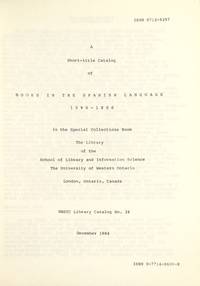
1984rif. 43714London Ontario: University of Western Ontario 1984. First edition 4to pp. 2 viii 1 plus 91 leaves; printed from typescript; original black cloth tape-backed yellow wrappers about fine. WHSTC Western Hemisphere Short-Title Catalog Library Catalog no. 24. University of Western Ontario unknown books
1988rif. 43710London Ontario: University of Western Ontario 1988. Reissue 4to 1 vii 65 leaves; printed from typescript; original black cloth tape-backed yellow wrappers; fine. WHSTC Western Hemisphere Short Title Catalog Library Catalog no. 20. University of Western Ontario unknown books
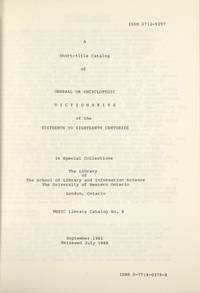
1988rif. 43712London Ontario: University of Western Ontario 1988. Reissue 4to pp. 2 vii 1 plus 33 leaves; printed from typescript; original black cloth tape-backed yellow wrappers; fine. WHSTC Western Hemisphere Short-Title Catalog Library Catalog no. 8. University of Western Ontario unknown books
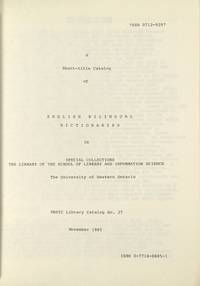
1985rif. 43716London Ontario: University of Western Ontario 1985. First edition 4to pp. 2 vii 1 plus 38 leaves; original black cloth tape-backed yellow wrappers; about fine. WHSTC World Hemisphere Short-Title Catalog Library Catalog no. 27. University of Western Ontario unknown books