10.482 resultados
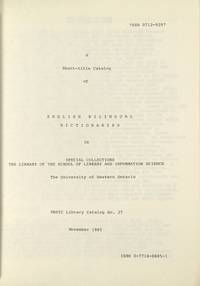
1985ref. 43716London Ontario: University of Western Ontario 1985. First edition 4to pp. 2 vii 1 plus 38 leaves; original black cloth tape-backed yellow wrappers; about fine. WHSTC World Hemisphere Short-Title Catalog Library Catalog no. 27. University of Western Ontario unknown books
1988ref. 43713London Ontario: University of Western Ontario 1988. Reissue 4to pp. 2 vii 1 plus 60 leaves; printed from typescript; original black cloth tape-backed yellow wrappers; fine. WHSTC Western Hemisphere Short-Title Catalog Library Catalog no. 10. University of Western Ontario unknown books
1960ref. 39953Orange CA: Great Western Cordage n.d. 1960. 4to spiral-bound salesman's sample book flexible brown morocco lettered in gilt on upper cover containing 34 original full-page photographs of Great Western Cordage products in various stages of production including rope twine specialities. Manila sisal cotton synthetics etc. with 8 pages of printed description of same illustrated throughout: fine. Great Western Cordage, n.d. unknown books
1960ref. 39951Orange CA: Great Western Cordage n.d. 1960. 4to pp. 24; original pictorial wrappers illustrated throughout and containing a section on knots and a glossary of cordage terms. Fine. Great Western Cordage, n.d. unknown books
1959ref. 39824Orange CA: Great Western Cordage 1959. 4to pp. 103; black 3-ring binder lettered in orange with 3 internal tabs Handbook Special Products Price Lists illustrated throughout and containing a section on knots and a glossary of cordage terms. Fine throughout. Great Western Cordage unknown books
1952ref. 72847New York 1952. Paperback. Very Good. photos 36p. Wrapper. Softcover. 28cm. paperback books
1940ref. 69647New York 1940. Paperback. Very Good. 126p. White wrapper. 31cm. Some cover soil and browning. Annual Report Form A Large and Medium Steam Roads and Switching and terminal Companies. paperback books
1983ref. 75708n.p. 1983. Paperback. Very Good. photos 60p. Wrapper. 28cm. Minor wear. Name and phone number in pencil on cover. Organization founded in 1954 of golf clubs organized by African Americans in California and other Western states. According to their 2022 website about 27 clubs including three asterisked as "predominantly female" clubs were members of this organization. paperback books
1958ref. 75538Pittsburgh 1958. Paperback. Very Good. Single sheet folded to form a narrow eight-page booklet. 22cm. paperback books
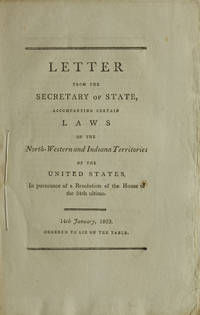
1802ref. 216710Washington D.C. 1802. First edition. 53 pp. 1 vols. 8vo. Sewn uncut. Fine. First edition. 53 pp. 1 vols. 8vo. Shaw and Shoemaker 3298 2 copies unknown books
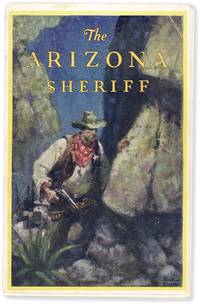
1925ref. 90208N.p. South Bend: Studebaker Corporation of America 1925 but 1926. 1926 reprint per rear wrapper slug. 16mo. Color printed thick-paper wrappers; 48pp; illus. Mild cover wear; child's pencil graffiti inside front cover; text clean tight and unmarked. A Very Good copy. A Studebaker "infomercial." The author Sheriff of Yavapai County presumably on commission for the manufacturer surveys his fellow lawmen throughout the state to report on the service records of their Studebaker police cruisers. The endorsements are presented in the form of Wild West lawman narratives well-illustrated with both b/w photographs and color vignette illustrations by Benton H. Clark. ADAMS SIX GUNS 1979 Noted as "scarce" but also as "A historically unimportant little pamphlet". Studebaker Corporation of America unknown books
ref. 80817A substantial archive of 779 original photographs documenting a young woman homesteader's life in North Dakota and Eastern Oregon beginning around 1910 through the 1940s. Photos are generally about 3" x 5" or the reverse a few smaller including some wallet-size images and several larger up to approximately 9" x 6". 102 are loose photos; the remainder are laid into four well-composed albums of varying dimensions as ennumerated below. About one third of album images are captioned though none are dated. Overall condition is Very Good with occasional rippling to images that have been pasted onto album leaves; occasional mild fading to the earliest photographs; five album images missing though very possibly present among loose photos. Idella Cook née McElrath was born in 1894 to a farming family in Dakota County Minnesota about twenty miles south of Minneapolis. The U.S. Census of 1910 shows the McElraths still residing in Orchard Lake Minnesota; but around that time the family appears to have emigrated to Plaza North Dakota in the sparsely-populated northwest corner of the state near the present-day Fort Berthold Indian Reservation. Idella remained in North Dakota until 1917 when she relocated to Klamath Falls Oregon possibly in the company of her future husband a druggist professional photographer and traveling salesman named Roy H. "Doc" Cook. The couple married in 1922. In Klamath Falls Idella learned photography and darkroom work presumably under the tutelage of Mr. Cook then in 1929 the couple opened a general store "Idella's" that operated continuously until 1947 and then until 1978 under new owners selling groceries curios photographs of local scenery and folk remedies. All of these phases of Idella Cook's life are captured in the current archive as is a one-year sojourn 1925-6 in Hawaii. However the bulk of material contained in two thick albums is devoted to the relatively brief interval - no more than six years - between the family's arrival in North Dakota and Idella's departure to Oregon in 1917. Idella's precise status in North Dakota is difficult to pinpoint. Her 1972 obituary in the Klamath Falls Herald and News states: ".as a young girl she staked out a claim on a homestead in North Dakota.17 miles from the nearest town" implying that she had emigrated to North Dakota on her own. However the photographs present here clearly show Idella in the presence of her family members including her younger sister Izetta born in 1904 and looking eight or nine years old in the earliest photos; another photo shows a stout man leading two draft horses captioned "Papa". A January 1913 notice in a Minot ND newspaper The Ward County Independent lists an "N.G. McElrath" almost certainly a transcription error for "U.G. McElrath" Idella's father as one of a group of about 200 settlers activating to carve a new county out of the the northeastern portion of the Bertholdt Reservation which had been opened to non-Indian settlement in 1910. So while it is clear that Idella's family settled in Plaza at some point between April 1910 and January 1913 it is not clear that Idella had yet ventured out as a homesteader. Assuming then that these photos date from the period 1911 to 1912 Idella would have been seventeen or eighteen years old - not precisely a "young girl;" also not old enough to claim a parcel under the Homestead Act but certainly old enough to strike out on her own. Not until 1917 when she is 21 do we find land office records in Idella's name - as the purchaser of four parcels totalling sixty acres near the now-defunct town of Sanish which was later inundated in the construction of Lake Sakakawea in 1953. Shortly after the purchase of those parcels Idella appears to have moved to Oregon. Idella's dependent status notwithstanding these are extraordinary photographs. The earliest images present a vivid picture of the windswept and desolate existence of the area's early settlers. The brand-new town of Plaza founded in 1908 is well represented looking rather like a 1950s cowboy movie set with horse-drawn carriages far outnumbering motorcars on the towns main street. Also represented in a number of photographs is the now-disappeared hamlet of Sanish a town which was inundated in the creation of Lake Sakakawea in 1953. Also lost in that event were many square miles of land sacred to the Mandan Hidatsa Arikara Nation whose members are also a constant presence in Cook's photographs; one important series of photographs captures a large Indian pow-wow likely held on the newly-established Fort Berthold Reservation around 1910. Though the albums are extensively captioned providing a wealth of information on the early settlement and demography of the region they are occasionally wanting for specifics of date and/or locale leaving much deductive work to be done to pinpoint locations and events. Of almost equivalent interest are the many photographs taken and developed by Idella after her move to Klamath Falls around 1917. These were still early days in eastern Oregon with many towns only coming into being in the 1890's and provide a wealth of grass roots historical detail that cannot be found outside primary source materials like this. unknown books
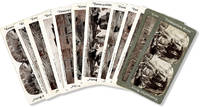
ref. 62435N.p. n.d. ca 1910s: Cosmopolitan Series. Twelve lithoprint stereoviews on cardstock each 3-1/2" x 7". Very mild edge-rubbing occasional light soil on versos; Very Good to Near Fine. A selection of Western and Native American scenes from this anonymously-published series. Though not expensively produced and though printed images halftones rather than original photos this selection is unusual for being very well-preserved. Includes scenes in New Mexico Colorado Yellowstone Park Alaska Minnesota and Arizona along with a few unlocated western views - "Camping in the Wild West;" "A Real American Cowboy;" and three Native American views including "Chippewa Squaw Making Birch Canoe" "Chief Blackhaw Squaw and Papoose;" and "Mounted Sioux Indians Western Plains." For brief reference on the series see DARRAH p.120. Cosmopolitan Series unknown books
1836ref. 49788Pittsburgh: William Allinder 1836. First Edition. Octavo 22.5cm.; removed; 22pp. Rather worn and somewhat soiled and toned remnants of original wrappers along spine margins; Good or better overall. The fourth and final report issued by the Society including letters from missionaries in western Africa the Ganges and among the Native American tribe the Wea. William Allinder unknown books
1951ref. 29849New York: Bell Telephone Laboratories Inc. for Western Electric Co. Inc 1951. First Thus. Stiff wraps. Near Fine. First Thus. 1-blank 7 792 pages. Large 4to 8 1/2 x 11 inches. Original printed thick grey cardstock covers. Previous owner name "A.E. Smith Code 434 ONR" written at head of top wrapper. The best copy of this work we have handled - it is notorious for the spine bowing away from the textblock and copies with provenance are difficult to find. Stiff wraps. The previous owner was Albert Eugene Smith a computer pioneer. He was the Acting Head of the Computer Branch of the Office of Naval Research ONR in 1949 see Redmond & Smith founder of the Digital Computer Newsletter and a participant in the development of the COBOL programming language working along side Grace Hopper and others. He was ONR's representative at the Moore School Lectures. See Wikipedia and Grokipedia for more information on Smith. THE TRANSISTOR contains 34 articles plus the introduction covering material given at a symposium on transistors held at the Bell Telephone Laboratories during the week beginning Sept. 17 1951. It includes work from luminaries like William Shockley 1956 Nobel Laureate in Physics with Bardeen and Brittain for "their researches on semiconductors and their discovery of the transistor effect" who contributed to three articles including "Holes and Electrons" derived from his similarly named book and "The Theory of p-n Junctions in Semi-Conductors and p-n Junction Transistors" published previously in the Bell System Technical Journal. From the transistor's invention in 1948 through the early 1950s the fledgling electronics industry was encouraged and funded by the military driving significant research into this startling new technology and it's potential. In retrospect the transistor was one of the most signficant inventions of the 20th century. Moore's law and the continual shrinking of transistor devices from a single device the size of a pea illustrated herein to many many thousands of transistors in the same space have driven the computer revolution and fundamentally changed our society in the process. This symposium details work conducted by primarily Bell System researchers to share what was then known much of it conducted under government contracts and previously unpublished. The symposium treats "theory transistor properties circuit design principles applications and finally characteristics of different transistor types then under development." As the Foreword notes: "It will be recognized that in a broad sense this constitutes by a progress report. The art is moving rapidly. There are still many problems to be solved and some of the material reported may be soon out of date. It is too early for a full appraisal of the extent to which the transistor may find its place in the field of electronics. Just now it is a promising infant trying to shed its swaddling clothes. It is hoped that this report will assist in this effort. Bell Telephone Laboratories Inc. Murray Hill N.J. November 5 1951." Important early work in the field of electronics. PROVENANCE: Purchased from Smith's descendants LITERATURE: Kent C. Redmond and Thomas M. Smith "Manuscript Edition Project Whirlwind Case History Bell Telephone Laboratories, Inc. for Western Electric Co., Inc unknown books
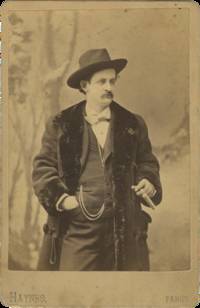
1879ref. Cat359Fargo Dakota Territory 1879. Cabinet card photograph measuring appx 4 x 5 ½ inches on larger mount. Very good plus. An early studio portrait by Frank Jay Haynes taken during his initial establishment in Fargo Dakota Territory shortly after his 1879 move from Moorhead. The mount—“Art Studio cor. 8th Ave. & Main St.”—appears to represent Haynes’s first likely short-lived location in the city set just off the main commercial corridor before he relocated his business to the more prominent Front Street Main Avenue. The sitter an affluent-looking man in a fur overcoat holds a cane. In 1879 the affluent class of Fargo consisted primarily of railroad officials tied to the Northern Pacific Railway for which Haynes would later become the official photographer land agents and speculators capitalizing on townsite expansion grain merchants and elevator operators profiting from the wheat boom and a small professional class. Haynes was the first major photographer in the area and would have a prolific output; this image represents an example of his early work before he was established in the city. unknown books
1941ref. TB33750Washington DC: U.S. Department of the Interior National Park Service WPA and CCC 1941. First Edition. Both volumes of this complete two volume set are in very good and near fine conditions. Both are small quartos of 10 1/4 by 7 3/4 inches bound in adhesive bindings in light brown cloth covered boards with darker brown text on the spines and front boards. The cloth at the head and heel of volume I is rubbed and worn and the upper fore corners of the front and rear boards are bumped but professionally straightened and strengthened. Volume II shows only light wear to the cloth at the head of the spine and the text block for this volume was made from two-hole punched paper. Volume I is made from standard un-holed paper. Both volumes contain four index tabs each. In volume I: Northwest Inland States; Pacific States; Yellowstone; and Yosemite; Volume II: Central States Southwestern National Monuments; Southwestern States; and Territorial Parks and Monuments. These two volumes contain 664 pages of bibliographies on 79 national parks and national monuments each one with its own pagination. This bibliography is not listed in any of the WPA or American Guide resources held by Town's End Books. OCLC locates only five institutions owning the book version of this title. The forward contained in volume I mentions that this project started in 1936 with: where "much credit is due Mrs. Hazel Hunt Voth for originally laying out the program and directing it until her resignation in April 1939." Hazel Voth's other other major accomplishment was A Bibliography of Yellowstone National Park which is reprinted in this set. U.S. Department of the Interior, National Park Service, WPA and CCC hardcover books
1925ref. 3241N.p. 1925. Very good plus. Eight silver gelatin photographs 5.25 x 2.75 inches all with pencil annotations on verso. Mild edge wear. An intriguing collection of eight annotated vernacular photographs picturing construction and other work taking place at an unnamed western riverside fort. The manual labor for the project was performed by incarcerated men who are sometimes pictured. The annotations on the verso of each image provide valuable information on the activities and settings in the pictures. The images themselves show the stockade adjacent to the river the prisoners' dining hall the front part of the bunkhouse and dining tent an elevated view of the stockade showing sand and cement being hauled down a nearby road three young men preparing dinner "prisoners building a concrete wall" "prisoners working on the retaining walls" and "prisoners starting a wall in the side of a very bad slide." In the latter photograph the compiler of the photographs reveals his own involvement in the activities here: "You can see me R.B.A. standing with a gun on my shoulder." An interesting group of photographs documenting the long tradition in the United States of employing prison labor to perform back-breaking manual labor. unknown books
1965ref. RWILNEW16efHelios 1965. Very Good. Wilby Basil editor. New Dimensions April/May 1965. Volume 3 Number 13. Western Mark; Ratazzi Peter. Cheltenham Gloucestershire UK: Helios 1965. 60pp. 8vo. Pale blue stapled wraps. Book condition: Very good with slightly yellowed spine and lightly bumped edges. Contains articles How to Read the Tarot Occult Experiences of a Witch The Shadow and more. Helios paperback books
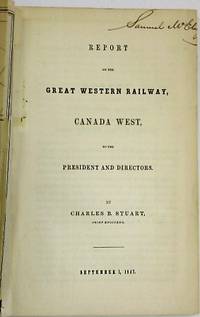
1847ref. 27881Ontario 1847. 47 1 blank pp plus two folding maps as issued: 'Map and Profile of the Great Western Railway Canada West' 48 1/2 cm x 32 cm; 'Map of the Route of the Great Western Railway Shewing its Connection with other Public Works' 35 1/2 cm x 29 cm. Versos with expertly repaired closed tears short margin tear else Very Good. The railroad is "on the precise ground that will enable it to control the trade and travel of such a vast portion of the Canadas and the prosperous American States." TPL 2850. Sabin 28478n. unknown books
1895ref. 143511895. BICYCLES. Western Wheel Works. Crescent Bicycles 1895. Chicago 1895. 15 1 p. Illus. Wrappers. Very good. "Advance catalogue." Illustrated trade catalogue of bicycles. unknown books
1895ref. 143521895. BICYCLES. Western Wheel Works. Crescent Bicycles 1895. Chicago 1895. 20 p. Illus. Wrappers. Very good. Illustrated trade catalogue of bicycles and bicycle parts. unknown books
1848ref. 3601848. PENNSYLVANIA. Western Pennsylvania Hospital. First Annual Report of the Managers . Together with the Act of Incorporation. Pittsburgh 1848. 16 p. Printed wrappers. Old library stamp on wrapper. Slight damp-staining. Much information on the process of setting up a hospital. unknown books
ref. 44211Japan and Western Medicine. Oranda jin Geka ryoji no zu Dutch Surgery in Nagasaki. Original pen ink and watercolor drawing on light brown-toned silk with 4 vertical lines of Japanese characters in the upper left corner. Japan: late 18th or early 19th century. 483 x 363 mm. mounted as a scroll at a modern date on light grey silk backed with paper with a half-round hanging rail with braided ribbon attached at the top and a suspension bar at the foot measuring 914 x 443 mm. overall; preserved in a custom-made wooden box. A few tiny pinholes in upper corners of image but fine with the coloring fresh and bright. This striking image showing an amputation carried out by a Dutch surgeon in Japan was most likely painted in the late eighteenth or early nineteenth century during Japan's self-imposed period of national isolation. The hand-painted image is related but by no means identical to a Nagasaki woodblock print titled "Surgery by a Dutch Physician" one of many popular souvenir prints depicting scenes unique to Nagasaki which at the time was the sole point of contact between Japan and the outside world. See our reproduction of the print. It may be that our scroll is the original of the image; however it is also possible that both hand-painted and woodcut versions of the image were produced simultaneously. Western surgery came to Japan in the sixteenth and seventeenth centuries via the Portuguese who in 1543 became the first Europeans to make direct contact with Japan and the Dutch who became the only European nation allowed to trade with Japan after Japan's expulsion of the Portuguese in 1639. Surgeons attached to the Dutch East India Company established practices at the island of Dejima in Nagasaki Bay which led to the formation of several Japanese schools of surgery based on European methods. "This aspect of Western medicine known as K m -ry geka or 'Surgery of the Red-Haired' has had a profound effect on the development of surgical practice in Japan" Van Gulik p. 37. Van Gulik "Dutch surgery in Japan" in Red-Hair Medicine: Dutch-Japanese Medical Relations ed. Beukers et al. pp. 37-50. . unknown books
ref. 2852qsThe Marjorie Kinnan Rawlings Journal of Florida Literature 2009. Octavo paperbound stiff white illus. paper 143 pp. Quarter shaped tear to upper cover; otherwise Near-Fine. unknown books