Trigault, Nicolas u. Matteo RicciAntiquariat.de
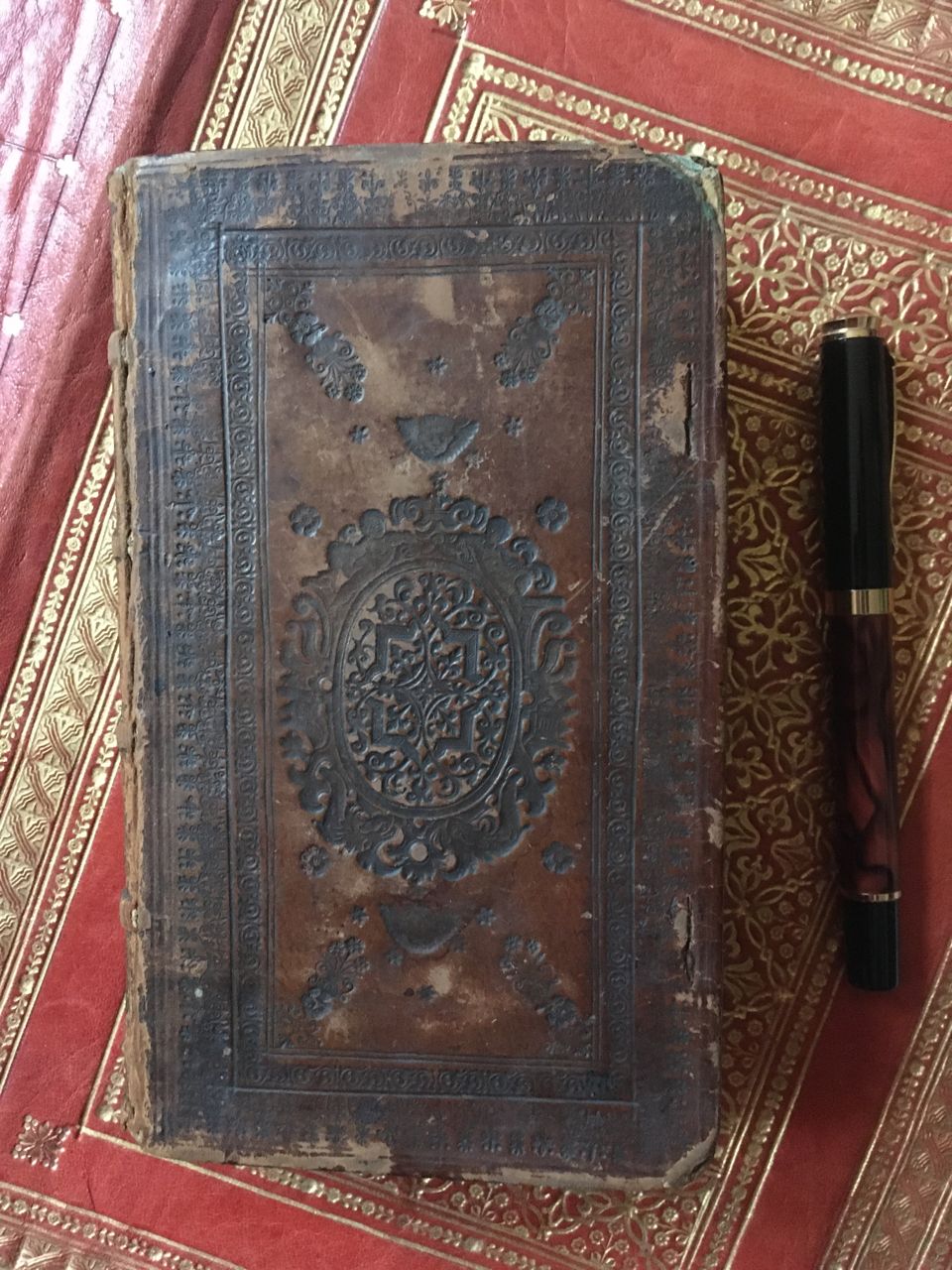
1640réf. CHI3155Herbipoli (Würzburg), Henricus Pigrin, 1640. 7 S. Vorrede, 4 S. Inhaltsverz., 712 Seiten Text, 21 S. Index, H 18 x 11 x 4,5 cm, ornament. gepr. Ganzleder, Vollgoldschnitt. - Einband mit Gebrauchsspuren, berieben, beschabt. Altes Ex Libris, Name (geschwärzt) auf Vorsatz, Name auf Titel. Fraßspuren? auf letzten Seiten. Buchblock fest, ungelesen. fest gebunden/ hardcover
réf. LCS-18446Précieux exemplaire relié à l’époque en maroquin rouge aux armes d’Emmanuel-Céleste-Augustin de Durfort, duc de Duras, maréchal de France. Paris, Ruault, 1776. 2 tomes en 2 volumes in-8 de : I/ (1) f.bl., 1 frontispice gravé à pleine page, viii pp., 512 pp., (1) f.bl.. Saut dans la pagination de la p. 501 à la p.505 sans manque. Pt. trou de vers dans la marge des pp. 505 à 511; II/ (1) f.bl., (2) ff., 1 frontispice gravé à pleine page, 720 pp., (2) ff. d’approbation, (1) f.bl. Qq. légères rousseurs. Maroquin rouge de l’époque, triple filet doré encadrant les plats avec petits fleurons d’angles, armoiries dorées frappées au centre des plats, dos à nerfs ornés de fleurons dorés, pièces de titre et de tomaison de maroquin vert, filet doré sur les coupes, roulette intérieure dorée, tranches dorées. Qq. très discrets trous de vers sur les dos. Reliure de l’époque. 193 x 122 mm.
réf. LCS-1864052
1892Series complete from volume 1 to volume 83 (1892-1990) except for (missing:) volume 77 fasc.1 and volume 82 (1989), Original 1892-1990-edition (NO reprints), 25cm., volumes 1 to 45 and 47 to 50 are uniformly bound in nice hardcover bindings (marbled boards, spine in red leather with gilt lettering, marbled endpapers), volumes 46 and 51 to 83 are in original softcover (with few traces of use at some fascs.), together over 60.000 pages, with some ills., provenance: from the private collection of the Belgian byzantinist prof. Justin Mossay (with his ex-libris stamp and ex-dono ex-libris tipped in), very good set, ISSN 0007-7704, X93332
réf. LCS-186442
réf. LCS-18505Exemplaire de luxe réimposé sur grand papier en maroquin d’époque armorié. A Paris, chez Prault, 1775. 1 volume in-4, (3) ff., 1 portrait de Marie-Thérèse à pleine page hors texte, 337 pp., (3) pp. d’approbation, 4 planches hors texte. Plein maroquin rouge, triple filet doré autour des plats, armoiries au centre, dos lisse orné, pièce de titre de maroquin vert, double filet or sur les coupes, roulette intérieure, tranches dorées. Reliure armoriée de l’époque. 250 x 188 mm.
réf. LCS-1864034
réf. LCS-18454Exemplaire en maroquin rouge de l’époque. A Paris, chez Vente et Patas, 1775. In-4 de xii pp. y compris le titre gravé, pp. 1 à 92, (2) ff., pp. 95 à 147, (18) ff., 91 pp., (1) p., 9 tableaux sur double-page, 39 planches de costumes à pleine page, 1 grand plan dépliant, 1 planche d’armoiries dépliante, qq. discrètes brunissures sans gravité. Maroquin rouge, triple filet doré encadrant les plats, dos à nerfs orné de fleurons dorés, filets dorés sur les coupes, roulette intérieure, tranches dorées. Reliure de l'époque. 251 x 183 mm.
réf. LCS-18523L’un des rarissimes imprimé sur papier impérial conservé dans sa reliure de l’époque aux armes de l’Empereur Napoléon Ier. Paris, Imprimerie Impériale, 1812. Grand in-8 de 362 pp. Maroquin rouge à grain long, large roulette dorée autour des plats, armoiries au centre, dos lisse orné, coupes décorées, roulette intérieure, gardes et contre gardes de moire bleue, tranches dorées. Reliure de l’époque. 205 x 120 mm.
réf. LCS-18483Paris, Imprimerie Royale, 1661. Paris, de l’Imprimerie Royale, Sébastien Cramoisy, 1661. In-4 de (22) ff., 637 pp., (1) p. Maroquin rouge, triple filet doré encadrant les plats, armes frappées or au centre, dos à nerfs orné de fleurs-de-lys, coupes décorées, roulette intérieure dorée, tranches dorées. Reliure de l’époque. 244 x 173 mm.
réf. LCS-18572Précieux exemplaire à marges immenses (hauteur 175 mm) des bibliothèques Lurde et Ruble. Louvain (Francfort?), 1755. Petit in-8 de (2) ff., 161 pp. Plein maroquin citron, chiffre doré dans les angles des plats, dos à nerfs orné du même chiffre doré et répété, double filet or sur les coupes, roulette dorée intérieure, tranches dorées. Motte. 175 x 105 mm.
1624Köln, Ioannis Gymnici, Antonius Boetzer, 1624 a. 1621-1640. Folio. (40 x 26 cm.). Bound in 8 (thick) uniform contemp. full pigskin over wood. Raised bands and richly blindtooled covers. Titlelabels with gilt lettering. Clasps missing. Spines a bit rubbed. Wear to some spineends. Some upper compartments with nicks, one volume having a tear in leather at upper compartment. One volume having a small loss of leather also at upper compartement. With engraved title-page, engraved portrait of Baronius, engraved portrait of pope Urban VII. More than 10000 pp. Printed in double-columns. In general internally fine.
1691réf. AMO-4508[Paris, Elie Josset, 1691-1705] 9 volumes in-12 à pagination multiple. Environ 400 à 500 pages par volume. Reliure janséniste strictement de l'époque plein maroquin vieux rouge doublé maroquin vieux rouge, dos à nerfs, pièces de titre en maroquin olive portant uniquement le mois de l'année, roulette dorée en encadrement des pièces de titre, tranches dorées sur marbrure, doublures de maroquin vieux rouge encadrées d'un jeu de filets et roulette dorés, roulette dorée sur les coupes. Ex libris contrecollé sur la doublure (premier contreplat) de tous les volumes. Les volumes ont été reliés sans les pages de titre (volontaire). Exemplaire réglé à l'encre rouge. Très bel ensemble avec de minimes défauts d'usage (un mors partiellement fendu et consolidé au deuxième volume, infimes frottements, petits manques de cuir à deux coiffes inférieures, petit travail de vers sur une doublure sans gravité). (reliures attribuables à Luc-Antoine Boyet).
1923réf. 000435Berlin: Propyläen-Verlag. Very Good with no dust jacket. 1923. Leather Spine Tips. A MASTERPIECE OF BOOK DESIGN ONE OF THE MOST BEAUTIFUL FINE PRESS BOOKS AND A HIGH POINT OF GERMAN AND FRENCH LITERARY AND ARTISTIC TRADITIONS Number 117 of 400. No copies in 30 years in the American auction records. 17 Original Lithographs signed twice by Max Liebermann and numbered. Book: HEINE Heinrich. DER RABBI VON BACHERACH. Propyläen-Verlag Berlin 1923. Folio. With 17 ORIGINAL Lithographs by Max Liebermann. 1/2 Black Morocco and boards. This copy SIGNED TWICE as usual on limitation and additionally not in all copies on frontispiece lithograph. Minor spotting and soiling to beige boards otherwise a HANDSOME AND FINE COPY and internally clean. This book is a wonderful combination of two Jews one who brought to France German literary tendencies and the other who brought to the Germans French artistic tendencies. Heinrich Heine has been called 'the first modern intellectual' and became one of the greatest and most respected writers of the 19th century. Leibermann was the Great German artist that led the Berlin secession group and introduced French impressionism to Germany. This fine press book a magnificent combination of typography design and illustration is often lauded as among the most beautiful of Jewish fine press books if not all fine press books. Liebermann demonstrates a refined sensitivity in his artwork that parallels the emotive text. The Rabbi of Bacherach includes a lovely and romantic description of a Passover- the earliest and most expressive of the essence of the festival in modern Jewish literature. The story here recounts that in trans. and referring to the Haggadah " It was an old heirloom with ancient wine stains. It had come down from the days of her grandfather. The book contained many boldly and brightly colored pictures. As a little girl she had often looked at it so eagerly on Passover evenings." ; German Language; Folio - over 12" - 15" tall; JUDAISM HEBREW LANGUAGE Jewish Literature Kabbalah Judaica Jewish Studies Hebrew Talmud ; Signed by Illustrator . Propyläen-Verlag hardcover
1737réf. AMO-4509London, Printed for the Author ; and sold by W. Innys and R. Manby, 1737 3 parties reliées en 2 volumes in-8 (23,6 x 15 cm) de (13)-XXXII-431-(1 bl.) et (10)-352 pages, suivi de "An Appendix in Answer to a Book, etc." en pagination séparée de 85-(27) pages. Reliure strictement de l'époque plein maroquin noir, dos à nerfs richement ornés aux petits fers dorés, large dentelle dorée en encadrement des plats, armoiries dorées au centre des plats, roulette dorée sur les coupes et en encadremen intérieur des plats, doublures et gardes de papier peigne, tranches dorées. Légères marques aux reliures, sans gravité. Petits manques aux pièces de titre et sur un bord de coiffe (coiffe supérieure du premier volume), coins légèrement frottés ou usés, sans gravité, armoirires dorées sur le premier plat du premier volume légèrement frottées. Intérieur en bon état, imprimé sur beau papier fort à grandes marges (large paper).
1919réf. 0008194DAMASCUS PRE SYRIA POST OTTOMAN EMPIRE. Fair. 1919. On offer is a powerful poignant letter written by an early Zionist and volunteer of the Jewish Legion in Damascus immediately after the end of WW1. The letter contains 2 double-sided sheets measuring 9' x 5.8' and an envelope measuring 5.9' x 4.9'. The envelope has no inscriptions or stamps except a round sticker with bookseller's name - "Coles" the sheets are yellowed and torn in half at folds but it does not affect the text which is perfectly legible. The letter is written in Hebrew addressed to Shimon and signed by Shlomo Solomon. It seems from the context that they are very close friends. The first page bears the date and place: Damascus August 20 1919. It is also clear that the author was a Dutch Jew who had lived in Eretz Israel for some time before joining the military. Based on the date when he joined the army summer 1918 and other context it can be said with high level of certainty that he was a member of the Jewish Legion. The Jewish Legion was the name of 39th through 42nd Battalions of the Royal Fusiliers in the British Army that were formed of Jewish volunteers. The formation of a Jewish Regiment was initiative of Zeev Jabotinsky and Joseph Trumpeldor promoted by John Henry Patterson. Among its members were also David Ben-Gurion Dov Hoz Yitzhak Ben-Zvi Yakov Drori Levi Eshkol and other famous Zionist leaders many later became members of Haganah and laid the foundation of the Israel Defence Army. The initial unit Zion Mule Corps was formed in 1914 - 1915 in August 1917 formation of a Jewish regiment was officially announced in spring and summer 1918 volunteers from Palestine joined 39th and 40th Battalions and started service. That's exactly when the author volunteered: "My Dear Shimon some time ago I received your last letter probably the first one that you wrote to me in Hebrew and now I have a little more time and will answer to you when I am calm also in Hebrew - now I have been a soldier for over a year but what we hoped for when we volunteered for the Army was not realized.". There is something deeply moving in this letter full of thoughts about the future of Israel: "Until there is Jewish Army in the full sense of the word probably a long time must pass. This moment has not come yet. Unfortunately that's what we feel deep in our hearts. But anyway these times have been times of very important and interesting experiments and in this sense this time --- has not been lost" p.1; ".it is not possible yet to breathe freely much is still missing we can only hope that soon . the way out of the darkness the uncertainty where we are now will become clear that it will be possible to start large great fruitful work the giant work requiring all our spiritual and physical efforts without a second thought of each and each of us . to achieve our supreme goal our people living in the Land of Israel - happy people in fertile land" p.2. He has acute interest in current affairs of the Zionist movement writing about the convention of the Va'ad HaPoel HaZioni The Action Committee that was convening in London in the last week of August. The purpose of the congress was to work out principles of the Zionist movement in the era after the WW1 and the Balfour Declaration: ".Only when all great difficulties will be defeated when the situation is settled. This is our heart hope! . the convention that will be now in London will contribute to clearing up the situation. Is this convention a sort of a congress of representatives from all countries also from Germany and Austria Otherwise it is not a general convention and it will not have any authority to make declarations in the name of all Zionism". He is particularly interested in developments in Zionist movement in Holland mentioning names of some noted Dutch Zionists. He writes about his mood and frustrations from the army service and mentions his family: "I want for once to live like a human being because life in the army is not life at the end. ---. I have been sent to work at different army offices and now I am in Damascus. It is interesting to see some of the world this way but that is not what I have volunteered to the Hebrew army for. But what to do ----. And I do not think that I will be able to get back to life until the next summer. I also wanted to go and see the mother and everyone and breathe a little different air after a while." He asks Shimon about his plans to come: "What do you think about coming to Israel And what do they think about your preparations . I have not seen any Dutch that came to Israel so far. Neither De Haan nor Van Friesland nor . I hope now to be near Jaffa and Jerusalem. What about the other that you wrote would come here". De Haan was a Dutch Jewish writer and journalist who became interested in Judaism and Zionism he actually moved to Israel the same year later became close with Orthodox community and get into conflict with secular Zionists 5 years later he was killed by Haganah members for his anti-Zionist activity. In the letter Shlomo also asks about his letters published by Handelsblad the most important daily newspaper in Holland. This letter is an amazing historical document reflecting aspirations and frustrations of early Zionists and their mood and concerns in the wake of the First World War and Balfour Declaration.; Manuscript; 8vo - over 7¾" - 9¾" tall; KEYWORDS: HISTORY OF; EARLY 20TH CENTURY; 1910S; WW1; FIRST WORLD WAR; GREAT WAR; MANDATORY PALESTINE; SYRIA; DAMASCUS; OCCUPIED ENEMY TERRITORY ADMINISTRATION ARAB KINGDOM OF SYRIA FRENCH MANDATE STATE OF ALEPPO STATE OF DAMASCUS STATE OF SYRIA ALAWITE STATE JABAL AL-DRUZE JEWS IN THE BRITISH ARMY; JEWISH VOLUNTEERS IN THE WW1; ZIONISM; EARLY ZIONISTS; ROYAL FUSILIERS; JEWS AND THE MILITARY; WARS; ERETZ ISRAEL; YISHUV; OCCUPIED ENEMY TERRITORY ADMINISTRATION OETA; OETA SOUTH; BATTALIONS 39TH- 42ND OF THE ROYAL FUSILIERS; JEWISH REGIMENT IN THE BRITISH ARMY IN WW1; PALESTINIAN JEWS; IDEOLOGY OF ZIONISM; FIRST JUDEANS; THE ACTIONS COMMITTEE; VA'AD HAPOEL HAZIONI 1919 CONGRESS; DUTCH JEWRY AND ZIONISM; JACOB ISRAEL DE HAAN; ZIONIST MOVEMENT AFTER WW1; HANDWRITTEN MANUSCRIPT DOCUMENT LETTER AUTOGRAPH WRITER HAND WRITTEN DOCUMENTS SIGNED LETTERS MANUSCRIPTS DIARY DIARIES JOURNALS PERSONAL HISTORY SOCIAL HISTORY HISTORICAL HOLOGRAPH WRITERS AUTOGRAPHS PERSONAL MEMOIR MEMORIAL ANTIQUITÉ CONTRAT VÉLIN DOCUMENT MANUSCRIT PAPIER ANTIKE BRIEF PERGAMENT DOKUMENT MANUSKRIPT PAPIER OGGETTO D'ANTIQUARIATO ATTO VELINA DOCUMENTO MANOSCRITTO CARTA ANTIGÜEDAD HECHO VITELA DOCUMENTO MANUSCRITO PAPEL . unknown
1576Kiøbenhaffn, (Andreas Gutterwitz og Hans Stockelmann), 1576. Folio. (27 x 19 cm.). Senere velbevaret hellæderbind i flammet kalv fra omkring 1850. Ryg med svagt ophøjede ægte bind, smalle forgyldte borter langs bindene. Forgyldt rygtitel: HUUSPOSTIL. Eksemplaret er næsten komplet, idet der kun mangler titelbladet til 1. del og det sidste blanke blad. Del.1: 13 (af 14) unummererede blade + 214 nummererede blade. Del 2: 234 nummererede + 13 unummererede. Med talrige monumentale halvsides træsnit i teksten illustrerende Jesu levnedsløb, hvis kunstner indtil for nylig var uidentificeret. (Se noten neden for). Nogle fejlpagineringer i begge Dele. 2 signaturer (læg) ombyttede (i 1. Del og i registeret). Trykt på svært papir og med lettere brugsspor, mest blandt de første blade i 1. Del. Ca. 20 blade omkantede, ca. 15 blade kantforstærkede i højre margin, 3 blade reparerede med teksttab. Enkelte blade reparerede i kanter med tab af bogstaver i marginalierne. Kolofonbladet repareret i alle kanter, men uden tab af tekst. Enkelte blade med svage skjolder og brunpletter. Et læg i registeret løsnet. Alt i alt et usædvanligt velbevaret eksemplar af dette monumentalværk i dansk teologisk litteratur.
1576réf. 59834Kiøbenhaffn, (Andreas Gutterwitz og Hans Stockelmann), 1576. Folio. (27 x 19 cm.). Senere velbevaret hellæderbind i flammet kalv fra omkring 1850. Ryg med svagt ophøjede ægte bind, smalle forgyldte borter langs bindene. Forgyldt rygtitel: HUUSPOSTIL. Eksemplaret er næsten komplet, idet der kun mangler titelbladet til 1. del og det sidste blanke blad. Del.1: 13 (af 14) unummererede blade + 214 nummererede blade. Del 2: 234 nummererede + 13 unummererede. Med talrige monumentale halvsides træsnit i teksten illustrerende Jesu levnedsløb, hvis kunstner indtil for nylig var uidentificeret. (Se noten neden for). Nogle fejlpagineringer i begge Dele. 2 signaturer (læg) ombyttede (i 1. Del og i registeret). Trykt på svært papir og med lettere brugsspor, mest blandt de første blade i 1. Del. Ca. 20 blade omkantede, ca. 15 blade kantforstærkede i højre margin, 3 blade reparerede med teksttab. Enkelte blade reparerede i kanter med tab af bogstaver i marginalierne. Kolofonbladet repareret i alle kanter, men uden tab af tekst. Enkelte blade med svage skjolder og brunpletter. Et læg i registeret løsnet. Alt i alt et usædvanligt velbevaret eksemplar af dette monumentalværk i dansk teologisk litteratur. Folio. (27 x 19 cm.). Later well preserved full mottled calf binding from ca 1850. Slightly raised real bands to spine, slim gilt borders along the bands. Gilt title to spine. The copy is nearly complete, as its is only lacking the title-page for part 1 and the final blank. Part 1: 13 (of 14) unnumbered leaves + 214 numbered laeves. Part II: 234 numbered leaves + 13 unnumbered leaves. Some paginational errors in both parts. Two quires have been swapped (in part 1 and the index). With numerous half-page woodcuts in the text depicting the life of Jesus. Until recently, the artist had remained unidentified (please see note below for clarification). Printed on thick, heavy paper. Signs of use, mostly to the first leaves of part 1. Ca 20 leaves re-margined, and ca 15 leaves re-inforced at outer margin. Three leaves repaired with loss of text. A few leaves restores at edges with marginal loss of lettering. All edges of colophon repaired, but no loss of text. A few leaves with light damp staining and brownspotting. One quire of the index loose. All in all an unusually well preserved copy of this extremely rare monument of Danish theology.
1912réf. 5925ABStuttgart, Ferdinand Enke, 1912-1943. 8°. Zahlr. Illustr.. Orig.-Ln. + Wichtig: Für unsere Kunden in der EU erfolgt der Versand alle 14 Tage verzollt ab Deutschland / Postbank-Konto in Deutschland vorhanden + Bd 1-65 (Bde 5, 29 u. 55 fehlen).
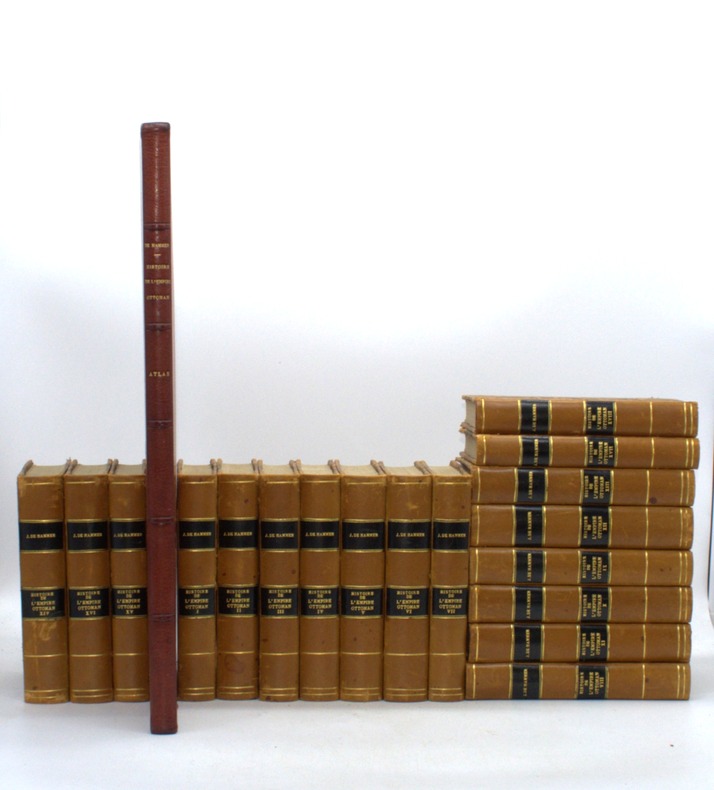
1835réf. PHO-1982Paris, Bellizard, Barthes, Dufour et Lowell ; Londres, Bossange, Barthes et Lowell ; Saint-Petersbourg, Fd. Bellizard et Cie, 1835-1844. 18 volumes de texte in-8 et un atlas in-folio. TEXTE : 18 volumes in-8, relié demi basane et coins moderne, dos lisse orné avec pièces d’auteur, titre et tomaison noires, frottements et épidermures, défauts d’usage, rousseurs dans le texte, tampon et étiquette du relieur. ATLAS : Paris. Bellizard, Dufour etc. 1844. Imprimé chez Thierry Frères. Demi basane et coins à long grain grenat, dos à nerfs avec titre et auteur, In-folio (520x345mm), IV-82pp.-40 planches, il est composé du Commentaire sur l’Atlas de l’Empire Ottoman, d'une liste des cartes, d'une carte générale de l'Empire Ottoman (690x550mm), de 22 cartes particulières (dont une sur 2 feuilles) (815x850), de 13 plans de batailles ou de siège, et de 4 plans de villes dont un grand plan dépliant de Constantinople (690x670mm), le plan de Vienne est en 2 états, par G. Heck et Plée et gravé par U. Muschani, roussurs éparses, 2 cartes uniformément brunies avec réparations, mouillure claire en marge, tache sur les 16 premiers feuillets en tête et en fin d’ouvrage en pied. Provenance : collection de S.A.R. le Prince Osman Ibrahim d'Égypte (1951-2025), fils de S.A.R. le Prince Amr Ibrahim d'Égypte et de S.A.I. la Princesse Nejla Hibetullah Sultan (Necla Osmanoğlu) de Turquie, petite-fille du dernier calife Abdulmejid II et du sultan Mehmed VI, avec sa marque au tampon.
réf. LCS-1864049Le volume comprend de plus 31 miniatures en chromolithographie par les mêmes artistes, dont 3 à pleine page. Paris, Henri Charpentier, 1859. Grand in-folio de 1 frontispice en couleurs, (4) ff., v pp., 2 planches à pleine page en couleurs, (1) p., 32 planches à pleine page en couleurs avec autant de feuillets de texte gravés en couleurs, (1) f. d’Avis au relieur. Reliure éditeur chagrin brun orné de filets or et à froid en encadrement, encadrement central à froid avec grands fleurons angulaires contenant au centre 1 grande représentation de la Sainte Vierge dorée aux 2 plats, dos à nerfs titré or orné d'1 représentation de la Vierge à l’enfant et de différents fers dorés, tranches dorées. Reliure de l’époque. 408 x 295 mm.
réf. LCS-18569Précieux exemplaire aux armes impériales portant sur le faux-titre cet envoi autographe à la princesse Mathilde Bonaparte. Paris, Firmin Didot Frères, Fils et Cie, 1862. Petit in-4 de xxviii pp., 358 pp., 48 tableaux dont 2 dépliantes. Relié en maroquin vert, double encadrement de filet estampé à froid autour des plats avec fleurons dorés aux angles, armoiries au centre, dos à nerfs orné de fleurons dorés, double filet or sur les coupes, roulette intérieure dorée, tranches dorées. Reliure de l’époque signée de Closs. 265 x 162 mm.
1793réf. 5161Guadalaxara: En la Imprenta de Don Mariano Valdes Tellez Giron 1793. About very good. 6xxviii2492pp. Small quarto. Original plain wrappers stitched as issued. Light dampstaining to wrappers slightly affecting gutter margin of outer text leaves. Some worming primarily in the gutter but affecting a few words of text. The first production of the first press in Guadalajara the fourth city in Mexico to have a printing press. The work commemorates the funeral obsequies of Fray Antonio Alcalde Barriga the Dominican Bishop of Guadalajara. Alcalde was a prominent preacher and minister in Spain for three decades until King Charles III sent him to Mexico in 1763; he became the Bishop of Guadalajara in 1771 and served in that capacity until his death in 1792. Following his arrival in the city he helped to establish the Hospital San Miguel and the Universidad de Guadalajara and dedicated much of his time and resources to the construction and restoration of churches and schools in the diocese. This book begins with a Latin eulogy given by José Apolonari de Vizcarra the rector of the seminary in Guadalajara who had been ordained and appointed by Alcalde. The second major component of this work is the Spanish-language sermon that was pronounced at the funeral by Juan José Moreno y Pizano the canon of the city cathedral and another Alcalde appointment. The final section is composed of copies of documents illustrative of the generosity and goodness that characterized the bishop's life including several decrees and a long detailed list of his gifts to various monasteries convents and schools. The volume ends with a sizable indeed somewhat embarrassing list of errata for the eulogy and sermon. The first printer of Guadalajara and the publisher of the present work was Mariano Valdés Tellez Giron. Sometime before 1792 city authorities and well-places private individuals in Guadalajara began to solicit among the printers of Mexico City to attract one of them to their growing metropolis. At first there were no takers but eventually Manuel Antonio Valdés the editor of the Gazeta de México accepted their offer and guarantees and sent his son Mariano to fill the position. The father ordered new type and equipment from Spain and all of the necessary permissions for establishing the first press of Guadalajara were in place by February 1792 but Valdés Tellez Giron did not arrive until the beginning of the next year. As with all first presses the available work was less than promised or envisioned but Valdés persisted and probably did much more job printing than book and broadside work. His presswork is characterized by neatness and good page design. "The first book printed in Guadalajara. Considerable biographical information of the Bishop and details of his Mexican achievements are given by Father Juan Joseph Moreno in this the funeral sermon for the Bishop" - Nebenzahl. The importance and scarcity of this work are underscored by its facsimile reproduction in a limited edition of fifty copies in 1982. No examples appear in available U.S. sales records since a 1988 Swann auction. Beristain I p.303. Medina Guadalajara 1. Palau 79207. Nebenzahl 4:61. Sabin 29025 & 22362. En la Imprenta de Don Mariano Valdes Tellez Giron unknown
1793réf. 5161Guadalaxara: En la Imprenta de Don Mariano Valdes Tellez Giron 1793. About very good. 6xxviii2492pp. Small quarto. Original plain wrappers stitched as issued. Light dampstaining to wrappers slightly affecting gutter margin of outer text leaves. Some worming primarily in the gutter but affecting a few words of text. The first production of the first press in Guadalajara the fourth city in Mexico to have a printing press. The work commemorates the funeral obsequies of Fray Antonio Alcalde Barriga the Dominican Bishop of Guadalajara. Alcalde was a prominent preacher and minister in Spain for three decades until King Charles III sent him to Mexico in 1763; he became the Bishop of Guadalajara in 1771 and served in that capacity until his death in 1792. Following his arrival in the city he helped to establish the Hospital San Miguel and the Universidad de Guadalajara and dedicated much of his time and resources to the construction and restoration of churches and schools in the diocese. This book begins with a Latin eulogy given by José Apolonari de Vizcarra the rector of the seminary in Guadalajara who had been ordained and appointed by Alcalde. The second major component of this work is the Spanish-language sermon that was pronounced at the funeral by Juan José Moreno y Pizano the canon of the city cathedral and another Alcalde appointment. The final section is composed of copies of documents illustrative of the generosity and goodness that characterized the bishop's life including several decrees and a long detailed list of his gifts to various monasteries convents and schools. The volume ends with a sizable indeed somewhat embarrassing list of errata for the eulogy and sermon. The first printer of Guadalajara and the publisher of the present work was Mariano Valdés Tellez Giron. Sometime before 1792 city authorities and well-places private individuals in Guadalajara began to solicit among the printers of Mexico City to attract one of them to their growing metropolis. At first there were no takers but eventually Manuel Antonio Valdés the editor of the Gazeta de México accepted their offer and guarantees and sent his son Mariano to fill the position. The father ordered new type and equipment from Spain and all of the necessary permissions for establishing the first press of Guadalajara were in place by February 1792 but Valdés Tellez Giron did not arrive until the beginning of the next year. As with all first presses the available work was less than promised or envisioned but Valdés persisted and probably did much more job printing than book and broadside work. His presswork is characterized by neatness and good page design. "The first book printed in Guadalajara. Considerable biographical information of the Bishop and details of his Mexican achievements are given by Father Juan Joseph Moreno in this the funeral sermon for the Bishop" - Nebenzahl. The importance and scarcity of this work are underscored by its facsimile reproduction in a limited edition of fifty copies in 1982. No examples appear in available U.S. sales records since a 1988 Swann auction. Beristain I p.303. Medina Guadalajara 1. Palau 79207. Nebenzahl 4:61. Sabin 29025 & 22362. En la Imprenta de Don Mariano Valdes Tellez Giron unknown books
1904réf. 8480Paris, Rome, Victor Lecoffre, Typographie Polyglotte de la S. C. de la Propagande, 1904. In-8 (245 x 160 mm), xvi-485-(3) pp., 1 tableau dépliant. Reliure de l'époque plein maroquin, emblème de la Société de Saint-Jean pour le développement de lart chrétien frappé sur le premier plat, filets intérieurs et sur les coupes, toutes tranches dorées, reliure signée Canape R(elieur) D(oreur) et datée de 1916, nerfs, coupes et mors frottés, un nom sur le f. de garde.Selon un feuillet manuscrit relié en début d'ouvrage, ce livre a été offert à l'abbé Paul Buffet, à l'occasion de son ordination sacerdotale, par les membres de la Société de Saint-Jean ; ce billet, daté de 1916, est signé par le président de la société M. Henry Cochin. Quinze artistes, membres ou proches de la Société de Saint-Jean, ont contribué à ce cadeau avec des aquarelles originales : frontispice de A. MOREAU-NERET daté du 1 juillet 1916, Joseph AUBERT (1849-1924) (p.144), P. VERDIER (p.154), Étienne AZAMBRE (1859-1933), (p.200), Georges-Henri BALLOT (1866-1942) (p.234), Valentine REYRE (1889-1943), (p.302), Maurice DENIS (1870-1943), (p.312), L... (?) (p.344), Georges CLAUDE (1854-1921) (p.382), Amédée BUFFET (1869-1933) (p.410), Adrien DUTHOIT (1867-1917) (p.418), Jules Henri Jean GRUYER (1871-1929) (p.428), Paul Hippolyte FLANDRIN (1856-1921) (p.436), Jeanne SIMON (1869-1949) (p.446) et Frédéric MONTENARD (1849-1926), (p.458). Excepté le frontispice (200x120 mm), la dimension des aquarelles est proche de 165x105 à 110 mm. Rare témoignage de l'activité de la Société de Saint-Jean et panorama des artistes peintres religieux du début du XXe siècle.