Cohon, Samuel SABAA

115 858 résultats
réf. 001823Chicago: Anti-defamation League of B'nai B'rith Book. Near Fine. Printed Wrappers. First Edition. No Date circa 1938. "Religious Workshop" stamp top edge front wrapper. Near Fine page 9 has light soiling at spine margin. Rebuttal of Nazi propaganda by this Jewish scholar in the runup to WW II. Anti-defamation League of B'nai B'rith Paperback books
1793réf. 5161Guadalaxara: En la Imprenta de Don Mariano Valdes Tellez Giron 1793. About very good. 6xxviii2492pp. Small quarto. Original plain wrappers stitched as issued. Light dampstaining to wrappers slightly affecting gutter margin of outer text leaves. Some worming primarily in the gutter but affecting a few words of text. The first production of the first press in Guadalajara the fourth city in Mexico to have a printing press. The work commemorates the funeral obsequies of Fray Antonio Alcalde Barriga the Dominican Bishop of Guadalajara. Alcalde was a prominent preacher and minister in Spain for three decades until King Charles III sent him to Mexico in 1763; he became the Bishop of Guadalajara in 1771 and served in that capacity until his death in 1792. Following his arrival in the city he helped to establish the Hospital San Miguel and the Universidad de Guadalajara and dedicated much of his time and resources to the construction and restoration of churches and schools in the diocese. This book begins with a Latin eulogy given by José Apolonari de Vizcarra the rector of the seminary in Guadalajara who had been ordained and appointed by Alcalde. The second major component of this work is the Spanish-language sermon that was pronounced at the funeral by Juan José Moreno y Pizano the canon of the city cathedral and another Alcalde appointment. The final section is composed of copies of documents illustrative of the generosity and goodness that characterized the bishop's life including several decrees and a long detailed list of his gifts to various monasteries convents and schools. The volume ends with a sizable indeed somewhat embarrassing list of errata for the eulogy and sermon. The first printer of Guadalajara and the publisher of the present work was Mariano Valdés Tellez Giron. Sometime before 1792 city authorities and well-places private individuals in Guadalajara began to solicit among the printers of Mexico City to attract one of them to their growing metropolis. At first there were no takers but eventually Manuel Antonio Valdés the editor of the Gazeta de México accepted their offer and guarantees and sent his son Mariano to fill the position. The father ordered new type and equipment from Spain and all of the necessary permissions for establishing the first press of Guadalajara were in place by February 1792 but Valdés Tellez Giron did not arrive until the beginning of the next year. As with all first presses the available work was less than promised or envisioned but Valdés persisted and probably did much more job printing than book and broadside work. His presswork is characterized by neatness and good page design. "The first book printed in Guadalajara. Considerable biographical information of the Bishop and details of his Mexican achievements are given by Father Juan Joseph Moreno in this the funeral sermon for the Bishop" - Nebenzahl. The importance and scarcity of this work are underscored by its facsimile reproduction in a limited edition of fifty copies in 1982. No examples appear in available U.S. sales records since a 1988 Swann auction. Beristain I p.303. Medina Guadalajara 1. Palau 79207. Nebenzahl 4:61. Sabin 29025 & 22362. En la Imprenta de Don Mariano Valdes Tellez Giron unknown books
1804réf. 6313Cambridge: Univ. Press 1804. First Edition. dsbd. A good copy; some light dust soiling. 8vo. Cockburn's defense of the christian religion. Univ. Press unknown books
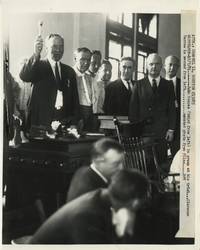
1925réf. List38112New York City: United Press International 1925. Photograph measuring 8 x 9 ¾ inches. With caption recto; manuscript caption and UPI and "Not For Publication" stamps verso. Excellent. A photograph of John Scopes Clarence Darrow and others during Tennessee's famous "Monkey Trial" in which Scopes was charged with violating the Butler Act which outlawed teaching human evolution in public schools. The case arose when the ACLU put out an advertisement for a teacher willing to violate the Act; community leaders from Dayton Tennessee saw an opportunity both to test the law and to draw attention to their community. New teacher John Scopes agreed to claim to have taught evolution likely falsely as he had not yet taught biology at all. He was represented by Clarence Darrow who was set against the prosecution's William Jennings Bryan-two of the most prominent legal minds of their day. Scopes was found guilty-though the verdict was overturned on a technicality-and the Butler Act stayed Tennessee law until 1967. United Press International unknown books
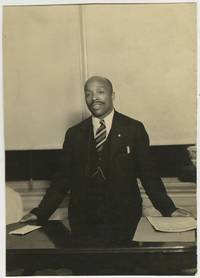
1940réf. List3825Washington D.C. 1940. Silver gelatin photograph 5 x 7 inches showing Father Divine standing behind a desk or table hands resting before him in suit and striped tie. Pulled from a scrapbook with paper remnants on verso; fine contrast and very good overall. Although this particular print is not credited on the mount or verso the image is a confirmed Addison Scurlock photograph. Very good. Father Divine also known as The Messenger and Reverend Major Jealous Divine was one of the more distinctive American religious figures of the early twentieth century. Founder of the International Peace Mission movement he attracted a large interracial following and was widely covered admired criticized and caricatured in the press. This photograph shows him in Washington D.C. formally dressed and posed before what appears to be a plain institutional or meeting-room backdrop a quieter image than the more sensational public accounts that often surrounded him. Addison Scurlock was one of the leading African American photographers in Washington D.C. and his studio produced a major visual record of Black civic social religious and cultural life in the capital. This copy was likely printed in the 1930s or 1940s and survives as a strong period silver gelatin print though with scrapbook removal evidence on the back. A good photographic portrait connecting two significant figures in Black twentieth-century history. . unknown books
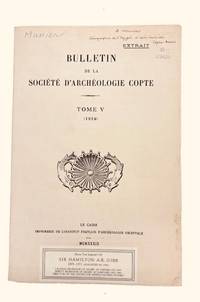
1939réf. 84206Cairo except for No. 6 which was published in London: Various publishers 1939. Paperback. Very Good. Shortest is 8 pages longest about 40 pages. Softcovers in original wrapper. Generally about 25 cm. Later owner's labels identify each pamphlet as having come from the library of Sir Hamilton A. R. Gibb. Various publishers paperback books
1949réf. 63957New Haven CT: the Foundation 1949. Pamphlet. Six panel brochure advertising the upcoming Annual Conference in 1950 folded size is 5.5x8.25 inches very good condition. the Foundation unknown books
1949réf. 63958New Haven CT: the Foundation 1949. 4 panel brochure folded size is 5.5x8.5 inches very good condition. the Foundation unknown books
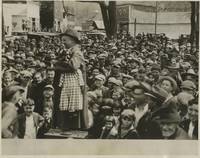
1933réf. List38109Cleveland Ohio: ACME Newspictures 1933. Photograph measuring 8 â… x 6 â… inches. With ACME and N.E.A. stamps caption and later sticker verso. Excellent. Note that the following contains descriptions of graphic violence. A press photograph of the scene outside the grand jury trial of John H. Mills in Inez Kentucky. Mills was charged with the murder of his mother Lucinda Mills and as the caption puts it "the attempted sacrifice of her body on a crude altar." Mills and several family members were accused of strangling Lucinda Mills to death with a chain after being called-following hours or on some accounts days of fasting praying dancing and glossolalia-to sacrifice a human. One newspaper account states that officers broke into the Mills' barricaded home just as the group was about to burn Lucinda Mills' body.1 A Time magazine account states that the crowd outside the trial was entertained with political speeches a medicine show and a mule trade while witnesses and jurors inside chatted and socialized.2 This photograph purports to show the medicine show; a man on a platform in front of a large crowd holds a racist doll under his arm. 1 "Aged Kentucky Woman Slain by Son For Family Sacrifice Say Officers" The Rocky Mountain News February 9 1933 1. 2 "Miscellany: Mountaineers" Time April 24 1933. . ACME Newspictures unknown books
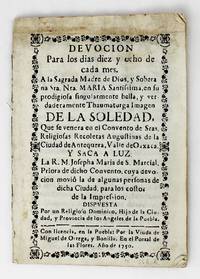
1750réf. 6184Puebla: Viuda de Miguel de Ortega y Bonilla 1750. Good plus. 20pp. Disbound. Top edge remargined occasionally affecting first line of text. Minor wear and dust soiling. A scarce brief manual that outlines prayers and acts of devotion to be performed and to be dedicated to the Virgin Mary on the 18th of each month the traditional day set aside for exclusive prayer to Santa Maria by the Catholic Church. This Puebla imprint is apparently the only edition of the work under this title and we locate no copies in U.S. institutions. A rather attractive production by a woman printer. Medina Puebla 533. Viuda de Miguel de Ortega y Bonilla unknown books
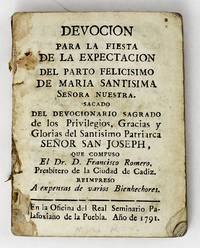
1791réf. 6185Puebla: En la Oficina del Real Seminario Palafoxiano 1791. Good plus. 94pp. 16mo. Disbound. Remnants of floral wrappers on spine. Light wear and soiling. Scattered faint foxing. A scarce 18th-century pocket devotional for the celebration of the Feast of the Expectation of the Blessed Virgin Mary. The feast day celebrated in the Spanish Catholic tradition on December 18th since the 7th Century CE honors the last days of the Virgin Mary's pregnancy and her happy expectation for the birth of Jesus. The text contains prayers and acts of devotion as well as prescriptions and exhortations for their execution for the week of December 18th leading up to Christmas. Printed in large type and small format this Pueblan imprint was clearly intended for a popular audience and is a very unusual survival. Not in OCLC. En la Oficina del Real Seminario Palafoxiano unknown books
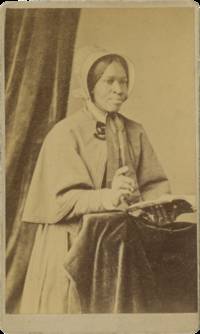
1870réf. Cat347New York: R. A. Lewis 160 Chatham Street 1870. Albumen print on original mount. Approximately 2½ x 4 inches. Light toning and minor wear to mount; image clear and well-preserved. A studio portrait of Amanda Berry Smith the formerly enslaved African-American evangelist who emerged in the late 1860s as one of the most prominent female preachers in the Methodist holiness movement. The photograph shows Smith seated in three-quarter view wearing a plain bonnet and shawl holding a book in her lap-an image consistent with her cultivated public identity as a modest yet authoritative religious figure. The imprint of R. A. Lewis at 160 Chatham Street places the photograph in New York during the period when Smith was actively preaching in the city and surrounding regions. Following an experience of sanctification in 1868 Smith began preaching in African-American churches in New York and New Jersey soon extending her ministry to mixed and predominantly white audiences at camp meetings and revival gatherings. By 1869 after the deaths of her husband and several of her children she had committed herself fully to itinerant evangelism traveling widely throughout the Northeast and Midwest. Her appearance before integrated congregations in the early 1870s including Methodist holiness meetings brought her unusual prominence as a Black woman preacher at a time when both racial and gender barriers sharply limited such roles. 1 During the decade following 1870 Smith traveled extensively as an independent evangelist addressing audiences across New England and the Middle States and gaining recognition for preaching on sanctification and the possibility of overcoming racial prejudice through religious experience. Her ministry in these years laid the foundation for her later international work in England India and West Africa. Photographic images of Smith from this early period are scarce particularly those issued by New York studios during her initial rise to prominence. The present portrait captures her at the moment she transitioned from local preacher to widely recognized itinerant evangelist. We find no examples of this image or records of similar cartes-de-visite in auction records or commerce. 1 "Amanda Berry Smith" Illinois Heritage Northern Illinois University Libraries archived September 19 2020 https://web.archive.org/web/20200919052750/https://www.lib.niu.edu/1998/ihwt9820.html. R. A. Lewis, 160 Chatham Street books
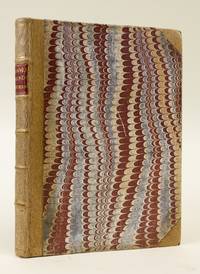
1578réf. ST15632London: Printed by John Kingston for Andrew Maunsell 1578. First Edition in English. 189 x 134 mm. 7 3/8 x 5 1/4". 4 87 1 leaves with foliation errors but complete.Translated from the Latin by Thomas Twyne. Retrospective half pigskin over marbled boards raised bands red morocco label. Title with woodcut ornament head- and tailpieces many decorative initials. Printed in black letter. Front pastedown with Macclesfield bookplate for the South library; title with inscription in ink "Dulcius ex ipso fonte bibuntur aquae" "Sweetly the waters have been drunk from the fountain itself" and with the initials "D. Fl." see below; a couple of contemporary annotations in ink one slightly shaved; numerous marginal readers' marks in ink and pencil. STC 6231; ESTC S105155. Paper a shade or two less than bright title somewhat soiled a dark stain affecting the upper corner of ff. 24-28 touching text but all is legible; still an overall very good clean copy in a pleasing new binding. This is the first appearance in English of Daneau's 1576 "Physica Christiana" the foundational work of "Mosaic physics" which attempted to reconcile the account of creation in Genesis with scientific knowledge of the natural world in order to create a "Christian natural philosophy." Though obviously theological in origin "Christian Physics" is nevertheless substantially a work of natural history generally adopting the Aristotelian worldview then prevalent. The first of two parts is a disquisition on creation a long Socratic dialogue on the meaning of the opening chapters of Genesis. The second part which occupies a good deal more than two-thirds of the volume is a broader treatise on nature including discussion of such things as light and shadow meteors the rainbow thunder precious stones glass gold various trees stars and planets fish birds elephants foxes and many more topics. A Calvinist theologian forced into itinerancy because of his incautiously expressed opinions Daneau 1530-95 produced a considerable number of books mostly commentaries on the Bible and controversial works written against Lutherans and Catholics alike. Our copy has a couple of curious contemporary marginal annotations. On the verso of fo. 2 at the beginning of the second chapter someone noted "Five / speciall / copies of na- / turall phi- / losophye." And at the head of fo. 39 mis-numbered 40 recto is the inscription "Sr. Walter Rawley Laureatus poeta May 4 anno reg. Eliz. 39 anno dom. 1598." There is nothing in Raleigh's biography that can account for his being mentioned as poet laureate in 1598; in that period he was occupied in naval pursuits against the Spanish armada. It has been suggested that our copy was once owned by scholar and translator Andrew Hartwell 1553-1606 a bibliophile who sometimes used the Latin motto which appears on the title page here and who marked passages in his books with the floret-like squiggle seen here on ff. 3-12. At the same time the "D. Fl." inscription on the title page resembles the ownership mark used by the celebrated 17th century bibliophile antiquary politician and magistrate Sir Daniel Fleming 1633-1701. Later the book was securely located in the great library of the earls of Macclesfield which was sold in 12 sales at Sotheby's from 16 March 2004 to 2 October 2008 for some £22 million at the time approximately $40 million. The library was dispersed when the 9th Earl Macclesfield Richard Timothy George Mansfield Parker b. 1943 who was described by the "Independent" as leading an "unconventional lifestyle" was forced to leave his 14th century Shirburn Castle after a protracted family dispute. Called by the paper "a sleeping beauty" his crenellated home had a moat a drawbridge and at the time of the Earl's departure a repair bill of approximately £2.6 million. Despite the building's dilapidation the books in the very large library were distinguished for being uniformly well preserved were almost always in their original bindings and were a sensation at auction for more than four years. The present work is rare: ABPC and RBH locate just one other copy at auction in the past 40 years. [Printed by John Kingston] for Andrew Maunsell unknown books
réf. 12950N.p. mid-19th century. Broadside 13 x 5.5 inches on light pink silk with text printed within elaborate ornamental border. Minor foxing and staining some soft creases light occasional fading to text. Very good overall. An attractive display piece printing the first prayer recited in the Continental Congress delivered by Rev. Jacob Duche on September 7 1774. Reverend Duhe delivered a powerful extemporaneous opening prayer following reports of a British attack on Boston. The prayer asked for divine protection for the American colonies in the "righteousness of their cause" "wisdom in council and valor in the field" a quick peace and so forth. A brief note at the top of the broadside provides some cotext: "In Thatcher's Military Journal under date of December 1777 is found a note containing the identical 'first prayer in Congress' made by the Rev. Jacob Duche a gentleman of great eloquence. Here it is - an historical curiosity. unknown books
1807réf. 4567Mexico City 1807. Very good. Letterpress broadside illustrated with large engraving 12 x 8.25 inches. Minor wear and foxing engraving printed slightly off register. An evocative and rare Mexican broadside relating the story of Italian Jesuit Francesco de Geronimo 1642-1716. The portrait was executed by Francisco Gordillo also the chief assayer of the Mexico City mint. This broadside was produced the year following Francesco's beatification in 1806; he was later canonized as a saint in 1839. This "Very Light Sketch of the Life of Francisco" includes a biographical history of Geronimo as well as a physical description and information on his beatification and burial. "St. Francis wanted to be sent to preach in the Far East but the Jesuit authorities wanted him to stay in Naples which was the centre of his apostolic labours. He worked through the 'Oratorio delle Missioni' an organization of working men which functioned as a sickness benefit and funeral society. His preaching was famous: sometimes he would bring a skull to the pulpit at others scourge his bare shoulders with an iron chain until they bled. He established hostels for reformed prostitutes and their children. His beatification postponed by the suppression of the Jesuit order finally took place in 1806 and his canonisation in 1839" - New Catholic Encyclopedia. Rare at auction and with only five copies in OCLC at the California State Library Boston College University of Pennsylvania the JCB Mathes copy and the Wellcome Library. unknown books
1825réf. 5684Queretaro 1825. Still very good. 42035pp. Contemporary sheep spine gilt leather label. Moderate wear to corners and edges; boards and spine scuffed. Occasional minor staining and foxing. Accomplished in a small but highly legible script. An extensive manuscript compilation of Catholic doctrines teachings and sermons assembled in Mexico during the early 19th century. The author is unidentified but an engraved indulgence dated 1804 from the Colegio de Santa Cruz in Queretaro is tipped onto the manuscript title page verso leading to the supposition that this work originated at that date and location. The indulgence bears an image of the Virgin of Guadalupe and the Latin phrase "Columba Mea in Forminibus Petrae" and promises various lengths of indulgence from several of the bishops of colonial Mexico. The initial 115 pages contains over thirty entries comprising the author's lessons on church doctrine and other teachings on subjects such as faith hope charity neighborly love marriage and much else. Each entry is headed by a short biblical quotation from which the text takes its prompt. The remaining 340 pages contain over fifty original sermons on a wide variety of topics each also as is traditional with a Bible passage as its inspiration. A detailed table of contents follows the title page. The final four entries are in an altered hand and were added later with last being dated "Zalapa 1825." A wealth of original Mexican Catholic teaching in manuscript. unknown books
1817réf. 5716Mexico City: Imprenta de D. Juan Bautista de Arizpe 1817. Very good. 210pp. Miniature 75 mm. Self wrappers stitched. Trimmed crookedly minor soiling. A charming miniature devotional comprised of a hymn followed by a prayer and a brief oration. The hymn is attributed to Manuel Sartorio. We locate one copy in OCLC at the University of Virginia. Imprenta de D. Juan Bautista de Arizpe unknown books
1775réf. 2487Mexico City: En la Imprenta de D. Felipe de Zuniga y Ontiveros 1775. About very good. 6118pp. Contemporary limp vellum. Fore-edges binding and text block darkened by smoke with markings creeping into margins of several leaves including title page. Light dampstaining along lower edge somewhat heaver on final leaves. An unusual Mexican religious primer with teachings based on the doctrines of St. Bonaventure but adapted to the practices of the Franciscan Order. The work was created for Franciscan novices and sets forth rules and orders for various offices duties and other responsibilities as well as standard beliefs and practices for the order. This is the second edition with the first having been printed over fifty years earlier in 1721. Both were likely printed in small numbers being intended for the rather limited audience of Franciscan novices. The present copy belonged to Henry Ward Poole the noted American engineer and collector of Mexicana with his manuscript initials and shelf number on the front pastedown. Scarce on the market with only one copy appearing in available sales records in the past thirty years and a fairly nice example with good provenance. En la Imprenta de D. Felipe de Zuniga y Ontiveros unknown books
1814réf. 6187Mexico: Mariano de Zuñiga y Ontivero 1814. Good. 13pp. 16mo. Contemporary limp vellum wrappers. Some creasing and wear to wraps. Moderate to heavy dust soiling in lower right quadrant of most leaves. Small contemporary ink stamp on final leaf recto. Small prayer book for the first day of each month "consecrated to God in veneration of his divine providence." A woodcut of the Trinity is printed on title page verso. The work was printed several times over the years in colonial Mexico but the present edition is quite scarce with OCLC locating only one copy at the JCB. A well-loved copy with obvious signs of regular use. Mariano de Zuñiga y Ontivero unknown books
1824réf. 6186Puebla 1824. Very good. 46pp. 16mo. Contemporary limp vellum wrappers marbled pastedowns. Upper right corner a bit dinged otherwise very light wear to wraps. Light toning and occasional small patches of staining internally. Small attractively printed prayer book for the veneration of Maris Santisima de la Luz for her feast day July 2. The work comprises various prayers acts of contrition and instructions for completing the ritual and also prints a woodcut of the Mary and the baby Jesus surrounded by angels the typical depiction of this version of the Virgin Mary. Not in OCLC and apparently unrecorded. unknown books
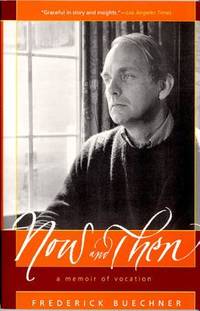
réf. 001933Harper & Row 1983 Book. As New. Soft cover. F. Original Wraps. As New. First Edition. Galley/Proof. 12mo - over 6" - 7" tall. Harper & Row, 1983 Paperback books
1899réf. List1632Providence 1899. First Edition. 4 pages 12 x 9 1/4 inches on one folding sheet; thin paper light chipping at edges. Very Good. A broadside advertising an appearance by Margaret Shepherd a nativist speaker who passed as an ex-nun lecturing prolifically on Catholicism and helping fuel nativist sentiment in the years following the publication of her likely fictitious autobiography My Life in the Convent: Or the Marvellous Personal Experiences of Margaret L. Shepherd Sister Magdalene Adelaide Consecrated Penitent of the Arno’s Court Convent Bristol England 1893. Anti-Catholic sentiment was a fundamental part of nativist organizations during the period including the KKK and Shepherd was one of several “ex-nuns” who lectured on the subject. unknown books
1952réf. 12849Various locations in North Texas mainly Greenville 1952. Eighteen manuscript diaries one daily entry per page all mostly filled in totaling approximately 5800pp. and about 575000 words with numerous ephemeral items laid in. All in matching black blue or crimson cloth with gilt titles on front cover reading "DIARY" and with the given year. with: Collection of Fourteen Manuscript Diaries from Hilger's Wife Mary Ollie Haynes Hilger. A deeply-informative collection of personal diaries kept by Rev. John Rufus Hilger a Baptist preacher and piano repair man based in Greenville Texas during the first half of the 20th century. John Rufus Hilger 1884-1952 was born and raised in Boone Arkansas but is noted as early as 1910 from census records as a "Minister" in Collin County Texas. Hilger married Mary Ollie Hayes in Collin County in 1901 and the couple raised four children. Reverend Hilger passed away in Greenville on January 7 1953 and is buried in Farmersville Texas. According to his obituary in the McKinney Courier Gazette Reverend Hilger "was a Baptist preacher for 42 years and was well known throughout Collin and Hunt counties." Reverend Hilger was a obsessive diarist recording his life and work almost every day in the eighteen annual diaries present here. The diaries necessarily detail a multitude of both personal and professional topics and activities over this time. A quick survey of personal activities recorded here include having dinner with various friends and congregants; noting visits by children family and friends; recording his finances and purchases often with lists of prices of various goods; gardening taking care of his livestock and keeping bees; mentioning election dates and commenting on current events "The Civil War in Spain is still raging. It started last September" February 23 1937; remarking when he works on a piano; and so much more. Interestingly the whole of his November 23 1936 entry records his family trip to Dallas to attend the Texas Centennial Exposition where he comments on seeing the "old relics" "old documents" and "new inventions." His entry for December 7 1941 is headed "WAR BEGAN" in bold capital letters. One part of his entry for May 8 1945 headed "V-E Day German surrendered" reads: "The war is ended in Europe but is still going on with Japan. Great celebrations went on all day by the Allies." Hilger's professional tasks include a legion of sermons throughout the years performed all across North Texas Hilger usually includes the titles of such sermons along with other details i.e. "Preached at 11: 'Missions.' Took collection for Home and Foreign Missions received $17.55"; conducting funerals at home and in other areas around the area; attending Baptist conferences and meetings around the state; teaching classes at Baptist schools; and more. A healthy number of ephemeral items are laid in throughout the diaries likely picked up by Hilger during the course of his work. Among these items are commercial cards receipts a piece of V-Mail sent home by Hilger's nephew from France in January 1945 a political campaign card for the local sheriff and a business card for a cobbler known as "The Crippled Shoemaker" in Paris Texas. Reverend Hilger's diaries last throughout the year before his death with his last entry dated in early February 1952. Greenville Texas was a notoriously racist town in north Texas. Once a center for the booming cotton industry officials in Greenville employed the typical array of Jim Crown laws to discourage settlement by African Americans in the 20th century. Additionally a welcome sign hung over Lee Street in downtown Greenville from 1921 to 1965 that read "Greenville - The Blackest Land The Whitest People." Reverend Hilger's views on race are hopefully more positive. The only mention we saw of African Americans in perusing the diaries is a line in his March 22 1945 entry: "Went to see the Negro about ploughing for us." Reverend Hilger's diaries are accompanied by fourteen additional manuscript diaries of the same type he used authored by his wife Mary Ollie Hayes Hilger 1882-1964. Mary Hilger was also born in Arkansas and likely accompanied Reverend Hilger to Texas at the turn of the 20th century. These diaries date from various years between 1942 and 1963. Adorably both Reverend Hilger in the above diaries and Mary Ollie in her diaries refer to each other as "Mrs. Hilger" and "Mr. Hilger" respectively. Mrs. Hilger records an understandably wide range of observations and activities over the course of twenty years. In and of themselves the present diaries are an interesting and informative collection of the thoughts and experiences of a Baptist woman in Texas at the midcentury mark. She often mentions visiting her daughter Jester in Fort Worth and other family matters and also occasionally includes observations on topics such as current affairs. In one such entry from November 5 1952 Mary comments on the recent presidential election: "Ike was elected by a large majority - the largest vote cast in the history of our country. Seems as though most of the people are fed up on Trumanism and war. I know I am and have been a long time." An extraordinary collection of the seemingly ordinary lives of a Baptist preacher and his wife in Texas over the course of more than twenty-five years seen through both of their eyes for much of the time with deep research potential. unknown books
1710réf. 6230Mexico City: Por las Herederos de la Viuda de Francisco Rodriguez Lupercio 1710. Good. 7pp. on two folding sheets. Small folio. Previously folded. Stitch holes moderate dampstaining a few small chips at edges. Moderate wear at horizontal fold causing some loss and resulting in tape repair to final leaf. Untrimmed in a modern quarter calf and pebbled cloth folder. A rare admission certificate to a congregation in Mexico City founded by Pope Alexander VII around 1665 to 1667 in honor of the Jesuit missionary Francis Xavier. It includes a plenary indulgence and lists the responsibilities of congregants which include communion at least once a month nightly prayers teaching Christian doctrine to servants and more. This example printed in 1710 is made out for a new female member Clara María Ximenez de los Cobos by secretary Joseph de Zertuche on 1 July 1722 and bears his signature. Attractively printed with a woodcut of Xavier a double ornamental border and large decorative initial. Not in Medina or OCLC. Por las Herederos de la Viuda de Francisco Rodriguez Lupercio unknown books
1770réf. 4695Mexico 1770. Good plus. 3pp. on a bifolium. Previously folded. Completed in manuscript with additional later manuscript annotations. Some edge wear and staining. Light tanning and scattered foxing. An attractively illustrated and scarce example of a confraternity patent for a religious order in mid-18th century Mexico. This bifolium confers membership to and lists the benefits for those inducted into the congregation of the Parish of San Sebastian and was filled out and given to Sebastian Fabian Mendoza on September 29 1770. The first leaf recto is attractively printed containing a skillful engraved illustration of the Virgin Mary accompanied by St. Joseph and St. Sebastian on each side with Jesus holding the Eucharist in a cloud over head and decorated with numerous detailed printers' ornaments. The text on this page prints the principal benefits of membership which include assistance with all burial rites upon death twenty-five pesos paid to surviving family following the same and inclusion in all masses said for the congregation as well as in all graces and indulgenced received by it. The interior two pages print a list of sixteen indulgences conferred upon the congregation by Pope Benedict XIV. Most interestingly several manuscript notes on the second leaf of the bifolium each dated from 1807 record that the recipient of the patent passed away earlier that month in September that he received burial rites in accordance with his membership and that twenty-five pesos was paid out by the treasury of the congregation. Scarce we locate one other copy of this patent at the University of Pennsylvania; the Newberry holds a copy of a later edition with a different illustration. A very interesting document of popular piety and local religious organization in 18-century Mexico. unknown books