7.608 Ergebnisse
Best.-Nr. 2608PG001LISBOA. Na Impressaõ Craesbeeckiana. Anno M. DC. LXXXVIII. 1688 À custa de Antonio Leyte Pereyra Mercador de Livros. Com todas as Licenças & Privilegio Real. In 8.º de 20x158 cm. Com viii 518 i.e. 520 32 24 págs. Encadernação da época inteira de pele com nervos ferros a ouro e rótulo vermelho. Cortes das folhas carminados. Exemplar com leves desgastes na encadernação em especial nas coifas cantos e charneiras com vestígios de um etiqueta no pé da lombada. Com assinatura de posse de José da Madre de Deus; com uma nota: «Este Livro achousse na Cella de hum Religioso que por presumir ser da Livraria o poem nella» as duas primeiras em letras coevas e a última em letra do século XVIII. As páginas preliminares contêm as censuras de Frei Tomé da Conceição Fr. António de S. Tomás P. Bartolomeu do Quental licenças entre elas da Religião assinada pelo P. Alexandre de Gusmão e erratas do primeiro volume. As páginas com numerações próprias no fim da obra incluem o índice das citações da Bíblia e o índice dos assuntos. Segunda parte da obra Rosa Mística que foi publicada na coleção dos Sermões que inclui os sermões nº 16 a nº 30 de um conjunto de 30 sobre Nossa Senhora do Rosário que é a 10ª parte dos Sermões. A obra Rosa Mística é um conjunto de Sermões em louvor da Virgem Maria em que o autor partindo de várias passagens dos Evangelhos demonstra as excelências da que foi escolhida para ser Mãe de Deus. Compara a Virgem primeira entre os Santos à Rosa primeira entre as flores. PADRE ANTÓNIO VIEIRA Lisboa 1608 - Salvador Brasil 1697 considerado por muitos como o maior escritor português é autor de uma vasta obra em português latim e italiano sendo definido lapidarmente por Fernando Pessoa como o «Imperador da língua portuguesa». Ao mesmo tempo desenvolveu com brilhantismo visão e coragem atividades políticas e diplomáticas na defesa de Portugal durante a Guerra da Restauração tendo entrado em conflito aberto com a Inquisição que venceu com o apoio do Papa. Mais importante ainda foi a sua prolongada e dedicada atividade missionária em que se distinguiu pela defesa da liberdade dos índios e pela condenação da escravatura dentro dos moldes possíveis na sua época pelo que chegou a ser expulso pelos colonos que tratavam mal os escravos oriundos de Ãfrica e queriam escravizar os índios apesar das leis régias em contrário que obteve de D. João IV e de D. Pedro II. Vieira conseguiu conciliar um grande realismo político com uma crença arraigada no Sebastianismo começando por identificar D. João IV como o «Desejado» do mito Sebastianista que havia de ressuscitar. Apesar de Vieira dar grande valor e se ter dedicado prolongadamente às suas obras teológicas e proféticas foram os sermões que o consagraram como grande orador e escritor. A sua forte personalidade e capacidade oratória atraíam multidões para ouvi-lo pregar mas foi a possibilidade de rever e acompanhar a publicação dos sermões que os tornou obras literárias de grande valor e não apenas o frio registo das suas capacidades oratórias. Em 1614 Vieira foi para a Baía com a família e ingressou no Colégio da Companhia de Jesus onde segundo uma lenda superou inesperadas dificuldades de aprendizagem destacando-se pelas suas habilidades intelectuais e linguísticas o que lhe valeu em 1625 aos 17 anos a tarefa de redigir o relatório anual evento conhecido como o «Estalo de Vieira». Em 1623 iniciou o noviciado familiarizando-se com a cultura e a língua tupi e em 1625 fez os primeiros votos começando a ensinar retórica em Olinda. Ordenado sacerdote em 1634 tornou-se conhecido como orador realizando a sua primeira pregação oficial na Baía. Em 1641 acompanhou a Lisboa o filho do Vice-rei do Brasil iniciando uma fase como conselheiro político de D. João IV e missões diplomáticas na Europa. Em Roma reviu os seus sermões publicando o primeiro volume em 1679 e recebeu isenção da Inquisição. Regressou ao Brasil em 1681 onde se dedicou até à sua morte à revisão dos sermões e à redação da sua obra teológica «Clavis Prophetarum». EN This 20x15.8 cm volume features a contemporary full leather binding with raised bands gilt tooling a red spine label and red edges showing light signs of wear on the spine caps corners and hinges alongside historical ownership marks including the signature of José da Madre de Deus and an 18th-century library note. The book includes preliminary censorships licensesnotably signed by Father Alexandre de Gusmãoerrata and closing indexes for biblical citations and subjects. Content-wise it constitutes the second part of Rosa Mística comprising sermons 16 to 30 on Our Lady of the Rosary which forms the tenth part of the larger Sermões collection a theological work that uses gospel passages to praise the Virgin Mary"s excellence allegorically comparing her to a rose among flowers. Father António Vieira 16081697 famously hailed by Fernando Pessoa as the 'Emperor of the Portuguese language' was a monumental writer diplomat and Jesuit missionary whose brilliant oratory and literary mastery were immortalized through the publication of his widely celebrated Sermões. Throughout his life which spanned from his early education and intellectual awakening in Bahia to high-stakes diplomatic missions in Europe as a trusted advisor to King João IV he combined a pragmatic geopolitical realism with a deep faith in Sebastianism. A courageous defender of indigenous freedom and an opponent of slavery within his era"s constraints Vieira actively clashed with Portuguese colonists and successfully withstood the Roman Inquisition with papal support. He dedicated his final years in Brazil to composing his theological work Clavis Prophetarum and meticulously editing the written sermons that established him as Portugal"s greatest baroque author. Ref.: -Padre António Vieira. Bibliografia. BNP. 1999. Nº 1019. -Azevedo e Samodães 3516 II Volume página 743. -Inocêncio. I 290. SACO PG142-10 hardcover
Best.-Nr. 2606PG003aos 14 de Septembro deste anno de 1642. Tendose publicado as Cortes pera o dia seguinte. Com as licenças necessarias. Lisboa Por Domingos Lopes Rosa. Anno 1645. In 4.º de 199x152 cm. Com 14 fólios. Cadernos cosidos com capa posterior em papel mais recente. Ilustrado com as armas do reino enquadradas por um complexa composição xilográfica que ocupa mais de metade da folha de rosto. Dois anjos de vestes longas com bandeiras da Ordem de Cristo esquerdo e da Ordem de Avis direito suportam a coroa real que encima o escudo de armas. Os Anjos estão em suportes que partem de uma representação antropomórfica ao centro em baixo que tem do lado esquerdo uma esfera armilar com compasso e quadrante e a legenda «Spera in Deo» e do lado direito um pelicano alimentando os filhos. Na frente do fólio 2 apresenta uma inicial decorada. Exemplar com numeração manuscrita na frente do canto superior direito de 74 a 87 e acastanhamento próprio do papel. Muito importante para o estudo da divulgação dos sermões de Vieira para a fixação crítica do texto e para o estudo da oratória sagrada em Portugal. 2.ª Edição muito rara deste sermão de Vieira na variante de que existem menos exemplares catalogados na BNP a variante D conforme foi identificada pela primeira vez na Bibliografia do Padre António Vieira BNP 1999. Esta variante caracteriza-se entre muitas outras marcas pela disposição do texto no fólio 2 frente como por exemplo: linha 3: «ao lume da Igre-/ja»; linha 8: «celebra-/mos festa hoje. Necessario». Notável sermão que foi pregado no dia 14 de Setembro de 1642 em honra de Santo António na véspera da reunião das Cortes do Reino em Lisboa pois como artificiosamente disse o Padre António Vieira era como se o Santo fosse o procurador do Céu enviado às Cortes pois «como há dias que o ceo está pella Coroa de Portugal manda tambem seu Procurador o ceo ás Cortes do Reyno.». Desenvolvendo o tema escolhido Vieira expõe diversas considerações políticas sobre a responsabilidade dos procuradores dos seus deveres de justiça e de rectidão defende que devem ter sempre as virtudes de Santo António como modelo e especifica mesmo que ao determinarem aumentos de impostos necessários para a guerra devem ter o maior cuidado em que sejam obtidos pela persuasão e sejam repartidos por todos. fólio 7 r. tema que é a questão principal do sermão. Texto do sermão começa ao alto do fólio 2 frente e termina na frente do fólio 14 com a expressão Laus Deo o fólio 14 verso está em branco. Texto em caracteres redondos com as citações em itálico. Referências bíblicas e bibliografia das obras citadas em itálico nas margens. PADRE ANTÓNIO VIEIRA Lisboa 1608 - Salvador Brasil 1697 considerado por muitos como o maior escritor português é autor de uma vasta obra em português latim e italiano sendo definido lapidarmente por Fernando Pessoa como o «Imperador da língua portuguesa». Ao mesmo tempo desenvolveu com brilhantismo visão e coragem atividades políticas e diplomáticas na defesa de Portugal durante a Guerra da Restauração tendo entrado em conflito aberto com a Inquisição que venceu com o apoio do Papa. Mais importante ainda foi a sua prolongada e dedicada atividade missionária em que se distinguiu pela defesa da liberdade dos índios e pela condenação da escravatura dentro dos moldes possíveis na sua época pelo que chegou a ser expulso pelos colonos que tratavam mal os escravos oriundos de Ãfrica e queriam escravizar os índios apesar das leis régias em contrário que obteve de D. João IV e de D. Pedro II. Vieira conseguiu conciliar um grande realismo político com uma crença arraigada no Sebastianismo começando por identificar D. João IV como o «Desejado» do mito Sebastianista que havia de ressuscitar. Apesar de Vieira dar grande valor e se ter dedicado prolongadamente às suas obras teológicas e proféticas foram os sermões que o consagraram como grande orador e escritor. A sua forte personalidade e capacidade oratória atraíam multidões para ouvi-lo pregar mas foi a possibilidade de rever e acompanhar a publicação dos sermões que os tornou obras literárias de grande valor e não apenas o frio registo das suas capacidades oratórias. Em 1614 Vieira foi para a Baía com a família e ingressou no Colégio da Companhia de Jesus onde segundo uma lenda superou inesperadas dificuldades de aprendizagem destacando-se pelas suas habilidades intelectuais e linguísticas o que lhe valeu em 1625 aos 17 anos a tarefa de redigir o relatório anual evento conhecido como o «Estalo de Vieira». Em 1623 iniciou o noviciado familiarizando-se com a cultura e a língua tupi e em 1625 fez os primeiros votos começando a ensinar retórica em Olinda. Ordenado sacerdote em 1634 tornou-se conhecido como orador realizando a sua primeira pregação oficial na Baía. Em 1641 acompanhou a Lisboa o filho do Vice-rei do Brasil iniciando uma fase como conselheiro político de D. João IV e missões diplomáticas na Europa. Em Roma reviu os seus sermões publicando o primeiro volume em 1679 e recebeu isenção da Inquisição. Regressou ao Brasil em 1681 onde se dedicou até à sua morte à revisão dos sermões e à redação da sua obra teológica «Clavis Prophetarum». EN In quarto. 19.9 × 15.2 cm. 14 folios. Stitched quires with a back cover made of diferent and mare recente paper. Illustrated with the kingdoms coat of arms framed by a complex woodcut composition that occupies more than half of the title page. Two angels in long robes bearing the flags of the Order of Christ left and the Order of Avis right support the royal crown that surmounts the coat of arms. The angels stand on pedestals that rise from an anthropomorphic figure at the bottom centre; to the left of this figure is an armillary sphere with a compass and quadrant and the inscription Spera in Deo and to the right is a pelican feeding its young offsprings. The front of folio 2 features a decorated initial. A copy with handwritten numbering in the top right-hand corner ranging from 74 to 87 and natural browning of the paper. Of great importance for the study of the dissemination of Vieiras sermons for the critical collation of the text and for the study of sacred oratory in Portugal. A very rare second edition of this sermon by Vieira in the variant of which there are fewer catalogued copies in the BNP variant D as first identified in the Bibliography of Father António Vieira BNP 1999. This variant is characterised amongst many other features by the layout of the text on folio 2 verso for example: line 3: ao lume da Igre-/ja; line 8: celebra-/mos festa hoje. Necessario. A remarkable sermon preached on 14 September 1642 in honour of Saint Anthony on the eve of the meeting of the Cortes of the Kingdom in Lisbon; for as Father António Vieira artfully put it it was as though the Saint were Heavens procurator sent to the Cortes for just as Heaven has been with the Crown of Portugal for days now so too does Heaven send its procurator to the Cortes of the Kingdom. In developing his chosen theme Vieira sets out various political considerations regarding the responsibility of public prosecutors and their duties of justice and integrity; he argues that they must always embody the virtues of Saint Anthony as a model and even specifies that when determining tax increases necessary for the war they must take the utmost care to ensure that these are obtained through persuasion and shared equally amongst all. folio 7 r. a theme which forms the main focus of the sermon. The sermon text begins at the top of folio 2 front and ends on the front of folio 14 with the phrase Laus Deo; folio 14 verso is blank. The text is set in round type with quotations in italics. Biblical references and a bibliography of the works cited are given in italics in the margins. FATHER ANTÓNIO VIEIRA Lisbon 1608 Salvador Brazil 1697 regarded by many as the greatest Portuguese writer is the author of a vast body of work in Portuguese Latin and Italian and was succinctly described by Fernando Pessoa as the Emperor of the Portuguese language. At the same time he pursued political and diplomatic activities with brilliance vision and courage in defence of Portugal during the War of Restoration coming into open conflict with the Inquisition which he overcame with the Popes support. Even more important was his long and dedicated missionary work during which he distinguished himself by defending the freedom of the indigenous peoples and condemning slavery as far as was possible in his time; for this he was eventually expelled by the colonists who mistreated slaves from Africa and sought to enslave the indigenous peoples despite royal decrees to the contrary which he had obtained from King João IV and King Pedro II. Vieira managed to reconcile a profound political realism with a deep-rooted belief in Sebastianism beginning by identifying King João IV as the Desired One of the Sebastianist myth who was destined to rise from the dead. Although Vieira placed great value on his theological and prophetic works and devoted himself to them at length it was his sermons that established him as a great orator and writer. His strong personality and oratorical skills drew crowds to hear him preach but it was the opportunity to revise and oversee the publication of his sermons that turned them into literary works of great value rather than merely a cold record of his oratorical abilities. In 1614 Vieira moved to Baía with his family and enrolled at the College of the Society of Jesus where according to legend he overcame unexpected learning difficulties and distinguished himself through his intellectual and linguistic abilities which earned him in 1625 at the age of 17 the task of drafting the annual report an event known as the Estalo de Vieira. In 1623 he began his novitiate familiarising himself with Tupi culture and language and in 1625 he took his first vows beginning to teach rhetoric in Olinda. Ordained as a priest in 1634 he became known as an orator delivering his first official sermon in Bahia. In 1641 he accompanied the son of the Viceroy of Brazil to Lisbon embarking on a period as a political adviser to King João IV and undertaking diplomatic missions in Europe. In Rome he revised his sermons publishing the first volume in 1679 and was granted exemption from the Inquisition. He returned to Brazil in 1681 where he devoted himself until his death to revising his sermons and writing his theological work Clavis Prophetarum. Referências/References: José Pedro Paiva - Padre António Vieira 1608-1697. Bibliografia 1079 Arouca 222 Catálogo das Miscelâneas da BGUC 2820 Leite 1949 IX 205 42 Ãvila Perez 8008 Monteverde 5564 Palha 3053 Inocêncio I 370 2678 Barbosa Machado I 422 SACO RS869-10 unknown
Best.-Nr. 2201PG014Adaptado ao ensino dos indigenas da lingua mbundu nas escolas ruraes das Missões Catolicas 5ª Edição. Tipografia da Missão. Huambo. 1928. 2 Volumes de 153x105 cm. Com 70 i; 112 págs. Brochados. Segundo volume: O 2º LIVRO DOS VIMBUNDOS. Nas Escolas Indígenas das Missões Catolicas. Tipografia da Missão. Huambo. 1929. Muito raro. Não existem exemplares catalogados na BNP. A 1ª edição foi publicada em 1919 e 1920. É conhecida uma 10.º edição de 1951. Os volumes têm nas folhas de rosto o pseudónimo do autor - Padre João Ninguém Muito importante para o estudo das questões relativas ao ensino e em especial do ensino do português em complemento ou em competição com as línguas indígenas. Inclui vocabulário frases cenários de conversação e provérbios poesias de caracter moral patriótico e e religiosos tudo em português e com a tradução para umbundu. No fim inclui modelos para escrever correspondência diversa bilingues ou só em português. Domingos Vieira Baião Baguim Rio Tinto 1886 - Porto 1952 padre da Congregação dos Missionáreios do Espírito Santo mais conhecidos por Espiritanos. Fez os seus estudo no Seminário de Formiga. Em 1909 foi professor no Colégio Fischer Açores. Em 1912 foi enviado como missionário para Angola missão de Cuando onde viveu quase 30 anos e onde desempenhou as funções de pároco professor e ecónomo. É autor de outras obras sobre linguística com muitas edições cada uma a Base de dados da UTAD contém 12 registos tais como: O português ensinado aos indígenas quimbundos Lisboa 1938. Publicou obras com o seu nome e primeiro apelido Domingos Vieira ou com o pseudónimo de João Ninguém. Ref.: Portugaliae Monumenta Linguistica. Corpus Linguístico Missionário. Base de dados da UTAD - Universidade de Trás-os-Montes e Alto Douro. Ezra Alberto Chambal Nhampoca - Fichas sobre o Padre Domingos e as suas obras. SACO PG147 unknown
Best.-Nr. 125467Toronto: Anon Green/Wesleyan Printing Establishment 1860. hardcover xi 424pp. Very good no dust jacket. 12mo. Fine ribbed olive-brown stamped cloth. Pages 11-14 have separated but are present and whole. Spine is faded thought the gilt title may still be read. Corners lightly bumped; occasional foxing throughout; inner hinges lightly starting at page 315. Internally very clean. Frontispiece. Kah-Ke-Wa-Quo-Na-By was an Ojibwe missionary and the first person to translate some of the Christian prayers and hymns into Ojibwe. As well he wrote the first comprehensive history of the Ojibwe people. This memoir was published posthumously. Anon Green/Wesleyan Printing Establishment Hardcover
1656Best.-Nr. 00JT33NEWNEVERS FRANCE 1656. On offer is an original handwritten ancient document signed by five individuals most notably Monsieur le curé François Adam curé de l'église de Magny" or "Mr François Adam pastor of the church of Magny'. The document concerns among other things the payment of a number of Masses to be said and specifies Nevers and Roux. VG. Autograph. Manuscript. Very Good. 4to - over 9¾" - 12" tall. French. Paperback
1836Best.-Nr. 9693Paris: Desrez 1836-40. Tredici volumi di cm. 25 pp. 10.000 ca. complessive. Legatura del tempo in mezza pelle dorsi lisci con titoli e filetti in oro. Tagli colorati. Dorsi un po' lisi e arrossature a qualche sezione di carte ma ben conservato. Raro insieme dei primi tredici volumi di quest'opera storica spesso contenente testi inediti con commenti note chiarimenti glossari ecc. Vengono presentate le cronache straniere relative alle spedizioni francesi durante il XIII. secolo Le Cronache di Jean Froissart in tre volumi e moltissimi altri testi spesso trascurati dalla storiografia tradizionale databili fino al XVI. secolo. Volumi facenti parte della celebre serie letteraria: Panthéon littéraire. Cfr. Vicaire VI 318 e seguenti. Desrez unknown
1911Best.-Nr. 12832Paris: Bong 1911-14 . Cinque volumi in-folio cm. 38 pp. 2.000 ca. complessive. Illustrato con centinaia di illustrazioni fotografiche nel testo 60 cartine geografiche colorate a doppia pagina e 206 tavole fuori testo molte delle quali in cromolitografia raffiguranti costumi vedute panorami e scorci delle località descritte. Splendida legatura editoriale di lusso in mezza pelle e percallina blu con piatti e dorsi interamente decorati in rilievo. Tagli colorati. Ottimo stato di conservazione. Si tratta di uno dei monumenti della geografia d'inizio novecento munito di un apparato iconografico di rilevante bellezza. Non comune a reperirsi completo con la legatura "de grand luxe" e ben conservato come il presente esemplare. Bong unknown
1900Best.-Nr. 106073The Gravure Illustration Company. 1900. Hardcover. Wraps Stiff card covers. Original folding Chemise with ties that has been restored. FINE condition. 1900. The Gravure Illustration Company. Nine Parts all in Very Good Plus condition. Gravures. ; Folio 13" - 23" tall . The Gravure Illustration Company hardcover
2003Best.-Nr. 250827009The Nicholson Family Library 2003-01-01. paperback. Good. 5x1x8. Includes both volumes. Ships Out Tomorrow! The Nicholson Family Library paperback
1880Best.-Nr. 000978Good. 1880. Leather. On offer is the original handwritten diary of the Reverend G.E. Ihison. It appears the young Reverend is newly installed in Clinton Congregational Church and there are immediate problems he must deal with. In neat tight script Rev. Ihison reveals immediately of his writing a Mr. Duncan refusing the pastoral position in Benton Harbor Congregational Church. He further details all his contacts congregants welcoming him new purchases and moving into his new home with his wife Ellen. Local historians and collectors will delight as the Reverend fully names all his contacts visitors and occasions attended. There are a great number of entries dealing with his personal economy. The leather binding is in rough shape and the text block is still attached but beginning to separate at the front pages.; 8vo - over 7¾" - 9¾" tall; Michigan Ann Arbor Religion Church Collection Charity genealogy Personal Memoir Handwritten hand written autograph autographs signed letters document documents manuscript manuscripts writers writer author holograph personal Americana Religion Pioneer Florida FL Education ANTIQUITÉ CONTRAT VÉLIN MANUSCRIT PAPIER ANTIKE BRIEF PERGAMENT DOKUMENT . hardcover
1825Best.-Nr. mon0000141508Longman and Co 1825-01-01. Hardcover. Acceptable. in x in x in. Ex-library book usual markings. Well read copy with some spine wear but still very useable. Hardback/Hard cover. Longman and Co hardcover
1974Best.-Nr. ZKW0021St. Paul Editions 1974. Hardcover with no DJ. Good. Prompt shipment with tracking. we ship in CLEAN SECURE NEW boxes Good hardcover with no DJ some discoloration 1113 pages Sm 8vo St. Paul Editions hardcover
1843Best.-Nr. 853N10London: Edward Moxon 1843-1845 . Leather. Good. 8.5" by 5.5". Nont. Famed for their collaboration this set contains the complete dramatic works of Renaissance playwrights Francis Beaumont and John Fletcher. Comprising the complete dramatic works of Renaissance playwrights Francis Beaumont and John Fletcher this set of eleven volumes includes bibliographic and performance notes as well as a biographical memoir of the dramatists by Reverend Alexander Dyce. With a frontispiece to the first two volumes. Includes their collaborative plays The Woman Hater Cupid's Revenge and The Noble Gentleman. In a full calf binding with gilt stamping to the spines. Externally generally sound. Volumes III V and XI are missing a spine label. The joint front joint has failed to volumes I II VI VIII and X so the front boards are detached. The front joint to volumes III and IV and the rear joint of volume I are extremely tender and may the boards may detached with further handling. The calf is torn to the rear joints of volumes III V VI VII IX and X but has been repaired. The front joint of volume VII is starting but firm and both the front and rear joints are starting but firm to volume XI. The rear hinge is starting and is a little tender to volumes VII and VIII. Internally firmly bound with a little strain to the rear of volume III. Aside from the plates pages are generally bright and clean with some occasional light spots and the odd bit of marginalia in pencil. Good Edward Moxon hardcover
1750Best.-Nr. 9755Aberdeenshire: Unpublished 1750 - 1902. A rich family album compiled by Lucy Gwendoline Duff grand daughter of the Rev James Grant in the early 20th century preserving family documents printed obituaries and tributes and a fine selection of photographs which together trace the achievements and history of the Grant family dating back to the mid 1700s in the Glenbuchat Badenoch and Towie ares of Aberdeenshire. Much of the album is dedicated to the line of the Rev. James Grant 1822 -1902 great grandson of the Laird and Miss Oliphant a native of Towie Aberdeenshire a graduate of Aberdeen University in 1840 and later minister at Dunoon in 1846 and then Ordiquhill. The Rev. Grant married Katherine Stewart Forbes Watson and they went on to have 9 children listed on the family tree and 5 grandchildren. A hand drawn family tree contains c.45 family names beginning with the Grant and Gordon families who united in the early 1700s through the marriage of the Laird of Tullachgorum of Badenoch a Grant and Miss Oliphant of Auchavaich Glenbuchat a Gordon. Seemingly compiled by a grand daughter of the Rev. Grant Lucy Gwendoline Duff the album provides rich detail revealing the lives of further member of the family and recording the geographical spread of the family throughout Old Morlich Banff Ordiquhill Fordyce Banchory Colinton Edinburgh America John Grant b.1759 'went to America maybe father of General Grant' and later Manchester and London. The stories of many family members include those of the Rev. James Grant's sons John Forbes Watson Grant and Lachlan Gordon Duff Grant and many of the women in the family including his grand daughter Lucy Gwendoline Duff. To the rear of the album a delightful collection of 14 responses to a Book Of Tastes set of questions include answers by Nelli C S Grant and Mary C Grant both dated 1897. DESCRIPTION: Original half morocco album slightly rubbed in very good condition. Contents clean and legible. Laid in and pasted in ephemera. 69pp. excluding blanks.Ephemera and 13 photographs pasted and laid in includes: INDIVIDUAL ITEMS INCLUDE: 1. A handwritten list of the family names and dates of birth of the Rev. James Grant's father and his aunts and uncles born between 1748 - 1765. Written in a contemporary hand. 2. A handwritten record of the Rev. James Grant's parents Robert Grant 1763 - 1838 and Isobel Ross 1782 -1849 and his 3 siblings William Isobel and Robert. Written in a contemporary hand. 3. A double page family tree dating 1748 - 1895 listing c 45 family members. 4. An ornately designed family register document recording the children born to Rev. James Grant Minister of Old iquhill and Katherine F Watson naming seven children born between 1849 - 1860. 5. A full page supplement to the Banffshire Journal April 14 1896 depicting the Rev James Grant M.A. D.D. Minister of Parish of Fordyce. 6. A hand written 3 pp. biography of the life of the Rev. James Grant. 7. Numerous paper cuttings recording the career achievements of the Rev. James Grant. 8. A booklet reprinted from the Banffshire Journal of January 8th 1895 honouring Dr and Mrs Grant. 9. Paper cuttings recording the Ministerial Jubilee and obituary of the Rev. R. Grant of Stracathro Rev. James Grant's brother. Dated Dec. 24th 1901. 10. A memorial text and paper cuttings celebrating the work of Caroline Stuart Grant 1856 - 1930 the daughter of Rev. James Grant. 11. Magazine cutting celebrating the life of the late Dr T.A. Stewart 1846 - 1904 HM Chief Inspector of Schools IN Scotland. Married to the Rev. James Grant's daughter Katherine. 12. Death notices for family members including Duff Grant of Kensington Mansions Earls Court. 13. A contemporary handwritten Banns of marriage and handwritten account of the marriage in 1819 between George Watson Castletown of Braemar and Jane Mc Hardy daughter of Findlat Mc Hardy farmer. The mother and father of Katherine Forbes Watson. 14. A handwritten character reference for George Watson in the hand of Hirom Watson Elder dated Braemar July 27th 1820. 15. An obituary and an In Memoriam for Dr John Forbes Watson dated 1892 an ex East India Company employee and researcher of the influence of food and climate on the human body. son of Rev James Grant and Katherine Stewart Forbes Watson. 16. A hand written letter outlining the career of Rev. John Forbes Watson Grant MA of St Stephen's Parish Edinburgh an alumni of the Aberdeen Department of Philosophy in 1877. 17. A handwritten will and testament by Robert Grant 1763 -1838 father of Rev James Grant naming his wife Isobel Ross and son William Grant as his sole executors. 18. A handwritten last will and testament of Isobel Ross Grant dated 1849 and a a pen portrait of Lachlan Gordon Duff Grant son of Rev James Grant. 19. A studio photograph of Helen K Grant aged 6 and a half months marked to rear 'Uncle John's elder daughter'. 20. Aberdeenshire studio portrait titled ' my grandmother on my father's side of the family'. 21. Nellie and May Grant taken by George Shaw Art Studios Edinburgh. 22. Photograph of 'Mother 1917' 23. Photograph of 'Auntie Katie daddy's sister and her husband Tom Stewart on their presentation to King Edward VII and Queen Alexandria at Holyrood House'. 24. 'Uncle Tom Stewart and his wife Katherine'. 22. Photograph of 'My grandfather the Rev James Grant'. 23. Photograph of 'Daddy's elder sister Aunt Katie'. 24. Photograph of 'My father Lachlan Gordon Duff Grant'. 25. Photographh of the probable compiler of the album Lucy Gwendoline Duff daughter of Lachlan Gordon Duff and grand daughter of Rev Jmaes Grant who was Lady Superintendant of nurses of Manchester Royal Infirmary and is photographed in her nursing uniform. 26. Photograph of 'Mother'. 27. Family portrait 'at Ellengowan'. Please contact Christian White Rare Books Ltd for more information or images of this item 1750 Unpublished unknown
1847Best.-Nr. 70979hOxford: Henry Parker 1847. Book. Fine. Hardcover. Second Edition. 8vo - over 7¾ - 9¾" tall. Three volumes in matching original gilt decorative stamped cloth with Oxford cameo to fronts rebacked with new spine and gilt morocco spine labels. Original yellow endpapers. The second edition published in 1847 and 1848 respectively. Corners worn but retouched; edges toned. Early gift inscription verso endpaper in one volume. Some mild scattered foxing and toning. Otherwise clean tight and unmarked. Very neat -- a sound and handsome set. A total of 85 plates John Le Keux after F. Mackenzie with many woodcuts in-text. Publisher's catalogue at rear of two volumes. . Henry Parker Hardcover
197010 vols., 8vo., cloth, a near fine set. Much-needed and high quality facsimile reissue of the original edition published 1847-54. Comprises the complete works together with Heber's 'Life'. NOW VERY SCARCE IN ITS OWN RIGHT
Best.-Nr. 103348Madrid D. Leonardo Nuñez de Vargas 1817. 20 tomes en 20 volumes. 1 frontispice. CCLXVI. 146 pages. LXIV. 358 pages. XL. 1 carte dépliante en noir hors-texte. 388 pages. LXXXVI. 378 pages. C. 287 pages. LXXXII. 322 pages. XCVI. 310 pages. LXXIV. 314 pages. XC. 310 pages. XCII. 312 pages. . XXVIII. 396 pages. XL. 400 pages. CXL. 239 pages. CCXII. 231 pages. CLXXXVIII. 256 pages. CLXVII. 134 pages. 76 pages de table générale. CCCLXII. VIII. 419 pages. XVI. 424 pages. XVI. 437 pages. 22x15 Cm. Demi-cuirs à coins bruns. Dos lisses à motifs dorés. Auteur pièces de titre et tomaisons en lettres dorées. Plats et dos frottés. Quelques petits accrocs au cuir. Coiffes accidentées aux tomes 2 4 6 7 11 12 et 14. Petits trous de vers en dos en tomes 7 10 12 et 20. Coins émoussés. Juan de Mariana était jésuite théologue et historien espagnol. La Historia General de España est son oeuvre majeure publiée pour la première fois en latin en 1592 sous le nom de "Historiae de rebus Hispaniae" puis suite à son succès en langue espagnole entre 1601 et 1609. On y observe de très nombreuses pages de tableaux chronologiques notamment aux quatre derniers tomes composés uniquement de ceux-ci. Au premier tome on trouve un portrait en noir de l'auteur en frontispice. Au troisième tome est insérée une carte de l'ancienne Espagne en noir datant de l'année 1817 et dessinée par le géographe Don Juan Lopez. Quelques rousseurs éparses sans gravité ainsi que des mouillures claires. L'intérieur des volumes est en bon état général. Jolie conservation. Madrid, D. Leonardo Nuñez de Vargas, 1817. unknown
2011Best.-Nr. 006988Roma: L'Erma di Bretschneider 2011. Un volume di 1216 pagine cartonato editoriale illustrato. Dimensioni: 22x29 cm. Ottime condizioni. 365 tavole nel testo 1 pieghevole. Contributi in lingua italiana francese tedesca e spagnola. Collana Bibliotheca Archaeologica 47. L'Erma di Bretschneider unknown
1840Best.-Nr. 56549Genova: presso Ferrando 1840-41. Tre volumi di cm. 215 pp. 1000 ca. complessive. Con 9 bei ritratti incisi in rame su altrettante tavole f.t. ciascuno protetto da velina. Solida ed elegante legatura coeva in pieno marocchino verde dorsi lisci con titoli e fregi romantici in oro. Piatti inquadrati da filetto in oro e fregi centrali a secco. Bell'esemplare fresco e marginoso. Bella e rara raccolta antologica di scrittrici femminili. presso Ferrando unknown
1974Best.-Nr. 011166Paris 1974 Librairie Honoré Champion Full-Leather 1st Edition
1868Best.-Nr. 7371Edinburgh London Dublin:: A.Fullerton and Co. 1868. First thus. Near Fine. A handsome Near Fine Set in Two Volumes. Royal Octavo 7 x 10 inches. Quarter calf over black textured cloth. Gilt tooled/ lettered spine in five panels with four raised bands. Gilt lettering on black set in panels two and four. Marbled endpapers. Printed by Fullerton and MacNab Edinburgh. Boards lightly scuffed corner tipped with light edge wear minor rubbing to head and foot of spine yet both volumes are solid and firm. Light scattered foxing; most plates and maps are bright and clean. Tidy period owner's signature on prelims of both volumes. Illustrated with all 59 maps plans and steel engraved plates listed in the 'Directions for Placing the Plates' plus one additional plate. Two plates View of Edinburgh and Loch Ken and Castle misbound but present. Vol I: 1 lxxviv 846p frontispiece engraved half-title vignette plus 17 maps 11 plates. Large engraved map of Scotland by G.H Swanston torn and detached from Volume I but extant. Vol II: 1 872p frontispiece engraved half-title vignette not called for in Vol II but present plus 20 maps and plans 7 plates. A fine Gazetteer introducing the natural political and ecclesiastical view of mid-nineteenth century Scotland illustrated with a complete county atlas various geographical maps city plans plans of ports and harbours and interesting pastoral views with folk engaged in seasonal activities; picnicking fishing harvesting as well as animals rural and formal architecture walled castle gardens estuaries river and loch views with sailing vessels atmospheric Highland views from the river at sunset waterfalls Inchyre and Balmarino Abbeys St. Giles Church Donne Castle Dumbarton Castle Edinburgh Castle with the New Chapel Tower and a nice view of Edinburgh near St. Anthony's Chapel with plant gatherers in the foreground Estuary of the Clyde city plans of Glasgow Edinburgh and Leigh Perth Bridge Loch of Awe Eke Ken and Castle. Ports and Harbours on the West Coast. An attractive collection of richly engraved plates by Thomas Dick Joseph Swan W. Forrest McGregor after drawings by J. Flaming W. O. Hill JP Houston and J. Stewart. Fine hand-colored maps of clusters of islands shires and cities all embellished with decorative and floral surrounds. Quarter Calf A.Fullerton and Co., hardcover
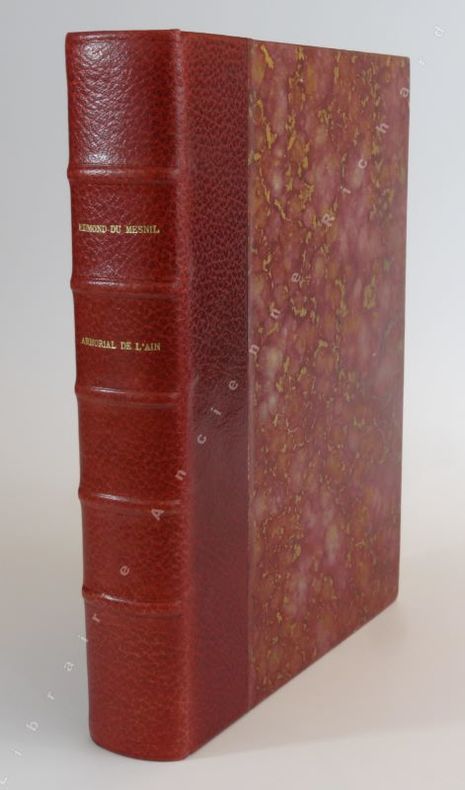
1872Best.-Nr. 3849Lyon, Imprimerie d'Aimé Vingtrinier, 1872, (1874) in-4 (315 x 235 mm.) (2) ff., XII-714 pp., (1) f., ill. n/b in-texte, 2 pl. n/b (portraits gravés), reliure demi-maroquin rouge à gros grain, dos à faux-nerfs, dos insolé, coins légèrement frottés, ex-libris collé sur contreplat, envoi de l'auteur sur page de faux-titre, très bel exemplaire.
1892Best.-Nr. 30097Paris 1892-1902. Tre cartelle di cm. 33 pp. 1728 complessive. Con migliaia di incisioni. Cartell edit. in mezza tela con laccetti di chiusura. Ben conservato. Vastissima raccolta composta da 144 monografie riguardanti edifici storici francesi castelli edifici ville; ciascuna di esse presenta varie incisioni d'insieme e particolari della costruzione accompagnati da testo esplicativo. Si tratta di tutto il pubblicato; non comune e davvero interessante per la ricchissima iconografia. hardcover
Best.-Nr. MD46Quarto bifolium ca. 25x19 cm or 9 ¾ x 7 ½ in. 25 pp. Brown ink on creamy wove paper; addressed on verso of the second leaf. Foldmarks and creases paper slightly age-toned second leaf with a minor tear and a hole after opening not affecting the text but overall a very good letter written in a legible hand. An interesting private letter written by a young port worker in New England likely in Providence Rhode Island in ca. 1840s. The compiler was most likely Francis Edward Prevaux “a Baptist missionary from Amesbury Massachusetts. He graduated from Brown University in 1846 and Newton Theological Institute in 1849. He was ordained a Baptist evangelist in 1850 and was sent to California by the American Baptist Home Mission Society where he began preaching at Bethel Church San Francisco California and became the principal of the San Francisco Academy. He remained in California until 1859 and died in Amesbury Massachusetts in 1860” Guide to the Bancroft's California Gold Rush Digital Collections// Berlekey Library University of California; see more. Written most likely shortly after Prevaux’s graduation from Brown University in 1846 the letter is addressed to his mother “Mrs. Lydia Prevaux Amesbury Mass. pr. kindness of Mrs. Green” Lydia Prevaux née Randall 1787-1876. The author talks about his living conditions dining in the “Seamen’s Home” his leave for Newton and upcoming “theological course” subsequent visit to his family home in Amesbury and a meeting with “an old tar” who “has lately run away from a British man of war was in the late war between England and China and is pretty well scarred up” likely talking about the First Opium War 1839-1842. Overall an interesting early letter written by a prominent Baptist missionary in San Francisco during the Gold Rush. Over seventy of Rev. F.E. Prevaux’s letters are deposited in the special collections of the UC Berkeley Library see more. Excerpts from the letter: “I always feel disposed Mother to seize upon every favourable opportunity which offers itself for writing to you. Mrs. Green having offered to take a letter I of course must write a letter. I commenced last Monday to take my dinner at the Seamen’s Home and I find it even more than I anticipated. I feel fifty per cent better than I did when I was eating alone. I still continue however to breakfast and sup by myself since I now am getting along finely and I tell you I enjoy my dinners as well as I ever did. I do love the company of sailors and this affection is in part at least returned. I love their society so well Mother that you need not be surprised to hear one of these days that I had slipped on board some vessel as a foremast hand and was enjoying the company of sailors in the forecastle. My health is good and I am able to do my full amount of labour and hope when my time is up to leave for Newton in as good health and spirits. Three weeks from next Monday morning I expect to leave this city perhaps spend a day or two in Boston and then away to the pleasantest place in Creation. I do anticipate much benefit from my theological course perhaps more than I shall realize but if my health should be good I intend to make hard study my business while I remain there. I think it’s a chance if any of my correspondents receive as many letters for three years to come as they have during my three years in college and perhaps they will be glad of it. <…> Time passes rapidly away and the little more than three weeks I have to remain here seems very short but the three and a half months before I can visit Amesbury seems somewhat long. <…> We are now having fine cool weather just the sort for work and I try to improve it as well as I am able. There is not however so much to be done as there has been the number of vessels in our harbour is comparatively small; they seem to be hauling off into warmer climates as the cold weather approaches. However I have enough to keep me busy a good portion of the time. Do come Mother to Cambridge if you can make it convenient. I shall expect to see you there and would prefer not to be disappointed. I found an old tar knocking about this forenoon. I overhauled him and spent the most of the forenoon with him. He has lately run away from a British man of war was in the late war between England and China and is pretty well scarred up. He is a jolly fellow and has just arrived here from Quebec where he left the man of war. I took him with me to get him a … on board some vessel and I expect he will soon leave for Pictou…” unknown
1738Best.-Nr. 98727Venezia: Presso Niccolo Pezzana MDCCXXXVIII 1738. 1738. Very good. - Quarto 9 inches high by 6-3/4 inches wide. Hardcovers two volumes uniformly bound in full cream vellum with the title embossed in gilt within gilt decorated bronze panels on the spines. The cream covers are slightly stained. There is a spot of rubbing to the bottom of the first volume's front hinge with damage to the vellum of the rear cover of that volume. The title page of the first volume is printed in red and black with the collation as follows volume 1: half title title with printer's mark pages i-lxxxiii 1 pages 1-217 220-221 220-221 224-225 224-630 & 1-34. Pages 218-219 and 222-223 are skipped in the numbering without any loss of text; pages 220-221 and 224-225 are repeated in the numbering. The second volume's collation is as follow: title with printer's mark pages iii-xxv 1 pages 1-192 1-4 193-609 & 1-31. Each volume is illustrated with an engraved headpiece by Carlo Orsolini c.1703-c.1780. In volume 1 the Creation is pictured and in volume 2 the Annunciation. Each volume is further enhanced with pictorial initials and tailpieces. There is a tear to the inner edge of the folding plan not affecting the image. The first volume's text block is cracked opposite the title page with a tiny tear to the bottom of the inner edge of that volume's slightly pulled title signature. There are remnants of an early brown paper stamp to the verso of the first volume's title page resulting in a tiny hole to that page. There is offsetting to the first three leaves of the second volume from a paper stamp which once adhered to the verso of that volume's title page. There is occasional staining and minor foxing throughout. Very good. The work was first published in French in 1718. It is here translated into Italian by the Venetian Carmelite Arcangelo Agostini 1660-1746 writing under his pseudonym Selvaggio Canturani. It is a history of the Old and New Testaments up to the destruction of Jerusalem. The folding plan of Herod's Temple is accompanied by 4 pages describing its numbered sites. The volumes also contain detailed chronological tables. Venezia: Presso Niccolo Pezzana, MDCCXXXVIII (1738). hardcover