Joseph David Cure SyrienBiblio.com

7 633 résultats
réf. 1396769404.Ghardcover. Good. Access codes and supplements are not guaranteed with used items. May be an ex-library book. hardcover
réf. 1396473777.Gpaperback. Good. Access codes and supplements are not guaranteed with used items. May be an ex-library book. paperback
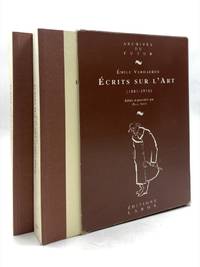
1997réf. 13841Bruxelles: Éditions Labro 1997. Ottimo stato di conservazione difetti macchie all’interno e segni d’uso sulla custodia. Due volumi in brossura editoriale illustrata con custodia in cartoncino cm 21.5 x 15 pp 558 2 4 559-1024 2. Collana Archives du Futur. Raccolta della produzione critica del poeta belga Émile Verhaeren 1855 - 1916: recensioni articoli prefazioni relative alla pittura e le arti plastiche della modernità a lui contemporanea Moreau Rodin Seurat - del quale fu il primo acquirente e della grande pittura fiamminga e olandese. Éditions Labro unknown
1810réf. 5622Paris Debray - Chaumerot 1810 -in-8 broché plaquette blanche (booklet), brochée in-octavo (21,7 x 13 cm), légère cicatrice de mouillure claire sur la couverture (scar of waterstain on the front cover), texte sur paper vergé blanc ligné, illustrations : orné de (illuminated of) d'un bandeau (headpiece) tête de chapitre gravé en noir représentant "Napoléon priant" et une gravure en bas du titre représentant les "Grandes Armes Impériales" en noir + un cachet d'authenticité gravé en noir : "dans un cercle : UNION, PAIX, Bonheur avec au centre les lettres A. J. G. avec 2 épées gravées croisées au centre, un soleil en dessous et un ciel étoilé au dessus", 32 pages, 1810 à Paris Chez Debray - Chez Chaumerot et Chez l'Auteur,
1877réf. 35503224Bourg-en-Bresse, Impr. J.-M. Villefranche, 1877 ; plaquette in-8, brochée, couv. imprimée 47 pp. - 2 pl. hors-texte gravées à l’eau-forteRare plaquette tirée à 50 exemplaires. Hommage de l’auteur “À mon excellent ami le Dr. de Viry” manuscrit sur la couv.
1930réf. WOC-92550 dessins de Henri Guys,1 plan de la ville, Panorama de la Dent d'Oche et 1 carte en couleur Compagnie Générale de la Navigation sur le Lac .Paris, Ateliers d'Arts Graphiques du Matin, 1930. Petit in-4 (25,5x20,3cm) broché, couverture supérieure ornée de 2 vues en couleurs et d'1 vignette sur la couverture inférieure. 107pp.
réf. 1407JC072Extraída da obra do mesmo nome do Padre Manuel Fialho. Publicação prefácio e índices de Armando Gusmão. Edições Nazareth. Évora. MCMXLV 1945. De 26x20 cm. Com xxiv 450 págs. Encadernação com lombada e cantos em pele com nervos e feeros a ouro. Preserva as capas de brochura. Obra escrita no final do séc. XVII a cuja composição segundo os juízos críticos do final do séc. XIX presidiu um admirável espírito de ordem tornando a sua disposição de sobremaneira metódica regular e clara. A introdução e o prólogo da obra do Padre António Franco fornecem um importante estudo dos manuscritos e do enquadramento histórico da obra de Fialho. I-211-L-13 unknown
1976réf. 1454File box made of galvanized zinc 163 x 142 x 85 cm containing 1 folded colophon page 67 handwritten addressed and stamped numbered and dated envelopes containing a photocopied answer – to the question 'cosa la rosa per te - of each addressee one original piece by Angela Ricchi Lucchi being a rectangular piece of cloth with the handwritten text 'Profumo di… A.M.L. the cloth had been drenched in rose water. - First edition. One of 50 signed and hand numbered copies. Contributing artists non-artists: Eleonora Selvatici Emilio Isgro' Silvio Ceccato Rosa Rosa Tommaso Trini Giuliano Giuman Sebastiano Matta Luigi Ontani Stanislao PacusFranco Vaccari Veronica Sulpizio Ada Torquato Pipperi Romana Loda Marcanciel Stupro' Maurizio Osti Giovanni Mantellini Walter Amici Concetto Pozzati Corrado Costa Adriano Altamira Giuseppe Desiato Fausto Melotti Gabriele Amadori Claudio Parmiggiani Giulia Niccolai Adriano Spatola Tiziano Spatola Carlo Hollesch Iole De Sanna Valerio Miroglio Giovanni Battaglia Rosanna Chiessi Cesare Zavattini Franco Farina Elio Marchegiani Plinio Mesciulam Massimo Boni Luciano Ingapin William Xerra Franco Guerzoni Claudio Beria Rosa Rivista Femminile Giuliano Della Casa Marion Baruch Sandra Gavina Ugo La Pietra Gabriella Cardazzo Giorgio Zucchini Alberto Faietti Giuseppe D'agata Aldo Tagliaferri Roberto Lenassini Nino Migliori Jervant Gianikian Miro Silvera Renzo Lazzarin Nazareno Noia Ugo Sterpini Giuseppe Chiari Lucio Del Pezzo Takako Saito Maurizio Nannucci Giovanni Rubino Roberto Comini Francesco Casetti Ugo Nespolo Luigi Mainolfi. 'Angela Ricci Lucchi describes her work as follows: "I was already very interested in the use of the media and I started a kind of 'investigation' later published by the Pari & Dispari editions which consisted of asking everyone a series of essential questions: what is the rose for you Among others I asked Zavattini who sent me a beautiful letter. And I also asked Jervant whom I had just met. I started sending this message in June 1974; the operation continues to this day. Known and unknown people responded to me. Anyone who received these letters could send their reply. I didn't make any critical choices. This collection is in fact ordered only according to the date of the postmarks. In the same period the artist created numerous experimental and avant-garde cinema short films the so-called "scented films" Alice scented with roses 1975 the screening of which is accompanied by the diffusion of aromatic essences that interact with the film. The work is exhibited at the Mart museum in Rovereto and in 2018 it was part of the exhibition dedicated to "Rosanna Chiessi. Pari&Dispari" by the MAMbo Museum of Modern Art of Bologna and published in the catalogue." pariedispari website See also: "Cos'è la rosa per te" by Filippo Perfetti. This essay offers a reinterpretation of the early artistic work of Yervant Gianikian and Angela Ricci Lucchi through the lens of analogical thought exploring the meaning and structure of their initial creations. Starting from Ricci Lucchi's 1976 inquiry "Cos'è la rosa per te" it reconstructs an aesthetic and methodological path that intertwines fairy tale synesthesia and cataloging placing their work in dialogue with the contemporary scenes of independent cinema and visual art. The essay argues that for the two artists the film should be understood as a field of forces in which things are no longer fixed entities but relational nodes. In this light the question "cos'è la rosa per te" – "What is the rose for you" – becomes emblematic of a heuristic method based on plurality incompleteness and the tension between elements proposing analogy as the central epistemological structure of their artistic project. Pari Editori & Dispari