2,649 results
ref. 27655aafAugsburg, Mathias Wolff, 1730, pt. in-8°, 270 S. + 1 w. Bl. + 3 Bl. (Reg.) mit 3 Kopfleisten, hs. Besitzvermerk auf Deckel-Verso ‘Dises Buch gehört des Gotts Haus St: Ursula zu Freÿburg in Üchtlande 1768:’, Original-Lederband, rotes Titelschild ‘HJM LEJT’ auf Rücken.
ref. 48856aafHertogenbosch, P. N. Verhoeven, 1865, in-8°, frontispice en couleur (portrait gravé de Canisius) + 539 p., demi-toile (bibl.).
1907iv + 216pp.met zw/w illustraties, gecart.band, linnen rug met titel in goudopdruk, 27cm., goede staat, R17237
1907ref. R17237s.l., 1907 iv + 216pp.met zw/w illustraties, gecart.band, linnen rug met titel in goudopdruk, 27cm., goede staat, R17237
s.l., s.d. [1907], 216pp.geïllustreerd, uitgave bij de 75e verjaardag der Belgische provincie 3 december 1832 - 3 december 1907, R17287
ref. R17287, s.l., s.d. [1907], 216pp.geïllustreerd, uitgave bij de 75e verjaardag der Belgische provincie 3 december 1832 - 3 december 1907, R17287
1662In-12°, (16), 202pp, (2), legatura in pergamena, buono stato, ritratto di Eraclito all’antiporta. La prima fase della produzione del B. è dominata dalla tradizione poetica che fa capo al Marino, se si pensa che a questa ascendenza si ricollegano direttamente le giovanili raccolte di rime dello scrittore bolognese (Poesie varie, Bologna 1655, e i citati Virgulti di Lauro, Bologna 1660). Ad altro genere letterario, che risale ad una fortunata attività di Pierio Valeriano innestandosi poi sul gusto assai vivo in tutto il Rinascimento per l'emblematica, si riconduce la terza opera a stampa del B.: Veneris speculatio emblematica,hierogliphica (Bononiae 1660), mentre una prima sottolineatura moralistica, sicuramente non incoerente rispetto a quel gusto ed anzi ad esso legata nella prospettiva di una simbolica trasportata al morale, si ha con il Chiron Achillis,seu Novarchus humanae vitae. Emblemata moralia, Bononiae 1661, che fu tradotto l'anno successivo in italiano e stampato sempre a Bologna. Nello stesso 1662 il B. mise insieme una raccolta di carmina (Variorum epigrammatum collectio, Bononiae 1662)e stampò una nuova operetta morale: Heraclitus sive morales fletus, Bononiae 1662, ove si realizza una perfetta corrispondenza con i temi della riflessione morale di tradizione gesuitica. Se si tiene conto della sua imponente attività letteraria, si resta quasi stupefatti che la notorietà dello scrittore sia rimasta sempre limitata entro un orizzonte di cultura provinciale. In effetti abbastanza limitata fu la sua stessa cultura anche nel campo di quella produzione lirica in cui l'aggancio con la poetica del concettismo avrebbe potuto garantire al suo contributo una maggiore incidenza. Tuttavia l'importanza dello scrittore va giudicata in ordine a quella forte pregnanza simbolica, cui tendono anche le manifestazioni marginali della sua attività (continuazione della lirica latina, prosa moraleggiante, potenziamento dell'eloquenza italiana con forti innesti degli scrittori latini meno consueti). Non a caso le opere più tarde del B. sono quelle a carattere più chiaramente devoto e oratorio: ciò che può solo in parte spiegarsi con una reviviscenza dei fervori religiosi, e deve invece trovare una più ampia giustificazione supponendo una partecipazione dello scrittore bolognese ad una ricerca, soprattutto retorica, in cui si travagliò tutta la sua epoca. In-12 °, (16), 202pp, (2), vellum binding, portrait of Heaclitus at the frontispiece, good condition. The first phase of B.'s production is dominated by the poetic tradition that belongs to Marino, if we think that the Bolognese writer's young collections of rhymes (Poesie vari, Bologna 1655, and the aforementioned Virgulti di Lauro, are directly connected to this ancestry Bologna 1660). Another literary genre, which dates back to a successful activity by Pierio Valeriano, grafting itself on the very lively taste throughout the Renaissance for the emblematic, is the third printed work of the B .: Veneris speculatio emblematica, hierogliphica ( Bononiae 1660), while a first moralistic emphasis, certainly not inconsistent with respect to that taste and indeed linked to it in the perspective of a symbolic carried to the moral, is had with the Chiron Achillis, seu Novarchus humanae vitae. Emblemata moralia, Bononiae 1661, which was translated the following year into Italian and printed again in Bologna. In the same 1662 B. put together a collection of Carmina (Variorum epigrammatum collectio, Bononiae 1662) and printed a new moral operette: Heraclitus sive morales fletus, Bononiae 1662, where a perfect correspondence is made with the themes of the moral reflection of the Jesuit tradition . If one takes into account his impressive literary activity, one is almost amazed that the writer's reputation has always remained limited within a horizon of provincial culture. Indeed, his own culture was quite limited even in the field of that lyrical production in which the connection with the poetics of conceptism could have guaranteed a greater incidence to his contribution. However, the importance of the writer must be judged in relation to that strong symbolic significance, to which the marginal manifestations of his activity also tend (continuation of the Latin lyric, moralizing prose, strengthening of Italian eloquence with strong grafts of less usual Latin writers). It is no coincidence that the later works of B. are those of a more clearly devout and oratory nature: what can only partially be explained by a revival of religious fervor, and must instead find a wider justification by assuming a participation of the Bolognese writer in a research, above all rhetoric, in which his entire era was troubled.
1910ref. 27DwBrugges Desclée De Brouwer 1910 15,5x22 237 pages - broché - couverture defraichie - papier jauni - etat satisfaisant
ref. ORD-3259Coloniae Agripp., Sumptibus Cornelii ab Egmond et Sociorum. 1634. In-32 (62 x 118mm) plein veau brun, dos à 4 nerfs ornés de filets formant caissons avec vignette au centre (reliure ancienne), double filet or en encadrement sur les plats, 514, (6) pages. Page de titre illustrée et 6 curieuses gravures sur cuivre emblématiques présentant toutes le soleil et le tournesol. Reliure un peu râpée sinon bon exemplaire. Ouvrage recherché.
1826ref. 49201826 plaquette minuscule in-16, couverture rose illustrée en noir sur le verso, long papier, 32 pages, 1826 Paris H. Langlois Fils et Compagnie,
ref. 46699aafBern, Eidgen. Drucksachen- und Materialzentrale, 1973, in-4°, 282 S., vereinzelte Textmarkierungen mit Bleistift u. Kugelschr., Original-Kunstleder, OU rhodoïd, schuber. Schönes Exemplar
ref. 49468aafBern, Eidgen. Drucksachen- und Materialzentrale, 1973, in-4°, 282 S., Original-Broschüre.
ref. ORD-9113Les Productions de Paris. 1963. In-8 (182 x 206mm) cartonnage illustré de l'éditeur, 361 pages, nombreuses illustrations dans et hors texte. Bel exemplaire.
ref. QWA-8748Dervy, 1994, in-8 br., 363 p., 2ème édition, coll. "Mystiques & Religions", très bon état.
1934574pp., br.orig., 20cm., qqs.cachets, bon état, [Opera auspicata dal secondo congresso naz. del vangelo, Milano 1926]
1934ref. R59994Vicenza, 1934 574pp., br.orig., 20cm., qqs.cachets, bon état, [Opera auspicata dal secondo congresso naz. del vangelo, Milano 1926]
1552In -8°, 132 cc., cartonato; incisioni nel testo, capilettera, finalini. Un capolettera in rosso e nero apre la dedica al cardinale Reginaldo Polo, raffigurandone lo stemma. Prima e unica edizione di questo trattato dottrinario, scritto da un prolifico e contraddittorio predicatore che sarebbe stato condannato dall’Inquisizione non più di tre anni dopo: all’epoca della pubblicazione Davidico era a Roma, nelle grazie del cardinale Reginald Pole al quale il lavoro è dedicato. Scrittore controverso, prolifico e disordinato, la sua produzione riflette il suo carattere, diviso fra aspirazioni di santità e ambizione materiale, così come emblematico è questo suo trattato, scritto in un volgare fitto e sostenuto, che inquadra le indicazioni dottrinarie in un discorso spesso polemico e censorio verso il vizio di una parte della Chiesa stessa. L’autore non era estraneo ai vizi, sembrerebbe: la biografia di Davidico (Paolo Lorenzo Castellino, Vercelli 1513-1574) è tumultuosa e costellata di accuse di vario genere, dalla sodomia al commercio di indulgenze al furto vero e proprio, così come appare controverso e composito il suo rapporto con vari ordini clericali, tra cui i barnabiti e i gesuiti: i barnabiti lo avevano ammesso all’istituto nel 1536, ma ne fu espulso nel 1547, mentre rimase sempre al margine della Società del Gesù, alla quale non fu mai ammesso nonostante le sue istanze. La condanna arriva nel 1555, dopo un aperto conflitto col cardinale Giovanni Morone, che due anni prima l’aveva chiamato alla Diocesi di Novara come vicario, per poi espellerlo soltanto tre mesi dopo, accusato di malversazione. Nei mesi successivi Davidico avrebbe cominciato a segnalare metodicamente il Morone come eretico a varie autorità. L’Inquisizione, prevalentemente per accuse di sodomia, arresta Davidico stesso che rimarrà in carcere fino al 1559. In -8°, 132 ll., boards. Illustrations, initials, finals, a black and red initial at the beginning of dedication to Cardinal Polo, whom the book is dedicated. First and only edition of this treaty, written by a self-contradictory preacher who was sentenced to prison three years later. Davidico’s production reflects his controversial nature, between holiness instances and material ambitions. Davidico (Paolo Lorenzo Castellino, Vercelli 1513-1574) seems to have been quite vicious, since the various charges submitted to him also before the 1555 sentence: from sodomy to mercies commerce, to robbery, he was imprisoned under omosexuality charges, and he came out of prison in 1559 when the roman prison was opened by civil unrest.
1862ref. H120739Amsterdam, C.L. Van Langenhuysen 1862 vi + 124pp., 19cm., originele omslag (rug verstevigd), tekst helder en in goede staat, H120739
1877[vi] viii + 420pp., linnen band met lederen rug (titel in goudopdruk), 18cm., 1e Nederlandstalige editie, goede staat
1877ref. H50142Gent, Poelman 1877 [vi] viii + 420pp., linnen band met lederen rug (titel in goudopdruk), 18cm., 1e Nederlandstalige editie, goede staat
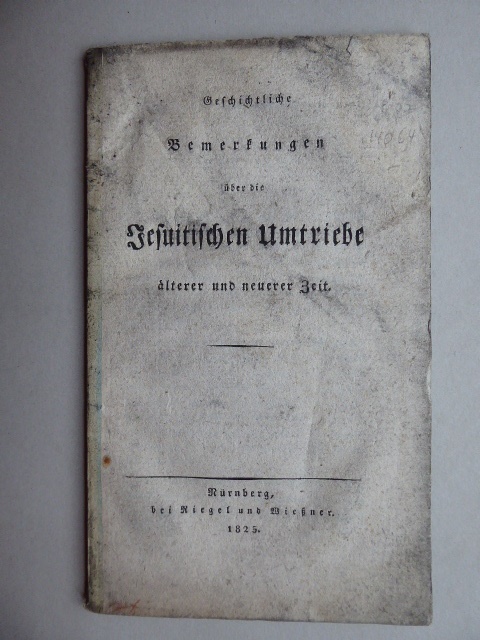
1825ref. 14064Nürnberg. Riegel & Wießner. 1825. 48 Seiten. Original-Papierbroschur. Unbeschnittenes Exemplar. (Papier fleckig u. etwas knittrig).
1819ref. 1249972Nürnberg, Riegel u. Wießner, 1819. 6, 218 S., 1 Bl. m. handschriftlicher Notiz. Neuer Ppbd (Stempel a. d. Titelrückseite, die ersten 6 S. stärker, dann meist schwach braunrandig, vereinzelt stärker, sonst nur etwas braunfleckig).
1910xxvii + 1008pp., in the series "Quellen und Forschungen zur Geschichte, Literatur und Sprache Österreich und seiner Kronländer", 24cm., original softcover (with some minor wear), few annotations in pencil in index and first 8 pages (can be erased easily), few occasional foxing, else good, rare, R106562
1910ref. R106562Wien, Ambr. Opitz Nachfolger 1910 xxvii + 1008pp., in the series "Quellen und Forschungen zur Geschichte, Literatur und Sprache Österreich und seiner Kronländer", 24cm., original softcover (with some minor wear), few annotations in pencil in index and first 8 pages (can be erased easily), few occasional foxing, else good, rare, R106562