1 879 résultats
réf. 13977957s. l.: , c. 1937 in-4, 38 pages, carte, 10 planches hors texte, dessins dans le texte. Reliure basane verte, couv. conservée, bon état.
réf. 34438P. et Genève, Société des Missions Evangéliques, 1947, in 8° broché, 136 pages ; illustrations hors-texte ; couverture illustrée (un peu fanée).
réf. 6269Paris, Gaume et Cie, Libraires-Editeurs, 1890 (quatrième édition). 1 volume in-8, 474 pp., reliure demi-chagrin, plats cartonnés marbrés, quelques rousseurs éparses, bel exemplaire.Ouvrage illustré d'un frontispice du Père Jean-Gabriel et de 8 planches hors texte.
réf. 40814P., La Bonne Presse, 1930, in 12 broché, XIV-259 pages.
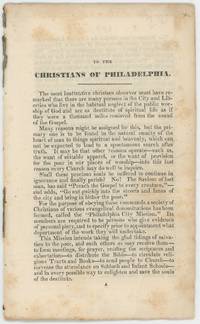
1831réf. BK0169Philadelphia: William F. Geddes 1831. 2 12 2 pp. Stitched pamphlet measuring 4 ¼ x 7 inches. Good plus with scattered foxing and soiling some wear to edges. An early appeal for organized missionary work among Philadelphia's urban poor issued upon the establishment of the Philadelphia City Mission in March 1831. The organization brought together Christians from several evangelical denominations to reach residents who rarely or never attended church. Its organizers acknowledged that poverty itself could prevent participation in religious life citing "the want of suitable apparel or the want of provision for the poor in our places of worship-into this last reason every Church may do well to inquire." The pamphlet begins by describing the large numbers of people living in Philadelphia and its surrounding districts who remained outside the ordinary reach of the churches: "The most inattentive christian observer must have remarked that there are many persons in the City and Liberties who live in the habitual neglect of the public worship of God and are as destitute of spiritual life as if they were a thousand miles removed from the sound of the Gospel." The Mission proposed to carry religious instruction directly into poorer neighborhoods through home visits prayer meetings the distribution of Bibles and tracts and efforts to increase attendance at Sabbath and infant schools. Its members were to be drawn from different evangelical denominations and required to demonstrate personal piety before undertaking missionary work. An interesting document of Philadelphia's early urban missionary movement particularly for its recognition of the economic and social barriers separating the city's poorer inhabitants from established religious institutions. . William F. Geddes unknown
1831réf. BK0169Philadelphia: William F. Geddes 1831. 2 12 2 pp. Stitched pamphlet measuring 4 ¼ x 7 inches. Good plus with scattered foxing and soiling some wear to edges. An early appeal for organized missionary work among Philadelphia's urban poor issued upon the establishment of the Philadelphia City Mission in March 1831. The organization brought together Christians from several evangelical denominations to reach residents who rarely or never attended church. Its organizers acknowledged that poverty itself could prevent participation in religious life citing "the want of suitable apparel or the want of provision for the poor in our places of worship-into this last reason every Church may do well to inquire." The pamphlet begins by describing the large numbers of people living in Philadelphia and its surrounding districts who remained outside the ordinary reach of the churches: "The most inattentive christian observer must have remarked that there are many persons in the City and Liberties who live in the habitual neglect of the public worship of God and are as destitute of spiritual life as if they were a thousand miles removed from the sound of the Gospel." The Mission proposed to carry religious instruction directly into poorer neighborhoods through home visits prayer meetings the distribution of Bibles and tracts and efforts to increase attendance at Sabbath and infant schools. Its members were to be drawn from different evangelical denominations and required to demonstrate personal piety before undertaking missionary work. An interesting document of Philadelphia's early urban missionary movement particularly for its recognition of the economic and social barriers separating the city's poorer inhabitants from established religious institutions. . William F. Geddes unknown books
1885réf. 248751885. Leitch spent 11 years in Sri Lanka with the American Board of Commissioners for Foreign Missions. She was co-author of "Seven Years in Ceylon" published by the American Tract Society. In this photo she is seated with a book under her arm surrounded by four adorable Sri Lankan girls. Cabinet card albumen photograph title beneath gilt edges. 4 1/4 x 6 1/2". A bit of light marking o/w very good condition. unknown
réf. 64813P., Au Bureau et Gaume, 1830, 2 volumes in 16 reliés pleine basane brune ancienne, dos lisses très ornés, étiquettes noires, XX-232 et 258 pages ; petits frottis et petites épidermures.
réf. 30794P., Karthala, 1995, in 8° broché, 368 pages ; illustrations ; couverture illustrée (légèrement fanée).
réf. ORD-14611Supplément du Journal des Missions Catholiques. 1896. Feuille de ca 1060 x 730 mm, pliée en 16, carte de ca 970 x 660 mm. Carte générale centrale de ca 490 x 420 mm, entourée de 24 cartes des différentes îles et archipels. Tirage en rouge sur fond vert pâle. Réparations aux croisements des plis d'origine sans dommage pour la carte. Bon exemplaire.
1829réf. 46567Philadelphia. 1829-1838. Significant Run of Missions Reports A run of ten annual reports for the Board of Missions of the General Assembly of the Presbyterian Church. Reports contain details on the missionary activities as well as a list of missionaries with much on American Indian missions during the 1830's. Ten pamphlets bound in one volume various paginations. Modern half calf and marbled boards leather label. Light toning and soiling. Contemporary manuscript notations on one report. Very good. hardcover
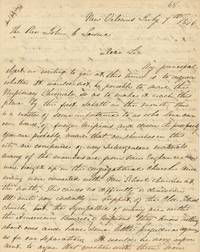
1846réf. List2863New Orleans Louisiana 1846. Single letter three 8 x 10 inch pages. Torn at folds some tears repaired with archival tape; hole at location of seal; otherwise very good to excellent. John Holt Rice 1818–1878 was the son of a Presbyterian minister and nephew of Archibald Alexander founding professor of the Princeton Theological Seminary from which Rice graduated in 1845. When he wrote this letter he was working as a city missionary to the poor in New Orleans. Rice would spend his career ministering around the southern United States before his death from yellow fever. His correspondent is John Cameron Lowrie 1808–1900 a Scottish immigrant fellow Princeton graduate and a missionary in Colonial India. When his health became too precarious to remain abroad Lowrie returned to serve with the Board of Foreign Missions. The subject of missions boards was part of the Old School-New School controversy and schism in the Presbyterian Church particularly over whether missionary work should be primary the Old School view or secondary the New School view to the Church’s work.1 Those holding the latter view were satisfied with the work of the American Board of Commissioners for Foreign Missions ABCFM which was not a specifically Presbyterian body. Those of the former view believing that the Church’s missionary board ought to be itself Presbyterian formed the Western Foreign Missionary Society. When the Church’s second schism occurred in 1837 the Western society was renamed the Board of Foreign Missions BFM and headquartered in New York City. In this letter Rev. Rice finds himself in the delicate position of being an Old School supporter of the BFM ministering to Congregationalists and New School-raised supporters of the ABCFM. He writes to Rev. Lowrie requesting that copies of the BFM’s monthly Missionary Chronicle be sent to him in a timely manner as this was “a matter of some importance to us who love our own board of foreign missions”: “You are probably aware that our churches in this city are composed of very heterogeneous materials many of the members are from New England and were brought up in the congregational church and many were connected with New School churches at the north. This causes no difficulty or division All unite very cordially in support of the Old School church but the sympathies of many are with the American Board of Missions. They know nothing about ours and have some little prejudice against us for our separation. It would be very impudent to argue that question with them now or attempt to convince them that our own board ought to be patronised by those connected with one of our churches rather than the American. But I feel certain that if they knew more of our operations they would take an interest in them.” Rice also notes that he is an editor for the New Orleans Protestant newspaper and suggests that Lowrie send “something now and then” to excite “missionary zeal”. Of interest to scholars of Presbyterian history especially the 19th-century Old School-New School schism. 1 Rev. Dr. Michael Parker “175 Years of Presbyterian World Mission” Presbyterian Historical Society archived November 1 2023 at https://web.archive.org/web/20231101183954/http://www.history.pcusa.org/history-online/topics-note/history-world-mission. unknown
1829réf. 46567Philadelphia. 1829-1838. Significant Run of Missions Reports A run of ten annual reports for the Board of Missions of the General Assembly of the Presbyterian Church. Reports contain details on the missionary activities as well as a list of missionaries with much on American Indian missions during the 1830's. Ten pamphlets bound in one volume various paginations. Modern half calf and marbled boards leather label. Light toning and soiling. Contemporary manuscript notations on one report. Very good. hardcover books
1846réf. List2863New Orleans Louisiana 1846. Single letter three 8 x 10 inch pages. Torn at folds some tears repaired with archival tape; hole at location of seal; otherwise very good to excellent. John Holt Rice 1818–1878 was the son of a Presbyterian minister and nephew of Archibald Alexander founding professor of the Princeton Theological Seminary from which Rice graduated in 1845. When he wrote this letter he was working as a city missionary to the poor in New Orleans. Rice would spend his career ministering around the southern United States before his death from yellow fever. His correspondent is John Cameron Lowrie 1808–1900 a Scottish immigrant fellow Princeton graduate and a missionary in Colonial India. When his health became too precarious to remain abroad Lowrie returned to serve with the Board of Foreign Missions. The subject of missions boards was part of the Old School-New School controversy and schism in the Presbyterian Church particularly over whether missionary work should be primary the Old School view or secondary the New School view to the Church’s work.1 Those holding the latter view were satisfied with the work of the American Board of Commissioners for Foreign Missions ABCFM which was not a specifically Presbyterian body. Those of the former view believing that the Church’s missionary board ought to be itself Presbyterian formed the Western Foreign Missionary Society. When the Church’s second schism occurred in 1837 the Western society was renamed the Board of Foreign Missions BFM and headquartered in New York City. In this letter Rev. Rice finds himself in the delicate position of being an Old School supporter of the BFM ministering to Congregationalists and New School-raised supporters of the ABCFM. He writes to Rev. Lowrie requesting that copies of the BFM’s monthly Missionary Chronicle be sent to him in a timely manner as this was “a matter of some importance to us who love our own board of foreign missions”: “You are probably aware that our churches in this city are composed of very heterogeneous materials many of the members are from New England and were brought up in the congregational church and many were connected with New School churches at the north. This causes no difficulty or division All unite very cordially in support of the Old School church but the sympathies of many are with the American Board of Missions. They know nothing about ours and have some little prejudice against us for our separation. It would be very impudent to argue that question with them now or attempt to convince them that our own board ought to be patronised by those connected with one of our churches rather than the American. But I feel certain that if they knew more of our operations they would take an interest in them.” Rice also notes that he is an editor for the New Orleans Protestant newspaper and suggests that Lowrie send “something now and then” to excite “missionary zeal”. Of interest to scholars of Presbyterian history especially the 19th-century Old School-New School schism. 1 Rev. Dr. Michael Parker “175 Years of Presbyterian World Mission” Presbyterian Historical Society archived November 1 2023 at https://web.archive.org/web/20231101183954/http://www.history.pcusa.org/history-online/topics-note/history-world-mission. unknown books
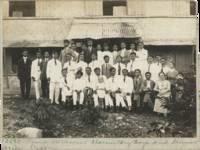
réf. List3148Vigan The Philippines early 20th century. Photograph measuring 5 x 6 ¾ inches mounted on heavy cardstock. Manuscript caption recto. Wear and some damage to edges; excellent. A photograph of a group of young Filipino men in suits with two white women and a child posing in front of a building. The caption reads “Grove Methodist Dormitory Boys and Missionaries Vigan”. The Methodist Episcopal Church began planning its missionary outreach to the Philippines shortly after the 1898 American victory in the Spanish Civil War when the Philippines became an American colony. The mission center in Vigan the capital of Ilocos Sur on the island of Luzon was opened in 1904 headed by Kansan Berndt O. Peterson.1 Missionaries opened schools—with the aim of both educating and Americanizing their students—and made Vigan the base for evangelizing around the region. According to the UMC’s history of their activities in Asia many Filipinos saw the church’s activities as an extension of American imperialism leading to Nicolás Zamora’s foundation of the Iglesia Evangelica Metodista en las Islas Filipinas in 1909. 1 Wade Crawford Barclay History of Methodist Missions Vol. 4 The Board of Missions and Church Extension of the Methodist Church 1949. unknown
réf. List3148Vigan The Philippines early 20th century. Photograph measuring 5 x 6 ¾ inches mounted on heavy cardstock. Manuscript caption recto. Wear and some damage to edges; excellent. A photograph of a group of young Filipino men in suits with two white women and a child posing in front of a building. The caption reads “Grove Methodist Dormitory Boys and Missionaries Vigan”. The Methodist Episcopal Church began planning its missionary outreach to the Philippines shortly after the 1898 American victory in the Spanish Civil War when the Philippines became an American colony. The mission center in Vigan the capital of Ilocos Sur on the island of Luzon was opened in 1904 headed by Kansan Berndt O. Peterson.1 Missionaries opened schools—with the aim of both educating and Americanizing their students—and made Vigan the base for evangelizing around the region. According to the UMC’s history of their activities in Asia many Filipinos saw the church’s activities as an extension of American imperialism leading to Nicolás Zamora’s foundation of the Iglesia Evangelica Metodista en las Islas Filipinas in 1909. 1 Wade Crawford Barclay History of Methodist Missions Vol. 4 The Board of Missions and Church Extension of the Methodist Church 1949. unknown books
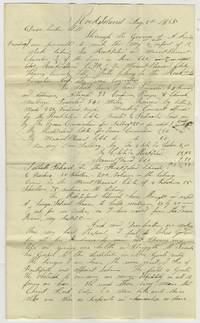
1845réf. BK0133Rock Island Illinois 1845. Autograph letter signed 2 pp. 7 ½ x 12 ¾ inches on a folded folio sheet with integral address panel addressed to Rev. B. M. Hill Corresponding Secretary of the American Baptist Home Mission Society Troy New York. Red Chicago August 5 postmark and manuscript postal rate. Folded for mailing with remnants of original seal; very good. A detailed report by Baptist missionary Daniel Dye on his work among the rapidly growing communities of western Illinois and Iowa sent to Benjamin M. Hill of the American Baptist Home Mission Society. Dye gives a granular account of thirteen weeks of missionary labor at Rock Island and Mount Pleasant in Henry County: forty sermons and addresses twenty-two conferences and prayer and church meetings 541 miles traveled 228 pastoral visits and visits to two schools. He also records the churches' contributions toward his salary and missionary work and describes Sabbath schools at Rock Island and Mount Pleasant with ten teachers forty pupils and libraries totaling 275 volumes. Dye had come to Rock Island in the wake of Baptist missionary Ezra Fisher who left the region in the spring of 1845 for Oregon. A later history of the First Baptist Church records Dye's pastorate as beginning July 19 1845 two weeks before this letter. The same history notes that the young congregation organized with seven members in 1837 purchased a brick schoolhouse in 1844 for use as its meeting place.1 Dye supplies a contemporary description of the building: "The Rock Island Church have bought and repaired a large School House to hold meetings in 28 x 40." The report closes with a broader assessment of Baptist missionary work throughout the upper Mississippi Valley. "The field is great" Dye writes "the obstacles to overcome are many; infidelity in all its forms are here." Davenport was without a settled minister Dubuque had been "destitute" since the departure of its pastor and "there are many Churches destitute in the Des Moines Association." He summarizes the appeal of these western congregations to their eastern brethren in a memorable phrase: "The long and loud cry is come over and help us." Dye stresses that the small congregations were already supporting the work as well as they could noting that two members at Mount Pleasant had each paid four dollars toward three months of occasional preaching although "they are not worth much over 1000 dollars each." Dye was preparing to return temporarily to New York to see a son from whom he had been separated for more than a year but the Rock Island congregation had already given him a unanimous call to return and settle among them. He hoped while east to attend Baptist associations and "wake them up more to the interest of the Great Valley." 1 The Past and Present of Rock Island County Ill. H. F. Kett & Co. 1877 168. . unknown
1845réf. BK0133Rock Island Illinois 1845. Autograph letter signed 2 pp. 7 ½ x 12 ¾ inches on a folded folio sheet with integral address panel addressed to Rev. B. M. Hill Corresponding Secretary of the American Baptist Home Mission Society Troy New York. Red Chicago August 5 postmark and manuscript postal rate. Folded for mailing with remnants of original seal; very good. A detailed report by Baptist missionary Daniel Dye on his work among the rapidly growing communities of western Illinois and Iowa sent to Benjamin M. Hill of the American Baptist Home Mission Society. Dye gives a granular account of thirteen weeks of missionary labor at Rock Island and Mount Pleasant in Henry County: forty sermons and addresses twenty-two conferences and prayer and church meetings 541 miles traveled 228 pastoral visits and visits to two schools. He also records the churches' contributions toward his salary and missionary work and describes Sabbath schools at Rock Island and Mount Pleasant with ten teachers forty pupils and libraries totaling 275 volumes. Dye had come to Rock Island in the wake of Baptist missionary Ezra Fisher who left the region in the spring of 1845 for Oregon. A later history of the First Baptist Church records Dye's pastorate as beginning July 19 1845 two weeks before this letter. The same history notes that the young congregation organized with seven members in 1837 purchased a brick schoolhouse in 1844 for use as its meeting place.1 Dye supplies a contemporary description of the building: "The Rock Island Church have bought and repaired a large School House to hold meetings in 28 x 40." The report closes with a broader assessment of Baptist missionary work throughout the upper Mississippi Valley. "The field is great" Dye writes "the obstacles to overcome are many; infidelity in all its forms are here." Davenport was without a settled minister Dubuque had been "destitute" since the departure of its pastor and "there are many Churches destitute in the Des Moines Association." He summarizes the appeal of these western congregations to their eastern brethren in a memorable phrase: "The long and loud cry is come over and help us." Dye stresses that the small congregations were already supporting the work as well as they could noting that two members at Mount Pleasant had each paid four dollars toward three months of occasional preaching although "they are not worth much over 1000 dollars each." Dye was preparing to return temporarily to New York to see a son from whom he had been separated for more than a year but the Rock Island congregation had already given him a unanimous call to return and settle among them. He hoped while east to attend Baptist associations and "wake them up more to the interest of the Great Valley." 1 The Past and Present of Rock Island County Ill. H. F. Kett & Co. 1877 168. . unknown books
réf. 39081P., Cahiers de Foi et Vie, 1932, in 8° broché, 128 pages.
réf. 43817P., Cahiers de Foi et Vie, sans date, in 8° broché, 134 pages ; quelques piqûres.
réf. 43818P., Cahiers de Foi et Vie, sans date, in 8° broché, 119 pages ; quelques piqûres.
réf. 54576Sans lieu ni nom (Lausanne, Imprimerie La Concorde), sans date (vers 1920), petit in 8° broché, 173 pages2 planches hors-texte ; quelques rousseurs ; couverture fanée et effrangée.
réf. 13977766Namur: Grands lacs, 1938 in-8, pp. 545-752, illustrations. Broché, jaquette défr. avec petits manques de papier, rares rousseurs, sinon bon état.
réf. 13977801Namur: Pères blancs d'Afrique, 1962 in-4, 68 pages, illustrations. Agrafé.
réf. 54487P., Albin Michel, 1957, in 8° broché, 331 pages ; bibliographie in-fine ; 2 cartes et 4 planches ; couvetrure illustrée en couleurs.