8910 risultati
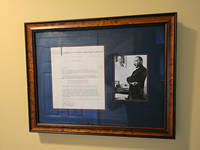
1963rif. 022128Atlanta 12 August 1963. Framed Letter. Near Fine and handsomely presented. Superb letter on Southern Christian Leadership Conference stationery dated 12 August 1963. "I want to personally thank you for the support which you have given to our nonviolent direct action movement to eliminate the immoral and shameful practice of racial discrimination and segregation from American life. I am particularly pleased that as part of your contribution to our work you have acquired a copy of my latest book STRENGTH TO LOVE. In the preface of this book I said: 'In these turbulent days of uncertainty the evils of war and of economic and racial injustice threaten the very survival of the human race.' These words are even more relevant to this current phase of the civil rights revolution than it was when the preface was printed. It has always been a source of inner strength to me and those of my associates in the Southern Christian Leadership Conference to be able to meet and overcome many of the indignities and humiliations of segregation in America with unswerving faith in the American dream of freedom for all men. I believe it can be said that the Strength To Love in the midst of adversities is one of the most significant features of the nonviolent direct action movement in our country today." SIGNED "Martin L. King Jr." Matted in deep blue and maroon with a casual photograph of King standing at his desk with a photo of Gandhi behind him. In an antique carved gilt frame 21-1/2" wide by 17" high. unknown
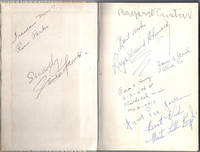
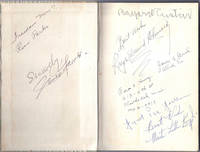
1962rif. 022483New York: William Morrow and Company 1962. First Edition. Hardcover. Mild toning to endpapers but autographs clear and dark. Very Good in a Good dustwrapper lacking the rear inner flap. Second Printing. INSCRIBED and SIGNED on the front pastedown and front endpaper by several of the luminaries of the Civil Rights movement including "Best Wishes/Martin Luther King Jr."; "Freedom Now!!/Rosa Parks"; "Sincerely/James Farmer"; "Best wishes/Ralph David Abernathy"; "Aaron E. Henry" who adds his address and phone number; "James T. Bevel/Atlanta GA"; "Bayard Rustin"; and "Wyatt Tee Walker." The book is also INSCRIBED and SIGNED by the author on the half-title page. Outstanding and possibly unique collection of Civil Rights pioneers as King and Parks are seldom if ever seen on the same item. William Morrow and Company hardcover books
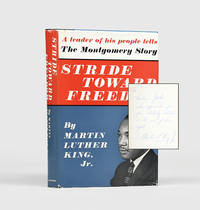
1958rif. 193893New York: Harper & Brothers 1958. Presented to America's highest-ranking Black elected official First edition presentation copy inscribed by the author on the front free endpaper: "To Hulan Jack In appreciation for your outstanding contribution in the area of human rights. Martin L. King Jr.". Stride Toward Freedom was King's first book his memoir of the Montgomery bus boycott. Hulan Jack 1906-1986 represented Harlem in the New York State Assembly from 1941 to 1953 and served as Manhattan borough president from 1954 to 1961. His obituary observed that this was "the highest administrative political office then held by a black in the United States. As a politician he came to symbolize for many blacks an important milestone in a long struggle for political and social equality. Over the years Mr. Jack established a record as the untiring author of legislation for human rights and against racial discrimination of any type. Though his bills usually fell by the wayside he remained convinced that he was not wrong but merely ahead of his time" New York Times 22 December 1986. King stayed in New York for several days to publicize the book following its publication on 17 September 1958. On 19 September he shared a platform with Jack at a rally at Harlem's Hotel Theresa. Jack warned King that he had heard threatening remarks from the crowd but was told by King not to get a bodyguard. The following day King was stabbed while signing copies of the book by someone who had been in the crowd Nakayama pp. 13-14. Octavo. Original black quarter cloth spine lettered in silver blue cloth sides. With dust jacket. Unclipped jacket lightly rubbed and nicked but otherwise bright; a fine copy in a near-fine jacket. Don K. Nakayama "The Harlem assassination attempt on Martin Luther King Jr." The Pharos Spring 2016. hardcover
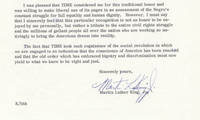
1964rif. 3590625/03/1964. Among the finest MLK letters we have seen on the market He references “the Negro's constant struggle for full equality and human dignity” and sees with satisfaction the Civil Rights struggle as having made significant progress foreseeing its success The honor from Time was not his alone but “a tribute to the entire civil rights struggle and the millions of gallant people all over the nation who are working so untiringly to bring the American dream into reality” <img class=""alignnone wp-image-35912 size-post-window"" src=""https://cdn.raabcollection.com/wp-content/uploads/20260309191039/MLK-March-25-1964-1-1600x484.jpg"" alt="""" width=""1600"" height=""484"" /> Time has become renowned for annually naming a ‘‘Man of the Year’’ doing so in the first issue of a new year and featuring and profiling a person group idea or object that ""for better or for worse…has done the most to influence the events” of the previous year. To receive the honor was more than prestigious; it drew broad attention to the winner’s work. The winners for 1961 and 1962 were President Kennedy and Pope John XXIII respectively. 1963 was a pivotal point for the Civil Rights Movement. It was a year of the outcry for equality of massive demonstrations of sit-ins and speeches and street confrontations of soul searching and psalm singing. Nineteen million Negro citizens and their allies forced the nation to take stock of itself—in the Congress and in the corporation in factory and field in restaurant and store in pulpit and playground in kitchen and classroom. At the head of this movement and its symbol was Martin Luther King Jr. and many saw him as a Moses sent to lead his people to the Promised Land of first-class citizenship. His speeches were models of inspiration that nourished hope and excoriated injustice. On April 12 1963 Dr. King was arrested with Ralph Abernathy by Birmingham Police Commissioner ""Bull"" Connor for demonstrating without a permit. This launched the Birmingham campaign which would prove to be the turning point in the war to end segregation in the South. During the eleven days he spent in prison King wrote his famous Letter from Birmingham Jail. On May 10 the Birmingham agreement was announced whereunder the city’s stores restaurants and schools would be desegregated hiring of blacks implemented and charges against civil rights leaders dropped. On June 23 King lead over 200000 people on a Freedom Walk in Detroit. Then came the most famous moment in King’s long career and long struggle: The March on Washington for Jobs and Freedom which took place in Washington D.C. on August 28 1963. Attended by some 250000 people it was the largest demonstration ever seen in the nation's capital up to that time and one of the first to have extensive television coverage. During that march King delivered his “I_Have a Dream”_speech which remains one of the most famous speeches in American history. He started with prepared remarks saying he was there to ""cash a check"" for ""Life Liberty and the pursuit of Happiness"" while advising fellow protesters that non-violence was key to the movement: ”We must rise to the majestic heights of meeting physical force with soul force."" But then he departed from his script shifting into the ""I have a dream"" theme speaking of an America where his children ""will not be judged by the color of their skin but by the content of their character."" He followed this with an exhortation to ""let freedom ring"" across the nation. The impact of all of this on the American people was enormous and you could see people’s perceptions changing. Now King’s agenda came to the front and center of the national consciousness. Time magazine saw King as the personification of the Civil Rights Movement and in its January 4 1964 issue gave him Man of the Year honors for 1963. In that issue the cover featured a portrait of King by artist Robert Vickrey and a seven-page article that highlighted King’s leadership in the civil rights movement. It featured pictures of King during some of the most memorable moments of his civil rights career including a meeting with President Lyndon B. Johnson and King’s arrest in Birmingham Alabama. King received many congratulatory telegrams and letters. He wrote Time editor Henry Luce thanking him and saying that Times’s recent treatment of the achievements of black Americans ‘‘does much to help grind away the granite-like notions that have obtained for so long that the Negro is not able to take his place in all fields of endeavor.’’ <img class=""alignnone wp-image-35913 size-post-window"" src=""https://cdn.raabcollection.com/wp-content/uploads/20260309191110/MLK-March-25-1964-2-1600x306.jpg"" alt="""" width=""1600"" height=""306"" /> King did not consider that the honor was his alone but rather as a tribute being paid to the civil rights movement. He also saw it as a sign that bigotry was waning in America and that justice was on the rise. Typed letter signed as President of the Southern Christian Leadership Conference SCLC and on its letterhead Atlanta Georgia March 25 1964 to Robert W. Fischer in Milan Italy enunciating his true feelings about the deeper meaning of the Time Magazine award the course of the entire Civil Rights struggle and the part he played in it. “Please accept my deep appreciation for your kind letter in reference to my being chosen by TIME magazine as its Man of the Year. It was very thoughtful of you to take the time to write to me in this connection and I am deeply grateful for this expression of support. “I was pleased that TIME considered me for this traditional honor and was willing to make liberal use of its pages in an assessment of the Negro's constant struggle for full equality and human dignity. However I must say that I sincerely feel that this particular recognition is not an honor to be enjoyed by me personally but rather a tribute to the entire civil rights struggle and the millions of gallant people all over the nation who are working so untiringly to bring the American dream into reality. “The fact that TIME took such cognizance of the social revolution in which we are engaged is an indication that the conscience of America has been reached and that the old order which has embraced bigotry and discrimination must now yield to what we know to be right and just."" King was right that “the conscience of America has been reached” and that the civil rights movement had made important gains that augured well for the future. He was perhaps too modest about the part he was playing in making equality a reality. <img class=""alignnone wp-image-25018 size-post-window"" src=""https://cdn.raabcollection.com/wp-content/uploads/20231204144051/Folder-site-11-1600x1327.jpg"" alt="""" width=""1600"" height=""1327"" /> unknown
1964rif. 3590625/03/1964. Among the finest MLK letters we have seen on the market He references “the Negro's constant struggle for full equality and human dignity” and sees with satisfaction the Civil Rights struggle as having made significant progress foreseeing its success The honor from Time was not his alone but “a tribute to the entire civil rights struggle and the millions of gallant people all over the nation who are working so untiringly to bring the American dream into reality” <img class=""alignnone wp-image-35912 size-post-window"" src=""https://cdn.raabcollection.com/wp-content/uploads/20260309191039/MLK-March-25-1964-1-1600x484.jpg"" alt="""" width=""1600"" height=""484"" /> Time has become renowned for annually naming a ‘‘Man of the Year’’ doing so in the first issue of a new year and featuring and profiling a person group idea or object that ""for better or for worse…has done the most to influence the events” of the previous year. To receive the honor was more than prestigious; it drew broad attention to the winner’s work. The winners for 1961 and 1962 were President Kennedy and Pope John XXIII respectively. 1963 was a pivotal point for the Civil Rights Movement. It was a year of the outcry for equality of massive demonstrations of sit-ins and speeches and street confrontations of soul searching and psalm singing. Nineteen million Negro citizens and their allies forced the nation to take stock of itself—in the Congress and in the corporation in factory and field in restaurant and store in pulpit and playground in kitchen and classroom. At the head of this movement and its symbol was Martin Luther King Jr. and many saw him as a Moses sent to lead his people to the Promised Land of first-class citizenship. His speeches were models of inspiration that nourished hope and excoriated injustice. On April 12 1963 Dr. King was arrested with Ralph Abernathy by Birmingham Police Commissioner ""Bull"" Connor for demonstrating without a permit. This launched the Birmingham campaign which would prove to be the turning point in the war to end segregation in the South. During the eleven days he spent in prison King wrote his famous Letter from Birmingham Jail. On May 10 the Birmingham agreement was announced whereunder the city’s stores restaurants and schools would be desegregated hiring of blacks implemented and charges against civil rights leaders dropped. On June 23 King lead over 200000 people on a Freedom Walk in Detroit. Then came the most famous moment in King’s long career and long struggle: The March on Washington for Jobs and Freedom which took place in Washington D.C. on August 28 1963. Attended by some 250000 people it was the largest demonstration ever seen in the nation's capital up to that time and one of the first to have extensive television coverage. During that march King delivered his “I_Have a Dream”_speech which remains one of the most famous speeches in American history. He started with prepared remarks saying he was there to ""cash a check"" for ""Life Liberty and the pursuit of Happiness"" while advising fellow protesters that non-violence was key to the movement: ”We must rise to the majestic heights of meeting physical force with soul force."" But then he departed from his script shifting into the ""I have a dream"" theme speaking of an America where his children ""will not be judged by the color of their skin but by the content of their character."" He followed this with an exhortation to ""let freedom ring"" across the nation. The impact of all of this on the American people was enormous and you could see people’s perceptions changing. Now King’s agenda came to the front and center of the national consciousness. Time magazine saw King as the personification of the Civil Rights Movement and in its January 4 1964 issue gave him Man of the Year honors for 1963. In that issue the cover featured a portrait of King by artist Robert Vickrey and a seven-page article that highlighted King’s leadership in the civil rights movement. It featured pictures of King during some of the most memorable moments of his civil rights career including a meeting with President Lyndon B. Johnson and King’s arrest in Birmingham Alabama. King received many congratulatory telegrams and letters. He wrote Time editor Henry Luce thanking him and saying that Times’s recent treatment of the achievements of black Americans ‘‘does much to help grind away the granite-like notions that have obtained for so long that the Negro is not able to take his place in all fields of endeavor.’’ <img class=""alignnone wp-image-35913 size-post-window"" src=""https://cdn.raabcollection.com/wp-content/uploads/20260309191110/MLK-March-25-1964-2-1600x306.jpg"" alt="""" width=""1600"" height=""306"" /> King did not consider that the honor was his alone but rather as a tribute being paid to the civil rights movement. He also saw it as a sign that bigotry was waning in America and that justice was on the rise. Typed letter signed as President of the Southern Christian Leadership Conference SCLC and on its letterhead Atlanta Georgia March 25 1964 to Robert W. Fischer in Milan Italy enunciating his true feelings about the deeper meaning of the Time Magazine award the course of the entire Civil Rights struggle and the part he played in it. “Please accept my deep appreciation for your kind letter in reference to my being chosen by TIME magazine as its Man of the Year. It was very thoughtful of you to take the time to write to me in this connection and I am deeply grateful for this expression of support. “I was pleased that TIME considered me for this traditional honor and was willing to make liberal use of its pages in an assessment of the Negro's constant struggle for full equality and human dignity. However I must say that I sincerely feel that this particular recognition is not an honor to be enjoyed by me personally but rather a tribute to the entire civil rights struggle and the millions of gallant people all over the nation who are working so untiringly to bring the American dream into reality. “The fact that TIME took such cognizance of the social revolution in which we are engaged is an indication that the conscience of America has been reached and that the old order which has embraced bigotry and discrimination must now yield to what we know to be right and just."" King was right that “the conscience of America has been reached” and that the civil rights movement had made important gains that augured well for the future. He was perhaps too modest about the part he was playing in making equality a reality. <img class=""alignnone wp-image-25018 size-post-window"" src=""https://cdn.raabcollection.com/wp-content/uploads/20231204144051/Folder-site-11-1600x1327.jpg"" alt="""" width=""1600"" height=""1327"" /> unknown books
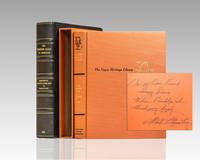
1965rif. 149476Yonkers: Educational Heritage Inc 1965. First edition of this comprehensive anthology that compiles historical documents speeches and firsthand accounts to trace the evolving struggle for African American freedom and equality. Quarto original publisher's orange cloth boards with black and white illustrations. Association copy inscribed by Martin Luther King Jr. to Sammy Davis Jr. on the front free endpaper "To my Dear Friend Sammy Davis Whose Friendship I Cherish very deeply Martin Luther King." Sammy Davis Jr. 1925–1990 was an American singer dancer and actor whose extraordinary versatility made him one of the most celebrated entertainers of the twentieth century. As the only Black member of the Rat Pack Davis broke racial barriers in entertainment while confronting segregation both on and off stage. His friendship with Dr. Martin Luther King Jr. began through Davis’s activism and fundraising for King’s civil-rights efforts and deepened during the Civil Rights Movement. Davis used his fame to raise awareness and funds for King’s initiatives performing at civil rights benefits and supporting the 1963 March on Washington. In near fine condition with a small loss to the crown of the spine. Edited by Alfred E. Cain. Illustrated by Horace Varela. Housed in the original orange cloth slipcase within a custom folding chemise within a custom half morocco slipcase with gilt titles to the spine. Martin Luther King Jr. was a Baptist minister and activist who became the most visible spokesperson and leader in the civil rights movement from 1954 through 1968. He is best known for his role in the advancement of civil rights using the tactics of nonviolence and civil disobedience based on his Christian beliefs and inspired by the nonviolent activism of Mahatma Gandhi. King led the 1955 Montgomery bus boycott and in 1957 became the first president of the Southern Christian Leadership Conference SCLC. With the SCLC he led an unsuccessful 1962 struggle against segregation in Albany Georgia and helped organize the nonviolent 1963 protests in Birmingham Alabama. He also helped organize the 1963 March on Washington where he delivered his famous "I Have a Dream" speech. On October 14 1964 King received the Nobel Peace Prize for combating racial inequality through nonviolent resistance. In 1965 he helped to organize the Selma to Montgomery marches and the following year he and the SCLC took the movement north to Chicago to work on segregated housing. In his final years he expanded his focus to include opposition towards poverty and the Vietnam War alienating many of his liberal allies with a 1967 speech titled "Beyond Vietnam". In 1968 King was planning a national occupation of Washington D.C. to be called the Poor People's Campaign when he was assassinated on April 4 in Memphis Tennessee. He was posthumously awarded the Presidential Medal of Freedom and the Congressional Gold Medal. Martin Luther King Jr. Day was established as a holiday in numerous cities and states beginning in 1971 and as a U.S. federal holiday in 1986. The Martin Luther King Jr. Memorial on the National Mall in Washington D.C. was dedicated in 2011. Educational Heritage, Inc hardcover
1520rif. 33261-1160Wittenberg Melchior Lotter the younger 1520. Title within nice decorative woodcut border attributed to Lucas Cranach and woodcut initial on A3. 50 ff. Small 4to 212 x 157 mm. Late 19th century half cloth one corner bumped. Wittenberg Melchior Lotter the younger 1520. First printing of the editio definitiva Druck B of the appeal "To the Christian Nobility of the German Nation" addressed to the Emperor and the German nobility. Present here is for the first time the complete enlarged and finally text immediately issued after printing the forthy-eight-page template from Aug. 5 1520. Considered Martin Luther's 1483-1546 pivotal work this is the most influential and important of the first of his three primary treatises. It is Luther's answer to the "Bull of Excommunication" published in Rome in June 1520. A first and most important powerful call to action urging the nobility and leaders to participate actively in reforming the Church and society. Here Luther asserts the right of civil power to reform the spiritual and asks the government to exercise this right. He boldly identifies the pope as the Antichrist and goes on to attack the concept that the Church is superior to the State by his assertion that every baptized Christian is a priest. The new added chapter 26 on the false legal claims of the popes' claims to have taken over the Holy Roman Empire from Byzantine Emperors and brought it into the German nation. This gave the work additional explosive force. Luther then proposes drastic reforms against the authority of the Pope against a celibate priesthood and against corruption in the Church. It is interesting to note that Machiavelli and Morus both looked critically at political power and the behavior of rulers. So in summary these connections demonstrate that Luther's "An den Christlichen Adel deutscher Nation" is embedded within a broader philosopical context that also includes the works of Thomas Morus and Niccolò Machiavelli. Luther's book was in effect a call for the Reformation to begin and had a most profound influence on the history of Europe and later on large parts of the world over all centuries.- Nice copy of outmost and exceptionally rarity. - VD 16 L 3759; Benzing 684; cf. PMM 49; Stickelberger Coll. 407; Pflugk-Harttung 49; not in Adams nor Knaake or Kuczynski. REFORMATION ; GERMANY ; Wittenberg, Melchior Lotter, the younger hardcover
1962rif. 022483New York: William Morrow and Company 1962. First Edition. Hardcover. Mild toning to endpapers but autographs clear and dark. Very Good in a Good dustwrapper lacking the rear inner flap. Second Printing. INSCRIBED and SIGNED on the front pastedown and front endpaper by several of the luminaries of the Civil Rights movement including "Best Wishes/Martin Luther King Jr."; "Freedom Now!!/Rosa Parks"; "Sincerely/James Farmer"; "Best wishes/Ralph David Abernathy"; "Aaron E. Henry" who adds his address and phone number; "James T. Bevel/Atlanta GA"; "Bayard Rustin"; and "Wyatt Tee Walker." The book is also INSCRIBED and SIGNED by the author on the half-title page. Outstanding and possibly unique collection of Civil Rights pioneers as King and Parks are seldom if ever seen on the same item. William Morrow and Company hardcover
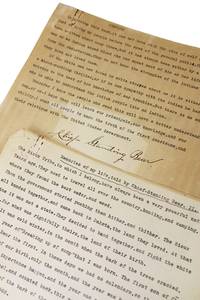
1927rif. 6426Los Angeles 1927. Very good. 343 leaves typed on rectos only. Typescript. Some light toning and wear occasional rust from removed paperclips. Signed by the author on the Preface leaf. Preface and several other leaves typed on letterhead of the American Indian Progressive Association Chief Standing Bear President. With a manuscript note regarding provenance. The original unexpurgated typescript of Chief Standing Bear's seminal work on Native American rights My People the Sioux signed by him on the preface. Luther Standing Bear 1868-1939 was born on the Pine Ridge Reservation with a traditional Lakota upbringing. This changed when at the age of eleven he was sent to the Carlisle Indian School in Pennsylvania eventually becoming part of its first graduating class. He returned to Pine Ridge after graduation and subsequently toured with Buffalo Bill's Wild West Show. Returning from performing he became chief among his people. Because of his fame with the Wild West Show however he was recruited as an actor by Hollywood and he moved to California to act in numerous films and write books about his life and culture. Standing Bear advocated for indigenous self-determination; preservation of Lakota religion language and cultural traditions; and cultural dignity in public representation. His writing contributed to the broader intellectual and political climate that culminated in the 1934 Indian Reorganization Act. Later through his work in Hollywood and co-founding of the Indian Actors Association he continued his efforts to combat stereotypes and assert indigenous agency. The present typescript is Standing Bear's first book My People the Sioux published in 1928. In it he recounts Lakota life before and after confinement on reservations the trauma of Indian boarding schools intertribal conflicts treaty violations and the philosophical foundations of Lakota sovereignty and spirituality. His memoirs specifically highlight his time at Carlisle the Ghost Dance period and his time with the Wild West Show. This typescript preserves Standing Bear's full unfiltered narrative voice prior to editorial compression. In the signed preface Standing Bear writes "In writing this book it has not been with the idea of self glory. It is just to bring my people before the eyes of the general public. They have been written about many times but it has always been either by a white man or an Indian mixed blood who has spent most of his or her life away from the reservation. They do not know the struggles of the Indians because they have not lived them. If the white man has tried to write stories about us it is either a blood-curdling thriller or if he has sympathy with the Indian he has written to the best of his knowledge of our troubles. But there is no one who is able to understand the Indian people like an Indian." The typescript is accompanied by a manuscript note written by collector and Western historian E.A. Brininstool. Brininstool published extensively on Buffalo Bill and other Western figures and maintained close working relationships with Native leaders whose firsthand narratives he helped preserve. He served as literary associate and facilitator in bringing Standing Bear's work to publication: "This package contains the original manuscript of Chief Standing Bear just as written by himself containing approximately 116000 words. In the book brought out by Houghton Mifflin Co. in March 1928 about 100000 words only were used. Much valuable material was cut out by the publishers which is to be found in this the original manuscript." The present object therefore constitutes a primary source for scholars of Native American studies federal Indian policy cultural preservation and Progressive Era reform. Important and unique. unknown
1927rif. 6426Los Angeles 1927. Very good. 343 leaves typed on rectos only. Typescript. Some light toning and wear occasional rust from removed paperclips. Signed by the author on the Preface leaf. Preface and several other leaves typed on letterhead of the American Indian Progressive Association Chief Standing Bear President. With a manuscript note regarding provenance. The original unexpurgated typescript of Chief Standing Bear's seminal work on Native American rights My People the Sioux signed by him on the preface. Luther Standing Bear 1868-1939 was born on the Pine Ridge Reservation with a traditional Lakota upbringing. This changed when at the age of eleven he was sent to the Carlisle Indian School in Pennsylvania eventually becoming part of its first graduating class. He returned to Pine Ridge after graduation and subsequently toured with Buffalo Bill's Wild West Show. Returning from performing he became chief among his people. Because of his fame with the Wild West Show however he was recruited as an actor by Hollywood and he moved to California to act in numerous films and write books about his life and culture. Standing Bear advocated for indigenous self-determination; preservation of Lakota religion language and cultural traditions; and cultural dignity in public representation. His writing contributed to the broader intellectual and political climate that culminated in the 1934 Indian Reorganization Act. Later through his work in Hollywood and co-founding of the Indian Actors Association he continued his efforts to combat stereotypes and assert indigenous agency. The present typescript is Standing Bear's first book My People the Sioux published in 1928. In it he recounts Lakota life before and after confinement on reservations the trauma of Indian boarding schools intertribal conflicts treaty violations and the philosophical foundations of Lakota sovereignty and spirituality. His memoirs specifically highlight his time at Carlisle the Ghost Dance period and his time with the Wild West Show. This typescript preserves Standing Bear's full unfiltered narrative voice prior to editorial compression. In the signed preface Standing Bear writes "In writing this book it has not been with the idea of self glory. It is just to bring my people before the eyes of the general public. They have been written about many times but it has always been either by a white man or an Indian mixed blood who has spent most of his or her life away from the reservation. They do not know the struggles of the Indians because they have not lived them. If the white man has tried to write stories about us it is either a blood-curdling thriller or if he has sympathy with the Indian he has written to the best of his knowledge of our troubles. But there is no one who is able to understand the Indian people like an Indian." The typescript is accompanied by a manuscript note written by collector and Western historian E.A. Brininstool. Brininstool published extensively on Buffalo Bill and other Western figures and maintained close working relationships with Native leaders whose firsthand narratives he helped preserve. He served as literary associate and facilitator in bringing Standing Bear's work to publication: "This package contains the original manuscript of Chief Standing Bear just as written by himself containing approximately 116000 words. In the book brought out by Houghton Mifflin Co. in March 1928 about 100000 words only were used. Much valuable material was cut out by the publishers which is to be found in this the original manuscript." The present object therefore constitutes a primary source for scholars of Native American studies federal Indian policy cultural preservation and Progressive Era reform. Important and unique. unknown books