King, Martin Luther (Jr )Biblio.com
8910 risultati
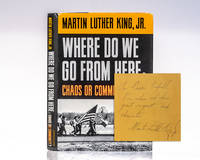
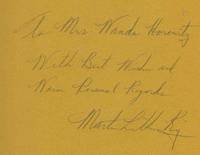
1967rif. 17909New York: Harper & Row. Very Good in Very Good dust jacket. First Edition. Hardcover. DJ has 2" closed tear to front; INSCRIBED with ball point pen by King to Wanda Horowitz the daughter of the conductor Toscanini.; 8vo - 8" to 9" tall; 209 pages . 1967. Harper & Row hardcover
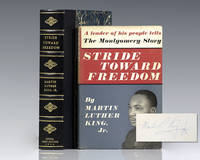
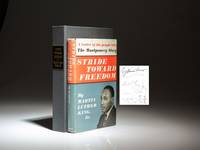
1958rif. 130938New York: Harper & Brothers Publishers 1958. First edition of Dr. Martin Luther King’s first book. Octavo original half cloth illustrated. Boldly signed by Martin Luther King Jr. on the front free endpaper. Near fine in a very good dust jacket with light rubbing name to the front pastedown. Housed in a custom half morocco clamshell. Stride Toward Freedom is Dr. Martin Luther King Jr.'s account of the first successful large-scale application of nonviolence resistance in America is comprehensive revelatory and intimate. King described his book as "the chronicle of fifty thousand Negroes who took to heart the principles of nonviolence who learned to fight for their rights with the weapon of love and who in the process acquired a new estimate of their own human worth.'' Harper & Brothers, Publishers hardcover
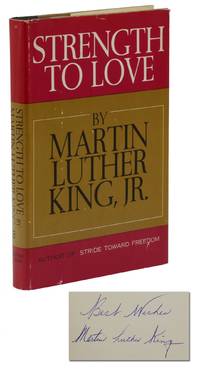
1963rif. 140942245New York: Harper & Row 1963. First Edition. Very Good/Very Good. First edition first printing. Signed by Martin Luther King on the front free endpaper. Very Good with owner name effaced and taped over above King's signature abrasion to front and rear pastedowns. Former ownership stamp and handwritten date to half-title page. In a Very Good unclipped dust jacket with rubbing light wear and some small areas of discoloration. A collection of sermons by the civil rights leader centering around racial segregation with a focus on permanent religious values. Harper & Row unknown books
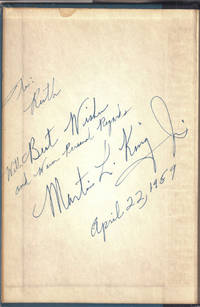
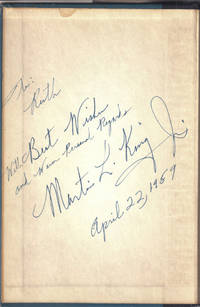
1958rif. 021985New York: Harper & Brothers 1958. First Edition. Hardcover. Chip to cloth at bottom of spine. Very Good in a Near Fine dustwrapper with typically sunned spine. Early but not first printing of Martin Luther King's first book. Illustrated with photographs. Boldly INSCRIBED and SIGNED by the author on the front pastedown: "To:/Ruth/With Best Wishes/and Warm Personal Regards/Martin L. King Jr./Aprill 22 1959." On the front endpaper are two further inscriptions one dated 21 February 1959 and SIGNED "M.G.G." and the other dated 14 June 1959 by Theodore E. Brown who at the time was the assistant director of the AFL-CIOs civil rights department: "To a stimulating person/May you grow in wisdom and intellect/May you achieve man's greatest/quest; peace of mind and spirit./Theodore E. Brown." Brown is thanked by King for his "significant suggestions and real encouragement" in the preface to this book. Brown was appointed secretary of the Negro American Labor Council in 1961. As president of the American Negro Leadership Conference on Africa 1962-1968 Brown campaigned to bar American warships from refueling at South African ports. He later worked for the U.S. Department of State and the Agency for International Development. Laid in are two programs from Temple Sharey Shalom in Springfield NJ presenting an Evening with Dr. Martin Luther King Jr. speaking on "Revolution in Religion." There is also a 11 September 1966 program from The Union Baptist Church in Montclair NJ when King gave a guest sermon following riots in Atlanta and the arrest of Stokely Carmichael the chairman of the Student Non-Violent Coordinating Committee. "We have made too much progress through nonviolence to turn now to violence" King told his audience of about 2000. "The old eye-for-an-eye philosophy leaves everybody blind." Along with a few newsclippings about local ministers. Harper & Brothers hardcover books
1522rif. 5088Antwerp: Michiel Hillen 1522. AN EARLY EDITION ONE OF FIVE PRINTED IN 1522 The book was first printed in 1521 at London. A Rome edition also appeared in 1521. Hardcover. Fine. A fine copy bound in 17th c. calf ca. 1680 either English or Dutch with some surface wear and a stain and small sympathetic repair to the lower board corners bumped lacking label gilding perished in places. Title and verso of final blank lightly soiled first few leaves with light marginal finger-soiling a few marginal blemishes. With an intricate historiated woodcut title border dated 1520 featuring grotesques urns and a triumph with cherubs putti and an elephant. Two fine historiated woodcut initials and several other decorative initials. 18th c. English signature on front flyleaf. Printed by the Antwerp bookbinder-printer-bookseller-publisher Michiel Hillen a. 1476-1558. During Henry VIII’s reign Hillen printed a number of important books for the English market both Catholic and Protestant including William Tyndale’s “practyse of prelates 1530 which criticized Henry VIII’s divorce. Written in 1521 in response to Martin Luther’s “The Babylonian Captivity of the Church” -the reformer’s radical exposition of the Protestant faith and attack on the papacy- Henry VIII’s “Defense of the Seven Sacraments” won for its author the coveted title of “Defensor Fidei” Defender of the Faith from Pope Leo X. Coming as it did from such a powerful Christian prince Luther was forced to respond to Henry’s work which he did with more than his usual severity insulting the king and challenging his theological points. In turn Henry’s most talented theologians Thomas More and John Fisher penned defenses of the king’s “Defense” and further challenges to Luther’s religious views in what was to become one of the most important debates on the substance of Luther’s doctrine in this crucial early period. Henry VIII’s “Defense of the Seven Sacraments against Martin Luther” was published in the summer of 1521 by which time Luther had already been excommunicated and outlawed but his creed was spreading fast and had begun to penetrate England: “The body of Henry’s ‘Assertio’ is primarily concerned with a defense of the seven sacraments against Luther’s attack but there are occasional digressions to take up other controversial points in Luther’s theology. Henry began the main body of his work by castigating Luther for having once acknowledged the value of indulgences which he openly condemned in his ‘95 Theses’. Similarly he criticized the reformer because of his earlier acknowledgment of a papal authority that he now rejected in favor of a law of his own establishing. “Henry VIII could not conceive of a serpent more venomous than the author of the ‘Babylonian Captivity’. Luther he said had put his own sense and meaning into the sacraments to the destruction of ecclesiastical rites and ceremonies. He had despised the holy and ancient interpreters of scripture; he had called Rome Babylon and the authority of the popes tyranny. For Henry Luther was a detestable trumpeter of pride calumny and schism…. “Henry was outraged by Luther’s view that marriage instituted by God could unite husband and wife without carrying with it a divinely infused grace. Henry countered that marriage must be regarded as something more holy than a mere care for propagating the flesh. The more holy thing he said is the grace that God the Prelate of all sacraments infuses into married people in a consecrated marriage. Gravely and no doubt sincerely this man of many future marriages said ‘Carnal concupiscence by the grace of God is changed into wine of the best taste. Christ says ‘What God has put together let no man put asunder.’ O admirable word which none could have spoken but the Word made flesh.’ “The king was bitterest of all in attacking Luther’s views on the sacrament of holy orders. The special order and authority of the priesthood was the very essence of the order and authority so important to the king. In place of the order of this sacrament Luther is substituting anarchy and gathering into it all the treasuries of his malice. For what else Henry asked does Luther aim at by taking away the sacrament of the priestly orders than to render the ministers of the church contemptible to procure that the sacraments of the church may also be despised and undervalued as being administered by vile and illegitimate ministers which is the only drift of Luther’s work To the king of England Luther represented a menace to stability and authority a threat to the existing social and political order.”H. Maynard Smith “Henry VIII and the Reformation” From a historical perspective it is a great irony that the king who would himself be excommunicated and establish himself as the head of a Protestant English church should defend the legitimacy of the papacy and –a greater irony still- the sacramental nature and sanctity of marriage. However the true power and “historical value” of Henry’s “Defense” is its demonstration of the seriousness of the threat posed by Luther and his ideas to the institutions of power both temporal i.e. the kings and potentates of Europe and spiritual i.e. the pope and the priesthood who held a tight grip the keys to salvation. Coming as it did from such a powerful Christian prince Luther was forced to respond to Henry’s "Assertio" which he did with more than his usual severity insulting the king and challenging his theological points. In turn Henry’s most talented theologians Thomas More and John Fisher penned defenses of the king’s book and further challenges to Luther’s religious views in what was to become one of the most important debates on the substance of Luther’s doctrine in this crucial early period. Michiel Hillen hardcover
1522rif. 5088Antwerp: Michiel Hillen 1522. AN EARLY EDITION ONE OF FIVE PRINTED IN 1522 The book was first printed in 1521 at London. A Rome edition also appeared in 1521. Hardcover. Fine. A fine copy bound in 17th c. calf ca. 1680 either English or Dutch with some surface wear and a stain and small sympathetic repair to the lower board corners bumped lacking label gilding perished in places. Title and verso of final blank lightly soiled first few leaves with light marginal finger-soiling a few marginal blemishes. With an intricate historiated woodcut title border dated 1520 featuring grotesques urns and a triumph with cherubs putti and an elephant. Two fine historiated woodcut initials and several other decorative initials. 18th c. English signature on front flyleaf. Printed by the Antwerp bookbinder-printer-bookseller-publisher Michiel Hillen a. 1476-1558. During Henry VIII’s reign Hillen printed a number of important books for the English market both Catholic and Protestant including William Tyndale’s “practyse of prelates 1530 which criticized Henry VIII’s divorce. Written in 1521 in response to Martin Luther’s “The Babylonian Captivity of the Church” -the reformer’s radical exposition of the Protestant faith and attack on the papacy- Henry VIII’s “Defense of the Seven Sacraments” won for its author the coveted title of “Defensor Fidei” Defender of the Faith from Pope Leo X. Coming as it did from such a powerful Christian prince Luther was forced to respond to Henry’s work which he did with more than his usual severity insulting the king and challenging his theological points. In turn Henry’s most talented theologians Thomas More and John Fisher penned defenses of the king’s “Defense” and further challenges to Luther’s religious views in what was to become one of the most important debates on the substance of Luther’s doctrine in this crucial early period. Henry VIII’s “Defense of the Seven Sacraments against Martin Luther” was published in the summer of 1521 by which time Luther had already been excommunicated and outlawed but his creed was spreading fast and had begun to penetrate England: “The body of Henry’s ‘Assertio’ is primarily concerned with a defense of the seven sacraments against Luther’s attack but there are occasional digressions to take up other controversial points in Luther’s theology. Henry began the main body of his work by castigating Luther for having once acknowledged the value of indulgences which he openly condemned in his ‘95 Theses’. Similarly he criticized the reformer because of his earlier acknowledgment of a papal authority that he now rejected in favor of a law of his own establishing. “Henry VIII could not conceive of a serpent more venomous than the author of the ‘Babylonian Captivity’. Luther he said had put his own sense and meaning into the sacraments to the destruction of ecclesiastical rites and ceremonies. He had despised the holy and ancient interpreters of scripture; he had called Rome Babylon and the authority of the popes tyranny. For Henry Luther was a detestable trumpeter of pride calumny and schism…. “Henry was outraged by Luther’s view that marriage instituted by God could unite husband and wife without carrying with it a divinely infused grace. Henry countered that marriage must be regarded as something more holy than a mere care for propagating the flesh. The more holy thing he said is the grace that God the Prelate of all sacraments infuses into married people in a consecrated marriage. Gravely and no doubt sincerely this man of many future marriages said ‘Carnal concupiscence by the grace of God is changed into wine of the best taste. Christ says ‘What God has put together let no man put asunder.’ O admirable word which none could have spoken but the Word made flesh.’ “The king was bitterest of all in attacking Luther’s views on the sacrament of holy orders. The special order and authority of the priesthood was the very essence of the order and authority so important to the king. In place of the order of this sacrament Luther is substituting anarchy and gathering into it all the treasuries of his malice. For what else Henry asked does Luther aim at by taking away the sacrament of the priestly orders than to render the ministers of the church contemptible to procure that the sacraments of the church may also be despised and undervalued as being administered by vile and illegitimate ministers which is the only drift of Luther’s work To the king of England Luther represented a menace to stability and authority a threat to the existing social and political order.”H. Maynard Smith “Henry VIII and the Reformation” From a historical perspective it is a great irony that the king who would himself be excommunicated and establish himself as the head of a Protestant English church should defend the legitimacy of the papacy and –a greater irony still- the sacramental nature and sanctity of marriage. However the true power and “historical value” of Henry’s “Defense” is its demonstration of the seriousness of the threat posed by Luther and his ideas to the institutions of power both temporal i.e. the kings and potentates of Europe and spiritual i.e. the pope and the priesthood who held a tight grip the keys to salvation. Coming as it did from such a powerful Christian prince Luther was forced to respond to Henry’s "Assertio" which he did with more than his usual severity insulting the king and challenging his theological points. In turn Henry’s most talented theologians Thomas More and John Fisher penned defenses of the king’s book and further challenges to Luther’s religious views in what was to become one of the most important debates on the substance of Luther’s doctrine in this crucial early period. Michiel Hillen hardcover books
1520rif. 5185Strasbourg: Johannes Prüß the younger 1520. A RARE STRASBOURG EDITION printed in the year of the first edition. Hardcover. Fine. With a historiated woodcut title border with columns garlands wrestling cherubs and grotesques. Bound in early 20th c. blind-embossed leather signed “MK” with scrolling vines and Luther roses. A nice crisp copy with just a very faint dampstain to the title page. The border with early color. This is the original German-language version of the book which preceded Luther’s Latin edition from which it differs in certain respects. Luther’s short preface addressed to Hermann Mühlpfort does not appear in this edition. “The Freedom of a Christian Man” is the third in a trilogy of works that Martin Luther published in 1520 in order to set forth the principles of his Reformation theology. In it Luther explains that a Christian is dependent not on the Church or good works for his salvation but only on the Word of God sola scriptura which he must receive in faith for it is only through faith sola fide that a person can be saved. In Luther’s words “As a book it is small but the sum of a Christian life is contained in it." In the first work in his trilogy “An Address to the Nobility of the German Nation” Luther had challenged the Church’s power in secular matters and called upon the laity the “priesthood of all believers” to take an active role in bringing about the reformation of the Church. In the second work “Prelude to the Babylonian Captivity of the Church” Luther attacked the legitimacy of the papacy denying that the pope was Christ’s representative on earth and published his radical critique of the sacramental system. In “The Freedom of a Christian Man” Luther reveals the doctrine of justification by faith alone to be “an emancipation through faith of the individual Christian from the bondage of external works”. Luther is quick to emphasize however that although the individual does not need to perform works to attain salvation he is still obliged to work in service of his fellow man selflessly and without a desire for reward. “If faith alone justifies why concern ourselves with works If Luther replies man were a purely spiritual being works would indeed be superfluous. He would forthwith attain by faith to the fullness of the inner spiritual life. But he is a being of flesh and blood not of pure spirit and can only advance in the spiritual life by the practice of self-discipline and service for others… “He considers the subject from the point of the individual and from that of the individual in relation to others. Individual self-discipline is an essential of the Christian life. But here too the motive principle must be faith which creates the aspiration and lends the inspiration to do what is pleasing to God. Works of this kind are to be done solely in this spirit and with this object not with a view to justification and not as merits to this end… “In discussing the subject from the point of view of the relation of the individual to others he gives expression to a splendid Christian altruism. It would indeed be difficult to find a finer expression of it. Faith works by love and of this love service for the common benefit is an instinctive inherent element though here again he warns against the tendency to do this service in a wrong spirit and for a wrong object: “Lastly we shall speak of those works which we are to exercise towards our neighbor. For man lives not for himself alone in the works that he does in this mortal life but for all men on earth yea he lives only for others and not for himself. For to this end he subjects his body in order that he may be able the more freely and wholeheartedly to serve others as Paul says in Romans xiv. : ‘For none of us liveth to himself and none dieth to himself. For whether we live we live unto the Lord or whether we die we die unto the Lord.’ It is not possible therefore to take his ease in this life and abstain from works towards his neighbor. For as has been said he must perforce live and have converse with men as Christ made in the likeness of men and found in fashion as a man lived among and had intercourse with men. . . . To this end the Christian must have a care for his own body and strive to maintain it in health and fitness in order to be able to minister to the help of those who are in need so that the strong may serve the weak and we may be sons of God caring and laboring the one for the other mutually bearing each others’ burdens and so fulfilling the law of Christ. Behold this is the truly Christian life –which with joy and love makes itself profitable in the freest service serving feely and willingly providing abundantly out of the fullness and riches of its faith.”Mackinnon “Luther and the Reformation” Vol II The Two Versions: “The differences between the two tracts the Latin and the German arose in part out of the slightly different audiences for them: the one is addressed to theologians clerics and church leaders for whom Latin was the common language and one addressed to the German- speaking public which included the nobility townsfolk the lesser clergy and others who could read or have Luther’s writings read to them.” Wengert. [Johannes Prüß the younger] hardcover
1520rif. 5185Strasbourg: Johannes Prüß the younger 1520. A RARE STRASBOURG EDITION printed in the year of the first edition. Hardcover. Fine. With a historiated woodcut title border with columns garlands wrestling cherubs and grotesques. Bound in early 20th c. blind-embossed leather signed “MK” with scrolling vines and Luther roses. A nice crisp copy with just a very faint dampstain to the title page. The border with early color. This is the original German-language version of the book which preceded Luther’s Latin edition from which it differs in certain respects. Luther’s short preface addressed to Hermann Mühlpfort does not appear in this edition. “The Freedom of a Christian Man” is the third in a trilogy of works that Martin Luther published in 1520 in order to set forth the principles of his Reformation theology. In it Luther explains that a Christian is dependent not on the Church or good works for his salvation but only on the Word of God sola scriptura which he must receive in faith for it is only through faith sola fide that a person can be saved. In Luther’s words “As a book it is small but the sum of a Christian life is contained in it." In the first work in his trilogy “An Address to the Nobility of the German Nation” Luther had challenged the Church’s power in secular matters and called upon the laity the “priesthood of all believers” to take an active role in bringing about the reformation of the Church. In the second work “Prelude to the Babylonian Captivity of the Church” Luther attacked the legitimacy of the papacy denying that the pope was Christ’s representative on earth and published his radical critique of the sacramental system. In “The Freedom of a Christian Man” Luther reveals the doctrine of justification by faith alone to be “an emancipation through faith of the individual Christian from the bondage of external works”. Luther is quick to emphasize however that although the individual does not need to perform works to attain salvation he is still obliged to work in service of his fellow man selflessly and without a desire for reward. “If faith alone justifies why concern ourselves with works If Luther replies man were a purely spiritual being works would indeed be superfluous. He would forthwith attain by faith to the fullness of the inner spiritual life. But he is a being of flesh and blood not of pure spirit and can only advance in the spiritual life by the practice of self-discipline and service for others… “He considers the subject from the point of the individual and from that of the individual in relation to others. Individual self-discipline is an essential of the Christian life. But here too the motive principle must be faith which creates the aspiration and lends the inspiration to do what is pleasing to God. Works of this kind are to be done solely in this spirit and with this object not with a view to justification and not as merits to this end… “In discussing the subject from the point of view of the relation of the individual to others he gives expression to a splendid Christian altruism. It would indeed be difficult to find a finer expression of it. Faith works by love and of this love service for the common benefit is an instinctive inherent element though here again he warns against the tendency to do this service in a wrong spirit and for a wrong object: “Lastly we shall speak of those works which we are to exercise towards our neighbor. For man lives not for himself alone in the works that he does in this mortal life but for all men on earth yea he lives only for others and not for himself. For to this end he subjects his body in order that he may be able the more freely and wholeheartedly to serve others as Paul says in Romans xiv. : ‘For none of us liveth to himself and none dieth to himself. For whether we live we live unto the Lord or whether we die we die unto the Lord.’ It is not possible therefore to take his ease in this life and abstain from works towards his neighbor. For as has been said he must perforce live and have converse with men as Christ made in the likeness of men and found in fashion as a man lived among and had intercourse with men. . . . To this end the Christian must have a care for his own body and strive to maintain it in health and fitness in order to be able to minister to the help of those who are in need so that the strong may serve the weak and we may be sons of God caring and laboring the one for the other mutually bearing each others’ burdens and so fulfilling the law of Christ. Behold this is the truly Christian life –which with joy and love makes itself profitable in the freest service serving feely and willingly providing abundantly out of the fullness and riches of its faith.”Mackinnon “Luther and the Reformation” Vol II The Two Versions: “The differences between the two tracts the Latin and the German arose in part out of the slightly different audiences for them: the one is addressed to theologians clerics and church leaders for whom Latin was the common language and one addressed to the German- speaking public which included the nobility townsfolk the lesser clergy and others who could read or have Luther’s writings read to them.” Wengert. [Johannes Prüß the younger] hardcover books
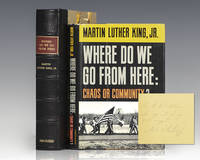
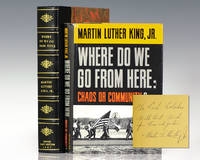
1967rif. 120468New York: Harper & Row Publishers 1967. First edition of King's "last grand expression of his vision" Cornel West. Octavo original half cloth illustrated with eight pages of black-and-white photogravures. Presentation copy inscribed by the author on the front free endpaper "To Mr. H.O. Wilson In appreciation for your great support Martin Luther King Jr." Fine in a near fine dust jacket. Jacket design by Ronald Clyne. Jacket photograph of Martin Luther King Jr. by Bob Fitch. Housed in a custom half morocco clamshell box. Where Do We Go from Here is Dr. King’s analysis of the state of American race relations and the movement after a decade of U.S. civil rights struggles. ‘‘With Selma and the Voting Rights Act one phase of development in the civil rights revolution came to an end’’ he observed King 3. King believed that the next phase in the movement would bring its own challenges as African Americans continued to make demands for better jobs higher wages decent housing an education equal to that of whites and a guarantee that the rights won in the Civil Rights Act of 1964 and the Voting Rights Act of 1965 would be enforced by the federal government. Harper & Row, Publishers hardcover
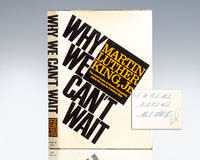
1964rif. 144190New York: Harper & Row Publishers 1964. First edition of Dr. King's third book including his reflections on his 1963 Birmingham campaign. Octavo original half cloth illustrated with eight pages of black-and-white photogravures. Presentation copy inscribed by the author on the front free endpaper "To Mr. Charles Martin With Best Wishes Martin Luther King Jr." Fine in a near fine dust jacket. Published the same year Martin Luther King Jr. won the Nobel Peace Prize Why We Can’t Wait was his response to the assassination of President Kennedy as well as his attempt to “place the events of 1963 in historical perspective relating the Negro’s own long search for freedom since the Emancipation Proclamation” Oates Let the Trumpet Sound. Includes King’s famous Letter from Birmingham Jail published here in full for the first time. Harper & Row Publishers hardcover
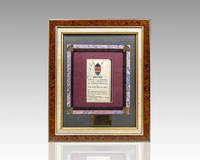
1964rif. 151903Stockholm 13 December 1964. Rare invitation to a celebration of the first anniversary of Kenyan Independence in Stockholm Sweden signed by Martin Luther King Jr. Coretta Scott King and Ralph Abernathy. The color-printed invitation to the event "Kenya Celebrates 1st Anniversary of Independence & Republic Day" held at the Hotel Malmen in Stockholm signed at the upper left in ink by both Martin Luther King Jr. and Coretta Scott King and by Ralph Abernathy at upper right although this signature faded. The card is numbered 803 and invites Anna Lisa Dahlback to the celebration. Three days after accepting the Nobel Peace Prize and giving a speech in Oslo Martin Luther King Jr. attended an event with his wife in Stockholm celebrating the 1st anniversary of Kenyan Independence. Dr. King was the second African American to receive the Nobel Peace Prize rendering this an important moment not only in American history but also for bringing the Civil Rights struggle to the world stage. In his speech upon receiving the award Dr. King remarked "I accept the Nobel Prize for Peace at a moment when 22 million Negroes of the United States of America are engaged in a creative battle to end the long night of racial injustice. I accept this award on behalf of a civil rights movement which is moving with determination and a majestic scorn for risk and danger to establish a reign of freedom and a rule of justice. I am mindful that only yesterday in Birmingham Alabama our children crying out for brotherhood were answered with fire hoses snarling dogs and even death. I am mindful that only yesterday in Philadelphia Mississippi young people seeking to secure the right to vote were brutalized and murdered. And only yesterday more than 40 houses of worship in the State of Mississippi alone were bombed or burned because they offered a sanctuary to those who would not accept segregation. I am mindful that debilitating and grinding poverty afflicts my people and chains them to the lowest rung of the economic ladder. Therefore I must ask why this prize is awarded to a movement which is beleaguered and committed to unrelenting struggle; to a movement which has not won the very peace and brotherhood which is the essence of the Nobel Prize. After contemplation I conclude that this award which I receive on behalf of that movement is a profound recognition that nonviolence is the answer to the crucial political and moral question of our time – the need for man to overcome oppression and violence without resorting to violence and oppression." In very good condition with the the Abernathy signature faded as noted. The invitation measures 6.25 inches by 3.5 inches. Double matted and framed. The entire piece measures 15.75 inches by 14.5 inches. Scarce. Signed items from King's time in Stockholm are scarce. We can trace only one other example of this signed invitation in the auction record without the signature of King's wife Coretta Scott. unknown
1967rif. 137331New York: Harper & Row Publishers 1967. First edition of King's "last grand expression of his vision" Cornel West. Octavo original half cloth illustrated with eight pages of black-and-white photogravures. Presentation copy inscribed by the author on the front free endpaper "To Carl Colodne With Best Wishes for Peace and Justice Martin Luther King Jr." Fine in a fine dust jacket small name. Jacket design by Ronald Clyne. Jacket photograph of Martin Luther King Jr. by Bob Fitch. Housed in a custom half morocco clamshell box. Where Do We Go from Here is Dr. King’s analysis of the state of American race relations and the movement after a decade of U.S. civil rights struggles. ‘‘With Selma and the Voting Rights Act one phase of development in the civil rights revolution came to an end’’ he observed King 3. King believed that the next phase in the movement would bring its own challenges as African Americans continued to make demands for better jobs higher wages decent housing an education equal to that of whites and a guarantee that the rights won in the Civil Rights Act of 1964 and the Voting Rights Act of 1965 would be enforced by the federal government. Harper & Row, Publishers hardcover
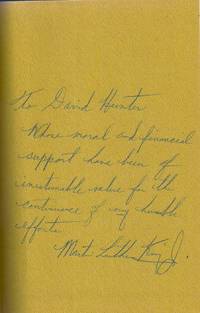
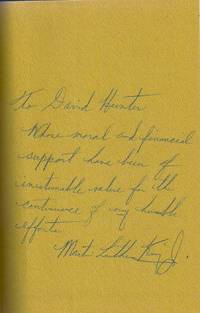
1967rif. 019026New York: Harper & Row 1967. First Edition. Hardcover. Two small scratches on the front of the dustwrapper that slightly affect the front cover of the book. About Fine in a close to Fine dustwrapper. A beautiful copy and outstanding inscription. INSCRIBED and SIGNED by the author filling most of the front free endpaper: "To David Hunter/Whose moral and financial/support have been of/inestimable value for the/continuance of my humble/efforts/Martin Luther King Jr." Harper & Row hardcover books
1521rif. 5114Wittenberg: Johann Rhau-Grunenberg 1521. SECOND PRINTING by the original publisher. The first edition appeared in 1520 and was followed by numerous printings in other cities by other publishers. Hardcover. Fine. With a historiated woodcut border from the workshop of Lucas Cranach featuring cherubs lounging about the thistles dressed as musicians soldiers and one with a cardinal’s hat. A crisp copy with broad margins annotated throughout by a contemporary reader. Bound in modern boards binding soiled boards worn. Light stain from an ink smear to the final few leaves not affecting legibility. “The Freedom of a Christian Man” is the third in a trilogy of works that Martin Luther published in 1520 in order to set forth the principles of his Reformation theology. In it Luther explains that a Christian is dependent not on the Church or good works for his salvation but only on the Word of God sola scriptura which he must receive in faith for it is only through faith sola fide that a person can be saved. In Luther’s words “As a book it is small but the sum of a Christian life is contained in it." This is the original German-language version of the book. It preceded Luther’s Latin edition from which it differs in certain respects the Latin edition for instance had an opening epistle to Pope Leo X while the German editions have a short preface to Hermann Mühlpfort. In the first work in his trilogy “An Address to the Nobility of the German Nation” Luther had challenged the Church’s power in secular matters and called upon the laity the “priesthood of all believers” to take an active role in bringing about the reformation of the Church. In the second work “Prelude to the Babylonian Captivity of the Church” Luther attacked the legitimacy of the papacy denying that the pope was Christ’s representative on earth and published his radical critique of the sacramental system. In “The Freedom of a Christian Man” Luther reveals the doctrine of justification by faith alone to be “an emancipation through faith of the individual Christian from the bondage of external works”. Luther is quick to emphasize however that although the individual does not need to perform works to attain salvation he is still obliged to work in service of his fellow man selflessly and without a desire for reward. “If faith alone justifies why concern ourselves with works If Luther replies man were a purely spiritual being works would indeed be superfluous. He would forthwith attain by faith to the fullness of the inner spiritual life. But he is a being of flesh and blood not of pure spirit and can only advance in the spiritual life by the practice of self-discipline and service for others… “He considers the subject from the point of the individual and from that of the individual in relation to others. Individual self-discipline is an essential of the Christian life. But here too the motive principle must be faith which creates the aspiration and lends the inspiration to do what is pleasing to God. Works of this kind are to be done solely in this spirit and with this object not with a view to justification and not as merits to this end… “In discussing the subject from the point of view of the relation of the individual to others he gives expression to a splendid Christian altruism. It would indeed be difficult to find a finer expression of it. Faith works by love and of this love service for the common benefit is an instinctive inherent element though here again he warns against the tendency to do this service in a wrong spirit and for a wrong object: “Lastly we shall speak of those works which we are to exercise towards our neighbor. For man lives not for himself alone in the works that he does in this mortal life but for all men on earth yea he lives only for others and not for himself. For to this end he subjects his body in order that he may be able the more freely and wholeheartedly to serve others as Paul says in Romans xiv. : ‘For none of us liveth to himself and none dieth to himself. For whether we live we live unto the Lord or whether we die we die unto the Lord.’ It is not possible therefore to take his ease in this life and abstain from works towards his neighbor. For as has been said he must perforce live and have converse with men as Christ made in the likeness of men and found in fashion as a man lived among and had intercourse with men. . . . To this end the Christian must have a care for his own body and strive to maintain it in health and fitness in order to be able to minister to the help of those who are in need so that the strong may serve the weak and we may be sons of God caring and laboring the one for the other mutually bearing each others’ burdens and so fulfilling the law of Christ. Behold this is the truly Christian life –which with joy and love makes itself profitable in the freest service serving feely and willingly providing abundantly out of the fullness and riches of its faith.”Mackinnon “Luther and the Reformation” Vol II The Two Versions: “The differences between the two tracts the Latin and the German arose in part out of the slightly different audiences for them: the one is addressed to theologians clerics and church leaders for whom Latin was the common language and one addressed to the German- speaking public which included the nobility townsfolk the lesser clergy and others who could read or have Luther’s writings read to them.” Wengert. Johann Rhau-Grunenberg hardcover
1521rif. 5114Wittenberg: Johann Rhau-Grunenberg 1521. SECOND PRINTING by the original publisher. The first edition appeared in 1520 and was followed by numerous printings in other cities by other publishers. Hardcover. Fine. With a historiated woodcut border from the workshop of Lucas Cranach featuring cherubs lounging about the thistles dressed as musicians soldiers and one with a cardinal’s hat. A crisp copy with broad margins annotated throughout by a contemporary reader. Bound in modern boards binding soiled boards worn. Light stain from an ink smear to the final few leaves not affecting legibility. “The Freedom of a Christian Man” is the third in a trilogy of works that Martin Luther published in 1520 in order to set forth the principles of his Reformation theology. In it Luther explains that a Christian is dependent not on the Church or good works for his salvation but only on the Word of God sola scriptura which he must receive in faith for it is only through faith sola fide that a person can be saved. In Luther’s words “As a book it is small but the sum of a Christian life is contained in it." This is the original German-language version of the book. It preceded Luther’s Latin edition from which it differs in certain respects the Latin edition for instance had an opening epistle to Pope Leo X while the German editions have a short preface to Hermann Mühlpfort. In the first work in his trilogy “An Address to the Nobility of the German Nation” Luther had challenged the Church’s power in secular matters and called upon the laity the “priesthood of all believers” to take an active role in bringing about the reformation of the Church. In the second work “Prelude to the Babylonian Captivity of the Church” Luther attacked the legitimacy of the papacy denying that the pope was Christ’s representative on earth and published his radical critique of the sacramental system. In “The Freedom of a Christian Man” Luther reveals the doctrine of justification by faith alone to be “an emancipation through faith of the individual Christian from the bondage of external works”. Luther is quick to emphasize however that although the individual does not need to perform works to attain salvation he is still obliged to work in service of his fellow man selflessly and without a desire for reward. “If faith alone justifies why concern ourselves with works If Luther replies man were a purely spiritual being works would indeed be superfluous. He would forthwith attain by faith to the fullness of the inner spiritual life. But he is a being of flesh and blood not of pure spirit and can only advance in the spiritual life by the practice of self-discipline and service for others… “He considers the subject from the point of the individual and from that of the individual in relation to others. Individual self-discipline is an essential of the Christian life. But here too the motive principle must be faith which creates the aspiration and lends the inspiration to do what is pleasing to God. Works of this kind are to be done solely in this spirit and with this object not with a view to justification and not as merits to this end… “In discussing the subject from the point of view of the relation of the individual to others he gives expression to a splendid Christian altruism. It would indeed be difficult to find a finer expression of it. Faith works by love and of this love service for the common benefit is an instinctive inherent element though here again he warns against the tendency to do this service in a wrong spirit and for a wrong object: “Lastly we shall speak of those works which we are to exercise towards our neighbor. For man lives not for himself alone in the works that he does in this mortal life but for all men on earth yea he lives only for others and not for himself. For to this end he subjects his body in order that he may be able the more freely and wholeheartedly to serve others as Paul says in Romans xiv. : ‘For none of us liveth to himself and none dieth to himself. For whether we live we live unto the Lord or whether we die we die unto the Lord.’ It is not possible therefore to take his ease in this life and abstain from works towards his neighbor. For as has been said he must perforce live and have converse with men as Christ made in the likeness of men and found in fashion as a man lived among and had intercourse with men. . . . To this end the Christian must have a care for his own body and strive to maintain it in health and fitness in order to be able to minister to the help of those who are in need so that the strong may serve the weak and we may be sons of God caring and laboring the one for the other mutually bearing each others’ burdens and so fulfilling the law of Christ. Behold this is the truly Christian life –which with joy and love makes itself profitable in the freest service serving feely and willingly providing abundantly out of the fullness and riches of its faith.”Mackinnon “Luther and the Reformation” Vol II The Two Versions: “The differences between the two tracts the Latin and the German arose in part out of the slightly different audiences for them: the one is addressed to theologians clerics and church leaders for whom Latin was the common language and one addressed to the German- speaking public which included the nobility townsfolk the lesser clergy and others who could read or have Luther’s writings read to them.” Wengert. Johann Rhau-Grunenberg hardcover books
1958rif. 021985New York: Harper & Brothers 1958. First Edition. Hardcover. Chip to cloth at bottom of spine. Very Good in a Near Fine dustwrapper with typically sunned spine. Early but not first printing of Martin Luther King's first book. Illustrated with photographs. Boldly INSCRIBED and SIGNED by the author on the front pastedown: "To:/Ruth/With Best Wishes/and Warm Personal Regards/Martin L. King Jr./Aprill 22 1959." On the front endpaper are two further inscriptions one dated 21 February 1959 and SIGNED "M.G.G." and the other dated 14 June 1959 by Theodore E. Brown who at the time was the assistant director of the AFL-CIOs civil rights department: "To a stimulating person/May you grow in wisdom and intellect/May you achieve man's greatest/quest; peace of mind and spirit./Theodore E. Brown." Brown is thanked by King for his "significant suggestions and real encouragement" in the preface to this book. Brown was appointed secretary of the Negro American Labor Council in 1961. As president of the American Negro Leadership Conference on Africa 1962-1968 Brown campaigned to bar American warships from refueling at South African ports. He later worked for the U.S. Department of State and the Agency for International Development. Laid in are two programs from Temple Sharey Shalom in Springfield NJ presenting an Evening with Dr. Martin Luther King Jr. speaking on "Revolution in Religion." There is also a 11 September 1966 program from The Union Baptist Church in Montclair NJ when King gave a guest sermon following riots in Atlanta and the arrest of Stokely Carmichael the chairman of the Student Non-Violent Coordinating Committee. "We have made too much progress through nonviolence to turn now to violence" King told his audience of about 2000. "The old eye-for-an-eye philosophy leaves everybody blind." Along with a few newsclippings about local ministers. Harper & Brothers hardcover
1525rif. 5149Erfurt: Melchior Sachse 1525. SECOND EDITION in the year of the 1st ed. Hardcover. Fine. Stitched. Housed in a modern clamshell box. A very good copy of this scarce publication. Very slight curling to extreme upper and outer margin of title title lightly toned at head. Very light marginal stain on penultimate leaf. Early foliation in upper corners. Blank verso of final leaf with mild soiling. With an elaborated woodcut title-page border Luther Titeleinfassungen der Reformationszeit 74. Both Claus who lists eleven printings and Benzing who lists ten place this second. A rare collection of four letters by the radical reformer Thomas Müntzer the "murderous and bloodthirsty prophet" and the most significant figure in the second crucial phase of the Peasants' War Bauernkrieg one of the bloodiest chapters in the turbulent early history of the German Reformation which left over 100000 dead. These letters were published by Martin Luther to expose his former ally's most heretical and radical ideas. In 1523 Müntzer formerly the leader of the radical "Zwickau Prophets" began to radicalize the area of Allstedt where he was then pastor preaching that the ungodly were to be eliminated and the elect would establish a kingdom of Christ on earth and threatening the political rulers of the area with rebellion. In early 1524 as Müntzer grew bolder in his denunciation of the authorities and called for an elimination of the enemies of God he divided the citizenry into military units in order to resist any outside interference in his activities. Müntzer openly challenged and attacked Luther who was openly opposed to Müntzer's ministry of the elect as one of "our mad debauching pigs which are horrified by the windstorm the raging billows and by all the waters of wisdom." In his commentary that accompanies the letters Luther writes "I write all of this and will have it printed not because I am joyful at the misfortunes of others . . . I only really want to warn all other rebels that they should avoid suffering from the same judgement and anger of God and should turn away from the harmful false prophets and give themselves up to peace and obedience." Following Müntzer's execution on May 27 Luther would write "I killed Müntzer; his death is on my shoulders. But I did it because he wanted to kill my Christ'". Brecht Vol II p. 185 In these letters Müntzer claims he receives orders from God threatens to murder aristocrats calling one a "sack of maggots" refers to Luther's theology as "Martin's peasant gruel" names the leaders of the Allstedt uprising see below and provides updates on peasant revolts in other towns. The letters were written in April and May 1525 during the Peasants' War in the three weeks leading up to the disastrous Battle of Frankenhausen on May 15 in which 5000 peasants died. Muntzer was captured during the battle and imprisoned and soon after executed. Luther published this book following Müntzer's execution a punishment Luther claims was God's judgement on the rebellion: "You can see how this murderous spirit boasted that God spoke with him and that he fulfilled the will of God and acted as if he would gain everything. And yet before he could turn around he lay there with several thousand others in the mud." The first letter Luther prints is Müntzer's letter to the people of Allstedt written April 26 or 27 in which he tells the people that they must be prepared to suffer for God: "May the pure fear of God be with you dear brothers. How much longer will you sleep how much longer will you resist God's Will . . . if you are not willing to suffer for the sake of God then you will become martyrs of the Devil." Müntzer describes recent successes in the Peasants' War: "In Fulda in Easter week four abbeys were laid waste the peasants of Klettgau and Hegau in the Black Forest have risen three times one hundred thousand strong and the army is growing ever greater" and "the people of Salza wanted to lay hands on the administrator of Duke Georg because he had secretly wanted to kill three of them." Müntzer exhorts the people of Allstedt to take up arms against the nobles: "On on onwards for the fire is hot!" and he names four men to lead the uprising in Allstedt: "You must set to it onwards for it is time. Let Balthasar and Barthel Krump Valentin and Bischoff lead the dance". The second letter is to Müntzer's "arch-enemy" Count Ernst of Mansfeld written on May 12. It was at Ernst's Heldrungen Castle that Müntzer was tortured following his capture at the Battle of Frankenhausen May 15. Müntzer enumerates the Count's crimes including "tyrannical raging" martyring Christians and slandering Christianity. He asks the Count "you miserable wretched sack of maggots - who made you into a prince over the people whom God redeemed with his own precious blood" Count Ernst is promised "safe-conduct" if he repents but if he refuses "every brother will be prepared to spill their own blood to fight you as if you were the Turk. Then you will be hunted down and rooted out for every man will be far keener to gain an indulgence at your expense than any indulgence that the Pope ever offered." Müntzer claims to be an instrument of God in destroying the unrepentant Ernst: "we have been given our orders I say this to you: the eternal living God has commanded that you be cast down from your throne by the power that has been given to us." In the third letter to Albrecht or Albert von Mansfeld Müntzer asks "Have you not been able to spoon up from your Lutheran gruel your Wittenberg soup that which Ezekiel prophesied in his 37th chapter And have you not been able to taste in your Martin's peasant gruel . . . that God would command all the birds of the air to feast on the flesh of the princes and commanded the unthinking beasts to lap up the blood of the bigwigs as is described in the secret book of revelations" The following day Müntzer again writes to Albrecht in the fourth letter suggesting a parley between the peasants and the aristocracy: "We invite you and your men to a Christian meeting with around thirty horsemen to appear at Mertens Rita just before the bridge at twelve o'clock tomorrow Friday." Instead of a negotiation the Battle of Frankenhausen took place. In his commentary on the letters Luther describes Müntzer's most fantastical claims: "the peasants could strike five dead with nothing but a felt hat" "the bullets would turn back in flight and slay the enemy" and Müntzer's sleeve would "catch all the bullets which were fired against his people." The Peasants' War was one of the bloodiest chapters in the turbulent early history of the German Reformation. The uprising began in upper Swabia in early 1524 and quickly spread to southern and western Germany as well as to parts of Switzerland and Austria. The peasants were motivated by a number of factors: crushing taxation lack of a voice in government no recourse to the courts crop failure and helplessness in the face of their feudal masters' demands. But whereas these conditions had resulted in smaller uprisings in the past the massive rebellion of 1524-5 was also a result of the turbulent upheaval caused by the nascent Reformation. By the time the rebellion was crushed in late 1525 some 100000 combatants and civilians had been killed. Reprisals were carried out for the next two years and the peasants' demands as outlined in their Twelve Articles came to nothing. Three of the letters Luther included in this pamphlet are in "The Collected Works of Thomas Müntzer" Matheson 1994 they are numbers 75 - "To the People of Allstedt" composed April 26 or 27 88 - "To Count Ernst of Mansfeld" and 89 - "To Count Albert von Mansfeld" both composed on May 12. The fourth letter is also to Count Albert composed on May 13. All are from 1525. The translation is by Andrew Drummond author of "The Dreadful History and Judgment of God on Thomas Müntzer" 2024. [Melchior Sachse] hardcover
1525rif. 5149Erfurt: Melchior Sachse 1525. SECOND EDITION in the year of the 1st ed. Hardcover. Fine. Stitched. Housed in a modern clamshell box. A very good copy of this scarce publication. Very slight curling to extreme upper and outer margin of title title lightly toned at head. Very light marginal stain on penultimate leaf. Early foliation in upper corners. Blank verso of final leaf with mild soiling. With an elaborated woodcut title-page border Luther Titeleinfassungen der Reformationszeit 74. Both Claus who lists eleven printings and Benzing who lists ten place this second. A rare collection of four letters by the radical reformer Thomas Müntzer the "murderous and bloodthirsty prophet" and the most significant figure in the second crucial phase of the Peasants' War Bauernkrieg one of the bloodiest chapters in the turbulent early history of the German Reformation which left over 100000 dead. These letters were published by Martin Luther to expose his former ally's most heretical and radical ideas. In 1523 Müntzer formerly the leader of the radical "Zwickau Prophets" began to radicalize the area of Allstedt where he was then pastor preaching that the ungodly were to be eliminated and the elect would establish a kingdom of Christ on earth and threatening the political rulers of the area with rebellion. In early 1524 as Müntzer grew bolder in his denunciation of the authorities and called for an elimination of the enemies of God he divided the citizenry into military units in order to resist any outside interference in his activities. Müntzer openly challenged and attacked Luther who was openly opposed to Müntzer's ministry of the elect as one of "our mad debauching pigs which are horrified by the windstorm the raging billows and by all the waters of wisdom." In his commentary that accompanies the letters Luther writes "I write all of this and will have it printed not because I am joyful at the misfortunes of others . . . I only really want to warn all other rebels that they should avoid suffering from the same judgement and anger of God and should turn away from the harmful false prophets and give themselves up to peace and obedience." Following Müntzer's execution on May 27 Luther would write "I killed Müntzer; his death is on my shoulders. But I did it because he wanted to kill my Christ'". Brecht Vol II p. 185 In these letters Müntzer claims he receives orders from God threatens to murder aristocrats calling one a "sack of maggots" refers to Luther's theology as "Martin's peasant gruel" names the leaders of the Allstedt uprising see below and provides updates on peasant revolts in other towns. The letters were written in April and May 1525 during the Peasants' War in the three weeks leading up to the disastrous Battle of Frankenhausen on May 15 in which 5000 peasants died. Muntzer was captured during the battle and imprisoned and soon after executed. Luther published this book following Müntzer's execution a punishment Luther claims was God's judgement on the rebellion: "You can see how this murderous spirit boasted that God spoke with him and that he fulfilled the will of God and acted as if he would gain everything. And yet before he could turn around he lay there with several thousand others in the mud." The first letter Luther prints is Müntzer's letter to the people of Allstedt written April 26 or 27 in which he tells the people that they must be prepared to suffer for God: "May the pure fear of God be with you dear brothers. How much longer will you sleep how much longer will you resist God's Will . . . if you are not willing to suffer for the sake of God then you will become martyrs of the Devil." Müntzer describes recent successes in the Peasants' War: "In Fulda in Easter week four abbeys were laid waste the peasants of Klettgau and Hegau in the Black Forest have risen three times one hundred thousand strong and the army is growing ever greater" and "the people of Salza wanted to lay hands on the administrator of Duke Georg because he had secretly wanted to kill three of them." Müntzer exhorts the people of Allstedt to take up arms against the nobles: "On on onwards for the fire is hot!" and he names four men to lead the uprising in Allstedt: "You must set to it onwards for it is time. Let Balthasar and Barthel Krump Valentin and Bischoff lead the dance". The second letter is to Müntzer's "arch-enemy" Count Ernst of Mansfeld written on May 12. It was at Ernst's Heldrungen Castle that Müntzer was tortured following his capture at the Battle of Frankenhausen May 15. Müntzer enumerates the Count's crimes including "tyrannical raging" martyring Christians and slandering Christianity. He asks the Count "you miserable wretched sack of maggots - who made you into a prince over the people whom God redeemed with his own precious blood" Count Ernst is promised "safe-conduct" if he repents but if he refuses "every brother will be prepared to spill their own blood to fight you as if you were the Turk. Then you will be hunted down and rooted out for every man will be far keener to gain an indulgence at your expense than any indulgence that the Pope ever offered." Müntzer claims to be an instrument of God in destroying the unrepentant Ernst: "we have been given our orders I say this to you: the eternal living God has commanded that you be cast down from your throne by the power that has been given to us." In the third letter to Albrecht or Albert von Mansfeld Müntzer asks "Have you not been able to spoon up from your Lutheran gruel your Wittenberg soup that which Ezekiel prophesied in his 37th chapter And have you not been able to taste in your Martin's peasant gruel . . . that God would command all the birds of the air to feast on the flesh of the princes and commanded the unthinking beasts to lap up the blood of the bigwigs as is described in the secret book of revelations" The following day Müntzer again writes to Albrecht in the fourth letter suggesting a parley between the peasants and the aristocracy: "We invite you and your men to a Christian meeting with around thirty horsemen to appear at Mertens Rita just before the bridge at twelve o'clock tomorrow Friday." Instead of a negotiation the Battle of Frankenhausen took place. In his commentary on the letters Luther describes Müntzer's most fantastical claims: "the peasants could strike five dead with nothing but a felt hat" "the bullets would turn back in flight and slay the enemy" and Müntzer's sleeve would "catch all the bullets which were fired against his people." The Peasants' War was one of the bloodiest chapters in the turbulent early history of the German Reformation. The uprising began in upper Swabia in early 1524 and quickly spread to southern and western Germany as well as to parts of Switzerland and Austria. The peasants were motivated by a number of factors: crushing taxation lack of a voice in government no recourse to the courts crop failure and helplessness in the face of their feudal masters' demands. But whereas these conditions had resulted in smaller uprisings in the past the massive rebellion of 1524-5 was also a result of the turbulent upheaval caused by the nascent Reformation. By the time the rebellion was crushed in late 1525 some 100000 combatants and civilians had been killed. Reprisals were carried out for the next two years and the peasants' demands as outlined in their Twelve Articles came to nothing. Three of the letters Luther included in this pamphlet are in "The Collected Works of Thomas Müntzer" Matheson 1994 they are numbers 75 - "To the People of Allstedt" composed April 26 or 27 88 - "To Count Ernst of Mansfeld" and 89 - "To Count Albert von Mansfeld" both composed on May 12. The fourth letter is also to Count Albert composed on May 13. All are from 1525. The translation is by Andrew Drummond author of "The Dreadful History and Judgment of God on Thomas Müntzer" 2024. [Melchior Sachse] hardcover books
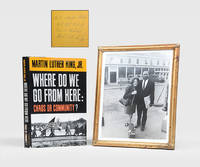
1967rif. 187244New York: Harper Row 1967. To the parents of a young volunteer First edition inscribed by the author on the front free endpaper "To Dr. & Mrs. Jesse Holland with best wishes for Peace and Brotherhood Martin Luther King Jr.". Included is a photograph of King with his arm around their daughter Jessica E. Holland - "a key member of Dr. Martin Luther King's staff at the Southern Christian Leadership Conference" Oral History Review. In 1968 Jessica paused her studies at Barnard College to volunteer with King and the Southern Christian Leadership Conference. Jessica likely arranged the inscription for her parents who lived in Far Rockaway Long Island although the family recalls that they were also donors to the SCLC. After King's assassination Jessica returned to Barnard and graduated in 1969. She later worked as a corporate oral historian including for the New York Stock Exchange McKinsey and Company Philip Morris and AT&T. Where Do We Go from Here was published after the 1965 Voting Rights Act and other civil rights milestones and reflected on the next steps for African Americans. The book sought to offer an alternative to the radicalism of the Black Power movement and instead advocate King's vision of peaceful and non-revolutionary change. Octavo. Original black quarter cloth spine lettered in gilt yellow paper sides. With dust jacket. Together with photograph in original frame with new window mount and conservation-standard acrylic frame size 20.5 x 25.5 cm. Minimal sunning at extremities; unclipped jacket with slight rubbing and nicking at extremities minor creasing: a near-fine copy in very good jacket. "Dedication: In Memory of Jessica E. Holland" in The Oral History Review Vol. 17 No. 1 Spring 1989. hardcover
1967rif. 019026New York: Harper & Row 1967. First Edition. Hardcover. Two small scratches on the front of the dustwrapper that slightly affect the front cover of the book. About Fine in a close to Fine dustwrapper. A beautiful copy and outstanding inscription. INSCRIBED and SIGNED by the author filling most of the front free endpaper: "To David Hunter/Whose moral and financial/support have been of/inestimable value for the/continuance of my humble/efforts/Martin Luther King Jr." Harper & Row hardcover
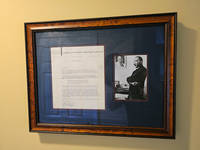
1963rif. 022128Atlanta 12 August 1963. Framed Letter. Near Fine and handsomely presented. Superb letter on Southern Christian Leadership Conference stationery dated 12 August 1963. "I want to personally thank you for the support which you have given to our nonviolent direct action movement to eliminate the immoral and shameful practice of racial discrimination and segregation from American life. I am particularly pleased that as part of your contribution to our work you have acquired a copy of my latest book STRENGTH TO LOVE. In the preface of this book I said: 'In these turbulent days of uncertainty the evils of war and of economic and racial injustice threaten the very survival of the human race.' These words are even more relevant to this current phase of the civil rights revolution than it was when the preface was printed. It has always been a source of inner strength to me and those of my associates in the Southern Christian Leadership Conference to be able to meet and overcome many of the indignities and humiliations of segregation in America with unswerving faith in the American dream of freedom for all men. I believe it can be said that the Strength To Love in the midst of adversities is one of the most significant features of the nonviolent direct action movement in our country today." SIGNED "Martin L. King Jr." Matted in deep blue and maroon with a casual photograph of King standing at his desk with a photo of Gandhi behind him. In an antique carved gilt frame 21-1/2" wide by 17" high. unknown books
rif. 48870Jena Christian Rödinger Donatus Richtzenhain Thomas Rebart 1555-1562. 4°; Titelblätter jeweils in Rot und Schwarz m. Vignette in Holzschnitt zahlreiche 4- bis 7-zeilige Initialen u. einige Vignetten in Holzschnitt; Bd. 1: 11 Bl. 588 pag. Bl. 4 Bl. 2 Bl. m. je 1 Holzschnitt 2 Bl.; Bd. 2: 6 Bl. 523 pag. Bl. 2 Bl. 2 Bl. m. je 1 Holzschnitt; Bd. 3: 6 Bl.1 ganzseit. Holzschnitt 534 pag. Bl. m. 1 Abb. in Holzschnitt; Bd. 4: 4 Bl. m. 1 ganzseit. Holzschnitt 547 pag. Bl. m. 3 Holzschnitten 2 Bl.; Bd. 5: 7 Bl. 1 ganzseit. Holzschnitt 536 pag. Bl. 2 Bl.; Bd. 6: 7 Bl. 1 ganzseit. Holzschnitt 546 pag. Bl. 2 Bl.; Bd. 7: 5 Bl. 1 ganzseit. Holzschnitt 449 pag. Bl. 1 Bl.; Bd. 8: 5 Bl. 1 ganzseit. Holzschnitt 391 pag. Bl. 1 Bl. Pgt. Unterschiedlich gebräunt auf Holzdeckeln mit 9 von 16 metallenen Schliessen. Innen etw. stock-fleckig tlw. gebräunt einige Randverluste u. -risse zahlr. Marginalien u. Unterstreichungen in Tinte von alten Händen ebenso Notizen auf den Vs. gesamthaft gutes Exemplar. Komplettes und kollationiertes Exemplar der berühmten Jenaer Gesamtausgabe. Bde. 1 und 2 in erster Auflage. VD16/L 3323 L 3324 L 3348 L 3349 L 3350 L 3351 L 3353 L 3354. Alle Bände mit Titelholzschnitt Friedrich der Weise und Luther unter dem Kreuz knieend die Bde. 1 und 2 jeweils mit 2 Holzschnitten Luther und Melanchthon bzw. Georg III. Fürst von Anhalt-Dessau sowie dessen Wappenschild die Bde. 3 bis 8 jeweils mit einem Holzschnitt der Herzöge von Sachsen Joh. Friedrich II. Joh. Wilhelm I. und Joh. Friedrich III. auf Tafeln; im Bd. 3 zusätzlich 1 Holzschnitt Papstesel im Bd. 4 drei Holzschnitte davon 1 Karte im Text.Auf Veranlassung des Kurfürsten Johann Friedrich von Sachsen Ernestiner genannt «der Großmütige» 1503 - 1554 gaben Nikolaus von Amsdorf Georg Rörer Johannes Aurifaber u. a. diese Ausgabe als Konkurrenzausgabe zur Wittenberger Ausgabe heraus welche als teilweise verfälscht erachtet wurde.Luthers Privatsekretär und Vertrauter Georg Rörer 1492 - 1557 der bereits massgeblich am Zustandekommen der Wittenberger Ausgabe beteiligt war blieb bei der vorliegenden Ausgabe mehr auf die Funktion des Korrektors beschränkt und stand unter der Oberaufsicht der um Jahrzehnte jüngeren Hofprediger Aurifaber und Stoltz. Diese Jenaer Gesamtausgabe gilt der Wittenberger «auf Grund der wissenschaftlichen Editionsgrundsätze als überlegen» R. Jauernig. 010 Jena, Christian Rödinger, Donatus Richtzenhain, Thomas Rebart, 1555-1562 unknown
1967rif. 149391New York: Harper & Row Publishers 1967. First edition of King's "last grand expression of his vision" Cornel West. Octavo original half cloth illustrated with eight pages of black-and-white photogravures. Association copy warmly inscribed by the author on the front free endpaper "To Cass Canfield For whom I have great respect and admiration Martin Luther King Jr." The recipient Cass Canfield was the longtime President and Chairman of Harper & Brothers Publishers and profoundly shaped twentieth-century literary culture. After investing in the firm in 1924 and managing its London office he signed major authors such as James Thurber E. B. White and Julian Huxley. Rising through the company’s leadership—from president to board chairman—Canfield played a pivotal role in publishing influential works including John Updike’s first book in 1958 and authored seven nonfiction books of his own. Near fine in a near fine dust jacket. Jacket design by Ronald Clyne. Jacket photograph of Martin Luther King Jr. by Bob Fitch. Photograph of the Selma March to the front panel by Steve Schapiro. An exceptional association one of the finest we have seen. Where Do We Go from Here is Dr. King’s analysis of the state of American race relations and the movement after a decade of U.S. civil rights struggles. ‘‘With Selma and the Voting Rights Act one phase of development in the civil rights revolution came to an end’’ he observed King 3. King believed that the next phase in the movement would bring its own challenges as African Americans continued to make demands for better jobs higher wages decent housing an education equal to that of whites and a guarantee that the rights won in the Civil Rights Act of 1964 and the Voting Rights Act of 1965 would be enforced by the federal government. Harper & Row, Publishers hardcover
1958rif. 17050New York: Harper & Brothers 1958. First Edition First Printing. Cloth. Near fine/very good. Signed first edition of Stride Toward Freedom: The Montgomery Story by Martin Luther King Jr. with an incredible collection of signatures including Martin Luther King Jr. Ralph Abernathy Jesse Jackson James Farmer Julian Bond and Shirley Chis. Octavo 230pp 2. Blue cloth covers title in silver on black spine. Stated "First Edition" on copyright page with publisher's "H-H" code. Solid text block rubbing to head and tail of spine otherwise fine condition. In the publisher's first state dust jacket $2.95 retail price on front flap lightly shelf worn. Small chips from edges of spine corners and hinge flaps with small piece of archival tape reinforcing spine on verso. Housed in a custom cloth clamshell title in gilt on black morocco label affixed to spine. Signed by the author on the front free endpaper: "Best Wishes / Martin Luther King Jr." Additionally inscribed by numerous members of the Civil Rights movement on the front endpapers. Signatures vary between small inscriptions autographs and clipped signatures pasted in. This work includes signatures from the following notable individuals: - "Best Wishes / Martin Luther King Jr." - "With best wishes / from your friends / Martin Luther King Jr. RDA / Ralph D. Abernathy" Ralph Abernathy 1926-1990 a founding member of the Southern Christian Leadership Conference. - Twice signed by Jesse Jackson: "4/28/88 Peace! Jesse Jackson" - James Farmer a fellow nonviolent protest supporter and initiator of the first Freedom Ride in 1961. - Shirley Chisholm the first Black woman to be elected to the U.S. Congress representing New York's 12th district 1968. - Julian Bond founding member of the Student Nonviolent Coordinating Committee served a total ten terms in the Georgia state legislature and was chairman of the NAACP from 1998-2010. - John Lewis clipped signature - Coretta Scott King clipped signature. Harper & Brothers unknown
1958rif. 17050New York: Harper & Brothers 1958. First Edition First Printing. Cloth. Near fine/very good. Signed first edition of Stride Toward Freedom: The Montgomery Story by Martin Luther King Jr. with an incredible collection of signatures including Martin Luther King Jr. Ralph Abernathy Jesse Jackson James Farmer Julian Bond and Shirley Chis. Octavo 230pp 2. Blue cloth covers title in silver on black spine. Stated "First Edition" on copyright page with publisher's "H-H" code. Solid text block rubbing to head and tail of spine otherwise fine condition. In the publisher's first state dust jacket $2.95 retail price on front flap lightly shelf worn. Small chips from edges of spine corners and hinge flaps with small piece of archival tape reinforcing spine on verso. Housed in a custom cloth clamshell title in gilt on black morocco label affixed to spine. Signed by the author on the front free endpaper: "Best Wishes / Martin Luther King Jr." Additionally inscribed by numerous members of the Civil Rights movement on the front endpapers. Signatures vary between small inscriptions autographs and clipped signatures pasted in. This work includes signatures from the following notable individuals: - "Best Wishes / Martin Luther King Jr." - "With best wishes / from your friends / Martin Luther King Jr. RDA / Ralph D. Abernathy" Ralph Abernathy 1926-1990 a founding member of the Southern Christian Leadership Conference. - Twice signed by Jesse Jackson: "4/28/88 Peace! Jesse Jackson" - James Farmer a fellow nonviolent protest supporter and initiator of the first Freedom Ride in 1961. - Shirley Chisholm the first Black woman to be elected to the U.S. Congress representing New York's 12th district 1968. - Julian Bond founding member of the Student Nonviolent Coordinating Committee served a total ten terms in the Georgia state legislature and was chairman of the NAACP from 1998-2010. - John Lewis clipped signature - Coretta Scott King clipped signature. Harper & Brothers unknown books