5610 risultati
1962rif. 18937ECleveland OH: Meridian Books 1962. First Edition - Paperbound. Signed and inscribed by the author / artist Saul Steinberg to the great film director and noted art collector Billy Wilder. Inscribed: “To Billy W. - Saul ST. ‘62.” Near fine copy with a touch of fading to the spine and a hint of use in printed wrappers. A selection of drawings reproduced from three previous books of Steinberg: ‘The Art Of Living’ ‘The Passport’ and ‘The Labyrinth.’ According to UCSB art historian David Beghard Wilder had “one of the largest and certainly one of the finest collections of Saul Steinberg.” Billy Wilder was one of Hollywood’s most fabled art collectors including works by Picasso Miro Matisse Braque Chagall Cornell Dubuffet Renoir Pissaro Schwitters Schiele Klee Leger Giacometti etc. Billy Wilder’s legendary status in Hollywood as a director screenwriter and producer includes such classic films as Ninotchka Sunset Boulevard Double Indemnity The Lost Weekend Stalag 17 Some Like it Hot The Seven Year Itch The Apartment and The Fortune Cookie. Meridian Books unknown
1964rif. 163682New York: Stevens Productions 1964. Draft script for the 1965 play undated circa 1965 and seen here under the working title "Bummidge." Working copy belonging to actor Ted Schwartz with his last name on the title page and his extensive annotations in manuscript pencil and ink on virtually every page marking deletions revisions additions to dialogue and stage direction. Saul Bellow's only theatrical effort about a New York comedian who conducts a psychiatric examination on himself in his own apartment which he televises and broadcasts to a group of therapists at the Waldorf. The play debuted on October 1 1964 at the Belasco Theatre and ran for 28 performances closing on October 24 1964. Black titled Hart Stenographic Bureau wrappers. Title page present undated with credit for Bellow. 136 leaves with last page of text numbered 2-65. Mimeograph duplication rectos only. Pages Very Good plus wrapper Very Good plus bound with two silver screw brads. Stevens Productions unknown
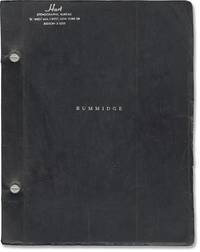
1964rif. 163682New York: Stevens Productions 1964. Draft script for the 1965 play undated circa 1965 and seen here under the working title "Bummidge." Working copy belonging to actor Ted Schwartz with his last name on the title page and his extensive annotations in manuscript pencil and ink on virtually every page marking deletions revisions additions to dialogue and stage direction. Saul Bellow's only theatrical effort about a New York comedian who conducts a psychiatric examination on himself in his own apartment which he televises and broadcasts to a group of therapists at the Waldorf. The play debuted on October 1 1964 at the Belasco Theatre and ran for 28 performances closing on October 24 1964. Black titled Hart Stenographic Bureau wrappers. Title page present undated with credit for Bellow. 136 leaves with last page of text numbered 2-65. Mimeograph duplication rectos only. Pages Very Good plus wrapper Very Good plus bound with two silver screw brads. Stevens Productions unknown books
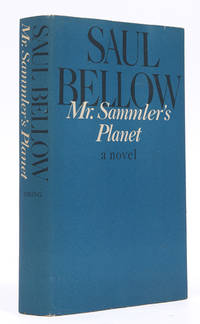
rif. 119627New York The Viking Press 1969. . First edition first printing inscribed by the author; 8vo; light foxing to prelims and endpapers else unmarked internally; publisher's quarter blue cloth over blue paper-covered boards titles to spine in black with the price-clipped dust-jacket designed by Mel Williamson hint of sunning to spine minor rubbing to extremities; housed in custom blue cloth solander box. A lovely association copy inscribed by the author to American writer and art critic Harold Rosenberg in black ink on the title page: 'For Harold master of masters. Saul'. Bellow would later write a fictional portrait of Rosenberg in his short story 'What Kind of Day Did You Have' 1984. New York, The Viking Press, 1969. hardcover
rif. 1947081978. Two original production cels together with an original background showing Frodo Sam and Gollum at their first meeting in the crags of Emyn Muil. The character cel appears at 1:35:16 in the film although the background comprising a watercolour on paper and detail on acetate appears a few minutes earlier in the sequence at 1:32:16. Ralph Bakshi's 1978 animated film used a hybrid of traditional cel animation and rotoscoped live action footage. It adapted Tolkien's The Fellowship of the Ring and the first half of The Two Towers. Despite criticism about the truncated narrative the film was a financial success and Peter Jackson freely admitted its influence on his own films. After graduating from the High School of Industrial Arts in Manhattan Bakshi began as an inker painting the reverse side of animation cels for Terry Toons where he progressed quickly and eventually ran the Mighty Heroes series. In 1977 Bakshi made Wizards in which he started experimenting with rotoscoping techniques. However Lord of the Rings was a major step forward and for this picture Bakshi first produced a full live action feature first which would be used as a reference for the animators. In an recently released interview with animation historian Jim Korkis conducted in 1978 and intended for publication in The Comics Journal Magazine Bakshi says "I had the actors play it straight. The rotoscope in the past has been used in scenes and then exaggerated. The action becomes cartoony. I wanted to bring another level to animation. I wanted to try to get away from the Wizards cartoon work. It's a rotoscope realism unlike anything that's been seen. LOTR was done with honesty. You can't buy the love that went into the project. It's the finest thing I've done." The background was likely by John Vita 1917-1988. Original character cel annotated "4 - N - 24" and "37" at foot background cel annotated "Key 339 4N BG2" at foot and watercolour background on paper 267 x 318 mm. Mounted framed and glazed framed size: 386 x 445 mm. Some minor creases not affecting image: near-fine. In His Own Words: Ralph Bakshi Talks About "The Lord of the Rings" Jim Korkis Cartoon Research June 12 2020 unknown
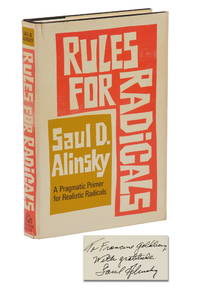
rif. 140946223New York: Random House 1971. First Edition. First edition first printing. Signed by Saul Alinsky on the front free endpaper and inscribed" To Francine Goldberg. With gratitude: Saul Alinsky." xxvi 196 pp. Bound in publisher's black cloth with gilt spine lettering red lettering on front board. Near Fine with slight lean to binding in a Near Fine unclipped dust jacket with small edge tears and light rubbing to panels not much of the usual fading to spine panel. An excellent signed copy of Alinksy's best-known work commonly referred to as "the bible of community organizing. Random House unknown
rif. 140946223New York: Random House 1971. First Edition. First edition first printing. Signed by Saul Alinsky on the front free endpaper and inscribed" To Francine Goldberg. With gratitude: Saul Alinsky." xxvi 196 pp. Bound in publisher's black cloth with gilt spine lettering red lettering on front board. Near Fine with slight lean to binding in a Near Fine unclipped dust jacket with small edge tears and light rubbing to panels not much of the usual fading to spine panel. An excellent signed copy of Alinksy's best-known work commonly referred to as "the bible of community organizing. Random House unknown books
1944rif. 46937New York:: The Vanguard Press 1944. First edition. publisher's cloth in dust jacket. A fine copy in a beautiful jacket with a few tiny nicks at extremities. 8vo. Author's first book. The Vanguard Press, hardcover
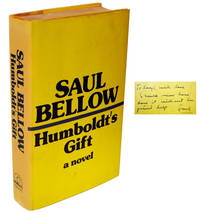
rif. 1289New York: The Viking Press 1975. First edition of the author's Pulitzer Prize-winning work. Octavo original half cloth. Association copy inscribed by the author on the front free endpaper "To Karyl with love I could never have done it without your patient help Saul." The recipient Karyl Kylie typed the manuscript of this novel. Fine in a near fine dust jacket with just a touch of wear. Jacket design by Mel Williamson. An exceptional association. Humboldt's Gift is a self-described "comic book about death" whose title character is modeled on the lyric poet Delmore Schwartz. Charlie Citrine an intellectual middle-aged author of award-winning biographies and plays contemplates two significant figures and philosophies in his life: Von Humboldt Fleisher a dead poet who had been his mentor and Rinaldo Cantabile a very-much-alive minor mafioso who has been the bane of Humboldt's existence. Humboldt had taught Charlie that art is powerful and that one should be true to one's creative spirit. Rinaldo Charlie's self-appointed financial adviser has always urged Charlie to use his art to turn a profit. At the novel's end Charlie has managed to set his own course. The Viking Press hardcover
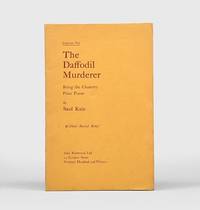
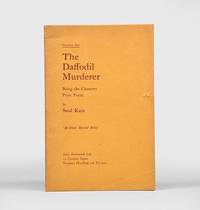
1913rif. 150527London: John Richmond Ltd 1913. Presentation copy of Sassoon's pseudonymous parody inscribed to the distinguished antiquarian bookseller and scholar Percy Muir First edition first impression presentation copy inscribed by the author on the half-title: "P. H. Muir from Siegfried Sassoon 4.10.29"; one of 1000 copies printed highly uncommon in such condition. A pseudonymous parody of John Masefield's early narrative poems The Daffodil Murderer was published as the winner of the entirely fictional "Chantrey Prize" and wryly advertised as "Brilliant Beyond Belief" on the front wrapper. The recipient of this copy was Percy Muir 1894-1979 the distinguished antiquarian bookseller and scholar of children's books. Sassoon inscribed this copy to Muir in the year before Muir joined the London antiquarian booksellers Elkin Mathews Limited. Muir joined the firm in 1930 and remained with them until his death. Muir was president of the Antiquarian Booksellers Association from 1945-1947 and chaired the first conference of the International League of Antiquarian Booksellers ILAB in 1947. He became president of the ILAB from 1950-1952 and was subsequently elected the first Life President of Honour. His major work English Children's Books was published in 1954. Sassoon's poem is frequently cited as a parody of John Masefield's long narrative poem The Everlasting Mercy published in 1911. Masefield's work was read in pubs denounced from pulpits and branded in the words of Lord Alfred Douglas "nine-tenths sheer filth". The original publishers were sufficiently worried about prosecution to leave blank spaces where Masefield had written the word "bloody" and it was later claimed by Robert Graves that Masefield's innovative diction emboldened Shaw to use the word in Pygmalion. J. M. Barrie called the work "the finest literature" Edmund Gosse noted that in it was "a happy blending of the traditional and the revolutionary" and Masefield was duly awarded the Royal Society of Literature's Edmond de Polignac prize for 1911. Masefield had hit a rich-seam in poetry and followed The Everlasting Mercy with The Widow in the Bye Street published in 1912 Dauber published in 1912 and The Daffodil Fields published in 1913. Sassoon appears to have been rather frustrated at literature's latest craze and he sat down to write his own version and created a parody of Masefield's general style diction and subjects across The Everlasting Mercy The Widow in the Bye Street and The Daffodil Fields. There were two results of Sassoon's parody. The first was that in many ways it had helped Sassoon find a poetic voice. In The Weald of Youth Sassoon describes how in December 1912 the thought struck him: "Why not amuse myself by scribbling a few pages of parody I may as well say at once that the immediate result was far beyond what I had intended. I began his story in crudest imitation of Masefield's manner. Stimulating my pencil with an occasional dose of The Everlasting Mercy I found myself corking down the 'human document' with astonishing facility. After the first fifty lines or so I dropped the pretence that I was improvising an exuberant skit. While continuing to burlesque Masefield for all I was worth I was really feeling what I wrote - and doing it not only with abundant delight but a sense of descriptive energy quite unlike anything I had experienced before. Never before had I been able to imbue commonplace details with warmth of poetic emotion. I felt that. I had found a new pair of poetic legs and the fact that they had been graciously presented to me by John Masefield made no difference to my sense of self-satisfaction". The other result of publishing The Daffodil Murderer was that it brought Sassoon to the attention of Edward Marsh - the editor of Georgian Poetry - and Marsh soon became Sassoon's mentor. Despite the parody Sassoon and Masefield met during November 1918. Masefield's Great War poem Reynard the Fox undoubtedly owes some inspiration from Sassoon Masefield advised Sassoon on a forthcoming lecture tour of the United States Masefield sent letters introducing Sassoon to some of his closest American friends Sassoon dedicated the American edition of Picture-Show to Masefield Sassoon was invited to one of Masefield's festivals of spoken poetry in 1930 and in 1957 Sassoon was the recipient of the Queen's Medal for Poetry an idea devised by Masefield. Octavo. Original yellow wrappers lettered in dark red. Housed in a custom green cloth case. Foxing to edges and leaves else an exceptional near-fine copy of a fragile book rarely seen in such bright condition. Keynes A10. hardcover
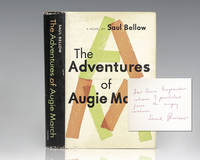
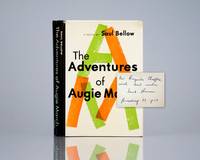
1953rif. 111689New York: The Viking Press 1953. First edition of Bellow's first National Book Award winning novel. Octavo original cloth salmon topstain. Presentation copy inscribed by the author on the front free endpaper "For Ann Englander whom I protected from the angry wolves Saul Bellow." Fine in a near fine price-clipped first-issue dust jacket with the John Steinbeck ad on the rear flap and no reviews. Jacket design by Robert Hallock. An exceptional example. The Adventures of Augie March comes on stage with one of literature's most famous opening lines. "I am an American Chicago born and go at things as I have taught myself free-style and will make the record in my own way: first to knock first admitted." Bellow quickly found a receptive audience for his new energetic style. The critic Irving Howe took note of Bellow's "free style" manner calling it "the first major new style in American prose fiction since those of Hemingway and Faulkner." This novel went on to win the National Book Award for 1954. Both Time Magazine and the Modern Library Board named it one of the hundred best novels in the English language. The Viking Press hardcover
1971rif. 345j1187New York: Random House Inc. Very Good in Good dust jacket. 1971. First Edition. Hardcover. 0394443411 . Signed and inscribed to a friend by Saul Alinsky 1909-1972 atop front free endpaper. "America's most famous community organizer tells the Have-Nots how they can organize to achieve real political power for the practice of true democracy. The distillation of Mr. Alinsky's more than forty years as a professional radical. This hard-headed tactical advice provides an alternative not only to the powerlessness that threatens our democracy but to the random violence and bitter alienation by which so much radical energy is wasted." - dust jacket. In her B.A. thesis entitled 'An Analysis of the Alinsky Model' Hillary Clinton wrote "In regard to the paper itself there are three people who deserve special appreciation including Mr. Alinsky for providing a topic sharing his time and offering me a job." Book very clean bright tight and unmarked with negligible wear. Average wear to unclipped dust jacket now preserved in glossy new archival-grade Brodart. A quality signed example.; 8vo; Signed by Author . Random House Inc hardcover
1944rif. 147721New York: The Vanguard Press 1944. First edition of the Nobel Prize-winning author's first book. Octavo original beige cloth topstain brown. Presentation copy inscribed by the author on the dedication page "For Poetry and for Van Allen Bradley with very best wishes Saul Bellow." The recipient Van Allen Bradley was an influential American literary critic editor and author. He gained prominence as the editor of the Chicago Daily News book review section where he championed emerging literary talents and fostered intellectual discourse. Bradley’s most notable contribution to literary scholarship was his book Gold in Your Attic which provided guidance on identifying rare and valuable books popularizing book collecting as a hobby and field of study. His work bridged the gap between literary criticism and the antiquarian book trade emphasizing the cultural and historical importance of preserving literary artifacts. Near fine in a near fine price-clipped dust jacket. From the library of noted collector William A. Strutz with his small bookplate to the pastedown. Housed in a custom half morocco clamshell box made by the Harcourt Bindery. An exceptional example with a noted association. Saul Bellow was a prominent American novelist and Nobel laureate whose works explore themes of identity morality and the human condition in modern society. Born in 1915 to Russian-Jewish immigrants his writing often reflects his immigrant roots and intellectual pursuits. Bellow’s most celebrated novels such as 'The Adventures of Augie March' 'Herzog' and 'Humboldt’s Gift' combine philosophical depth with richly drawn characters and sharp social commentary. Known for his distinctive prose style and exploration of existential questions Bellow's work has had a profound influence on 20th-century American literature earning him widespread critical acclaim and numerous awards including the Pulitzer Prize and the Nobel Prize in Literature in 1976. The Vanguard Press hardcover
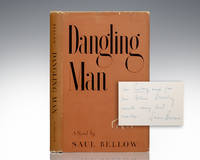
1944rif. 18037New York: The Vanguard Press 1944. First edition of the Nobel Prize-winning author's first book. Octavo original beige cloth. Presentation copy inscribed by the author on the title page "For Matthew and Adrienne greetings and blessings on your wedding Saul Bellow." Fine in a near fine price-clipped dust jacket with light rubbing to the crown and foot of the spine. One of the most honest pieces of testimony on the psychology of a whole generation who have grown up during the Depression and the war" Edmund Wilson The New Yorker. The Vanguard Press hardcover
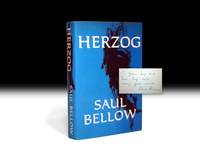
1964rif. 3538New York: The Viking Press 1964. First edition of the author's second of three National Book Award winning novels which was and remains an unprecedented literary accomplishment. Octavo original blue cloth. Association copy inscribed by the author on the front free endpaper to John Nef and his wife "To John Nef and Mrs. Nef with very good wishes Saul Bellow." The recipient John Nef was a economic historian and founder of The University of Chicago’s Committee on Social Thought where Bellow was a faculty member for over 30 years. Fine in a bright fine dust jacket. Jacket design by Mel Williamson. Housed in a custom half morocco clamshell box. An outstanding association. A novel complex compelling absurd and realistic Herzog became a classic almost as soon as it was published in 1964. In it Saul Bellow tells the tale of Moses E. Herzog a tragically confused intellectual who suffers from the breakup of his second marriage the general failure of his life and the specter of growing up Jewish in the middle part of the 20th century. He responds to his personal crisis by sending out a series of letters to all kinds of people. The letters in total constitute a thoughtful examination of his own life and that which has occurred around him. What emerges is not always pretty but serves as gritty foundation for this absorbing novel. "A masterpiece" The New York Times. Named by Time Magazine as one of the 100 best novels in the English language since Time's founding in 1923. The Viking Press hardcover
1913rif. 153720London: John Richmond Ltd 1913. His pseudonymous parody inscribed to Lady Ottoline Morrell First edition first impression presentation copy with a significant association inscribed by the author on the half-title: "To O.M. from 'S.K.'" Ottoline Morrell from Saul Kain. Perhaps the most important support that Lady Ottoline Morrell ever offered to a poet or artist was her friendship for Siegfried Sassoon during the First World War. She became aware of him when she read his poem "To Victory" in The Times on 15 January 1916 and traced him through Edmund Gosse. Like her he was an admirer of the Ballets Russes and she wrote of her pleasure at finding "in the dark prison-like days a sympathetic desire - to fly out beyond into the beauty and colour and freedom that one so longs for" Egremont p. 81. They continued to correspond frequently and Sassoon sent her his war poems as he wrote them in return for which she sent writings of her own. Morrell was of significant influence when Sassoon recuperated at the Morrells' country house Garsington Manor in spring 1917. Morrell's pacifism helped Sassoon's disillusionment with the war and shortly after his visit Sassoon published his infamous "Soldier's Declaration". This pseudonymous parody of John Masefield's early narrative poems was published as the winner of the fictional "Chantrey Prize" and wryly advertised as "Brilliant Beyond Belief" on the front wrapper. Masefield's narrative poem The Everlasting Mercy published in 1911 work was read in pubs denounced from pulpits and branded in the words of Lord Alfred Douglas "nine-tenths sheer filth". Sassoon appears to have been rather frustrated at literature's latest craze and he sat down to write his own version and created a parody of Masefield's general style diction and subjects. There were two results of Sassoon's parody. The first was that in many ways it had helped Sassoon find a poetic voice. In The Weald of Youth Sassoon describes how in December 1912 the thought struck him: "Why not amuse myself by scribbling a few pages of parody I may as well say at once that the immediate result was far beyond what I had intended . . . After the first fifty lines or so I dropped the pretence that I was improvising an exuberant skit. While continuing to burlesque Masefield for all I was worth I was really feeling what I wrote - and doing it not only with abundant delight but a sense of descriptive energy quite unlike anything I had experienced before". The other result of publishing The Daffodil Murderer was that it brought Sassoon to the attention of Edward Marsh - the editor of Georgian Poetry - and Marsh soon became Sassoon's mentor. Octavo. Original yellow wrappers lettered in dark red. Housed in a custom red cloth case. Bookplate of Henry Lewis Batterman Jr. to case. Closed tears and creases to wrappers some internal creases; else a near-fine copy. Keynes A10; Max Egremont Siegfried Sassoon 2005. hardcover
1965rif. 122002N.p.: N.p. 1965. A dazzling collection of ten original pressbooks designed by Saul Bass documenting the majority of the famed title and ad designer's work with director Otto Preminger in the 1950s 60s and 70s. Several of the pressbooks defy the conventions of pressbook design with custom shapes to represent items in keeping with the films for which they were made: "Advise and Consent" resembles a briefcase "In Harm's Way" is designed as a dossier with a string tie "The Cardinal" as a parcel and "Bunny Lake is Missing" as a newspaper. Other key titles in the collection include "Anatomy of a Murder" "Bonjour Tristesse" "Exodus" and "The Man with the Golden Arm." For most of the pressbooks in this collection we have never seen another example. A fascinating example of the advertising work done by the premiere title and ad designer of the twentieth century. Various sizes ranging from Very Good to Near Fine condition. Complete details available on request. N.p. unknown
1965rif. 122002N.p.: N.p. 1965. A dazzling collection of ten original pressbooks designed by Saul Bass documenting the majority of the famed title and ad designer's work with director Otto Preminger in the 1950s 60s and 70s. Several of the pressbooks defy the conventions of pressbook design with custom shapes to represent items in keeping with the films for which they were made: "Advise and Consent" resembles a briefcase "In Harm's Way" is designed as a dossier with a string tie "The Cardinal" as a parcel and "Bunny Lake is Missing" as a newspaper. Other key titles in the collection include "Anatomy of a Murder" "Bonjour Tristesse" "Exodus" and "The Man with the Golden Arm." For most of the pressbooks in this collection we have never seen another example. A fascinating example of the advertising work done by the premiere title and ad designer of the twentieth century. Various sizes ranging from Very Good to Near Fine condition. Complete details available on request. N.p. unknown books
1953rif. 4244New York: The Viking Press 1953. First edition of Bellow's first National Book Award-winning novel. Octavo original cloth salmon topstain. Presentation copy inscribed by the author on the front free endpaper "For Raymita Chaffee with best wishes Saul Bellow Breadloaf VT 1954." The recipient was a student of Bellow’s at Breadloaf. Fine in a near fine first-issue dust jacket Jacket design by Robert Hallock. Housed in a custom half morocco clamshell box made by the Harcourt Bindery. Contemporary inscriptions in this title are uncommon. The Adventures of Augie March comes on stage with one of literature's most famous opening lines. "I am an American Chicago born and go at things as I have taught myself free-style and will make the record in my own way: first to knock first admitted." Bellow quickly found a receptive audience for his new energetic style. The critic Irving Howe took note of Bellow's "free style" manner calling it "the first major new style in American prose fiction since those of Hemingway and Faulkner." This novel went on to win the National Book Award for 1954 and was listed on Modern Library's 100 greatest novels of the twentieth century. The Viking Press hardcover
1964rif. COLLECTI007323INEW YORK NY: VIKING PRESS THE. VG SPIRAL BOUND WRAPS. PUB SEPT 1964. FIRST EDITION. ISBN: UNREVISED PROOFS THAT APPARENTLY WERE AT A LATER STAGE SINCE A. ISBN: SIGNIFICANT NUMBER HAVE CORRECTED PAGES PASTED OVER THEM. PROOFS ARE LIGHTLY WORN AT THE CORNERS WITH SOME MODEST SOILING TO THEWRAPS. Keywords: UNCORRECTED PROOFS NATIONAL BOOK AWARD ABCDEF. VIKING PRESS (THE) paperback
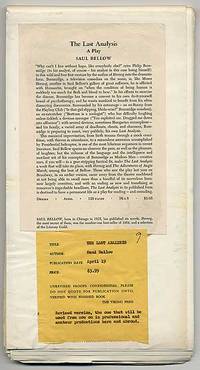
1965rif. 106713New York: Viking Press 1965. Unbound. Near Fine. Uncorrected proof consisting of unbound long folded galleys with two applied labels: a title label and a summary label. Modest wear near fine. A rare state of Bellow's first play it is likely that fewer than a dozen were printed. Viking Press unknown
1965rif. 106713New York: Viking Press 1965. Unbound. Near Fine. Uncorrected proof consisting of unbound long folded galleys with two applied labels: a title label and a summary label. Modest wear near fine. A rare state of Bellow's first play it is likely that fewer than a dozen were printed. Viking Press unknown books
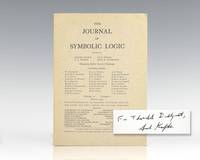
1959rif. 88076New Haven New Jersey: Association for Symbolic Logic Inc March 1959. First edition of Volume 24 of The Journal of Symbolic which includes the first appearance of Kripke's landmark paper A Completeness Theorem in Modal Logic. Presentation copy inscribed by Saul A. Kripke on the first page of his theorem "For Thorild Dahlquist Saul Kripke." In this paper Kripke both proves the formal completeness of modal logic supplemented by first-order quantifiers and the sign of equality and “creates a semantics now called Kripke semantics” Hurley Logic: The Essentials 217. “Of great importance is the paper “Semantical Analysis of Modal Logic I” where normal systems are treated. It is here that Kripke fully develops the analogy with the algebraic results of Jónsson and Tarski and proves completeness and decidability for propositional systems T S4 S5 and B the Brouwersche system which is here introduced It is in this paper that two crucial generalizations of the model theory are introduced” Stanford Encyclopedia of Philosophy. Octavo original wrappers as issued. In near fine condition. Scarce especially signed and inscribed. American philosopher and logician Saul Kripke has made some of the most important and original contributions to the field of formal mathematical logic particularly modal logic which extends classical logic to include modalities. Kripke wrote his first completeness theorem A Completeness Theorem in Modal Logic at the age of 17 before graduating high school and had it published a year later. Association for Symbolic Logic, Inc unknown
1960rif. 131763Los Angeles: Saul Bass and Associates 1960. Original glossy photographic title card for plate No. 3 in the title sequence from Stanley Kubrick's 1960 film "Spartacus." This plate was used for the portion of the title card sequence showing "LAURENCE OLIVIER as Crassus." Only a small portion of the photographic image here was used in the sequence with the entire photograph offered here being quite striking. With a vinyl pull attached to the right as originally designed "Saul Bass & Associates" rubber stamp and pencil annotations on the verso the number "3" in blue manuscript pencil on the recto. 20 x 22 inches. Near Fine. Saul Bass and Associates unknown
1960rif. 131763Los Angeles: Saul Bass and Associates 1960. Original glossy photographic title card for plate No. 3 in the title sequence from Stanley Kubrick's 1960 film "Spartacus." This plate was used for the portion of the title card sequence showing "LAURENCE OLIVIER as Crassus." Only a small portion of the photographic image here was used in the sequence with the entire photograph offered here being quite striking. With a vinyl pull attached to the right as originally designed "Saul Bass & Associates" rubber stamp and pencil annotations on the verso the number "3" in blue manuscript pencil on the recto. 20 x 22 inches. Near Fine. Saul Bass and Associates unknown books