Bellow, SaulBiblio.com

6.930 resultados
ref. 1289New York: The Viking Press 1975. First edition of the author's Pulitzer Prize-winning work. Octavo original half cloth. Association copy inscribed by the author on the front free endpaper "To Karyl with love I could never have done it without your patient help Saul." The recipient Karyl Kylie typed the manuscript of this novel. Fine in a near fine dust jacket with just a touch of wear. Jacket design by Mel Williamson. An exceptional association. Humboldt's Gift is a self-described "comic book about death" whose title character is modeled on the lyric poet Delmore Schwartz. Charlie Citrine an intellectual middle-aged author of award-winning biographies and plays contemplates two significant figures and philosophies in his life: Von Humboldt Fleisher a dead poet who had been his mentor and Rinaldo Cantabile a very-much-alive minor mafioso who has been the bane of Humboldt's existence. Humboldt had taught Charlie that art is powerful and that one should be true to one's creative spirit. Rinaldo Charlie's self-appointed financial adviser has always urged Charlie to use his art to turn a profit. At the novel's end Charlie has managed to set his own course. The Viking Press hardcover
1913ref. 150527London: John Richmond Ltd 1913. Presentation copy of Sassoon's pseudonymous parody inscribed to the distinguished antiquarian bookseller and scholar Percy Muir First edition first impression presentation copy inscribed by the author on the half-title: "P. H. Muir from Siegfried Sassoon 4.10.29"; one of 1000 copies printed highly uncommon in such condition. A pseudonymous parody of John Masefield's early narrative poems The Daffodil Murderer was published as the winner of the entirely fictional "Chantrey Prize" and wryly advertised as "Brilliant Beyond Belief" on the front wrapper. The recipient of this copy was Percy Muir 1894-1979 the distinguished antiquarian bookseller and scholar of children's books. Sassoon inscribed this copy to Muir in the year before Muir joined the London antiquarian booksellers Elkin Mathews Limited. Muir joined the firm in 1930 and remained with them until his death. Muir was president of the Antiquarian Booksellers Association from 1945-1947 and chaired the first conference of the International League of Antiquarian Booksellers ILAB in 1947. He became president of the ILAB from 1950-1952 and was subsequently elected the first Life President of Honour. His major work English Children's Books was published in 1954. Sassoon's poem is frequently cited as a parody of John Masefield's long narrative poem The Everlasting Mercy published in 1911. Masefield's work was read in pubs denounced from pulpits and branded in the words of Lord Alfred Douglas "nine-tenths sheer filth". The original publishers were sufficiently worried about prosecution to leave blank spaces where Masefield had written the word "bloody" and it was later claimed by Robert Graves that Masefield's innovative diction emboldened Shaw to use the word in Pygmalion. J. M. Barrie called the work "the finest literature" Edmund Gosse noted that in it was "a happy blending of the traditional and the revolutionary" and Masefield was duly awarded the Royal Society of Literature's Edmond de Polignac prize for 1911. Masefield had hit a rich-seam in poetry and followed The Everlasting Mercy with The Widow in the Bye Street published in 1912 Dauber published in 1912 and The Daffodil Fields published in 1913. Sassoon appears to have been rather frustrated at literature's latest craze and he sat down to write his own version and created a parody of Masefield's general style diction and subjects across The Everlasting Mercy The Widow in the Bye Street and The Daffodil Fields. There were two results of Sassoon's parody. The first was that in many ways it had helped Sassoon find a poetic voice. In The Weald of Youth Sassoon describes how in December 1912 the thought struck him: "Why not amuse myself by scribbling a few pages of parody I may as well say at once that the immediate result was far beyond what I had intended. I began his story in crudest imitation of Masefield's manner. Stimulating my pencil with an occasional dose of The Everlasting Mercy I found myself corking down the 'human document' with astonishing facility. After the first fifty lines or so I dropped the pretence that I was improvising an exuberant skit. While continuing to burlesque Masefield for all I was worth I was really feeling what I wrote - and doing it not only with abundant delight but a sense of descriptive energy quite unlike anything I had experienced before. Never before had I been able to imbue commonplace details with warmth of poetic emotion. I felt that. I had found a new pair of poetic legs and the fact that they had been graciously presented to me by John Masefield made no difference to my sense of self-satisfaction". The other result of publishing The Daffodil Murderer was that it brought Sassoon to the attention of Edward Marsh - the editor of Georgian Poetry - and Marsh soon became Sassoon's mentor. Despite the parody Sassoon and Masefield met during November 1918. Masefield's Great War poem Reynard the Fox undoubtedly owes some inspiration from Sassoon Masefield advised Sassoon on a forthcoming lecture tour of the United States Masefield sent letters introducing Sassoon to some of his closest American friends Sassoon dedicated the American edition of Picture-Show to Masefield Sassoon was invited to one of Masefield's festivals of spoken poetry in 1930 and in 1957 Sassoon was the recipient of the Queen's Medal for Poetry an idea devised by Masefield. Octavo. Original yellow wrappers lettered in dark red. Housed in a custom green cloth case. Foxing to edges and leaves else an exceptional near-fine copy of a fragile book rarely seen in such bright condition. Keynes A10. hardcover
1953ref. 111689New York: The Viking Press 1953. First edition of Bellow's first National Book Award winning novel. Octavo original cloth salmon topstain. Presentation copy inscribed by the author on the front free endpaper "For Ann Englander whom I protected from the angry wolves Saul Bellow." Fine in a near fine price-clipped first-issue dust jacket with the John Steinbeck ad on the rear flap and no reviews. Jacket design by Robert Hallock. An exceptional example. The Adventures of Augie March comes on stage with one of literature's most famous opening lines. "I am an American Chicago born and go at things as I have taught myself free-style and will make the record in my own way: first to knock first admitted." Bellow quickly found a receptive audience for his new energetic style. The critic Irving Howe took note of Bellow's "free style" manner calling it "the first major new style in American prose fiction since those of Hemingway and Faulkner." This novel went on to win the National Book Award for 1954. Both Time Magazine and the Modern Library Board named it one of the hundred best novels in the English language. The Viking Press hardcover
1971ref. 345j1187New York: Random House Inc. Very Good in Good dust jacket. 1971. First Edition. Hardcover. 0394443411 . Signed and inscribed to a friend by Saul Alinsky 1909-1972 atop front free endpaper. "America's most famous community organizer tells the Have-Nots how they can organize to achieve real political power for the practice of true democracy. The distillation of Mr. Alinsky's more than forty years as a professional radical. This hard-headed tactical advice provides an alternative not only to the powerlessness that threatens our democracy but to the random violence and bitter alienation by which so much radical energy is wasted." - dust jacket. In her B.A. thesis entitled 'An Analysis of the Alinsky Model' Hillary Clinton wrote "In regard to the paper itself there are three people who deserve special appreciation including Mr. Alinsky for providing a topic sharing his time and offering me a job." Book very clean bright tight and unmarked with negligible wear. Average wear to unclipped dust jacket now preserved in glossy new archival-grade Brodart. A quality signed example.; 8vo; Signed by Author . Random House Inc hardcover
1944ref. 147721New York: The Vanguard Press 1944. First edition of the Nobel Prize-winning author's first book. Octavo original beige cloth topstain brown. Presentation copy inscribed by the author on the dedication page "For Poetry and for Van Allen Bradley with very best wishes Saul Bellow." The recipient Van Allen Bradley was an influential American literary critic editor and author. He gained prominence as the editor of the Chicago Daily News book review section where he championed emerging literary talents and fostered intellectual discourse. Bradley’s most notable contribution to literary scholarship was his book Gold in Your Attic which provided guidance on identifying rare and valuable books popularizing book collecting as a hobby and field of study. His work bridged the gap between literary criticism and the antiquarian book trade emphasizing the cultural and historical importance of preserving literary artifacts. Near fine in a near fine price-clipped dust jacket. From the library of noted collector William A. Strutz with his small bookplate to the pastedown. Housed in a custom half morocco clamshell box made by the Harcourt Bindery. An exceptional example with a noted association. Saul Bellow was a prominent American novelist and Nobel laureate whose works explore themes of identity morality and the human condition in modern society. Born in 1915 to Russian-Jewish immigrants his writing often reflects his immigrant roots and intellectual pursuits. Bellow’s most celebrated novels such as 'The Adventures of Augie March' 'Herzog' and 'Humboldt’s Gift' combine philosophical depth with richly drawn characters and sharp social commentary. Known for his distinctive prose style and exploration of existential questions Bellow's work has had a profound influence on 20th-century American literature earning him widespread critical acclaim and numerous awards including the Pulitzer Prize and the Nobel Prize in Literature in 1976. The Vanguard Press hardcover
1944ref. 18037New York: The Vanguard Press 1944. First edition of the Nobel Prize-winning author's first book. Octavo original beige cloth. Presentation copy inscribed by the author on the title page "For Matthew and Adrienne greetings and blessings on your wedding Saul Bellow." Fine in a near fine price-clipped dust jacket with light rubbing to the crown and foot of the spine. One of the most honest pieces of testimony on the psychology of a whole generation who have grown up during the Depression and the war" Edmund Wilson The New Yorker. The Vanguard Press hardcover
1964ref. 3538New York: The Viking Press 1964. First edition of the author's second of three National Book Award winning novels which was and remains an unprecedented literary accomplishment. Octavo original blue cloth. Association copy inscribed by the author on the front free endpaper to John Nef and his wife "To John Nef and Mrs. Nef with very good wishes Saul Bellow." The recipient John Nef was a economic historian and founder of The University of Chicago’s Committee on Social Thought where Bellow was a faculty member for over 30 years. Fine in a bright fine dust jacket. Jacket design by Mel Williamson. Housed in a custom half morocco clamshell box. An outstanding association. A novel complex compelling absurd and realistic Herzog became a classic almost as soon as it was published in 1964. In it Saul Bellow tells the tale of Moses E. Herzog a tragically confused intellectual who suffers from the breakup of his second marriage the general failure of his life and the specter of growing up Jewish in the middle part of the 20th century. He responds to his personal crisis by sending out a series of letters to all kinds of people. The letters in total constitute a thoughtful examination of his own life and that which has occurred around him. What emerges is not always pretty but serves as gritty foundation for this absorbing novel. "A masterpiece" The New York Times. Named by Time Magazine as one of the 100 best novels in the English language since Time's founding in 1923. The Viking Press hardcover
ref. SKU0468975Pearson 2016-01-15. Paperback. Good. Textbook May Have Highlights Notes and/or Underlining BOOK ONLYNO ACCESS CODE NO CD Ships with Emailed Tracking Pearson paperback
1944ref. ABE-1658583450326Vanguard Press NYC 1944 This is a gorgeous SIGNED first edition of the author's first book. It has been bound in navy blue goatskin leather and is secure in a suede lined slipcase. The author has simply signed this without dedication on the title page in what looks like fountain pen ink - which has faded a bit. This is not just beautifully bound; it is thoroughly well bound. The hand marbled endpapers enhance the pleasure of this book. Whoever bound this has followed the spine titling design of the original issue. Signed by Author. 1st Edition. Hardcover. Fine. Vanguard Press NYC hardcover
1944ref. 157559New York: The Vanguard Press 1944. Sociology and poetry in Chicago First edition first printing of the author's first book inscribed by him on the front free endpaper "To Kurt & Carla Wolff affectionately Saul Bellow". One of the Wolffs has added "Chicago Ap 15 44" beneath Bellow's inscription and "Kurt & Karla Wolff Chicago Mr. 27 1944 H. Bookstore" above. This is an excellent association from Bellow to his friend and fellow writer the influential sociologist Kurt Wolff 1912-2003. They met in Chicago: Bellow was raised there and Wolff "had fallen in love with the region with the people and with the situation" quoted in Stehr while a research fellow at the Social Science Research Council in the early 1940s. Bellow wrote this book about a young Chicago man waiting to be drafted during his service with the merchant marine during the Second World War. Both Bellow and Wolff were significantly engaged in one another's disciplines: Bellow was a writer educated in sociology and Wolff a sociologist whose literary experiments Bellow encouraged. Bellow was a Canadian-born Lithuanian-Jew who had graduated from Northwestern University with an honours in anthropology and sociology the study of which had a marked influence on his literary style. Wolff was a Jewish German-born sociologist forced out of Germany by rising Naziism who recounted that "after a relatively short time in America I began to write literature in which the most important help I received was from Saul Bellow whom I got to know in Chicago in 1943". Wolff co-founded a short-lived poetic journal titled Experiment around this time and it was then that his central sociological ideas of surrender and catch "gave rise to a synthesis between sociology and poetry". He stated that "my method of imagination is neither sociological nor poetic but rather spontaneously phenomenological if I may call it that. That means the attempt to capture something as exactly as possible which is thus as you see connected to the art of poetry as much as to the appearance of nature but isn't one of the other: it's a third method". Both Wolff and Bellow shared this dedication to a "third method": in 1962 Bellow returned to Chicago as a professor on the Committee on Social Thought the goal of which was to develop multidisciplinary approaches to learning. He taught on the committee for more than 30 years. This is a significant association from the beginning of an intellectually fertile relationship. Octavo. Original light green cloth spine lettered in brown small design of man with arm outstretched on front cover in brown top edge brown. With dust jacket. Spine a touch sunned and cocked spine ends just bumped cloth and edges lightly soiled edges of endpapers lightly toned. A very good copy indeed internally clean in like jacket edges toned shallow chips to head of spine and corners a little rubbing to front panel a few short closed tears to folds and one across spine head of front panel and flaps a touch creased edges nicked unclipped a clean example. Nico Stehr "A Conversation with Kurt H. Wolff" Gary Backhaus & George Psathas eds. The Sociology of Radical Commitment: Kurt H. Wolff's Existential Turn 2007. hardcover
1913ref. 153720London: John Richmond Ltd 1913. His pseudonymous parody inscribed to Lady Ottoline Morrell First edition first impression presentation copy with a significant association inscribed by the author on the half-title: "To O.M. from 'S.K.'" Ottoline Morrell from Saul Kain. Perhaps the most important support that Lady Ottoline Morrell ever offered to a poet or artist was her friendship for Siegfried Sassoon during the First World War. She became aware of him when she read his poem "To Victory" in The Times on 15 January 1916 and traced him through Edmund Gosse. Like her he was an admirer of the Ballets Russes and she wrote of her pleasure at finding "in the dark prison-like days a sympathetic desire - to fly out beyond into the beauty and colour and freedom that one so longs for" Egremont p. 81. They continued to correspond frequently and Sassoon sent her his war poems as he wrote them in return for which she sent writings of her own. Morrell was of significant influence when Sassoon recuperated at the Morrells' country house Garsington Manor in spring 1917. Morrell's pacifism helped Sassoon's disillusionment with the war and shortly after his visit Sassoon published his infamous "Soldier's Declaration". This pseudonymous parody of John Masefield's early narrative poems was published as the winner of the fictional "Chantrey Prize" and wryly advertised as "Brilliant Beyond Belief" on the front wrapper. Masefield's narrative poem The Everlasting Mercy published in 1911 work was read in pubs denounced from pulpits and branded in the words of Lord Alfred Douglas "nine-tenths sheer filth". Sassoon appears to have been rather frustrated at literature's latest craze and he sat down to write his own version and created a parody of Masefield's general style diction and subjects. There were two results of Sassoon's parody. The first was that in many ways it had helped Sassoon find a poetic voice. In The Weald of Youth Sassoon describes how in December 1912 the thought struck him: "Why not amuse myself by scribbling a few pages of parody I may as well say at once that the immediate result was far beyond what I had intended . . . After the first fifty lines or so I dropped the pretence that I was improvising an exuberant skit. While continuing to burlesque Masefield for all I was worth I was really feeling what I wrote - and doing it not only with abundant delight but a sense of descriptive energy quite unlike anything I had experienced before". The other result of publishing The Daffodil Murderer was that it brought Sassoon to the attention of Edward Marsh - the editor of Georgian Poetry - and Marsh soon became Sassoon's mentor. Octavo. Original yellow wrappers lettered in dark red. Housed in a custom red cloth case. Bookplate of Henry Lewis Batterman Jr. to case. Closed tears and creases to wrappers some internal creases; else a near-fine copy. Keynes A10; Max Egremont Siegfried Sassoon 2005. hardcover
1965ref. 122002N.p.: N.p. 1965. A dazzling collection of ten original pressbooks designed by Saul Bass documenting the majority of the famed title and ad designer's work with director Otto Preminger in the 1950s 60s and 70s. Several of the pressbooks defy the conventions of pressbook design with custom shapes to represent items in keeping with the films for which they were made: "Advise and Consent" resembles a briefcase "In Harm's Way" is designed as a dossier with a string tie "The Cardinal" as a parcel and "Bunny Lake is Missing" as a newspaper. Other key titles in the collection include "Anatomy of a Murder" "Bonjour Tristesse" "Exodus" and "The Man with the Golden Arm." For most of the pressbooks in this collection we have never seen another example. A fascinating example of the advertising work done by the premiere title and ad designer of the twentieth century. Various sizes ranging from Very Good to Near Fine condition. Complete details available on request. N.p. unknown
1965ref. 122002N.p.: N.p. 1965. A dazzling collection of ten original pressbooks designed by Saul Bass documenting the majority of the famed title and ad designer's work with director Otto Preminger in the 1950s 60s and 70s. Several of the pressbooks defy the conventions of pressbook design with custom shapes to represent items in keeping with the films for which they were made: "Advise and Consent" resembles a briefcase "In Harm's Way" is designed as a dossier with a string tie "The Cardinal" as a parcel and "Bunny Lake is Missing" as a newspaper. Other key titles in the collection include "Anatomy of a Murder" "Bonjour Tristesse" "Exodus" and "The Man with the Golden Arm." For most of the pressbooks in this collection we have never seen another example. A fascinating example of the advertising work done by the premiere title and ad designer of the twentieth century. Various sizes ranging from Very Good to Near Fine condition. Complete details available on request. N.p. unknown books
1953ref. 4244New York: The Viking Press 1953. First edition of Bellow's first National Book Award-winning novel. Octavo original cloth salmon topstain. Presentation copy inscribed by the author on the front free endpaper "For Raymita Chaffee with best wishes Saul Bellow Breadloaf VT 1954." The recipient was a student of Bellow’s at Breadloaf. Fine in a near fine first-issue dust jacket Jacket design by Robert Hallock. Housed in a custom half morocco clamshell box made by the Harcourt Bindery. Contemporary inscriptions in this title are uncommon. The Adventures of Augie March comes on stage with one of literature's most famous opening lines. "I am an American Chicago born and go at things as I have taught myself free-style and will make the record in my own way: first to knock first admitted." Bellow quickly found a receptive audience for his new energetic style. The critic Irving Howe took note of Bellow's "free style" manner calling it "the first major new style in American prose fiction since those of Hemingway and Faulkner." This novel went on to win the National Book Award for 1954 and was listed on Modern Library's 100 greatest novels of the twentieth century. The Viking Press hardcover
1964ref. COLLECTI007323INEW YORK NY: VIKING PRESS THE. VG SPIRAL BOUND WRAPS. PUB SEPT 1964. FIRST EDITION. ISBN: UNREVISED PROOFS THAT APPARENTLY WERE AT A LATER STAGE SINCE A. ISBN: SIGNIFICANT NUMBER HAVE CORRECTED PAGES PASTED OVER THEM. PROOFS ARE LIGHTLY WORN AT THE CORNERS WITH SOME MODEST SOILING TO THEWRAPS. Keywords: UNCORRECTED PROOFS NATIONAL BOOK AWARD ABCDEF. VIKING PRESS (THE) paperback
1965ref. 106713New York: Viking Press 1965. Unbound. Near Fine. Uncorrected proof consisting of unbound long folded galleys with two applied labels: a title label and a summary label. Modest wear near fine. A rare state of Bellow's first play it is likely that fewer than a dozen were printed. Viking Press unknown
1965ref. 106713New York: Viking Press 1965. Unbound. Near Fine. Uncorrected proof consisting of unbound long folded galleys with two applied labels: a title label and a summary label. Modest wear near fine. A rare state of Bellow's first play it is likely that fewer than a dozen were printed. Viking Press unknown books
1959ref. 88076New Haven New Jersey: Association for Symbolic Logic Inc March 1959. First edition of Volume 24 of The Journal of Symbolic which includes the first appearance of Kripke's landmark paper A Completeness Theorem in Modal Logic. Presentation copy inscribed by Saul A. Kripke on the first page of his theorem "For Thorild Dahlquist Saul Kripke." In this paper Kripke both proves the formal completeness of modal logic supplemented by first-order quantifiers and the sign of equality and “creates a semantics now called Kripke semantics” Hurley Logic: The Essentials 217. “Of great importance is the paper “Semantical Analysis of Modal Logic I” where normal systems are treated. It is here that Kripke fully develops the analogy with the algebraic results of Jónsson and Tarski and proves completeness and decidability for propositional systems T S4 S5 and B the Brouwersche system which is here introduced It is in this paper that two crucial generalizations of the model theory are introduced” Stanford Encyclopedia of Philosophy. Octavo original wrappers as issued. In near fine condition. Scarce especially signed and inscribed. American philosopher and logician Saul Kripke has made some of the most important and original contributions to the field of formal mathematical logic particularly modal logic which extends classical logic to include modalities. Kripke wrote his first completeness theorem A Completeness Theorem in Modal Logic at the age of 17 before graduating high school and had it published a year later. Association for Symbolic Logic, Inc unknown
1960ref. 131763Los Angeles: Saul Bass and Associates 1960. Original glossy photographic title card for plate No. 3 in the title sequence from Stanley Kubrick's 1960 film "Spartacus." This plate was used for the portion of the title card sequence showing "LAURENCE OLIVIER as Crassus." Only a small portion of the photographic image here was used in the sequence with the entire photograph offered here being quite striking. With a vinyl pull attached to the right as originally designed "Saul Bass & Associates" rubber stamp and pencil annotations on the verso the number "3" in blue manuscript pencil on the recto. 20 x 22 inches. Near Fine. Saul Bass and Associates unknown
1960ref. 131763Los Angeles: Saul Bass and Associates 1960. Original glossy photographic title card for plate No. 3 in the title sequence from Stanley Kubrick's 1960 film "Spartacus." This plate was used for the portion of the title card sequence showing "LAURENCE OLIVIER as Crassus." Only a small portion of the photographic image here was used in the sequence with the entire photograph offered here being quite striking. With a vinyl pull attached to the right as originally designed "Saul Bass & Associates" rubber stamp and pencil annotations on the verso the number "3" in blue manuscript pencil on the recto. 20 x 22 inches. Near Fine. Saul Bass and Associates unknown books
ref. 138119Cambridge: Harvard University Press 1980. First edition of this work widely considered one of the most important philosophical works of the twentieth century. Octavo original cloth. Signed by the author on the title page "Best wishes Saul Kripke." Fine in a near fine dust jacket. Housed in a custom half morocco clamshell box. Rare and desirable signed. "In the philosophy of language Naming and Necessity is among the most important works ever ranking with the classical work of Frege in the late nineteenth century and of Russell Tarski and Wittgenstein in the first half of the twentieth century . . . Naming and Necessity played a large role in the implicit but widespread rejection of the view—so popular among ordinary language philosophers—that philosophy is nothing more than the analysis of language" Philosophical Analysis in the Twentieth Century Harvard University Press hardcover
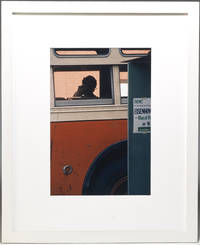
1954ref. 1306041954. Signed. LEITER Saul. Photograph: ""Bus New York"" New York 1954 but printed later. Fujicolor Crystal Archive print signed titled and dated on print verso. Image measures 13-1/2 by 9 inches print measures 14 by 11 inches; handsomely framed entire piece measures 21-3/4 by 17-1/2 inches. $12000.Original color photograph signed by Saul Leiter one of the masters of mid-twentieth century photography.""The American artist Saul Leiter 1923Ã2013 became enchanted by painting and photography as a teenager in Pittsburgh. After he relocated to New York City in 1946 his visionary imagination and tireless devotion to artistic practice pushed him to become one of the iconic photographers of the mid-twentieth century. An innate sense of curiosity made him a lifelong student of art of all kinds and he retained his spirit of exploration and spontaneity throughout his long career in both his fashion images and his personal work. Leiter began experimenting with color photography in New York in the late 1940s using slide film such as Kodachrome. The 2006 release of his first monograph Early Color revealed radically innovative compositions and a groundbreaking mastery of color that permanently changed the history of photography. Though Leiter sometimes defended the use of color in fine-art photography he refused to analyze or explain his own work. 'I don't have a philosophy' Leiter said. 'I have a camera.'"" Saul Leiter Foundation. ""Saul Leiter American painter and photographer was part of what was known as the New York school of photography of the 1940s and 50s and resided on East 10th Street between 2nd and 3rd Avenues for 61 years until his death in 2013. His photographs from the 1950s experimented with color unlike those of his contemporaries and many were street scenes of his East Village neighborhood. Also unlike many of his contemporaries the significance of this work has only recently come to be recognized and he is now duly credited as an early pioneer of color photography. The son of a well-known Talmudic scholar and rabbi Saul Leiter was born in Pittsburgh Pennsylvania on December 3 1923 and expected to follow in his father's footsteps. Much to his family's dismay he left religious school at the age of 23 and went to New York City to pursue painting. While at art school he befriended abstract-expressionist painter Richard Pousette-Dart who encouraged Leiter's experiments with photography. He also became acquainted with photographer W. Eugene Smith who would introduce him to members of what would be known as the New York school of photography and included such noted photographers as Diane Arbus Robert Frank William Klein and Richard Avedon. Leiter had begun to experiment with color photography by 1948 using an inexpensive 35mm camera and film which was sometimes past its date of expiration. The main subjects during this time in the 1950s were his friends and street scenes mostly in the East Village. He said that he was especially fond of photographing First Avenue due to the lighting along the thoroughfare as a result of the low buildings. His plays with focus light form reflection and composition generated an innovative and painterly quality to his work which makes his photos stand out from those of his contemporaries"" Sarah Bean Apmann. Provenance: from Howard Greenberg Gallery. Fine condition. unknown
1954ref. 1306041954. Signed. LEITER Saul. Photograph: ""Bus New York"" New York 1954 but printed later. Fujicolor Crystal Archive print signed titled and dated on print verso. Image measures 13-1/2 by 9 inches print measures 14 by 11 inches; handsomely framed entire piece measures 21-3/4 by 17-1/2 inches. $12000.Original color photograph signed by Saul Leiter one of the masters of mid-twentieth century photography.""The American artist Saul Leiter 1923Ã2013 became enchanted by painting and photography as a teenager in Pittsburgh. After he relocated to New York City in 1946 his visionary imagination and tireless devotion to artistic practice pushed him to become one of the iconic photographers of the mid-twentieth century. An innate sense of curiosity made him a lifelong student of art of all kinds and he retained his spirit of exploration and spontaneity throughout his long career in both his fashion images and his personal work. Leiter began experimenting with color photography in New York in the late 1940s using slide film such as Kodachrome. The 2006 release of his first monograph Early Color revealed radically innovative compositions and a groundbreaking mastery of color that permanently changed the history of photography. Though Leiter sometimes defended the use of color in fine-art photography he refused to analyze or explain his own work. 'I don't have a philosophy' Leiter said. 'I have a camera.'"" Saul Leiter Foundation. ""Saul Leiter American painter and photographer was part of what was known as the New York school of photography of the 1940s and 50s and resided on East 10th Street between 2nd and 3rd Avenues for 61 years until his death in 2013. His photographs from the 1950s experimented with color unlike those of his contemporaries and many were street scenes of his East Village neighborhood. Also unlike many of his contemporaries the significance of this work has only recently come to be recognized and he is now duly credited as an early pioneer of color photography. The son of a well-known Talmudic scholar and rabbi Saul Leiter was born in Pittsburgh Pennsylvania on December 3 1923 and expected to follow in his father's footsteps. Much to his family's dismay he left religious school at the age of 23 and went to New York City to pursue painting. While at art school he befriended abstract-expressionist painter Richard Pousette-Dart who encouraged Leiter's experiments with photography. He also became acquainted with photographer W. Eugene Smith who would introduce him to members of what would be known as the New York school of photography and included such noted photographers as Diane Arbus Robert Frank William Klein and Richard Avedon. Leiter had begun to experiment with color photography by 1948 using an inexpensive 35mm camera and film which was sometimes past its date of expiration. The main subjects during this time in the 1950s were his friends and street scenes mostly in the East Village. He said that he was especially fond of photographing First Avenue due to the lighting along the thoroughfare as a result of the low buildings. His plays with focus light form reflection and composition generated an innovative and painterly quality to his work which makes his photos stand out from those of his contemporaries"" Sarah Bean Apmann. Provenance: from Howard Greenberg Gallery. Fine condition. unknown books
2003ref. SBBIH-CFKGO4QBRIFZLoughborough University Departm 2003. paperback. Acceptable. Please see the condition note after this for details if this is missing please consider Acceptable to mean poor quality that could include major staining water damage writing missing dustjacket etc etc. Our books are dispatched from a Yorkshire former cotton mill. We list via barcode/ISBN so please note that the images are stock images and may not be the exact copy you receive furthermore the details about edition and year might not be accurate as many publishers reuse the same ISBN for multiple editions and as we simply scan a barcode or enter an ISBN we do not check the validity of the edition data when listing. If you're looking for an exact edition please don't order at least not without checking with us first although we don't always have time to check. We aim to dispatch prompty the service used will depend on order value and book size. We can ship to most countries see our shipping policies. Payment is via Abe only. Loughborough University, Departm paperback
1992ref. 80345Springfield IL: Charles C. Thomas 1992. Presumed First Edition First printing. Hardcover. Very good. xxiii 1 302 pages. Inscribed by the editor on the fep: "2/7/92 To Victor--with affection & respect! Saul". Dr. Saul Feldman D. P. A. was the Chairman of the Board at U.S. Behavioral Health a part of The Travelers Corporation. He was also President of the Bay Area Foundation for Human Resources and Editor of the journal Administration and Policy in Mental Health. Earlier Dr. Feldman had been President of HealthAmerica Corporation of California Director of the Staff College at the National Institute of Mental Health and Consultant to the World Health and Pan American Organizations. Appointed by the U.S. Secretary of Health and Human Services he was for 6 years a member of the National Advisory Council of the Substance Abuse and Mental Health Services Administration. For two years he served on a panel of experts appointed by the Institute of Medicine a component of the National Academy of Sciences to analyze and make recommendations for the improvement behavioral health services across the country. The Institute's final report Crossing the Quality Chasm has been published by the National Academy Press. He has also served on a national policy panel sponsored by the Robert Wood Johnson Foundation to recommend improvements in the quality of treatment for alcohol and drug problems. Dr. Feldman is a founding fellow and former President of the American College of Mental Health Administration. The College established an award in his name for individuals who have made outstanding lifetime contributions to behavioral health policy and administration. This compendium has chapters addressing topics such as: Group Health Insurance Health Maintenance Organizations Mental Health Insurance Information Systems Quality Assurance Legal Issues Ethical Issues Mental Health in the Public Sector Mental Health Economics and Evaluation of Mental Health Programs. Among the contributors are: Michael Bennett Jeffrey Berlant Stephen Blum Richard Frank Gary Gaumer Michael Goran Trevor Hadley Richard Kunnes Judith Lave Marvis Oehm Joan Pearson Peter Rich Aileen Rothbard Arie Schinnar Joseph Smith and H. G. Whittington. Charles C. Thomas hardcover