Kain, Saul / (Siegfried Sassoon)Biblio.com
6900 risultati
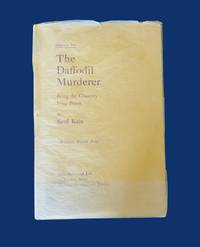
1913rif. JM041First Edition. Octavo. Original mustard-yellow paper wrappers lettered in red. Complete with the rare fragile glassine dust wrapper and an early bookseller receipt. Author: KAIN Saul Siegfried Sassoon Binding: Original softcover mustard wrappers Year: 1913 Edition: First Edition Condition Cover: Good condition. Mustard paper wrappers are clean with no tears or creases. Glassine Jacket: Fragmented but present. The front panel and spine are fully intact. The rear panel is fragile with approximately two-thirds missing. Interior: Pages appear little used with square edges. Moderate to heavy foxing present across all internal pages. Ephemera: Includes an original loose 1947 receipt showing a previous purchase price of £3. Additional Details: Photographs of the cover glassine jacket internal foxing and the 1947 receipt are provided in the listing gallery. Synopsis and Historical Importance Published under the pseudonym Saul Kain a playful nod to the protagonist of John Masefield's The Everlasting Mercy The Daffodil Murderer 1913 holds immense historical importance as Siegfried Sassoon's very first commercially published trade edition. Prior to this Sassoon had only printed his verse in obscure privately circulated pamphlets. The book was conceived as a biting satirical parody of Masefield's smash-hit narrative poems which Sassoon felt were overly dramatic and full of manufactured gritty realism. The book itself mocks the literary establishment; it features a fake preface by an imaginary "William Butler" and a wry front cover blurb shouting "Brilliant Beyond Belief" for a fictional award called the "Chantrey Prize". Crucially writing this piece changed the trajectory of Sassoon's career. He later admitted in his autobiography The Weald of Youth that while burlesquing Masefield he suddenly discovered his own authentic poetic voice learning how to imbue real-world commonplace details with raw emotional warmth. Furthermore this specific piece caught the attention of Edward Marsh the influential editor of Georgian Poetry. Marsh quickly became Sassoon's literary mentor launching him into the forefront of the Edwardian and wartime poetry scenes. John Richmond Ltd paperback
1913rif. 23751London: John Richmond 1913. A first edition first printing published by John Richmond in 1913. Original frail orange-yellow wrappers printed in red. Some toning and rubbing - no inscriptions. The first of Sassoon's books published as a trade edition preceded by a string of privately printed volumes of verse. After reading this parody of John Masefield's 'Everlasting Mercy' Edmund Gosse suggested that Sassoon send a parcel of his books to John Marsh editor of `Georgian Poetry' which led to further encouragement which Sassoon later said helped "tilt up the bushel under which my light had been burning." Published under the name Saul Kain with an admiring preface by "William Butler" actually the publisher and presented as if it were "the Chantrey Prize Poem" complete with a fake excerpt from a review or judge's pronouncement on the front wrapper: "brilliant beyond belief." Farmer A10. Excessively scarce. John Richmond unknown
1913rif. 150527London: John Richmond Ltd 1913. Presentation copy of Sassoon's pseudonymous parody inscribed to the distinguished antiquarian bookseller and scholar Percy Muir First edition first impression presentation copy inscribed by the author on the half-title: "P. H. Muir from Siegfried Sassoon 4.10.29"; one of 1000 copies printed highly uncommon in such condition. A pseudonymous parody of John Masefield's early narrative poems The Daffodil Murderer was published as the winner of the entirely fictional "Chantrey Prize" and wryly advertised as "Brilliant Beyond Belief" on the front wrapper. The recipient of this copy was Percy Muir 1894-1979 the distinguished antiquarian bookseller and scholar of children's books. Sassoon inscribed this copy to Muir in the year before Muir joined the London antiquarian booksellers Elkin Mathews Limited. Muir joined the firm in 1930 and remained with them until his death. Muir was president of the Antiquarian Booksellers Association from 1945-1947 and chaired the first conference of the International League of Antiquarian Booksellers ILAB in 1947. He became president of the ILAB from 1950-1952 and was subsequently elected the first Life President of Honour. His major work English Children's Books was published in 1954. Sassoon's poem is frequently cited as a parody of John Masefield's long narrative poem The Everlasting Mercy published in 1911. Masefield's work was read in pubs denounced from pulpits and branded in the words of Lord Alfred Douglas "nine-tenths sheer filth". The original publishers were sufficiently worried about prosecution to leave blank spaces where Masefield had written the word "bloody" and it was later claimed by Robert Graves that Masefield's innovative diction emboldened Shaw to use the word in Pygmalion. J. M. Barrie called the work "the finest literature" Edmund Gosse noted that in it was "a happy blending of the traditional and the revolutionary" and Masefield was duly awarded the Royal Society of Literature's Edmond de Polignac prize for 1911. Masefield had hit a rich-seam in poetry and followed The Everlasting Mercy with The Widow in the Bye Street published in 1912 Dauber published in 1912 and The Daffodil Fields published in 1913. Sassoon appears to have been rather frustrated at literature's latest craze and he sat down to write his own version and created a parody of Masefield's general style diction and subjects across The Everlasting Mercy The Widow in the Bye Street and The Daffodil Fields. There were two results of Sassoon's parody. The first was that in many ways it had helped Sassoon find a poetic voice. In The Weald of Youth Sassoon describes how in December 1912 the thought struck him: "Why not amuse myself by scribbling a few pages of parody I may as well say at once that the immediate result was far beyond what I had intended. I began his story in crudest imitation of Masefield's manner. Stimulating my pencil with an occasional dose of The Everlasting Mercy I found myself corking down the 'human document' with astonishing facility. After the first fifty lines or so I dropped the pretence that I was improvising an exuberant skit. While continuing to burlesque Masefield for all I was worth I was really feeling what I wrote - and doing it not only with abundant delight but a sense of descriptive energy quite unlike anything I had experienced before. Never before had I been able to imbue commonplace details with warmth of poetic emotion. I felt that. I had found a new pair of poetic legs and the fact that they had been graciously presented to me by John Masefield made no difference to my sense of self-satisfaction". The other result of publishing The Daffodil Murderer was that it brought Sassoon to the attention of Edward Marsh - the editor of Georgian Poetry - and Marsh soon became Sassoon's mentor. Despite the parody Sassoon and Masefield met during November 1918. Masefield's Great War poem Reynard the Fox undoubtedly owes some inspiration from Sassoon Masefield advised Sassoon on a forthcoming lecture tour of the United States Masefield sent letters introducing Sassoon to some of his closest American friends Sassoon dedicated the American edition of Picture-Show to Masefield Sassoon was invited to one of Masefield's festivals of spoken poetry in 1930 and in 1957 Sassoon was the recipient of the Queen's Medal for Poetry an idea devised by Masefield. Octavo. Original yellow wrappers lettered in dark red. Housed in a custom green cloth case. Foxing to edges and leaves else an exceptional near-fine copy of a fragile book rarely seen in such bright condition. Keynes A10. hardcover
1913rif. 153720London: John Richmond Ltd 1913. His pseudonymous parody inscribed to Lady Ottoline Morrell First edition first impression presentation copy with a significant association inscribed by the author on the half-title: "To O.M. from 'S.K.'" Ottoline Morrell from Saul Kain. Perhaps the most important support that Lady Ottoline Morrell ever offered to a poet or artist was her friendship for Siegfried Sassoon during the First World War. She became aware of him when she read his poem "To Victory" in The Times on 15 January 1916 and traced him through Edmund Gosse. Like her he was an admirer of the Ballets Russes and she wrote of her pleasure at finding "in the dark prison-like days a sympathetic desire - to fly out beyond into the beauty and colour and freedom that one so longs for" Egremont p. 81. They continued to correspond frequently and Sassoon sent her his war poems as he wrote them in return for which she sent writings of her own. Morrell was of significant influence when Sassoon recuperated at the Morrells' country house Garsington Manor in spring 1917. Morrell's pacifism helped Sassoon's disillusionment with the war and shortly after his visit Sassoon published his infamous "Soldier's Declaration". This pseudonymous parody of John Masefield's early narrative poems was published as the winner of the fictional "Chantrey Prize" and wryly advertised as "Brilliant Beyond Belief" on the front wrapper. Masefield's narrative poem The Everlasting Mercy published in 1911 work was read in pubs denounced from pulpits and branded in the words of Lord Alfred Douglas "nine-tenths sheer filth". Sassoon appears to have been rather frustrated at literature's latest craze and he sat down to write his own version and created a parody of Masefield's general style diction and subjects. There were two results of Sassoon's parody. The first was that in many ways it had helped Sassoon find a poetic voice. In The Weald of Youth Sassoon describes how in December 1912 the thought struck him: "Why not amuse myself by scribbling a few pages of parody I may as well say at once that the immediate result was far beyond what I had intended . . . After the first fifty lines or so I dropped the pretence that I was improvising an exuberant skit. While continuing to burlesque Masefield for all I was worth I was really feeling what I wrote - and doing it not only with abundant delight but a sense of descriptive energy quite unlike anything I had experienced before". The other result of publishing The Daffodil Murderer was that it brought Sassoon to the attention of Edward Marsh - the editor of Georgian Poetry - and Marsh soon became Sassoon's mentor. Octavo. Original yellow wrappers lettered in dark red. Housed in a custom red cloth case. Bookplate of Henry Lewis Batterman Jr. to case. Closed tears and creases to wrappers some internal creases; else a near-fine copy. Keynes A10; Max Egremont Siegfried Sassoon 2005. hardcover
1913rif. 45772John Richmond Ltd: London 1913. Very Good. London: John Richmond Ltd 1913. First Edition. Octavo 21cm; publisher's mustard card wrappers printed in red; 30pp. Light shelf wear especially along spine edge wrapper margins a bit toned contemporary heraldic ex libris mounted inside upper wrapper else Very Good and sound. A contemporary pencil note signed "EBH" notes that "Siegfried Sassoon 'Saul Kain' says he is 'mortally ashamed' of the parody." Siegfried Sassoon's first appearance in print "The Daffodil Murderer" is a long poem published pseudonymously with the help of the poet T.W.H. Crosland. Though the poem was originally written as an homage to John Masefield Crosland wanted it published explicitly as a satire of Masefield's recently published collection "The Daffodil Fields" while the preface attributed to "William Butler" also a Sassoon pseudonym was a snipe at Yeats. The Chatrey Prize is also entirely made up. Reference: Jean Moorcroft Wilson "Siegfried Sassoon: The Making of a War Poet" 2024. London unknown
19138vo., First Edition, fore-edges very lightly foxed as often; strongly bound in tan buckram, upper board with printed paper label, ORIGINAL PRINTED WRAPPERS PRESERVED, a very good, bright, clean copy. 1000 copies were published on 10 February 1913. Sassoon's delightful parody of Masefield's early work was sparked by a chance re-reading of the latter's 'Everlasting Mercy'. Sassoon's publisher, TWH Crosland helped in the correction of the proofs, and 'Sassoon awoke as the anonymous author of a sixpenny pamphlet in cheerful orange-coloured wrappers' ('The Weald of Youth', p.124 ff). The mock-serious preface was written by Crosland and issued under his trading name of John Richmond. Sassoon sent a copy to Edmund Gosse, who handed it on to Eddie Marsh, the result being a long letter from Marsh criticizing Sassoon's poetry, to the latter's great advantage (see Keynes pp.32-33). SCARCE, ESPECIALLY IN THIS CONDITION. Keynes, A10.
1913rif. 45772John Richmond Ltd: London 1913. Very Good. London: John Richmond Ltd 1913. First Edition. Octavo 21cm; publisher's mustard card wrappers printed in red; 30pp. Light shelf wear especially along spine edge wrapper margins a bit toned contemporary heraldic ex libris mounted inside upper wrapper else Very Good and sound. A contemporary pencil note signed "EBH" notes that "Siegfried Sassoon 'Saul Kain' says he is 'mortally ashamed' of the parody." Siegfried Sassoon's first appearance in print "The Daffodil Murderer" is a long poem published pseudonymously with the help of the poet T.W.H. Crosland. Though the poem was originally written as an homage to John Masefield Crosland wanted it published explicitly as a satire of Masefield's recently published collection "The Daffodil Fields" while the preface attributed to "William Butler" also a Sassoon pseudonym was a snipe at Yeats. The Chatrey Prize is also entirely made up. Reference: Jean Moorcroft Wilson "Siegfried Sassoon: The Making of a War Poet" 2024. London unknown books
2024rif. 2-0367306603Routledge 2024. Paperback. New. 220 pages. 9.31x5.81x9.33 inches. Routledge paperback
rif. 0367306603.Gpaperback. Good. Access codes and supplements are not guaranteed with used items. May be an ex-library book. paperback
rif. 0813375061.Ghardcover. Good. Access codes and supplements are not guaranteed with used items. May be an ex-library book. hardcover
1988rif. 072309United States: Westview Press 1988. Card covers in tidy condition 201pp. Paperback. Very Good. 8vo - over 7¾" - 9¾" tall. Westview Press Paperback
1988rif. Q-0813375088Westview Press 1988-04-07. Paperback. New. New. In shrink wrap. Looks like an interesting title! Westview Press paperback
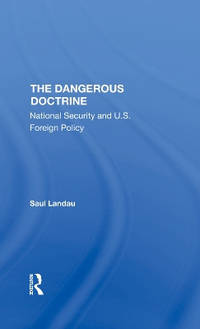
rif. A9780367306601Paperback / softback. New. In The Dangerous Doctrine Saul Landau reviews the history of national security doctrine from Truman's declaration that national security was at stake in Iran Greece and Turkey and the subsequent use of the words national security by government officials to explain justify or excuse executive actions that were dubious or illegal. paperback
rif. A9780367291143Hardback. New. In The Dangerous Doctrine Saul Landau reviews the history of national security doctrine from Truman's declaration that national security was at stake in Iran Greece and Turkey and the subsequent use of the words national security by government officials to explain justify or excuse executive actions that were dubious or illegal. hardcover
1946rif. 55084London: John Lehmann 1946. First printing. Near fine in a very good plus jacket. First UK edition of Bellow's acclaimed first book the beginning of an auspicious career that culminated in the National Book Award Pulitzer and Nobel Prizes among numerous other accolades. Fellow Nobel winner J.M. Coetzee wrote of THE DANGLING MAN: "in it can be discerned the lonely humiliated clerks of Gogol and Dostoevsky brooding upon revenge; the Roquentin of Sartre's NAUSEA the scholar who undergoes a strange metaphysical experience that estranges him from the world; and the lonely young poet of Rilke's NOTEBOOKS OF MALTE LAURIDS BRIGGE." An important debut. 7.25'' x 4.75''. Original full yellow cloth. In original unclipped 8s. 6d. pictorial jacket designed by Robert Medley. 192 pages. Jacket spine toned some rubbing and soiling to rear panel. Book has tiny lean a few small bumps. Overall bright and sound. John Lehmann unknown
1944rif. 55082New York: The Vanguard Press 1944. First printing. Very good plus in a very good plus jacket. First edition of Bellow's acclaimed first book the beginning of an auspicious career that culminated in the National Book Award Pulitzer and Nobel Prizes among numerous other accolades. Fellow Nobel winner J.M. Coetzee wrote of THE DANGLING MAN: "in it can be discerned the lonely humiliated clerks of Gogol and Dostoevsky brooding upon revenge; the Roquentin of Sartre's NAUSEA the scholar who undergoes a strange metaphysical experience that estranges him from the world; and the lonely young poet of Rilke's NOTEBOOKS OF MALTE LAURIDS BRIGGE." A nice copy of an important debut. 8'' x 4.75''. Original beige full cloth with red titles. In original unclipped $2.50 jacket. 192 pages. Spine moderately sunned; minor edgewear and rubbing. Book has slight lean. Some offsetting to endpapers. Else clean and sound. The Vanguard Press unknown
1944rif. B01083New York: The Vanguard Press 1944. First Edition. 191pp. Hardcover: NEAR FINE. Dust Wrapper: VERY GOOD. Hardcover has minor staining on pastedowns and flyleaf which also has a pencil marking. Wrapper shows slight fading and creasing; a few minor chips around edges. A nice copy. The Nobel Prize-winning author's first novel which documents a man's psychological reaction to his inactivity while war rages around him and his uneasy insights into the nature of freedom and choice. Expecting to be inducted into the army Joseph has given up his job and has carefully prepared for his departure to the battlefront. When his induction is delayed he finds himself facing a year of idleness. "One of the most honest pieces of testimony on the psychology of a whole generation who have grown up during the Depression and the war" Edmund Wilson The New Yorker. Vanguard Press hardcover
rif. 045104231X.Gmass_market. Good. Access codes and supplements are not guaranteed with used items. May be an ex-library book. unknown
rif. 0452252512.Gpaperback. Good. Access codes and supplements are not guaranteed with used items. May be an ex-library book. paperback
1944rif. 137390New York: The Vanguard Press 1944. First Edition. First Edition. The author's first book with a price of $2.50 at the bottom of the jacket front flap as called for. Near Fine in a bright about Near Fine dust jacket with a lovely deep brown topstain. Backstrip and jacket spine panel both very slightly sunned with some minor wear at the spine ends. A very attractive copy overall. Hanna 308. The Vanguard Press unknown
1946rif. 55084London: John Lehmann 1946. First printing. Near fine in a very good plus jacket. First UK edition of Bellow's acclaimed first book the beginning of an auspicious career that culminated in the National Book Award Pulitzer and Nobel Prizes among numerous other accolades. Fellow Nobel winner J.M. Coetzee wrote of THE DANGLING MAN: "in it can be discerned the lonely humiliated clerks of Gogol and Dostoevsky brooding upon revenge; the Roquentin of Sartre's NAUSEA the scholar who undergoes a strange metaphysical experience that estranges him from the world; and the lonely young poet of Rilke's NOTEBOOKS OF MALTE LAURIDS BRIGGE." An important debut. 7.25'' x 4.75''. Original full yellow cloth. In original unclipped 8s. 6d. pictorial jacket designed by Robert Medley. 192 pages. Jacket spine toned some rubbing and soiling to rear panel. Book has tiny lean a few small bumps. Overall bright and sound. John Lehmann unknown books
1944rif. 55082New York: The Vanguard Press 1944. First printing. Very good plus in a very good plus jacket. First edition of Bellow's acclaimed first book the beginning of an auspicious career that culminated in the National Book Award Pulitzer and Nobel Prizes among numerous other accolades. Fellow Nobel winner J.M. Coetzee wrote of THE DANGLING MAN: "in it can be discerned the lonely humiliated clerks of Gogol and Dostoevsky brooding upon revenge; the Roquentin of Sartre's NAUSEA the scholar who undergoes a strange metaphysical experience that estranges him from the world; and the lonely young poet of Rilke's NOTEBOOKS OF MALTE LAURIDS BRIGGE." A nice copy of an important debut. 8'' x 4.75''. Original beige full cloth with red titles. In original unclipped $2.50 jacket. 192 pages. Spine moderately sunned; minor edgewear and rubbing. Book has slight lean. Some offsetting to endpapers. Else clean and sound. The Vanguard Press unknown books
1944rif. 137390New York: The Vanguard Press 1944. First Edition. First Edition. The author's first book with a price of $2.50 at the bottom of the jacket front flap as called for. Near Fine in a bright about Near Fine dust jacket with a lovely deep brown topstain. Backstrip and jacket spine panel both very slightly sunned with some minor wear at the spine ends. A very attractive copy overall. Hanna 308. The Vanguard Press unknown books
1948rif. 140733Culver City CA: Columbia Pictures 1948. Vintage double weight still photograph from the 1948 film. Photographer's rubber stamp and mimeograph snipe to the verso. Featuring an image of Lee J. Cobb and William Holden at a chess board. A psychopathic killer takes a young psychoanalyst and his family hostage never expecting that the psychoanalyst would cure him of his murderous urges. 8 x 10 inches. Fine condition. Grant US. Selby US Canon. Silver and Ward Classic Noir. Spicer US. Columbia Pictures unknown
1948rif. 140733Culver City CA: Columbia Pictures 1948. Vintage double weight still photograph from the 1948 film. Photographer's rubber stamp and mimeograph snipe to the verso. Featuring an image of Lee J. Cobb and William Holden at a chess board. A psychopathic killer takes a young psychoanalyst and his family hostage never expecting that the psychoanalyst would cure him of his murderous urges. 8 x 10 inches. Fine condition. Grant US. Selby US Canon. Silver and Ward Classic Noir. Spicer US. Columbia Pictures unknown books