31 841 résultats
1876réf. 53982Philadelphia: Collins printer 1876. First edition 8vo pp. 22 2; removed from stabbed binding; very good. Based on the imperfect and incomplete list issued in the Royal Society of London's Catalogue of Scientific Papers. Lea 1792-1886 was an American conchologist geologist and publisher Carey & Lea Lea & Blanchard. Collins, printer unknown
1876réf. 53982Philadelphia: Collins printer 1876. First edition 8vo pp. 22 2; removed from stabbed binding; very good. Based on the imperfect and incomplete list issued in the Royal Society of London's Catalogue of Scientific Papers. Lea 1792-1886 was an American conchologist geologist and publisher Carey & Lea Lea & Blanchard. Collins, printer unknown books
réf. 202002343Paris, NRF Gallimard - du monde entier, 1959 ; in-12, 282 pp., br. Traduit du russe avec une introduction par Maurice Parijanine.
réf. 201206448London, Frederick Warne and co Redford street, covent garden, 1866 ; in-12, 420-540-540 pp., cartonnage de l'éditeur. Les 3 volumes. Bon état - (un angle de reliure 1er vol (mors inférieur abimé) complet en 3 volumes - a new édition.
1980réf. _202302742S. l. (Paris), Éditions Stock, 1980 ; in-8, 304 pp., broché. Bibliothèque cosmopolite. Traduit de l'américain par Gilles Chahine, avec la collaboration de Marie-Pierre Castelnau.
réf. 202004094Paris, Classique hachette, 1956 ; in-8, 367 pp., br.
réf. 201605341Paris, Le cabinet cosmopolite stock, 1978 ; in-8, 372 pp., br.
1991réf. 202203606Paris, Éditions Stock, 1991 ; in-8, 249 pp., broché. Le Cabinet cosmopolite. Traduction de l'anglais par Marie-Pierre Bay. Isaac Baashevis Singer est un auteur d'origine juive polonaise. Il est naturalisé Américain et décède à Miami, en Floride. Il écrit en yiddisch et obtient le Prix Nobel, en 1978. Ce roman est une parabole de l'expression : l'homme est un loup pour l'homme. Très bon état.
réf. 200802323Paris, Denoel - empreinte, 1991 ; in-8, 256 pp., broché. Roman - traduit de l'anglais par Marie- Pierre Bay.
réf. 200701228Paris, Denoel - empreinte, 1991 ; in-8, 256 pp., broché. Roman - traduit de l'anglais par Marie- Pierre Bay.
1979réf. _202302743Paris, Éditions Stock, 1979 ; in-8, 392 pp., broché. Collection «Nouveau Cabinet Cosmopolite», dirigé par André Bay. Traduit de l’anglais par Marie-Pierre Castelnau-Bay et Jacqueline Chnéour.
réf. 201300724Paris, Nouveau cabinet cosmopolite - Stock, 1994 ; in-8, 385 pp., br. Broché bon état (dos un peu passé).
réf. 201216059Paris, Stock - nouveau cabinet cosmopolite, 1979 ; in-8, 395 pp., broché, couverture illustr. TEXTE INTÉGRAL - broché bon état bruni.
1913réf. 12450New York: Isaac Markens 1913. FIRST EDITION. Original printed heavy wrappers with red string tie wrappers soiled with a couple tiny tears. First edition number 100 of 100 inscribed by Markens. A complete review of Lincoln's Gettysburg Address written on the occasion of the fiftieth anniversary of its delivery. Monaghan 2096. Isaac Markens unknown
1913réf. 12450New York: Isaac Markens 1913. FIRST EDITION. Original printed heavy wrappers with red string tie wrappers soiled with a couple tiny tears. First edition number 100 of 100 inscribed by Markens. A complete review of Lincoln's Gettysburg Address written on the occasion of the fiftieth anniversary of its delivery. Monaghan 2096. Isaac Markens unknown books
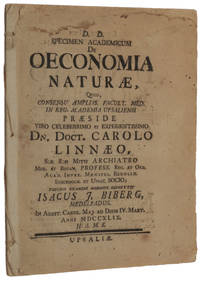
1749réf. 5245Uppsala: np 1749. First edition. First edition extremely rare. "This essay was the first sketch of a science of ecology. Linnaeus used his economy-of-nature concept as an organising principle to unify an important but previously amorphous part of natural history. In so doing he was also attempting to transform an important background concept into the central theory of a new science" Egerton. "In regard to Linnaeus' concepts of an economy of nature Darwin used these ideas as major explanations of the workings of natural selection. So Linnaeus supplied major assistance for Darwin's arriving at his theory of evolution" Stauffer. . THE BIRTH OF THE SCIENCE OF ECOLOGY. First edition extremely rare of Linnaeus' pioneer dissertation which created the science of ecology. "This essay was the first sketch of a science of ecology. Linnaeus used his economy-of-nature concept as an organising principle to unify an important but previously amorphous part of natural history. In so doing he was also attempting to transform an important background concept into the central theory of a new science . The term 'economy of nature' bore an obvious similarity to the contemporary term for animal physiology 'animal economy' which involved studying how the parts contributed to the functioning of the whole. Linnaeus may indeed have had in mind an analogy between the organs in an animal and the species in a habitat because his analysis of the interrelations between the plants and animals in nature implied a close and well-defined interaction for the good of the whole: 'To perpetuate the established course of nature in a continued series the divine wisdom has thought fit that all living creatures should constantly be employed in producing individuals that all natural things should contribute and lend a helping hand towards preserving every species and lastly that the death and destruction of one thing should always be subservient to the restitution of another' . The Oeconomia naturae begins with the above-quoted definition and then explains how that concept can be used to interpret phenomena in inanimate nature and in the plant and animal kingdoms. For both the plant and animal kingdoms Linnaeus considered propagation preservation and destruction as the phenomena which maintained the economy of nature" Egerton p. 335. "The phrase 'Oeconomy of Nature' "should be familiar to readers of Darwin for he claims in the Origin p. 102 that 'all organic beings are striving it may be said to seize on each place in the economy of nature.' When the word 'economy' appears in Darwin's texts there is a tendency to look to political economy for precursors . but concepts like the animal economy and the economy of nature debatably belonged to intellectual lineages that were relatively independent of their social and political context . I will argue that Darwin's idea of a place in the economy of nature stems from the work of previous naturalists like Carl Linnaeus and Charles Lyell and that it played a key role in the development of his evolutionary ideas. . Darwin read translations of Linnaeus' dissertations Oeconomia naturae 1749 and Politia naturae 1760 in May 1841. Although the phrase 'economy of nature' appears only once in Darwin's notebooks of the late 1830s it can be found throughout his first sketches on transmutation in 1842 and 1844. Given this chronology it is likely that the idea came to play a greater role in Darwin's work because of his encounter with these Linnaean texts" Pearce pp. 494-6. The dissertation was dictated by Linnaeus in Swedish to Isaac Biberg a doctoral candidate who translated it into Latin and defended it according to the academic custom of the eighteenth century. ABPC/RBH lists no copy in the last 80 years. OCLC lists 5 copies in US Madison Wisconsin; Kansas; Harry Ransom Texas; Minnesota; Huntington. "Like most naturalists of his time Linnaeus was trained in medicine and thus would have been familiar with the term 'oeconomia animalis' as employed by Charleton Hermann Boerhaave and others. However Linnaeus set his sights higher - what he wanted to describe was not the animal economy but the economy of nature as a whole. Of course others had used the term 'economy of nature' e.g. Sir Kenelm Digby in a variety of works but only as a brief metaphor. For example Digby writes in 1644 that natural motion 'hath its birth from the universall oeconomy of nature here among us.' What Linnaeus did instead was extend the physiological idea of the animal economy to nature in its entirety. In his eyes the economy of nature deserved a description just as detailed and rational as that of the animal economy. "In the dissertation 'Oeconomia Naturae' defended by his student Isaac Biberg in 1749 Linnaeus defines his title as follows: 'By the oeconomy of nature we understand the all-wise disposition of the creator in relation to natural things by which they are fitted to produce general ends and reciprocal uses.' The 'reciprocal uses' are the key to the whole idea for 'the death and destruction of one thing should always be subservient to the restitution of another;' thus mould spurs the decay of dead plants to nourish the soil and the earth then 'offers again to plants from its bosom what it has received from them.' Linnaeus points out that natural processes always follow a certain order with each stage dependent on the previous. A fallen tree for instance does not go to waste but is colonized and eliminated by an ordered series of creatures: liverworts mushrooms beetles caterpillars and woodpeckers. Just as the respiratory cardiovascular lymphatic and digestive systems play different functional roles in the economy of the human body different species play different functional roles in the economy of nature as a whole. For example each kind of insect lays its eggs on a particular kind of plant: '. every different tribe chooses its own species of plant. Nay there is scarce any plant which does not afford nourishment to some insect; and still more there is scarcely any part of a plant which is not preferred by some of them. Thus one insect feeds upon the flower; another upon the trunk another upon the root; and another upon the leaves.' "Each type of organism therefore according to Linnaeus has its special function in nature's economy. Just as the animal economy ensures the health and well-being of the animal body the economy of nature ensures the health and well-being of the natural world. Linnaeus discusses the many creatures that help cleanse and purify nature's body without which the 'whole earth would be overwhelmed with carcases and stinking bodies.' Thus if a horse dies near a roadway its body will 'be filled with innumerable grubs of carniverous flies by which he is entirely consumed and removed out of the way that he may not become a nuisance to passengers by his poisonous stench.' Likewise specialized aquatic predators like the thornback the hound fish or the conger eel consume fish carcasses near the shore. Linnaeus even suggests an experiment to prove the purifying potential of insects: '. knats lay their eggs in stagnant putrid and stinking waters and the grubs that arise from these eggs clear away all the putrefaction; and this will easily appear if any one will make the experiment by filling two vessels with putrid water leaving the grubs in one and taking them all out of the other. For then he will soon find the water that is full of grubs pure and without any stench while the water that has no grubs will continue stinking.' "Thus for Linnaeus even scavengers and grubs the lowest of all species play an essential role in the economy of nature" Pearce pp. 497-8. "Oeconomia Naturae is both the culmination of a great tradition - that of Christian natural theology and the starting point of a new science the one that Ernst Haeckel named 'ecology' in 1866. In accordance with the natural theology and the 'age of optimism' celebrated in the works of William Derham John Ray Bernhard Nieuwentyt Gottfried von Leibniz and Christian von Wolff Linnaeus defines 'the economy of nature' as the Creator's wise arrangement and deposition of all things according to which they fulfil their purpose for the glory of God and the happiness of Man. "And although individuals perish their roles persist . The roles in Linnaean nature are what today's ecologists call 'niches': a multidimensional 'space' defined by the abilities of the species and their interactions with the environment - their physiology and habitat preferences position in food chains and ecosystem structure. Although the Oeconomia Naturae reads like an ecology textbook it also sparkles with the eroticism of the Baroque. Like a voluptuous painter Linnaeus revels in the splendour of life in its beautiful 'costumes' its sensual appeal and showy extravagance the delightful colours forms and adaptations the impressive devices for preservation survival defence attack sex and propagation mating and pollination the means of dispersal and child-rearing . "Between 1743 and 1776 Linnaeus wrote more than 180 such academic theses. But few achieved the instant success of the Oeconomia Naturae. A Swedish translation was produced within a year. English and German versions soon appeared. It was also reprinted in Latin in the many editions of Linnaeus's Amoenitates academicae published in Amsterdam Leyden Erlangen and Graz through the second half of the eighteenth century. New translations continue to appear today" Hestmark. "Darwin's influence on the history of ecology resulted in the very christening of the science itself by Ernst Haeckel who once explained that 'By ecology we mean the body of knowledge concerning the economy of nature' and who concluded 'in a word ecology is the study of all those complex interrelationships referred to by Darwin as the conditions of the struggle for existence' . "When we come to consider the sources of Darwin's ecological insight the importance of his personal experience is obvious . Besides the influence of Darwin's field observations there was the influence of his reading . The importance for Darwin of Lyell's discussion of the economy of nature and allied topics in his Principles of Geology is very clear . Lyell's references in regard to the economy of nature point directly back to the major earlier source: the writings of Carl Linnaeus. The importance of Linnaeus in the evolution of ecology is very great and it is striking that among the naturalists writing after Linneaus and before Darwin it is the geologist Charles Lyell who shows the clearest grasp of Linnaeus' ideas on the economy of nature and who makes the fullest use of them in his own work . After coming to know in the pages of Lyell's Principles ideas and facts from a number of these Linnaean essays Darwin encountered Linnaeus himself in English translation in May of 1841 . From this year of 1841 on Darwin made increasing use of the phrases 'economy of nature' and 'polity of nature' . "The conventional wisdom is that Darwin overthrew the work of Linnaeus in so far as he replaced the orthodox dogma of fixity of species by his theory of evolution. But in regard to Linnaeus' concepts of an economy of nature Darwin used these ideas as major explanations of the workings of natural selection. So Linnaeus supplied major assistance for Darwin's arriving at his theory of evolution" Stauffer. "In German and Swedish universities in the eighteenth century the serious test of the student was the skill with which he conducted his oral defence of the thesis he presented. His major professor who presided at the disputation was often the author of the thesis to be defended. At Uppsala Linnaeus generally dictated the essays which his students published and paid the printer's bill for. He quite naturally regarded these dissertations as his own work. In a letter to his friend the English naturalist John Ellis he wrote: 'The fourth volume of my Amoenitates Academicae is very nearly printed . Among the dissertations I am about to publish are Genera morborum Aer habitabilis Flora Jamaicensis Sus porcus Anthropomorpha & Generatio ambigens. In the last of these I shall show that the brain and spinal marrow only proceed from the mother and the rest of the body from the father.' "Nowadays unless there is direct evidence to the contrary it is customary to regard Linnaeus as the author of all these dissertations" ibid. Soulsby Catalogue of the works of Linnaeus 2nd ed. 1933 1514. Egerton 'Changing concepts of the balance of nature' The Quarterly Review of Biology 48 1973 pp. 322-50. Hestmark 'Oeconomia Naturae L' Nature 405 2000 p. 19. Pearce 'A great complication of circumstances - Darwin and the Economy of Nature' Journal of the History of Biology 43 2010 pp. 493-528. Stauffer 'Ecology in the long manuscript version of Darwin's 'Origin of Species' and Linnaeus' 'Oeconomy of Nature'' Proceedings of the American Philosophical Society 104 1960 pp. 235-41. 4to pp. viii 48 woodcut initials head- and tail-pieces first and last pages tanned spotted water stain to upper edge of the first two leaves. String bound. A very good copy in original state of this extremely rare dissertation. np unknown
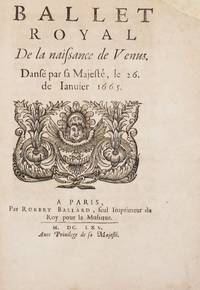
1665réf. 3806A Paris: Par Robert Ballard seul Imprimeur du Roy pour la Musique 1665. First edition. Later green half morocco over marbled paper boards spine lettered in gilt. Italian provenance: early manuscript ownership inscription on the first leaf dated 30 Genn.o 1665 30 January 1665 partly torn and restored; later engraved armorial bookplate on the inner front panel. Paper tanned as usual; early folds and handling marks; otherwise clean and well preserved. First edition. Later green half morocco over marbled paper boards spine lettered in gilt. 52 2 p. Scarce first edition of the libretto of Lully's Naissance de Vénus a key work in the development of the French court-ballet tradition in a copy preserving a contemporary inscription dated only days after the premiere. First edition printed for the premiere of the libretto for the court ballet performed on 26 January 1665 at the Palais-Royal. The text was written by Isaac de Benserade and the music composed principally by Jean-Baptiste Lully at the request of Louis XIV and in honour of the king's sister-in-law Henrietta of England who appeared in the performance as Venus. The copy preserves an early Italian inscription dated 30 January 1665 only four days after the premiere suggesting that it may have been received in connection with the performance possibly by someone present at the court spectacle. The ballet belongs to the tradition of the French ballet de cour one of the principal ceremonial theatrical forms cultivated at the court of Louis XIV. The libretto presents a large mythological spectacle in two parts comprising twelve entrées. Conceived on an exceptional scale the production involved 96 performers representing 106 roles accompanied by 20 musicians and 14 singers with Louis XIV himself appearing in the final scene as Alexander the Great. Printed libretti of this type formed part of the broader genre of festival books ephemeral publications describing royal festivities and spectacles staged for political and ceremonial display. The present libretto is accordingly included in the Oxford "Early Modern Festival Books" collection which documents printed accounts of court celebrations and theatrical spectacles across Europe. A rare printed witness preserving a contemporary inscription to one of the most elaborate court ballets of Louis XIV's reign and an important document of early French operatic culture marking the culmination of the ballet tradition from which Lully would soon develop the tragédie en musique. LWV 27 . Par Robert Ballard, seul Imprimeur du Roy pour la Musique unknown
2002réf. 875802002 Lyon, Editions BGA Permezel, 2002, fort volue grand in 8° broché, 596 pages ; couverture illustrée.
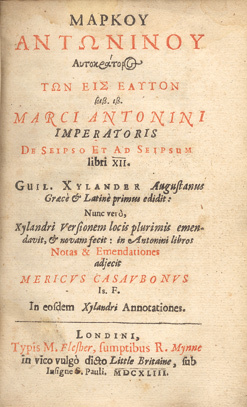
1643réf. 6506London, Flesher, R. Mynne, 1643 ; petit in-8 ; plein veau glacé havane, dos à nerfs richement décoré et doré, titre doré, double filet doré d'encadrement des plats avec au centre les armes de Louis-Urbain Le Fevre, seigneur de Caumartin, marquis de Saint-Ange, comte de Moret (OHR, 651), roulette sur les coupes (reliure fin du XVIIe - déb. XVIIIe) ; (56), 343, (1 bl.), 148, (4) pp. (bien complet du feuillet blanc qui suit le feuillet de titre).
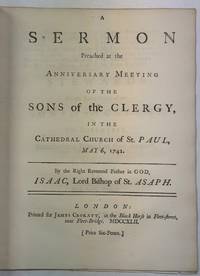
1742réf. 42431London: Printed for James Crokatt at the Black Horse in Fleet-street near Fleet-Bridge 1742. 4to. 6 14 pp as issued with the half title. Disbound else Very Good. Help the Widows and "the poor destitute children" of deceased ministers. Our Church is "so opposite to that seducing Spirit which forbids to marry" i.e. Roman Catholics. ESTC T47575. Printed for James Crokatt, at the Black Horse in Fleet-street, near Fleet-Bridge unknown
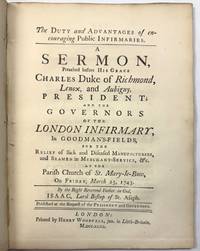
1743réf. 41756London: Printed by Henry Woodfall jun. in Little-Britain 1743. 4to. 4 36 pp as issued with the half title. Disbound else Very Good. This is one of seven 1743 printings all by Woodfall at London and each with slightly different imprint. ESTC calls ours and three others the second edition. ESTC locates copies only at the University of Cambridge and UCLA. Pages 25-36 present a detailed account of the London Infirmary including patient accounts donors and governors. Maddox's text elaborates on Psalm xli: "Blessed is the man that provideth for the sick and needy. . ." Wikipedia's entry for Maddox notes his interest in promoting medical care and other charitable endeavors. ESTC N9048 2. Printed by Henry Woodfall, jun. in Little-Britain unknown
1742réf. 42431London: Printed for James Crokatt at the Black Horse in Fleet-street near Fleet-Bridge 1742. 4to. 6 14 pp as issued with the half title. Disbound else Very Good. Help the Widows and "the poor destitute children" of deceased ministers. Our Church is "so opposite to that seducing Spirit which forbids to marry" i.e. Roman Catholics. ESTC T47575. Printed for James Crokatt, at the Black Horse in Fleet-street, near Fleet-Bridge unknown books
1743réf. 41756London: Printed by Henry Woodfall jun. in Little-Britain 1743. 4to. 4 36 pp as issued with the half title. Disbound else Very Good. This is one of seven 1743 printings all by Woodfall at London and each with slightly different imprint. ESTC calls ours and three others the second edition. ESTC locates copies only at the University of Cambridge and UCLA. Pages 25-36 present a detailed account of the London Infirmary including patient accounts donors and governors. Maddox's text elaborates on Psalm xli: "Blessed is the man that provideth for the sick and needy. . ." Wikipedia's entry for Maddox notes his interest in promoting medical care and other charitable endeavors. ESTC N9048 2. Printed by Henry Woodfall, jun. in Little-Britain unknown books
1834réf. 25246Baltimore: Sands & Neilson 1834. 30 1 1 blank pp. Stitched untrimmed and partly uncut. Last two leaves foxed. Else Very Good with the ink ownership signature of 'Hon. Nathaniel Silsbee' a Massachusetts Whig who when this pamphlet was printed was a United States Senator. A rare pamphlet criticizing McKim a Baltimore Jacksonian Congressman for rejecting his constituents' instructions that he oppose Jackson's removal of the federal deposits from the Bank of the United States. McKim refused on the ground that about half the names of the alleged constituents did not appear on the rolls of qualified voters. R.D. Milholland Matthew Kelly George Thomae Aaron Clapp and Alexan. Kirkland representatives of each of the five wards in McKim's district angrily rebut McKim's assertion. They present a 20-page "List of Signers to the instructions to the Hon. Isaac McKim whose names are found on the poll-books of the first five wards of the city of Baltimore"; a List of Signers to the Instructions whose names were rejected by McKim although they were in fact legal and qualified voters; and another list of 205 names voters who would have signed the instructions but had been unable to do so in timely fashion. OCLC records copies of this pamphlet only at the Boston Athenaeum and Temple University. American Imprints adds the Boston Public Library and the Peabody Institute in Baltimore. AI 22849 2. OCLC 66290907 2 as of April 2020. Not in Sabin Eberstadt Decker. Sands & Neilson unknown
1834réf. 25246Baltimore: Sands & Neilson 1834. 30 1 1 blank pp. Stitched untrimmed and partly uncut. Last two leaves foxed. Else Very Good with the ink ownership signature of 'Hon. Nathaniel Silsbee' a Massachusetts Whig who when this pamphlet was printed was a United States Senator. A rare pamphlet criticizing McKim a Baltimore Jacksonian Congressman for rejecting his constituents' instructions that he oppose Jackson's removal of the federal deposits from the Bank of the United States. McKim refused on the ground that about half the names of the alleged constituents did not appear on the rolls of qualified voters. R.D. Milholland Matthew Kelly George Thomae Aaron Clapp and Alexan. Kirkland representatives of each of the five wards in McKim's district angrily rebut McKim's assertion. They present a 20-page "List of Signers to the instructions to the Hon. Isaac McKim whose names are found on the poll-books of the first five wards of the city of Baltimore"; a List of Signers to the Instructions whose names were rejected by McKim although they were in fact legal and qualified voters; and another list of 205 names voters who would have signed the instructions but had been unable to do so in timely fashion. OCLC records copies of this pamphlet only at the Boston Athenaeum and Temple University. American Imprints adds the Boston Public Library and the Peabody Institute in Baltimore. AI 22849 2. OCLC 66290907 2 as of April 2020. Not in Sabin Eberstadt Decker. Sands & Neilson unknown books