BIGELOW, HENRY JACOBBiblio.com
56 310 résultats
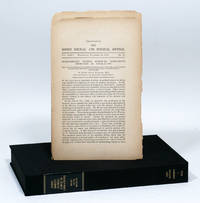
1847réf. 2758Boston 1847. 1st Edition. Original Wrappers. Very Good. FIRST EDITION OFFPRINT of the first announcement of the successful use of anesthesia during surgical operations one of the greatest discoveries of nineteenth-century medicine. A visitor to Boston Massachusetts would be well advised to take a stroll to the Ether Dome at Massachusetts General Hospital to see the amphitheater where surgery without pain began. On October 16 1846 dentist William T.G. Morton publicly performed a painless surgery through the use of general anesthesia thereby transforming surgical medicine and marking one of the greatest advances in medicine one that not only liberated patients from pain but enabled surgeons to perform more extensive operations. Offered here is the first edition offprint of the first announcement of Morton's seminal achievement as reported by Henry Jacob Bigelow in the November 18 1846 issue of The Boston Medical and Surgical Journal Vol. XXXV No. 16 pp. 309-316. Interestingly the offprint omits the last seven paragraphs from the journal article critical of the patent-holders: Drs. Morton and Charles T. Jackson. The redacted paragraphs likely indicates the offprint was issued shortly after the journal. Offprint from: The Boston Medical and Surgical Journal vol. XXXV No. 16. 8 pages. As issued without wrappers. Paper uniformly toned. First and last leaves detached from stitching. Small closed tear in margin of last leaf edges rough. Presented in a handsome custom box. RARE. unknown
1847réf. 2758Boston 1847. 1st Edition. Original Wrappers. Very Good. FIRST EDITION OFFPRINT of the first announcement of the successful use of anesthesia during surgical operations one of the greatest discoveries of nineteenth-century medicine. A visitor to Boston Massachusetts would be well advised to take a stroll to the Ether Dome at Massachusetts General Hospital to see the amphitheater where surgery without pain began. On October 16 1846 dentist William T.G. Morton publicly performed a painless surgery through the use of general anesthesia thereby transforming surgical medicine and marking one of the greatest advances in medicine one that not only liberated patients from pain but enabled surgeons to perform more extensive operations. Offered here is the first edition offprint of the first announcement of Morton's seminal achievement as reported by Henry Jacob Bigelow in the November 18 1846 issue of The Boston Medical and Surgical Journal Vol. XXXV No. 16 pp. 309-316. Interestingly the offprint omits the last seven paragraphs from the journal article critical of the patent-holders: Drs. Morton and Charles T. Jackson. The redacted paragraphs likely indicates the offprint was issued shortly after the journal. Offprint from: The Boston Medical and Surgical Journal vol. XXXV No. 16. 8 pages. As issued without wrappers. Paper uniformly toned. First and last leaves detached from stitching. Small closed tear in margin of last leaf edges rough. Presented in a handsome custom box. RARE. unknown books
1580réf. 1011220071Georg Rabe for Sigismund Feyerabend 1580 1580. Hardcover. Good. Quarto. Reprint of 2nd edition of 1559. Bound contemporary vellum. Front stamped "AVB" and "1587." Numerous woodcut illustrations. 6 100 leaves; lacks A3 with large woodcut of childbirth scene on recto repeated on G4v. Restored binding. Cracking and chip loss to vellum boards. Some foxing. Stains to margins. Extensive early notation and marginalia. Three small worming holes in blank outer margins throughout do not affect text or engravings. Opening leaves frayed restored along edges. Front free endpaper lacking. Lawrence I. Feinberg copy. Adams R 868; Hellman Early Obstetrical Books 31; Waller 8302; VD16 R3583; Durling 3982; vgl. Garrison-Morton 6141; Hagelin Womans Booke 19; Bird 2101 Georg Rabe for Sigismund Feyerabend, 1580 hardcover
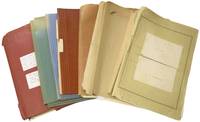
réf. 745931920s-1960s. Author's archive A series of nine manila folders containing writings photographs and elements of publishing history from Jacob's career. Folders are as follows: I Tan folder 34 x 25cm containing typed drafts of Jacob's post-WWII articles on Italy which she compiled after moving from her English wartime residence back to her permanent home in Lake Garda. With pieces on recreational subjects such as Italian cookery travel and topography but also more political topics such as life after the war and Italy's relationship with other countries. II Beige folder 35 x 25cm containing a list of eligible British magazines for Jacob send material to compiled by either her or her editor. Following are numerous copies of a letter dated 1946/1947 asking each of these publications whether they would consider taking Jacob's articles on Italy 'in view of the importance of the present and future relationship between England and this country.' Stapled to these copies are the magazines' responses which is frequently a 'no' due to limited space and shortage of paper. Many would only consider apolitical work on subjects such as Italian cookery/gardening. A fascinating glimpse into the lasting effects of war. III Beige folder titled 'B.B.C. Book Me - Philosophically' 34 x 24cm containing typed drafts of chapters for a book Jacob was writing based on some talks she did for the BBC about her opinions on the human condition. With chapter headings such as 'Gossip' 'Growing Old' 'Education' and 'Difficult Days' many inked annotations penned by either Jacob or her editor. IV Light beige folder titled 'Raccoglitore Benaco' 34 x 24cm containing more typed drafts of chapters for 'Me - Philosophically.' With topics such as 'Being Ill' 'Clothes' and 'Children.' Copious inked notes from Jacob or her editor. 'Me - Philosophically' is not listed in Jacob's bibliography so it was either unfinished or its title was changed. V Beige folder with pink pencil to front 35 x 23cm containing other miscellaneous work from Jacob. Includes drafts of blurbs for her novels an advertisement for Foyles' Book Club she wrote at the behest of Christina Foyle and a eulogy for fellow queer poet Radclyffe Hall. VI Red folder 35 x 26cm containing British and Italian theatre memorabilia including a Teatro Reale dell'Opera programme from 1938-1939 and some British theatrical programs circa 1920s when Jacob was regularly acting onstage. Also includes the typescript of her one-act play 'The Ace' and an Italian house-plan. VII Green folder 36 x 28cm containing personal photographs of Jacob and her friends/family/pets as well as numerous copies of a portrait picture used for her author photo in various books. VIII Blue folder 33 x 27cm containing clippings of a few of Jacob's published magazine articles. Includes an Italian travel article a short story for the Daily Sketch a piece for the Evening Standard's 'Did it Happen' series and a critical discussion of Jacob in Lilliput Magazine. IX Russet folder 33 x 27cm posthumous material relating to Jacob including various newspaper obituaries and bank statements dated shortly before her death on August 27 1964. X Loose pen and ink illustration of the Unicorn Hotel Ripon which used to be owned by Jacob's grandfather Robert Ellington Collinson he was also mayor. The drawing is by Yorkshire artist George Jackson. Moderate edgewear and sunning to folders some minor ageing and edgewear to contents but largely fine. Naomi Jacob was a popular novelist columnist actor and socialite of her day. Born in Ripon Yorkshire she began her career as a teacher but soon pivoted to acting starring in both plays and films. She wrote many of her novels whilst living in Sirmione Lake Garda the warm clime a necessity for her lifelong battle with tuberculosis. She was also a suffragette a socialist and queer - delightfully ahead of her time. 1920s-1960s unknown
1691réf. 41859Leipzig, Grosse & Gleditsch, 1691. 4to. Contemp. full vellum. Faint handwritten title on spine. a small stamp on titlepage. In: ""Acta Eruditorum Anno MDCLXXXXI"". Leibniz' papers: pp.277-281 a. 1 plate, pp. 435-439. Johann Bernoulli: pp. 274-276 a. 1 plate. Huygens: pp. 281-282. - Jacob Bernoulli: pp. 282-290 a. 1 plate. Entire volume: (8), 590, (6) pp. and 13 (of 15) folded engraved plates - the two plates lacking are the first two of the volume and do not belong to the papers listed.
1757réf. 51848Amsterdam, Petrus Schenk, 1757-74. Large folio. (55 x 34,5 cm.). A large uncut copy in contemp. marbled boards, spine gone and later backed with buckram, original corners in leather a bit bumped. Stamps on foot of first title-page. Halftitel, title-pages in red/black with engraved vignettes. (2),2 engraved leafs with dedications, 14"(2),8 pp. and 25 + 24 large double-page or triple-page folded engraved plates + 6 additional plates (only sometimes present). With a total of 55 plates. On thick, heavy paper, wide-margined and internally fine and clean.
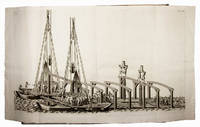
1757réf. 51848Amsterdam Petrus Schenk 1757-74. Large folio. 55 x 345 cm. A large uncut copy in contemp. marbled boards spine gone and later backed with buckram original corners in leather a bit bumped. Stamps on foot of first title-page. Halftitel title-pages in red/black with engraved vignettes. 22 engraved leafs with dedications 14;28 pp. and 25 24 large double-page or triple-page folded engraved plates 6 additional plates only sometimes present. With a total of 55 plates. On thick heavy paper wide-margined and internally fine and clean. Second edition. "Tileman van der Horst and Jan Schenk produced the Theatrum Machinarium Univesale one of the most celebrated works on the construction of all those elements so necessary to keeping life dry in Amsterdam the place of the book’s publication. It was perhaps the most important work then produced on dikes sluices dams weirs canals and swing-bridges the very elements of existence in Holland. Jan Schenck was the engraver of this work which may also be the most accurate and the most sumptuously illustrated book of its type in Holland in the 18th century - the technical aspects of the rendering was just superb." - Brunet V1082 - Graesse VII 258. hardcover
1691réf. 41859Leipzig Grosse & Gleditsch 1691. 4to. Contemp. full vellum. Faint handwritten title on spine. a small stamp on titlepage. In: "Acta Eruditorum Anno MDCLXXXXI". Leibniz' papers: pp.277-281 a. 1 plate pp. 435-439. Johann Bernoulli: pp. 274-276 a. 1 plate. Huygens: pp. 281-282. - Jacob Bernoulli: pp. 282-290 a. 1 plate. Entire volume: 8 590 6 pp. and 13 of 15 folded engraved plates - the two plates lacking are the first two of the volume and do not belong to the papers listed. First appearance of all five papers all being of extreme importance in the development of the Calculus. Leibniz' two papers on the catenary curve paper 1-2 offered here were written at the instigation of Jacques Bernoulli. Following the example of Blaise Pascal who had initiated in 1658 a contest for the construction of the cycloid Leibniz also provoked the geometers of his time by challenging them to submit at the fixed date of mid-1691 their geometric method for the construction of the catenary curve. Leibniz later provided the answer followed by Johann Bernoulli and Huygens.'These two papers are a historical account of the origin of the study of this transcendental curve and at the same time the first physical-geometric construction showing the species-relationship between the catenary and the logarithmic curves as two companion curves; one arithmetic the other geometric. All of the differentials of the catenary curve are arithmetic means of corresponding differentials of the logarithmic curve; and all of the differentials of the logarithmic curve are geometric means of the catenary.'"The Catenary is the form of a hanging fully flexible rope or chain the name comes from "catena" which means 'chain' suspended on two points. The interest in this curve originated with Galileo who thought that is was a parabola. Young Christiaan Huygens proved in 1646 that this cannot be the case. What the actual form was remained an open question till 1691 when Leibniz Johann Bernoulli and the then much older Huygens sent solutions to the problem to the "Acta" Jakob Bernoulli 1690 Johann Bernoulli 1691 Huygens 1691 and Leibniz 1691 - these 4 1691-papers offered here - in which the previous year Jakob Bernoulli had challenged mathematicians to solve it. As published the solutions did not reveal the methods but through later publications of manuscripts these methods have been known. Huygens applied with great paper 4 virtuosity the by then classical methods of 17th century infinitesimal mathematics and he needed all his ingenuity to reach a satisfactory solution. Leibniz the papers 1-2 and Bernoulli paper 3 applying the new Calculus found the solutions in a much direct way. In fact the catenary was a test-case between the old and the new style in the study of curves and only because the champion of the old style was a giant like Huygens the test-case can formally be considered as ending in a draw." Grattan-Guiness in "From the Calculus to Set Theory 1630-1910.".The paper by JACOB BERNOULLI no. 5 offered here is a milestone papers as it marks the invention of the "SYSTEM OF POLAR COORDINATES" with points located by reference to a fixed point and a line through that point. Although newton had earlier also devised such a coordinate system in 1671 his work was not known so that the credit for the discovery generally goes to Bernoulli. Parkinson Breakthroughs 1691.Further papers contained in this volume of Acta Eruditorum:DENYS PAPIN: Mecanicorum de Viribus Motricibus sententia asserta a D. Papino adversius C.G.G. L. Leibniz objectiones. pp. 6-13. The plate lacks. - and Dion. Papini Observationes quaedam circa materias ad Hydraulicam spectantes. Pp. 208-213 a. 1 plate. This importent paper is part of the LEIBNIZ-PAPIN-CONTROVERSY.JACOB BERNOULLI: Specimen Calculi Differentialis in dimensione Parabolæ helicoidis ubi de flexuris curvarum in genere carundem evolutionibus. Pp. 13-22. The plate lacks. - and J.B. Demonstratio Centri Oscillationis ex Natura Vectis reperta occassione eorum quæ super hac materia in Historia Literaria Roterodamensi recensentur articulo.Pp.317-321.LEIBNIZ: O.V.E. Additio ad Schediasma de Medii Resistentia publicatum in Actis mensis Febr. 1889. Pp. 177-178. and O.V.E. Quadratura Arithmetica Communis Sectionum Conicarum quæ centrum babent.Pp. 178-182 a. 1 plate.TSCHIRNHAUS: Singularia Effecta Vitri Caustici bipedalis quod omnia magno sumtu hactenus constructa specula ustoria virtute superat per D.T. Pp. 517-520 hardcover
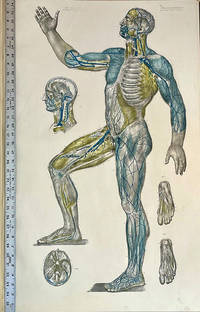
1854réf. 51129Brussels: Comptoir des éditeurs 1854. Bourgery Jean-Baptiste Marc 1797-1849 and Nicolas Henri Jacob 1782-1871. Anatomie élémentaire en vingt planches representant chacune un sujet dans son entier à la proportion de demi-nature . . . Atlas only. Elephant folio. Title-leaf and 20 lithographed plates most hand-colored. Brussels: Meline Cans et Cie; Comptoir des Éditeurs 1854. 888 x 600 mm. 20th-century quarter morocco boards slight wear. A few marginal tears repaired minor dampstaining but very good. Later edition first published in both Paris and Brussels in 1836 of this set of very large anatomical plates that were intended to be mounted on the walls of dissection rooms. All editions are extremely rare-OCLC does not cite any copies of the 1854 edition. This is the only copy of any edition of this work that we have handled in over 50 years of trading. The work was originally accompanied by a small 20-page pamphlet of text that is not present here. The impressive plates in this atlas reproduce the illustrations in Bourgery and Jacob's Traité complet d'anatomie at a much larger scale than their counterparts in the Traité-roughly half life-size. Some plates were lithographed in Paris; others in Brussels. Plates I and II are devoted to osteology and syndesmology; plates III - VIII to myology and aponeurology; plates IX-XIV to angiology; plates XV-XVII to neurology; plates XVIII-XIX to the digestive system; and plate XX to the reproductive organs. The plates were originally sold separately; uncolored versions were priced at 6 francs and colored versions at 12 francs. Currently two uncolored plates from this series are on the market for about $1300. . Comptoir des éditeurs unknown
1854réf. 51129Brussels: Comptoir des éditeurs 1854. Bourgery Jean-Baptiste Marc 1797-1849 and Nicolas Henri Jacob 1782-1871. Anatomie élémentaire en vingt planches representant chacune un sujet dans son entier à la proportion de demi-nature . . . Atlas only. Elephant folio. Title-leaf and 20 lithographed plates most hand-colored. Brussels: Meline Cans et Cie; Comptoir des Éditeurs 1854. 888 x 600 mm. 20th-century quarter morocco boards slight wear. A few marginal tears repaired minor dampstaining but very good. Later edition first published in both Paris and Brussels in 1836 of this set of very large anatomical plates that were intended to be mounted on the walls of dissection rooms. All editions are extremely rare-OCLC does not cite any copies of the 1854 edition. This is the only copy of any edition of this work that we have handled in over 50 years of trading. The work was originally accompanied by a small 20-page pamphlet of text that is not present here. The impressive plates in this atlas reproduce the illustrations in Bourgery and Jacob's Traité complet d'anatomie at a much larger scale than their counterparts in the Traité-roughly half life-size. Some plates were lithographed in Paris; others in Brussels. Plates I and II are devoted to osteology and syndesmology; plates III - VIII to myology and aponeurology; plates IX-XIV to angiology; plates XV-XVII to neurology; plates XVIII-XIX to the digestive system; and plate XX to the reproductive organs. The plates were originally sold separately; uncolored versions were priced at 6 francs and colored versions at 12 francs. Currently two uncolored plates from this series are on the market for about $1300. . Comptoir des éditeurs unknown books
1976réf. 92951Andre Sauret. New. 1976. Hardcover. FREE UPGRADE to Courier/Priority Shipping Upon Request - IN STOCK AND IMMEDIATELY AVAILABLE FOR SHIPMENT - Flawless copy brand new pristine never opened -- Text in French. 166 pages; 97 illustrations including 28 in color. Catalogue Raisonne Catalog Raisonné Complete Works La Vie et L'uvre Oeuvre Raisonnee -- with a bonus offer . Andre Sauret hardcover
réf. 61561Regensburg 1766. 4to. 144 pp. Engraved portrait. 135 handcoloured edgraved plates. Modern calf over wooden boards. Title-page a little soiled. Engraved portrait with minor stain in lower margin. Last leaf a little stained. Latin and German parallel text. . hardcover
1780réf. 150669Ratisbonae 1780. Cm. 30 cc. 156 di 143 di tavole incise in rame ed in fine coloritura coeva. Solida ed elegante legatura di poco posteriore in mezza pelle con punte dorso a nervi con titoli in oro su tassello. Esemplare particolarmente fresco e ben conservato stampato su carta forte. Terza e migliore edizione di quest'affascinante opera di entomologia per opera del naturalista tedesco J.C. Schaeffer il quale collaborò con i massimi scienziati ed entomologi dell'epoca tra cui Linneo e Ferchault de Réaumur. unknown
1756réf. elala1110Paris: l'Imprimerie Royale 1756. 1756. 12mo. pp. viii 275. full modern mottled calf a few scattered stains. First Duodecimo Edition. Published the same year as the first edition in quarto. This is the French reply to an English memorial addressed to the courts of Europe stating their position on the war on the Ohio justifying their actions and setting forth their claims to the region west of the Alleghenies. Accusing the English of unprovoked aggression and foul play the French sought to demonstrate that it was Washington's 'assassination' of Jumonville in the Fort Necessity campaign among other offensive actions which had sparked the war. Most of the text is composed of 'pièces justificatives' comprising documents and letters written between 1749 and 1755 by La Jonquière Governor of New France Albemarle Rouillé General Braddock Contrecoeur Villiers Sir William Johnson George Washington and Robert Stobo an engineer with Washington who had planned Fort Necessity. Among the more important papers are translations of the instructions given to Braddock by the British Crown letters to and from Braddock and Sir William Johnson and various officials two of Johnson's 'harangues' to the Indians and the first printing although in French translation of extracts from the journal kept by George Washington in the 1754 expedition to fortify the forks of the Ohio that ended with the British surrender to the French at Fort Necessity in July 1754 pp. 109-146. This is quite distinct from Washington's first journal of his mission for Governor Dinwiddie late in 1753 printed at Williamsburg in 1754. Most of these British papers were seized by the French following the capitulation at Fort Necessity. An early work on the French and Indian War described by Lawrence Wroth in his John Carter Brown Library report for 1945-46' as "one of the most important documents in American colonial history." Dionne II 548. JCB I 1123. Lande 657. Sabin 47511. TPL 250. Vlach 549. cfHowes M-787 different pag. cfGagnon II 1369 & cfStreeter II 1013 first in 4to. Wroth American Bookshelf p. 22. 1st Edition. Soft cover. Paris: l'Imprimerie Royale, 1756. Paperback
1757réf. A2DFNA01U79OAmsterdam: Petrus Schenk II & son vol. II: Petrus Schenk III 1757. Red half sheepskin blue-grey paper sides ca. 1800. Imperial folio 50 x 34 cm. With 2 title pages in red and black each with the same engraved allegorical device a double-page engraved dedication plate with 2 large cartouches showing the arms of the Beemster polder and of the 9 members of its water authority and 41 double-page and 7 larger folding engraved illustration plates the folding plates numbered as 2 to give plates I-XXV vol. I I-XXIV and I-VI vol. II. Further with 1 woodcut tailpiece and bands of cast fleurons. Second edition of both volumes of a remarkably detailed set of scale construction drawings plans sections elevations perspective views etc. including many detail drawings of individual parts of 18th-century Dutch waterworks with the accompanying letterpress descriptions and notes. It includes locks sluices bridges pumps pile drivers an ice-breaker an elaborate water-bailing mill and more. Most of the plates measure about 45 x 54 cm with the folding ones about 52 x 76 cm. At least most of the plates depict existing works and the text occasionally gives some historical information. The drawings are so detailed and give such a clear picture of how the mechanisms functioned that one could use them to reconstruct the works shown.A fine copy nearly untrimmed with only some false folds in the half-title and an occasional minor defect in the paper. Plate 23 in volume 1 has no number but it may have been trimmed off at the head. The inside front hinge has partly separated from the book-block but the binding is otherwise good. A fine copy of a magnificent display of Dutch hydraulic engineering.l Bierens de Haan 3818.5 & 4839.5 vol. II only with later ed. of vol. I; STCN 2 & 4 copies of the 2 volumes; not in Berlin Kat.; Roberts & Trent Bibl. Mechanica. Petrus Schenk [II] & son (vol. II: Petrus Schenk [III]), unknown
1516réf. 3256Oppenheim Germany 1516. Paper binding. paper cover- 36 pp good condition - https://librarywwuedu/node/17464 unknown
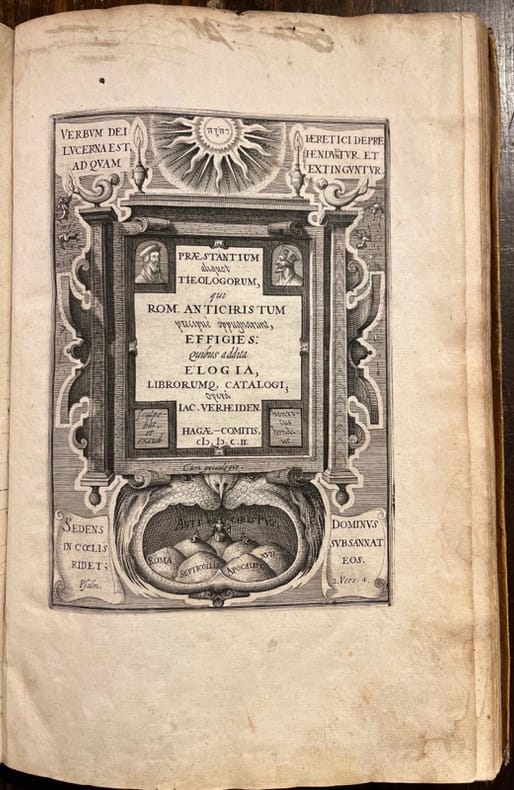
1602réf. 16378Hagae Comitis [La Haye], Ex officina Bucoldi Cornelii Nieulandii, 1602. In-folio de [12]-226 pages [*6; A-Z4;Aa-Cc4; Dd6-Ee3], plein vélin à rabats, étiquette de titre manuscrite (en vélin), traces d'attaches. Ex-libris JFC, inscription ancienne au verso du titre.
1837réf. 1206921837. First Edition. WHEELER Jacob D. A Practical Treatise on the Law of Slavery. Being a Compilation of all the Decisions Made on that Subject in the Several Courts of the United States and State Courts. New York and New Orleans: Allan Pollock Jr. and Benjamin Levy 1837. Octavo modern half brown sheep burgundy morocco spine label. $3600.First edition of this important work on the legal aspects of slavery in the United States one of the earliest digests on the subject.Wheeler's Practical Treatise is one of the earliest digests of virtually all American court decisions on slavery including cases from both the North and South. This book was initially intended for use by slaveholders and other interested parties but it became an important tool of abolitionists who used it for its incidental descriptions of slavery and its attendant cruelty. ""The work bears marks of haste in its preparation but it is a valuable compilation of decisions on practical questions arising under the Law of Slavery in the United States. It will be serviceable to the Profession as a comprehensive digest of authorities on this branch of law and it will afford much instruction to philanthropists and statesmen interested in reconciling the welfare of slaves with the integrity and just operation of Constitutional Law"" Marvin 729. Harvard Law Catalogue 908. Cohen 9883. Work 344. Light to moderate foxing to text a few spots of soiling to edges of text block binding attractive. An extremely good copy. unknown
1837réf. 1206921837. First Edition. WHEELER Jacob D. A Practical Treatise on the Law of Slavery. Being a Compilation of all the Decisions Made on that Subject in the Several Courts of the United States and State Courts. New York and New Orleans: Allan Pollock Jr. and Benjamin Levy 1837. Octavo modern half brown sheep burgundy morocco spine label. $3600.First edition of this important work on the legal aspects of slavery in the United States one of the earliest digests on the subject.Wheeler's Practical Treatise is one of the earliest digests of virtually all American court decisions on slavery including cases from both the North and South. This book was initially intended for use by slaveholders and other interested parties but it became an important tool of abolitionists who used it for its incidental descriptions of slavery and its attendant cruelty. ""The work bears marks of haste in its preparation but it is a valuable compilation of decisions on practical questions arising under the Law of Slavery in the United States. It will be serviceable to the Profession as a comprehensive digest of authorities on this branch of law and it will afford much instruction to philanthropists and statesmen interested in reconciling the welfare of slaves with the integrity and just operation of Constitutional Law"" Marvin 729. Harvard Law Catalogue 908. Cohen 9883. Work 344. Light to moderate foxing to text a few spots of soiling to edges of text block binding attractive. An extremely good copy. unknown books
1712réf. 4343Rome: Francesco Gonzaga 1712. Extremely rare first edition of this luxuriously illustrated anthology of extracts from papal sermons delivered between 1703-09 in Latin prose and facing Italian verse: an unusual example of Baroque ecclesiastical culture from the pontificate of Clement XI. On the basis of extreme rarity and contents the volume numbers among those commemorative and honorific volumes which were never sold in the trade but offered as a ceremonial gift to cardinals ambassadors and other important personagescorroborated by the ownership inscription in the present volume by a monsignor during Clements papacy. The volume is singular in our experience for its contents. Latin extracts of Clements sermons generally rather brief are printed on the left side of the page then freely and somewhat copiously versified in Italian by the poet Guidi. The sparsity of the elegantly printed text leaves positively wasteful margins! Each sermon is preceded by a full-page engraving on the subject of the sermon the Holy Family adoring the Christ Child for Christmas the Resurrection for Easter etc. designed by Pietro Leone Ghezzi one of the principal artists in Clements retinue and engraved by Roman engravers generally also associated with Clementine projects Frey van Westerhout etc. The designs were made expressly for the present volume and are echoed as it were in a series of initials and vignettes devoted to the same theme; as such they must have been engraved for the present volume and not simply taken from the printers stock. If somewhat overshadowed by Maratti in his lifetime and by his epoch-making role as the first professional caricaturist Ghezzi 1674-1755 was nonetheless an important painter of religious subjects who worked on Albanis most prestigious public projects. The surfaces of Ghezzis paintings were considerably less finished than those of Maratti and he seems more receptive to Venetian color and unfinishednessthus showing a different aspect of Albani taste. Ghezzi was commissioned in 1712 the year this book was published to paint The Election of St. Fabian for the Albani Chapel in S. Sebastiano fuori le Mura. Within the next decade he helped paint the frescos the ancient basilica of S. Clemente and the nave decoration of St. John Lateran. His portraits including one of Clement XI are unusually informal and realistic possibly due to Ghezzis experience at caricature. Alessandro Guidi 1650-1712 who translated the sermons was a prolific Arcadian poet. OCLC records a single copy Berkeley and we locate no additional American copies. Large 4to. 28 x 20.5 cm engraved portrait of Clement XI xvi pp. full-page engraving 213 pp. including 5 full-page engravings paginated with text. 18th-c. vellum over boards spine with 5 raised bands and red morocco label gilt-stamped; covers with large blind-tooled central ornament blind-tooled filets and ornaments. Short tears at head and foot of spine and a few nicks there. Early inscription on front pastedown mentions Monsignor Bianchini Prelato Domestico e Camerario segreto di S. Santita Papa Clem. XI. Mild finger-soiling in margins of title and a little foxing on some text leaves but overall a very fine attractive copy. Francesco Gonzaga hardcover
1712réf. 4343Rome: Francesco Gonzaga 1712. Extremely rare first edition of this luxuriously illustrated anthology of extracts from papal sermons delivered between 1703-09 in Latin prose and facing Italian verse: an unusual example of Baroque ecclesiastical culture from the pontificate of Clement XI. On the basis of extreme rarity and contents the volume numbers among those commemorative and honorific volumes which were never sold in the trade but offered as a ceremonial gift to cardinals ambassadors and other important personagescorroborated by the ownership inscription in the present volume by a monsignor during Clements papacy. The volume is singular in our experience for its contents. Latin extracts of Clements sermons generally rather brief are printed on the left side of the page then freely and somewhat copiously versified in Italian by the poet Guidi. The sparsity of the elegantly printed text leaves positively wasteful margins! Each sermon is preceded by a full-page engraving on the subject of the sermon the Holy Family adoring the Christ Child for Christmas the Resurrection for Easter etc. designed by Pietro Leone Ghezzi one of the principal artists in Clements retinue and engraved by Roman engravers generally also associated with Clementine projects Frey van Westerhout etc. The designs were made expressly for the present volume and are echoed as it were in a series of initials and vignettes devoted to the same theme; as such they must have been engraved for the present volume and not simply taken from the printers stock. If somewhat overshadowed by Maratti in his lifetime and by his epoch-making role as the first professional caricaturist Ghezzi 1674-1755 was nonetheless an important painter of religious subjects who worked on Albanis most prestigious public projects. The surfaces of Ghezzis paintings were considerably less finished than those of Maratti and he seems more receptive to Venetian color and unfinishednessthus showing a different aspect of Albani taste. Ghezzi was commissioned in 1712 the year this book was published to paint The Election of St. Fabian for the Albani Chapel in S. Sebastiano fuori le Mura. Within the next decade he helped paint the frescos the ancient basilica of S. Clemente and the nave decoration of St. John Lateran. His portraits including one of Clement XI are unusually informal and realistic possibly due to Ghezzis experience at caricature. Alessandro Guidi 1650-1712 who translated the sermons was a prolific Arcadian poet. OCLC records a single copy Berkeley and we locate no additional American copies. Large 4to. 28 x 20.5 cm engraved portrait of Clement XI xvi pp. full-page engraving 213 pp. including 5 full-page engravings paginated with text. 18th-c. vellum over boards spine with 5 raised bands and red morocco label gilt-stamped; covers with large blind-tooled central ornament blind-tooled filets and ornaments. Short tears at head and foot of spine and a few nicks there. Early inscription on front pastedown mentions Monsignor Bianchini Prelato Domestico e Camerario segreto di S. Santita Papa Clem. XI. Mild finger-soiling in margins of title and a little foxing on some text leaves but overall a very fine attractive copy. Francesco Gonzaga hardcover books
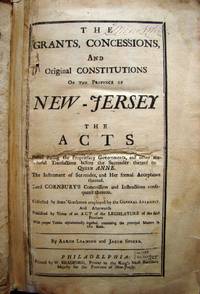
1758réf. 016251Philadelphia: William Bradford 1758. First Edition. Hardcover. Title page with a few repaired tears hinged with following Preface page; two adjoining leaves pages 441-444 of text lacking and supplied with facsimiles. Contents Very Good binding about Fine. Folio 7-1/4" x 11-1/2" bound in contemporary calf leather with a decorative blindstamped border recently rebacked with a new gilt-lettered and decorated spine preserving original paste-downs and free endpapers; 4 763 pages. Title within rule border decorative woodcut head- and tail-pieces. An important compilation of the fundamental New Jersey charters and session laws of the proprietary period 1664 to 1702 up to Lord Cornbury's commission and instructions as Royal Governor when New Jersey became a crown colony under Queen Anne. Publication was ordered by the New Jersey Assembly in 1752 but two years were required to collect the documents to be included while the typesetting and printing took Bradford an additional three. By the date of publication some 170 copies had been subscribed. This title was the largest volume issued from Bradford's press and one of the largest from any eighteenth-century American press. Evans 8205; Sabin 39527. Early owner name on the title page and early twentieth century names on the front pastedown. W[illiam] Bradford hardcover books
réf. 20313The Limited Editions Club. Fine. Hardcover. Signed by Hersey Penn and Lawrence. Limited edition of 1500 copies this being copy #869. Black aniline leather cover is sunned on spine else fine. Boards and spine are straight. Binding is tight. Publisher's notes laid-in. Pages are clean and pristine. 8 beautiful color silk screens. Slipcase has a couple of faint modest scuffs else fine.; Signed by Author . 1983. The Limited Editions Club hardcover
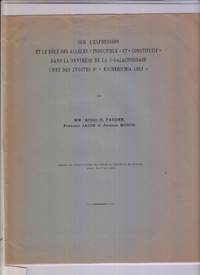
1958réf. display5rm00Comptes rendus hebdomadaires des seances de l 1958. Very Good. Prompt shipment with tracking. we ship in CLEAN SECURE NEW boxes Offprint. Faded at edges. First separate edition. Very good in wrappers. Garrison and Morton 6894 . The PaJaMo experiment of PArdee JAcob and MOnod broke the impasse in Crick and Brenner's comprehension of how information in the sequence of bases in DNAcame to be expressed as a sequence of the amino acids in protein and thus led to the theory of the messenger and the solution of the coding problem. Judson 390. Provenance: William B. Provine Comptes rendus hebdomadaires des seances de l unknown
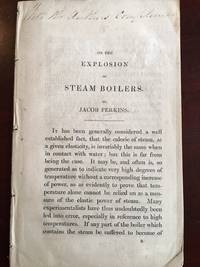
1827réf. 30AN EXTRAORDINARY EARLY AMERICAN INVENTOR AND ENGINEER "THE THEORY OF THIS INGENIOUS METHOD OF ABSTRACTING HEAT" PERKINS Jacob. On the Explosion of Steam Boilers. caption-title. 8vo disbound pp. 18 folding plate. N.p. n.d. i.e. London: 1827. First Edition. Rare. "In 1823 at fifty-seven years of age Perkins started an entirely new type of activity new to him and almost entirely new to science. This was his experimental work with steam of high pressure."-Dirk J. Struik Yankee Science in the Making 1948 p. 69. Our copy is exactly like the BL copy without formal title-page and beginning on sig. "B"1. Inscribed on title: "With the Author's Compliments" and with a single correction in ink on p. 16. In 1823 Perkins invented super heated steam in an experiment called a "flash boiler" one thousand shots per minute using 900psi steam. This steam was later used in nuclear power plants to turn the steam turbines and small flash boilers were used on some steam automobiles and provided quick acceleration. In flash boilers water is delivered to preheated tubes and vaporizes almost immediately. "The theory of this ingenious method of abstracting heat was described by Perkins in a small printed pamphlet published in 1827 entitled On the Explosion of Steam Boilers…This pamphlet consists of eighteen pages and a folding plate engraved with a diagram showing the relationship of the piston and the crank at various pressures. Perkins was very chary of distributing copies of his pamphlet before his patent of March 22 1827 was finally sealed for fear that it might prematurely reveal the nature of his invention. A copy is in the author's possession Perkins has written on the margin of the first page: 'With the author's compliments. Confidential."-Greville Bathe & Dorothy Bathe Jacob Perkins: His Inventions His Times & His Contemporaries 1943 p. 123 & note. Perkins says in a long letter to his friend and one-time-partner Dr. Thomas P. Jones in Philadelphia that he is sending him a copy of the pamphlet and that he gave copies to Dr. Wollaston and Michael Faraday "and to several engineers whom I could trust and who all agree that it assigns the true cause of explosions."-Barthe p. 125. Born in 1766 in Newburyport Massachusetts Perkins 1766-1849 was a gifted and prolific inventor running a goldsmith business by age 15! By 21 the state of Massachusetts commissioned him to make the dies for the State's copper coins. At 31 he invented a machine for heading and pointing nails and tacks in a single operation a remarkable invention for its day. He moved to New York later to Philadelphia where he developed probably the first steel plates for banknote engraving a system of preventing banknote forgery. Unable to get financial backing in this country he moved to England in 1819 taking his sons and a group of craftsmen with him. "America's loss was Britain's gain…He started a successful banknote business and went on to develop instruments for measuring ships' speeds for determining diving depths and a score of other devices. When he turned his attention to steam development this amazing man really hit his stride…Then he invented his steam gun. The Duke of Wellington became very interested in this Perkins gun…" and its military uses were explored then spurned by the British government. The London Mechanics Register of Nov. 6 1824 said "If Mr. Perkin's steam guns were introduced into general use there would be but very short wars; since no fecundity could provide population for its attacks." See W. H. B. Smith Mr. Perkin's Extraordinary Steam Gun of 1824 original published in 1957 and reprinted in Lateral Science: A plethora of science & engineering subjects both real & virtual 8 July 2012. The DAB calls his experiments with high-pressure steam "unique" saying "He received recognition in various countries particularly in England but he was a hundred years ahead of his time." In all Perkins created over 21 inventions and between 1819 and 1836 patented 19 of them. His biography in ODNB is included in the biography of his son Angier March Perkins and in fact gets the longest treatment there. Another useful biography is at madehow.com. For all things Perkins see Baker Perkins Historical Society online. OCLC locates two copies National Library of Sweden & Swarthmore College. NUC adds Univ. of Illinois. First Edition not in COPAC.