Jacob, GilesBiblio.com
54 694 résultats
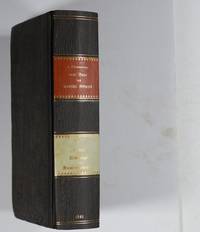
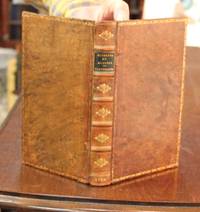
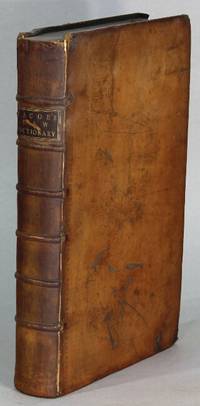
1736réf. 64429London: in the Savoy: printed by E. and R. Nutt and R. Gosling assigns of Edw. Sayer Esq; for J. J. and P. Knapton D. Midwinter A. Bettesworth and C. Hitch et al. 1736. Folio pp. 774; collating pi2 a2 B-9H2 9I1; lexicon in double column 4; full contemporary calf red morocco label on spine; upper joint cracked top of spine chipped level with text block label with single scratch affecting the letter 'A' in "Law" otherwise a very good copy. Includes "the history and antiquity of the law and our manners customs and original government collected and abstracted from all dictionaries abridgments institutes reports yearbooks charters registers chronicles and histories published to this time." Alston XVIII 198; Vancil p. 119; not in Zischka. in the Savoy: printed by E. and R. Nutt, and R. Gosling, (assigns of Edw. Sayer, Esq;) for J. J. and P. Knapton, D. Midwinter, A unknown
1736réf. 64429London: in the Savoy: printed by E. and R. Nutt and R. Gosling assigns of Edw. Sayer Esq; for J. J. and P. Knapton D. Midwinter A. Bettesworth and C. Hitch et al. 1736. Folio pp. 774; collating pi2 a2 B-9H2 9I1; lexicon in double column 4; full contemporary calf red morocco label on spine; upper joint cracked top of spine chipped level with text block label with single scratch affecting the letter 'A' in "Law" otherwise a very good copy. Includes "the history and antiquity of the law and our manners customs and original government collected and abstracted from all dictionaries abridgments institutes reports yearbooks charters registers chronicles and histories published to this time." Alston XVIII 198; Vancil p. 119; not in Zischka. in the Savoy: printed by E. and R. Nutt, and R. Gosling, (assigns of Edw. Sayer, Esq;) for J. J. and P. Knapton, D. Midwinter, A unknown books
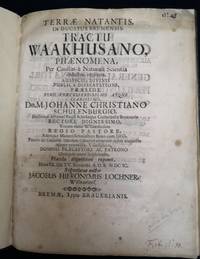
réf. 554830Bremen: Brauer Bremae: Typis Brauerianis o.J. 1699. Der alte feste Broschur Buchblock unbeschnitten in neuen Pappdeckeln montiert komplett mit den gefalteten Tafeln. Dort die erste Erwähnung Worpswedes. - Mit gestochenen Titelvignetten. - Mit den zwei einfach gefalteten Tafeln zu den Kapiteln "Terrae Natantis In Ducatus Bremensis Tractu Waakhusano Phaenomena" und "Caput I. Præviam eamque brevem Insularum Natantium Historiam complectitur." "Caput II. Waakhusanæ Terræ Phænomena" "Caput III. Variis Observationibus ad Phænomenorum caussas rite indagandas viam sternit" "Caput IV. Caussas enarratorum". - In lateinischer Sprache. - Montiertes Korrekturblatt auf Seite 46. - Buchbloch etwas fleckig. Tafeln gering randfleckig. Sonst gutes und wohlerhaltenes Exemplar. 0 1 0 Bremen: Brauer (Bremae: Typis Brauerianis) o.J. [1699]. unknown
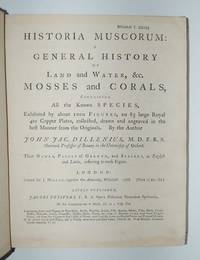
réf. 38095London: Printed for J. Millan 1768. Second edition second issue large 4to 295 x 230 mm 2 13 1 10pp. followed by 85 copper engraved plates some light toning to text plates general nice and clean bound in a handsome cont. full calf joint cracked at head and foot spine tooled in gilt with an attractive floral design contrasting red morocco label lettered in gilt. Dillenius Johann Jakob Dillenius 16871747 was was contemporaneous with both Ray and Linnaeus and this is regarded as "his greatest work."DNB. First published in 1741 this 1768 edition is a re-issue of the original plates with explanatory text it covers mosses liverworts lycopods and algae - the illustrations all drawn and engraved by the author. Provenance: Small previous owner stamp of William T. Doyle at head of title. Nissen BBI 491; Stafleu & Cowan 1472; Henrey III 642. London: Printed for J. Millan, 1768 unknown
1860réf. 36183Basel, 1860. 8vo. A little later green half cloth with a recent printed paper title-label to spine. Brownspotting to some leaves. Some underlinings and maginal annotations, all in pencil. Near contemporary annotations/description pasted on to verso of dedication-leaf. (4), 576 pp.
1697réf. 45644Leipzig, Grosse & Gleditsch, 1697. 4to. No wrappers. In: ""Acta Eruditorum Anno MDCXCVII"", No V, May-issue. Pp. 193-240 (entire issue offered). With titlepage to the volume 1697. Leibniz: pp. 201-205. Johann Bernoulli: pp. 206-211. Jacob Bernoulli: pp. 211-214. Newton: pp. 223-224. As usual, some leaves with browning.
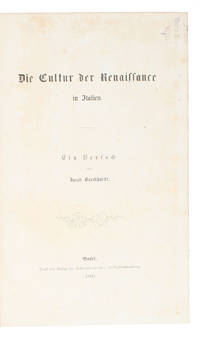
1860réf. 36183Basel 1860. 8vo. A little later green half cloth with a recent printed paper title-label to spine. Brownspotting to some leaves. Some underlinings and maginal annotations all in pencil. Near contemporary annotations/description pasted on to verso of dedication-leaf. 4 576 pp. The scarce first edition of Burckhardt's main work the groundbreaking work on the culture of the Renaissance which helped found the historical study of this previously much overlooked era. " "The most penetrating and subtle treatise on the history of civilization" in Lord Acton's words "a mere essay" as Burckhardt himself called it "The Civilization of the Renaissance in Ittaly" has for more than a century determined the general conception of thirteenth- to fifteenth-century Italy." PMM p. 210This classic of Renaissance historiography is of the greatest importance to the development of the history of the Renaissance and of history of art and culture in general. More specifically Burckhardt here establishes the fact that the Renaissance came first in developing the human individuality to the highest degree. He places the earliest signs of "the modern European Spirit" in Florence which was a great contributing factor to the comprehension of this city as representing one of the highlights of European culture.The Swiss historian of art and culture Jacob Chrisoph Burckhardt 1818-1897 contributed seminally to the historiography of these two fields. He is considered the discoverer of the Renaissance and with his main work he founded the study of thirteenth- to fifteenth-century Italy and thereby the historical study of the Renaissance the society of which he dealt with all aspects of. In general Burckhardt's works all constitute an original historical approach to the study of art culture social institutions etc. As a highly respected scholar of Greek civilization Burckhardt with his original historiographical approach was highly admired by Nietzsche who also attended his lectures. The two kept in contact and corresponded frequently. Like Nietzsche Burckhardt was a great admirer of Schopenhauer and he greatly opposed the Hegelian interpretations of history.". as in the case of other great historians such as Gibbon Ranke Macaulay no criticism of details can detract from the powerful spell which Burckhardt's book has exercised upon such widely different writers as Ruskin Nietzsche and Gobineau as well as upon innumerable lovers of the most magnificent period of European history." PMM.Printing and the Mind of Man 347. hardcover
1697réf. 45644Leipzig Grosse & Gleditsch 1697. 4to. No wrappers. In: "Acta Eruditorum Anno MDCXCVII" No V May-issue. Pp. 193-240 entire issue offered. With titlepage to the volume 1697. Leibniz: pp. 201-205. Johann Bernoulli: pp. 206-211. Jacob Bernoulli: pp. 211-214. Newton: pp. 223-224. As usual some leaves with browning. First appearance of the famous issue of Acta Eruditorum in which the 4 solutions by the 4 most eminent mathematicians at the time were printed together. There were in all 5 solutions to the posed problem and Newton's solution was first printed in the Philosophical Transactions January 1697 and reprinted here. The solution proposed by L'Hopital not printed here was not published until 1988.The brachistochrone problem was posed by Johann Bernoulli in Acta Eruditorum in June 1696. He introduced the problem as follows: "I Johann Bernoulli address the most brilliant mathematicians in the world. Nothing is more attractive to intelligent people than an honest challenging problem whose possible solution will bestow fame and remain as a lasting monument. Following the example set by Pascal Fermat etc. I hope to gain the gratitude of the whole scientific community by placing before the finest mathematicians of our time a problem which will test their methods and the strength of their intellect. If someone communicates to me the solution of the proposed problem I shall publicly declare him worthy of praise." Johann Bernoulli and Leibniz deliberately tempted Newton with this problem. It is not surprising given the dispute over the calculus that Johann Bernoulli had included these words in his challenge:- ."there are fewer who are likely to solve our excellent problems aye fewer even among the very mathematicians who boast that they. have wonderfully extended its bounds by means of the golden theorems which they thought were known to no one but which in fact had long previously been published by others."According to Newton's biographer Conduitt he solved the problem in an evening after returning home from the Royal Mint. Newton: . "in the midst of the hurry of the great recoinage did not come home till four in the afternoon from the Tower very much tired but did not sleep till he had solved it which was by four in the morning."Newton send his solution to his friend Charles Montague and Montague published anonymously in the Transactions. Newton's solution presented here in the Acta is also anonymous. The episode did not please Newton as he later wrote: "I do not love to be dunned pestered and teased by foreigners about mathematical things ." After the competition Johann Bernoulli said ". my elder brother made up the fourth of these after Leibniz himself and Newton that the three great nations Germany England and France each one of their own to unite with myself in such a beautiful search all finding the same truth."Struik Edt. "A Source Book in Mathematics 1200-1800 pp. 391 ff. unknown
1979réf. 49497BASTEI-LÜBBE 04/1979. 2. softcover. Titanen BASTEI-LÜBBE paperback
1989réf. 50329BASTEI-LÜBBE 07/1989. 2. softcover. Inkarnation der Unsterblichkeit Die BASTEI-LÜBBE paperback
1843réf. 660591843. Kefvinge bei Stockholm 23.VI.1843. 1 1/2 S. gr.4°. Mit Blindsiegel und Adresse. Jöns Jakob Freiherr von 1779-1848 schwedischer Chemiker; begründete die quantitative Analyse organischer Verbindungen führte die chemischen Symbole ein und entdeckte mehrere Elemente. An den Chemiker Théophile-Jules Pelouze Mitglied der Académie des sciences in Paris wegen der Zusendung einer "collection du Journal de l'Ecole polytécnique". ". Ne connoissant point à quelle personne j'aurois pu m'adresser par une lettre officielle je vous prie de vouloir bien de ma part présenter les remercimens de l'Académie au lieu dû et annoncer que l'envoie est arrivé. Les Numeros 1 9 & 10 y manquèrent. Je suppose que la raison en est que ces numeros ne se trouvent plus. Il y avoit l'Analyse mathématique appliquée de La g r a n g e ." Der Empfänger Théophile-Jules Pelouze 1807-1867 war ein französischer Chemiker er bestimmte mit sehr hoher Genauigkeit das Atomgewicht mehrerer Elemente. Ferner entwickelte er einen Sprengstoff und exprimierte mit der von Christian Friedrich Schönbein entdeckten Schießbaumwolle. Ascanio Sobrero und Alfred Nobel waren seine Schüler. unknown
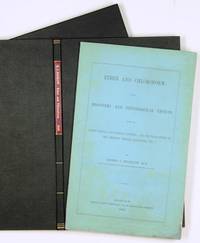
1848réf. 206001848. From the Boston Medical and Surgical Journal; And the Transactions of the American Medical Association Vo. 1. - Boston: David Clapp Printer .184 Washington Street 1848 8° 1 Bl. 27 pp. 18 pp. Orig. Broschiert. FIRST EDITION of one of the most significant early papers on anesthesia! This is a very good to fine copy in the original rare blue wrappers as the copy in the NLM. The first article was originally published in the Boston Medical Surgical Journal in 1846. The second article is from the Transactions of the American Medical Association Vol. 1. "Bigelow's speedy publication of Morton's discovery and his subsequent advocacy of ether assured its adoption throughout the civilized world. The above work deals with the priority claims in general and with a defense of Morton's claim in particular" and contains detailed information on their surgical use dangers and history." Garrison & Morton Bigelow had great concern for the suffering of surgical patients and was interested in finding an ideal agent which could be used as an anesthetic. Ether had the potential to be of use though there was concern over its flammability. Bigelow used ether and published his observations on use of vapors from sulphuric ether in the Boston Medical Surgical Journal in 1846. In the present report Bigelow discusses the pros and cons on using ether vapors or chloroform and compares this in the second article with other anesthetic agents. This clinical research was a major advancement for surgical operations where pain to the patient was greatly minimized or not felt during the surgery. Henry Jacob Bigelow 1818-1880 the Boston surgeon is noted for important contributions to surgery and for having published the first account of the use of ether in a surgical operation. He attended the Boston Latin School entered Harvard at the age of fifteen years and was a graduated with the class of 1837. He then studied medicine with his father as preceptor and attended lectures at the medical schools of Harvard and Dartmouth. In 1838 and 1839 he served as a house surgeon at the Massachusetts General Hospital and obtained the degree of doctor of medicine from Harvard Medical School. Bigelow also made important surgical contributions. Through his Boylston Prize essay Manual of Orthopedic Surgery 1844 he directed attention to a field of surgical endeavor until then neglected in America. In 1869 he described the iliofemoral ligament and its mechanism and demonstrated the importance of the structure in reducing dislocations of the hip by the flexion method which had been advocated earlier by William W. Reid. Bigelow also improved an instrument lithotrite for crushing stones of the bladder and perfected an evacuator of large caliber for immediate removal of the fragments. He designated the operation "litholaplaxy". Rare - RLIN locates 4 copies some evidently without the original wrapper with its collective title. Garrison & Morton No. 5730 unknown
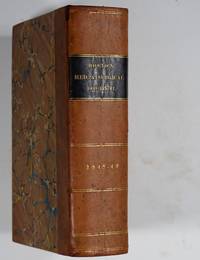
1848réf. 648941848-1849. Boston Med. Surg. J. 3839. - Boston David Clapp February 1848 to August 1848 8° 532 pp.; August 1848 to February 1849 8° 548 pp. half leather with marbled boards; fine. First Edition! HENRY JACOB BIGELOW 1818-90. - "As the dangers of surgical anesthesia became more well known Bigelow wrote a series of articles detailing these problems. To clarify some of the questions concerning the hazards of surgical anesthesia Bigelow also prepared a report for presentation to the members of the American Medical Association. This series of papers was later reprinted as a monograph entitled Ether and chloroform; their discovery and physiological effects Boston: D. Clapp 1848 G-M 5730." Rutkow Bigelow's speedy publication of Morton's discovery and his subsequent advocacy of ether as an anesthetic assured its adoption throughout the civilized world. The above work deals with the priority claims of Morton and Charles Thomas Jackson with Bigelow taking Morton's side in the dispute. Further of interest: REUBEN DIMOND MUSSEY 1780-1866: Chloroform in surgical operations pp.194-195. Chloroform pp.520-521. "Mussey was professor of surgery at the Medical College of Ohio in Cincinnati at the time he wrote these two letters to the editor of the Boston medical and surgical journal. As the clinical use of surgical anesthesia increased there was a growing controversy both in America and Europe over the efficacy of chloroform versus ether. Mussey had had extensive experience with chloroform and noted that his operations proceeded "without a single unpleasant effect in any case." Rutkow JONATHAN KNIGHT 1789-1864 & DAVID ATWATER TYLER 1818-85: Popliteal aneurism successfully treated by compression pp.293-296. "The present paper contains an account of the first reported cure of aneurism by the method of digital compression." Rutkow JONATHAN PARKER MAYNARD 1817-98: Discovery and application of the new liquid adhesive plaster pp.178-183. "His article describes the first known use of collodion as a surgical dressing. Collodion is a term used to describe a solution of pyroxylin or soluble gun cotton cellulose treated with nitric acid dissolved in alcohol and ether. Flexile collodion is made by adding castor oil and turpentine." Rutkow Rutkow ANp28293132 GSp8384 hardcover
1841réf. 440591841. Samuel Thomas von Sömmerring vom Baue des menschlichen Körpers 6. - Neue umgearbeitete und vervollständigte Original-Ausgabe.- Leipzig Verl. v. Leopold Voß 1841 8° XXIV 1048 2 pp. 32 Abb. 5 Taf. Pappband. d.Zt.; Rücken erneuert. First Edition! Many of the histological discoveries of Friedrich Gustav Jakob Henle 1809-1885 are described in the above. He classified tissues histologically. Gefässnerven p.510 690. Demonstration of the presence of smooth muscle in the endothelial coat of small arteries". Garrison & Morton No. 543; 7094 unknown
1785réf. 307291785. Viennae Apud Rudolphum Graeffert 1785 8° 338 16 pp. Titerlkupfervignette Ledereinband d.Zt.; St. a.Tit. Rücken erneuert; feines Expl. Seltene Erstausgabe der frühen Schrift zu den Vergiftungen und deren Gegenmittel! Joseph Jacob von Plenck 1733-1807 Professor der Chirurgie Chemie und Botanik lehrte an der Wiener Josephs-Akademie. Er ist der Verfasser seiner Zeit sehr beliebter Kompendien über verschiedene medizinische Teilgebiete die sich durch übersichtliche und anregende Darstellung auszeichnen. "Plenck war eine hochbegabte Natur er vermochte sich rasch in jede Materie hineinzuarbeiten und dieselbe derartig zu beherrschen das sie klar übersichtlich und wohlgeordnet vortragen konnte." Puschmann Erst 30 Jahre nach der vorliegenden Abhandlung Plencks erschien 1815 in Paris das erste moderne Standartwerk der Toxikologie von M.J. Orfila. First Edition of Plenck's famous textbook on toxicology. Plenck was one of the last great medical writers to publish all of his principal works in Latin. Plenck provided the first classification of poisons based on origin: 1. Animal poisons. 2. Vegetable poisons. 3. Mineral poisons. 4. Poisonous vapors gases and dust. The popularity of his writings was such that they were soon translated into other modern languages. Wellcome IV p.402; Blake NLM 18th Century p.356 Selten. Nicht in der umfangreichen Plenck-Sammlung der Josephinischen Bibliothek zu Wien. unknown
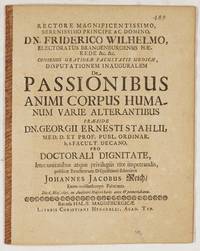
1695réf. 419751695. Halae Magdeb. Literis Christiani Henckelii 1695 Kl.4° 16 6 pp. orig. Broschur. Erste Ausgabe zweiter Abdruck! Die hier vorliegenden "Disputatio de passionibus animi" "Über den mannigfaltigen Einfluß von Gemütsbewegungen auf den menschlichen Körper" zeigt daß es Stahl schon zum Beginn seines Wirkens in Halle seit 1694 also um das Problem der psychophysischen Wechselwirkung gegangen ist. Er hat seine Bedeutung seine Auswirkung in der Praxis beobachtet. Man findet hier die Grundlagen der medizinischen Psychologie. Es werden Beispiele für den Einfluß seelischer Erregungen auf den menschlichen Organismus angeführt. In der Einleitung wird hervor gehoben: "So leiten sich von den Leidenschaften des Gemütes in ihrer vielfältigen Bestimmung Leitung oder Änderungen der Bewegungen des menschlichen Körpers auch viele Krankheitsanzeichen her." Die Mehrschichtigkeit seelischer Alterationsstufen das Unverlierbare besonders tiefe Eindrücke wird in der Vorahnung späterer Erkenntnisse Freudausgesprochen: Zugegeben sei "daß der im Erbgang geprägte Prototyp der Leidenschaften und Neigungen des Gemüthes in gewohnheitsmäßiger Festigung nicht ganz umgekehrt werden kann" so vermag doch "die domminierendende Leidenschaft durch eine ihr entgegengesetzte Gewohnheit an die zweite oder gar dritte Stelle verdrängt werden wo sie zwar noch innerhalb der Ordnungen steht gleichwohl ihre Rangstufe wechselt." Es liegt dem in nuce die Idee von der Verdrängung zugrunde. Es wird schließlich empfohlen die psychologischen Beobachtungen bei der Behandlung der Patienten nützlich anzuwenden und zu verwerten indem man den Kranken "viele Ausbrüche des Erschreckens der Furcht des Zornes anhebender Ängstlichkeit durch guten Zuspruch und durch vertrauenserweckende Sicherheit" benimmt. So zieht die Arbeit die Folgerung: "Seelenleiden die von Verletzungen des Körpers herrühren sind oft mit schwerwiegenden und dauernden Folgen verbunden. Doch sie sind zu vertreiben mit der Heilung der Körperschäden." Die Lehre von den symptomatischen Psychosen wird im Ansatz vorweggenommen wenn auch die Terminologie auf einen noch neuen Begriffsterain vortastet. Es sind Gehversuche auf einem noch dunklem Gebiet in der ärztlichen Praxis. Man kann die "Disputatio" als eine frühe Arbeit bezeichnen die sich aus der Sicht des Arztes mit dem Problem psychisch verursachter Störungen von Krankheitsabläufen beschäftigt. Es handelt sich hierbei nicht um Geisteskrankheiten. Es geht vor allem um die körperlichen Einflüsse transitorischer Seelenzustände die man heute in der Lehre von den Neurosen und ihren verschiedenen Erscheinungsformen zusammenfassen würde. Die seit der Antike beknatte Verbindung zwischen Knostitution und Charakter wird auch nach der therapeutischen Seite hin erwogen und berücksichtigt. Es ist der Geist einer naturwissenschaftlichen Betrachtungsweise der sich durch diese Arbeit hindurchzieht. Es zeigt wie vorbeitreffend die Annahme war den STAHL'schen Animismus nur religiös zu interpretieren." "In dem an zweiter Stelle stehenden "Propempticon inaugurale" - es ist eine dem Doktoranden JOHANN JACOB REICH gewidmete Abschiedsrede STAHLS mit angeschlossener Vita REICHS - nimmt STAHL zu dem Thema "De synergeia naturae in medendo" Stellung. Man findet hier alle Merkmale des STAHLschen Systems und erkennt wie sehr der aus der Erfahrung schöpfende Psychologe den Vorrang gehabt hat. So wird eine tiefe Kenntnis des Eigenrhythmus biologischer Abläufe in dem Gedanken ausgesprochen: "Die Natur hat ihr eigenes Zeitmaß und verwendet dieses bei den rhythmischen Vorgängen des Lebens von längerer Zeitdauer so bei der Embryonalentwicklung bei der Geburt Zahnung Pubertät". Die Synergie der Organe unter der Direktion der Lebenskraft enthält im Krankheitsfalle das ärztliche Problem die nützlichen Bewegungen der Naturheilkraft von den eigentlichen Krankheitsbewegungen zu unterscheiden. Der Arzt muß vor allem die Bewegungen erkennen die auf einen nützlichen Zweck abzielen. Theoretische Fragen werden aus dieser Sicht kurzerhand beiseite geschoben und in der für STAHL typischen Art das Leib-Seele-Problem zu einem biologischen Postulat'gemacht : "Es handelt sich nicht um eine Annahme sondern wir beweisen a priori mit der Vernunft daß im Menschen von einer einzigen Seele alle diese Akte und Bewegungen vollzogen werden können. Erfahrung und Vernunft zeigen a posteriori daß diese Zusammenhänge zwischen Leib und Seele in der Tat vorliegen." In diesem Problem sieht STAHL den Inhalt seiner Lebensarbeit: "Darauf werfe ich mich mit ganzer Seele. Dem gilt meine ganze Arbeit. Weder Mühe noch Neid können mich dabei verdrießlich machen. Ich hoffe vielmehr mit dem Problem in würdiger Weise fertig zu werden. Möge die Medizin dann wieder auf ihr rechtes Fundament gestellt sein"!" Diese beiden Texte "vermitteln so ein interessantes Bild der ärztlichen Persönlichkeit STAHLS ihres Temperamentes und ihrer Suche nach den biologischen und psychologischen Gesetzen einer wirksamen Therapie. Er gibt sich mit der Vorstellung einer nur mechanistischen Arzneiwirkung nicht zufrieden. Er nennt die besondere "Chronometrie" biologischer Abläufe das Gesetz der Ganzheit den Begriff des allen Einzelerscheinungen übergeordneten Organismus den Einfluß seelischer Erregungen auf die Vitalbewegungen desselben. Die psychophysische Wechselwirkung wird dem Arzt als praktisch wichtiges Problem gestellt. Jedenfalls hat STAHL bereits im Jahre 1695 alle wesentlichen Gedanken seines medizinischen Systems dargelegt. Die Ansicht er habe erst durch CHRISTIAN WOLF gewichtige Anregungen erhalten ist nicht mehr haltbar. Bereits 12 Jahre vor dem Erscheinen seiner "Theoria medica vera" hat die Forschungsrichtung STAHLS ihr wesentliches Ziel gehabt. Wenn man die Geschichte der medizinischen Psychologie überdenkt so wird man GEORG ERNST STAHL auf Grund der Einsichten in die ärztliche Bedeutung des Psychischen wie schon KORNFELD mit Recht ausgeführt hat an den Anfang einer Erschließung dieses Fachgebietes stellen dürfen. Die Leitsätze am Schluß der "Disputatio" enthalten das historische Fundament dieser neuen erst in unserer Zeit zur Anerkennung gekommenen Wissenschaft." B.J. Gottlieb G.E.Stahl Sudhoffs Klassiker der Medizin pp.18-21 23-47 unknown
1960réf. 0033615Springfield: Charles C. Thomas 1960. First Edition. Hardcover Hardcover. Good Condition. 23.5cm x 16cm. xlii 1080 pages black and white illustrations. Green cloth no jacket. The leading 20th century monograph on human injury as a result motor vehicle accidents written by an orthopaedic surgeon for a medical audience. Crash Injuries was a source of inspiration for J. G. Ballard's 1973 novel Crash. Ex-Raymon H. Mulford Library Medical College of Ohio University of Toledo spine label stamps and plates. Minor general wear. Category: Transportation; 20th Century: 1960s; Medicine & Health. Inventory No: 0033615. BZDB407 Transportation; 20th Century: 1960s; Medicine & Health. Unbranded Jacob Kulowski Crash Injuries: The Integrated Medical Aspects of Automobile Injuries and Death Charles C. Thomas hardcover
1958réf. PRINT15JT0021Comptes rendus hebdomadaires des seances de l'Academie des sciences 24625 1958. Pamphlet. Collectible; Very Good. First edition. Prompt shipment with tracking. we ship in CLEAN SECURE NEW boxes Offprint. Reprinted from Comptes Rendus Hebdomadaires des Seances de l'Academie des Sciences 24625. 1958. First separate edition. Offprint. Original wrappers. Comptes rendus hebdomadaires des seances de l'Academie des sciences 246(25) unknown
réf. 16-5879London: sumptibus auctoris 1732. Engravings on 18th Century laid paper. 39.5 x 23.5cm. Some trimmed Most plates annotated in the lower margin in elegant 18th Century scholarly penmanship.The most important 18th-century work on plants in a private garden to be published in England. 'James Sherard 1666-1738 botanist and apothecary had gardens at Eltham south of Greenwich famous for rare plants. Dillenius made the garden memorable through excellent illustrations drawn and engraved by himself. They were sufficiently accurate to be of considerable service to Linnaeus.' Hunt. Nissen BBI 492; cf. Henrey 643; cf. Hunt 637. . 27 planches certaines découpées. Traces d'humidité et petites galeries de vers en marge de certaines planches déchirure à une planche. Expertise by : Amaury BONNETAIN. London: sumptibus auctoris, 1732 unknown
1752réf. B4844London : Samuel Peterson c.1752. . A near fine copy. Plates and text are clean and crisp. . Edition: Second Edition. Binding: Contemporary calf boards with gilt decorative borderings. Rebacked skillfully. Spine in six compartments of raised bands with gilt decorative devices and rulings. Gilt title on green calf label on 2. Notes: This is one of the most important works introducing Newtonian physics to continental Europe. Wilhelm Jacob Gravesande 1688-1742 was a Dutch lawyer and natural philosopher chiefly remembered for developing experimental demonstrations of the laws of classical mechanics. As professor of mathematics astronomy and philosophy at Leiden University he helped to propagate Isaac Newton’s ideas in Continental Europe. Size: 8vo. 184x127mm. Illustration: Illustrated with a multitude of in text equations as well as 4 fold out plates depicting mathematical relationships. Pages: P. Title Blank Preface iii-iv 1-187 Category: Book Science & Technology; Samuel Peterson hardcover
réf. 011523New York: Orange Judd and Company 1870. The Swiss-born landscape architect emigrated to the Unites States in 1859 settling in Hartford. This his first book ".documents his major commissions.and contains the best surviving evidence of his technical skill in site engineering as well as his taste in landscape design" "Pioneers of American Landscape Design" Forty pages of illustrated text discussing technique are followed by twenty-four illustrated plans of work in Hartford and the Northeast. First edition. Folio 35 x 27 cm; 40 pp.; 84 text cuts and 24 colored lithographic plates. Rubbing and wear to backstrip and extremities; bookplate and owners ink stamp to front pastedown; plates bright and clean. A good copy in original gilt-stamped maroon publishers cloth. . First Edition. New York: Orange Judd and Company, (1870). hardcover
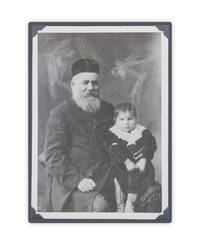
réf. FRE22Ca. 163 original gelatin silver photographs and real photo postcards mostly mounted on loose cardboards from ca. 178x228 cm 7 x 9 in to ca. 68x49 cm 2 ½ x 2 in. Ca. 30 photos with English captions or dates on the mounts either in manuscript or typewritten text; with one identification badge of a newborn ca. 35x72 cm 2 ¾ x 1 ¼ in. Several photos detached one photo lacking a small fragment at the margin one photo with a horizontal fold mark and one photo with small fragments at the lower right corner attached by scotch tape but otherwise a very good collection of strong photos. Historically interesting archive of lively vernacular photographs and real photo postcards related to the New York–based Ukrainian and Belarusian Jewish families of Yurowsky and Rothstein. From 1881 to 1917 the United States experienced its largest wave of immigration. Following the assassination of Tsar Alexander II of Russia blamed by many on the Jews a series of violent pogroms erupted across the Russian Empire. With official tolerance and new restrictive laws these attacks devastated over 160 towns leaving thousands of Jewish families impoverished. As a result more than two million Jews emigrated to the United States over one million settling in New York. The compilers’ family appears to have left during this period seeking safety from widespread anti-Jewish violence. According to the captions the archive belonged to the family of Ukrainian and Belarusian Jews Jacob Yurowsky ca. 1886-1962 and Lillian Rothstein ca. 1888-1961. Jacob’s parents Louis Yourowsky ca. 1858- and Yetta Yourowsky ca. 1860- emigrated to the United States in 1896 leaving their children with relatives in Ukraine. Born in Zhitomir Jacob eventually joined his parents in America in 1905 arriving amidst the First Russian Revolution and anti-Jewish pogroms. In 1917 he married Lillian who had emigrated from Belarus with most of her siblings. The couple first lived in Manhattan before later settling in the Bronx where they raised their son Morton Yourowsky ca. 1919–2006. U.S. World War II Army Enlistment Records 1938–1946 indicate that Morton graduated from Utica College and worked as a pressman and plate printer prior to his military service in the World War II. The collection contains over 163 lively vernacular photographs and real photo postcards mostly taken and collected in New York. The earliest photographs in the archive apparently date to 1902–1903 and were produced in the pioneer Minsk studios of Osip Bernstein and L. Rosowski. These portraits likely capture Lillian’s sisters Sonia and Minnie prior to the family's emigration from Belarus. Importantly the archive includes at least fifty excellent cabinet photographs of the Yourowsky family and their relatives taken at early lesser-known New York studios. Most of the photographs identify the specific photographer or studio frequently providing the studio address printed directly on the mount. Among these are excellent images from People’s Photo Gallery at 45 Canal Street; Spachner & Berger on 12th Avenue in the Lower East Side M. Robbins at 49 Canal Street; H. R. Trachtenberg at 62 Avenue C; and Isidor Yog at 45 Canal Street - the latter of whom was a noted Jewish anarchist associated with the Yiddish theatre community. The collection further contains work from Wolfson’s Art Gallery at 399 Grand Street and the Farb Photo Studio at 1535 Madison Avenue. The rest of the photographs were taken outdoors and show the daily life of the Ukrainian and Belarusian Jewish diaspora in 1920s-1930s New York. The images mostly portray Yurowsky family members and their Jewish relatives posing at the beach on balconies in natural settings and city streets on horseback at Coney Island in their yard in Central Park at a Jewish cemetery in New York and in Burbank California. The collection also contains at least three real photo postcards with Russian and Ukrainian inscriptions on the verso sent from immediate relatives in Ukraine to Lillian and an infant identification band from Morton’s birth in 1919. Overall historically interesting archive of over 165 original gelatin silver photographs and real photo postcards related to the family of New York–based Ukrainian and Belarusian Jews who fled the anti-Jewish pogroms of the Russian Empire. hardcover
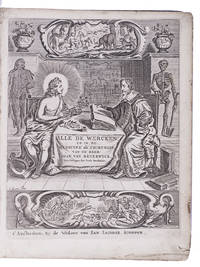
1672réf. KBJA62HZUVCNAmsterdam 1672. 4to. widow of Jan Jacobsz. Schipper Contemporary vellum. With engraved frontispiece 28 engravings in volume one 29 engravings in volume two including one on the title-page and 20 engravings including one on the title-page plus 1 woodcut in volume three. 3 volumes bound as 1. 18 252; 8 127 1 328 48; 8 278=276 12 pp. Penultimate edition of the most influential medical work in the Low Countries during the 17th-century the collected works of Johannes Van Beverwijck 1594-1647. It was very popular partly through the inserted poems by Jacob Cats and its illustrations. The three main parts contain a general survey of the several elements of medicine varying from medical folklore and herbal knowledge to anatomy and chirurgy. At the end of the third part "Heel-konste" letters from and to Van Beverwijck as well as some other important letters are issued. Among these are letters of Descartes on the motion of the hart written ca. 1637-1643 to and from Anna Maria van Schurman ca. 1640 and William Harvey. Van Beverwijck was a very well-read man and all his writings include many references to ancient and contemporary authors on the subject. With owners' inscriptions on flyleaf and some modern underscoring and annotations in pencil. Front board and spine detached from bookblock a few tiny wormholes a couple tears in the foot margin otherwise in good condition.l BMN I p. 387; Krivatsy 1191; STCN 840960328; Wellcome II p. 159. hardcover
1840réf. F2KA3EDGC1WVGroningen: J. Oomkens 1840. Original publisher's printed paper wrappers with at the back an advertisement for 6 other works by Van Cleeff. 8vo. Rare first edition of a schoolbook on navigation in the form of questions and exercises by Jacob van Cleeff 1788-1862 lecturer in mathematics engineering and navigation at the maritime academy at Groningen known as the Academie Minerva. The work was meant to be used together with Jan Carel Pilaar's Handleiding tot de beschouwende en werkdadige stuurmanskunst first published in 1831. A second edition of the present work appeared in 1846 and a third in 1859.With a library stamp of "Kon. College Zeemanshoop" on title-page and an owner's stamp of Dr. P.J. Kaiser on the title-page and wrappers. Title-page and paste-downs foxed. Spine of the wrappers gone and a few small chips along the edges. Good copy most of the quires with the bolts unopened.l Crone Library 844 cf. 916 third ed.; NCC 1 copy; WorldCat 5 copies incl. that in the NCC; cf. Bierens de Haan 874 second ed.; Cat. NHSM p. 694 third ed. J. Oomkens, unknown
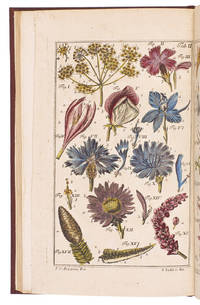
1759réf. K79FEANEEDP9Regensburg 1759. 8vo. F. Zunkel Modern reddish brown cloth title in gold on spine. With engraved illustration on title-page and 4 hand-coloured engraved plates. 12 96 8 pp. Rare first and only edition of a botanical work by the German clergyman-naturalist Jacob Christian Schaeffer 1718-1790. "His first botanical publication was an Isagoge in botanicam expeditiorem 1759 a preliminary to his Botanica expeditior of 1760. This guide to botany consists of an enumeration of all genera in tabular form followed by extensive synonomy. The books brings little new but is interesting because it is one of the first few German works in which the Linnaean generic reform taxonomic as well as nomenclatural if fully accepted" Stafleu. The present work includes a chapter explaining the classification systems of Tournefort Rivinus and Linnaeus. The fore-edge margin of one of the plates slightly soiled and some spots on the title-page but otherwise in very good condition.l Pritzel 8110; Soulsby 638; Stafleu & Cowan 10470; Stafleu Linnaeus and the Linnaeans p. 254. hardcover