56.075 Ergebnisse
1789Best.-Nr. 247021Paris: Chez Barrois 1789. First edition in French. Avec trente-quatre planches. 34 finely etched plates by Copia EXQUISITELY COLORED by a contemporary hand. 4 324; 4 295 pp. 2 vols. 8vo. Contemporary tan polished calf triple gilt-filet borders smooth spines richly gilt with 2 black leather spine label by Bozerien jeune. First edition in French. Avec trente-quatre planches. 34 finely etched plates by Copia EXQUISITELY COLORED by a contemporary hand. 4 324; 4 295 pp. 2 vols. 8vo. An extremely rare if not unique copy of Engel's classic treatise on acting with the plates colored by hand. This is the very scarce first French edition of Engel's famous Ideen Zu Einer Mimik first printed in German in 1785-86 and one of the most important works on the theory and psycho-physiology of acting. Engel 1741-1802 was a German philosopher who was professor of moral philosophy in the Joachimstal Gymnasium in Berlin and following that tutor to the crown prince of Prussia the future Frederik William III. In 1787 he became director of the Royal Theater in Berlin where he wrote many plays which enjoyed considerable success as well as many essays on aesthetic subjects ONE OF A VERY FEW COPIES WITH HAND-COLORED PLATES. Cohen-De Ricci 346-347; Brunet III 982; Magriel p. 179 Chez Barrois unknown books
1934Best.-Nr. 219112London 1934. Variant of the portrait from the same session published in PORTRAITS: the Photographs of Carl Van Vechten 1978 edited by Saul Mauriber. Bust portrait of the sculptor in profile. 1 vols. 35 x 27.7 cm. approximately 14 x 11 inches. Docketed in pencil on verso giving the name of the sitter the date of the session and a reference to negative and print "XXIII - F - 30". Variant of the portrait from the same session published in PORTRAITS: the Photographs of Carl Van Vechten 1978 edited by Saul Mauriber. Bust portrait of the sculptor in profile. 1 vols. 35 x 27.7 cm. approximately 14 x 11 inches. unknown books
1934Best.-Nr. 219114London 1934. Variant of the portrait from the same session published in PORTRAITS: the Photographs of Carl Van Vechten 1978 edited by Saul Mauriber. Bust portrait of the sculptor. 1 vols. 23.2 x 31.5 cm. approximately 12-1/2 x9 inches. Docketed in pencil on verso giving the name of the sitter "Jason Epstein - Hyde Park Gate London" the date of the session and a reference to negative and print "XXIII - F - 28". Variant of the portrait from the same session published in PORTRAITS: the Photographs of Carl Van Vechten 1978 edited by Saul Mauriber. Bust portrait of the sculptor. 1 vols. 23.2 x 31.5 cm. approximately 12-1/2 x9 inches. unknown books
1725Best.-Nr. 227524Uppsala: Werner 1725. Collation π1 A-C8; Pp. i title-ii verso blank 1-48. 1 vols. 16mo. Stitched. Ink signature at foot of title minor paper flaw in top margin of first two leaves three manuscript corrections in text else fine. Collation π1 A-C8; Pp. i title-ii verso blank 1-48. 1 vols. 16mo. Early work on the Norse voyages to Greenland Vinland Helluland Skraelingaland and discussion of the textual record of the exploration of North America. Celsius the uncle of Anders of the temperaturs scale fame was an early mentor of Carl Linneaus. Howes W15; Sabin 100960; Alden 725/208 Werner unknown books
1934Best.-Nr. 219342London 1934. Published in PORTRAITS: the Photographs of Carl Van Vechten 1978 edited by Saul Mauriber. Bust portrait of the sculptor facing camera. 1 vols. 35 x 27.7 cm. approximately 14 x 11 inches. Docketed in red ink on verso giving the date of the session and a reference to negative and print "XXIII - F - 21" with pencilled name of the sitter "Sir Jacob Epstein". Published in PORTRAITS: the Photographs of Carl Van Vechten 1978 edited by Saul Mauriber. Bust portrait of the sculptor facing camera. 1 vols. 35 x 27.7 cm. approximately 14 x 11 inches. unknown books
1875Best.-Nr. 51479Paris: Auguste Fontaine 1875. First edition. No. 8 of 50 copies on Whatman Paper. Frontispiece portrait in two states. 4 xv xvi blank 510 2 table 8 Extrait du Catalogue Auguste Fontaine. 1 vols. 8vo. Original printed wrappers all edges uncut. Some browning to wrappers partial split at spine of front wrapper two small chips from margins of front wrapper else very fine unopened copy. First edition. No. 8 of 50 copies on Whatman Paper. Frontispiece portrait in two states. 4 xv xvi blank 510 2 table 8 Extrait du Catalogue Auguste Fontaine. 1 vols. 8vo. Printer's apprentice turned prolific author Restif de la Bretonne 1734-1806 was one of the distinctive literary voices of late eighteenth-century France whose works chronicle the excesses of the ancien régime and the tumults of the Revolution. Exceedingly scarce édition de tête of this bibliography which remains important and has been reprinted on several occasions. Auguste Fontaine unknown books
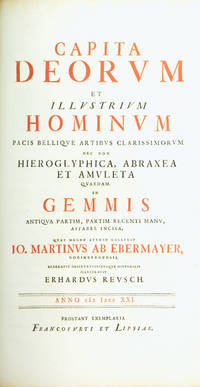
1720Best.-Nr. 40329Nuremburg: Aedibus Ebermayerianis 1720. First edition. With folding portrait and folding plate of Cabinet. 30 plates part I 1720; 7 plates part II 1722; 4 plates part III 1722; and 5 plates part IV 1722. 1 vols. Folio. Contemporary mottled sheep rebacked. Wear staining and some cracking to the bottom back board and bottom of spine internally a fine crisp copy. First edition. With folding portrait and folding plate of Cabinet. 30 plates part I 1720; 7 plates part II 1722; 4 plates part III 1722; and 5 plates part IV 1722. 1 vols. Folio. Ebermayer 1664-1743 was a Nuremberg banker whose very fine collection of gems featured many with portraits cut in relief of all the Luminaries of Ancient and Modern History. The last 4 parts are quite rare. According to Graesse the first is usually encountered with another collection of engraved gems by Erhard Reusch published in the same year. Graesse 1: 276; Ebert 6547 Aedibus Ebermayerianis unknown books
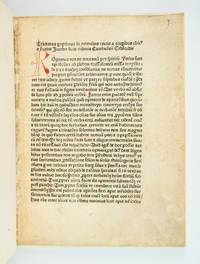
1477Best.-Nr. ST21103Blaubeuren: Conrad Mancz ca. 1477. Second Edition in Latin. 278 x 205 mm. 11 x 8". 20 leaves. COMPLETE. Single column 32 lines in gothic type. Modern stiff vellum flat spine. Capitals struck in red nine hand-drawn two- to four-line initials in red. Front pastedown with engraved armorial bookplate of Boies Penrose II and with armorial morocco bookplate and paper library label of Eric Hyde Lord Sexton FSA. Goff J-22; BMC II 565; ISTC ij00022000. See Wetzer und Welte's Kirchenlexikon VI 1168. Rear cover with minor soiling first leaf tipped onto tab and with repairs along gutter first two leaves a bit soiled and foxed last two leaves with neat old repairs to lower fore-edge corner the text as a whole with slight softening because of exposure to damp. Not without obvious defects but still an incunable appealing for its content rarity and provenance as well as for its generous margins and unworn binding. One of just three copies in North America located by ISTC this is the extremely rare Blaubeuren edition of a work that offers guidance on dealing with ghostly apparitions a topic not often dealt with in incunabular printing. "On Souls Stripped of their Bodies or On the Apparitions and Receptacles of Souls" was written in the late 1450s in response to a plea for advice from a Franciscan monastery in Leipzig that was experiencing what appeared to be supernatural disturbances instigated by a ghost or demon. A Carthusian prior who also served as rector and professor of canon law at the University of Erfurt Jacobus de Clusa also known as Jacob of Jüterbogk or Jacob of Paradiso 1381-1465 was known for his numerous writings on moral theology. First issued in 1475 in German and in Latin the present response to the concerned Franciscans became the most widely read of his works. According to Wetzer & Welte Jacobus considers in the book "such apparitions to be quite possible particularly in places where the deceased had sinned as they may hope to be released from Purgatory sooner through the intercession of surviving relatives or friends. Consequently he offers advice to the latter on this matter. 'If souls ask for intercession' he says 'it should be granted but one must not give way to idle fantasies.' He identifies the most effective means of aid as: Masses almsgiving prayers fasting and good works. In this context he discusses the state of the soul after death in a clear and illuminating manner. 'Immediately after death' he states 'the particular judgment takes place at the very spot where death occurred; for God is everywhere.' He designates four places to which departed souls may go: a. the Empyrean Heaven; b. the underworld "infernus sub terra"; c. Limbo of the Infants "limbus puerorum"; d. Purgatory. In his view escaping Purgatory entirely is very difficult." This open discussion of what happens to the soul after death and the possibility of the existence of ghosts was unsurprisingly appealing to a wide audience particularly as it came from a respected theologian. ISTC indicates that ours is the second incunabular edition following the first printing in Esslingen ca. 1474--all early printings are now uncommon in commerce. This is one of 24 works issued between 1473 and 1478 by Conrad Mancz the only 15th century printer in Blaubeuren a small city near Ulm. Jacobus de Clusa was the author of three of these publications the other two being books of sermons. Our copy was owned by Philadelphia bibliophile Boies Penrose II 1902-76 before its acquisition by Eric Hyde Lord Sexton 1902-80 an avid collector of early printing who amassed a library of incunabula from 114 different printing locations. This volume sold at his 1981 sale at Christie's for $2200. ISTC identifies the Sexton copy as one of three in North America the others being at the Huntington and the Beinecke. Searches of RBH and ABSA find just one other copy of the Blaubeuren edition at auction since 1928 that one appearing at Doerling in 1981 where it fetched 6500 Deutsche marks $2879. Conrad Mancz unknown books
1983Best.-Nr. 87645Chicago & London: University of Chicago Press 1983. First edition. xxiv 270 pp w/index. Fine in fine dust jacket. Nathaniel Tarn’s copy with his bookplate. Chicago & London: University of Chicago Press unknown books
1960Best.-Nr. 87671London: Watkins & Clark 1960. First printing of this edition originally published in 1634. xlvii 723 pp. Hard bump to rear panel else very near fine in near fine dust jacket with a sticker shadow over the printed price on the front flap and some ripples to spine. Translated by John Sparrow. Edited by C.J.B. and D.S.H. London: Watkins & Clark, unknown books
1986Best.-Nr. 88010Chicago & London: University of Chicago Press 1986. First edition. xxii 641 pp w/indexes. Fine in fine dust jacket. From the collection of Nathaniel Tarn with his bookplate. Chicago & London: University of Chicago Press unknown books
1986Best.-Nr. 88364Chicago & London: University of Chicago Press 1986. First edition. xvii 267 pp w/index of Biblical & Talmudic references. Fine in fine dust jacket with a small corner crease to the front flap. Chicago & London: University of Chicago Press unknown books
1993Best.-Nr. 88407Northvale & London: Jason Aronson 1993. First edition. xii 194 pp w/index. Fine in fine dust jacket. Nathaniel Tarn’s copy with his bookplate inside the front cover. Northvale & London: Jason Aronson unknown books
1986Best.-Nr. 87020Seattle & London: University of Washington Press/Seattle Art Museum 1986. First edition. 4to. 235 pp w/index. Fine in very near fine dust jacket. Foreword by Bruce Guenther. Essay by Patricia Hill. Dated 1/29/90 and SIGNED by Lawrence on the title page. Seattle & London: University of Washington Press/Seattle Art Museum unknown books
1970Best.-Nr. 82264Glen Ellyn: Cat’s Pajamas Press 1970. First edition. Fourteen leaves stapled along the top edge. Near fine. One of “about” 50 numbered copies. Duane Locke Victoria McCabe Derek Pell Martha JacobDarrell Kerr John Jacob James Bertolino and Terry Stokes contribute. [Glen Ellyn]: Cat’s Pajamas Press unknown books
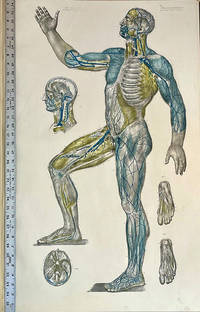
1854Best.-Nr. 51129Brussels: Comptoir des éditeurs 1854. Bourgery Jean-Baptiste Marc 1797-1849 and Nicolas Henri Jacob 1782-1871. Anatomie élémentaire en vingt planches representant chacune un sujet dans son entier à la proportion de demi-nature . . . Atlas only. Elephant folio. Title-leaf and 20 lithographed plates most hand-colored. Brussels: Meline Cans et Cie; Comptoir des Éditeurs 1854. 888 x 600 mm. 20th-century quarter morocco boards slight wear. A few marginal tears repaired minor dampstaining but very good. Later edition first published in both Paris and Brussels in 1836 of this set of very large anatomical plates that were intended to be mounted on the walls of dissection rooms. All editions are extremely rare-OCLC does not cite any copies of the 1854 edition. This is the only copy of any edition of this work that we have handled in over 50 years of trading. The work was originally accompanied by a small 20-page pamphlet of text that is not present here. The impressive plates in this atlas reproduce the illustrations in Bourgery and Jacob's Traité complet d'anatomie at a much larger scale than their counterparts in the Traité-roughly half life-size. Some plates were lithographed in Paris; others in Brussels. Plates I and II are devoted to osteology and syndesmology; plates III - VIII to myology and aponeurology; plates IX-XIV to angiology; plates XV-XVII to neurology; plates XVIII-XIX to the digestive system; and plate XX to the reproductive organs. The plates were originally sold separately; uncolored versions were priced at 6 francs and colored versions at 12 francs. Currently two uncolored plates from this series are on the market for about $1300. . Comptoir des éditeurs unknown books
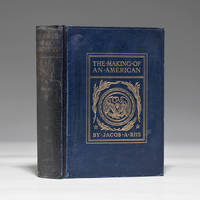
1901Best.-Nr. 1228141901. First Edition. Signed. RIIS Jacob. The Making of an American. New York: Macmillan 1901. Octavo modern full blue morocco gilt raised bands marbled endpapers top edge gilt with original gilt stamped cloth front cover bound in at rear. $4500.First edition of the pioneering photographer and reformer's autobiography published the decade after his influential work How the Other Half Lives with frontispiece portrait and 83 photographic illustrations many full-page in original bright gilt cloth inscribed to a prominent social reformer and close friend of Jane Addams mentioned in the text: ""Mrs Emmons Blaine with the admiration and respect of the author Jacob A. Riis. New York Dec 9 1901.""In this profusely illustrated autobiography Riis charts his life from his youth in Denmark to his immigration to America and his dedication to documenting the social injustice of New York's slums first as a police photographer and then as a newspaper photographerÑ""the first photographer to use the power of the image as a tool for reform"" McDarrah 381. His 1890 photobook How the Other Half Lives marks the landmark beginning of ""a photographic attitude an ethos-humanist documentary photographyÑin which the photographic social document is employed to bear critical witness to what is going on in the world"" Parr & Badger I:53. ""A pioneer in the development of the documentary"" to Theodore Roosevelt Jacob Riis was ""the staunchest most efficient friend the children of New York City have ever had"" and ""the ideal American citizen"" ANB. With rear leaf of publisher's advertisements. This copy is inscribed to Anita McCormick Blaine a famous Chicago philanthropist and the widow of Emmons Blaine. The son of a powerful political operative his father was a former Republican Secretary of State who lost the presidential race to Grover Cleveland Emmons Blaine was vice president of the B&O Railroad. However he died at just 33 years old leaving his 26-year-old wife a widow. Fortunately her family's intervention into the financial aspects of her marriage ensured that she was a wealthy widow while her late husband guaranteed that she was welcomed into the highest social and political circles. As a newly single mother Blaine became deeply interested in her son's education. She became acquainted with Col. Francis Parker and began to absorb and enact progressive ideas on education. She helped to found the Chicago Institute for teacher training. She also founded two additional schools including a free school for poor children. The success of Blaine's educational initiatives earned her a spot on the Chicago School Board. Blaine soon came to be recognized as a leading philanthropist and social reformer. Much of her work focused on Jane Addams' Hull-House and similar ventures aimed at improving the lives of the poor. Blaine's empirical mindset set her apart and the information and data she doggedly collected supported further social and legislative reform. As a result Blaine was welcome onto the Chicago Board of Charities and the United Charities. She also worked together with Jane Addams to create the City Homes Association dedicated to providing housing for the poor. Collaborating with Addams Blaine fought for labor reform particularly the eight-hour work day and peace. Peace soon became her primary interest after her son died from the 1918 flu spread by World War I. A supporter of the League of Nations and later the United Nations Blaine hoped that she could spare other mothers her fate. At her death Blaine was one of the greatest philanthropists of her time the acknowledged doyenne of the social reform world. She donated over 10 million dollars to social causes and left a huge fortune to the New World Financial Trust. Blaine is mentioned in the last chapter of The Making of an American which is essentially an acknowledgments chapter. Riis writes: ""Jane Addams and Mrs. Emmons Blaine leaven that shall yet leaven the whole unsightly lump out yonder by the western lake and let in the light"" page 436. Blaine's archived correspondence at the University of Wisconsin reveals a request from John Bogue to sell tickets for Riis' lecture ""How the other half lives"" and an invitation from Maud Warner McCormick to a lecture by Jacob Riis. Interestingly Warner McCormick was married to Alexander Agnew McCormick a Chicago alderman and Daily News editor who was a residential member of the University of Illinois' Chicago Literary Club and a member of Chicago Historical Society with possible relative Cyrus Hall McCormick Jr. Blaine's brother.Interior generally fine with a few leaves reinforced at gutter's edge. Attractive in blue morocco most desirable inscribed. hardcover books
1963Best.-Nr. vas5336Gainesville: University of Florida Press 1963. Octavo green cloth hardcover xxxv 326 pp. Fine in a Near Fine dust jacket with mylar wrapper. From dust jacket: In June 1836 24-year-old Jacob Rhett Motte a Harvard-educated Southern gentleman trained as a surgeon departed his hometown of Charleston to serve as an Army surgeon in wars against the Creek and Seminole Indians. Motte who had a genuine literary flair began keeping a journal -- “While witnessing the dreadful scenes of Indian warfare I was also impressed with the conviction that descriptions of horrible massacres imminent and hairbreadth escapes bloody battles and dreadful murders have always been subjects of interest to the human mind” he later wrote. University of Florida Press, 1963. hardcover books
1987Best.-Nr. 79187Whitethorn: Holmgangers Press 1987. First edition. 20 pp. Fine in stapled wrappers. Kestrel 11. Whitethorn: Holmgangers Press unknown books
1973Best.-Nr. 79151Oak Park: Cat's Pajamas Press 1973. First edition. 8 pp. Very good plus in stapled wrappers. INSCRIBED by Jacob on the verso of the title page “This one’s / for Gary - / John.” Oak Park: Cat's Pajamas Press unknown books
1853Best.-Nr. 50480London: Taylor and Francis 1853. Whole issue in original printed wrappers mostly uncut & unopened. iv 311-561 1 15pp.; 7 plates Plates XIX. - XXVI. Jacob Augustus Lockhart Clarke 1817-1880 was an English physician physiologist histologist and neurologist. Clarke received his material edication at Guy's Hispital and St. Thomas's Hospital in London. He was liscenced by the Apothecaries Society and subsequently went to love with his mother at Pimlico where he established a private practice. From 1851 to 1868 while Clarke was engaged in general practice and continuing his studies at St. George's Hospital he conducted his now famous research on the central nervous system. "Most of his numerous works were published in in the Philosophical Transactions 1851 53 58 59 60 65 68 in the Proceedings of the Royal Society 1857 61 the Microscopical Journal British and Foreign Medical Review 1864 and others. His earlier works concern the anatomy and the physiology of the medulla oblongata and the spinal marrow as well as the brain. His discovery of the Clark's column also designated nucleus dorsalis was done in this period. His later research is more concerned with pathological studies in his special field. he also published on tetanus diabetes paraplegias of muscular atrophy. Clarke was described as a man of the highest character "with s singleness of purpose of noble independence honest and just conscientious and intellectually keen but with a singularly retiring and reserved disposition. He never acquired a large practice and is reputed not to have been well off financially." Whonamedit Jacob Augustus Lockhart Clarke. Accessed 11/4/2022. . Taylor and Francis unknown books
1856Best.-Nr. 9751gcsNew York: Harper & Brothers Publishers 1856. Signed by Elias Loomis to his son Henry Elias Loomis famous scientist. Duodecimo red blind-stamped cloth hardcover gilt letters 160 pp. Very Good with edgewear. Harper & Brothers, Publishers, (1856). hardcover books
1858Best.-Nr. 1354648Boston: Phillips Sampson and Company 1858. First Edition. Hardcover. Octavo v 7-75 pages. In Good plus condition. Bound in embossed brown cloth with gilt lettering. Boards show some discoloration to covers; spine with light wear to edges and corners. Text block foxed. Inscribed by author on front free endpaper: "Prof. Geo. B. Wood with the author's regards." An ex-library embossed stamp on title page. MF Consignment. NOTE: Shelved in Rockville Annex Aisle A Top Shelf. George Bacon Wood received his B.A. and M.D. from the University of Pennsylvania. Wood first taught at the Philadelphia College of Pharmacy beginning in 1822 as professor of chemistry and then in 1831 becoming professor of materia medica. He concluded his teaching at the College of Pharmacy in 1835 when he was named professor of materia medica at the University of Pennsylvania; in 1850 he became professor of the theory and practice of medicine a position he held until he retired in 1860. In 1863 he was elected to the University of Pennsylvania's board of trustees where he remained until his death. In 1865 Wood endowed an Auxiliary Faculty of Medicine at Penn with five chairs in zoology and comparative anatomy; botany; mineralogy and geology; hygiene; and medical jurisprudence and toxicology. Up until 1855 he continued to instruct medical students privately as well. Wood was connected with many other institutions during his career. He was an attendant physician at the Pennsylvania Institute for the Deaf and Dumb from 1822 to 1844 and at Philadelphia Hospital later Philadelphia General Hospital from 1835 to 1859. He was president of the American Philosophical Society from 1859 until his death of the American Medical Association from 1855 to 1856 and also for many years of Philadelphia's College of Physicians. Wood was also the author of many books most notably the Dispensatory of the United States with Dr. Franklin Bache in 1833 and Treatise on the Practice of Medicine in 1847. - University of Pennsylvania website. 1354648. Special Collections - Upstairs. Phillips, Sampson and Company hardcover books
1987Best.-Nr. 67546Whitethorn: Holmgangers Press 1987. First edition. 20 pp. Fine in stapled wrappers. Dated 9/23/87 and warmly INSCRIBED by Jacob on the title page. Laid into this copy is a full page holograph letter from Jacob to the book’s publisher. Kestrel 11. Whitethorn: Holmgangers Press unknown books
1993Best.-Nr. 67175Washington DC: Rappahannock Press/Phillips Collection 1993. First edition. 4to. 172 pp w/selected bibliography & index. Fine in fine dust jacket. Introductory essay by Henry Louis Gates Jr. 116 illustrations of which 60 are in full color. Washington DC: Rappahannock Press/Phillips Collection, unknown books