Brett, JacobABAA

55.913 risultati
1882rif. 40720London 1882. Very Good. Brett Jacob. A.L.s. to Latimer Clark. London September 18 1882. 2- pp. 181 x 114 mm. Remains of mounting present. Provenance: Latimer Clark. Regarding Clark's request for a portrait photograph. Jacob Brett was the younger brother of John Brett the head of the Magnetic Telegraph Company in England and one of the co-founders of Cyrus Field's Atlantic Telegraph Company. In 1850 John and Jacob Brett laid the first undersea cable between England and France. This failed after one garbled message a French fisherman cut the cable thinking it was a new variety of seaweed but in 1851 the Bretts laid a much stronger cable that remained in use for many years. . unknown books
1870rif. 31578Paris 1870. Preparation by Ludovic. Engraved by Roussin after a drawing by Jacob. Very good to fine condition. 60 x 40 cm. This is one of the largest and most dramatic images in the spectacular Bourgery & Jacob set of anatomical atlases. unknown books
1909rif. 131161909. First edition offprint issue. 231-264pp. Original printed wrappers. Very good. "This work led to the universal clinical use of phenolsulphonephthalein in renal function tests and of phenoltetrachlorphthalein in hepatic function tests" Garrison-Morton.com 1896. unknown books
1968rif. 387331968. Jacob Francois 1920- ; Monod Jacques 1910-75; Lwoff Andre 1902-94; & Brenner Sydney 1927- . Group of 22 offprints mimeographs etc. on molecular biology and bacterial genetics together with 2 related papers by other authors. Various sizes. 1947-1968. Together in one volume cloth "Institut Pasteur" in gilt on the spine. Overall good to very good; see detailed condition descriptions below. From the library of G. G. and Elinor Meynell authors of Theory and Practice in Experimental Biology 1970 with their address label on the front endpaper and ownership signatures on several of the offprints. First / First Separate Editions. Jacob Monod and Lwoff all colleagues at the Institut Pasteur received the 1965 Nobel Prize in physiology / medicine for their discoveries concerning genetic control of enzyme and virus synthesis-discoveries that "opened up a new field of research that deserved to be called 'molecular biology'" Magill The Nobel Prize Winners: Physiology or Medicine II p. 921. Their work answered the fundamental question of how the hereditary information contained in DNA can be translated into the chemical processes that synthesize cellular proteins this question had been posed most succinctly and explicitly in Francis Crick's theoretical paper "On protein synthesis" 1957 which laid the groundwork for over a decade's worth of research in this area. Brenner another key figure in this field worked with Jacob and Matthew Meselson on providing experimental evidence for messenger RNA; he was awarded a share of the 2002 Nobel Prize for his discoveries concerning genetic regulation of organ development and programmed cell death. The collection we are offering here focuses largely on the Nobel Prize-winning work done by the Institut Pasteur group-Lwoff Jacob and Monod-in the 1950s and 1960s. The work can be divided into four sections: 1 lysogeny and bacterial conjugation 2 expression of the genetic material via messenger RNA 3 the regulation of the genetic activity of bacterial cells by operons 4 the organization of bacterial genetic material. In the following paragraphs we will attempt to highlight the more important papers in this remarkable collection; however all the papers here touch upon these central questions of molecular biology. Lysogeny defined as the hereditary ability to produce the bacteriophage virus is a peculiar type of infection in which the phage becomes part of the genetic material of a bacterial cell; in this non-infective form prophage it can then be inherited by succeeding generations of cells becoming virulent only when some environmental stimulus causes the bacterium to produce and release phage. "Lysogeny brought a model for the interrelation between a virus and a cell. And also a model for the possible mode of action of carcinogenic agents which could disturb something in this balance" Judson p. 368. Lwoff studied this phenomenon intensively in the late 1940s and early 1950s successfully demonstrating the genetic nature of lysogeny which was disputed by several scientists including Delbruck and discovering how it is induced. In 1953 he published an important review of the subject "Lysogeny" Bacteriological Review 17; see no. 2 below. Lysogeny was also studied by Jacob and Elie Wollman whose paper "Induction of phage development in lysogenic bacteria" CSH Symposia on Quant. Biol. 18 1953; see no. 5 below summarizes what had been learned about lysogeny as of that date. Lwoff's work on lysogeny inspired Jacob and Wollman to investigate the phenomenon of bacterial conjugation the transfer of genetic information from a male donor bacterium to a female recipient resulting in genetic recombination to see if they could discover where in the bacterium's genetic material the prophage was located. In 1955 working with a highly recombinant strain of E. coli K12 discovered by William Hayes Jacob and Wollman performed what came to be known as their "coitus interruptus" experiment in which they used a Waring blender to interrupt the mating bacteria at various stages of their conjugation. They found that the donor cell's genetic characteristics were not transferred all at once but rather sequentially over time-a discovery of great importance. "Wollman and Jacob had stumbled upon a way to measure off the genes on the bacterial chromosome as directly and physically as a child squeezes toothpaste onto a brush or a carpenter unrolls a coiled steel tape measure. As they saw instantly and reported in a note in mid-June 1955 in the weekly Comptes rendus of the Academie des Sciences "Sur le mecanisme du transfert de materiel genetique au cours de la recombinaison chez E. coli K12"; see no. 6 below they had the means to make a genetic map of biochemical characteristics expressed in units of time" Judson p. 385. In 1956 Wollman and Jacob published the first albeit rudimentary timed map of the K12 strain of E. coli in a paper published in France. This map was printed again in their English-language paper "Conjugation and genetic recombination in E. coli K-12" CSH Symposia on Quant. Biol. 21 1956; see no. 8 below which also contained the first publication of Thomas Anderson's famous electron micrograph of two conjugated bacteria. In 1958 Jacob delivered his paper "Transfer and expression of genetic information in E. coli K12" see no. 9 below at a symposium in Brussels; this paper together with one given by Jacob's sometime colleague Arthur Pardee "ranged over the whole matter of transfer of genes between bacteria and the regulation of their expression" Judson p. 400. Jacob and Wollman had originally represented the hereditary material in linear form while stating that the genetic map could be formally represented as a circle. In 1963 at a Cold Spring Harbor conference the researcher J. Cairns provided physical evidence that the E. coli chromosome was circular; at this same conference Jacob Brenner and co-author Francois Cuzin presented their paper "On the regulation of DNA replication in bacteria" CSH Symposia on Quant. Biol. 28; see no. 16 below containing their "replicon model of chromosome replication in bacteria a model that almost required circularity of chromosomal and F factor DNA" Brock p. 103. Experimental proof of the existence of messenger RNA the substance responsible for coding protein synthesis was announced in Brenner Jacob and Meselson's landmark paper "An unstable intermediate carrying information from genes to ribosomes for protein synthesis" Nature 190 1961; see no. 1 below. The theoretical groundwork for messenger RNA had been laid in Crick's "On protein synthesis" 1957; demonstration of the substance's existence had been foreshadowed by Volkin and Astrachan's discovery of a high-turnover unstable RNA distinct from the ribosomal and transfer varieties 1956 and by the famous "PaJaMo" experiment demonstrating the negative control mechanism of enzyme induction 1958. However it was not until the spring of 1960 that these previous findings were combined by Brenner Jacob and Francis Crick into a biological model setting forth the exact means of communication between gene and cytoplasm while eliminating the various problems associated with earlier ribosome-based theories of gene expression. As Brock puts it the ribosome was now seen as "simply a nonspecific translation machine something like a computer whose behavior depended on what software it contained" Brock p. 306. Working with Matthew Meselson who had developed experimental techniques for tagging and separating ribosomes Brenner and Jacob performed the critical experiment described in their paper which provided direct evidence for the existence of an unstable rapidly turning over messenger RNA. The concept of the operon-a group of adjacent genes functioning as a unit under the control of another gene the operator gene-developed between 1958 and 1960 on the basis of work done by Monod and Jacob who were investigating the repressor model of gene regulation. Jacob developed the idea that gene regulation was based on a repression system that operated like an on-off switch and that "genetic units of a higher order existed . . . that contained several genes subject to unitary expression. . . . On the basis of these ideas and observations Jacob and Monod developed the concept of two kinds of genes structural which coded for the synthesis of proteins and regulatory which did not" Brock p. 300. In October 1959 Jacob and Monod published the theoretical basis for the operon in "Genes de structure et genes de regulation dans la biosynthese des proteines" C. r. Acad. Sci. 249; see no. 11 below. Their paper "established the sharp distinction between the familiar genes that determined protein structures and the new class of genes that regulated. It even looked to them then as though the product of the regulatory gene were not a protein by RNA. But the fact to be underlined they said was that in every known case when several structural genes had their expression controlled by the same regulatory gene-'that is to say in all probability by a unique repressor'-the structural genes were grouped tightly together. . . . The best fit to the evidence was that the group of genes had among them a single element: the operator target of the repressor" Judson p. 410. The Jacob/Monod operon model of gene expression was further explored in their 1961 paper "On the regulation of gene activity CSH Symposia on Quant. Biol. 26; see no. 14 below which presented a more detailed examination of the mechanics of protein synthesis. For further information see Judson The Eighth Day of Creation 2nd ed. and Brock The Emergence of Bacterial Genetics; specific references are given below. 1. Brenner Sydney; Jacob Francois; & Meselson Matthew. An unstable intermediate carrying information from genes to ribosomes for protein synthesis. Offprint from Nature 190 May 13 1961. 576-581pp. Diagrams. Without wrappers as issued. Light toning. Ownership signature of E. W. Meynell on the first page. Garrson-Morton 256.10. Brock ch. 10.12. Judson pp. 414-27. 2. Lwoff Andre. Lysogeny. Offprint from Bacteriological Review 17 1953. 269-337pp. Without wrappers. Small stamp on first page. Brock ch. 7.4. 3. Monod Jacques. Inhibition de l'adaptation enzymatique chez une bacterie E. coli infectee par un bacteriophage. Offprint from C. r. Acad. Sci. 224 1947. 2 2 blankpp. Without wrappers. Light browning creased horizontally with small tear along crease. Ownership stamp and ms. annotations of A. A. Miles. 4. Lwoff & Siminovitch Louis. Induction de la lyse d'une bacterie lysogene sans production de bactÈrophage. Offprint from C. r. Acad. Sci. 233 1951. 3pp. Fore-edge frayed marginal tear affecting a few words. A. A. Miles's signature. 5. Jacob Francois & Wollman Elie. Induction of phage development in lysogenic bacteria. Offprint from CSH Symposia on Quant. Biol. 18 1953. 101-121pp. Without wrappers. Light soiling a few annotations. Owner's name on first page. Judson p. 382. 6. Wollman & Jacob. Sur le mecanisme du transfert de materiel genetique au cours de la recombinaison chez E. coli K12. Offprint from C. r. Acad. Sci. 240 1955. 3pp. Without wrappers. Creased horizontally light toning. Ownership signature of Elinor Meynell. Brock ch. 5.7. 7. Jacob; Alfoldi Lajos; & Wollman Elie. Zygose letale dans des croisements entre souches colicinogenes et non colicinogËnes d'E. coli. Offprint from C. r. Acad. Sci. 244 1957. 3pp. Without wrappers. Small marginal tears. Elinor Meynell signature. 8. Wollman; Jacob & Hayes W. Conjugation and genetic recombination in E. coli K-12. Offprint from CSH Symposia on Quant. Biol. 21 1956. 141-162pp. Without wrappers. Brock ch. 5.11. 9. Jacob. Transfer and expression of genetic information in E. coli K12. Manuscript for the Symposium of the Society for Cell Biology Brussels 1958. 29 3pp. Dittoed table. Mimeographed. Without wrappers. Edges a bit frayed. E. Meynell signature. Judson p. 400. 10. Jacob & Fuerst Clarence R. The mechanism of lysis by phage studied with defective lysogenic bacteria. Offprint from J. Gen. Microbiol. 18 1958. 518-526pp. Without wrappers. E. Meynell signature. 11. Jacob & Monod. Genes de structure et genes de regulation dans la biosynthese des proteines. Offprint from C. r. Acad. Sci. 249 1959. 3pp. Without wrappers. Creased horizontally. E. Meynell signature. Brock ch. 10.10. Judson p. 410. 12. Changeux Jean-Pierre. Sur l'expression biochimique de determinants genetiques d'E. coli introduits chez Salmonella typhimurium. Offprint from C. r. Acad. Sci. 250 1960. 3pp. Creased horizontally. Meynell signature. 13. Jacob. Comments. Offprint from Cancer Research 20 1960. 695-697pp. Without wrappers. 14. Jacob & Monod. On the regulation of gene activity. Offprint from CSH Symposia on Quant. Biol. 26 1961. 193-211pp. Without wrappers. Meynell signature. Brock ch. 10.13. 15. Jacob & Monod. Elements of regulatory circuits in bacteria. Unesco Symposium on Biological Organization. Paris 1962. Mimeographed. 27pp. plus tables and figures. Without wrappers. Light browning. 16. Jacob; Brenner Sydney; & Cuzin Francois. On the regulation of DNA replication in bacteria. Offprint from CSH Symposia on Quant. Biol. 28 1963. 329-348pp. Without wrappers. Meynell signature. Brock ch. 5.11. 17. Jacob & Ryter Antoinette. Etude au microscope Èlectronique des relations entre mÈsosomes et noyaux chez Bacillus subtilis. Offprint from C. r. Acad. Sci. 257 1963. 4pp. Plate. Without wrappers. Meynell signature. 18. Lennox Edwin S. ; Novick Aaron; & Jacob. Relation between repression level and rate of enzyme synthesis. Offprint from Colloques Internationaux du Centre Nat. de la Recherche Scientifique. No. 124. Mecanismes de regulation des activites cellulaires chez les microorganisms 1965. 209-219pp. Orig. wrappers. Meynell signature. 19. Sebald Madeleine & Schaeffer Pierre. Toxinogenese et sporulation chez Clostridium histolyticum. Offprint from C. r. Acad. Sci. 260 1965. 3pp. Without wrappers. 20. Jacob & Ryter. Segregation des noyaux chez Bacillus subtilis au cours de la germination des spores. Offprint from C. r. Acad. Sci. 263 1966. 4pp. Plate. Without wrappers. Meynell signature. 21. Jacob & Ryter. Segregation des noyaux pendant la croissance et la germination de B. subtilis. Offprint from C. r. Acad. Sci. 264 1967. 3pp. Plate. Without wrappers. 22. Jacob. Genetics of the bacterial cell. Offprint from Science 152 1966. 9pp. Orig. printed self-wrappers. Nobel address. Meynell signature. 23. Jacob; Pereira da Silva Luiz; & Eisen Harvey. Sur la rÈplication du bacteriophage l. Offprint from C. r. Acad. Sci. 266 1968. 3pp. Without wrappers. 24. Ryter A.; Hirota Y.; & Jacob. DNA-Membrane complex and nuclear segregation in bacteria. Offprint from CSH Symposia on Quant. Biol. 33 1968. 669-676pp. . unknown books
1981rif. 36990Markesan: Pentagram Press 1981. First edition. 32 pp. Fine in printed wrappers. Prose. One of 550 copies. Markesan: Pentagram Press, unknown books
2003rif. 36991Oak Park: Gotta Serve Somebody Press 2003. First edition. 15 pp. Fine in stapled wrappers. Five poems. Oak Park: Gotta Serve Somebody Press unknown books
1983rif. 38641Markesan: Pentagram 1983. First edition. 24 pp. Near fine in sewn wrappers. One of 180 copies on Arches Text paper SIGNED by Jacob. Markesan: Pentagram, unknown books
1998rif. 38640Concord: Small Poetry Press 1998. First edition. 11 pp. Fine in stapled wrappers. Concord: Small Poetry Press unknown books
1983rif. 38643Peoria: Spoon River Press 1983. First edition. 20 pp. Fine in stapled wrappers. A long poem. Peoria: Spoon River Press, unknown books
1995rif. 38642Deerfield: Lake Shore Publishing 1995. First edition. 63 pp. Fine in glossy illustrated wrappers. Poems. Deerfield: Lake Shore Publishing unknown books
2004rif. 31985Oak Park: D'Cypher Press 2004. First edition. 120 pp. Fine in full cloth with gilt-stamping to spine. One of a small number of hardcover copies SIGNED by Jacob. Oak Park: D'Cypher Press, hardcover books
1972rif. 24195Monroe: X An' Z Press 1972. First edition. 14 pp. Near fine in unprinted blue wrappers. Monroe: X An' Z Press, unknown books
2004rif. 31701Oak Park: D'cypher Press 2004. First trade edition. 120 pp. Fine in glossy illustrated wrappers. Poems by this Chicago poet and former editor of Mojo Navigator. Oak Park: D'cypher Press, unknown books
1976rif. 24192Milwaukee: Pentagram Press 1976. First edition lettered & signed issue. 15 pp. Fine in printed wrappers. One of 26 lettered copies SIGNED by Jacob. Milwaukee: Pentagram Press unknown books
1976rif. 24194Milwaukee: Pentagram Press 1976. First edition. 15 pp. Fine in printed wrappers. One of 600 of 626 copies. Milwaukee: Pentagram Press unknown books
1975rif. 31702Glen Ellyn: Two Bags Press 1975. First edition. 17 pp. Very near fine in stapled wrappers. Poet and juvenile rights specialist Jacobs' presentation of the case of one child Glenn Graves as treated by the institutions who were to care for him. Glen Ellyn: Two Bags Press unknown books
1934rif. 1413182Indianapolis: The Bobbs-Merrill Company 1934. First Edition First Printing. Hardcover. Octavo 330 pages. In Very Good condition. Bound in publisher's red cloth boards with worn gilt lettering to spine. Spine cocked. Mild bumping to bottom corners of boards. Minor scuffing and soiling to cloth. Inscribed on second free endpaper: "To My Intellectual Friend George A. Affeldt with best wishes / Jacob H. Rubin 5/12/1935". Shelved in Case 8 1/2. 1413182. Shelved Dupont Bookstore. The Bobbs-Merrill Company hardcover books
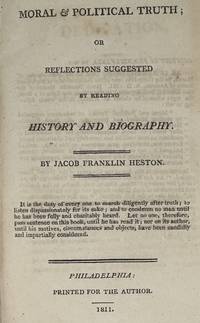
1811rif. 69404Philadelphia PA: Printed for the author 1811. 18.5 cm. 401pp. errata. Period full leather binding rubbed with gilt stamped red leather spine label. Front joint open tender. Contemporary ownership signature of Geo. Heckert on front pastedown. Sowerby 3542. Dedicated to Thomas Jefferson. From Heston's letter to Jefferson presenting him with a copy "But sir if it is a pleasure to reflect on your services it must also be a pleasure to know that they have met with a grateful reward. I do not however mean to insinuate that your reward is equal to your services; but I believe it is the greatest which a wise man can experience and it arises from the happiness gratitude and veneration of his fellow citizens. If it must afford pleasure even to an ordinary mind to reflect on the happiness of this extensive country; what delight must it give to you to behold the felicity of so many millions; especially if you consider that you were so greatly instrumental in procuring it." Jacob Franklin Heston ca. 1779-1845 attorney was born in Philadelphia County and admitted to the bar in 1804. Printed for the author unknown books
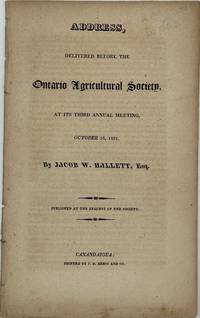
1821rif. 68439Canandaigua NY: J. D. Bemis and Co 1821. 22.5 cm. 16pp. Disbound pamphlet. Hallett offers advice on crop selection livestock etc. and notes "the great benefit and advantage our country will derive form the completion of that stupendous work the Grand Canal; by it we shall have a cheap safe and steady conveyance to market for our surplus produce; in lieu of the dangerous and fluctuating one through the medium of the St. Lawrence." A list of the officers and town managers of the society follows the text. American Imprints 5522 with no locations. Sabin 29891. OCLC also shows no locations. J. D. Bemis and Co unknown books
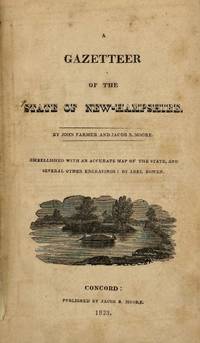
1823rif. 67922Concord NH: Jacob B. Moore 1823. First edition. 12mo. 276 pp. Folding map frontis. crisp and nine engravings. Contemporary calf spine and corners rubbed and worn hinges cracked. Foxed. Howes F-41. Hamilton 438. Jacob B. Moore unknown books
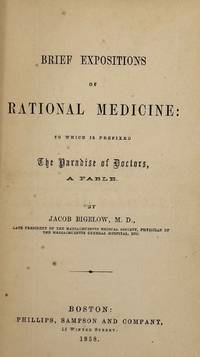
1858rif. 68103Boston MA: Phillips Sampson and Company 13 Winter Street 1858. First edition. 18.5 cm. 75pp. Publishers embossed brown cloth with shortened title stamped in gilt on front cover. Very good. Blind embossed stamp of North Scituate Public Library on front endpaper. In the fable Massachusetts residents begin to take three times the medicine required. Phillips, Sampson and Company, 13 Winter Street unknown books
rif. 67433as recorded in a lot of manuscripts receipts 6 from their children acknowledging their shares as distributed by their brother Jacob Null a debt bond from Jacob to Elisabeth following John's death an accounting of money due the children following John's death a group receipts 5 for taxes paid by John 1814-1828 one partly printed two acknowledgements of debts to John signed by two of his children receipts 10 to Jacob acknowledging payment for merchandise includes list of items taxes or services rendered e.g. "$1.00 for preaching at St. Peters Church" signed by Christian Reitzel an 1863 will signed by Jacob's brother-in-law Silas Winebarger and an 1879 family ALS from Jacob's sister Barbara. John Null emigrated from Pennsylvania to Lincoln County in the late 18th century. Expected storage wear but a very good lot. For the 27 items unknown books
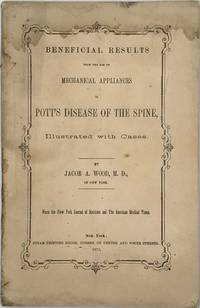
1875rif. 66592New York NY: Steam Printing House Corner of Centre and White Streets 1875. First edition. 22.5 cm. 57pp. Numerous illustrations. Original printed pink wrappers some soiling and staining to edges of wrappers and text margins. Steam Printing House, Corner of Centre and White Streets unknown books
1867rif. 63216NP 1867. First edition. 8vo. 8 pp. Illustrated with two small woodcuts. From the unsigned prefatory note: "These leaves were printed by an amateur who had never previously set up more than a few pages of type." OCLC locates a dozen copies. Very good. Original printed self-wrappers lacking original stitching recently stapled at the spine. 9897. unknown books
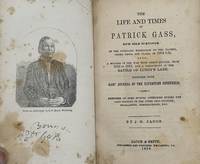
1859rif. 62094Wellsburg VA: Jacob & Smith Publishers and Printers 1859. First edition. 12mo. 280 pp. Frontispiece portrait and three plates. The story of the Corps of Discovery and its exploration of Jefferson's Louisiana Purchase seen through the lens of this biography of the last surviving member of the expedition. "The biography of its citizens is the history of a nation and we trust that the reputations of history will not suffer from one departure in permitting the humble biography of a hero of the ranks to stand by those of the great and title" from the preface. Howes J-31. Graff 2183. Wagner-Camp 6:10: "Gass became one of the best-known members of the expedition for several reasons: his key role as sergeant brought his name up frequently in the journals of Lewis and Clark his account was the first to be published he was the first to have a biography written about him and finally he outlived the other members of the Corps of Discovery by decades dying at the age of ninety-nine in 1870." Plates with foxing text toned but a very good copy. 20th-century green three-quarter leather and cloth gilt rules and title on spine. 9761. Jacob & Smith, Publishers and Printers unknown books