56 025 résultats
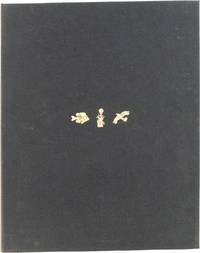
1968réf. 82867Roosevelt NJ: New Jersey Volunteers for McCarthy 1968. First Limited Edition. No. 201 of 250 copies issued. Black cloth portfolio 45cm x 34cm containing a broadside poem and 14 pencil-signed lithographic plates by New Jersey artists. Printed by Pearl Seligman on Rives Heavyweight. Minor soil with pronounced toning to the cover sheet which prints the Lowell poem from contact with the portfolio flaps; a few faint spots of foxing to the final plate George Segal; remaining contents complete and fine. Features a broadside of Lowell's poem "Fall 1961" and 14 pencil-signed lithographs by the following New Jersey artists: Richard Anuskiewicz Carmen Cicero Leo Dee Joseph Demarais John Goodyear James Kearns Jacob Landau Stefan Martin George Ortiman Pat Pickering Gregorio Prestopino Jean Schonwalter George Segal and Herbert Steinberg. According to the colophon the portfolio was issued in response to "the challenge presented to the American political system by Senator Eugene McCarthy during the presidential campaign of 1968." Though not indicated this copy from the studio of contributing artist Gregorio Prestopino; a fair number of the artists represented here including Landau Segal and the printer Pearl Seligstein were neighbors of Prestopino in the progressive planned community of Roosevelt New Jersey. A scarce item; OCLC finds only two locations Harvard & Princeton; none others found in commerce. New Jersey Volunteers for McCarthy unknown books
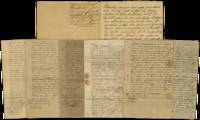
1836réf. List3741New York City 1836. Twelve documents totaling fourteen pages. See description for full inventory. Generally very good to excellent. Cary Ludlow 1736-1814 was a lawyer and merchant from the prominent New York City Ludlow family. In 1768 Ludlow had bought a property at 9 State Street on the Battery with plans to build a mansion there-lower Manhattan was becoming fashionable after the building of the Kennedy Mansion at 1 Broadway by Archibald Kennedy 11th Earl of Cassilis.1 However Ludlow was an ardently pro-Stamp Act Tory and because of this had to flee with his family to England around the outbreak of the Revolutionary War. Upon his return in 1784 he began work on the 9 State Street mansion which was completed around the mid-1790s shortly after the marriage of his daughter Catherine 1767-1849 to Jacob Morton 1761-1836. Later New York City Comptroller and Major General of the New York Militia during the War of 1812 Morton-who also appears in these documents-had been the marshal at George Washington's first inauguration.2 After the Revolutionary War many of New York's high society were moving to lower Manhattan especially on Front Street State Street and Broadway around Bowling Green and the Battery.1 The collection of legal filings offered here document this process of gentrification: they show Ludlow purchasing multiple lots surrounding his property on State Street from members of the lower classes. In particular Ludlow buys lots occupied by John Roorbach a grocer and Richard Anders an oysterman. Roorbach and Anders may have been renters or partial owners as the deals go through Samuel Craig whose occupation is listed as "gentleman" Robert Tuite Kemble formerly an officer of the British Army3 Cornelius Rosevelt likely of the Roosevelt family; also listed as "gentleman" and others. Following Cary Ludlow's death in 1814 the 9 State Street estate passed to Catherine and Jacob Morton and became a social center for the well-to-do epitomized by the 1824 ball the couple threw for the Marquis de Lafayette. However after Jacob Morton's death in 1836 the house became a boarding house; by the 1870s the 26-room mansion was home to "twenty-six Irish families" and Battery Park had become a spot where "roughs played base-ball" and vendors sold "horrible sweetmeats wormy apples and villanous lemonade". 1 The documents offered here illustrate several features of life for the elite during the Early Republic era: first they are primary documents of the gentrification of a neighborhood showing the displacement of its lower-class residents and the consolidation of property in the hands of a small number of wealthy owners; second the names appearing in them-Ludlow Morton Kemble-indicate that other than a small blip during the Revolutionary War financial ties outpaced political ones. State Street property documents: September 20 1794. Purchase and sale agreement between Roorbach and Ludlow for a house and lot on State Street "the street formerly called Copsey Street". Of the £1000 £600 goes to Kemble £200 to Samuel Craig and wife and £200 to Roorbach. 7 ¾ x 12 ½ inches 2pp folded Near Fine. February 7 1795. Release and quitclaim by Roorbach for two lots "in consideration of the sum of Five shillings . paid by Cary Ludlow" which were "mentioned and described in two certain Indentures" one between Cornelius and Catherine Rosevelt and Robert Tuite Kemble and the other between Kemble and Gerard Steddeford. 7 ¾ x 12 ½ inches 1pp folded excellent. February 7 1795. Agreement between Ludlow and Kemble with £500 owed to Kemble for a lot on the Battery bought by Kemble from Steddeford in 1791. 8 x 13 inches 1pp folded and separated at bottom fold with large tear at middle fold very good. February 7 1795. A stipulation that any payments by Ludlow to Roorbach would count towards his debt to Kemble. 8 x 12 ½ inches 1pp folded with several large tears at folds very good. May 4 1795. Indenture between Ludlow and Richard Anderson selling a "small lot" on State Street to Ludlow. The lot is specified as being bordered by the homes of Joseph Correy Stephen Smith and Ludlow likely No. 9. 9 ½ x 14 ¼ inches 2pp folded with some water stains but legible very good plus. June 19 1795. Release and quitclaim by Samuel Craig and his wife Rachel to Ludlow of a lot occupied by Roorbach. 8 x 12 ½ inches 1pp folded excellent to Near Fine. July 17 1795. Agreement between Ludlow and Anders to trade a house owned by Ludlow on Petticoat Lane Marketfield Street for one owned by Anders on State Street. 8 x 12 ¾ inches 1pp folded excellent. Other family documents: April 1775. Legal document signed by Ludlow as plaintiff's attorney in a debt case between Nicholas Ray and Benjamin Davis. 7 ½ x 5 inches 1pp very good plus. January 17 1818. Power of Attorney granted by Ludlow's widow Hester to John and George Morton brothers of Jacob Morton. 8 x 12 ½ inches 1pp excellent. February 28 1825. Grant of commission by Hester Ludlow to John and George Morton on proceeds to Ludlow's estate. 6 ½ x 8 inches 1pp excellent to Near Fine. January 21 1831. Receipt for sale of six shares in Butchers' and Drovers' Bank to Jacob Morton. 3 ½ x 7 ½ inches good. December 1 1836. Title to Vault 136 in the New York City Marble Cemetery for Jacob Martin. 7 x 9 ½ inches excellent. Of interest to historians of development and demographic change in New York City during the Early Republic era. 1 Rodolphe E. Garczynski "Some Old Houses illustrated" Appleton's Journal 8 no. 195 Dec 21 1872 696-699. 2 "Jacob Morton 1761-1836" American Aristocracy https://americanaristocracy.com/people/jacob-morton accessed April 23 2026. 3 "Robert Kemble 1755-1820" American Aristocracy https://americanaristocracy.com/people/robert-kemble accessed April 23 2026.
1836réf. List3741New York City 1836. Twelve documents totaling fourteen pages. See description for full inventory. Generally very good to excellent. Cary Ludlow 1736-1814 was a lawyer and merchant from the prominent New York City Ludlow family. In 1768 Ludlow had bought a property at 9 State Street on the Battery with plans to build a mansion there-lower Manhattan was becoming fashionable after the building of the Kennedy Mansion at 1 Broadway by Archibald Kennedy 11th Earl of Cassilis.1 However Ludlow was an ardently pro-Stamp Act Tory and because of this had to flee with his family to England around the outbreak of the Revolutionary War. Upon his return in 1784 he began work on the 9 State Street mansion which was completed around the mid-1790s shortly after the marriage of his daughter Catherine 1767-1849 to Jacob Morton 1761-1836. Later New York City Comptroller and Major General of the New York Militia during the War of 1812 Morton-who also appears in these documents-had been the marshal at George Washington's first inauguration.2 After the Revolutionary War many of New York's high society were moving to lower Manhattan especially on Front Street State Street and Broadway around Bowling Green and the Battery.1 The collection of legal filings offered here document this process of gentrification: they show Ludlow purchasing multiple lots surrounding his property on State Street from members of the lower classes. In particular Ludlow buys lots occupied by John Roorbach a grocer and Richard Anders an oysterman. Roorbach and Anders may have been renters or partial owners as the deals go through Samuel Craig whose occupation is listed as "gentleman" Robert Tuite Kemble formerly an officer of the British Army3 Cornelius Rosevelt likely of the Roosevelt family; also listed as "gentleman" and others. Following Cary Ludlow's death in 1814 the 9 State Street estate passed to Catherine and Jacob Morton and became a social center for the well-to-do epitomized by the 1824 ball the couple threw for the Marquis de Lafayette. However after Jacob Morton's death in 1836 the house became a boarding house; by the 1870s the 26-room mansion was home to "twenty-six Irish families" and Battery Park had become a spot where "roughs played base-ball" and vendors sold "horrible sweetmeats wormy apples and villanous lemonade". 1 The documents offered here illustrate several features of life for the elite during the Early Republic era: first they are primary documents of the gentrification of a neighborhood showing the displacement of its lower-class residents and the consolidation of property in the hands of a small number of wealthy owners; second the names appearing in them-Ludlow Morton Kemble-indicate that other than a small blip during the Revolutionary War financial ties outpaced political ones. State Street property documents: September 20 1794. Purchase and sale agreement between Roorbach and Ludlow for a house and lot on State Street "the street formerly called Copsey Street". Of the £1000 £600 goes to Kemble £200 to Samuel Craig and wife and £200 to Roorbach. 7 ¾ x 12 ½ inches 2pp folded Near Fine. February 7 1795. Release and quitclaim by Roorbach for two lots "in consideration of the sum of Five shillings . paid by Cary Ludlow" which were "mentioned and described in two certain Indentures" one between Cornelius and Catherine Rosevelt and Robert Tuite Kemble and the other between Kemble and Gerard Steddeford. 7 ¾ x 12 ½ inches 1pp folded excellent. February 7 1795. Agreement between Ludlow and Kemble with £500 owed to Kemble for a lot on the Battery bought by Kemble from Steddeford in 1791. 8 x 13 inches 1pp folded and separated at bottom fold with large tear at middle fold very good. February 7 1795. A stipulation that any payments by Ludlow to Roorbach would count towards his debt to Kemble. 8 x 12 ½ inches 1pp folded with several large tears at folds very good. May 4 1795. Indenture between Ludlow and Richard Anderson selling a "small lot" on State Street to Ludlow. The lot is specified as being bordered by the homes of Joseph Correy Stephen Smith and Ludlow likely No. 9. 9 ½ x 14 ¼ inches 2pp folded with some water stains but legible very good plus. June 19 1795. Release and quitclaim by Samuel Craig and his wife Rachel to Ludlow of a lot occupied by Roorbach. 8 x 12 ½ inches 1pp folded excellent to Near Fine. July 17 1795. Agreement between Ludlow and Anders to trade a house owned by Ludlow on Petticoat Lane Marketfield Street for one owned by Anders on State Street. 8 x 12 ¾ inches 1pp folded excellent. Other family documents: April 1775. Legal document signed by Ludlow as plaintiff's attorney in a debt case between Nicholas Ray and Benjamin Davis. 7 ½ x 5 inches 1pp very good plus. January 17 1818. Power of Attorney granted by Ludlow's widow Hester to John and George Morton brothers of Jacob Morton. 8 x 12 ½ inches 1pp excellent. February 28 1825. Grant of commission by Hester Ludlow to John and George Morton on proceeds to Ludlow's estate. 6 ½ x 8 inches 1pp excellent to Near Fine. January 21 1831. Receipt for sale of six shares in Butchers' and Drovers' Bank to Jacob Morton. 3 ½ x 7 ½ inches good. December 1 1836. Title to Vault 136 in the New York City Marble Cemetery for Jacob Martin. 7 x 9 ½ inches excellent. Of interest to historians of development and demographic change in New York City during the Early Republic era. 1 Rodolphe E. Garczynski "Some Old Houses illustrated" Appleton's Journal 8 no. 195 Dec 21 1872 696-699. 2 "Jacob Morton 1761-1836" American Aristocracy https://americanaristocracy.com/people/jacob-morton accessed April 23 2026. 3 "Robert Kemble 1755-1820" American Aristocracy https://americanaristocracy.com/people/robert-kemble accessed April 23 2026. books
réf. 4912Paris, Ed. Martin Flincker, 1950. In-8, broché.
réf. 21531P., Delahays, 1858, in 12 broché, 364 pages ; rousseurs ; couverture fanée avec petits manques.
1841réf. 52211A. Hauman & cie | Bruxelles 1841 | - | relié
1874réf. 41043Firmin Didot | Paris 1874 | 20 x 29.70 cm | relié
1841réf. 52211Bruxelles Brussels: A. Hauman & cie 1841. Fine. A. Hauman & cie Bruxelles Brussels 1841 - relié First edition illustrated with an engraved title and 15 steel engravings hors-texte on heavy paper. Contemporary full navy blue shagreen binding signed Westley & Clark London. Spine with false raised bands richly decorated. Boards very decorative with several successive frames. Edges gilt. Rubbing to headcaps joints bands and corners. 2 corners slightly turned. One signature sprung. Scattered foxing particularly at the tissue guards. Handsome copy nonetheless in a rich English Romantic binding. Collection of texts by various authors on Ghent Antwerp Bruges Mechelen the University of Louvain. Preface by Bibliophile Jacob. A. Hauman & cie hardcover
1874réf. 41043Paris: Firmin Didot 1874. Fine. Firmin Didot Paris 1874 20 x 29.70 cm relié Fifth edition statement. Edition illustrated with 19 chromolithographs and 400 wood engravings. Publisher's binding in imitation of great Grolier-style bindings. Half dark green shagreen with shagreen-textured cloth boards. Corners slightly bumped. Very occasional light foxing. The interest of this work manifests itself both through its erudition and its accessibility and readability historical anecdotes. We owe it to Paul Jacob who was a great bibliophile a writer and scholar and the curator of the Arsenal library. If the entire series has become a great classic in the field it is because it successfully combines the work of publisher printer bookbinder historian illustrators and documentation and few books have ultimately achieved this amalgamation that we owe to Firmin-Didot at a time when books had become quite mediocre. Firmin Didot hardcover
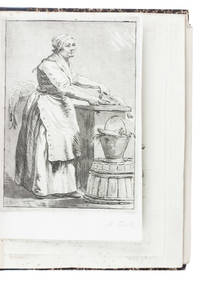
1818réf. 1418Rotterdam 1818. 4to or cut down folio. J. Immerzeel Mid-19th-century half maroon sheepskin chemical-marbled sides shell-marbled endpapers manuscript spine label. A series of 32 of 33 numbered full-page aquatint and stipple-engraved costume and profession prints engraved by Matthias de Sallieth after drawings made ca. 1790 by Perkois and Prins including folk musicians with their instruments. Lacking plate 5 which has been replaced by an aquatint of a woman cleaning fish by Hermanus Fock with his name in pencil at the foot. With 2 extra prints loosely inserted: colour-printed versions inked a la poupée of plates 20 and 25. 33 engr. ll. An aquatint and stipple-engraved print series of costumes and professions. They were drawn by Perkois 1756-1804 and Prins 1757-1806 ca. 1790 and engraved by Sallieth 1749-1791 as models for young artists to follow. The 1818 publication indicates that they had previously been issued individually but never before collected for publication in book form. The two loosely inserted prints have the exposed skin of the faces necks arms and hands printed in a soft shade of red with the rest in black inked a la poupée. With a tear in one plate not affecting the image repaired with tape 3 plates foxed and a few others with minor foxing but still in very good condition.l Cat. Kunsthist. Bibl. Rijksmuseum Amsterdam II p. 777; Colas 2311; Landwehr Colour plates 389; Lipperheide Gb 46 note. ABE CAT Art History ABE CAT Costumes & Uniforms unknown
réf. 201316041Paris, Librairie belin, 1961 ; in-8, 492 pp., br.
réf. 201311135Paris, Belin, 1965 ; in-8, 575 pp., br.
réf. 201200785Paris, Librairie classique eugene belin, 1952 ; in-8, 319 pp., br.
réf. 200802187Paris, Librairie belin, 1961 ; in-8, 492 pp., broché, couverture illustr.
réf. 7365London, Gordon Fraser, 1975, 1 vol. in-4 oblong (235 x 275) toilé sous jaquette illustrée, de 220 pp. Déchirures et pliures à la jaquette, bel exemplaire par ailleurs.
1719réf. F5OGBDYNZ8OAAmsterdam: Gerard Valk 1719. Very large engraved folding plan comprising 1 1/2 sheets measuring 46 x 83 cm as assembled engraved by Danckert Danckertsz. and his father after drawings by Jacob Vennekool including the two hemispheres of the world map and a celestial map of the constellations of the northern hemisphere each 10 cm in diameter. Very large engraved plan showing the extraordinary cartographic mosaic floor of the Burgerzaal of the Amsterdam City Hall designed by Jacob van Campen with a celestial map in the centre and the magnificent map of the world in 2 hemispheres on either side. The engraving was first published in 1661 and the map shows Tasman's recent discoveries in Australia and Tasmania and depicts California as an island. Many discoveries from his second voyage remained otherwise unpublished until the end of the 17th-century. This engraved representation is all that is left of this cartographical work of art. Wear caused by people walking on the mosaic meant it had to be restored about a hundred years later. When in turn this restoration was damaged the two hemispheres were filled in with plain marble slabs without pictorial representation.The drawing of the floor was made by Jacob Vennekool who worked closely with Van Campen and since his drawings were first published even before the building was completed they may reflect Van Campen's plan more closely than the finished building itself. They also of course show it before the alterations made at various times in later years.Slightly wrinkled in the right margin one fold reinforced and a few tiny spots otherwise in very good condition.l Cf. BAL 533 1st Dutch ed.; Fowler 77 & 274 1st Dutch ed.; Berlin Kat. 2235 1st French ed. Gerard Valk, unknown
réf. 201902578Zurich, Ben Gonrad Orell und Comp., 1740 ; in-12, cartonnage de l'éditeur. En très bon état qlq tampons de bibliothèque tome 2 seul bien complet.
réf. 4553Club Français du Livre. 1953. 3 tomes en 3 volumes in-8°, reliure pleine toile noire. 173 & 190 & 191 pages. Tirage numéroté hors commerce. Très propre.
réf. GF3980Lithographie format 37,5 x 25,5 cm marges comprises - Paris - Imprimerie Lemercier - vers 1880 -
1882réf. 70233Cincinnati:: Peter F. Thompson 1882. First edition. publisher's printed wrappers. A few tiny chips and slight use to wrappers; otherwise fine. . 12mo. Together with a small flyer on pick paper announcing an enlarged edition bound in cloth. Peter F. Thompson, unknown
1954réf. 39912Buenos Ayres: Aroysgegebn Durkh Di Ratner Landslayt Fareyen In Argentine Un Nord-Amerike 1954. Hardcover. 1st edition original cloth 8vo. 806 pages illustrations throughout. In Yiddish with a Spanish title page. “German soldiers first passed through Ratne at the end of June 1941 but Nazi rule was established in the town only in July. Between the retreat of the Soviets and the arrival of German security forces and administrators locals plundered Jewish homes and businesses. Shortly after the Germans arrived they shot 27 Jews and 30 Soviet prisoners of war. Acting through the Ukrainian police they also introduced an array of anti-Jewish measures: Jews had to wear identifying armbands later yellow patches comply with a curfew hand in valuables including ritual objects and provide forced labor. It was forbidden for Jews to speak to Ukrainians. As early as July 1941 Jews from the countryside were already being relocated to Ratne. In the spring of 1942 a ghetto was set up there. After a partisan raid on Ratne in June 1942 the Germans shot more than 110 Jews along with a few Ukrainians. The Destruction of the Jewish Community. In August the Germans recruited Ukrainian peasants from Prokhid to dig pits at a nearby sand lot. On August 26 the ghetto was “liquidated” by a unit from the Gestapo outpost in Brest supported by the local German Gendarmerie post and Ukrainian auxiliary police force. Although several hundred Jews fled before they could be taken to Prokhid. Many others hid in the ghetto. Most were eventually caught and murdered as well. Between 1 300 and 1 500 Jewish men women and children were killed during this operation. A few dozen skilled laborers were left alive and employed in a workshop. They were shot in February 1943.” protecting-memory.org 2018 SUBJECTS : Jews -- Ukraine -- Ratne. Holocaust Jewish 1939-1945 Ratno Ukraine -- Ethnic relations. OCLC: 38702086. Light wear on cover and spine page edges yellowed previous owner’s name and imprint on front end page. Good Condition Overall. Inscription on Spanish title page. YIZ-19-16A. Buenos Ayres: Aroysgegebn Durkh Di Rat?ner Landslayt? Fareyen In Argent?ine Un Nord-Amerik?e hardcover
réf. 8040LA NOUVELLE CRITIQUE, revue du marxisme militant, N° 24, mars 1951. In-12, broché.
réf. 10801La Parisienne, n° 2-39 [sauf 19 et 21], février 1953 - décembre 1956. 36 fascicules in-8, brochés.
réf. 12698La nouvelle revue française, n°91, 4/1921. In-8, broché.
réf. 12741La nouvelle revue française, n°175, 4/1928. In-8, broché.