Toorenvliet, JacobBiblio.com
54 699 résultats
réf. 1506135Contentum Ltd. Loose sheet. New. High-quality art print based on an original work from the Rijksmuseum. Created in the 17th century 1651. Professionally printed on premium fine-art paper Photo Matt Fibre in size A2. The artwork is printed with a white border museum-style presentation. Contentum Ltd. unknown
réf. 1506134Contentum Ltd. Loose sheet. New. High-quality art print based on an original work from the Rijksmuseum. Created in the 17th century 1651. Professionally printed on premium fine-art paper Museum Etching museum quality in size A3. The artwork is printed with a white border museum-style presentation. Contentum Ltd. unknown
réf. 0265383943.Ghardcover. Good. Access codes and supplements are not guaranteed with used items. May be an ex-library book. hardcover
1913355 p. + Frontis and full page plates. Publisher's device on title page. 8vo. Original full green cloth binding, gold lettered spine. Hardbound. First Edition. "The Haskalah, or Jewish Enlightenment, was an intellectual movement in Europe that lasted from approximately the 1770s to the 1880s. The Haskalah was inspired by the European Enlightenment but had a Jewish character. It encouraged Jews to study secular subjects, to learn both the European and Hebrew languages, and to enter fields such as agriculture, crafts, the arts and science. The maskilim (followers of the Haskalah) tried to assimilate into European society in dress, language, manners and loyalty to the ruling power. The Haskalah eventually influenced the creation of both the Reform and Zionist movements" - Shira Schoenberg. Some of its leaders in Russia were: Tobias Cohn; Isaac bar Levinsohn; Max Lilienthal; Alexander Zederbaum; Perez ben Mosheh Smolenskin; Moses Lob Lilienblum; and others. Very good copy. JUDAICA BOX 2
1913réf. URAIHAS00FBJewish Publication Society of America 1913. Very Good. Raisin Jacob S. The Haskalah Movement in Russia. Philadelphia: Jewish Publication Society of America 1913. 355pp. Indexed. Illustrated. Bibliography. 8vo. Cloth. Book condition: Very good. Jewish Publication Society of America hardcover books
réf. B9781016305822Hardback. New. hardcover
réf. 0364297557.Ghardcover. Good. Access codes and supplements are not guaranteed with used items. May be an ex-library book. hardcover
réf. 1451018940.Gpaperback. Good. Access codes and supplements are not guaranteed with used items. May be an ex-library book. paperback
réf. 6131402488Papeback. New. pp. 394 unknown
réf. 1023071266.Ghardcover. Good. Access codes and supplements are not guaranteed with used items. May be an ex-library book. hardcover
réf. 1347158804.Ghardcover. Good. Access codes and supplements are not guaranteed with used items. May be an ex-library book. hardcover
réf. 1426491549.Gpaperback. Good. Access codes and supplements are not guaranteed with used items. May be an ex-library book. paperback
réf. 3849522164.Ghardcover. Good. Access codes and supplements are not guaranteed with used items. May be an ex-library book. hardcover
réf. 1016305826.Ghardcover. Good. Access codes and supplements are not guaranteed with used items. May be an ex-library book. hardcover
réf. 1241094012.Gpaperback. Good. Access codes and supplements are not guaranteed with used items. May be an ex-library book. paperback
réf. 1597522554.Gpaperback. Good. Access codes and supplements are not guaranteed with used items. May be an ex-library book. paperback
réf. 384951188X.Gpaperback. Good. Access codes and supplements are not guaranteed with used items. May be an ex-library book. paperback
1913réf. bing105mm0005The Jewish Publication Society of America 1913. Hardcover. Very good. Prompt shipment with tracking. we ship in CLEAN SECURE NEW boxes Philadelphia: The Jewish Publication Society of America 1913. Hardcover no dust jacket. Clean pages. Tight binding. Bookplate on front free endpaper. 8vo. 355pp. The Jewish Publication Society of America hardcover
1913réf. 67024Philadelphia PA: The Jewish Publication Society of America 1913. Presumed first edition/first printing. Hardcover. Good. Bookplate on inside cover. Some pages uncut. Cover has some wear and soiling. Includes illustrations. Copyright is 1914 but date on title page is 1914. Notes. Bibliography. Index. From Wikipedia: "Haskalah the Jewish Enlightenment was a movement among European Jews in the 18th 19th centuries that advocated adopting enlightenment values pressing for better integration into European society and increasing education in secular studies Hebrew language and Jewish history. Haskalah in this sense marked the beginning of the wider engagement of European Jews with the secular world ultimately resulting in the first Jewish political movements and the struggle for Jewish emancipation. The division of Ashkenazi Jewry into religious movements or denominations especially in North America and anglophone countries began historically as a reaction to Haskalah. Leaders of the Haskalah movement were called Maskilim. In a more restricted sense haskalah can also denote the study of Biblical Hebrew and of the poetical scientific and critical parts of Hebrew literature. The term is sometimes used to describe modern critical study of Jewish religious books such as the Mishnah and Talmud when used to differentiate these modern modes of study from the methods used by Orthodox Jews. Haskalah differed from Deism of the European Enlightenment by seeking modernised philosophical and critical revision within Jewish belief and lifestyle acceptable for emancipation rights. Rejectionist tendencies within it led to assimilation motivating establishment of Reform and Neo-Orthodox denominations. Its outreach eastwards opposed resurgent mysticism and traditional scholarship. While early Jewish individuals such as Spinoza and Salomon Maimon advocated secular identity it remained until the late 19th century for secular Jewish ideologies to replace Judaism. In the 20th century Gershom Scholem reestablished the historical significance of Jewish mysticism dismissed by Haskalah historiography.Even as emancipation eased integration into wider society and assimilation prospered the haskalah also resulted in the creation of secular Jewish culture with an emphasis on Jewish history and Jewish identity rather than religion. This resulted in the engagement of Jews in a variety of competing ways within the countries where they lived; these included the struggle for Jewish emancipation involvement in new Jewish political movements and later in the face of continued persecutions in late nineteenth century Europe the development of a Jewish Nationalism. One source describes these effects as The emancipation of the Jews brought forth two opposed movements: the cultural assimilation begun by Moses Mendelssohn and Zionism founded by Theodor Herzl in 1896. One facet of the Haskalah was a widespread cultural adaptation as those Jews who participated in the enlightenment began in varying degrees to participate in the cultural practices of the surrounding Gentile population. Connected with this was the birth of the Reform movement whose founders such as Israel Jacobson and Leopold Zunz rejected the continuing observance of those aspects of Jewish law which they classified as ritual as opposed to moral or ethical. Even within orthodoxy the Haskalah was felt through the appearance of the Mussar Movement in Lithuania and Torah im Derech Eretz in Germany. Enlightened Jews sided with Gentile governments in plans to increase secular education among the Jewish masses bringing them into acute conflict with the orthodox who believed this threatened Jewish life. Another important facet of the Haskalah was its interests to non-Jewish religions. Moses Mendelssohn criticized some aspects of Christianity but depicted Jesus as a Torah-observant rabbi who was loyal to traditional Judaism. Mendelssohn explicitly linked positive Jewish views of Jesus with the issues of Emancipation and Jewish-Christian reconciliation. Similar revisionist views were expressed by Rabbi Isaac Ber Levinsohn and other traditional representatives of the Haskalah movement. The Jewish Publication Society of America hardcover
réf. 1020905077.Ghardcover. Good. Access codes and supplements are not guaranteed with used items. May be an ex-library book. hardcover
réf. 1584560584.Ghardcover. Good. Access codes and supplements are not guaranteed with used items. May be an ex-library book. hardcover
réf. B9781020905070Hardback. New. hardcover
réf. 0978659856.Gperfect. Good. Access codes and supplements are not guaranteed with used items. May be an ex-library book. unknown
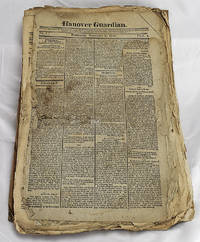
1818réf. 2603240008Hanover Guardian; Joseph Schmuck Hanover Pa 1818. Magazines & Periodicals. Good. A large run of an very early newspaper from York County Pennsylvania from James Monroe's Presidency. 62 issues printed on four pages 248 pages total. Unbound. Some minor stains but generally a clean and legible collection. The first issue has a tear at the center with some loss. The second issue has a closed tear at the rear page. Includes v.1. complete in 52 issues Sept 2 1818 - Aug. 25 1819; v.2. 6 issues 1819: no. 60 Oct 20 no.62 Nov. 3 no.65 Nov. 24 no.66 Dec 1 no.68 Dec 15 no.72 Jan 12 1820; v.3. 4 issues from 1820: no. 108 Sept. 27 no. 111 Oct. 18 no. 113 Nov. 1 115 Nov. 15. "Weekly. Established in August 1818 by Jacob H. Wiestling with the title of the "Guardian." In 1819 he sold the paper to Joseph Schmuck who continued it until after 1820 J. Gibson "History of York County" 1886 p. 382." - American Antiquarian Society. Includes advertisements for agricultural products real estate sales political news international news Revolution in e.g. Sicily Spain; local Democratic York county politics; support for President James Monroe; and many interesting news articles. One very interesting front page piece from the York's Democratic party includes resolutions against Gov. Joseph Hiester. The York Democrats opposed him because he voted against the gradual abolition of slavery in Pennsylvania "that curse and stigma on humanity; he also voted in effect in favor of slave trade against the punishment of kidnappers." An interesting early pro-abolitionist opinion from rural Pennsylvania. Includes James Monroe's 1819 message to Congress on the State of the Union. Also prints accounts of local murders and other crimes. Hanover Guardian; Joseph Schmuck, Hanover, Pa unknown
1970réf. 210722113American Jewish Archives 1970-01-01. Paperback. Like New. Signed by author American Jewish Archives paperback