Jacob OrshalickBiblio.com
56 487 résultats
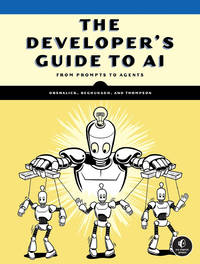
réf. A9781718504769Paperback / softback. New. Working developers everywhere now use AI tools but most still struggle to turn prompts and prototypes into reliable software features. The Developer's Guide to AI teaches engineers how to build real maintainable AI capabilities using the tools they already know-JavaScript Python APIs vector search and simple agent workflows without advanced math or machine learning. Readers learn where AI belongs in an application how to design around real-world constraints like latency and cost and how to avoid the brittle prototypes that fail under changing requirements. With clear examples and production-focused patterns this book helps developers ship AI features that last. paperback
2026réf. __1718504764No Starch Press 2026. Paperback. New. 336 pages. 9.25x7.00x9.19 inches. No Starch Press paperback
réf. 1410214729.Gpaperback. Good. Access codes and supplements are not guaranteed with used items. May be an ex-library book. paperback
1989réf. 79450Washington DC: United States Air Force Office of Air Force History 1989. Presumed First Edition First printing. Hardcover. Good/Good. xiii 3 409 1 pages. Photographs. Charts. Tables. Appendices. Notes. Glossary. Bibliographic Notes. Index. DJ is in a plastic sleeve is taped around the boards and has slight wear soiling and small edge tear. This is one of the Air Force's General Histories series. Jacob "Jack" Neufeld was the Director of the Air Force Historical Studies Office. He previously served as Senior Historian and was the Director of the Center for Air Force History. Mr. Neufeld was also the editor of Air Power History the quarterly journal of the Air Force Historical Foundation. He earned B.A. and M.A. degrees in history at the New York University and did doctoral studies at the University of Massachusetts Amherst. The author was the Chief of the Headquarters USAF Branch Office of Air Force History. He became an Air Force historian in 1967 starting with the Eighth Air Force. Throughout his varied assignments in the Office of Air Force History he has specialized in the history of aerospace technology Following World War II the onset of nuclear weapons long-range jet bombers and ballistic missiles radically changed American foreign policy and military strategy. The United States Air Force led by men of far-sighted vision and uncommon dedication accepted the challenge of organizing and leading a massive research and development effort to build ballistic missiles. In the quarter of the century since these weapons have constituted one of the tree legs of the strategic triad the basis of America's strategy of deterring nuclear war yet they have received less attention from the public and within the Air Force than the more glamorous manned bombers of the Strategic Air Command or the missile-launching submarines of the U.S. Navy. This volume attempts to correct the imbalance by telling the story of development of Air Force ballistic Missiles. It concentrates on the first generation of ballistic missiles: the intercontinental Atlas and Titan and the intermediate range Thor. Although the effort to develop rockets has a longer history than commonly assumed the modern history spans the relatively short era from 1945 to 1960. During this brief interval missiles advanced from drawing board to alert status where the next generation now remains poised to deter war. A ballistic missile follows a ballistic trajectory to deliver one or more warheads on a predetermined target. These weapons are guided only during relatively brief periods—most of the flight is unpowered. Short-range ballistic missiles stay within the Earth's atmosphere while intercontinental ballistic missiles ICBMs are launched on a sub-orbital trajectory. These weapons are in a distinct category from cruise missiles which are aerodynamically guided in powered flight. The earliest form of ballistic missiles dates from the 13th century with its use derived from the history of rockets. In the 14th century the Ming Chinese navy used an early form of a ballistic cruise missile weapon called the Huo long chu shui in naval battles against enemy ships. A modern pioneer ballistic missile was the A-4 commonly known as the V-2 developed by Nazi Germany in the 1930s and 1940s under the direction of Wernher von Braun. The first successful launch of a V-2 was on October 3 1942 and it began operation on September 6 1944 against Paris followed by an attack on London two days later. By the end of World War II in Europe in May 1945 more than 3000 V-2s had been launched. The course taken by ballistic missiles has two significant desirable properties. First ballistic missiles that fly above the atmosphere have a much longer range than would be possible for cruise missiles of the same size. Powered rocket flight through thousands of kilometers of air would require vastly greater amounts of fuel making the launch vehicles larger and easier to detect and intercept. Powered missiles that can cover similar ranges such as cruise missiles do not use rocket motors for the majority of their flight but instead use more economical jet engines. However cruise missiles have not made ballistic missiles obsolete due to the second major advantage: ballistic missiles can travel extremely quickly along their flight path. An ICBM can strike a target within a 10000 km range in about 30 to 35 minutes.citation needed With terminal speeds of over 5000 m/s ballistic missiles are much harder to intercept than cruise missiles due to the much shorter time available. Therefore ballistic missiles are some of the most feared weapons available despite the fact that cruise missiles are cheaper more mobile and more versatile. The R-7 Semyorka was the first intercontinental ballistic missile. United States Air Force, Office of Air Force History hardcover
1990réf. 0101861990. Soft Cover. Very Good. Publisher: United States Air Force 1990 V.Good Soft Cover ISBN: 0-912799-62-5 paperback
1990réf. 90575San Bernardino CA: Progressive Management Publications 1990. Presumed First Edition First printing. Trade paperback. Very good. 286 2 pages. Illustrations. Chapter Notes. Appendices. Notes Glossary. Bibliographic Note. Front cover has some curving. Jacob "Jack" Neufeld had been Editor Emeritus of Air Power History. Over the course of his long and distinguished career Jack left his mark on three decades of Air Force historical research writing and publishing from as early as 1970 through his two retirements first from the Air Force history program in 2006 and second from editorship of this magazine in 2014. After his Masters degree Jake was commissioned in the U.S. Army and served with the Corps of Engineers at Ft. Campbell Kentucky and Ft. Belvoir Virginia from 1964 to 1966. After his Army service he joined the Air Force History program in 1967 serving initially at HQ Eighth Air Force SAC. While there he completed all of the course work for a doctoral degree at the University of Massachusetts Amherst in American studies. In 1970 Jack chose to transfer to the Office of Air Force History in Washington D.C. He remained assigned to that office until retiring in 2006. After this retirement he continued to edit Air Power History until 2014 completing twenty-one years of leadership. A gifted researcher writer and editor Jack wrote or edited numerous scholarly works in military history and the history of technology including The Development of Ballistic Missiles in the United States Air Force 1945-1960. In all he had more than a dozen works to his name. He was an adjunct professor of history at American Military University Montgomery College and the University of Maryland. Following World War II the onset of nuclear weapons long-range jet bombers and ballistic missiles radically changed American foreign policy and military strategy. The U.S. Air Force led by men of far-sighted vision and uncommon dedication accepted the challenge of organizing and leading a massive research and development effort to build ballistic missiles. In the quarter of a century since these weapons have constituted one of the three legs of the strategic triad -- the basis of Americas strategy of deterring nuclear war -- yet they have received less attention from the public and within the Air Force than the more glamorous manned bombers of the Strategic Air Command or the missile-launching submarines of the U.S. Navy. This volume attempts to correct the imbalance by telling the story of the development of Air Force ballistic missiles. It concentrates on the first generation of ballistic missiles the intercontinental Atlas and Titan and the intermediate-range Thor. Although the effort to develop rockets has a longer history than commonly assumed the modern history spans the relatively short era from 1945 to 1960. During this brief interval missiles advanced from drawing board to alert status where the next generation now remains poised to deter war. The author describes the difficulties involved in the technological competition with the Soviets to be first to develop and deploy a ballistic missile force. With innovative leadership the Air Force succeeded also in overcoming conflict with the Army and Navy budgetary constraints administrative complications and of course formidable engineering problems. Progressive Management Publications paperback
2026réf. 9781718504769No Starch Press 2026 Book. New. Paperback. No Starch Press paperback
réf. ING9781718504769No Starch Press. New. Special order direct from the distributor No Starch Press unknown
1969réf. 011106E. P. Dutton & Co. First US Edition. Hardcover. Condition: Fine. Dust Jacket: Near Fine with slight crackling in top corners and to top edges. Bright orange with bright black and blue lettering. . Fine. Hardcover. 1st Edition. 1st Printing. 1969. E. P. Dutton & Co hardcover
réf. 6288879Springer . Hardback. New. pp. 220 Springer hardcover
réf. 63066059Springer . Papeback. New. pp. 218 Springer unknown
2005réf. 1050Hardback with pictorial cover 2004 pages NEAR FINE Kluwer Academic hardcover
2004réf. Q-1402076665Springer 2004-12-07. Hardcover. New. In shrink wrap. Looks like an interesting title! Springer hardcover
réf. 1022118579.Gpaperback. Good. Access codes and supplements are not guaranteed with used items. May be an ex-library book. paperback
réf. 1020876344.Ghardcover. Good. Access codes and supplements are not guaranteed with used items. May be an ex-library book. hardcover
réf. 054869074X.Gpaperback. Good. Access codes and supplements are not guaranteed with used items. May be an ex-library book. paperback
réf. 1449762085.Ghardcover. Good. Access codes and supplements are not guaranteed with used items. May be an ex-library book. hardcover
réf. 6131551059Hardback. New. pp. 246 hardcover
2015réf. Gyan-9789333643788Facsimile Publisher 2015. Hardcover. New. 28.94 x 22.59 x 6.84 cm. English Facsimile Publisher hardcover
2015réf. Gyan-9789333444729Facsimile Publisher 2015. Paperback. New. x x 4.788 cm. English Facsimile Publisher paperback
2015réf. Gyan-9789333643788Facsimile Publisher 2015. Hardcover. New. 28.94 x 22.59 x 6.84 cm. English Facsimile Publisher hardcover
2015réf. Gyan-9789333444729Facsimile Publisher 2015. Paperback. New. x x 4.788 cm. English Facsimile Publisher paperback
réf. 0979398177.Gpaperback. Good. Access codes and supplements are not guaranteed with used items. May be an ex-library book. paperback
2012réf. 5842372Springer 2012. This is an ex-library book and may have the usual library/used-book markings inside.This book has hardback covers. In fair condition suitable as a study copy. No dust jacket. Please note the Image in this listing is a stock photo and may not match the covers of the actual item1700grams ISBN:9789400713147 Springer hardcover
réf. 12535745-nnew. unknown