988 résultats
2001réf. 51991Bern Switzerland: Verlag Hans Huber. New. 2001. Paperback. 3456836465 . FREE UPGRADE to Courier/Priority Shipping Upon Request IN STOCK AND IMMEDIATELY AVAILABLE FOR SHIPMENT - Flawless copy brand new pristine never opened - Text in German. 171 pages. -- with a bonus offer . Verlag Hans Huber paperback
2003A portfolio of 51 haunting original etchings by Hanif Lehmann printed on extremely fine, thick wove paper, with 12 pages of relevant text excerpts from Dante's Inferno in German, as translated by Stefan George. ONE OF ONLY FIVE COPIES OF THE LARGE FOLIO EDITION WITH ALL OF THE ETCHINGS SIGNED, JUSTIFIED, AND TITLED BY THE ARTIST (in the regular edition, limited to 25 copies, there are only 48 etchings, and they are not signed). Each of these five copies was printed for a specific collector, named in the printed justification: this copy was printed for a well-known Italian opera singer. The justification is also signed by the artist. The brooding portrait of Dante (the frontispiece) in this copy is the very first impression taken from the plate, and is justified as such ("Erstabzug"). Large folio (47.2 cm). Loose as issued in the original, gorgeously-produced cloth and board folding case. FINE AND BRIGHT, WITH NO DEFECTS. Hanif Lehmann
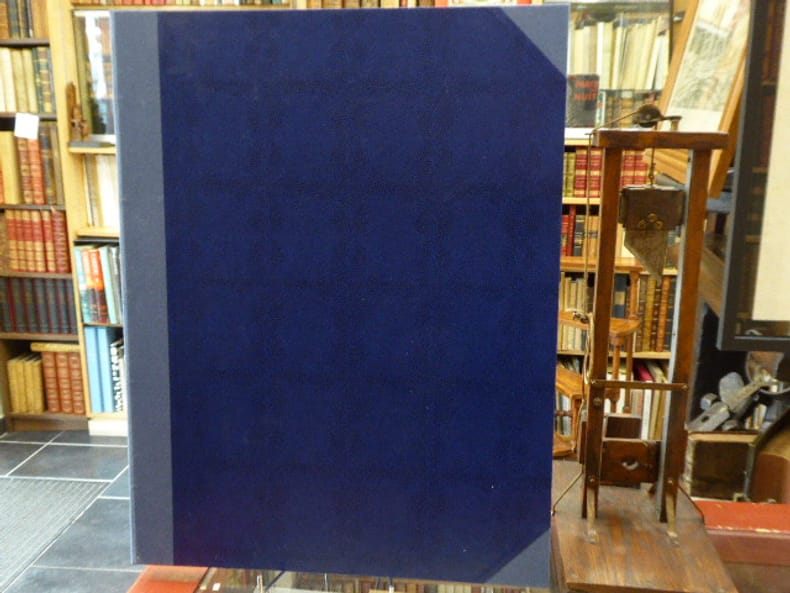
réf. 354239Au Dépôt Général De La Marine S.L. 1831 Grand in-folio ( 675 X 525 mm ), demi-toile bleue à coins, plats de percaline maroquinée. Exemplaire complet de son feuillet d'index gravé et de ses 32 cartes gravées -majoritairement marines- dont 8 sur double page ( dont carte générale de la Corse ) et montées sur onglet. EDITION ORIGINALE. Rousseurs passim et petite mouillure claire en marge intérieure. Bon exemplaire. TRES RARE. Cervoni, Image de la Corse, 138.
2006La Divina Commedia di Alfonso d'Aragona (Divine Comedy of Alfonso of Aragon). Londra, British Library, Ms. Yates Thompson 36. Sontuoso manoscritto miniato della Divina Commedia di Dante Alighieri. Realizzato a cavallo del XV secolo, nel nord Italia, da due maestri miniatori: Priamo della Quercia e Giovanni de Paolo. Illustrato con 110 miniature inquadriate nei margini inferiori, tre grandi iniziali istoriate con cornici floreali all’inizio dei tre canti, numerose iniziali foliate e tutte le iniziali delle strofe minori delimitate con colori intensi e dorature splendenti. Legatura in velluto di seta con borchie e medaglione centrale e bindelle di chiusura. Formato 26x37 cm. Pagine 380 (190 fogli). Commentario, in due volumi (formato 25x32 cm. 340 pagine totali), a cura di Milvia Bollati. Pregiato cofanetto di custodia. Tiratura limitata e numerata a 750 copie. Condizioni ottime.
réf. 554791New York: Genesis : Grasp Press 1971. Softcover. Fine. First edition. Oblong 24mo. Light blue stapled wrappers. Fine. With the original Genesis : Grasp mailing envelope addressed to poet Clark Coolidge. Also included is a Typed Letter Signed from Richard Meyers a.k.a. Richard Hell to Coolidge dated December 28 1970 mimicing the cover illustrations. The letter informs Coolidge that the press has accepted four of his poems we assume for inclusion in Genesis : Grasp 4 and presents this copy of Uh which is to be the subscriber supplement #5: "I thought you might like it. It's going to be lying around here in packages deteriorating for the two months or so it will take us to raise money and print the issue." The first book by the influential musician and writer Richard Hell published under the pseudonym Ernie Stomach. An artist's flip-book that utilized an alphabet specially created by Hell and published in an edition of 500 copies with 470 trade copies and with 30 numbered and signed by the author. A mystifyingly uncommon book which despite the stated limitation is the only copy we've seen. Genesis : Grasp Press unknown
réf. 554791New York: Genesis : Grasp Press 1971. Softcover. Fine. First edition. Oblong 24mo. Light blue stapled wrappers. Fine. With the original Genesis : Grasp mailing envelope addressed to poet Clark Coolidge. Also included is a Typed Letter Signed from Richard Meyers a.k.a. Richard Hell to Coolidge dated December 28 1970 mimicing the cover illustrations. The letter informs Coolidge that the press has accepted four of his poems we assume for inclusion in Genesis : Grasp 4 and presents this copy of Uh which is to be the subscriber supplement #5: "I thought you might like it. It's going to be lying around here in packages deteriorating for the two months or so it will take us to raise money and print the issue." The first book by the influential musician and writer Richard Hell published under the pseudonym Ernie Stomach. An artist's flip-book that utilized an alphabet specially created by Hell and published in an edition of 500 copies with 470 trade copies and with 30 numbered and signed by the author. A mystifyingly uncommon book which despite the stated limitation is the only copy we've seen. Genesis : Grasp Press unknown books
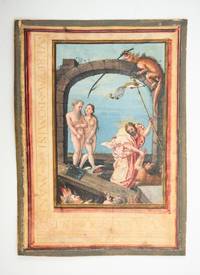
1540réf. ST20622Germany ca. 1540. 183 x 133 mm. 7 1/8 x 5 1/4". WITH A FULL-PAGE MINIATURE DEPICTING THE HARROWING OF HELL featuring a naked Adam and Eve on the left and on the right Christ bending down to rescue John the Baptist the figures framed by a stone archway supporting a hairy creature who aims the point of a spear directly at Adam and Eve the miniature in a thin brown frame with gilt lines surrounded on two sides by the words "VERBUM DOMINI MANET IN ETERNUM" in gilt all framed in gray and red washes with double rules of black and gilt. Light soiling to frame a little flaking to the gray border and a couple of small scuffs and smudges elsewhere verso with spotting but the miniature vibrant and well preserved with only very trivial imperfections. A close copy of an early 16th century engraving by Albrecht Dürer this powerful miniature depicting the Harrowing of Hell is an intriguing artifact that ties together manuscript art print culture and the Reformation. The image depicts an apocryphal tale in the Gospel of Nicodemus in which Christ following his death but before his Resurrection descends into Limbo in order to save righteous souls who had passed away before him particularly figures from the Old Testament. Christ appears here in pale pink robes carrying a long staff with a cross and banner adorning the top. Having just brought down the gates of Hell he stoops to rescue John the Baptist here dressed in furs from its depths. A naked Adam and Eve covering their loins stand at the left of the composition--Adam now a gray-bearded old man as a reflection of sin and mortality but Eve still as she was at the Expulsion in keeping with the period's inclination to retain the classically idealized youthful feminine form. Above them is a stone arch upon which a dog-like demon perches stealthily aiming a spear directly at the oblivious couple. Another demon snaps its jaws at the feet of Christ and we can see a lick of flames below the broken gate as more captive souls clamor to escape. The painting is skillfully done showing the artist's facility with anatomy proportion and foreshortening. The bodies of Adam and Eve are particularly excellent with lovely skin tones and convincing molding. The composition is clearly based on an engraving by Dürer published in 1513 as part of a major series of 16 images known as the "Engraved Passion." In translating a black & white print into a full-color painting the artist here dispensed with a few details seen in Dürer's work such as the shadowy figure behind Adam and Eve and the stigmata on Christ's hand; however the overall composition deviates little from the original suggesting that the artist may have been working from an actual engraving. Although this leaf contains just a few words in the form of a border inscription--"Verbum Domini manet eternum" "the Word of the Lord endures forever"--they are monumentally important. This line from Isaiah 40:8 and 1 Peter 1:25 became the motto of the Lutheran Reformation appearing on art clothing coins and even armor of the 16th century. The Schmalkaldic League an influential group of allied Lutheran principalities in the Holy Roman Empire at the time also adopted it as their motto. Given the dominance of print materials during the Reformation period our hand-painted miniature--possibly produced as a frontispiece--must have been a very special commission. It is also an object that is prime for further study touching on aspects of book production religious art and the transmission of images and ideas in the early modern period. unknown
1540réf. ST20622Germany ca. 1540. 183 x 133 mm. 7 1/8 x 5 1/4". WITH A FULL-PAGE MINIATURE DEPICTING THE HARROWING OF HELL featuring a naked Adam and Eve on the left and on the right Christ bending down to rescue John the Baptist the figures framed by a stone archway supporting a hairy creature who aims the point of a spear directly at Adam and Eve the miniature in a thin brown frame with gilt lines surrounded on two sides by the words "VERBUM DOMINI MANET IN ETERNUM" in gilt all framed in gray and red washes with double rules of black and gilt. Light soiling to frame a little flaking to the gray border and a couple of small scuffs and smudges elsewhere verso with spotting but the miniature vibrant and well preserved with only very trivial imperfections. A close copy of an early 16th century engraving by Albrecht Dürer this powerful miniature depicting the Harrowing of Hell is an intriguing artifact that ties together manuscript art print culture and the Reformation. The image depicts an apocryphal tale in the Gospel of Nicodemus in which Christ following his death but before his Resurrection descends into Limbo in order to save righteous souls who had passed away before him particularly figures from the Old Testament. Christ appears here in pale pink robes carrying a long staff with a cross and banner adorning the top. Having just brought down the gates of Hell he stoops to rescue John the Baptist here dressed in furs from its depths. A naked Adam and Eve covering their loins stand at the left of the composition--Adam now a gray-bearded old man as a reflection of sin and mortality but Eve still as she was at the Expulsion in keeping with the period's inclination to retain the classically idealized youthful feminine form. Above them is a stone arch upon which a dog-like demon perches stealthily aiming a spear directly at the oblivious couple. Another demon snaps its jaws at the feet of Christ and we can see a lick of flames below the broken gate as more captive souls clamor to escape. The painting is skillfully done showing the artist's facility with anatomy proportion and foreshortening. The bodies of Adam and Eve are particularly excellent with lovely skin tones and convincing molding. The composition is clearly based on an engraving by Dürer published in 1513 as part of a major series of 16 images known as the "Engraved Passion." In translating a black & white print into a full-color painting the artist here dispensed with a few details seen in Dürer's work such as the shadowy figure behind Adam and Eve and the stigmata on Christ's hand; however the overall composition deviates little from the original suggesting that the artist may have been working from an actual engraving. Although this leaf contains just a few words in the form of a border inscription--"Verbum Domini manet eternum" "the Word of the Lord endures forever"--they are monumentally important. This line from Isaiah 40:8 and 1 Peter 1:25 became the motto of the Lutheran Reformation appearing on art clothing coins and even armor of the 16th century. The Schmalkaldic League an influential group of allied Lutheran principalities in the Holy Roman Empire at the time also adopted it as their motto. Given the dominance of print materials during the Reformation period our hand-painted miniature--possibly produced as a frontispiece--must have been a very special commission. It is also an object that is prime for further study touching on aspects of book production religious art and the transmission of images and ideas in the early modern period. unknown books
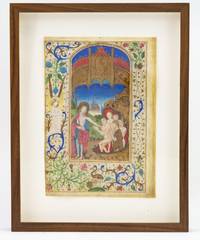
1470réf. ST17764Delft ca. 1470. Leaf: 175 x 122 mm. 6 7/8 x 4 3/4"; Frame: 250 x 195 mm. 9 3/4 x 7 3/4". No text on recto or verso. In an attractive wooden frame. A FINELY PAINTED MINIATURE OF THE HARROWING OF HELL within an arch-topped compartment the mouth of hell depicted on the left with a fiery red interior and five people emerging from it the figure of Christ on the left holding a cross on a long staff and half-clothed in a pink and blue robe the background with a castle in the distance ALL OF THIS BENEATH A VERY DETAILED ARCHITECTURAL CANOPY suspended in the sky AND THE WHOLE WITHIN A FULL BORDER of acanthus leaves and other foliage and flowers in reds blues greens yellows and brushed gold along with very many small burnished gold ivy leaves and buds on hairline stems a small stork in the bottom border and a large delicately shaded angel in the left border. ◆Left margin trimmed very close to decoration just escaping loss and the other three margins ample mild darkening right at fore and tail edge but not reaching into borders otherwise IN FINE CONDITION the colors rich and true and the burnished gold still shimmering. This extraordinary miniature notable for its uncommon subject matter memorable imagery and fine workmanship was produced by a talented artist belonging to the stylistic group known as the Masters of the Delft Half-Length Figures. The subject here is infrequently depicted in Books of Hours: the Harrowing of Hell appears as a full-page miniature in only three of the 119 prayer books described by Roger Wieck in his "Time Sanctified" and three others contain a Harrowing depiction inside an initial. Christian theological tradition tells us that after his crucifixion Christ went to liberate souls from Limbo--a location inhabited by those barred from entry into Heaven because they died before the Redemption. In our scene Christ wrapped in a regal cloak and carrying a long staff his hands and feet still bleeding from the wounds he received on the Cross reaches into an absolutely wonderful Hellmouth to extricate Adam and Eve and other naked souls while the recently deceased and original saint John the Baptist still clad in an animal skin garment waits patiently for his turn to emerge. The great maw of Hell as depicted here has bulging eyes a distended snout thickly matted hair and a bad complexion; his gaping mouth punctuated by sharp gray teeth glows red hot and one can tell from the creature's expression that he is loath to comply with this rescue of souls. In addition to its compelling subject matter there is a high level of artistic achievement here including delicately molded figures impressively detailed architectural elements and a lovely color palette. The elegance and quiet sophistication observed in this miniature distinguishes the artist responsible for this work as a particularly talented member of his circle. Active from about 1450-80 the Masters of the Delft Half-Length Figures were named by James Marrow after the angels and other figures whose upper bodies are typically found emerging from a cloud within the borders. Although the present leaf uncharacteristically contains a full-length angel in the border it shares other stylistic similarities such as the elaborate architectural canopy hovering over the main composition; and it particularly resembles the work of the artist of Keble College MS 77 an illuminator described in "The Golden Age of Dutch Manuscript Illumination" as "one of the more articulate of the group" whose "figures are more fully modelled and his palette . . . deeper and brighter" than that of his contemporaries. Because the subject of the present miniature goes beyond the standard image program seen in routine productions and because of the high level of artistic accomplishment seen here this leaf was almost certainly part of an elaborate Book of Hours produced in response to an important commission. unknown
1470réf. ST17764Delft ca. 1470. Leaf: 175 x 122 mm. 6 7/8 x 4 3/4"; Frame: 250 x 195 mm. 9 3/4 x 7 3/4". No text on recto or verso. In an attractive wooden frame. A FINELY PAINTED MINIATURE OF THE HARROWING OF HELL within an arch-topped compartment the mouth of hell depicted on the left with a fiery red interior and five people emerging from it the figure of Christ on the left holding a cross on a long staff and half-clothed in a pink and blue robe the background with a castle in the distance ALL OF THIS BENEATH A VERY DETAILED ARCHITECTURAL CANOPY suspended in the sky AND THE WHOLE WITHIN A FULL BORDER of acanthus leaves and other foliage and flowers in reds blues greens yellows and brushed gold along with very many small burnished gold ivy leaves and buds on hairline stems a small stork in the bottom border and a large delicately shaded angel in the left border. ◆Left margin trimmed very close to decoration just escaping loss and the other three margins ample mild darkening right at fore and tail edge but not reaching into borders otherwise IN FINE CONDITION the colors rich and true and the burnished gold still shimmering. This extraordinary miniature notable for its uncommon subject matter memorable imagery and fine workmanship was produced by a talented artist belonging to the stylistic group known as the Masters of the Delft Half-Length Figures. The subject here is infrequently depicted in Books of Hours: the Harrowing of Hell appears as a full-page miniature in only three of the 119 prayer books described by Roger Wieck in his "Time Sanctified" and three others contain a Harrowing depiction inside an initial. Christian theological tradition tells us that after his crucifixion Christ went to liberate souls from Limbo--a location inhabited by those barred from entry into Heaven because they died before the Redemption. In our scene Christ wrapped in a regal cloak and carrying a long staff his hands and feet still bleeding from the wounds he received on the Cross reaches into an absolutely wonderful Hellmouth to extricate Adam and Eve and other naked souls while the recently deceased and original saint John the Baptist still clad in an animal skin garment waits patiently for his turn to emerge. The great maw of Hell as depicted here has bulging eyes a distended snout thickly matted hair and a bad complexion; his gaping mouth punctuated by sharp gray teeth glows red hot and one can tell from the creature's expression that he is loath to comply with this rescue of souls. In addition to its compelling subject matter there is a high level of artistic achievement here including delicately molded figures impressively detailed architectural elements and a lovely color palette. The elegance and quiet sophistication observed in this miniature distinguishes the artist responsible for this work as a particularly talented member of his circle. Active from about 1450-80 the Masters of the Delft Half-Length Figures were named by James Marrow after the angels and other figures whose upper bodies are typically found emerging from a cloud within the borders. Although the present leaf uncharacteristically contains a full-length angel in the border it shares other stylistic similarities such as the elaborate architectural canopy hovering over the main composition; and it particularly resembles the work of the artist of Keble College MS 77 an illuminator described in "The Golden Age of Dutch Manuscript Illumination" as "one of the more articulate of the group" whose "figures are more fully modelled and his palette . . . deeper and brighter" than that of his contemporaries. Because the subject of the present miniature goes beyond the standard image program seen in routine productions and because of the high level of artistic accomplishment seen here this leaf was almost certainly part of an elaborate Book of Hours produced in response to an important commission. unknown books
réf. 14544In 8 demi chagrin marron à nerfs, titre, filets caissons dorés, plats percaline chagrinée marron, filets à froid en encadrement. Faux-titre, frontispice portrait de DANTE, sous serpente, titre, VI, 635 pages, 1 feuillet d’errata, 4 gravures sur acier hors texte.150x225mm, poids 1kg. Paris Librairie d’Adrien Le Clerc & Cie 1841.Edition originale. Rousseurs en début et fin de volume ainsi qu’à certaines pages, selon la qualité du papier.
1976A CURA DI CESARE SEGRE INTRODUZIONE DI LANFRANCO CARRETTI EINAUDI RICCIARDI 1976 287 PP. SEGNI DEL TEMPO, TRACCE DI POLVERE AI TAGLI, BUONE CONDIZIONI GENERALI.