981 risultati
2013rif. 12046New York: Metropolitan Museum of Art 2013. First Edition/No DJ as issued. Hardcover. Near Fine. First Edition/No DJ as issued. Hardcover. From the Collection of Jenny Lens. Catalog for the Metropolitan Museum of Art Costume Institute's exhibition on punk fashion featuring essays on punk performers Richard Hell and John Lydon richly illustrated. Light shelfwear else tight bright and unmarred. Black paper over boards. Black pictorial endpapers. 4to 240pp b/w color illus. Matte paper. Metropolitan Museum of Art hardcover books
2007rif. 13531New York: CUZ Editions 2007. First Edition Thus. Original Wraps. Near Fine in Wraps. First Edition Thus. Original Wraps. The first compiled edition consists of 250 copies 50 of which were numbered and signed by author. This copy un-numbered but includes the inscription on title page. 'or "Sailing with Hermes" for Joshua Richard Hell NYC 2007'. A handsome copy. Discrete tiny crease in bottom front wrapper minor shelf/edge wear else tight bright and unmarred.Glossy white staplebound warps gold lettering np. 8.5x11. Inscribed and dated by the author. CUZ Editions unknown books
rif. 554791New York: Genesis : Grasp Press 1971. Softcover. Fine. First edition. Oblong 24mo. Light blue stapled wrappers. Fine. With the original Genesis : Grasp mailing envelope addressed to poet Clark Coolidge. Also included is a Typed Letter Signed from Richard Meyers a.k.a. Richard Hell to Coolidge dated December 28 1970 mimicing the cover illustrations. The letter informs Coolidge that the press has accepted four of his poems we assume for inclusion in Genesis : Grasp 4 and presents this copy of Uh which is to be the subscriber supplement #5: "I thought you might like it. It's going to be lying around here in packages deteriorating for the two months or so it will take us to raise money and print the issue." The first book by the influential musician and writer Richard Hell published under the pseudonym Ernie Stomach. An artist's flip-book that utilized an alphabet specially created by Hell and published in an edition of 500 copies with 470 trade copies and with 30 numbered and signed by the author. A mystifyingly uncommon book which despite the stated limitation is the only copy we've seen. Genesis : Grasp Press unknown books
rif. 170808005New York: Dot Books 1973. First Edition. Paperback. First edition. Signed by Richard Hell on fake author bio at front: "March 15 1996 For Marlene to improve her library heh heh xxx Theresa Stern Richard." 32pp. with one page publisher list at rear. Illustrated black stiff wraps. An unread copy Fine with the faintest edge-rubbing to wraps. Musician and writer Richard Meyers AKA Hell's first book co-written with his Neon Boys and Television bandmate Tom Miller AKA Verlaine under a pseudonym. Proto-punk poetry from the New York streets rare signed. Dot Books paperback books
1988rif. 2092First Edition. 67-99 pp. each black toner on white commercial stock in stiff printed wrappers. Occasional illustrations. 8vo. Very good. Minor spotting toning handling marks to wrappers interiors clean and bright. 2092 Complete run of Richard Hell's literary magazine sponsored by The Poetry Project at St. Mark's with contributions from across the downtown NYC scene including David Wojnarowicz Eileen Myles Rene Ricard Hell himself and many others. The Poetry Project books
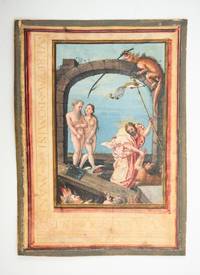
1540rif. ST20622Germany ca. 1540. 183 x 133 mm. 7 1/8 x 5 1/4". WITH A FULL-PAGE MINIATURE DEPICTING THE HARROWING OF HELL featuring a naked Adam and Eve on the left and on the right Christ bending down to rescue John the Baptist the figures framed by a stone archway supporting a hairy creature who aims the point of a spear directly at Adam and Eve the miniature in a thin brown frame with gilt lines surrounded on two sides by the words "VERBUM DOMINI MANET IN ETERNUM" in gilt all framed in gray and red washes with double rules of black and gilt. Light soiling to frame a little flaking to the gray border and a couple of small scuffs and smudges elsewhere verso with spotting but the miniature vibrant and well preserved with only very trivial imperfections. A close copy of an early 16th century engraving by Albrecht Dürer this powerful miniature depicting the Harrowing of Hell is an intriguing artifact that ties together manuscript art print culture and the Reformation. The image depicts an apocryphal tale in the Gospel of Nicodemus in which Christ following his death but before his Resurrection descends into Limbo in order to save righteous souls who had passed away before him particularly figures from the Old Testament. Christ appears here in pale pink robes carrying a long staff with a cross and banner adorning the top. Having just brought down the gates of Hell he stoops to rescue John the Baptist here dressed in furs from its depths. A naked Adam and Eve covering their loins stand at the left of the composition--Adam now a gray-bearded old man as a reflection of sin and mortality but Eve still as she was at the Expulsion in keeping with the period's inclination to retain the classically idealized youthful feminine form. Above them is a stone arch upon which a dog-like demon perches stealthily aiming a spear directly at the oblivious couple. Another demon snaps its jaws at the feet of Christ and we can see a lick of flames below the broken gate as more captive souls clamor to escape. The painting is skillfully done showing the artist's facility with anatomy proportion and foreshortening. The bodies of Adam and Eve are particularly excellent with lovely skin tones and convincing molding. The composition is clearly based on an engraving by Dürer published in 1513 as part of a major series of 16 images known as the "Engraved Passion." In translating a black & white print into a full-color painting the artist here dispensed with a few details seen in Dürer's work such as the shadowy figure behind Adam and Eve and the stigmata on Christ's hand; however the overall composition deviates little from the original suggesting that the artist may have been working from an actual engraving. Although this leaf contains just a few words in the form of a border inscription--"Verbum Domini manet eternum" "the Word of the Lord endures forever"--they are monumentally important. This line from Isaiah 40:8 and 1 Peter 1:25 became the motto of the Lutheran Reformation appearing on art clothing coins and even armor of the 16th century. The Schmalkaldic League an influential group of allied Lutheran principalities in the Holy Roman Empire at the time also adopted it as their motto. Given the dominance of print materials during the Reformation period our hand-painted miniature--possibly produced as a frontispiece--must have been a very special commission. It is also an object that is prime for further study touching on aspects of book production religious art and the transmission of images and ideas in the early modern period. unknown books
1952rif. 238186New York 1952. pamphlet. Very scarce signed Playbill featuring "The First Drama Quartette" a loose ensemble of friends consisting of Charles Laughton Charles Boyer Cedric Hardwicke and Agnes Moorehead appearing in the 1952 Broadway production of Bernard Shaw's "Don Juan in Hell" at the Plymouth Theatre. Signing on the cover next to a fantastic photo are Laughton Boyer and Hardwicke. Moorehead's autograph is absent. Near fine condition. unknown books
rif. 201814Tubingen: Ernst Wasmuth. hardcover. very good/very good. Many Photo. Illus. by the author. 4to gray cloth lightly rubbed d.w. Tubingen: Ernst Wasmuth n.d. circa 1970. vg Photography of mostly historic sites. Text in German. Ernst Wasmuth unknown books
1988rif. 106150Munich and Cambridge: Bayerische Staatsbibliothek and Houghton Library 1988. stiff paper wrappers. Music. square small 4to. stiff paper wrappers. 138 pages. Alban Berg and The Second Viennese School Musians in American Exile. Illustrated exhibition catalogue. Bayerische Staatsbibliothek and Houghton Library unknown books
1968rif. 587263New York: Genesis : Grasp 1968. Softcover. Very Good. First edition. Small octavo. 49pp. Illustrated. Wrappers with light wear and the front cover a bit foxed topedge with a tiny stain and first two leaves with a corner crease very good or better. Inaugural issue of this literary magazine that prints a manifesto and contributions from Richard Meyers Thomas Merton David Giannini Jim Jowers George Wagner William Leo Coakley Richard Eberhart and Yuki Hartman. Richard Meyer would later reinvent himself as Richard Hell; according to an article in The New Yorker he typeset some of the issues himself on a Varityper machine. Genesis : Grasp unknown books
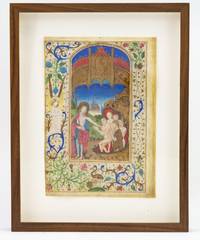
1470rif. ST17764Delft ca. 1470. Leaf: 175 x 122 mm. 6 7/8 x 4 3/4"; Frame: 250 x 195 mm. 9 3/4 x 7 3/4". No text on recto or verso. In an attractive wooden frame. A FINELY PAINTED MINIATURE OF THE HARROWING OF HELL within an arch-topped compartment the mouth of hell depicted on the left with a fiery red interior and five people emerging from it the figure of Christ on the left holding a cross on a long staff and half-clothed in a pink and blue robe the background with a castle in the distance ALL OF THIS BENEATH A VERY DETAILED ARCHITECTURAL CANOPY suspended in the sky AND THE WHOLE WITHIN A FULL BORDER of acanthus leaves and other foliage and flowers in reds blues greens yellows and brushed gold along with very many small burnished gold ivy leaves and buds on hairline stems a small stork in the bottom border and a large delicately shaded angel in the left border. ◆Left margin trimmed very close to decoration just escaping loss and the other three margins ample mild darkening right at fore and tail edge but not reaching into borders otherwise IN FINE CONDITION the colors rich and true and the burnished gold still shimmering. This extraordinary miniature notable for its uncommon subject matter memorable imagery and fine workmanship was produced by a talented artist belonging to the stylistic group known as the Masters of the Delft Half-Length Figures. The subject here is infrequently depicted in Books of Hours: the Harrowing of Hell appears as a full-page miniature in only three of the 119 prayer books described by Roger Wieck in his "Time Sanctified" and three others contain a Harrowing depiction inside an initial. Christian theological tradition tells us that after his crucifixion Christ went to liberate souls from Limbo--a location inhabited by those barred from entry into Heaven because they died before the Redemption. In our scene Christ wrapped in a regal cloak and carrying a long staff his hands and feet still bleeding from the wounds he received on the Cross reaches into an absolutely wonderful Hellmouth to extricate Adam and Eve and other naked souls while the recently deceased and original saint John the Baptist still clad in an animal skin garment waits patiently for his turn to emerge. The great maw of Hell as depicted here has bulging eyes a distended snout thickly matted hair and a bad complexion; his gaping mouth punctuated by sharp gray teeth glows red hot and one can tell from the creature's expression that he is loath to comply with this rescue of souls. In addition to its compelling subject matter there is a high level of artistic achievement here including delicately molded figures impressively detailed architectural elements and a lovely color palette. The elegance and quiet sophistication observed in this miniature distinguishes the artist responsible for this work as a particularly talented member of his circle. Active from about 1450-80 the Masters of the Delft Half-Length Figures were named by James Marrow after the angels and other figures whose upper bodies are typically found emerging from a cloud within the borders. Although the present leaf uncharacteristically contains a full-length angel in the border it shares other stylistic similarities such as the elaborate architectural canopy hovering over the main composition; and it particularly resembles the work of the artist of Keble College MS 77 an illuminator described in "The Golden Age of Dutch Manuscript Illumination" as "one of the more articulate of the group" whose "figures are more fully modelled and his palette . . . deeper and brighter" than that of his contemporaries. Because the subject of the present miniature goes beyond the standard image program seen in routine productions and because of the high level of artistic accomplishment seen here this leaf was almost certainly part of an elaborate Book of Hours produced in response to an important commission. unknown books
1994rif. 45299New York: Poetry Project 1994. Very Good. New York: Poetry Project 1994. First Edition. Octavo 23cm; publisher's white pictorial card wrappers by Shen Chen; 127pp. Light soil to textblock margins else Very Good to Near Fine. Poetry Project unknown books
rif. 32701NY: Dot Books 1973. Paperback. Very good. Paperback. First Edition. 32pp. Head of spine rubbed with some light edgewear else very good in publisher's wraps. Inscribed and signed by Hell on the front free endpaper thus: For--/Soul Bro Bob/From/Theresa Stern/&/ Richard/ Meyers/ Hell/ 10/1/82. Dot Books paperback books
2005rif. 23435Milwaukee WI: Repair 2005. First edition. Signed by Richard Hell. One of 500 copies bound in wrappers. Very fine copy. 8vo original wrappers. Very fine copy. Repair unknown books
2005rif. 23434Milwaukee WI: Repair 2005. First edition. One of 16 hardbound copies hors commerce signed by the authors; this being copy number 13. The entire edition consisted of 42 hardbound copies and 500 copies in wrappers. Very fine copy. 8vo original red cloth dust jacket. Very fine copy. Repair unknown books
1763rif. 395.1763Munich & Ingolstadt for J. Fr. X. Crätz 1763. 8vo. contemporary gray boards lightly rubbed; 21 pages of manuscript notes in an 18th century hand on the front and rear endleaves. Handsome woodcut printer's mark on the title. This fifth edition is an interesting COMPENDIUM listing among other things the founding dates of European universities the various Orders of Knighthood heresies dynasties important peace-treaties etc. There are also large sections which have geographical interest. See: Holzmann-Bohatta I. No. 873. In Boards Munich & Ingolstadt for J. Fr. X. Crätz hardcover books
2013ril. Il giudizio universale e la dannazione eterna sono apocalissi che l'uomo contemporaneo ha rimosso dalla propria coscienza e che la stessa Chiesa Cattolica spesso fatica ad ammettere. Si tratta di un tema che è sempre più trascurato, anche dalla predicazione, quasi che l'Inferno sia colpito da una sorta di congiura del silenzio: un silenzio che contrasta con la necessità di recuperare la prospettiva dell'eternità e della salvezza. Stabilito che l'Inferno esiste ed è eterno, bisogna precisare a quali condizioni ci si vada: morendo in stato di peccato mortale e senza pentimento. Le condizioni per la perdizione eterna sono espresse con chiarezza dal Magistero della Chiesa cattolica, tuttavia di nessun'anima si può dire con certezza che sia all'Inferno, forse neppure di Giuda, il Traditore. Dopo aver trattato delle pene infernali, l'inchiesta sull'Inferno prosegue esaminando la concezione degli Inferi e della perdizione eterna nella Sacra Scrittura e nella dottrina cristiana dai primi secoli al concilio di Trento. Si presentano quindi le diverse visioni dell'Inferno avute da santi e mistici cristiani, fino a quella straordinaria esperienza che è il viaggio nell'Aldilà compiuto in anima e corpo da Jakov e Vicka, due dei veggenti di Medjugorje, accompagnati dalla Regina della Pace. Un viaggio nella tradizione teologica e nella devozione popolare che smuove la coscienza e lascia il segno.
2009ill., br.
2001brossura
2020br. In perpetuo bilico tra l'immaginario dantesco, così radicato da sembrare una visualizzazione legittima del pensiero teologico, e una realtà quotidiana che lo mette costantemente a contatto con inferni in terra, l'uomo continua a interrogarsi sul male, sulla dannazione e sull'orizzonte della propria esistenza tra caduta e riscatto. La riflessione proposta in questo libro prende avvio dalle opere di artisti come Giotto, Botticelli, Michelangelo e Goya, si prolunga nell'Ottocento di Rodin e Munch e nel secolo breve di Bacon, per concludersi con i fratelli Chapman, Boltanski e Holzer. È la proposta di un percorso sugli aspetti che può assumere, dal Medioevo a oggi, l'idea degli inferi e della dannazione, letta attraverso il punto di vista immaginifico, spietato e profetico, delle arti visive.
2015br. La dottrina della reincarnazione non si trova solo nelle tradizioni orientali ma anche nei filosofi greci, a partire da Pitagora fino ad interessare uomini come Voltaire, Goethe e Mazzini. In realtà tale dottrina è presente in ogni tradizione mistica, nella Cabbalà ebraica e nel sufismo islamico. Anche nel Cristianesimo delle origini la reincarnazione era tenuta in considerazione, come testimoniato dai testi gnostici e da uomini di Chiesa come Origene e Sinesio. Il presente saggio racconta la storia ben documentata di una decisione politica: l'imperatore Giustiniano, ispirato dalla moglie Teodora, arrivò a far rapire un Papa per sradicare dalla teologia cristiana ogni possibilità di salvezza perenne per le anime, condannando così - senza appello e senza misericordia - ad un inferno eterno tutti coloro che non volevano piegarsi al volere della Chiesa Imperiale.
19498vo., First Edition, some very faint offsetting from fold-ins to free endpapers; cloth, backstrip lettered in black, a very good, bright, clean copy in unclipped dustwrapper. Scarce in this condition
19628vo., First Edition; black cloth, backstrip lettered in white, a near fine copy in unclipped dustwrapper
19972 vols., 8vo., First Edition, with 73 plates on 32, 42 full-page maps in the text and several full-page charts depicting command structures in the text; cloth, a very good, clean set in the dustwrapper. The definitive history of 1 SS Panzer Corps (1st and 12th SS Panzer Divisions) in Normandy, the Ardennes and the Eastern Front 1944-45
19938vo., First Edition, with plates; black cloth, gilt back, a fine copy in unclipped dustwrapper. Detailed account with several statistical appendices.