9 846 résultats
1710réf. 37844Frankfurt a. M. 1710. First edition. Hardcover. fair to g. Folio. 1 leaf 4 leaves 99 leaves 114 leaves 9 leaves 13 leaves 1 leaf. Contemporary brown leather with blind tooling along the border and spine as well as raised bands. Blue edges. Illustrated title page with image of a swan. Head and tail pieces. Commentary on the Talmud that elucidates contradictions within the text. Author makes use of gematriot based on his name. Text printed in double columns with talmudic text in regular script and author's comments in Rashi script. Source notes on side margins. Text in Hebrew. Significant peeling and scratching to leather boards. Bottom edge torn. Tail of spine mostly missing. Some misnumbering to leaves. Leaf 5 was bound after the fact. Name of previous owner on front endpaper. Heavy foxing to leaves. Overall in fair to good condition. hardcover
réf. 64080Bureaux de l'Administration - Paris 4 volumes 203 numeros In-folio 39 cm 368-424-416-416pp. illustr. nombreuses gravures sur bois hors-textes reliures demi-cuir basane fauve de l'epoque dos plats ornes quelques marques d'usage details et photos sur demande Nb-0270 unknown
1984réf. 87672 Copies filed J: Cyhoeddiadau Barddag 1984. Paperback. Used: Acceptable. Paperback - 1984 - fair condition clean sunfaded on edge Cyhoeddiadau Barddag paperback
réf. 67195London Priestley and Weale 1820. 4to. Engr. front engr. title 63 pp. 39 engr. plates of which one partly hand-coloured. Foxing and spotting and with a water stain at upper corner at the end. Worn contemporary full calf gilt spine with raised bands and a defective red label gilt edges. Book plate of Venetia Inglefied and with a partly erased owner’s signature. Vinet 1542 with a slightly different titles gives 1819 or 1822 as dates. First edition. A reprint was made in 1848. Henry Englefield was an antiquary and scientific writer. He was a made a fellow of the Society of Antiquites in 1779 and also served as its president for a short period. hardcover
1794réf. 667471794. London : printed for T. Evans Paternoster Row and J. Stead at the Naval and Military Printing-Office Gosport 1794 8° 8 XX 170 pp. Halbledereinband d.Zt.; Rücken erneuert. Rare First Edition! "A treatise on the blood or general arrangement of many important facts relative to the vital fluid. With some cursory observations on the theory of animal heat. Interspersed with pathological and physiological remarks from the inductions of modern chemistry. By Hugh Moises surgeon of the Western Regiment of Middlesex Militia and Late Senior Pupil to the General Hospital Nottingham." "With the general acceptance of the Lavoisier-Crawford theory of animal heat as a resultant of respiration or slow combustion much of the subsequent search for the site of body heat production revolved about two questions. What happens to the inspired oxygen Or alternately where in the body was the carbonic acid first formed A subsidiary and often perplexing question asked at what temperatures the products of combustion carbonic acid and water actually could be formed The last question is of particular interest because the heats of combustion of carbon and hydrogen were utilized in the early nineteenth century attempts to establish the respiration theory of animal heat. Séguin citing Priestley and Bertholet had argued that these combustions could occur at ordinary body temperature. Hugh Moises in his Treatise on the Blod 1794 was equally emphatic : We know of no experiment which might authorize us to suppose that carbon can unite with oxygene in a temperature of 97°-99° or that hydrogene and oxygene air combine and form water in so low a temperature." "The early studies of this limited problem suggested solutions based on the ability of the different gases to cause the color changes observed in blood. Both Girtanner and Hassenfratz had attempted to show that venous blood became bright red upon the absorption of oxygen and thereby demonstrated their contention that the blood took up oxygen in the lungs. Another line of experimentation attempted to recover gases from the blood. Hugh Moises for instance confined arterial blood in bottles with gases containing no oxygen and claimed to find oxygen in the residue." Everett Mendelsohn: The Controversy over the Site of Heat Production in the Body. Proceedings of the American Philosophical Society 105/4 1961 pp. 412-420 Hugh Moises M.D. "Surgeon of the Western Regiment of Middlesex Militia.- An Inquiry into the Abuses of the Medical Department of the Militia. Lond. 1794 8vo.- A Treatise on the Blood; or General Arrangement of many important Facts relative to the Vital Fluid . Lond. 1794 8vo. 5s. - An Appendix to the Toilet; or an Essay on the Management of the Teeth. Loud. 1799 8vo. 2s. 6d." R. Watt: Bibliotheca Britannica. 4. V. 1824 unknown
1884réf. 688281884. Am. J. M. Sc. 88. - Philadelphia The American Journal of the Medical Sciences July 1884 8° 51 1 pp. 2 Figs. orig. wrappers. Rare Offprint! "The localization of brain functions has been raised from the level of an hypothesis to that of a definitely ascertained fact within the past ten years. Meynert was the first to discard the doctrine of Flourens that the brain acted as a whole and on anatomical grounds declared that different portions possessed different powers. The study of aphasia led French observers independently to the same result. Fritsch and Hitzig in Germany and Ferrier in England arrived at a similar conclusion soon after by means of their well-known physiological experiments upon animals and the results reached by them have been confirmed in a most striking manner by Munk Dalton and others. But while anatomical study demonstrating a connection between various organs of the body and definite regions of the surface of the brain may furnish grounds for a priori reasoning as to the function of those regions; and while physiological experiments upon animals may afford valuable suggestions as to the probable effect of limited brain disease in man an accurate determination of the question of localization can only be reached by a study of clinical cases. The appreciation of this fact has led Charcot Ferrier Nothnagel Exner Wernicke and others to collect the cases on record in which a limited area of disease whose position was determined by a careful autopsy had given rise to definite symptoms. From the comparison and classification of these eases certain general conclusions have been reached and it is now possible to refer many symptoms occurring in the course of brain disease to a destruction of a definite area of the surface." Starr Moses Allen Starr 1854-1932 'Professor of Neurology in the College pf Physician and Surgeons at Columbia University New York City' "had plans for a career in classical culture when he graduated from Princeton and embarked for Germany to study Greek and Roman history. In Berlin however several visits to Helmholtz's laboratory revived a latent interest in natural science. He returned to his native New York graduated from the College of Physicians and Surgeons P&S Columbia University did a residency at Bellevue Hospital then returned to Europe to work at Heidelberg Vienna and Paris. On return to New York he set up a laboratory in his home and in 1884 published an essay on the sensory tracts of the central nervous system elucidating some of the then-current questions of myelination. Starr's regard as an American pioneer in the field of cerebral localization stemmed from his participation in a symposium on that subject with the famous English neurologist David Ferrier and neurosurgeon Victor Horsley who were delegates to the 1888 Congress of American Physicians and Surgeons in Washington D.C. He became professor of nervous diseases at the Montreal Neurological Institute. During neurosurgical operations they electrically stimulated the surface of the exposed unanesthetized brains of patients who were talking. On-going speech was blocked by excitation of the parietal-temporal area the inferior frontal area and the supplemental motor area of the left hemisphere Penfield & Roberts 1959. Those experimental protocols were a continuation of Penfield's long quest to add to the knowledge of body representations on the neocortex." H.W. Magoun & L. Marshall; American Neuroscience in the Twentieth Century 2005 pp.383-384 unknown
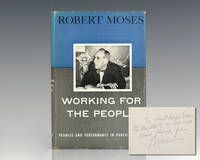
1956réf. 124814New York: Harper & Brothers 1956. First edition of this work by the legendary Robert Moses. Octavo original cloth. Presentation copy inscribed by the author on the front free endpaper "To Janet Hooper Ostahn the daughter of an old and valued friend from Robert Moses." Near fine in a near fine dust jacket. Foreword by Herbert Bayard Swope. Books signed by Moses are uncommon. Robert Moses was a public official who worked mainly in the New York metropolitan area. Known as the "master builder" of mid-20th century New York City Long Island Rockland County and Westchester County he is sometimes compared to Baron Haussmann of Second Empire Paris and was one of the most polarizing figures in the history of United States urban development. His decisions favoring highways over public transit helped create the modern suburbs of Long Island. Although he was not a trained civil engineera Moses's programs and designs influenced a generation of engineers architects and urban planners nationwide. Moses held up to 12 official titles simultaneously including New York City Parks Commissioner and Chairman of the Long Island State Park Commission but was never elected to any public office. He ran only once as the Republican nominee for Governor of New York in 1934 and lost in a landslide. Nevertheless he created and led numerous semi-autonomous public authorities through which he controlled millions of dollars in revenue and directly issued bonds to fund new ventures with little or no input or oversight. As a result of Moses's work New York has the United States' greatest proportion of public benefit corporations which remain the primary driver of infrastructure building and maintenance and account for most of the state's debt. Moses's projects were considered economically necessary by many contemporaries after the Great Depression. Moses led the construction of New York campuses for the 1939 and 1964 World's Fairs and helped persuade the United Nations to locate its headquarters in Manhattan instead of Philadelphia. Harper & Brothers hardcover
réf. Z1-K-016-01119Heinemann Educational Books - Primary Division. Used - Like New. Used - Like New. Book is new and unread but may have minor shelf wear. Ships from UK in 48 hours or less usually same day. Your purchase helps support Sri Lankan Children's Charity 'The Rainbow Centre'. 100% money back guarantee. We are a world class secondhand bookstore based in Hertfordshire United Kingdom and specialize in high quality textbooks across an enormous variety of subjects. We aim to provide a vast range of textbooks rare and collectible books at a great price. Our donations to The Rainbow Centre have helped provide an education and a safe haven to hundreds of children who live in appalling conditions. We provide a 100% money back guarantee and are dedicated to providing our customers with the highest standards of service in the bookselling industry. Heinemann Educational Books - Primary Division unknown
2004réf. SONG3772813534Frommann-Holzboog 2004-03-01. hardcover. Used: Good. 6.10x2.48x8.50. Buy with confidence. Excellent Customer Service & Return policy. Frommann-Holzboog hardcover
1831réf. 23445London: Henry Moses 1831 Seventeen fine quality engraved plates as called for in the list of plates but some with mis matched numbers plus engraved title plate and another for the dedication to Queen Adelaide. 23 text pages plus a loose printed sheet headed Windsor Castle confirming approval of the dedication. Morocco spine with plain boards the engraved title panel being surface mounted. Wear to cover edges. Capillary stains to two pages each fore and aft but not affecting text or image. Light random foxing to some plates. Henry Moses hardcover
1688réf. M6135Amsterdam 1688. Some discolouration of the green otherwise in very good condition. Notes: The map depicts the greater area of Tielt Ghent Hulst and Grimberge. Size : 410x520 mm 16.125x20.5 Inches Coloring: Original Hand Coloring Category: ; Maps Europe Benelux unknown
1903réf. 17370New York: Moses King 1903. Cloth. Very Good. A very important Association copy -- and a significant piece of turn-of-the-century New York history. INSCRIBED BY MOSES KING in February 1904 TO ADOLPH S. OCHS THE PUBLISHER AND OWNER OF THE NEW YORK TIMES 1896-1935 AND A MAJOR FORCE IN THE GROWTH OF NEW YORK AS A WORLD-CLASS CITY. A solid very presentable copy to boot of the 1903 installation of this photographic tribute to New York both overseen and published by the powerful Moses King himself a formidable figure in the world of New York movers and shakers. This copy is solid and VG to VG in its tan cloth with bright gilt-titling to the front panel. Light wear at the spine ends and the tips mild rubbing along the front panel's bottom-edge and very light soiling to the rear panel. Folio hundreds of crisp black-and-white plates glorifying the city's architectural acheivements. Laid-into this copy is a hand-sewn uncommon 1933 booklet called "Adolph S. Ochs at Seventy-Five" which pays tribute to the publisher's accomplishments from the perspective of Jewish theology and ideals. Moses King unknown
1984réf. 87179MMI Americana Press 1984-01-01. Hardcover. Like New. Gorgeous leather bound edition with scallop design embossed to both boards. Robert Sack's Isreal Sack family personal copy with his name in gold leaf to front board. Warmly inscribed to him by author and signed. Promotional art work material laid in all in slipcase. Please email for photos. MMI Americana Press hardcover
1952réf. 216371952. Letters. Near Fine. A 2 pg. Robert Moses typed letter signed written on his personal stationary with the Babylon Long Island letterhead and addressed to radio and theatre producer and director Day Tuttle. Moses here discusses the challenges and complexities of building on Fire Island and displays a firm grasp of the material citing specific causeways projects and developments. The letter 2 separate 9"x11" pages has held up very well. Clean and crisp and very well-preserved with a strong ink signature by Moses. unknown
1970réf. 21705New York: McGraw-Hill 1970. Leatherette. Near Fine/Very Good . INSCRIBED BY ROBERT MOSES on the half-title. A very solid copy to boot of the 1970 1st edition in its pebbled navy-blue leatherette. Tight and Near Fine in a crisp VG to Near Fine example of the unprinted mylar dustjacket with several tiny chips along the spine ends. Thick octavo top-edge gilt. McGraw-Hill unknown
1946réf. 23879City Planning Commission City of New York 1946. Original wraps. Near Fine. Scarce November 1946 report spearheaded by the Construction Co-Ordinator of the City Planning Commission of New York the legendary Robert Moses. The report consists of research by Consulting Engineers Gano Dunn and W. Earle Andrews of Andrews & Clark and Gilmore D. Clarke Chairman of Clarke Rapuano & Holleran and includes the "Report of the Engineering Committee on New York City Traffic". Beautifully illustrated throughout with the "Perspective Drawings" by William Boice Julian Michele and Cornelius Flynn and the "Aerial Photographs" by Fried-Leder Photo-Aerographic Service. This copy is bright and crisp and very well-preserved in its maroon stapled wrappers. Internally very clean as well save for one piece of writing a small 4-word note at the top of the title page written in pencil and stating "Robert Moses's Orig copy". Though we're unable to autherticate this given the very impressive provenance of this copy shared upon request we believe it's distinctly possible. Folio sophisticated maps photographs and charts many of them in rich color throughout. Printed by Steidinger Press Inc. City Planning Commission, City of New York unknown
1901réf. 34494Berlin: Otto Lienekampf 1901. First edition. Softcover. vg. Folio. 4 323-351 3pp. Original wrappers illustrated by Art Nouveau illustrator Ephraim Moses Lilien. Exquisite issue of this early German interior design magazine published between 1900 and 1914. This August 1901 issue contains numerous b/w photographic reproductions as well as bordures motifs and illustrations by artist E. M. Lilien and others E. Lasch C. von Sivers A. von Lepell G. von Estorff etc. This copy is complete with its two large fold-out floral pattern sheets including one by Lilien and its color plate depicting a design by C. von Sivers . Page 326 features a large art nouveau pattern by Lilien 15 3/4" x 8". Pattern sheets measure appr. 52" x 45" each. Minor shelf wear. Text in German. Wrappers and interior in overall very good condition. Otto Lienekampf unknown
réf. 24753Rare French edition of the celebrated letters of Jewish Enlightenment philosopher Moses Mendelssohn documenting the religious controversies surrounding Judaism and Christianity in the Age of Enlightenment. An important work on Jewish emancipation and religious tolerance illustrated with an engraved frontispiece depicting scenes of Jewish life.Modern old style binding half calf leather. Else a good copy with an ownership mark on the titlepage Joseph Basler or Basbe. With an engraved frontispiece showing three scenes from jewish life and a small engraving on the titlepage by I.M. Eben. A-Z 8 pag.: 368. The filosopher Moses Mendelssohn 1729-1786 was the spiritual leader of the German Jewry during the Enlightenment. He wrote many philosophical treatises and is considered the father of the Jewish Enlightenment. Thus he became the symbol of progressive Judaism to the Christian world. At the height of his career in 1769 Mendelssohn was publicly challenged by a Christian apologist a Zurich pastor named John Lavater to defend the superiority of Judaism over Christianity. The letters forming his reply - published in German in 1770 and translated for the present rare French edition - neither attacked Christianity nor defended Judaism; they maintained instead that such polemics were inconsistent with Judaism and unbecoming of Jews. The controversy which disturbed Mendelssohn greatly forced him to recognize that his Judaism created a barrier between himself and his enlightened colleagues. Mendelssohn wanted to take the Jews out of a ghetto lifestyle and into secular society. He tried to improve the relationship between Jews and Christians as he argued for tolerance and humanity. B0109. hardcover
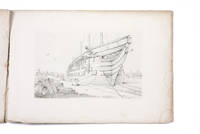
1824réf. 4504491London 1 Portland Place Wandsworth Road: by Henry Moses 1824. Slight staining and creasing some wear at edges spine neatly strengthened. 11 etched plates 193 x 282 mm; original illustrated brown paper wrappers. A scarce series of privately-published etchings of shipping in the London Dockyards. This section of Henry Moses' publication comprises his complete series on London's Docklands. An advertisement in the Quarterly Review 1826 shows that he had then published altogether six parts of his Sketches of Shippng by that date with a further two announced. The six parts contained five engravings each. The first ten etchings depicted shipping on the Thames the second ten showed Sheerness and the Medway while the final ten depicted life on London's docks. The present copy lettered in ink "Nos 5 & 6" actually contains 11 plates although the advertisement in fact only calls for nine plates in the these two parts. There are five with the shared title "London Docks" as against four called for in the advertisement while the eleventh plate differing in style to the others probably comes from an earlier part. 1. Vessels off the Tower Two-masted ship with numerous sightseers in rowed boats in the foreground 2. Limehouse Sailing ship being unloaded by crane at pier. A sailing barge is on the river. In the foreground a rowing boat and anchor are visible on the shore. 3. Blackwall Reach with the Columbus in the Distance A cutter in Blackwall Reach with another beyond on the right. The four-masted barque Columbus a vast 300-foot Canadian-built experimental timber carrier is seen as a long grey hull in the distance stretching from the centre or the image to the right edge. 4. Limehouse Sailing ship moored at Limehouse with rowing boats and barges unloading barrels. 5. A West Indiaman in Cox & Curlin's Yard Limehouse the substantial docks later known as Limehouse Yard where very large vessels could be built 6. London Docks Men sitting on timber slabs ship with sails hanging loose behind in dock 7. London Docks Barge in front of stern of ship at dock sails up and catching the wind two ships to left one making way 8. London Docks Numerous ships at anchor sails drying tender at centre with barrels being rowed by two men 9. London Docks Large three-master in dock. tender with barrels in front dockside showing a sluicegate 10. London Docks Two ladies in a boat rowed by a man three ships behind wiht sails loose 11. Trafalgar 120 Guns Different in style to the other plates close-up view of the hull of recently launched Trafalgar at dock. Henry Moses c.1782-1870 was prolific and "worked throughout the first half of the present century enjoying a great reputation for his outline plates which are distinguished for the purity and correctness of the drawing. His art was peculiarly suited to the representation of sculpture and antiquities and he published many sets of plates of that class; he was one of the engravers employed upon the official publication Ancient Marbles in the British Museum 1812-1845" DNB. This delightful series was one that he produced on his own account. It is very scarce on the market. The British Museum's set for example comprises just the first four parts bound together. Only a reissued version by Ackermann of 1837 is recorded in Australian libraries and that only held by the National Library and the Vaughan Evans Library at the Australian National Maritime Museum. Appendix 1: Quarterly Review ad in 1826: Sketches of Shipping on the Thames the Medway and in the Dockyards drawn and engraved by Henry Moses. Nos. 1. to 6. containing the following plates: Parts 1-2 1 A Sailing Match near Vauxhall Bridge. 2 An India-man in Barnard's Yard Deptford. 3 The City Canal. 4 Wellington Indiaman in Blackwall Basin. 5 Another View of the same. 6 Stern View of ditto. 7 The Basin at Blackwall 8 Surat Castle Indiaman in the Basin. 9 A Dance on Board an Indiaman in the Basin. 10 Part of Blackwall Yard with View of the River. Parts 3-4 11 Waterman in his Boat in the Medwuy. 12 View on the Medway. 13 Shipping off Sheerness. 14 Hulks at Sheerness. 15 The Trafalgar of 120 guns in the Basin Sheerness. 16 Bow View of the same. 17 Stern View of ditto. 18 Entrance to the Basin Sheerness. 19 Part of Sheerness Yard from a Window of the Fountain Inn. 20 Another View of the same. Parts 5-6 Vessels off the Tower. Limehouse. Another View of the same. Blackwall Reach with the Columbus in the distance. A West Indiaman in Cox and Curlin's Yard Limehouse. London Docks. Four Views of the same. Price on Imperial 8vo. 18s. A few Copies are printed on Imperial 4to. price 1L. 4s. ### Nos. 7. and 8. just published containing 10 Views in Portsmouth Harbour. Appendix 2: Other works by Moses The Decision of the Flower by Henry Moses after Moritz Retzsch illustration to Goethe's Faust I The Gallery of Pictures painted by Benjamin West 12 plates 1811 patronage of Thomas Hope2; A Collection of Antique Vases Altars &c. from various Museums and Collections 170 plates 1814; Select Greek and Roman Antiquities 36 plates 1817; Vases from the Collection of Sir Henry Englefield 40 plates 1819; Examples of Ornamental Sculpture in Architecture drawn by L. Vulliamy 36 plates 1823; Illustrations to Goethe's Faust after Moritz Retzsch 26 plates 1821; Illustrations to Schiller's Fridolin and Fight with the Dragon 1824 and 1825; Georg Heinrich Noehden's Specimens of Ancient Coins of Magna Graecia and Sicily 24 stipple plates 1826; Works of Canova with text by Countess Albrizzi 3 vols. 1824-8; and Selections of Ornamental Sculpture from the Louvre 9 plates 1828. Moses contributed many of the illustrations to James Hakewill's Tour of Italy 1820 and Woburn Abbey Marbles 1822. He etched from his own designs Picturesque Views of Ramsgate 23 plates 1817; Sketches of Shipping and Marine Sketch Book 1824 reissued by Ackermann 1837; and Visit of William IV when Duke of Clarence to Portsmouth in 1827 17 plates 1830. Moses's final work was a set of twenty-two illustrations to Pilgrim's Progress after Henry Courtney Selous executed for the Art Union of London 1844.1 Appendix 3: DNB: MOSES HENRY 1782P-1870 engraver worked throughout the first half of the present century enjoying a great reputation for his outline plates which are distinguished for the purity and correctness of the drawing. His art was peculiarly suited to the representation of sculpture and antiquities and he published many sets of plates of that class ; he was one of the engravers employed upon the official publication ' Ancient Marbles in the British Museum' 1812-1845. Of the works wholly executed by himself the most important are : ' The Gallery of Pictures painted by Benjamin West' 12 plates 1811 ; ' A Collection of Antique Vases Altars &c. from various Museums and Collections' 170 plates 1814 ; ' Select Greek and Roman Antiquities' 36 plates 1817 ; ' Vases from the Collection of Sir Henry Englefield' 40 plates 1819 ; ' Examples of Ornamental Sculpture in Architecture drawn by L. Vulliamy' 36 plates 1823 ; illustrations to Goethe's ' Faust' after Retzsch 26 plates 1821; illustrations to Schiller's 'Fridolin' and 'Fight with the Dragon' 1824 and 1825 ; Noehden's 'Specimens of Ancient Coins of Magna Graecia and Sicily' 24 stipple plates 1826 ; ' Works of Canova' with text by Countess Albrizzi 3 vols. 1824-8 ; and ' Selections of Ornamental Sculpture from the Louvre' 9 plates 1828. Moses also contributed many of the illustrations to Hakewill's ' Tour of Italy' 1820 and ' Woburn Abbey Marbles' 1822 ; he etched from his own designs ' Picturesque Views of Ramsgate' 23 plates 1817 ; ' Sketches of Shipping ' and ' Marine Sketch Book' 1824 reissued by Ackermann 1837; and ' Visit of William IV when Duke of Clarence to Portsmouth in 1827' 17 plates 1830. Moses's latest work was a set of twenty-two illustrations to ' Pilgrim's Progress' after H. C. Selous executed for the Art Union of London 1844. He died at Cowley Middlesex 28 Feb. 1870. Redgrave's Diet of Artists ; Dodd's Collections in British Museum Add. MS. 33403 ; Universal Cat. of Books on Art. F. M. O'D. . by Henry Moses unknown
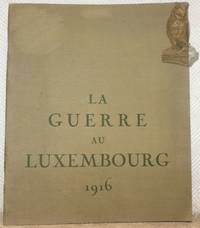
1916réf. 121112Paris : Dan. Niestlé 1916. broché. CENDRARS Blaise. - KISLING Moise dessins de.La guerre au Luxembourg. Six dessins de Kisling. Paris Dan. Niestlé1916 295x145mmnon paginé 6 planches n/b et un dessin in texte à la page de justification de tirage broché. Un des 950 exemplaires sur papier Hollande vergé numéroté à la presse n° 308. Mention : “Cette édition ne sera par réimprimée”. Couverture inférieure tachée intérieur propre. Bel exemplaire. For shipments to the U.S.A. with a value exceeding 800 USD VAT is not included. Please contact us via our website if needed. Dan. Niestlé unknown
réf. SKU0190385Wolters Kluwer Law & Business 2017-04-18. Loose Leaf. Good. Textbook May Have Highlights Notes and/or Underlining BOOK ONLY-NO ACCESS CODE NO CD Ships with Tracking Wolters Kluwer Law & Business unknown
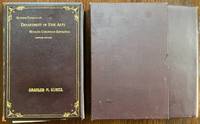
1893réf. 60194Chicago: W.B. Conkey Co. Publishers to the Exposition 1893. Two vols. 8vo. 506; 506 pp. Frontisp. both vols. With maps photo plates. 1st vol. -- Full dark brown morocco over beveled boards gilt ornamented borders gilt lettering & ownership stamp on front cover gilt lettering on spine gilt inner dentelles marbled endpapers t.e.g. minor rubbing edgewear front hinge tender rear hinge just starting very slight uniform interior toning as usual still VG- copy w/ presentation ALS on Conkey private letterhead presenting to Charles M. Kurtz dated Oct. 28th 1893; 2nd vol. -- Full flexible Bible calf dark purple silk moire endpapers gilt lettering stamped front cover & spine a.e.g. w/ dark maroon cloth d.j. backed in dark purple silk moire a F/F presentation copy from Conkey to Kurtz w/ inscription on half-title preserved in open-backed slipcase. First editions thus presentation copies and the second copy with publisher’s note indicating this was No. 91 of 275 Editor’s Deluxe copies signed & presented to Charles McMeen Kurtz 1855-1909 at the time one of Halsey Ives’s Assistants in the Fine Arts Department of the 1893 World’s Columbian Exposition Art Director of the 1894 St. Louis Exposition and later Museum Director at the Buffalo Museum of Art 1905-1909. Conkey writes in the letter for the first volume to Charles Kurtz “I send you herewith a copy of the Catalogue which you may deem to file away as a reminder of many hours spent in order that others might see intelligently the grand work which you with others have done in the Art Department.” Walter Blakesley Conkey had founded the printing house in 1877 occupied many different job printers and in 1890 absorbed the Illinois Printing & Binding Co. and in Jan. 1893 signed the contracts awarding him exclusive rights for printing the myriad of catalogues and handbooks for the Columbian Exposition receiving a deposit of $ 10000. W.B. Conkey Co., Publishers to the Exposition, hardcover
2009réf. 10113Ships with insurance and US orders only signature confirmation . 2008 oversize hardcover in photographic boards and no dj as published. Fraying on edges corners bumped light curling musty smell if you go into the spine a bit of rubbing on cover else text clean binding tight . No printing listed presumed 1st edition. Not paginated. Oversize book – extra shipping charges will apply for international and priority orders as this will not fit into a flat rate envelope. Contrasto
2017réf. BN68347CreateSpace Independent Publishing Platform 2017. 2017. Tha Holy Bibizzle CreateSpace Independent Publishing Platform unknown
réf. Frommann-9783772813535frommann-holzboog Verlag e.K. German. Hardcover. New. XLII 855 p. 156 x 209 cm. This volume provides annotations for the approximately 125 articles by Mendelssohn in the Briefen die neueste Litteratur betreffend 17591765 Letters concerning the Most Recent Literature and shows the scope of his essays on the most important humanities-related institution of the »Berlin Enlightenment«. Moreover the commentary includes the thematic connections between Mendelssohns reviews and those of his contemporaries and for the first time calls attention to Hamann Kant still unknown at this time Boscovich the physicist and Leeuwenhoek the biologist. The merits of Spinozas still unrecognized at that time as well as contemporary philosophy and aesthetics are also discussed. frommann-holzboog Verlag e.K. hardcover