Michael L and Joel Moses DertouzosBiblio.com

11.201 risultati
rif. Z1-W-018-02106MIT Press. Used - Good. Ships from UK in 48 hours or less usually same day. Your purchase helps support Sri Lankan Children's Charity 'The Rainbow Centre'. Ex-library so some stamps and wear but in good overall condition. 100% money back guarantee. We are a world class secondhand bookstore based in Hertfordshire United Kingdom and specialize in high quality textbooks across an enormous variety of subjects. We aim to provide a vast range of textbooks rare and collectible books at a great price. Our donations to The Rainbow Centre have helped provide an education and a safe haven to hundreds of children who live in appalling conditions. We provide a 100% money back guarantee and are dedicated to providing our customers with the highest standards of service in the bookselling industry. MIT Press unknown
rif. Z1-A-007-02093Nabu Press. Used - Like New. Used - Like New. This is a reproduction of an out of print title. This book may have occasional imperfections such as missing or blurred pages poor pictures errant marks etc. that were either part of the original artifact or were introduced by the scanning process. Ships from UK in 48 hours or less usually same day. Your purchase helps support Sri Lankan Children's Charity 'The Rainbow Centre'. 100% money back guarantee. We are a world class secondhand bookstore based in Hertfordshire United Kingdom and specialize in high quality textbooks across an enormous variety of subjects. We aim to provide a vast range of textbooks rare and collectible books at a great price. Our donations to The Rainbow Centre have helped provide an education and a safe haven to hundreds of children who live in appalling conditions. We provide a 100% money back guarantee and are dedicated to providing our customers with the highest standards of service in the bookselling industry. Nabu Press unknown
1736rif. 0001326MARLBOROUGH MASSACHUSETTS MASS MA 1736. On offer is a charming relic of Marlborough Massachusetts ephemera being a manuscript dated 1736 detailing the specifics of a new road in the town. "A way laid out beginning near the dwelling house of Jeremiah Barstow & so running along between the land of Col Thomas How & the land of Simon Gates & is bounded by said Gates land by boundry mark't trees & it is Eight rods wide until it comes to that which is called the Indian land & then running across the County road along by the house of Zachariah Maynard four rods wide & still extends four rod wide along between land of Daniel Rice & land of Eliazer Rice & along through the land of Thomas Martin down where the path now goeth. Down that which is called Sandy Hill & then it is tow rods wide & then turning & then running through the land of Joshua Rice through a corner of Rice's land and then through Daniel Rice's land & the land of Thomas Martin down to that which is called the new Bridge over Fort Meadow Crook. between the meadow of Daniel Rice and the Meadows of Simon Gates & it is two rod wide to the lot granted to Abraham How as the way is mark't on the west side by markt trees & then running on westerly end of said lot granted to Said How four rods wide & so running a long through the lot of Hezekiah Bush & so running along over Sto. Low Bridge markt with trees on the east side of sd way running along the way which runs along by the Dwelling house of Peter How near Alfabeth sp River." This was accepted by the town March 3d 1729: "A True Coppy Attest Moses sp WoodsTown Ca. Marlboro Feb 27 1736." The paper document measures 9 7/8 x 6 inches and overall is G. Autograph. Manuscript. Good. 8vo - over 7¾" - 9¾" tall. Paperback
1786rif. 55770Providence 1786. Folio sheet approx. 15" x 12" docketed on the verso; previous folds with splits no loss; overall toning; good. Brigadier General James Angell 1723-1785 descendant of one of the first settlers of Providence died February 2 1785. This inventory was taken by Moses Brown 1736-1838 executor of the will and both a friend and relative. The Angell's daughter Abigail married a Goddard relatives of the Brown family. Among assets listed are Angell's Johnston farm lot 160 acres of Vermont land a third of an acre lot in North Providence; "we to give James and Jacob a Deed of the Whole of remd of Johnston farm & North Providence lott." James Angell was town clerk of Providence until 1775 and Theodore Foster said of him "I became intimately acquainted with the said James Angell and many of his Family Connexions among whom was the Honorable Stephen Hopkins Esq. whose Sister married the said James Angell." Documentary History of R.I. Angell was also appointed chairman of the committee to revise laws of the state. unknown
1786rif. 55770Providence 1786. Folio sheet approx. 15" x 12" docketed on the verso; previous folds with splits no loss; overall toning; good. Brigadier General James Angell 1723-1785 descendant of one of the first settlers of Providence died February 2 1785. This inventory was taken by Moses Brown 1736-1838 executor of the will and both a friend and relative. The Angell's daughter Abigail married a Goddard relatives of the Brown family. Among assets listed are Angell's Johnston farm lot 160 acres of Vermont land a third of an acre lot in North Providence; "we to give James and Jacob a Deed of the Whole of remd of Johnston farm & North Providence lott." James Angell was town clerk of Providence until 1775 and Theodore Foster said of him "I became intimately acquainted with the said James Angell and many of his Family Connexions among whom was the Honorable Stephen Hopkins Esq. whose Sister married the said James Angell." Documentary History of R.I. Angell was also appointed chairman of the committee to revise laws of the state. unknown books
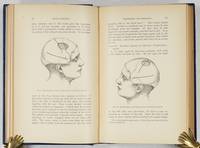
1893rif. 665411893. New York: William Wood & Company 1893 8° XII 295 pp. 55 Figs. orig. cloth; rebacked; with stamp of "Worchester State Hospital Medical Library". First Edition! Embossed stamp on title a stamp on the head of the first page ex-libris of the Worchester Hospital and Arthur Edwards Lyons on the front endpaper. Moses Allen Starr's "Brain surgery" was the first American book on neurosurgery published the same year as Macewen's pioneering neurosurgical classic. Moses Allen Starr 1854-1932 'Professor of Neurology in the College pf Physician and Surgeons at Columbia University New York City' "had plans for a career in classical culture when he graduated from Princeton and embarked for Germany to study Greek and Roman history. In Berlin however several visits to Helmholtz's laboratory revived a latent interest in natural science. He returned to his native New York graduated from the College of Physicians and Surgeons P&S Columbia University did a residency at Bellevue Hospital then returned to Europe to work at Heidelberg Vienna and Paris. On return to New York he set up a laboratory in his home and in 1884 published an essay on the sensory tracts of the central nervous system elucidating some of the then-current questions of myelination. Starr's regard as an American pioneer in the field of cerebral localization stemmed from his participation in a symposium on that subject with the famous English neurologist David Ferrier and neurosurgeon Victor Horsley who were delegates to the 1888 Congress of American Physicians and Surgeons in Washington D.C. He became professor of nervous diseases at the Montreal Neurological Institute. During neurosurgical operations they electrically stimulated the surface of the exposed unanesthetized brains of patients who were talking. On-going speech was blocked by excitation of the parietal-temporal area the inferior frontal area and the supplemental motor area of the left hemisphere Penfield & Roberts 1959. Those experimental protocols were a continuation of Penfield's long quest to add to the knowledge of body representations on the neocortex." H.W. Magoun & L. Marshall; American Neuroscience in the Twentieth Century 2005 pp.383-384 Garrison & Morton No.9637 hardcover
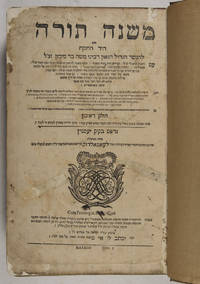
1739rif. 27896Jessnitz Saxony-Anhalt: Bi-defus Yisrael bar Avraham 1739. Hardcover. Good. Four volumes folio published between 1739 and 1742. Woodcut printer's device at titles; woodcut endpieces in first volume. Hebrew text opens from right to left; leaf numbers in Hebrew characters. Hebrew chronograms yield Jewish dates of publication 5499-5502. Brown library buckram scuffed at extremities spines lettered in gilt. Endleaves renewed. A good set. See foliation and condition notes for each volume below. Scarce eighteenth-century edition of this seminal compendium of Jewish law halakhah. Compiled between 1170 and 1180 while Maimonides was living in Egypt the Mishneh Torah is regarded as the author's magnum opus. It is the only Medieval-era work that surveys the full panoply of Jewish observance including those laws that are only applicable when the Jerusalem Temple is in existence. The present edition is the first to contain Judah Rosanes' commentary Mishneh le-melekh. "Mishneh Torah" The Repetition of the Law is an appellation originally applied to the biblical book of Deuteronomy; the subtitle "ha-Yad ha-Hazakah" The Book of the Strong Hand plays on its subdivision into fourteen books: the numerical value fourteen is represented in Hebrew letters as Yud 10 Dalet 4 which forms the word "yad" hand. Maimonides sought to provide a complete statement of the Oral Law so that a person who mastered first the Written Torah and then the Mishneh Torah would be in no need of any other book. Contemporary reaction was mixed with strong and immediate opposition focusing on the absence of sources and the belief that the work appeared to be intended to supersede study of the Talmud itself. Maimonides responded to these criticisms and the Mishneh Torah endures as an influential work in Jewish religious thought. According to several authorities a decision may not be rendered in opposition to a view of Maimonides even where he apparently militated against the sense of a Talmudic passage for in such cases the presumption was that the words of the Talmud were incorrectly interpreted. Likewise: One must follow Maimonides even when the latter opposed his teachers since he surely knew their views and if he decided against them he must have disapproved their interpretation. Vol. 1: 1 title 8 234 102 3 ff. Repairs at title page with very slight loss of text at verso following leaf and the final leaf. Text embrowned often heavily in first half with some light marginal dampstains throughout. Old manuscript entries in Hebrew at title in at least three hands. Vol. 2: 1 title 148 112 2 ff. Marginal repairs to first and last two leaves no loss of text. Moderately dampstained throughout with some mild embrowning. Old manuscript entries in Hebrew at title in at least two hands; three old stamps at title including at least one censor's approbation. Vol. 3: 1 title 221 169 ff. Repairs at bottom margin to title with loss of some text below imprint and at final lines of rabbinic approbations at verso and at bottom margin following leaf with some text loss and obscuration by translucent paper tape. Small marginal repair at final leaf. Light dampstaining in first half; remaining text with mild embrowning. Old manuscript entries in Hebrew at title in at least two hands; two old stamps at title including at least one censor's approbation. Vol. 4: 1 title 135 138-154 157 1 ff. Marginal repairs to title and final leaf no loss of text. Sporadic light embrowning and marginal stains. Old manuscript entry in Hebrew at title. A complete set with only minimal text loss in a few places -- a very usable scholar's copy. References: Vinograd Jessnitz 46; Fürst 2: p. 295; Zenker p. 583 Title in Hebrew: משנה תורה ×”×•× היד החזקה להנשר הגדול ×”×’×ון רבינו משה בר מימון זצ׳׳ל ×¢× השגת הר×ב׳׳ד זצ׳׳ל ופירוש הרב מגיד משנה וכסף משנה להג×ון המשביר רבינו יוסף ק×רו זצ׳׳ל ומגדל עוז והגהות מימונייות ופירוש רבינו עובדי והרב המוסמך מדר׳׳ל ן׳ חביב על הלכות קידוש החדש ×¢× כל הצורות השייכות להלכות ×לו ולהלכות שבת וסוכה ×•×¢× מורה ×ž×§×•× על דברי הרב המגיד וכסף משנה ×’× שתי מפתחות גדולות ורחבות ×חת על סדר ×”×¤×¨×§×™× ×•×חת על דרך ××œ×¤× ביתה ×œ× חסר דבר מכל כפי ×שר נדפס ב××ž×©×˜×¨×“× Rabbi Moses Maimonides the Rambam was a 12th century Jewish philosopher and halachic legal scholar. A highly controversial figure both during his lifetime and after his death he is generally acknowledged as the preeminent Jewish thinker of the Middle Ages. He was born in Córdoba Spain but fled as a child from the Almohad persecution. He eventually settled in Egypt where he served as a rabbi physician and philosopher. His fourteen-volume Mishneh Torah his only work not in Arabic still carries canonical authority particularly within the Yemenite Jewish community as the codification of Talmudic law. His other works include "Kitab al-Siraj" a commentary on the Mishnah "Kitab al-Fara'I" a book on precepts and the celebrated philosophical work "Dalalat al-Ha'irin" known in Hebrew as the "Moreh Nevukhim" The Guide to the Perplexed. In this latter work Maimonides attempted a philosophical/theological reconciliation of the Hebrew Bible and Greek knowledge. This work came to play a central role in all subsequent major controversies over philosophy within the Jewish community during the Middle Ages. Bi-defus Yisrael bar Avraham hardcover
1739rif. 27896Jessnitz Saxony-Anhalt: Bi-defus Yisrael bar Avraham 1739. Hardcover. Good. Four volumes folio published between 1739 and 1742. Woodcut printer's device at titles; woodcut endpieces in first volume. Hebrew text opens from right to left; leaf numbers in Hebrew characters. Hebrew chronograms yield Jewish dates of publication 5499-5502. Brown library buckram scuffed at extremities spines lettered in gilt. Endleaves renewed. A good set. See foliation and condition notes for each volume below. Scarce eighteenth-century edition of this seminal compendium of Jewish law halakhah. Compiled between 1170 and 1180 while Maimonides was living in Egypt the Mishneh Torah is regarded as the author's magnum opus. It is the only Medieval-era work that surveys the full panoply of Jewish observance including those laws that are only applicable when the Jerusalem Temple is in existence. The present edition is the first to contain Judah Rosanes' commentary Mishneh le-melekh. "Mishneh Torah" The Repetition of the Law is an appellation originally applied to the biblical book of Deuteronomy; the subtitle "ha-Yad ha-Hazakah" The Book of the Strong Hand plays on its subdivision into fourteen books: the numerical value fourteen is represented in Hebrew letters as Yud 10 Dalet 4 which forms the word "yad" hand. Maimonides sought to provide a complete statement of the Oral Law so that a person who mastered first the Written Torah and then the Mishneh Torah would be in no need of any other book. Contemporary reaction was mixed with strong and immediate opposition focusing on the absence of sources and the belief that the work appeared to be intended to supersede study of the Talmud itself. Maimonides responded to these criticisms and the Mishneh Torah endures as an influential work in Jewish religious thought. According to several authorities a decision may not be rendered in opposition to a view of Maimonides even where he apparently militated against the sense of a Talmudic passage for in such cases the presumption was that the words of the Talmud were incorrectly interpreted. Likewise: One must follow Maimonides even when the latter opposed his teachers since he surely knew their views and if he decided against them he must have disapproved their interpretation. Vol. 1: 1 title 8 234 102 3 ff. Repairs at title page with very slight loss of text at verso following leaf and the final leaf. Text embrowned often heavily in first half with some light marginal dampstains throughout. Old manuscript entries in Hebrew at title in at least three hands. Vol. 2: 1 title 148 112 2 ff. Marginal repairs to first and last two leaves no loss of text. Moderately dampstained throughout with some mild embrowning. Old manuscript entries in Hebrew at title in at least two hands; three old stamps at title including at least one censor's approbation. Vol. 3: 1 title 221 169 ff. Repairs at bottom margin to title with loss of some text below imprint and at final lines of rabbinic approbations at verso and at bottom margin following leaf with some text loss and obscuration by translucent paper tape. Small marginal repair at final leaf. Light dampstaining in first half; remaining text with mild embrowning. Old manuscript entries in Hebrew at title in at least two hands; two old stamps at title including at least one censor's approbation. Vol. 4: 1 title 135 138-154 157 1 ff. Marginal repairs to title and final leaf no loss of text. Sporadic light embrowning and marginal stains. Old manuscript entry in Hebrew at title. A complete set with only minimal text loss in a few places -- a very usable scholar's copy. References: Vinograd Jessnitz 46; Fürst 2: p. 295; Zenker p. 583 Title in Hebrew: משנה תורה ×”×•× היד החזקה להנשר הגדול ×”×’×ון רבינו משה בר מימון זצ׳׳ל ×¢× השגת הר×ב׳׳ד זצ׳׳ל ופירוש הרב מגיד משנה וכסף משנה להג×ון המשביר רבינו יוסף ק×רו זצ׳׳ל ומגדל עוז והגהות מימונייות ופירוש רבינו עובדי והרב המוסמך מדר׳׳ל ן׳ חביב על הלכות קידוש החדש ×¢× כל הצורות השייכות להלכות ×לו ולהלכות שבת וסוכה ×•×¢× מורה ×ž×§×•× על דברי הרב המגיד וכסף משנה ×’× שתי מפתחות גדולות ורחבות ×חת על סדר ×”×¤×¨×§×™× ×•×חת על דרך ××œ×¤× ביתה ×œ× חסר דבר מכל כפי ×שר נדפס ב××ž×©×˜×¨×“× Rabbi Moses Maimonides the Rambam was a 12th century Jewish philosopher and halachic legal scholar. A highly controversial figure both during his lifetime and after his death he is generally acknowledged as the preeminent Jewish thinker of the Middle Ages. He was born in Córdoba Spain but fled as a child from the Almohad persecution. He eventually settled in Egypt where he served as a rabbi physician and philosopher. His fourteen-volume Mishneh Torah his only work not in Arabic still carries canonical authority particularly within the Yemenite Jewish community as the codification of Talmudic law. His other works include "Kitab al-Siraj" a commentary on the Mishnah "Kitab al-Fara'I" a book on precepts and the celebrated philosophical work "Dalalat al-Ha'irin" known in Hebrew as the "Moreh Nevukhim" The Guide to the Perplexed. In this latter work Maimonides attempted a philosophical/theological reconciliation of the Hebrew Bible and Greek knowledge. This work came to play a central role in all subsequent major controversies over philosophy within the Jewish community during the Middle Ages. Bi-defus Yisrael bar Avraham hardcover books
1913rif. 97501913 Paris, Dan. Niestlé, 1913, in 4 br. de 20 feuillets non paginés, couverture sur papier vert pâle imprimé, très bel ex.
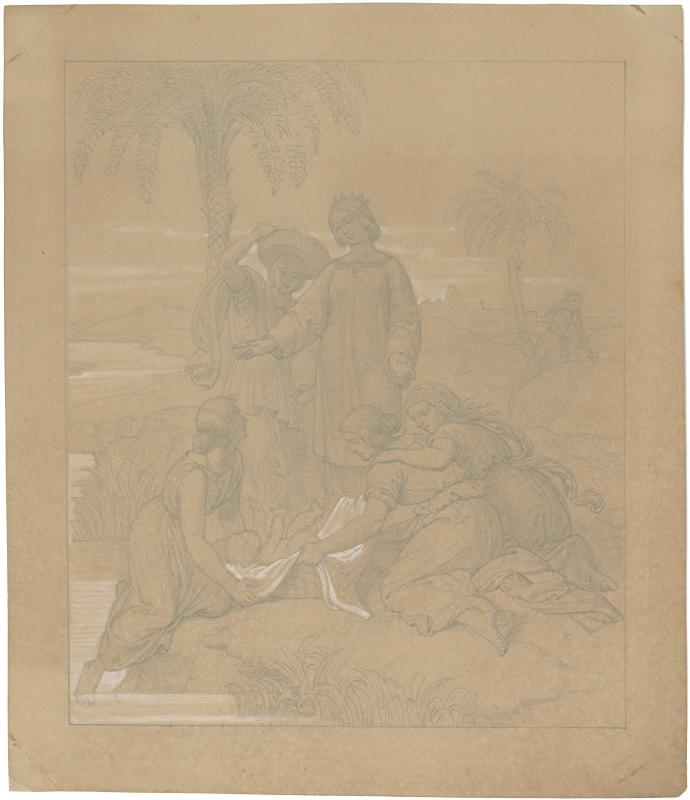
rif. 077-Eo.J. Bleistift, weiß gehöht, mit Bleistiftlinie umrandet, auf hellbraunem Papier, verso bezeichnet ?Fr. Overbeck?. Darstellungsgröße 20,8:17,5 cm, Blattgröße 24,8:21,4 cm.
1954rif. 12491Paris Bernard Klein 1954 Un volume in-folio en feuilles sous emboitage greige, pièce de titre à la chinoise en vélin blanc, et sous chemise rempliée illustrée par Kisling, 128 pages, bien complet de ses 25 illustrations. Infime déchirure sans manque à la chemise, néanmoins bel exemplaire numéroté (n°240), l'un des 2175 sur vélin d'Arches.
1797rif. 0009109NEW FRANKFURT HARRISON CO. WEST VIRGINIA 1797. On offer is are two lovely and fascinating letters from a father and mother to their daughter detailing their situation mere weeks after moving to New Frankford Virginia. The letter is signed Moses Starr and Elizabeth Starr and addressed to their Dear Daughter. The first letter is dated November 17th 1797 and the second is dated December 23 1797. In the letters they describe their journey to their new home in West Virginia their home and their farm. They now live in New Frankfurt in Harrison County Simpsons Creek Eight Miles From Clarkburg. The first letter begins Dear Daughter we embrace this opportunity to wright to you informing thee that we are all in great haealth at present thanks bea to God for his tender Merceys to us ward from time to time. They write that they have we have had no letters from thee this two years.and have had no opertunity to send any. We long to see thee and hear from thee if thou art single write whether thou would incline to come upon and live with us we think of comeing Down within two years more; like wise let us know how our Relations are in them parts.The back of the letter is a short sermon like passage stating Dear child strive to ear and Love God who is able to Love the utmost oall that come to him through Jesus Christ the Redeeme of lost Man. The next letter begins with them writing that they have received her last letter which gave us some cause to rejoice of hearing from our relations in general but gave us concern of mind for the loss of Nelly Starr and the disolate state of Uncle Joseph. They then remark on the their life in what is now West Virginia. Thy mother was braught to be of a daughter the Eleventh of last month wich we call Polly. They speak of their journey to Virginia taking two weeks from when they left their home. The farming has been good a well reaping 200 bushals of Sound Corn and 150 bushals of Oats with a trifel of buck wheat. I have 20 acres of wheat and Ry in the ground this fall. The letter ends with the usual pleasantries and again is signed by Moses and Elizabeth Starr. The two letters are in fair shape both having a fair share of rips tears and discoloration. The first letter has some moth damage that affects the readability of a sentence or two. The second letter has its tears along the creases and edges but it does not affect the content at all. Neither does the discoloration on either letter though it is very noticeable it does not block out any words. The ink on both letters has faded the first more than the second but both letters are fairly easy to read throughout. These letters are an interesting little snapshot of a family life in 1790s Virginia representing a change in a brand new America and hope for a new setting in this burgeoning nation. Good. 4to - over 9¾" - 12" tall. Manuscript. unknown
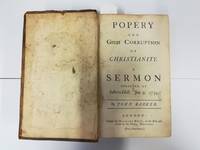
1735rif. 002177London: Printed for Richard Hett 1735. 1st Edition . Hardcover. Fair/No Jacket. 8vo - over 7¾ - 9¾" tall. 17 Sermons and a Conference bound together followed by contemporary hand written list of contents; full calf Cambridge binding with raised bands etc. Worn; scuffed; hinges/joints broken; ffep absent; pp. 848. Contents: 1 Popery; The Great Corruption of Christianity Barker 1735 pp. 34. 2 The Notes of the Church Considered 2nd ed. Chandler1735 pp. 57. 3 A Second Treatise on the Notes of the Church Chandler 1735 pp. 60. 4 The Supremacy of St Peter and the Bishops of Rome his Successors 2nd ed. Neal 1735 pp. 40. 5 The Church of Rome's Claim of Authority and Infallibility Examined Smyth 1735 pp. 71. 6 Scripture and Tradition Considered Wright 1735 pp. 54. 7 A discourse Concerning Transubstantiation: In jWhich the Words of the Institution of the Lord's Supper are Particularly Considered. Harris 1735 pp. 46. 8 A Second Discourse Concernign Tansubstantiation; in Which the Sixth Chapter of St John's Gospel is Particularly Considered. Harris 1735 pp. 38. 9 The Veneration of Saints and Images as Taught and Practis'd in the Church of Rome Examined. Hughes 1735 pp. 58. 10 The Sources of Corrupting both Natural and Revealed Religion Exemplified in the Romish Doctrine of Penance and Pilgrimages. Hunt 1735 pp. 40. 11 The Church of Rome's Doctrine and Practise with Relation to the Worship of God in an Unknown Tongue examin'd. Bayes 1735 pp. 48. 12 The Popish Doctrine of Auricular Confession and Priestly Absolution Considered. Burroughs 1735 pp. 48. 13 The Popish Doctrine of Merit and Justification Considered Newman 1735 pp. 48. 14 The Popish Doctrine of Purgatory Repugnant to the Scripture account of Remission through the Blood of Christ. Earle 1735 pp. 52. 15 The Principles of Popery Schismatical. Lowman 2nd ed. 1735 pp. 48. 16 Persecution and Cruelty in the Principles Practices and Spirit of the Romish Church Grosvenor 2nd ed. 1735 pp. 39. 17 The Reasons and Necessity of the Reformation Leavesly 1735 pp. 40. 18 Two Conferences.at the Bell Tavern.Between two Romish Priests a Divine fo the Church of England and Mr. Chandler and Dr. Hunt Dissenting Divines on the following Subjects. the Blashemy of many Popish Writers.Transubstantiation; Praying to Saints and Angels. 1735 pp. 28. 19 Pp. 2 hand written list of sermons. Rather a lovely volume if worn. Printed for Richard Hett hardcover
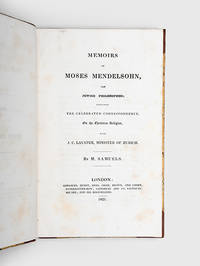
1825rif. 183948London: Longman Hurst Rees Orme Brown and Green; Sainsbury and Co. Salisbury Square and all booksellers 1825. First edition of this influential biography the first book written in English on the German-Jewish philosopher. The author Moses Samuel 1795-1860 was among Mendelssohn's most fervent admirers and the Memoirs helped shape the contemporary perception of Mendelssohn as a role model for the peaceful integration of Jews into modern European society. Octavo 213 x 129 mm pp. vii 1 171 1. Contemporary half calf spine ruled lettered and decorated in gilt and blind marbled paper boards edges sprinkled brown. Light rubbing infrequent minor foxing to endpapers and contents slight chip to outer margin of I8: a very good copy. hardcover
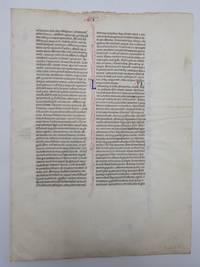
rif. 290159circa 1250. Very good; light wrinkling and marginal foxing to pages. Folio 30.5x22.5 cm. One sheet fine vellum folded with text from the book of Numbers in two columns. weight: 0.2 lb. Unknown scribe. hardcover
rif. 290159circa 1250. Very good; light wrinkling and marginal foxing to pages. Folio 30.5x22.5 cm. One sheet fine vellum folded with text from the book of Numbers in two columns. weight: 0.2 lb. Unknown scribe. hardcover books
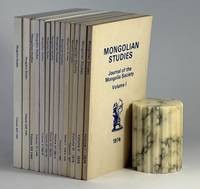
rif. 2411Bloomington Indiana: Research Center for Language and Semiotic Studies 1991. 14 volumes 6" x 9" each volume 1: pp. 128 volume 2: pp. 163 volume 3: pp. 138 volume 4: pp. 111 volume 5: pp. 121 volume 6: pp. 123 volume 7: pp. 135 volume 8: pp. 102 volume 9: pp. 107 volume 10: pp. 154 volume 11: pp. 120 volume 12: pp. 143 volume 13: pp. 222 volume 14: pp. 218. Off-white wrappers with blue text. Volume 12 has a small chip with loss at the top edge of the spine. Volumes 1-5 are lightly toned. Text is bright and clean. Very good. 14 volumes of the Journal of the Mongolian Society featuring articles covering a variety of topics related to Mongolia. Some articles include: Chinese Titles in Mongol Iran Life of a Mongol Woman Mongolian Art The Panching System Khitan Writing Systems and many more. Research Center for Language and Semiotic Studies unknown
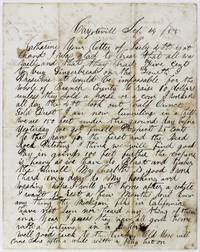
1855rif. 3206Coyoteville: September 12 1855. Very good. 2pp. plus integral blank. Original mailing folds moderate toning staining and ink spotting but still easily readable. Bottom fourth of integral blank excised. An informative Gold Rush letter about mining in the long-vanished ghost town of Coyoteville which was an extraordinarily rich gold area for a couple of years in the early 1850s. A noted tunneling method nicknamed "coyoteing" was developed in the town and subsequently inspired the name of the town. In the present letter Moses Pine writes to "Catherine" in Branch County Michigan and signs his name simply as "Mose Esq" at the conclusion. The author informs Catherine presumably his wife or sister of his activities some of the economic realities and some of the practical details of prospecting for gold in California. Presuming that "it would be impossible for the whole of Branch County to raise $10 unless they sell a horse" Pine comments that he had ginger bread on the Fourth of July after working all day and yielding a "half Ounce Gold Dust." He then provides a detailed description of his mining: "I am now tunneling in a hill. We are 150 feet under the ground. Day before yesterday we got small respect 25 cents to the pan for the first and the bed rock pitching. I think we will find good pay in the going 100 feet further the expense is heavy as we have to blast and timber the tunnel." Pine also talks of his health and that "I work hard every day do my cooking and baking." He then expresses his hope to get back to Michigan to "rest a few months" but knows nothing of other Michigan folks in California: "Have not seen nor heard anything of them in a year. I guess they have all gone home with a fortune in a horn. Well good luck to the lucky. Old Mose will come home after a while with a pretty hat on." A nicely-detailed letter from an unusual and obscure Gold Rush location. September 12 unknown
1855rif. 3206Coyoteville: September 12 1855. Very good. 2pp. plus integral blank. Original mailing folds moderate toning staining and ink spotting but still easily readable. Bottom fourth of integral blank excised. An informative Gold Rush letter about mining in the long-vanished ghost town of Coyoteville which was an extraordinarily rich gold area for a couple of years in the early 1850s. A noted tunneling method nicknamed "coyoteing" was developed in the town and subsequently inspired the name of the town. In the present letter Moses Pine writes to "Catherine" in Branch County Michigan and signs his name simply as "Mose Esq" at the conclusion. The author informs Catherine presumably his wife or sister of his activities some of the economic realities and some of the practical details of prospecting for gold in California. Presuming that "it would be impossible for the whole of Branch County to raise $10 unless they sell a horse" Pine comments that he had ginger bread on the Fourth of July after working all day and yielding a "half Ounce Gold Dust." He then provides a detailed description of his mining: "I am now tunneling in a hill. We are 150 feet under the ground. Day before yesterday we got small respect 25 cents to the pan for the first and the bed rock pitching. I think we will find good pay in the going 100 feet further the expense is heavy as we have to blast and timber the tunnel." Pine also talks of his health and that "I work hard every day do my cooking and baking." He then expresses his hope to get back to Michigan to "rest a few months" but knows nothing of other Michigan folks in California: "Have not seen nor heard anything of them in a year. I guess they have all gone home with a fortune in a horn. Well good luck to the lucky. Old Mose will come home after a while with a pretty hat on." A nicely-detailed letter from an unusual and obscure Gold Rush location. September 12 unknown books
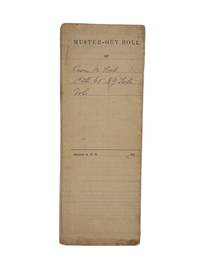
1863rif. 215941863. Medal of Honor Recipient Moses Veale Signed Civil War muster out roll dated June 8 1863 documents the discharge of 1st Lieutenant Orson Foot of the 60th New York Volunteer Infantry so he could accept a commission as Captain during the opening phase of the Gettysburg campaign. Issued at Aquia Creek Virginia the document bears the signature of Captain Moses Veale as mustering officer a Union officer later awarded the Medal of Honor for extraordinary gallantry during the Civil War. Veale's citation records that during the Battle of Wauhatchie Tennessee he continued directing his men after being struck by four enemy bullets and having his horse shot from under him. The presence of Veale's signature transforms the document from routine military administration into a signed record connected to one of the war's most decorated acts of battlefield courage. At the same time the roll records Foot's discharge to accept promotion during the Gettysburg Campaign. Foot Orson. Civil War muster out roll. Aquia Creek Virginia June 8 1863. One manuscript sheet completed in official Union Army muster format and signed by Captain Moses Veale as mustering officer. The document certifies that the officer "carefully examined this Roll. and mustered the said Orson Foot for discharge; and I hereby honorably discharge him from the service of the United States." It records Foot's enrollment at Ogdensburg New York on September 16 1861 identifies his rank as 1st Lieutenant in the 60th New York Volunteer Infantry and notes in the remarks that he was mustered out "to accept Commission of Captain." The sheet therefore documents the administrative transition by which an officer left one commission to assume another within the wartime command structure. The document's date and place situate it at the evacuation of Aquia Creek Landing one of the Army of the Potomac's principal logistical bases. Established during earlier campaigns in northern Virginia Aquia Creek served as a major supply depot linking Washington with Union forces in the field. As Robert E. Lee advanced north in June 1863 the Union command dismantled and abandoned the installation to support the army's rapid movement toward Pennsylvania. By the very day this roll was issued June 8 Federal forces were evacuating and destroying the depot to prevent its use by Confederate troops. Foot's promotion therefore occurred amid the redeployment that would culminate at the Battle of Gettysburg. Single manuscript sheet measuring approximately 32 x 11 inches when unfolded. Some age toning scattered ink staining and edge wear consistent with large-format wartime administrative documents; overall good condition. A substantial Civil War military document combining Gettysburg campaign context with the signature of Medal of Honor recipient Moses Veale whose later battlefield heroism makes his autograph particularly desirable within Civil War military manuscripts. A substantial Civil War military document produced during the evacuation of Aquia Creek and the opening phase of the Gettysburg campaign. unknown
1863rif. 215941863. Medal of Honor Recipient Moses Veale Signed Civil War muster out roll dated June 8 1863 documents the discharge of 1st Lieutenant Orson Foot of the 60th New York Volunteer Infantry so he could accept a commission as Captain during the opening phase of the Gettysburg campaign. Issued at Aquia Creek Virginia the document bears the signature of Captain Moses Veale as mustering officer a Union officer later awarded the Medal of Honor for extraordinary gallantry during the Civil War. Veale's citation records that during the Battle of Wauhatchie Tennessee he continued directing his men after being struck by four enemy bullets and having his horse shot from under him. The presence of Veale's signature transforms the document from routine military administration into a signed record connected to one of the war's most decorated acts of battlefield courage. At the same time the roll records Foot's discharge to accept promotion during the Gettysburg Campaign. Foot Orson. Civil War muster out roll. Aquia Creek Virginia June 8 1863. One manuscript sheet completed in official Union Army muster format and signed by Captain Moses Veale as mustering officer. The document certifies that the officer "carefully examined this Roll. and mustered the said Orson Foot for discharge; and I hereby honorably discharge him from the service of the United States." It records Foot's enrollment at Ogdensburg New York on September 16 1861 identifies his rank as 1st Lieutenant in the 60th New York Volunteer Infantry and notes in the remarks that he was mustered out "to accept Commission of Captain." The sheet therefore documents the administrative transition by which an officer left one commission to assume another within the wartime command structure. The document's date and place situate it at the evacuation of Aquia Creek Landing one of the Army of the Potomac's principal logistical bases. Established during earlier campaigns in northern Virginia Aquia Creek served as a major supply depot linking Washington with Union forces in the field. As Robert E. Lee advanced north in June 1863 the Union command dismantled and abandoned the installation to support the army's rapid movement toward Pennsylvania. By the very day this roll was issued June 8 Federal forces were evacuating and destroying the depot to prevent its use by Confederate troops. Foot's promotion therefore occurred amid the redeployment that would culminate at the Battle of Gettysburg. Single manuscript sheet measuring approximately 32 x 11 inches when unfolded. Some age toning scattered ink staining and edge wear consistent with large-format wartime administrative documents; overall good condition. A substantial Civil War military document combining Gettysburg campaign context with the signature of Medal of Honor recipient Moses Veale whose later battlefield heroism makes his autograph particularly desirable within Civil War military manuscripts. A substantial Civil War military document produced during the evacuation of Aquia Creek and the opening phase of the Gettysburg campaign. unknown books
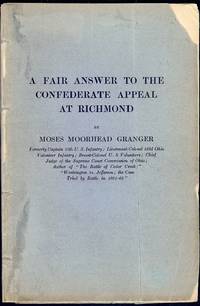
1907rif. 46511907. Granger Moses Moorhead. A FAIR ANSWER TO THE CONFEDERATE APPEAL AT RICHMOND. Self-published 1907. 12mo. printed blue wraps; 32 pages. First- and only- edition. A treatise debunking many claims made by Southern states and politicians that led to the Civil War. "Richmond" in the title refers to the unveiling of a statue of Jefferson Davis on June 3 1907 in that city and speeches at the time stating that Davis and the Southern states will eventually be vindicated for their actions leading to and during the Civil War. Granger 1831-1913 was born and also died in Zanesville Ohio where he was a lawyer and a judge. He served with Company S of the 122nd Regiment of the Ohio Volunteer Infantry during the Civil War where he earned the ranks of Lt. Colonel and Colonel. With an autograph note signed by Granger inside the front cover discussing some copyright confusion over the book's publication and with a "Publisher's Weekly" ink stamp on the same page. With another lengthy autograph note on the last page by Granger discussing the politics and various historic events that led to the war mentioning The Missouri Compromise The Nebraska Bill etc. Very rare with the only copies I have been able to locate in institutional libraries. Good condition some chipping covers but contents clean & tight; some repair to covers spine & inside front cover with clear archival tape. $1250.00. unknown
1907rif. 46511907. Granger Moses Moorhead. A FAIR ANSWER TO THE CONFEDERATE APPEAL AT RICHMOND. Self-published 1907. 12mo. printed blue wraps; 32 pages. First- and only- edition. A treatise debunking many claims made by Southern states and politicians that led to the Civil War. "Richmond" in the title refers to the unveiling of a statue of Jefferson Davis on June 3 1907 in that city and speeches at the time stating that Davis and the Southern states will eventually be vindicated for their actions leading to and during the Civil War. Granger 1831-1913 was born and also died in Zanesville Ohio where he was a lawyer and a judge. He served with Company S of the 122nd Regiment of the Ohio Volunteer Infantry during the Civil War where he earned the ranks of Lt. Colonel and Colonel. With an autograph note signed by Granger inside the front cover discussing some copyright confusion over the book's publication and with a "Publisher's Weekly" ink stamp on the same page. With another lengthy autograph note on the last page by Granger discussing the politics and various historic events that led to the war mentioning The Missouri Compromise The Nebraska Bill etc. Very rare with the only copies I have been able to locate in institutional libraries. Good condition some chipping covers but contents clean & tight; some repair to covers spine & inside front cover with clear archival tape. $1250.00. unknown books
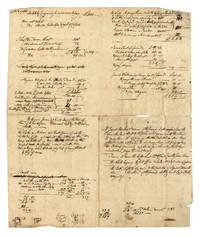
1842rif. 69781Buffalo NY 1842. Four manuscript documents 4 pp. each approx. 31 cm. each docketed on verso. All in very good condition legible one document more toned. A record of moneys collected by Joy and Bristol as Commissioners for the State of New York for distribution to the Niagara Sufferers. The documents include: 1 "Amts collected including what is due & collectable." caption title. This document signed by Joseph Clary and Moses Bristol Dec. 31 1830 records amounts collected by the commissioners plus the costs for the state less assignments sent to the comptroller dividends due Joy and Bristol etc. a "statement of the affairs of the Niagara Sufferers in a/c with the Comms. J & B." 2 "Statement of the affairs of the Niagara Suffers with Joy & Bristol." caption title. Calculations on the second document signed by Clary and Bristol on Dec. 16 1833 record the total amount collected by Joy and Bristol to be $69205.30 with cash paid out to the sufferers amounting to $62913.69 plus expenses of $350. Left in the hands of Joy was $2511.30; Bristol $1649.72; Clary $1396.36; plus smaller amounts to three other people. 3 "Statement of the affairs of the Niagara Suffers with Joy & Bristol." caption title. Document dated Buffalo Feb. 1 1836 and signed by Clary and Joy. The total amount collected by Bristol and Joy amounted to $69281.39 including $42464.60 assigned to the comptroller Nov. 30 1825; plus $16955.40 on Dec. 27 1833; and $2900.50 on March 28 1835. Additional amounts were left to be distributed or recorded as expenses or paid in commissions to Joy & Bristol. A detailed breakdown of how the "Niagara suffer business stands between T. Joy M. Bristol & J. Clary" is also given. 4 "Statement of the affairs of the Niagara Sufferers with Joy & Bristol." caption title. This fourth document is a neater copy of the Feb. 1 1836 document docketed on verso: "copied from J. Clary's statement March 7 1842" and signed by M. Bristol. During the War of 1812 incursions by the British on American soil had resulted in the burning of towns the loss of property and the impoverishment of citizens. On the Niagara frontier this included the village of Buffalo which was nearly burned to the ground on Dec. 30 1813. In a letter written by members of the Committee of Safety and Relief at Canandaigua on Jan. 8 1814 it was reported that "Niagara county and that part of Genesee which lies west of Batavia are completely depopulated. All the settlements in a section of country forty miles square and which contained more than twelve thousand souls are effectually broken up. Our roads are filled with people many of whom have been reduced from a state of competence and good prospects to the last degree of want and sorrow." see: Louis Babcock's book "The War of 1812 on the Niagara Frontier" Buffalo NY: 1927 pp.253-4 These "Niagara sufferers" were among the citizens of several states who petitioned the federal government for redress of losses suffered during the conflict. President Madison and Congress responded by establishing an Office of Claims in 1816 with Richard Bland Lee as its adminstrator "to solicit claims appraise lost property adjudicate cases and award restitution." According to a "Report of the Committee of Claims on the petition of the inhabitants of Niagara county New York sufferers by the enemy during the last war" dated Jan. 15 1821 and submitted to Congress these same "sufferers" in anticipation of federal relief began in 1816 to apply for loans from a newly established bank in the village of Buffalo. These citizens "being at that time in great want of means to rebuild their houses and repair their devastated estates were induced to apply to this bank for loans of money for that purpose and which loans they generally obtained by giving mortgages on their farms accompanied by honorary engagements that they should be repaid out of the moneys received by them under the law for their relief." New York also passed a law on April 15 1815 granting state loans to the sufferers. On Jan. 29 1822 the State of New York passed "An Act Granting relief to the sufferers on the Niagara frontier whose property was destroyed by the enemy during the late war." By this act the state trusting that the U.S. Congress would ultimately repay the sufferers in full for their losses as well as repay the state for their expenditures transferred to the commissioners 'the several debts due to the people of this state for monies loaned to the sufferers. also all monies due to this state on securities taken for the payment of the debt due from the Bank of Niagara. and all interest due on said several debts and on said bills." The commissioners were authorized to extend the term of five years for the debtors to repay their debts and to "take and receive the title to any lands or tenements mortgaged to the people of the state. and it shall be lawful for the commissioners to sell and in their own names convey any lands or tenements which under this act they may acquire." Once the federal monies were received by the state the residual due to the sufferers would be calculated. The commissioners were charged with accounting to the comptroller for the execution of the trust confided to them. Record is found in the New York newspapers of the day of several sales of mortgages taken out by "sufferers" in the years following the conclusion of the War of 1812 and transferred to Thaddeus Joy and Moses Bristol Acting Commissioners. Meanwhile the federal Office of Claims under Richard Lee was closed down for a time while investigations of its awards were carried on. Sectional rivalries also interfered with settlement claims by the federal government for the losses of private citizens. Citizens from the southern states whose slaves had been liberated by British forces had managed to get a proposal for their return or compensation included in the Treaty of Ghent which ended the war. Northern states appealed for some sort of equal calculations for their losses. According to Craig Hollander in his article "The Citizen Complains: Federal Compensation for Property Lost in the War of 1812" Law and History Review Vol. 38 No. 4 Nov. 2020 pp.659-698 the civilian sufferers "deftly created a sense of sectional aggrievement to garner additional support from their Northern colleagues." By as late as 1840 however many of the claims remained unresolved. In a letter to Thaddeus Joy written by Joseph Clary on Dec. 28 1840 Clary remarks that Dr. Moses Bristol "is very anxious to have the old Niagara Sufferers affairs brot to a close. It is now near seventeen years since the law authorizing a transfer of the debts to the sufferers was passed and it would seem very much like a neglect of duty for us to let the matter run this length of time without any effort to close it with the Comptroller." Clary continued to be concerned that Joy and Bristol would not be compensated for their work as commissioners. In Louis Babcock's book on the war he notes that "documents supplying further information on this aspect of the Niagara Sufferer's Claims are lacking so that for the present the matter is left untold." Babcock pp.318-19. unknown
1842rif. 69781Buffalo NY 1842. Four manuscript documents 4 pp. each approx. 31 cm. each docketed on verso. All in very good condition legible one document more toned. A record of moneys collected by Joy and Bristol as Commissioners for the State of New York for distribution to the Niagara Sufferers. The documents include: 1 "Amts collected including what is due & collectable." caption title. This document signed by Joseph Clary and Moses Bristol Dec. 31 1830 records amounts collected by the commissioners plus the costs for the state less assignments sent to the comptroller dividends due Joy and Bristol etc. a "statement of the affairs of the Niagara Sufferers in a/c with the Comms. J & B." 2 "Statement of the affairs of the Niagara Suffers with Joy & Bristol." caption title. Calculations on the second document signed by Clary and Bristol on Dec. 16 1833 record the total amount collected by Joy and Bristol to be $69205.30 with cash paid out to the sufferers amounting to $62913.69 plus expenses of $350. Left in the hands of Joy was $2511.30; Bristol $1649.72; Clary $1396.36; plus smaller amounts to three other people. 3 "Statement of the affairs of the Niagara Suffers with Joy & Bristol." caption title. Document dated Buffalo Feb. 1 1836 and signed by Clary and Joy. The total amount collected by Bristol and Joy amounted to $69281.39 including $42464.60 assigned to the comptroller Nov. 30 1825; plus $16955.40 on Dec. 27 1833; and $2900.50 on March 28 1835. Additional amounts were left to be distributed or recorded as expenses or paid in commissions to Joy & Bristol. A detailed breakdown of how the "Niagara suffer business stands between T. Joy M. Bristol & J. Clary" is also given. 4 "Statement of the affairs of the Niagara Sufferers with Joy & Bristol." caption title. This fourth document is a neater copy of the Feb. 1 1836 document docketed on verso: "copied from J. Clary's statement March 7 1842" and signed by M. Bristol. During the War of 1812 incursions by the British on American soil had resulted in the burning of towns the loss of property and the impoverishment of citizens. On the Niagara frontier this included the village of Buffalo which was nearly burned to the ground on Dec. 30 1813. In a letter written by members of the Committee of Safety and Relief at Canandaigua on Jan. 8 1814 it was reported that "Niagara county and that part of Genesee which lies west of Batavia are completely depopulated. All the settlements in a section of country forty miles square and which contained more than twelve thousand souls are effectually broken up. Our roads are filled with people many of whom have been reduced from a state of competence and good prospects to the last degree of want and sorrow." see: Louis Babcock's book "The War of 1812 on the Niagara Frontier" Buffalo NY: 1927 pp.253-4 These "Niagara sufferers" were among the citizens of several states who petitioned the federal government for redress of losses suffered during the conflict. President Madison and Congress responded by establishing an Office of Claims in 1816 with Richard Bland Lee as its adminstrator "to solicit claims appraise lost property adjudicate cases and award restitution." According to a "Report of the Committee of Claims on the petition of the inhabitants of Niagara county New York sufferers by the enemy during the last war" dated Jan. 15 1821 and submitted to Congress these same "sufferers" in anticipation of federal relief began in 1816 to apply for loans from a newly established bank in the village of Buffalo. These citizens "being at that time in great want of means to rebuild their houses and repair their devastated estates were induced to apply to this bank for loans of money for that purpose and which loans they generally obtained by giving mortgages on their farms accompanied by honorary engagements that they should be repaid out of the moneys received by them under the law for their relief." New York also passed a law on April 15 1815 granting state loans to the sufferers. On Jan. 29 1822 the State of New York passed "An Act Granting relief to the sufferers on the Niagara frontier whose property was destroyed by the enemy during the late war." By this act the state trusting that the U.S. Congress would ultimately repay the sufferers in full for their losses as well as repay the state for their expenditures transferred to the commissioners 'the several debts due to the people of this state for monies loaned to the sufferers. also all monies due to this state on securities taken for the payment of the debt due from the Bank of Niagara. and all interest due on said several debts and on said bills." The commissioners were authorized to extend the term of five years for the debtors to repay their debts and to "take and receive the title to any lands or tenements mortgaged to the people of the state. and it shall be lawful for the commissioners to sell and in their own names convey any lands or tenements which under this act they may acquire." Once the federal monies were received by the state the residual due to the sufferers would be calculated. The commissioners were charged with accounting to the comptroller for the execution of the trust confided to them. Record is found in the New York newspapers of the day of several sales of mortgages taken out by "sufferers" in the years following the conclusion of the War of 1812 and transferred to Thaddeus Joy and Moses Bristol Acting Commissioners. Meanwhile the federal Office of Claims under Richard Lee was closed down for a time while investigations of its awards were carried on. Sectional rivalries also interfered with settlement claims by the federal government for the losses of private citizens. Citizens from the southern states whose slaves had been liberated by British forces had managed to get a proposal for their return or compensation included in the Treaty of Ghent which ended the war. Northern states appealed for some sort of equal calculations for their losses. According to Craig Hollander in his article "The Citizen Complains: Federal Compensation for Property Lost in the War of 1812" Law and History Review Vol. 38 No. 4 Nov. 2020 pp.659-698 the civilian sufferers "deftly created a sense of sectional aggrievement to garner additional support from their Northern colleagues." By as late as 1840 however many of the claims remained unresolved. In a letter to Thaddeus Joy written by Joseph Clary on Dec. 28 1840 Clary remarks that Dr. Moses Bristol "is very anxious to have the old Niagara Sufferers affairs brot to a close. It is now near seventeen years since the law authorizing a transfer of the debts to the sufferers was passed and it would seem very much like a neglect of duty for us to let the matter run this length of time without any effort to close it with the Comptroller." Clary continued to be concerned that Joy and Bristol would not be compensated for their work as commissioners. In Louis Babcock's book on the war he notes that "documents supplying further information on this aspect of the Niagara Sufferer's Claims are lacking so that for the present the matter is left untold." Babcock pp.318-19. unknown books