Antiquariat.de

105 résultats
1790réf. 910839CGAmsterdam:, Westersteins en Smith, [um 1790]. Kupferstich 29 x 20 cm, Blattgröße 39 x 25 cm.
1731réf. 902626AGAmsterdam:, Westersteins en Smith, 1731. Kupferstich 28,5 x 19,5 cm (hoch), Blattgröße 39,5 x 24,5 cm (hoch).
1701réf. 29560Paris, Andreas Pralard, 1701. 8vo. Mit Holzschnitt-Titelvign. 32 Bl., 317, 215 S.; 1 Bl., 553 S. Ldr. d. Zt. auf 5 Bünden m. dekorativer Rückengoldprägung. Gesprenkelter Schnitt.
1777réf. 32265Berlin, bey Christian Friedrich Voß 1777. XXIV, 278 Seiten, 283 Seiten, Kl8° gebundene Ausgabe, Halbleder, Bibliotheksstempel auf Titelblatt, Rückenleder oben mit Fehlstück, sonst Exemplar in gutem Erhaltungszustand
1782réf. 395221782 In-12 (162 x 95 mm), demi-basane brune à petits coins, dos lisse orné dune roulette dorée en place des nerfs, titre doré, tranches mouchetées (reliure de lépoque), xii, 255 pages, (2) feuillets derrata. Dessau, dans la librairie des auteurs et des artistes [colophon: à Hale, de l'Imprimerie de Chr. Gottl. Taeubel], 1782.
1772réf. 35627BBParis, Saillant 1772. 8°: 2 n.n. Bl., XXIV S., 342 S., 1 Bl. Privileg. Mit gestochenem Frontispiz. Interimsbroschur der Zeit mit Marmorpapierbezügen.
1760réf. 51014AB1. - 8. Band (von 12). Leipzig, verlegts Johann Gottfried Dyck, 1760, 1758 - 1762. 8°. Ca. 3000 S., mit 8 gestochenen Porträtfrontispiz und einer jeweils wiederholten gestochenen Titelvignette. Halblederbände der Zeit mit goldgeprägten blassroten Rückenschildern.
1772réf. 14851A Paris, Saillant, 1772. Cont. full mottled calf. Back worn as the golddecoration is nearly gone. Engraved frontisp. XXIV,342,(2) pp. A few lvs. slightly browned, otherwise internally fine.
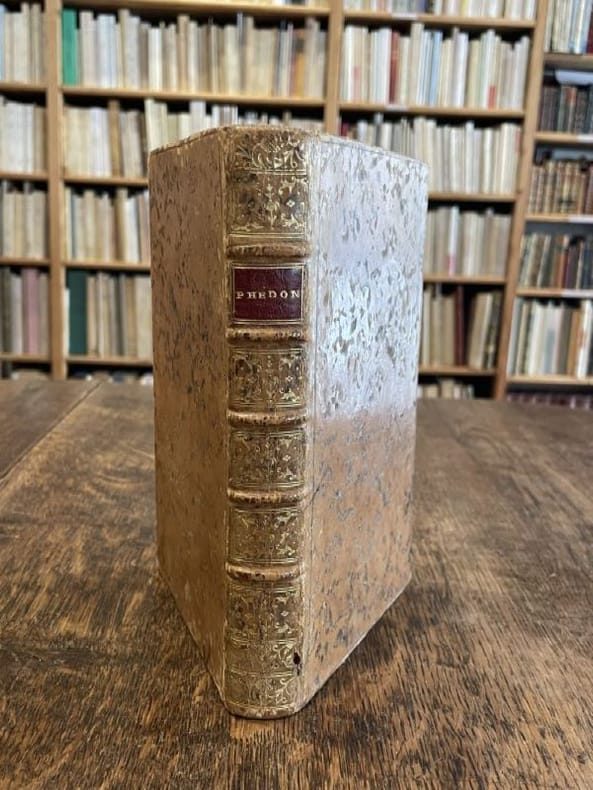
1772réf. 54813Paris et Bayeux Saillant et Lepelley 1772 1 vol. Relié in-8, veau fauve écaille, dos à nerfs, pièce de titre de maroquin rouge, caissons ornés de fleurons et dentelle dorés avec double filet en encadrement, coupes filetées, coiffes guillochées, tranches rouges, XXIV + 342 + (2) pp. Edition originale française ornée d'un beau frontispice d'après Monet, gravé par Ménil. Précédé d'une vie de Socrate, cet essai est composé en trois dialogues, à la manière du "Phédon" de Platon, à partir de la correspondance de Mendelssohn avec son ami Thomas Abbt. Infime galerie de ver au dos en pied, sinon très bon exemplaire en reliure d'époque avec ex-libris gravé Cazenove.
1772réf. 54813Paris et Bayeux Saillant et Lepelley 1772 1 vol. Relié in-8, veau fauve écaille, dos à nerfs, pièce de titre de maroquin rouge, caissons ornés de fleurons et dentelle dorés avec double filet en encadrement, coupes filetées, coiffes guillochées, tranches rouges, XXIV + 342 + (2) pp. Edition originale française ornée d'un beau frontispice d'après Monet, gravé par Ménil. Précédé d'une vie de Socrate, cet essai est composé en trois dialogues, à la manière du "Phédon" de Platon, à partir de la correspondance de Mendelssohn avec son ami Thomas Abbt. Infime galerie de ver au dos en pied, sinon très bon exemplaire en reliure d'époque avec ex-libris gravé Cazenove.
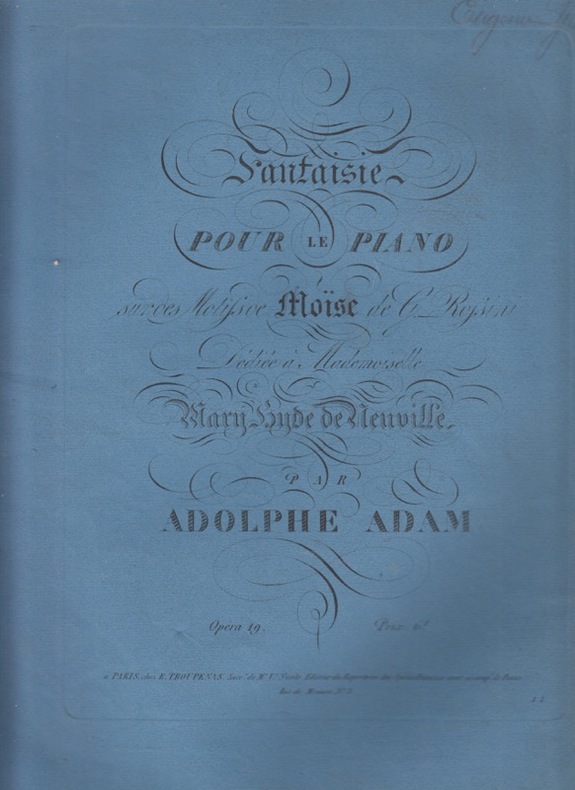
1800réf. 267401800 P.- TROUPENAS sd (vers 1800),MUSIQUE GRAVEE in folio broché,couverture bleue,14p.-213,bon etat,rare
1772réf. 42123A Paris, chez Saillant et à Bayeux, chez Lepelley, 1772. In-8 de 1 frontispice gravé, (4)-XXIV-342-(2) pp., veau marbré glacé, dos lisse orné, pièce de titre en maroquin rouge (reliure de l'époque).
1783réf. 93701783 Berlin, bey Friedrich Maurer, 1783. Un volume in-8 (105 x 174 mm) en deux parties, de [2]+96+141+[1bl] pages. Reliure de lépoque en dem-basane à coins, pièce de titre jaune. Petits accrocs en bordure de la pièce de titre, sinon ouvrage en parfait état.
1769réf. T96034's Graavenhaage ['s Gravenhage], by Pieter van Cleef 1769 x + 211pp.+ gegraveerd frontispice, "naar den tweeden verbeterden druk, uit het Hoogduitsch vertaald", 21cm., blinde gecart. omslag uit de tijd, enkele roestplekjes, goede staat, T96034
1782réf. PHO-1140Dessau, Librairie des auteurs et des artistes, 1782, XII-255pp.-2ff, relié demi basane postérieure, dos à nerfs avec auteur, titre et date en pied.
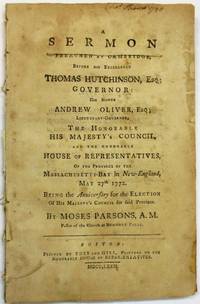
1772réf. 36416Boston: Edes and Gill 1772. 43 1 blank pp but lacking the half title. Disbound light to moderate foxing. Good. Ownership signature "Chas. Stearns 1780" at head of title. A desirable pre-Revolutionary War sermon. Parsons locates God's hand in all events "either when we enjoy the advantages of good civil government or find that it is altered and become grievous." The British heritage of good civil government is now disturbed: "The scene is changed- Grievances are complain'd of- In Great Britain- In Ireland- In America- In this Province.- The day is become gloomy and dark and the waters are troubled." Even in England "A King may be misled by evil counsellors- He may be corrupted by bad ministers and give into those measures which are injurious to the subject." As God has brought us safely out of the "howling wilderness" He will do so today when "our liberties have been invaded and hostile measures made use of to bring us to submit to things which are grievous." FIRST EDITION. Evans 12502. ESTC W29233. Edes and Gill unknown books
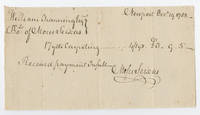
1788réf. 25418Seixas' 1790 letter of welcome elicited the first president's most compelling statement on religious liberty "to bigotry no sanction." In this 1788 receipt Seixas signs a receipt documenting payment for carpet by William Channing the state's new attorney general. MOSES SEIXAS.Manuscript Document Signed to William Channing December 18 1788. Receipt for carpeting. 1 p. 7¼ x 4 in. Complete Transcript Newport Decr 19 1788 William Channing Esq Bot Bought of Moses Seixas / 17 yds Carpeting . . . . . . . . . . .4/1 yd. £3.9. 5. Received payment In full / Moses Seixas Docketing on verso in another hand: Moses Seixas Moses Mendes Seixas 1744-1809 was born in New York into a Jewish family. His father immigrated from Portugal to New York about 1730 and became a merchant. The family moved to Newport Rhode Island in 1765. Moses Seixas married Jochebed Levy in 1770 and they had eight children. He was one of the organizers and first cashier of the Bank of Rhode Island which conducted business in his house until 1818. After the British occupied Newport during the Revolutionary War Seixas remained in Newport but was among the signers of a document supporting the patriot cause. In 1790 he was the president of the Congregation Yeshuat Israel later Touro Synagogue in Newport. He was also a charter member and first grand master of St. John's Lodge of Free and Accepted Masons in Newport. William Channing 1751-1793 was born in Newport Rhode Island and graduated from the College of New Jersey Princeton in 1769. In 1773 he married Lucy Ellery daughter of William Ellery a Newport lawyer who signed the Declaration of Independence and they had nine children. Channing was elected Attorney General of Rhode Island in 1777 and when Rhode Island ratified the U.S. Constitution in 1790 Channing became the first federal District Attorney. One of his sons was the famous Unitarian preacher William Ellery Channing 1780-1742. Historical Background From 15 Sephardic families who arrived in 1658 Newport Rhode Island's Jewish community grew to be the largest in the colonies. Many Jews left during the Revolutionary War when Newport was occupied by the British. A significant number returned when the British left in 1779. By the time Rhode Island became a state there were approximately 300 Jews in the thriving Newport community. Starting while on his way to New York to assume the presidency in April of 1789 George Washington received many messages from civic fraternal and religious organizations offering congratulations praise of his deeds in war peace and politics prayers on behalf of congregations or constituents. Washington's replies justly count among his most famous pronouncements setting a boldly inclusive tone that helped our new nation survive and expand. After the first session of the first Congress Washington set out on a tour of the New England states except for Rhode Island which had yet to ratify the Constitution. It finally did so in May of 1790 and three days after the second session of Congress adjourned Washington Jefferson and others set out to visit Newport. On August 18 Washington and his entourage were greeted with four addresses written as open letters and read in a public ceremony. First the town then from all the Christian clergy then the Masonic order and finally from the Hebrew Congregation. Moses Seixas on behalf of the Congregation Kahal Kadosh Yeshuat Israel congratulated Washington on his ascendancy to the Presidency. He invoked the language of the Revolution in arguing that Jews should be entitled to the same privileges as an American of any other religious denomination. Having been previously "deprived…of the invaluable rights of free Citizens" Seixas expressed his hopes for the success of the new "government erected by the majesty of the people a government which to bigotry gives no sanction—to persecution no assistance; but generously affording to all liberty of conscience." Seixas' letter moved President Washington who echoed Seixas' words and built on them to make his most celebrated statement on religious freedom. He responded as soon as he returned to the capital New York assuring the Hebrew congregation that "happily the Government of the United States which gives to bigotry no sanction to persecution no assistance requires only that they who live under its protection should demean themselves as good citizens in giving it on all occasions their effectual support. It would be inconsistent with the frankness of my character not to avow that I am pleased with your favorable opinion of my Administration and fervent wishes for my felicity. May the Children of the Stock of Abraham who dwell in this land continue to merit and enjoy the good will of the other Inhabitants; while every one shall sit in safety under his own vine and fig tree and there shall be none to make him afraid." Washington's addresses responding to religious congregations included those of Baptist Congregational Dutch Reformed Episcopalian German Lutheran German Reformed Jewish Protestant Presbyterian Quaker Roman Catholic and other denominations. Today we understand that Washington and his fellow Founding Fathers were oblivious to the realities of other kinds of oppression. Knowing what we know now how can we still value these slave-owners' declamations on freedom While acknowledging Washington's ownership of his full share of the universal biases of his age we can and should still treasure his "to bigotry no sanction" letter as a powerful testament to the promise of America. In the 218 years since Washington responded to Seixas' address has anyone come up with a better definition of the benefits and responsibilities of American citizenship Washington's original letter was acquired by the Morris Morgenstern Foundation in 1948 and is on long-term loan to the National Museum of American Jewish History in Philadelphia. Seixas' letter to Washington is in the Library of Congress and Seixas' retained copy was acquired by the Morgenstern Foundation in 1949 and is with Washington's letter. Condition Fine condition with intersecting folds and slight bit of foxing. books
1792réf. 34603Boston: I. Thomas and E.T. Andrews 1792. 123 1 blank pp. Disbound leather spine remnant remaining. Title page lightly foxed else a clean text. Good. Hemmenway was the pastor of a Congregational Church in Wells now Maine. The Discourse includes a Table of Contents. Hemmenway reviews the New Covenant the rights and privileges of church members the right of admission into the church the right of the unconverted to the privileges of external communion with an instituted church and other matters of interest. Quoting Evans includes the following: "Such is the reputation of this work that nearly two thousand subscribers for it have been obtained besides what are on more than a hundred subscription papers that are not yet returned." Evans 24389. Williamson 4412. ESTC W20143. I. Thomas and E.T. Andrews unknown books
1798réf. 17799Dedham: Mann and Adams 1798. Disbound. 28pp minor foxing. Attractive ornamentation at top of page 3. Very Good. Adams warns Wright that "the spirit of the times creates and promotes much bitterness in society highly unfavorable to religion." He faces the possibility of "persecution"; mean-spirited people hope American ministers will "meet the same treatment which has been dealt to the clergy in France." FIRST EDITION. Evans 33265. Not in Jenkins. Mann and Adams unknown books
1796réf. WRCAM45838Norwich Ct.: Thomas Hubbard 1796. 36pp. Dbd. Light foxing and toning. Very good. Part of a pamphlet war between lawyer Zephaniah Swift and the local Connecticut clergy hinging on the ordination of his friend Rev. Oliver Dodge. Dodge's appointment was blocked due to allegations of incorrect behavior which Swift denounced as false and manipulative writing several scurrilous pamphlets in response. In this work Moses Welch pastor of a Mansfield church responds in kind. Only a handful of copies in ESTC. EVANS 31607. SABIN 102518. ESTC W13227. Thomas Hubbard unknown books
1773réf. S13775London:: Printed for Edward and Charles Dilly 1773. 1773. Sm. 8vo. xxxvii 3 136 pp. Engraved frontispiece. On page 121: "Inscribed to Mr. Betteroth". Original calf rebacked with handsome new spine and red morocco gilt-stamped spine label. Bookplate of Hastings Nathaniel Middleton. Some minor ink annotations to the title. Very good. Originally issued in 1729 under a slightly different title and then again reissued in 1739. This is the third edition. "Brown was an enthusiastic angler and in 1750 at the suggestion of Dr. Johnson brought out an edition of Walton and Cotton's "Compleat Angler". . . MOSES BROWNE 1704 – September 1787 was a pen-cutter from Clerkenwell London England who became a poet and eventually rose amongst the ranks of the Church of England. He made various contributions to the Gentleman's Magazine founded by Edward Cave at St. John's Gate in 1731 who awarded Browne several prizes for his contributions. Browne mixed with some distinguished literary figures of his time including befriending Samuel Johnson. Browne was appointed vicar of Olney Buckinghamshire in 1753. In 1764 Browne took on the post of Chaplain at Morden College in Blackheath London. He remained vicar of Olney at the same time as vicar of Sutton Lincolnshire until his death in 1787. See: John Bartlett Catalogue of Books on Angling: Including Ichthyology . . . 1882 page 15; DNB III pp. 52-3; Thomas Westwood Thomas Satchell Bibliotheca piscatoria a catalogue of books on angling. . . 1883 pp. 43-4. Printed for Edward and Charles Dilly, 1773. unknown books
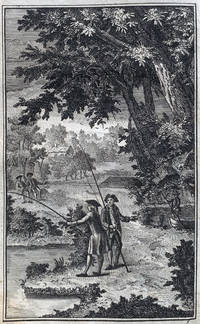
1773réf. 240394London: Printed for Edward and Charles Dilly 1773. Third edition. Engraved frontispiece of men fishing. xxxvii 2 136 pp. 1 vols. 8vo. Bound in three quarters green morocco t.e.g. Bookplate of Arnold Wood. Third edition. Engraved frontispiece of men fishing. xxxvii 2 136 pp. 1 vols. 8vo. The author a poetical mainstay of "The Gentleman's Magazine" was a friend of Dr. Johnson and editor of The Complete Angler. Westwood and Satchell p. 43-44 Printed for Edward and Charles Dilly unknown books
1773réf. 8107London: Printed for Edward and Charles Dilly 1773. Third edition. Frontispiece. 1 vols. 8vo. Contemporary calf new spine small portion of free endpaper gone light marginal waterstains on first few prelims else internally fine. Third edition. Frontispiece. 1 vols. 8vo. The author a poetical mainstay of "The Gentleman's Magazine" was a friend of Dr. Johnson. Westwood and Satchell p. 43-44 Printed for Edward and Charles Dilly unknown books
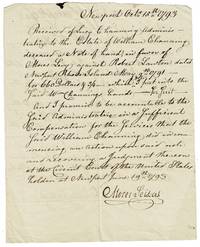
1793réf. 55221Newport: Oct. 15 1793. One-page octavo document approx. 8" x 6¼"; previous fold else near fine. Lucy Ellery Channing's father was William Ellery signer of the Declaration of Independence from Rhode Island. "For 660 dollars & 3/4 which note I put into the said Mr. William Channings hands - for suit - and I promised to be accountable to the said administratrix in a sufficient compensation for the services that the said William Channing did in commencing an action upon said note and recovering a judgment thereon at the Circuit Court of the United States holden at Newport June 19 1793." Signed by Moses Seixas and docketed on the verso. Moses Sexias was Moses Levy's grandson. Moses Levy had died a year earlier. Moses Seixas 1744-1809 was a "first generation Jewish-American whose parents migrated from Lisbon Portugal to Newport. Seixas rose to prominence as warden of Newport's Touro Synagogue of Congregation Jeshuat Israel Grand Master of the Grand Lodge of Free and Accepted Masons of Rhode Island and co-founder of the Bank of Rhode Island. Seixas is best remembered for the congratulatory letter he penned on behalf of his congregation to then recently inaugurated President George Washington in 1790. Written just months after Rhode Island became the last state to ratify the United States Constitution Seixas sought assurances that the enumerated rights of freedom of religion and enfranchisement would apply to American Jews in the new republic" MountVernon.org. Oct. 15 unknown books
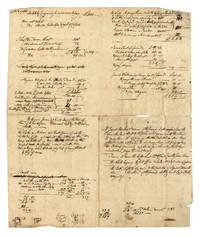
1786réf. 55770Providence 1786. Folio sheet approx. 15" x 12" docketed on the verso; previous folds with splits no loss; overall toning; good. Brigadier General James Angell 1723-1785 descendant of one of the first settlers of Providence died February 2 1785. This inventory was taken by Moses Brown 1736-1838 executor of the will and both a friend and relative. The Angell's daughter Abigail married a Goddard relatives of the Brown family. Among assets listed are Angell's Johnston farm lot 160 acres of Vermont land a third of an acre lot in North Providence; "we to give James and Jacob a Deed of the Whole of remd of Johnston farm & North Providence lott." James Angell was town clerk of Providence until 1775 and Theodore Foster said of him "I became intimately acquainted with the said James Angell and many of his Family Connexions among whom was the Honorable Stephen Hopkins Esq. whose Sister married the said James Angell." Documentary History of R.I. Angell was also appointed chairman of the committee to revise laws of the state. unknown books