Mannheimer, MosesBiblio.com

10 952 résultats
réf. 3368639048.Gpaperback. Good. Access codes and supplements are not guaranteed with used items. May be an ex-library book. paperback
1819pp. 16, 8 [Publisher's catalogue] + 5 Full Page Plates. Stamped ownership of M. F. Lobo on front wrap and title page. Plates and Publisher's catalogue very dampstained. Front wrap, first fly leaf and title page damaged with loss at bottom margins. 155mm. Original printed paper wraps. Publisher's advertisement on rear wrap. Wraps stained and worn. Moses Finzi Lobo was born in Bridgetown, Barbados, West Indies (1834). He came to Philadelphia about 1845, and lived there until his death (1904). He was a respected journalist, scholar, author, and leader in community affairs. His skill and knowledge of shorthand was exceptional, and he was frequently called upon to record scientific addresses, and other important events. He served as private secretary to the Superintendent of the Mint, before resigning that post to engage in literary work. We feel fortunate to be able to present Short-Hand books owned by him. SHORTHAND
1945réf. 3936EIMEF 1945
2019réf. 2-613945963XLAP Lambert Academic Publishing 2019. Paperback. New. 8.50x5.67x0.32 inches. LAP Lambert Academic Publishing paperback
Book shows some wear to covers, edgewear, corner wear, pictorial boards. Binding is solid and square, , text/interior is clean and free of marking of any kind. Lots of stuff about a big bearded dude in the sky who's in charge and the white people who do his bidding on earth and are in charge of everything down here and how all other people will burn in an eternal fire. "Does God have a Chosen People now too? Of course He has! Christians are His Chosen People!" Illustrated throughout with white people worshiping Daddy/God. Maps.
2003réf. Q-0262632675A Bradford Book 2003-01-24. Paperback. New. In shrink wrap. Looks like an interesting title! A Bradford Book paperback
réf. 1373248157.Ghardcover. Good. Access codes and supplements are not guaranteed with used items. May be an ex-library book. hardcover
réf. 1025969839.Ghardcover. Good. Access codes and supplements are not guaranteed with used items. May be an ex-library book. hardcover
réf. 43669247like new. unknown
réf. 43669247-nnew. unknown
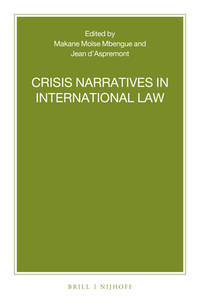
réf. B9789004472358Paperback / softback. New. This volume offers a series of short and highly self-reflective essays by leading international lawyers on how global crises inform the functioning and theorizing of international law as well as how international law addresses global crises. paperback
réf. BN318133Schulthess Juristische Medien. Softcover. Les accords de promotion et de protection des investissements de la Suisse Collection Genevoise Les accords de promotion et de protection des investissements de la Suisse Collection Genevoise Makane Moise Mbengue et Jan Vouillamoz Schulthess Juristische Medien paperback
réf. 39872194like new. unknown
réf. 39872194-nnew. unknown
2012réf. 1-3659264555Lap Lambert Academic Publishing 2012. Paperback. New. 88 pages. 8.66x5.91x0.20 inches. Lap Lambert Academic Publishing paperback
réf. 3659372293.Gpaperback. Good. Access codes and supplements are not guaranteed with used items. May be an ex-library book. paperback
2010réf. DADAX1167647688Kessinger Publishing 2010-09-10. paperback. New. 6.00x0.78x9.00. Buy with confidence. Excellent Customer Service & Return policy. Kessinger Publishing paperback
réf. 1160162271.Gpaperback. Good. Access codes and supplements are not guaranteed with used items. May be an ex-library book. paperback
réf. 1167647688.Gpaperback. Good. Access codes and supplements are not guaranteed with used items. May be an ex-library book. paperback
1828réf. 38188Salzburg: Arnsteinii et Filiorum 1828. Second edition. Hardcover. fair. Small quarto 12 117 leaves 2 67 leaves 84 leaves; 5 in text illustrations. Contemporary three quarter calf over marbled boards with gilt lettering on green and brown labels on spine. Latin and Hebrew title-pages plus title-pages before each of the 3 sections. Maimonides' "Guide for the Perplexed." First published in 1791 in Berlin and then in 1800 in Salzburg. Translated from Judeo-Arabic by Samuel ibn Tibbon. Commentary by Moses Narbonni and a contemporary commentary "Givat Hamoreh" printed anonymously but actually by the maskil Solomon Maimon. Edited by Isaac Abraham Euchel one of leaders of the moderate wing of the Berlin Haskalah. Prefaces by Narbonni and Maimon. Errata pages after the first and third sections. Explanation of philosophical terms. As with Moses Mendelssohn's Biur project this work exemplifies the moderate strain within the late 18th century German Haskalah which attempted to reform traditional Judaism using the medieval Jewish philosophical tradition exemplified by Maimonides. Text in Hebrew. Head and tail of spine with wear and chipped at head and green label. Leather broken just below brown label and at joints of spine. Corners and boards rubbed. Endpapers with offsetting in corners. Very light and sporadic foxing throughout. Binding in overall fair to good- interior in good condition. Title page info: "Auctore R. Mose Majemonide Arabico idiomate conscriptus a R. Samuele Abben Thibbone in Linguam Hebraeam translatus novis commentaris uno R. Mosis Narbonnensis ex antiquissimis manuscriptis depromto; altero anonymi cujusdam sub nomine Gibeath Hamore adauctus nunc in lucem editus cura et impensis Isaaci Eucheli. Solisbaci in officina arnsteinii et filiorum. MDCCC." R. Moses Maimonides Rambam was a 12th century Jewish philosopher and halachic legal scholar. A highly controversial figure both during his lifetime and after his death but generally acknowledged as the preeminent Jewish thinker of the Middle Ages. He was born in Córdoba Spain but fled as a child from the Almohad persecution. He eventually settled in Egypt where he served as a rabbi physician and philosopher. His fourteen-volume Mishneh Torah his only work not in Arabic still carries canonical authority particularly within the Yemenite Jewish community as the codification of Talmudic law. His other work includes a commentary on the Mishnah entitled Kitab al-Siraj Kitab al-Fara'I a book on precepts and the philosophical work Dalalat al-Ha'irin known in Hebrew as the Moreh Nevukhim The Guide to the Perplexed. The major premise is an attempted philosophical/theological reconciliation of the Hebrew Bible and Greek knowledge. This work came to play a central role in all subsequent major controversies over philosophy within the Jewish community during the Middle Ages. Arnsteinii et Filiorum hardcover books
1949réf. 16663New York: Bloch 1949. Hardcover. g. 4to. 93b-165a 2pp. Blue cloth with silver lettering to spine. Hebrew and English on opposing pages. The Mishneh Torah subtitled Yad ha-Chazaka is a code of Jewish law by one of the most important Jewish authorities Rabbi Moshe ben Maimon better known as Maimonides or by the Hebrew abbreviation RaMBaM usually written "Rambam" in English. The Mishneh Torah was compiled between 1170 and 1180 while he was living in Egypt and is regarded as Maimonides' magnum opus. It consists of fourteen books which subdivide into sections chapters and paragraphs. To this day it is the only post-Talmudic work that details all of Jewish observance including those laws which are only applicable when the Holy Temple is in place. Corners bumped spine faded. Scuffing rubbing staining to boards. Hinges starting back board. In Hebrew and English. Good condition. R. Moses Maimonides Rambam was a 12th century Jewish philosopher and halachic legal scholar. A highly controversial figure both during his lifetime and after his death but generally acknowledged as the preeminent Jewish thinker of the Middle Ages. He was born in Córdoba Spain but fled as a child from the Almohad persecution. He eventually settled in Egypt where he served as a rabbi physician and philosopher. His fourteen-volume Mishneh Torah his only work not in Arabic still carries canonical authority particularly within the Yemenite Jewish community as the codification of Talmudic law. His other work includes a commentary on the Mishnah entitled Kitab al-Siraj Kitab al-Fara'I a book on precepts and the philosophical work Dalalat al-Ha'irin known in Hebrew as the Moreh Nevukhim The Guide to the Perplexed. The major premise is an attempted philosophical/theological reconciliation of the Hebrew Bible and Greek knowledge. This work came to play a central role in all subsequent major controversies over philosophy within the Jewish community during the Middle Ages. Bloch hardcover books
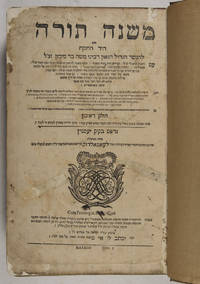
1739réf. 27896Jessnitz Saxony-Anhalt: Bi-defus Yisrael bar Avraham 1739. Hardcover. Good. Four volumes folio published between 1739 and 1742. Woodcut printer's device at titles; woodcut endpieces in first volume. Hebrew text opens from right to left; leaf numbers in Hebrew characters. Hebrew chronograms yield Jewish dates of publication 5499-5502. Brown library buckram scuffed at extremities spines lettered in gilt. Endleaves renewed. A good set. See foliation and condition notes for each volume below. Scarce eighteenth-century edition of this seminal compendium of Jewish law halakhah. Compiled between 1170 and 1180 while Maimonides was living in Egypt the Mishneh Torah is regarded as the author's magnum opus. It is the only Medieval-era work that surveys the full panoply of Jewish observance including those laws that are only applicable when the Jerusalem Temple is in existence. The present edition is the first to contain Judah Rosanes' commentary Mishneh le-melekh. "Mishneh Torah" The Repetition of the Law is an appellation originally applied to the biblical book of Deuteronomy; the subtitle "ha-Yad ha-Hazakah" The Book of the Strong Hand plays on its subdivision into fourteen books: the numerical value fourteen is represented in Hebrew letters as Yud 10 Dalet 4 which forms the word "yad" hand. Maimonides sought to provide a complete statement of the Oral Law so that a person who mastered first the Written Torah and then the Mishneh Torah would be in no need of any other book. Contemporary reaction was mixed with strong and immediate opposition focusing on the absence of sources and the belief that the work appeared to be intended to supersede study of the Talmud itself. Maimonides responded to these criticisms and the Mishneh Torah endures as an influential work in Jewish religious thought. According to several authorities a decision may not be rendered in opposition to a view of Maimonides even where he apparently militated against the sense of a Talmudic passage for in such cases the presumption was that the words of the Talmud were incorrectly interpreted. Likewise: One must follow Maimonides even when the latter opposed his teachers since he surely knew their views and if he decided against them he must have disapproved their interpretation. Vol. 1: 1 title 8 234 102 3 ff. Repairs at title page with very slight loss of text at verso following leaf and the final leaf. Text embrowned often heavily in first half with some light marginal dampstains throughout. Old manuscript entries in Hebrew at title in at least three hands. Vol. 2: 1 title 148 112 2 ff. Marginal repairs to first and last two leaves no loss of text. Moderately dampstained throughout with some mild embrowning. Old manuscript entries in Hebrew at title in at least two hands; three old stamps at title including at least one censor's approbation. Vol. 3: 1 title 221 169 ff. Repairs at bottom margin to title with loss of some text below imprint and at final lines of rabbinic approbations at verso and at bottom margin following leaf with some text loss and obscuration by translucent paper tape. Small marginal repair at final leaf. Light dampstaining in first half; remaining text with mild embrowning. Old manuscript entries in Hebrew at title in at least two hands; two old stamps at title including at least one censor's approbation. Vol. 4: 1 title 135 138-154 157 1 ff. Marginal repairs to title and final leaf no loss of text. Sporadic light embrowning and marginal stains. Old manuscript entry in Hebrew at title. A complete set with only minimal text loss in a few places -- a very usable scholar's copy. References: Vinograd Jessnitz 46; Fürst 2: p. 295; Zenker p. 583 Title in Hebrew: משנה תורה ×”×•× היד החזקה להנשר הגדול ×”×’×ון רבינו משה בר מימון זצ׳׳ל ×¢× השגת הר×ב׳׳ד זצ׳׳ל ופירוש הרב מגיד משנה וכסף משנה להג×ון המשביר רבינו יוסף ק×רו זצ׳׳ל ומגדל עוז והגהות מימונייות ופירוש רבינו עובדי והרב המוסמך מדר׳׳ל ן׳ חביב על הלכות קידוש החדש ×¢× כל הצורות השייכות להלכות ×לו ולהלכות שבת וסוכה ×•×¢× מורה ×ž×§×•× על דברי הרב המגיד וכסף משנה ×’× שתי מפתחות גדולות ורחבות ×חת על סדר ×”×¤×¨×§×™× ×•×חת על דרך ××œ×¤× ביתה ×œ× חסר דבר מכל כפי ×שר נדפס ב××ž×©×˜×¨×“× Rabbi Moses Maimonides the Rambam was a 12th century Jewish philosopher and halachic legal scholar. A highly controversial figure both during his lifetime and after his death he is generally acknowledged as the preeminent Jewish thinker of the Middle Ages. He was born in Córdoba Spain but fled as a child from the Almohad persecution. He eventually settled in Egypt where he served as a rabbi physician and philosopher. His fourteen-volume Mishneh Torah his only work not in Arabic still carries canonical authority particularly within the Yemenite Jewish community as the codification of Talmudic law. His other works include "Kitab al-Siraj" a commentary on the Mishnah "Kitab al-Fara'I" a book on precepts and the celebrated philosophical work "Dalalat al-Ha'irin" known in Hebrew as the "Moreh Nevukhim" The Guide to the Perplexed. In this latter work Maimonides attempted a philosophical/theological reconciliation of the Hebrew Bible and Greek knowledge. This work came to play a central role in all subsequent major controversies over philosophy within the Jewish community during the Middle Ages. Bi-defus Yisrael bar Avraham hardcover books
1959réf. 48773Jerusalem: Mossad Ha-Rav Kook 1959. Ex-Library. Hardcover. g. 3 volumes. Quarto. Continuous pagination of the first two volumes. lxxxviii. 524 89pp. Beige greenish cloth with black lettering to covers and spines. The Guide of the Perplexed is Maimonides' best known work. This specific edition was edited by Yehuda Kauffmann Even Shemuel a professor at the Hebrew University of Jerusalem whose Neo-Kantian outlook is apparent in his commentary and remarks. Further remarkable is the easy readable regular Hebrew print unlike the "Rashi"- print this work is normally printed in. Text in Hebrew. Bindings with some sunning to spines of vol. 1&3. Front and back covers with some light smudges and scratches endpapers with aging. Heads and tails slightly bumped. Some pages with light sunning to edges. Bindings in overall good interiors in good condition. The Arabic original Dalalat al-Hairin was completed about 1200 in Cairo Egypt. Shortly therafter it was translated into Hebrew as The Moreh Nevukhim. The first translation upon which this edition draws from a literal one was made by Samuel Ibn Tibbon with Maimonides' advice and completed in 1204. Maimonides wrote the Guide for someone who was firm in his religious beliefs and practices but having studied philosophy was perplexed by the literal meanings of Biblical anthropomorphic and antropopathic terms. Hence the title Maimonides also undertook here the explanation of Biblical parables. Thus the Guide is devoted to the philosophic interpretation of Scripture or to use Maimonides' terms to the "science of Law in its true sense" quoted in Encyclopedia Judaica p. 771. Mossad Ha-Rav Kook hardcover books
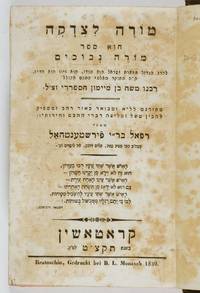
1864réf. 50647Krotoschin Krotoszyn/ Vienna/ Frankfurt am Main: Printed by B.L. Monasch/ Jacob Schlossberg's Buchhandlung/ Printed by Ferdinand Hauch 1864. First German translations. Hardcover. g to vg-. Octavo. 3/4 black morocco over buckram boards. Gilt lettering and ruling on the spine. Red speckled edges of book block. A complete set of the three parts of Maimonides acclaimed work The Guide for the Perplexed in German and Hebrew bound in one volume. All of the editions included here contain the first German translations of their respective parts of the text. Maimonides' intention with this work was to reconcile Aristotelian thought and logic with traditional Rabbinical Jewish theology. Originally written circa 1190 in Judeo-Arabic as Dalalat al-Ha'irin these writings takes the form of a lengthy three-part letter to his student Rabbi Joseph ben Judah of Ceuta and are seen as the main source for understanding Maimonides' philosophic view rather than his strictly being his views on Jewish law. It is the most known of his works in the non-Jewish world. The work's first translation into Hebrew was in 1204 by Rabbi Samuel ben Judah ibn Tibbon c.1150 - c.1230 a contemporary of Maimonides. Content: Moreh li-Tsedakah. Hu Sefer Moreh Nevukhim FIRST PART. 1839. Second German-language edition. 19 double-sided leaves with Hebrew pagination. 392pp. 3. In 1835 the first part of Maimonides acclaimed work was first translated into German with added commentary in Hebrew by Jacob Raphael Fürstenthal 1781-1855. That first edition featured the German translation printed in Latin script to accompany the Hebrew text. However for this second edition of that translation it is interesting to note that the text of the German is printed in Hebrew script. Content finely printed in double and single-column layouts with commentary printed in Rashi script. Divided in 76 chapters this part of the work contains discussions of an understanding and definition of the nature of God and divine anthropomorphism in the Hebrew bible including a detailed analysis of the Biblical Hebrew of the text to these ends. The final three pages included here contain and index in both Hebrew and German. BOUND WITH More Nebochim. Wegweiser für Berirrte SECOND PART. 1864. First German-language edition. x 99pp. This is the first German translation of the work's second part taken from the original Arabic text by way of the French translation by Salomon Munk 1861. The original Hebrew translation of the text is accompanied throughout by a translation and commentary in German by Max Emanuel Stern 1811-1873. Divided into 48 chapters the second part involves Maimonides discussion of proof of the existence of God the nature of creation the concept of prophecy and an examination of the 26 propositions for Aristotle's metaphysics. The initial pages contain introduction and foreword by Stern. Also included is a fold-out plate containing facsimile text from an original signed manuscript note from the hand of Maimonides himself written in Japhet son of Solomon's corrected manuscript copy of the Mishneh Torah held at Bodleian Library at Oxford MS Hunt.80 leaf 165a. AND WITH Dalalat al Haiirin Burechtweisung der Verirrten. Dritter Theil. THIRD PART. 1838. First German-language edition. viii 9 454pp. 5. This is the first German translation of the work's third part. Simon B. Scheyer 1804-1854 provides the translation and scholarly commentary in German to accompany the Hebrew of the text. This third and final part of Guide for the Perplexed is divided into 54 chapters and is considered the climax of the work and the culmination of Maimonides' previous analysis. Discussed are concepts including Jewish mysticism the Chariot of Ezekiel the moral aspects of the universe the problem of evil free will and the 613 mitzvot of the Torah. The final pages contain a scholarly index in German. Binding tight with some rubbing to extremities including the hinges of the spine. Spine and covers lightly sunned. Text throughout with some sporadic minor to light foxing. Much of the text is quite clean. A very few instances of underlining or notes in pencil. Binding in good interior in very good- condition overall. Hebrew title: מורה לצדקה .×”×•× ספר מורה × ×‘×•×›×™×/ מורה × ×‘×•×›×™×/ מורה × ×‘×•×›×™×. ×•×”×•× ספר דל×לה ×לח×ירין .חלק שלישי Author: משה בן מימון רפ×ל בר"י ×¤Ö¼×™×¨×©×˜×¢× ×˜×”×ל Publication: פרנקפורט/ קר×ט×שין תקצ״ט Alternate titles and transliterations: Moreh Nevukim Doctor Perplexorum Bibliographic references: PART 1 Vinograd Krotochin 14. PART 3 Vinograd Frankfurt 578 Provinence: Previously owned by Oxford religion scholar O.H.M. Lehmann dated 1949. Printed by B.L. Monasch/ Jacob Schlossberg's Buchhandlung/ Printed by Ferdinand Hauch hardcover books
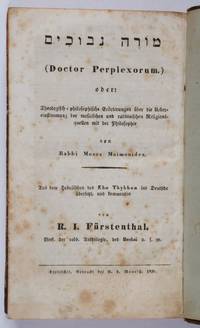
1839réf. 48414Wien: Krotoschin; printed by B. L. Monasch 1839. Later printing. Hardcover. g to vg. Octavo. 392 3 8pp. Original three-quarter leather over marbled boards with gilt lettering on red label and gilt tooling and ruling on spine. Red edges. Light blue endpapers. Translated into German from Ebn Thybbon's Hebrew translation of the Arabic original annotated and with an epilog on the preface by R. I. Fürstenthal. The publication is an edition of Maimonides seminal work on Jewish philosophy "Guide to the Perplexed" written app. 1190 in Arabic using Hebrew letters and first translated into Hebrew in 1204. Originally written in a three-part letter to his student Joseph ben Juda of Ceuta. It was written to enlighten a religious man according to Maimonides to explain obscure figures appearing in the Prophets; and generally addressed to an elect educated readership. Text in German and Hebrew. Binding with wear along edges small chips along edges and red leather label on spine. Marbled boards with light scuffing. Light scuffing at front joint of the spine with light fraying at head. Light foxing of front and back part of block. Binding in overall good interior in good to very good condition. References: Cf. Fürst II p. 305: Krotoschin 1838. Krotoschin; printed by B. L. Monasch hardcover books