Moises Lino e SilvaBiblio.com

11 169 résultats
réf. 43795518-nnew. unknown
réf. 43795518like new. unknown
réf. ria9780226818252_inpHardback. New. New Book; Fast Shipping from UK; Not signed; Not First Edition; N/A hardcover
réf. A9780226818252Hardback. New. hardcover
2022réf. x-022681825XUniv of Chicago Pr 2022. Hardcover. New. 240 pages. 9.00x6.00x0.79 inches. Univ of Chicago Pr hardcover
2022réf. x-0226818276Univ of Chicago Pr 2022. Paperback. New. 243 pages. 9.25x6.25x0.75 inches. Univ of Chicago Pr paperback
1989réf. Q-0906447437Chilton Book Co 1989-07-01. Hardcover. New. In shrink wrap. Looks like an interesting title! Chilton Book Co hardcover
1997réf. 281309Limburg : Lahn, 1997. [24] Seiten. Mit zahlreichen farbigen Illustrationen. 21 x 22 cm Originalpappband..
réf. 68635N° 9 - Octobre 1961 - Nouvelle série - Mensuel - In-4, broché
réf. 1020531975.Ghardcover. Good. Access codes and supplements are not guaranteed with used items. May be an ex-library book. hardcover
réf. 46415815like new. unknown
réf. 0265517958.Ghardcover. Good. Access codes and supplements are not guaranteed with used items. May be an ex-library book. hardcover
réf. JUDA2478Basel Goldschmidt 1968. gr.-8°. Zus. ca 2.900 Seiten uniforme schwarze Original-Kunstlederbände mit je einem dt. bzw. hebr. rotem Rückenschild verlagsfrisch ungelesen. Die Mischna ist eine Basis des Talmud denn sie ist das erste kanonische Werk der mündlichen Überlieferung des Judentums. Die Mischna stellt die wichtigste Sammlung religionsgesetzlicher Überlieferungen der rabbinischen Zeit dar. Sie bildet so die Grundlage der späteren talmudischen Argumentationen. Basel, Goldschmidt 1968. unknown
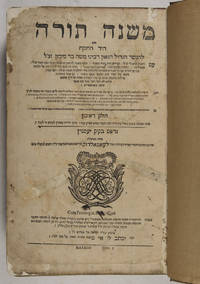
réf. 0700-13Berlin Sittenfeld 1864. 3 Tle. in 1 Bd. gr.-4°. 624; 128; 170 S. Titel in Rot u. Schwarz. Ldr. d. Zt. m. Rückensch. u. Rückengoldpräg. Wurmgänge a. d. Hinterdeckel. Cheleq rischon cheleq scheni. Mit Kommentaren etc. von Abraham ben David Vidal di Tolosa Josef Karo Obadja ben David Levi ben Chabib Avraham di Boton Jehuda Rosanes Nachum Trebitsch. - Enthalten sind die folgenden Bücher der Mischne Tora: Madda Ahava Zemanim sind die Bücher 1 bis 3. Berlin, Sittenfeld 1864. unknown
1994réf. 167209Berlin : Akad.-Verl., 1994. 568 S. ; 24 cm OLeinen, teils in Frakturschrift
réf. 47144530like new. unknown
réf. 163661003X.Gpaperback. Good. Access codes and supplements are not guaranteed with used items. May be an ex-library book. paperback
réf. 1885220286.Gunknown_binding. Good. Access codes and supplements are not guaranteed with used items. May be an ex-library book. unknown
1959réf. Sq19828Tel-Aviv: Am Olam 1959. Unstated. Good. 7 large hardcover volumes of Mishneh Torah including Sefer Hamitzvot. Includes commentaries of: Magid Mishneh Kesef Mishneh Lechem Mishneh Mishneh L'melech Migdal Oz and Hagahot Maimonit on the sides and bottom of the text. After the text a small selection of rabbinic commentaries and responsa eg. Pri Chadash Yaakov Emden. Sefer Hamitzvot includes notes by Nachmadides and the commentary called Megilat Esther. Unmarked text green boards no dj. Pages Yellowing. Covers slightly indented and curved upwards. Previous owner's name in front. Outside edge of pages with wear. Lh Am Olam hardcover
1862réf. 47726Berlin: Printed by Julius Sittenfeld 1862. Hardcover. g to vg. Elephant Folio. Original spotted leather with debossed vignette and decorative ruling on cover. Blue endpapers. Title page printed in red and black with engraved vignette. With commentaries by Vidal Yom Tov of Tolosa Abraham ben David of Posquières Joseph ben Ephraim Karo Shem Tov ben Abraham Ibn Gaon Meir ha-Kohen Abraham Hiyya de Boton Judah ben Samuel Rosanes Nehemiah Trebitsch and Nahman Avraham Goldberg. The Mishneh Torah is the only Medieval-era work that details all of Jewish observance including those laws that are only applicable when the Holy Temple is in existence. Its title is an appellation originally used for the Biblical book of Deuteronomy and its subtitle "Book of the Strong Hand" derives from its subdivision into fourteen books: the numerical value fourteen when represented as the Hebrew letters Yod 10 Dalet 4 forms the word yad "hand". Maimonides intended to provide a complete statement of the Oral Law so that a person who mastered first the Written Torah and then the Mishneh Torah would not need to refer to any other legal text. Contemporary reaction was mixed with strong and immediate opposition focusing on the absence of sources and the belief that the work appeared to be intended to supersede study of the Talmud. Maimonides responded to these criticisms and the Mishneh Torah endures as an influential work in Jewish religious thought. According to several authorities a decision may not be rendered in opposition to a view of Maimonides even when he differed from the understanding of the Talmudic passage for in such cases the presumption was that the words of the Talmud were incorrectly interpreted. Likewise: "One must follow Maimonides even when the latter opposed his teachers since he surely knew their views and if he decided against them he must have disapproved their interpretation. However despite his stature in Yemen and the Sephardic world the Rabbinic authorities from the 13th century onwards did not base their legal rulings and interpretations of Halicha on Maimonides. The Mishneh Torah was compiled between 1170 and 1180 4930-4940 while Maimonides was living in Egypt and is regarded as Maimonides' magnum opus. Text in Hebrew. Bindings with mostly light wear along edges with small chips some scuffing of covers and lightly rubbed. Volume three with two inch crack at lower front joint and chip at head of spine. Volume four with one and a half inch closed tear at head of spine. Few bookworm holes at lower foredge of first few pages of volume one. Brief inked notes on endpapers. bindings in overall good interiors in very good condition. Printed by Julius Sittenfeld hardcover
1739réf. 27896Jessnitz Saxony-Anhalt: Bi-defus Yisrael bar Avraham 1739. Hardcover. Good. Four volumes folio published between 1739 and 1742. Woodcut printer's device at titles; woodcut endpieces in first volume. Hebrew text opens from right to left; leaf numbers in Hebrew characters. Hebrew chronograms yield Jewish dates of publication 5499-5502. Brown library buckram scuffed at extremities spines lettered in gilt. Endleaves renewed. A good set. See foliation and condition notes for each volume below. Scarce eighteenth-century edition of this seminal compendium of Jewish law halakhah. Compiled between 1170 and 1180 while Maimonides was living in Egypt the Mishneh Torah is regarded as the author's magnum opus. It is the only Medieval-era work that surveys the full panoply of Jewish observance including those laws that are only applicable when the Jerusalem Temple is in existence. The present edition is the first to contain Judah Rosanes' commentary Mishneh le-melekh. "Mishneh Torah" The Repetition of the Law is an appellation originally applied to the biblical book of Deuteronomy; the subtitle "ha-Yad ha-Hazakah" The Book of the Strong Hand plays on its subdivision into fourteen books: the numerical value fourteen is represented in Hebrew letters as Yud 10 Dalet 4 which forms the word "yad" hand. Maimonides sought to provide a complete statement of the Oral Law so that a person who mastered first the Written Torah and then the Mishneh Torah would be in no need of any other book. Contemporary reaction was mixed with strong and immediate opposition focusing on the absence of sources and the belief that the work appeared to be intended to supersede study of the Talmud itself. Maimonides responded to these criticisms and the Mishneh Torah endures as an influential work in Jewish religious thought. According to several authorities a decision may not be rendered in opposition to a view of Maimonides even where he apparently militated against the sense of a Talmudic passage for in such cases the presumption was that the words of the Talmud were incorrectly interpreted. Likewise: One must follow Maimonides even when the latter opposed his teachers since he surely knew their views and if he decided against them he must have disapproved their interpretation. Vol. 1: 1 title 8 234 102 3 ff. Repairs at title page with very slight loss of text at verso following leaf and the final leaf. Text embrowned often heavily in first half with some light marginal dampstains throughout. Old manuscript entries in Hebrew at title in at least three hands. Vol. 2: 1 title 148 112 2 ff. Marginal repairs to first and last two leaves no loss of text. Moderately dampstained throughout with some mild embrowning. Old manuscript entries in Hebrew at title in at least two hands; three old stamps at title including at least one censor's approbation. Vol. 3: 1 title 221 169 ff. Repairs at bottom margin to title with loss of some text below imprint and at final lines of rabbinic approbations at verso and at bottom margin following leaf with some text loss and obscuration by translucent paper tape. Small marginal repair at final leaf. Light dampstaining in first half; remaining text with mild embrowning. Old manuscript entries in Hebrew at title in at least two hands; two old stamps at title including at least one censor's approbation. Vol. 4: 1 title 135 138-154 157 1 ff. Marginal repairs to title and final leaf no loss of text. Sporadic light embrowning and marginal stains. Old manuscript entry in Hebrew at title. A complete set with only minimal text loss in a few places -- a very usable scholar's copy. References: Vinograd Jessnitz 46; Fürst 2: p. 295; Zenker p. 583 Title in Hebrew: משנה תורה ×”×•× היד החזקה להנשר הגדול ×”×’×ון רבינו משה בר מימון זצ׳׳ל ×¢× השגת הר×ב׳׳ד זצ׳׳ל ופירוש הרב מגיד משנה וכסף משנה להג×ון המשביר רבינו יוסף ק×רו זצ׳׳ל ומגדל עוז והגהות מימונייות ופירוש רבינו עובדי והרב המוסמך מדר׳׳ל ן׳ חביב על הלכות קידוש החדש ×¢× כל הצורות השייכות להלכות ×לו ולהלכות שבת וסוכה ×•×¢× מורה ×ž×§×•× על דברי הרב המגיד וכסף משנה ×’× שתי מפתחות גדולות ורחבות ×חת על סדר ×”×¤×¨×§×™× ×•×חת על דרך ××œ×¤× ביתה ×œ× חסר דבר מכל כפי ×שר נדפס ב××ž×©×˜×¨×“× Rabbi Moses Maimonides the Rambam was a 12th century Jewish philosopher and halachic legal scholar. A highly controversial figure both during his lifetime and after his death he is generally acknowledged as the preeminent Jewish thinker of the Middle Ages. He was born in Córdoba Spain but fled as a child from the Almohad persecution. He eventually settled in Egypt where he served as a rabbi physician and philosopher. His fourteen-volume Mishneh Torah his only work not in Arabic still carries canonical authority particularly within the Yemenite Jewish community as the codification of Talmudic law. His other works include "Kitab al-Siraj" a commentary on the Mishnah "Kitab al-Fara'I" a book on precepts and the celebrated philosophical work "Dalalat al-Ha'irin" known in Hebrew as the "Moreh Nevukhim" The Guide to the Perplexed. In this latter work Maimonides attempted a philosophical/theological reconciliation of the Hebrew Bible and Greek knowledge. This work came to play a central role in all subsequent major controversies over philosophy within the Jewish community during the Middle Ages. Bi-defus Yisrael bar Avraham hardcover
2010réf. RELSPI/BOX72/MHY3/191125-Dec 01 2010. of God. Very Good. THE BOOK IS IN GOOD CONDITION PAGES ARE CLEAN Sold by the U.K Charity Kisharon Langdon. Offering Opportunities and Support for People within the Autism and Learning Disability Community unknown
réf. ANAIS-1885220693Moznaim Pub Corp. hardcover. Good. 1.8x09x2.1. Buy with confidence. Excellent Customer Service & Return policy. Moznaim Pub Corp hardcover
réf. 1885220375.Ghardcover. Good. Access codes and supplements are not guaranteed with used items. May be an ex-library book. hardcover
réf. 1885220693.Ghardcover. Good. Access codes and supplements are not guaranteed with used items. May be an ex-library book. hardcover