22.613 risultati
1737rif. 41768London: Chez Jean Brindley Libraire de S. A. R. Monseigeur le Prince de Galles dans New Bond-street 1737. Folio. 20 3/4 x 14 1/4 inches. Second edition deluxe large paper issue with wide margins. 43 double-page engravings after Abraham van Diepenbeke including 42 numbered 1-42 and the unnumbered 1658 title with Anvers imprint. Engraved head-piece to first dedication. Numerous woodcut illustrations throughout the text and woodcut historiated and inhabited initials head- and tail-pieces and printer's ornaments. 12 1-236. 248 pp. Letterpress title with London imprint and four dedications to Henriette Cavendishe-Holles the King of Grande-Bretagne Charles Vicomte de Mansfield and to Cavaliers. Avertissement avant-propos four livres plus an Abbrege de la Cavalerie conclusion additions table des chapitres. With incisive manuscript commentary pencilled in the margins in both French and English. Text in French. Bound to style in eighteenth-century half leather over eighteenth-century comb marbled paper-covered boards and marbled endpapers Deluxe large paper issue of Cavendish's classic 1737 treatise on equestrianism with 43 splendid double-page engravings: "The illustrations are among the most beautiful to ever grace equestrian literature." Ramsay Though considered a country of horse lovers England only produced one early master of classical riding: William Cavendish Duke of Newcastle who was a Royalist living in exile until the restoration of King Charles II. During his exile Cavendish opened a riding school in Belgium and wrote the present work La Méthode et Invention Nouvelle de Dresser les Chevaux. This text was the first of Cavendish's two important books on breeding and training horses and was translated into French from his English manuscript and published in Antwerp in two issues: 1657 and 1658 though many of the 1657 title-pages have been altered by hand to read 1658. The first printing was largely incinerated by a fire in the bookseller's shop and is all but impossible to acquire. Brunet Offered here is the deluxe large paper issue of the second edition of Cavendish's first book a work long cherished by bibliophiles for its typographical excellence and the masterful quality of its illustrations. It is a work that has been esteemed by countless generations of horsemen and revered by such master riders as La Guérinière Comte d'Aure and Steinbrecht. It is a landmark of equestrianism. Steinkraus Cavendish's book has been called the only really outstanding work on the subject written by an Englishman. Toole-Stott In it Cavendish discusses a wide variety of equine subjects including the recognition of the age and disposition of a horse; the characteristics of various types of horses such as the Spanish the Barb the English horse and the Arabian; methods of maintenance; and instructions on proper riding: "You must in all Airs follow the strength spirit and disposition of the horse and do nothing against nature; for art is but to set nature in order and nothing else." Of the 43 wonderful double-page engraved plates after Abraham van Diepenbeke 24 depict the multiple stages Cavendish and his assistant Captain Mazin employed in training horses in complicated maneuvers. The quality of the impressions in the present 1737 edition surpasses even those of the original edition. Steinkraus This was the first edition of La Méthode et Invention Nouvelle de Dresser les Chevaux to be published in England with engravings pulled from the original 1658 copperplates which were acquired by the publisher Jean Brindley. Brunet I 1700. Graesse II 93. Huth 23. Lowndes 1663. Mennessier de la Lance II p. 250. Nissen ZBI 848. Podeschi Mellon Books on the Horse and Horsemanship pp. 26 49. Ramsay "Early Dressage Literature to 1800" IOBA 6.9.03. Steinkraus Introduction to A General System of Horsemanship 2000. Toole-Stott Circus and the Allied Arts: A World Bibliography 84. Wing N884-87. Chez Jean Brindley, Libraire de S. A. R. Monseigeur le Prince de Galles, dans New Bond-street unknown books
1619rif. 18555Very Good HC. Text in Dutch blackletter; tekst in het Nederlands gotisch. Full contemporary vellum; untitled; raised bands on spine; red edges; 50 numbered full page copperplate engravings of Christian eremite saints 25 male 25 female printed recto with text pages verso; full page frontispiece for work as well as full page frontispiece for female section. Vellum in very good condition with some handling discoloration remains supple; ties at cover fore edges lacking; tightly bound; few pencil notes on front pastedown; without free end papers; lacking frontispiece for male section leaf A!; facsimile laid in; few leaves with light damp stains or soiling mostly in margins otherwise light and clean interior; one leaf B3 with large chip at top fore corner not affecting portrait but with some text missing from marginal notation on verso see photo; all leaves remain supple. 25 x 18 cm; 51 text pages; 50 numbered plates 2 frontispiece plates; in 4s. Ref OCLC #901301549. Hantvverpen (Antwerp): Hieronymus Verdussen hardcover
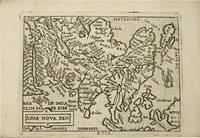
rif. BB17Venetia Per Scipion Banca 1667. 16mo 133 x 93 mm of 4 ll. 232 pp. 8 ll. 108 full-page engraved maps. Bound in contemporary stiff vellum. Handwritten exlibris on the half-title: " Bibliotheca Neorelli ". Italian pocket-edition of Ortelius' atlas illustrated with 108 full-page engraved maps. Philips 478 ; Tooley 31. " The commercial success of the pocket-atlas was considerable. It was translated into French and Latin now in prose and was reprinted several times long after Pieter Heyns had moved into the Netherlands together with his son Zacharias in 1588. In the year of Pieter Heyn's death 1598 his son Zacharias then living in Amsterdam repeated the successful best-seller of his father by publishing another Miroir du Monde using woodcut". Koeman. The illustration contains a world map and the continents' maps: Europe Asia Africa and America. The 103 other maps represent each country for which a note has been written on the opposite page. The first edition in Italian was printed in 1608. A charming copy preserved in its contemporary vellum binding. French Venetia Per Scipion Banca 1667. In-16 de 4 ff. 232 pp. 8 ff. 108 cartes gravées à pleine page. Relié en vélin rigide de l'époque. Ex libris manuscrit sur le faux titre : " Bibliotheca Neorelli ". 133 x 93 mm. Edition de poche italienne de l'atlas d'Ortelius ornée de 108 cartes gravées à pleine page. Philips 478 ; Tooley 31. " The commercial success of the pocket-atlas was considerable. It was translated into French and Latin now in prose and was reprinted several times long after Pieter Heyns had moved into the Netherlands together with his son Zacharias in 1588. In the year of Pieter Heyn's death 1598 his son Zacharias then living in Amsterdam repeated the successful best-seller of his father by publishing another Miroir du Monde using woodcut". Koeman. L'illustration s'ouvre sur une carte du monde et se poursuit avec les cartes des continents : l'Europe l'Asie l'Afrique et l'Amérique. Les 103 autres cartes représentent chacun des pays pour lesquels une notice a été rédigée en regard. La première édition en italien fut imprimée en 1608. Seduisant exemplaire conservé dans sa reliure en vélin de l'époque. hardcover
rif. LCS-1863L’Atlas de poche d’Ortelius en italien, complet de ses 108 cartes à pleine page, conservé dans sa reliure de l’époque. Venetia, Per Scipion Banca, 1667. In-16 de (4) ff., 232 pp., (8) ff. 108 cartes gravées à pleine page. Relié en vélin rigide de l’époque. Ex libris manuscrit sur le faux titre : « Bibliotheca Neorelli ». 133 x 93 mm.
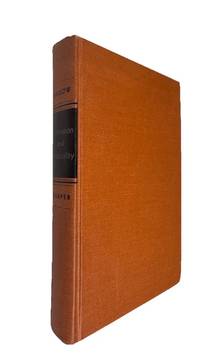
1954rif. 250317003New York: Harper & Brothers 1954. 1st Edition. Hardcover. Very Good/No Jacket. Motivation and Personality by Abraham Maslow. Finding signed documentation of any kind by Maslow is quite rare. Only a few signed copies of his publications are known. There are no other signed copies of this book Maslow's most important work listed for sale anywhere in the world and no record of a signed copy being sold in the auction record. OVERALL condition: VERY GOOD IMPORTANCE Motivation and Personality is one of the most influential and important psychology books ever written. It is a seminal work on the subject of the nature of human fulfillment and the significance of personal relationships implementing a conceptualization of self-actualization. Underachievers have a need for social love and affection but a self-actualized person has these "lower" needs to be gratified and is able to pursue his or her own path towards self-actualization. THE AUTHOR & HIS WORK Maslow's book is perhaps the best-known contemporary work on human needs. Maslow postulated a hierarchy of human needs stretching from basic physical needs at the bottom to spiritual or transcendental needs at the top. In Motivation and Personality Maslow argues that in order for individuals to thrive and excel a health-fostering culture must be created. Maslow is among the psychological theorists who believe that when parents fail to provide a safe nurturing environment their children will develop deep feelings of insecurity. Maslow believes that well-being causes people to freely express their inherent potentials. Maslow is most known for his belief that humans possess a hierarchy of needs. While he had been working on this theory and other ideas explored in this book since the late 1930s he first proposed his hierarchy of needs in his 1943 paper "A Theory of Human Motivation" in the journal Psychological Review. The theory is a classification system intended to reflect the universal needs of society as its base then proceeding to more acquired emotions. The hierarchy is split between deficiency needs and growth needs with two key themes involved within the theory being individualism and the prioritization of needs. Maslow's hierarchy of needs is often portrayed in the shape of a pyramid with the largest most fundamental needs at the bottom and the need for self-actualization and transcendence at the top. However Maslow himself never created a pyramid to represent the hierarchy of needs. BOOK INFO Published in 1954 by Harper & Brothers in New York City. First edition early printing. Inscribed by the author in graphite on the FFEP "To the Fanciest Taxi-driver/ A H Maslow." In original brown cloth covered boards with black lettering and design work on the spine. xiv 411 pp including Appendix and Bibliography. The book is in GOOD to VERY GOOD vintage condition. Partially erased pencil writing on a few pages and about half a dozen pages with areas of ink underlining. The cloth is unfaded with a few spots of soiling on back cover. Firm binding. Former owner name in ink on FFEP. Rubbing to extremities and one bumped corner. Harper & Brothers hardcover
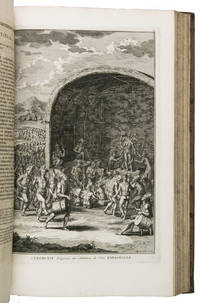
1727rif. 5737The Hague 1727. Folio. Rutgert Christoffel Alberts vols. 1-3 and Isaac van der Kloot vols. 3-4; Amsterdam Hermannus Uytwerf; Rotterdam Jan Daniel Beman Contemporary gold tooled mottled brown calf with red and black morocco title and volume labels lettered in gold each volume with a central lozenge-shaped ornament on both boards surrounded by two decorative borders gold tooled board edges marbled edges. With an engraved frontispiece 8 title-pages 6 in red and black each with one of 3 different engraved vignettes plus 3 part-titles with a woodcut decoration 224 full-page engraved plates including 1 folding and 38 double-page plates an engraving on the dedication leaf in vol. 1 and a few engravings in the text. Further with several engraved headpieces woodcut tailpieces and a few woodcut decorated initials. 6 volumes vols. 3 4 & 6 in 2 parts each bound as 7. First Dutch edition of Picart's famous and richly illustrated work on religious customs ceremonies and costumes from all over the world. With its six volumes it is the most sumptuous publication ever on the religions of the world richly and beautifully illustrated with large and sometimes double-page or even folding engraved plates by the French engraver Bernard Picart 1673-1733 who lived in Amsterdam from 1708. The text was compiled from a wide range of sources including R. Simon J. Abbadie Dupin Thiers P. le Brun Boulainvilliers and Reland and edited by the Amsterdam publisher Jean Frederic Bernard for a French edition titled Ceremonies et coutumes religieuses de tous le peuples du monde first published in 1723. It was translated into Dutch for the present edition by Abraham Moubach.The first two volumes discuss the religion of the Jews and Roman Catholics including a double-page engraving of the interior of the Portuguese synagoge in Amsterdam. The third and fourth volume deal with the religions of the "heathens" in the Americas including Mexico India Ceylon the Brahmans in India China Japan Africa and the Persians in Iran. The fifth volume concerns the Greek orthodox church and the several groups of Protestants. The last volume describes the Anglicans and smaller groups such as Quakers Mennonites Adamites Freemasons and finally Islam. Altogether the most important 18th-century survey work on the world's religions and their customs lavishly illustrated with very finely executed plates.From the library of Frederick H. Rindge 1859-1905. The boards are somewhat rubbed. The works are slightly browned and foxed throughout with the final leaves of volume 3 affected more than the others. Otherwise in good condition.l Alt-Japan-Katalog 1149; STCN 191420778; cf. Cordier Japonica col. 435; Lipperheide 1808; Sabin 62600 all French ed. hardcover
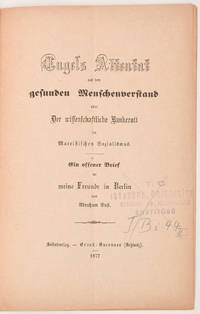
1877rif. 1812Grand-Saconnex Schweiz: Selbstverlag 1877. First edition. In publisher’s wrappers. Collection stamp and shelfmarks written in ink and pencil on the cover and the title-page. Distributor’s stamp on the cover. With traces of folding. Cover slightly dusted. Pages yellowed due to ageing. First five leaves with minor damage to the lower corners. Overall in fine condition. First edition. In publisher’s wrappers. 24 p. Scarce pamphlet reflecting on the debate on early Marxist communism countering Engels for Anti-Dühring. First and only edition of the socialist theorist Abraham Enss’ pamphlet in which he criticises Marx and his followers for “doing humbug with socialism” and virulently defending Dühring from Engels’ “pseudoscientific” diatribes on him. Since the editors of Berliner Freie Presse refused to accept his writing Enss self-published his open letter dated to February 4 1877 and supplemented by two postscripts dated to March 1 and March 18 respectively in the present pamphlet in Switzerland. In response to the appearance of his writings Engels called Enss the “Sancho Panza” of Dühring who he referred to as “modern Don Quixote” while Liebknecht wrote in his letters to Engels that “Enß is stupid and will soon go to the madhouse” and that he is “generally regarded as a donkey even an idiot”. Abraham Enss was a follower and friend of Eugen Dühring. From 1887 he edited Der Antikrat a Dühringian paper with anti-Semitic tendencies which appeared with the subtitle Gegen Parteigewalt und Hebräer-Einfluß. Für selbständige Geistesführung und sociale Gerechtigkeit. Against Party Violence and Hebrew Influence. For Independent Spiritual Leadership and Social Justice. Scarce WorldCat locates only one copy in institutional holding in the US in the Columbia University Library in New York. Literature: Engels F.; Marx K.: Marx & Engels Collected Works. Volume 25. London: Lawrence & Wishart 1987. p. 298.; Firedlaender B.: Der freiheitliche Sozialismus: im Gegensatz zum Staatsknechtsthum der Marxisten. Mit besonderere Berücksichtigung der Werke und Schicksale Eugen Dühring’s. Berlin: Freie Verlagsanschaft 1892. p. 71; Gay J.: The Blind Prometheus of German Social Science. Eugen Dühring as Philosopher Economist and Controversial Social Critic. Universität Erfurt 2012.; Liebknecht W.: Briefwechsel mit Karl Marx und Friedrich Engels. Berlin: Walter de Gruyter 2020. pp. 212–214.; Nettlau M.: Bibliographie de l’anarchie. Année 1897. — N° 8. Bruxelles: Bibliothèque des Temps Nouveaux 1897. p. 41. . Selbstverlag unknown
1708rif. 116863Amsterdam, les Frères Chatelain, 1708-1714, 4 vol. in-folio, (18)-8-(4)82, (16)-(10)-162 (pagination continue) et (12)-98 pp, lettrines, culs-de-lampes, reliures plein veau raciné, dos à 6 nerfs guillochés et caissons très ornés, pièces de titre et de tomaison basane naturelle, coupes guillochées, tranches rouges (rel. de l'époque), pet. travail de ver au tome 1 sans perte de texte, coiffes abîmées, qqs épidermures, 1 mors fendu sur 8 cm au tome 3, intérieurs propres, bon état
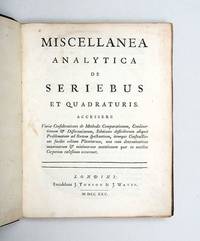
1730rif. 153282London: J. Tonson and J. Watts 1730. Binomial expansion First edition containing Moivre's first published attempt at approximating the terms of a binomial expansion. "Moivre's discovery greatly clarified the concept of probability in his own time and became the most fruitful single instrument of discovery used in probability theory and statistics for the next two centuries" Norman. Quarto 243 x 191 mm. Contemporary calf red morocco label red speckled edges. 18th-century armorial bookplate of Thomas Turton to front pastedown. Neat restoration to joints and extremities some scratches to covers light running staining in gutter and at head contents otherwise unmarked. A very good copy. ESTC T96683; Norman 1531. unknown
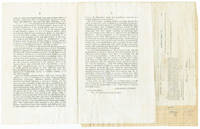
1863rif. 55254N.p. perhaps Virginia. Late 1863 or early 1864. Lincoln's Amnesty Proclamation: A Most Uncommon and Interesting Printing An exceedingly rare separate printing - perhaps by a military field press - of President Abraham Lincoln's December 1863 presidential proclamation offering amnesty to citizens of the Confederacy providing they take an oath that they "will abide by and faithfully support all proclamations of the President made during the existing rebellion having reference to slaves" i.e. the Emancipation Proclamation. When the number of persons in any state taking the oath reached ten percent of the number of voters in 1860 this group of loyal voters could form a state government that could be recognized by the President. The Amnesty Proclamation was issued with President Lincoln's third Annual Message to Congress i.e. State of the Union Address on December 8 1863. It was appended per the language in the title here to the official printing of that address but also printed separately. The present printing almost certainly executed in the weeks after Lincoln's State of the Union was likely hastily composed from the text of the official printing of the proclamation. The work carries no imprint information of any kind and bears the hallmarks of a military field press printing. Toward the close of 1863 with the Confederate Army in full retreat discussions in Congress centered on how to restore the Southern states to the Union. "The crisis which threatened to divide the friends of the Union is past" announced Lincoln. Now it was the duty of Congress to ensure that all citizens in the South regardless of race were guaranteed the equal protection of the law. A number of competing proposals emerged from deliberations but in the end during his message to Congress on December 8 1863 Lincoln declared reconstruction of the South a wholly executive responsibility and "offered 'full pardon.with restoration of all rights of property except as to slaves' to all rebels who would take an oath of future loyalty to the Constitution and pledge to obey acts of Congress and presidential proclamations relating to slavery" Donald p.471. Those excluded from taking the oath were the highest ranking members of the Confederacy - government officials judges military and naval officers above the rank of army colonel or navy lieutenant former congressmen and "all who have engaged in treating colored persons or white persons otherwise than lawfully as prisoners of war." Lincoln further encouraged the Southern states to make provisions "in relation to the freed people of such State which shall recognize and declare their permanent freedom provide for their education and which may yet be consistent as a temporary arrangement with their present condition as a laboring landless and homeless class." "Lincoln indicated that this was only one plan for reconstructing the rebel South and while it was the best he could think of for now he would gladly consider others and possibly adopt them. He might even modify his own classes of pardons if that seemed warrantable.Afterward almost everybody but die-hard Democrats seemed happy with the plan" Oates p.371. The proclamation is accompanied by a partially-printed Oath of Allegiance dated 1864 and datelined Harper's Ferry Virginia. The oath requires the taker to "solemnly swear that I will support protect and defend the Constitution and Government of the United States against all enemies." It is signed in type by Henry A. Urban Lieutenant and A.D.C. Aide-de-Camp. The oath is printed with a blank space for the name of the person taking the oath and the date. There is also a space for people who know the oath-taker and "certify on honor that we know Mr. blank to be a true and loyal man to the Federal Government." The Oath is affixed to a partial manuscript ledger report recording lost military stores for an unidentified unit in 1863 This printing of the Amnesty Proclamation is just as interesting as the government broadside printing or the first pamphlet printing as this edition would have also been used in the field by Union troops encountering Confederate rebels. The composition of the beginning of the seventh paragraph is consistent with the first pamphlet printing of the Amnesty Proclamation Monaghan 191 and not the broadside printing. The text here begins "Therefore I Abraham Lincoln."; in the broadside printing "Therefore" is present at the end of the preceding paragraph. The simple and somewhat loose execution of the composition seen here is consistent with field press printings as is the lack of an imprint of any kind. Perhaps this simple production was intended for Union troops to literally hand to Confederate soldiers to read. The presence of the portion of the ledger and the Oath of Allegiance lends credence to the notion that this edition of the Amnesty Proclamation was produced for use by the military. This printing of the Amnesty Proclamation is not in Monaghan OCLC or in any reference work we could find. In fact we could find no other three-page editions of the Amnesty Proclamation at all. Surely printed in small numbers to begin with it is perhaps a unique surviving example. The OATH affixed to a partial manuscript ledger report recording lost military stores for an unidentified unit in 1863 which is itself glued to the verso of the last blank page of the Amnesty Proclamation. Minor toning light foxing some wrinkling. Overall very good. In a cloth chemise and green half morocco and cloth slipcase spine gilt. MONAGHAN 191 ref. SABIN 41162 note. David Herbert Donald Lincoln New York 1995 p.471. Stephen B. Oates With Malice Toward None: A Life of Abraham Lincoln New York 1977 p.371. hardcover
1863rif. 55254N.p. perhaps Virginia. Late 1863 or early 1864. Lincoln's Amnesty Proclamation: A Most Uncommon and Interesting Printing An exceedingly rare separate printing - perhaps by a military field press - of President Abraham Lincoln's December 1863 presidential proclamation offering amnesty to citizens of the Confederacy providing they take an oath that they "will abide by and faithfully support all proclamations of the President made during the existing rebellion having reference to slaves" i.e. the Emancipation Proclamation. When the number of persons in any state taking the oath reached ten percent of the number of voters in 1860 this group of loyal voters could form a state government that could be recognized by the President. The Amnesty Proclamation was issued with President Lincoln's third Annual Message to Congress i.e. State of the Union Address on December 8 1863. It was appended per the language in the title here to the official printing of that address but also printed separately. The present printing almost certainly executed in the weeks after Lincoln's State of the Union was likely hastily composed from the text of the official printing of the proclamation. The work carries no imprint information of any kind and bears the hallmarks of a military field press printing. Toward the close of 1863 with the Confederate Army in full retreat discussions in Congress centered on how to restore the Southern states to the Union. "The crisis which threatened to divide the friends of the Union is past" announced Lincoln. Now it was the duty of Congress to ensure that all citizens in the South regardless of race were guaranteed the equal protection of the law. A number of competing proposals emerged from deliberations but in the end during his message to Congress on December 8 1863 Lincoln declared reconstruction of the South a wholly executive responsibility and "offered 'full pardon.with restoration of all rights of property except as to slaves' to all rebels who would take an oath of future loyalty to the Constitution and pledge to obey acts of Congress and presidential proclamations relating to slavery" Donald p.471. Those excluded from taking the oath were the highest ranking members of the Confederacy - government officials judges military and naval officers above the rank of army colonel or navy lieutenant former congressmen and "all who have engaged in treating colored persons or white persons otherwise than lawfully as prisoners of war." Lincoln further encouraged the Southern states to make provisions "in relation to the freed people of such State which shall recognize and declare their permanent freedom provide for their education and which may yet be consistent as a temporary arrangement with their present condition as a laboring landless and homeless class." "Lincoln indicated that this was only one plan for reconstructing the rebel South and while it was the best he could think of for now he would gladly consider others and possibly adopt them. He might even modify his own classes of pardons if that seemed warrantable.Afterward almost everybody but die-hard Democrats seemed happy with the plan" Oates p.371. The proclamation is accompanied by a partially-printed Oath of Allegiance dated 1864 and datelined Harper's Ferry Virginia. The oath requires the taker to "solemnly swear that I will support protect and defend the Constitution and Government of the United States against all enemies." It is signed in type by Henry A. Urban Lieutenant and A.D.C. Aide-de-Camp. The oath is printed with a blank space for the name of the person taking the oath and the date. There is also a space for people who know the oath-taker and "certify on honor that we know Mr. blank to be a true and loyal man to the Federal Government." The Oath is affixed to a partial manuscript ledger report recording lost military stores for an unidentified unit in 1863 This printing of the Amnesty Proclamation is just as interesting as the government broadside printing or the first pamphlet printing as this edition would have also been used in the field by Union troops encountering Confederate rebels. The composition of the beginning of the seventh paragraph is consistent with the first pamphlet printing of the Amnesty Proclamation Monaghan 191 and not the broadside printing. The text here begins "Therefore I Abraham Lincoln."; in the broadside printing "Therefore" is present at the end of the preceding paragraph. The simple and somewhat loose execution of the composition seen here is consistent with field press printings as is the lack of an imprint of any kind. Perhaps this simple production was intended for Union troops to literally hand to Confederate soldiers to read. The presence of the portion of the ledger and the Oath of Allegiance lends credence to the notion that this edition of the Amnesty Proclamation was produced for use by the military. This printing of the Amnesty Proclamation is not in Monaghan OCLC or in any reference work we could find. In fact we could find no other three-page editions of the Amnesty Proclamation at all. Surely printed in small numbers to begin with it is perhaps a unique surviving example. The OATH affixed to a partial manuscript ledger report recording lost military stores for an unidentified unit in 1863 which is itself glued to the verso of the last blank page of the Amnesty Proclamation. Minor toning light foxing some wrinkling. Overall very good. In a cloth chemise and green half morocco and cloth slipcase spine gilt. MONAGHAN 191 ref. SABIN 41162 note. David Herbert Donald Lincoln New York 1995 p.471. Stephen B. Oates With Malice Toward None: A Life of Abraham Lincoln New York 1977 p.371. hardcover books
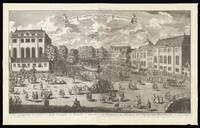
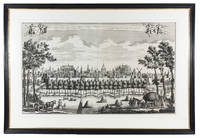
1730rif. 14402Amsterdam c1730. 565 by 935mm. 22.25 by 36.75 inches. Engraving with etching on two sheets joined. View of the Plantage Muidergracht and the Jonas Daniël Meijerplein. The view shown from the present day Mr. Visserplien the busy intersecti.on in central Amsterdam depicts the Portuguese Synagogue on the left and the High German or Great Synagogue. These momumental buildings now house the Jewish Historical Museum. The first Jews to settle in Amsterdam were the Sephardim who had been expelled from Portugal and Spain in 1493. They were joined in the following decades by the Ashkenazi from Central and Eastern Europe the first of whom had come from Germany in 1600. In those years the only available land for them was at the outskirts of the eastern side of the Centrum the island of Vlooienburg surrounded by the Amstel River and the canals so they settled along the island's main street Breestraat which quickly became known as Jodenbreestraat. The Great Synagogue now the Jewish Historical Museum and the Portuguese-Israelite Synagogue were opened in 1671 and 1675 respectively. The Portuguese Synagogue was the place where Spinoza was placed under the ban by the Sephardic Jewish community in 1656. Pieter Stevensz. van Gunst 1659-1732 also known as Pieter Stevens van Gunst or Petrus Stephani was a Dutch draughtsman copperplate engraver and printmaker active in Amsterdam London 1704 and the Dutch town of Nederhorst 1730-1731. Abraham Rademaker 1677 21 January 1735 was an 18th-century painter and printmaker from the Northern Netherlands. Rademaker was born in Lisse. According to the RKD he was a versatile artist who painted Italianate landscapes but is known mostly for his many cityscapes and drawings of buildings that were made into print. R.W.P. de Vries auction 1925: 295. unknown
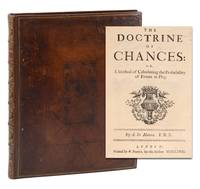
1718rif. 140950005London: Printed by W. Pearson for the Author 1718. First Edition. Near Fine. First edition of the first comprehensive textbook on probability theory. Folio in quarto format π2 A2 a-b2 c1 B-Z2 Aa-Yy2. 4 xiv 175 pp. printed on laid paper and decorated with engraved head- and tail-pieces. Skillfully rebound in period-style calf original paneled calf laid on elaborate gilt tooling and morocco title label to spine all edges speckled red. Original endpapers preserved. Near Fine with light spotting to textblock edges; binding tight. Light soiling to endpapers and widely scattered foxing and occasional smudging to contents. Bookplate to front pastedown effaced gift inscription in old hand to title page ownership signature of O. G. Gregory at upper right infill to upper right corner from removal of third ownership inscription. Dedication leaf creased and edgeworn errata list neatly crossed out in old ink. ESTC T33065. Abraham Moivre added the aristocratic de to his name when he moved from France to England as a young man one of thousands of Huguenot refugees seeking religious freedom. He taught math and within a few years met Isaac Newton who promoted his career and to whom this book is dedicated. De Moivre published several books and papers but it is The Doctrine of Chances which appealed to denizens of ivory towers and gambling dens alike for which the mathematician is most remembered. This copy was owned by the writer mathematician and astronomer Olinthus Gilbert Gregory a protege of Charles Hutton whose own major work was A Treatise of Mechanics 1806. Printed by W. Pearson, for the Author unknown
1718rif. 140950005London: Printed by W. Pearson for the Author 1718. First Edition. Near Fine. First edition of the first comprehensive textbook on probability theory. Folio in quarto format π2 A2 a-b2 c1 B-Z2 Aa-Yy2. 4 xiv 175 pp. printed on laid paper and decorated with engraved head- and tail-pieces. Skillfully rebound in period-style calf original paneled calf laid on elaborate gilt tooling and morocco title label to spine all edges speckled red. Original endpapers preserved. Near Fine with light spotting to textblock edges; binding tight. Light soiling to endpapers and widely scattered foxing and occasional smudging to contents. Bookplate to front pastedown effaced gift inscription in old hand to title page ownership signature of O. G. Gregory at upper right infill to upper right corner from removal of third ownership inscription. Dedication leaf creased and edgeworn errata list neatly crossed out in old ink. ESTC T33065. Abraham Moivre added the aristocratic de to his name when he moved from France to England as a young man one of thousands of Huguenot refugees seeking religious freedom. He taught math and within a few years met Isaac Newton who promoted his career and to whom this book is dedicated. De Moivre published several books and papers but it is The Doctrine of Chances which appealed to denizens of ivory towers and gambling dens alike for which the mathematician is most remembered. This copy was owned by the writer mathematician and astronomer Olinthus Gilbert Gregory a protege of Charles Hutton whose own major work was A Treatise of Mechanics 1806. Printed by W. Pearson, for the Author unknown books
1727rif. 1510220001Amsterdam: Michel Charles Le Cene 1727-01-01. Hardcover. Very Good. Folio. 2 12 439 pp.; 2 pp. 445-808p pagination continuous 43 of 44 plates. 2 Volumes in One Bound in contemporary vellum. 7 raised bands. Leather spine label. Good binding and cover. Spine and hinges restored. Faint soiling to vellum. Pages tanned with a several pages with some offsetting and foxing. Lacks frontis and added title. All 27 plates & 16 maps are present. Brunet IV 178; Cordier Japonica 367-68; Cordier Sinaca 2077; Lust 342 Jean Albert Mandeslo set out in 1636 with the Embassy that the Duke of Holstein sent to Russia and Persia. He visited India Ceylon Madagascar West Africa Congo and returned four years later. His story gives a very vivid picture of luxury vices curiosity and absolute disregard for life under the despotic tyranny of the Moghul Empire under Shah Jahan. In the port of Surat he arrived in April 1638 after he went to Ahmedabad and Agra. Although his observations of life in the capital are useful he apparently did not hear anything about the Taj Mahal which at that time was in the sixth year of building. Amsterdam: Michel Charles Le Cene hardcover
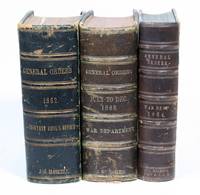
1862rif. 2923Washington D.C.: War Department 1862. Calf marbled boards. Very Good. FIRST OBTAINABLE PRINTING OF THE PRELIMINARY EMANCIPATION PROCLAMATION setting a date for the freedom of more than three million enslaved in the United States and reframing the Civil War as a fight against slavery. Issued by the War Department to regimental commanders in the field during the Civil War in the week after the completion of President Lincoln’s official manuscript version. Contained is a set of three volumes of General Orders covering the full year 1862 July-Dec 1863 and the full year 1864. History of the Emancipation Proclamation: “The proclamation has been called by responsible persons one of the three great documents of world history ranking with Magna Carta and the Declaration of Independence” – Eberstadt “From the first days of the Civil War slaves had acted to secure their own liberty. The Emancipation Proclamation confirmed their insistence that the war for the Union must become a war for freedom. It added moral force to the Union cause and strengthened the Union both militarily and politically. As a milestone along the road to slavery’s final destruction the Emancipation Proclamation has assumed a place among the great documents of human freedom” – National Archives Following the Seven Days Battle and General McClellan’s retreat from the Peninsula at the end of June 1862 President Lincoln realized that there would be no early end to the war and found himself “as inconsolable as it was possible for a human to be and yet live.” Anxious for news from the army and needing to escape the constant interruptions at the White House he frequently visited the telegraph office in the War Department building to await dispatches. It was during one such visit early in July that he asked the chief of the telegraph staff Major Thomas Thompson Eckert for some paper to “write something special” and began the first draft of the Emancipation Proclamation completing it in a few weeks. Lincoln had long hoped to resolve the slavery issue through a congressional act of emancipation compensating slave owners for their loss of “property” but that approach was roundly rejected by representatives from the border states leaving the President who had decided upon the necessity of emancipation with a presidential proclamation as the only option. The extraordinary document he conceived would announce the liberation on January 1 1863 of all slaves in those states still in rebellion against the Union and promised compensation to slave owners in those states that returned to the fold before that time if they adopted “immediate or gradual abolishment of slavery.” This proclamation would be followed by a final proclamation issued on the 1st of January identifying those states still in rebellion and confirming the liberation of all slaves therein. On Tuesday July 22 Lincoln presented his draft to the Cabinet telling them that he had resolved firmly upon the course of action it specified and asking them not for advice but suggestions. The only observation he had not anticipated came from Secretary of State Seward who proposed that it might be best to wait for a military victory before issuing the Proclamation as it could otherwise seem like “the last measure of an exhausted government.” Immediately recognizing the wisdom of the suggestion Lincoln held back. On September 17 after an anxious wait of nearly two months he received the victory he needed at the bloody Battle of Antietam. Completing his final draft Lincoln presented it to his cabinet for refinement on September 22. Following the meeting Seward took the amended draft with him to the State Department where a formal manuscript copy was made then signed by Lincoln and Seward. The formal official “Emancipation Proclamation” was of course issued on January 1 1863 the day it became the law of the land. Printing History: This printing in the War Department’s official “General Orders” is the fourth printing overall but realistically the first obtainable printing. It is preceded by: -The first printing Eberstadt #1 a small three-page circular intended for distribution within the government and to the local press likely printed on September 22. At the time that Charles Eberstadt published his study of the Proclamation 1950 he was able to locate only one copy which he himself owned and as nearly as we have been able to determine no other copies have come to light since then. -The second printing Eberstadt #2 may be a phantom printing. Charles Eberstadt was not able to locate a copy but he inferred its existence from the standard State Department practice of printing a folio edition consisting solely of the text of the proclamation followed by another printing consisting of the text of a letter of transmittal from the Secretary of State as well as the text of the proclamation. While there may be a copy of Eberstadt #2 in the National Archives as he speculated it is not recorded in their online catalogue nor have we been able to find a copy in any other online catalogue including OCLC the Library of Congress and the Abraham Lincoln Library. -Eberstadt’s third printing is of legendary rarity. It consists of Secretary of State Seward’s one-page letter of transmittal addressed “To the Diplomatic and Consular Officers of the United States in foreign countries” and the text of the proclamation. Eberstadt located a total of only five copies in institutions at the Library of Congress the National Archives Yale the Clements Library and Brown. OCLC does not record any additional copies nor is it recorded in Monaghan. There has been one copy at auction $400000 in 2021 and that was described as the only copy in private hands. -The present copy General Orders No. 139 is Eberstadt’s fourth printing of the Preliminary Emancipation Proclamation dated in print on September 24. Eberstadt surmises that this field order printing could have been accomplished as late as September 29 or 30. Although it may have been printed in as many as 15000 copies it is very rare in commerce likely due to the ephemeral nature of the printing and distribution. Additional General Orders and Provenance: The three volumes once belonged to John G. Haskell A.Q.M. Chief Quartermaster and contain the General Orders for the year 1862 July-December only for the year 1863 and for the full year 1864. John Gideon Haskell 1832-1907 was a resident of Kansas and joined the Union Army when the war broke out. He enlisted with the 14th Kansas Volunteer Cavalry Regiment and later served as Assistant Quartermaster General of Kansas as quartermaster of the Third Kansas and the Tenth Kansas Volunteers as Captain and Assistant Quartermaster on the staff of General James G. Blunt and as Chief Quartermaster of the Army of the Frontier. After the war Haskell was named official state architect and worked on the state house the capitol the State University and more. In addition to the preliminary Emancipation Proclamation the three volumes also contain the Acts of Congress on many other subjects including pay discharge recruitment handling of troops etc. Washington D.C.: War Department Adjutant General’s Office 1862-64. Three volumes. Small octavo contemporary three-quarter brown morocco two volumes with cloth boards one with marbled boards. Some rubbing and wear to bindings pencil notations on endpapers with collation and highlighting certain orders and some internal pages. Dampstaining to general title of 1862 volume; internal text and Emancipation Proclamation generally fine. RARE AND IMPORTANT. References: Charles Eberstadt. “Lincoln’s Emancipation Proclamation.” New York: 1950. War Department unknown
1862rif. 2923Washington D.C.: War Department 1862. Calf marbled boards. Very Good. FIRST OBTAINABLE PRINTING OF THE PRELIMINARY EMANCIPATION PROCLAMATION setting a date for the freedom of more than three million enslaved in the United States and reframing the Civil War as a fight against slavery. Issued by the War Department to regimental commanders in the field during the Civil War in the week after the completion of President Lincoln’s official manuscript version. Contained is a set of three volumes of General Orders covering the full year 1862 July-Dec 1863 and the full year 1864. History of the Emancipation Proclamation: “The proclamation has been called by responsible persons one of the three great documents of world history ranking with Magna Carta and the Declaration of Independence” – Eberstadt “From the first days of the Civil War slaves had acted to secure their own liberty. The Emancipation Proclamation confirmed their insistence that the war for the Union must become a war for freedom. It added moral force to the Union cause and strengthened the Union both militarily and politically. As a milestone along the road to slavery’s final destruction the Emancipation Proclamation has assumed a place among the great documents of human freedom” – National Archives Following the Seven Days Battle and General McClellan’s retreat from the Peninsula at the end of June 1862 President Lincoln realized that there would be no early end to the war and found himself “as inconsolable as it was possible for a human to be and yet live.” Anxious for news from the army and needing to escape the constant interruptions at the White House he frequently visited the telegraph office in the War Department building to await dispatches. It was during one such visit early in July that he asked the chief of the telegraph staff Major Thomas Thompson Eckert for some paper to “write something special” and began the first draft of the Emancipation Proclamation completing it in a few weeks. Lincoln had long hoped to resolve the slavery issue through a congressional act of emancipation compensating slave owners for their loss of “property” but that approach was roundly rejected by representatives from the border states leaving the President who had decided upon the necessity of emancipation with a presidential proclamation as the only option. The extraordinary document he conceived would announce the liberation on January 1 1863 of all slaves in those states still in rebellion against the Union and promised compensation to slave owners in those states that returned to the fold before that time if they adopted “immediate or gradual abolishment of slavery.” This proclamation would be followed by a final proclamation issued on the 1st of January identifying those states still in rebellion and confirming the liberation of all slaves therein. On Tuesday July 22 Lincoln presented his draft to the Cabinet telling them that he had resolved firmly upon the course of action it specified and asking them not for advice but suggestions. The only observation he had not anticipated came from Secretary of State Seward who proposed that it might be best to wait for a military victory before issuing the Proclamation as it could otherwise seem like “the last measure of an exhausted government.” Immediately recognizing the wisdom of the suggestion Lincoln held back. On September 17 after an anxious wait of nearly two months he received the victory he needed at the bloody Battle of Antietam. Completing his final draft Lincoln presented it to his cabinet for refinement on September 22. Following the meeting Seward took the amended draft with him to the State Department where a formal manuscript copy was made then signed by Lincoln and Seward. The formal official “Emancipation Proclamation” was of course issued on January 1 1863 the day it became the law of the land. Printing History: This printing in the War Department’s official “General Orders” is the fourth printing overall but realistically the first obtainable printing. It is preceded by: -The first printing Eberstadt #1 a small three-page circular intended for distribution within the government and to the local press likely printed on September 22. At the time that Charles Eberstadt published his study of the Proclamation 1950 he was able to locate only one copy which he himself owned and as nearly as we have been able to determine no other copies have come to light since then. -The second printing Eberstadt #2 may be a phantom printing. Charles Eberstadt was not able to locate a copy but he inferred its existence from the standard State Department practice of printing a folio edition consisting solely of the text of the proclamation followed by another printing consisting of the text of a letter of transmittal from the Secretary of State as well as the text of the proclamation. While there may be a copy of Eberstadt #2 in the National Archives as he speculated it is not recorded in their online catalogue nor have we been able to find a copy in any other online catalogue including OCLC the Library of Congress and the Abraham Lincoln Library. -Eberstadt’s third printing is of legendary rarity. It consists of Secretary of State Seward’s one-page letter of transmittal addressed “To the Diplomatic and Consular Officers of the United States in foreign countries” and the text of the proclamation. Eberstadt located a total of only five copies in institutions at the Library of Congress the National Archives Yale the Clements Library and Brown. OCLC does not record any additional copies nor is it recorded in Monaghan. There has been one copy at auction $400000 in 2021 and that was described as the only copy in private hands. -The present copy General Orders No. 139 is Eberstadt’s fourth printing of the Preliminary Emancipation Proclamation dated in print on September 24. Eberstadt surmises that this field order printing could have been accomplished as late as September 29 or 30. Although it may have been printed in as many as 15000 copies it is very rare in commerce likely due to the ephemeral nature of the printing and distribution. Additional General Orders and Provenance: The three volumes once belonged to John G. Haskell A.Q.M. Chief Quartermaster and contain the General Orders for the year 1862 July-December only for the year 1863 and for the full year 1864. John Gideon Haskell 1832-1907 was a resident of Kansas and joined the Union Army when the war broke out. He enlisted with the 14th Kansas Volunteer Cavalry Regiment and later served as Assistant Quartermaster General of Kansas as quartermaster of the Third Kansas and the Tenth Kansas Volunteers as Captain and Assistant Quartermaster on the staff of General James G. Blunt and as Chief Quartermaster of the Army of the Frontier. After the war Haskell was named official state architect and worked on the state house the capitol the State University and more. In addition to the preliminary Emancipation Proclamation the three volumes also contain the Acts of Congress on many other subjects including pay discharge recruitment handling of troops etc. Washington D.C.: War Department Adjutant General’s Office 1862-64. Three volumes. Small octavo contemporary three-quarter brown morocco two volumes with cloth boards one with marbled boards. Some rubbing and wear to bindings pencil notations on endpapers with collation and highlighting certain orders and some internal pages. Dampstaining to general title of 1862 volume; internal text and Emancipation Proclamation generally fine. RARE AND IMPORTANT. References: Charles Eberstadt. “Lincoln’s Emancipation Proclamation.” New York: 1950. War Department unknown books
1752rif. 14421Amsterdam c1752. 565 by 935mm. 21.5 by 36.75 inches. Engraving with etching on two sheets joined. View of the Plantage Muidergracht and the Jonas Daniël Meijerplein. The view shown from the present day Mr. Visserplien the busy intersecti.on in central Amsterdam depicts the Portuguese Synagogue on the left and the High German or Great Synagogue. These momumental buildings now house the Jewish Historical Museum. The first Jews to settle in Amsterdam were the Sephardim who had been expelled from Portugal and Spain in 1493. They were joined in the following decades by the Ashkenazi from Central and Eastern Europe the first of whom had come from Germany in 1600. In those years the only available land for them was at the outskirts of the eastern side of the Centrum the island of Vlooienburg surrounded by the Amstel River and the canals so they settled along the island's main street Breestraat which quickly became known as Jodenbreestraat. The Great Synagogue now the Jewish Historical Museum and the Portuguese-Israelite Synagogue were opened in 1671 and 1675 respectively. The Portuguese Synagogue was the place where Spinoza was placed under the ban by the Sephardic Jewish community in 1656. Pieter Stevensz. van Gunst 1659-1732 also known as Pieter Stevens van Gunst or Petrus Stephani was a Dutch draughtsman copperplate engraver and printmaker active in Amsterdam London 1704 and the Dutch town of Nederhorst 1730-1731. Abraham Rademaker 1677 21 January 1735 was an 18th-century painter and printmaker from the Northern Netherlands. Rademaker was born in Lisse. According to the RKD he was a versatile artist who painted Italianate landscapes but is known mostly for his many cityscapes and drawings of buildings that were made into print. R.W.P. de Vries auction 1925: 295. unknown
1728rif. 91I90T01U79OAmsterdam 1728. Leonardus Schenk Framed 82.5 x 121 cm. Large engraved wall print on 2 sheets together 57.5 x 97 cm showing the Leiden city wall between the Koepoort and Zijlpoort with various windmills and prominent buildings in the background identified by name. The title appears in a banderole at the head with putti on either side holding the arms of Leiden and Holland. Leonardus Schenk's name appears as engraver and publisher at the right end of the banderole. Large view of the city of Leiden by the Amsterdam engraver and publisher Leonardus Schenk. The viewer observes the city from the south from between the city's Koe and Zijl gates. In the background several windmills and a few characteristic buildings are identified by name in the engraving including the university the library the Pieterskerk the Town Hall the Mare kerk the "Burcht" the fort and the Hooglandse kerk. On the quay outside the wall groups of people walk sporadically passed by small boats on the nearby city moat. In the foreground we see a typical Dutch landscape with grazing cattle farm workers a loaded hay cart and haystacks in the field. We know of several other wall prints by Schenk depicting local situations with almost photographic detail. Thanks to this detail important socio-historical aspects have been passed on to later generations giving these prints an important cultural meaning today. A few spots formerly folded otherwise in very good condition.l Overvoorde Catalogus van de prentverzameling der Gemeente Leiden 1906 no. 640; Waller Biogr. woordenb. Noord Ned. graveurs p. 287. ART ARCHITECTURE & PHOTOGRAPHY CARTOGRAPHY GEOGRAPHY & TOPOGRAPHY DRAWINGS PRINTS & WATERCOLOURS LOW COUNTRIES City Plans Topography & Views Netherlands Prints & Print Series ZZ 003 TITELS GEBRUIKT VOOR 2022 unknown
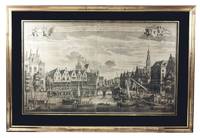
1728rif. A2RGD4WT38YEAmsterdam: Leonardus Schenk 1728. In black passepartout and gilt frame 82 x 121 cm. Large engraved wall print on 2 sheets together 58 x 97 cm the sheets overlapping each other slightly showing the traditional business centre of the city of Leiden. The title both in Dutch and French is printed in a banderole at the head with putti on each side supporting the arms of Leiden and Holland. Leonardus Schenk's name appears as engraver and publisher at the right tip of the banderole. A large engraved wall print in two sheets showing the trading and commercial centre of the city of Leiden at the convergence of the Oude Rijn and Nieuwe Rijn canals. Unlike most other Dutch towns Leiden had no central market square so that the waterways formed the major access routes for merchandise. On the banks of the canals there is a lively market that converges on the bridge central in the print. Market traders and customers come and go. Women from the coastal fishing villages of Katwijk and Noortwijk display fresh fish for sale. Right in the print we see the monumental "Waag" the weigh-house built in 1658 following a plan by the Dutch architect and engraver Pieter Post. The splendid relief designed by Rombout Verhulst that crowns the entrance is reproduced with a sharp eye for detail. In front of the building commercial goods are hoisted up from carts and a number of ships for transport to the weigh-house. Several other ships had moored and now continue to their destination. A boat flying the Dutch flag brings in a prominent party while a herald standing precariously at the bow trumpets for right of way. We know of several other wall prints by Schenk depicting local situations with almost photographic detail. Thanks to this detail important socio-historical aspects have been passed on to later generations giving these prints an important cultural meaning today. With some faint foxing otherwise in very good condition.l Overvoorde Catalogus van de prentverzameling der Gemeente Leiden 1906 no. 964; Waller Biogr. woordenb. Noord Ned. graveurs p. 287. Leonardus Schenk, unknown
1707rif. 5C8G6MOZMOJ3Nuremberg Christoph Weigel; 1707. Folio. Würzburg Martin Frantz Hertzen Contemporary vellum with the manuscript title at the head of the spine and a paper shelfmark label at the foot. With an engraved allegorical title-page a letterpress title-page printed in red and black and 100 engraved emblems in the text measuring 10.5 x 12 cm. 10 200 4 pp. & 100 ll. First edition of a German emblem book addressing virtues and vices in 100 emblems compiled by the German preacher Abraham à Sancta Clara born Johan Ulrich Mergerle; 1644 - 1709. As the title states the book's purpose is to refresh the readers virtues and to deter from vices by way of emblems. The concepts are explained in well-known fables and accessible symbols and allegories like the sun moon fire sea weather seasons metals gems animals etc. Each concept is illustrated in an emblem accompanied by a motto in Latin and a poem in German and Latin. The emblems were engraved by Christoph Weigel after illustrations by Caspar and Jan Luyken from the Ethica Naturalis ca. 1700. Each emblem is followed by two pages of text explaining the emblem.With a library inscription on the flyleaf "villae epponis ad bibliothecam". The binding is slightly soiled. Some marginal thumbing occasional foxing and some occasional spots and smudges. Otherwise in good condition.l Landwehr German emblem books 11; Faber du Faur 1125; Goedeke III 25 240. EUROPE LITERATURE & LINGUISTICS Emblems German Literature Germany hardcover
rif. CBS-9781119530305John Wiley Np Exclusive. New. John Wiley Np (Exclusive) unknown
rif. CBS-9781119530305John Wiley Np Exclusive. New. John Wiley Np (Exclusive) unknown
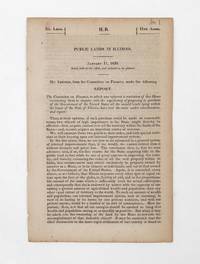
1839rif. 373003Vandalia Illinois 1839. First edition. 3 1pp. 8vo. Disbound. Housed in a morocco backed slipcase. First edition. 3 1pp. 8vo. Abraham Lincoln had yet to join the bar when he began his first stint in politics in the Illinois legislature in 1834 serving four consecutive terms in the Assembly through 1841. "This rare printing has the prestige of being the first occurrence of Lincoln's name as the sole author of a work. As a Whig lawmaker he was devoted to his party's program of public works through government financing. After the Panic of 18376 the spending he had advocated for had resulted in massive state debts. To relieve the budgetary burden Lincoln proposed that Illinois acquire land within its borders which the federal government still possessed and then sell the land at a fourfold profit to settlers and speculators resulting in both increased revenues and self-determined land ownership" Boroujerdi. Very rarethoma. Monaghan 1; Boroujerdi et. al. Abraham Lincoln: His Life in Print p. 29 unknown
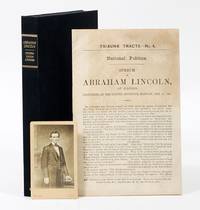
1860rif. 3104New York: New York Tribune 1860. FIRST EDITION. Original wrappers. Very Good. FIRST EDITION of Lincoln's historic Cooper Union Address delivered on February 27 1860 at the Cooper Institute in New York. The speech is largely credited to having launched Lincoln's Presidential bid. With silver print carte-de-visite of the Brady "Cooper Union" photograph. In the fall of 1859 James A. Briggs who served on the lecture committee of the Plymouth Church in Brooklyn invited presidential candidate hopeful Abraham Lincoln to speak to a New York audience on any subject of his choosing. Lincoln accepted the invitation choosing to speak of the current political climate in America. William O. Stoddard an Illinois journalist who worked for President Lincoln during his administration noted that "No previous effort of his life cost him so much hard work as did that Cooper Institute speech" and that the resulting speech "was a masterly review of the history of the slavery question from the foundation of the government with a clear bold statesmanlike presentation of the then present attitude of parties and of sections. It exhibited a careful research a thorough knowledge and understanding of political movements and developments that staggered even the most laborious and painstaking students. It showed a grasp a breadth a mental training and a depth of penetration which compelled the admiration of critical scholars" Stoddard Abraham Lincoln: The True Story of a Great Life. "Horace Greeley had rushed out the speech in pamphlet form as 'Tribune Tract' Number 4 under the headline: National Politics. Speech of Abraham Lincoln of Illinois Delivered at the Cooper Institute Monday Feb. 27 1860. The pamphlet was ready March 6 while Lincoln was still traveling through Connecticut. When he returned to New York he found it already available to the public. "Greeley marketed the eleven-page Tribune edition aggressively. As a bonus the publication included Wisconsin Republican senator James Doolittle's February 24 speech attaching 'the new doctrine of judicial infallibility' as did Lincoln's address at Cooper Union just three days later and also like Cooper Union railing agains 'the headstrong zeal pursued by the other party to force slavery into Territories'. "It was as if Republicans were now speaking with one voice: identifying with the founders attacking the Dred Scott decision rebuking John Brown and drawing their own 'dividing line' on slavery extension. Lincoln did not say it alone; but he said it best. 'Mr. Lincoln's is probably the most systematic and complete defense yet made of the Republican position with regard to Slavery' the Tribune declared in its initial advertisement for the reprints. 'We believe no speech has yet been made better calculated to win the intelligent minds over to our standard. Will the friends of the Cause everywhere aid us to circulate it' "The answer was yes. The Tribune Tract edition proved enormously popular going through at least five additional editions. Lincoln's New York oration was enjoying a new and sustained life in pamphlet form and was being purchased individually and in bulk alike by admirers and groups across the North. "The Cooper Union address tested whether Lincoln's appeal could extend from the podium to the page and from the rollicking campaigns of the rural West to the urban East. Cooper Union held the promise of transforming Lincoln from a regional phenomenon to a national figure. Lincoln knew it and rose to the occasion. "As if to illustrate his metamorphosis the Cooper Union appearance also inspired the most important single visual record on Lincoln's or perhaps any American presidential campaign: an image-transfiguring Mathew Brady photograph. Its later proliferation and reproduction in prints medallions broadsides and banners perhaps did as much to create a 'new' Abraham Lincoln as did the Cooper Union address itself. "Supposedly Lincoln volunteered when he encountered the famous photographer again a few months later: 'Brady and the Cooper Institute made me President'. Make him president they undoubtedly did" Harold Holzer Lincoln at the Copper Union: The Speech That Made Abraham Lincoln President. Note: Although it is difficult to date the carte-de-visite appears to be a late-nineteenth century production. Provenance for the speech: From the collection of George Hambrecht first president of the Wisconsin Lincoln Fellowship and renown Lincoln scholar/collector with his signature in pencil on rear wrapper. New York: New York Tribune Tribune Tracts No. 4 1860. Octavo original wrappers; custom box. Light uniform toning. Lincoln's speech comprises pages 1-11 out of a total of 16 pages. With New York Tribune ads and subscription terms on rear wrapper. RARE. New York Tribune unknown