Henri Abraham ChatelainBiblio.com
27 900 résultats
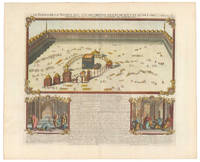
1719réf. NL-02162This is Henri Chatelain's dramatic and detailed capture of the Haram or Sacred Precinct in Mecca—the holiest site in Islam. It provides a detailed view of the historic complex which draws millions of pilgrims annually. In the center of the view the quadratic black Kaaba dominates. According to Islamic tradition this complex stands on the remains of the first temple that Abraham and his son Ishmael built for God. In addition to the Kaaba several shrines and other buildings have been drawn in their relative positions and domed porticoes frame the enormous courtyard holding it all. In this manner the view almost takes on the character of a plan. Chatelain brings his view to life by including many worshippers within the complex. While the view of the Holy Precinct occupies the upper register of the print in the lower register we find two smaller vignettes depicting the various positions that Muslims assume during prayer. Between the vignettes is a text that includes a legend and key related to the larger view as well as an introduction to the Islamic faith and tradition. Census The copper-engraved view comes from Chatelain's seminal seven-volume Atlas Historique published in Amsterdam between 1705 and 1720. The atlas combines the finest engraving and cartographic craftsmanship with academic studies of geography history ethnology heraldry and cosmography and it was one of the most widely distributed atlases in the 18th century. Context is Everything When Chatelain's detailed plan of Mecca was first published it was a true rarity. Few European travelers had ventured so profoundly into Arabia and the accounts of Muslims did not resonate broadly among the European intelligentsia at the time. Western Arabia particularly Mecca had been subjugated by the Ottoman Empire when Selim I defeated and dissolved the Mamluk Sultanate in Egypt. For centuries the Mamluks had controlled access to the sacred cities but now Barakat bin Muhammed the Sharif of Mecca was forced to acknowledge Ottoman supremacy. The only European to ever truly penetrate Mamluk Arabia was the Italian traveler Ludovico di Varthema who in 1502-03 visited Mecca with a Hajj caravan on his journey to India. But a French traveler truly opened Western Arabia to the world. The Parisian Jean Chardin 1643-1712 was a distinguished French traveler merchant and polyglot whose extensive travels in the Middle East and beyond significantly impacted the European understanding of Islam and its holy sites in the 18th century. Chardin spent eleven years exploring the Middle East where he gained access to the Persian court being appointed a royal merchant by Shah 'Abbas II. His journeys took him through Persia Turkey India and Georgia before he eventually settled in England. Among the most notable aspects of Chardin's voyages was his attempt to depict Islam's holy places particularly Mecca and Medina. His depictions were mainly based on information he acquired from Muslims who had performed the Hajj. Depictions of Islam's holiest sites were virtually non-existent in Europe at his time and Chardin's drawings constitute some of the earliest and best sources available. There is an unfinished manuscript plan of the Prophet's Tomb in Medina at the Royal Society in London. Still the more impactful image was Chardin's completed plan of the Kaaba precinct in Mecca. While this pioneering plan accurately captures the individual buildings and minarets including the colonnaded porticoes surrounding the central courtyard it also conflated elements from Medina and Mecca the circular colonnade around the Kaaba. Despite traveling with two professional artists including Grélot the drawings attributed to Chardin were most likely his work demonstrating his engagement with documenting his experiences. His detailed accounts and illustrations were later included in his publication Voyages en Perse et Autres Lieux de l'Orient the first volume published in 1686. Further volumes followed in 1711. These works were praised for their detailed observations and accuracy providing a valuable non-Persian perspective on the Safavid and Ottoman empires and it is clear that they were the source for Chatelain's view. Chardin's extensive travels and keen observations earned him a knighthood from Charles II of England for his services to the East India Company. His pioneering contributions remain crucial sources on Persia and Arabia's political history and cultural landscapes. Cartographer: Henri Abraham Chatelain 1684 – 1743 was a Protestant pastor Huguenot from Paris who due to his faith was forced to flee his native France. He settled first in London and later in Holland where he worked from both The Hague and Amsterdam during the early 18th century. While his primary calling was as a preacher his Atlas Historiquebecame a huge success partly due to the vivacious decoration and abundance of information on his charts.
réf. 632Jacob Abraham Grohusko 1908. First edition. Hardcover book bound in the publisher�s original full cloth gilt. 85 pp. In good condition. Lacks front fixed end page. Front hinge cracked but holding to the book block. A few interior pages contain notations/markings. A few pages with splatter stains. Moderate to heavy wear/soiling/bumping to the cloth covers. Rare. hardcover
réf. 95124Rare cast metal relief portrait of President Abraham Lincoln in profile. Housed in a custom circular frame with gilt decorative floral reliefs. The entire piece measures 16 inches by 16 inches. A handsome example. Abraham Lincoln served as the 16th President of the United States from March 1861 until his assassination in April 1865. He led the United States through its Civil War and in doing so preserved the Union of the United States of America abolished slavery and strengthened the federal government. Lincoln sought to create a Presidential cabinet that would unite the Republican party. His eventual cabinet would include his primary rivals for the Republican nomination and although his appointees held differing views on economic issues all were opposed to the expansion of slavery into the territories of the United States. The most senior cabinet post of Secretary of State was appointed to William Seward who had recently failed to win the 1860 Republican presidential nomination and Lincoln's choice for Secretary of the Treasury was Ohio Senator Salmon P. Chase Seward's primary political rival and the leader of a radical faction of the Republican party that sought the immediate abolition of slavery. unknown
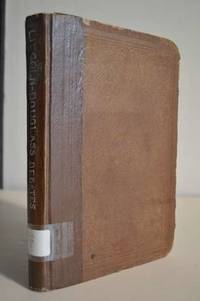
1860réf. SKU1039674Follett Foster and Company 1860. First Edition. hardcover. Acceptable. 0x0x0. This Book is an Ex-Library Book with several library markings. Political debates between Hon. Abraham Lincoln and Hon. Stephen A. Douglas in the celebrated campaign of 1858 in Illinois; including the preceding speeches of each at Chicago Springfield etc.; also the two great speeches of Mr. Lincoln in Ohio in 1859 as carefully prepared by the reporter of each party and published at the times of their delivery. Follett Foster and Company; Columbus 1860. Hardcover. First Edition First Issue. First issue with no advertisements no rule above the publishers imprint on the copyright page and with numeral 2 at the bottom of page 17. An Acceptable brown cloth binding with blind stamped ornate design on boards re-enforced spine with handwritten white ink title and library locations sticker on spine binding shaky starting hinges with partially cracked rear hinge heavy wear to board corners with some loss some scuffing and discoloration to boards abrasions along board margins specifically to rear bit pulpy text block with age toning and scattered foxing throughout rubbing to board and spine edges previous owner handwritten ink info on front free endpaper few small dog-eared pages faint moisture stain on fore-edge and slightly on page margins several library markings include: library bookplate library due date card pocket embossed library stamp ink library stamps few ink and pencil notes barcode sticker without Dust wrapper. 8vooctavo or approx. 6 x 9 inches. 268pp. We pack securely and ship daily with delivery confirmation on every book. The picture on the listing page is of the actual book for sale. Additional Scans are available for any item please inquire. Follett, Foster and Company hardcover
1894réf. 112666Lincoln Memorial University 1894. Leather. Very Good. 1894 Lincoln Memorial University Sponsors edition #500 of unstated limitation. 12 volume gilt decorated full leather bindings top edge gilt. Fine condition with no issues. oversized and overweight. B67 Please email for photos. Lincoln Memorial University hardcover
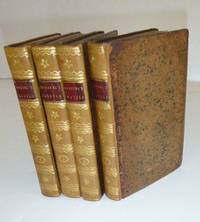
réf. 51-5978London : Printed for F. and C. Rivington . and sold by W. Richardson Cornwill1795. 8vo. 10.5 x 19.1cm. 4 vols. Contemporary mottled calf rebacked - calf spine gilt with red morocco title labels. Repair by A. & M. Winstanley's Salisbury Bookbinders England in 1969.Frontispiece and 4 plates in vol. 1; 4 plates in vol. 2. No plates in vols. 3 & 4.Second edition volume 4 lacks half-title advertisement leaf at end of volume 4 offsetting to text occasional spotting washed.Vol. I. Voyage to the Southern Parts of Europe and to the Cape of Good Hope in Africa. xii 318 index.x Vol. II. Containing two expeditions to the interior part of the country adjacent to the Cape of Good Hope and a voyage to the island of Java; performed in the years 1773 1774 and 1775.iv 316. index;.Vol. III. containing a voyage to Japan and travels in different parts of that empire. In the years 1775 and 1776. .xvi 286 xvi 32pp.Vol. IV. Travels in the Empire of Japan and in the Islands of Java and Ceylon together with the Voyage home. .xix 293 index. .OCLC Number / Unique Identifier:185263447 vol. 3 only. .Provenance : Sir Abraham Hume 2nd Baronet 29 February 1749 -24 March 1838 in London was a British floriculturist and Tory politician who sat in the House of Commons .Sep 30 2019 : Charles Berman mine medical officer and expert on primary liver cancer dies in Johannesburg. References. Verwey E.J. ed1995. London, : Printed for F. and C. Rivington ... and sold by W. Richardson, Cornwill,1795 unknown
1778réf. CLL-130Amsterdam, Marc-Michel Rey, 1778 In-4 de (8)ff., VI, 312pp., 1 f. bl., (19)ff. de table, (1)f. bl., sous couverture d'attente muette, entièrement non rogné.
1819réf. 2007240053London : Longman Hurst Rees Orme & Brown 1819. Hardcover. Good. Rees' Cyclopedia 37 volume set. Missing volumes 7 and 8. Bound in contemporary navy Russia Leather-backed marbled boards. Good bindings with minor shelf wear/rubbing. All edges marbled. Lacks the plate volumes. Armorial bookplate of John Proctor Anderdon. Anderdon 1760-1846 was a London merchant and noted collector. Abraham Rees 1743-1825 was a British clergyman best known for this his outstanding encyclopedic work The Cyclopaedia. Initially published 1802-1820. Rees' work not only featured theological and humanistic issues but also extensive articles on mathematics and natural sciences. The Cyclopaedia "is the richest work for technology of the period with detailed text and handsome carefully prepared plates." Ferguson Eugene. "Contributions to Bibliography in the History of Technology part II". Technology and Culture 3.2 1962: 169 p. "Rees was convinced that the important progress made during the last decades of the eighteenth century especially in the fields of history geography geology natural history and the physical sciences senu lato required a new type of encyclopedia with the accent on these fields as well as the still relatively undeveloped domains of biography and the history of sciences. The Cyclopaedia thus became one of the first works of its kind to be compiled with the help of 'persons eminently distinguished in these branches of science to which they had devoted their talents.'" Taxon Vol. 35 No. 2 1986 This is an oversized or heavy book that requires additional postage for international delivery outside the US. Encyclopedia London : Longman, Hurst, Rees, Orme & Brown hardcover
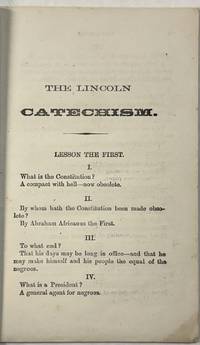
1864réf. 42194New York: J.F. Feeks Publisher 1864. Stitched. 46 2 publ. advts. Original printed wrappers the front wrapper and title page illustrated with a grotesque caricature of a Negro's face. Very Good plus. An unusually disgusting anti-Lincoln campaign document capitalizing on northern racist sentiments. Lincoln is called 'Abraham Africanus I'. His Emancipation Proclamation is ridiculed; the shifting focus of the War from a struggle to preserve the Union to a crusade against slavery is condemned; and the expansion of executive power to curtail civil liberties is denounced. The text includes "questions and sarcastic answers intended to defeat Lincoln" Monaghan. "What are the Ten Commandments Thou shalt have no other God but the negro. Thou shalt make an image of a negro and place it on the Capitol as the type of the new American man." "Strongly opposed to the election of Abraham Lincoln" Sabin Feeks the publisher was a Copperhead closely aligned with Chauncy Burr and other northern publishers of pro-slavey material. New York was "home to vigorous defenders of slavery who viewed African Americans as inferior and warned that abolition would hurt the nation's economy. Both sides took advantage of New York's role as center of publishing and the arts using the city's printing presses theaters and music halls to advocate for an end to slavery or for white supremacy" online Mus. of the City of New York ABOLISHING SLAVERY. FIRST EDITION. Monaghan 324. Bartlett 2734. Sabin 41204. J.F. Feeks, Publisher unknown
1864réf. 42194New York: J.F. Feeks Publisher 1864. Stitched. 46 2 publ. advts. Original printed wrappers the front wrapper and title page illustrated with a grotesque caricature of a Negro's face. Very Good plus. An unusually disgusting anti-Lincoln campaign document capitalizing on northern racist sentiments. Lincoln is called 'Abraham Africanus I'. His Emancipation Proclamation is ridiculed; the shifting focus of the War from a struggle to preserve the Union to a crusade against slavery is condemned; and the expansion of executive power to curtail civil liberties is denounced. The text includes "questions and sarcastic answers intended to defeat Lincoln" Monaghan. "What are the Ten Commandments Thou shalt have no other God but the negro. Thou shalt make an image of a negro and place it on the Capitol as the type of the new American man." "Strongly opposed to the election of Abraham Lincoln" Sabin Feeks the publisher was a Copperhead closely aligned with Chauncy Burr and other northern publishers of pro-slavey material. New York was "home to vigorous defenders of slavery who viewed African Americans as inferior and warned that abolition would hurt the nation's economy. Both sides took advantage of New York's role as center of publishing and the arts using the city's printing presses theaters and music halls to advocate for an end to slavery or for white supremacy" online Mus. of the City of New York ABOLISHING SLAVERY. FIRST EDITION. Monaghan 324. Bartlett 2734. Sabin 41204. J.F. Feeks, Publisher unknown books
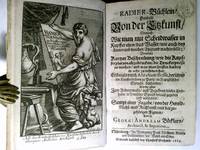
réf. 6726Engraved frontis.; eight engraved vignettes and head- & tailpieces 19 finely engraved plates most folding & some engravings in the text. 18 p.l. 254 36 pp. of index & errata. Thick 8vo 160 x 105 mm. late 18th-cent. marbled boards extremities a little rubbed & worn. Dresden: C. G. Nitzsche 1765. An important German edition of Bosse’s Traité des manières de graver en Taille douce 1st ed. in French: 1645 considerably augmented for the German audience. This work was translated and published by Carl Gottlieb Nitzsche from the 1745 Cochin edition. The Cochin edition was the first to promote etching with hard etching-ground vernis dur instead of the soft etching-ground vernis mol to imitate line engraving. It also featured long sections on Le Blon’s color printing and the refining of mezzotint illustration. In the present book we find four illustrations of the rolling press which Cochin had updated to account for several design upgrades. There are also several diagrams and cross-sections of printing presses. This book is richly illustrated with plates and vignettes executed by Carl Gottfried Nestler 1730-80 that depict various techniques equipment and the interiors of print shops. Nestler reworked the engraved title-page from the 1645 first edition for this book’s frontispiece. A very good copy internally fresh. Unidentified engraved bookplates with the initials “G. F.” on front and rear paste-downs. ⧠Benezit Dictionary of Artists Vol. 10 p. 258 Nestler. unknown
réf. 6726Engraved frontis.; eight engraved vignettes and head- & tailpieces 19 finely engraved plates most folding & some engravings in the text. 18 p.l. 254 36 pp. of index & errata. Thick 8vo 160 x 105 mm. late 18th-cent. marbled boards extremities a little rubbed & worn. Dresden: C. G. Nitzsche 1765. An important German edition of Bosse’s Traité des manières de graver en Taille douce 1st ed. in French: 1645 considerably augmented for the German audience. This work was translated and published by Carl Gottlieb Nitzsche from the 1745 Cochin edition. The Cochin edition was the first to promote etching with hard etching-ground vernis dur instead of the soft etching-ground vernis mol to imitate line engraving. It also featured long sections on Le Blon’s color printing and the refining of mezzotint illustration. In the present book we find four illustrations of the rolling press which Cochin had updated to account for several design upgrades. There are also several diagrams and cross-sections of printing presses. This book is richly illustrated with plates and vignettes executed by Carl Gottfried Nestler 1730-80 that depict various techniques equipment and the interiors of print shops. Nestler reworked the engraved title-page from the 1645 first edition for this book’s frontispiece. A very good copy internally fresh. Unidentified engraved bookplates with the initials “G. F.” on front and rear paste-downs. ⧠Benezit Dictionary of Artists Vol. 10 p. 258 Nestler. unknown books
1710réf. 25803Amsterdam 1710. Copper-engraved map period hand-colouring in outline. Tables upper left and along the right side. Attractive map of North America based upon De L'Isle's highly influential map of North America published in 1700. By combining a wealth of information and geographical observation with delicate engraving and an uncomplicated composition this elegant map is a superb example from the golden age of French mapmaking and was published in Chatelain's Atlas Historique an important encyclopaedic historical atlas. California is shown as a peninsula with a number of villages and mountains; the Mississippi River extends far north of its true source. The table along the right side details the various native tribes from each region with lettered references for locating on the map. Lowery 263; Phillips 579. unknown
1710réf. 25803Amsterdam 1710. Copper-engraved map period hand-colouring in outline. Tables upper left and along the right side. Attractive map of North America based upon De L'Isle's highly influential map of North America published in 1700. By combining a wealth of information and geographical observation with delicate engraving and an uncomplicated composition this elegant map is a superb example from the golden age of French mapmaking and was published in Chatelain's Atlas Historique an important encyclopaedic historical atlas. California is shown as a peninsula with a number of villages and mountains; the Mississippi River extends far north of its true source. The table along the right side details the various native tribes from each region with lettered references for locating on the map. Lowery 263; Phillips 579. unknown books
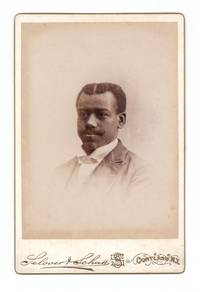
réf. 10055Cortland New York: Lelover & Schutt 1889. Albumen print 5.375" x 3.875" on larger gilt mount inscribed by DeMond on verso: "A. L. DeMond. Trumansburg. N.Y. '89." CONDITION: Very good. A scarce and early signed cabinet card portrait of a pioneering African American activist and minister who looked to the history of Black excellence as a map for America's future and preached at the Dexter Avenue Baptist Church fifty years before Martin Luther King Jr. Abraham Lincoln DeMond was born in Seneca New York in 1867 the youngest child of Quam DeMond and Phebe Cuffe Darrow grand-niece of the famous African American and Wampanoag sea captain Paul Cuffee. After becoming the first Black graduate of what is now SUNY Cortland DeMond studied theology at Howard University. His most famous speech-subsequently published in pamphlet form by the Emancipation Proclamation Association-was given on Jubilee Day of 1900 that is January 1st at the Dexter Avenue Baptist Church in Montgomery Alabama. Half a century later the church welcomed Martin Luther King Jr. as its pastor and became the launching point for the Montgomery bus boycott and the Civil Rights movement. DeMond's address "The Negro Element in American Life" lauds antislavery activists including Frederick Douglass and Henry Highland Garnet and examples of Black excellence among them Phillis Wheatley and Benjamin Banneker and situates African Americans at the heart of the nation's progress. He frames the Emancipation Proclamation as "essential to the fulfilling" of the Declaration of Independence: "Both were born in days of doubt and darkness. Both were the outcome of injustice overleaping the bounds of right and reason.Without the Declaration of Independence the nation could not have been born; without the Emancipation Proclamation it could not have lived." DeMond served as pastor of the First Congregational Church in Montgomery Alabama; the Plymouth Congregational Church in Charleston South Carolina; the First Congregational Church of New Orleans; and the First Congregational Church in the extraordinary town of Buxton the "Black man's utopia in Iowa." He and his wife Selma University graduate and music teacher Lula Watkins Patterson had five children. DeMond died in 1936. The cabinet card offered here shows a young mustachioed DeMond in crisp white collar and dark suit his hair parted at the center. Taken by Lelover & Schutt of Cortland New York this portrait may have been made upon DeMond's graduation from the Cortland Normal School in June of 1899. A month later his mother died in Trumansburg New York a town in which they had briefly stayed following the death of his father in 1877 and where Phebe had returned in 1886. After his mother's passing DeMond preached to a packed Methodist Church there and probably signed this card during the same stay. A wonderful early portrait of this soon-to-be influential Black minister signed by him the year he became the first Black graduate of what is now SUNY Cortland. REFERENCES: "Abraham Lincoln DeMond" and "Phebe Cuffe Darrow DeMond" at WikiTree online; "Abraham Lincoln DeMond Minister and Activist" at African American Registry online. Cortland, New York: Lelover & Schutt, (1889) unknown
réf. 10055Cortland New York: Lelover & Schutt 1889. Albumen print 5.375" x 3.875" on larger gilt mount inscribed by DeMond on verso: "A. L. DeMond. Trumansburg. N.Y. '89." CONDITION: Very good. A scarce and early signed cabinet card portrait of a pioneering African American activist and minister who looked to the history of Black excellence as a map for America's future and preached at the Dexter Avenue Baptist Church fifty years before Martin Luther King Jr. Abraham Lincoln DeMond was born in Seneca New York in 1867 the youngest child of Quam DeMond and Phebe Cuffe Darrow grand-niece of the famous African American and Wampanoag sea captain Paul Cuffee. After becoming the first Black graduate of what is now SUNY Cortland DeMond studied theology at Howard University. His most famous speech-subsequently published in pamphlet form by the Emancipation Proclamation Association-was given on Jubilee Day of 1900 that is January 1st at the Dexter Avenue Baptist Church in Montgomery Alabama. Half a century later the church welcomed Martin Luther King Jr. as its pastor and became the launching point for the Montgomery bus boycott and the Civil Rights movement. DeMond's address "The Negro Element in American Life" lauds antislavery activists including Frederick Douglass and Henry Highland Garnet and examples of Black excellence among them Phillis Wheatley and Benjamin Banneker and situates African Americans at the heart of the nation's progress. He frames the Emancipation Proclamation as "essential to the fulfilling" of the Declaration of Independence: "Both were born in days of doubt and darkness. Both were the outcome of injustice overleaping the bounds of right and reason.Without the Declaration of Independence the nation could not have been born; without the Emancipation Proclamation it could not have lived." DeMond served as pastor of the First Congregational Church in Montgomery Alabama; the Plymouth Congregational Church in Charleston South Carolina; the First Congregational Church of New Orleans; and the First Congregational Church in the extraordinary town of Buxton the "Black man's utopia in Iowa." He and his wife Selma University graduate and music teacher Lula Watkins Patterson had five children. DeMond died in 1936. The cabinet card offered here shows a young mustachioed DeMond in crisp white collar and dark suit his hair parted at the center. Taken by Lelover & Schutt of Cortland New York this portrait may have been made upon DeMond's graduation from the Cortland Normal School in June of 1899. A month later his mother died in Trumansburg New York a town in which they had briefly stayed following the death of his father in 1877 and where Phebe had returned in 1886. After his mother's passing DeMond preached to a packed Methodist Church there and probably signed this card during the same stay. A wonderful early portrait of this soon-to-be influential Black minister signed by him the year he became the first Black graduate of what is now SUNY Cortland. REFERENCES: "Abraham Lincoln DeMond" and "Phebe Cuffe Darrow DeMond" at WikiTree online; "Abraham Lincoln DeMond Minister and Activist" at African American Registry online. Cortland, New York: Lelover & Schutt, (1889) unknown books
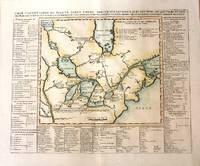
1719réf. M1126Paris c.1719. Very Good;. Notes: From Chatelain's Atlas Historique. This map is based on the 1703 map by Lahontan. The map covers the area of South Hudson Bay and concentrates on the Great Lakes. The St. Laurent is shown running into the Great Lakes from present day Lake Winnipeg. Georgian Bay is named "Baye de Toronto". English French Iroquois treaty is shown and many early settlements forts trading posts missions friendly and hostile Indian Villages are clearly marked. This is a highly significant and informative fur trade map. Surrounding the map are a number of descriptive panels contained lists of the birds fish plants and insects of Canada. Also the Indian tribes of the different regions together with a list of various trade goods including whiskey which were popular among the Indians. Size : 368x458 mm 14.49x18.03 Inches Coloring: Hand Colored Reference: Koeman II: Cha 7; Sellers and Van Ee 2; Kershaw II: 307. Category: Maps Canada; Maps North America Great Lakes; unknown
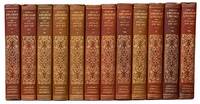
1894réf. 2311448Harrogate Tennessee: Lincoln Memorial University 1894. Limited Edition. Half-Leather. Near Fine/No Jacket. 0x0x0. Limited edition #399 of an unspecified limitation this set 'especially prepared for Harry J. Williams.' Signed by John Wesley Hill opposite limitation page. Copyright page states 1894 but this is clearly reproduced from the plates of the original - this set is circa 1905. Volume 1 has very minor discoloration to edges of cloth on rear board minor wear to corners spine a bit faded. Complete in twelve hardcover volumes. Red half-leather gilt titles and decorations top edges gilt decorative endpapers. A complete collection of Abraham Lincoln's works including speeches letters biographical writings etc. with an introduction by John Wesley Hill and special articles by various other contributors. The editors were Lincoln's private secretary and assistant secretary and also served in various other governmental roles Hay going on to become Secretary of State under McKinley and Roosevelt. Nicolay and Hay are perhaps best known for their ten-volume biographical history of Lincoln's administration originally published serially in The Century Magazine beginning in 1886 -- it remains one of the more exhaustive and personal accounts of the life of the 16th President of the United States and is notable for the inclusion of facsimiles of original drafts of important documents most importantly the Emancipation Proclamation. This set includes facsimiles of original correspondence and documents reproductions of contemporary photographs and engravings etc. Lincoln Memorial University hardcover
1894réf. 2311448Harrogate Tennessee: Lincoln Memorial University 1894. Limited Edition. Half-Leather. Near Fine/No Jacket. 0x0x0. Limited edition #399 of an unspecified limitation this set 'especially prepared for Harry J. Williams.' Signed by John Wesley Hill opposite limitation page. Copyright page states 1894 but this is clearly reproduced from the plates of the original - this set is circa 1905. Volume 1 has very minor discoloration to edges of cloth on rear board minor wear to corners spine a bit faded. Complete in twelve hardcover volumes. Red half-leather gilt titles and decorations top edges gilt decorative endpapers. A complete collection of Abraham Lincoln's works including speeches letters biographical writings etc. with an introduction by John Wesley Hill and special articles by various other contributors. The editors were Lincoln's private secretary and assistant secretary and also served in various other governmental roles Hay going on to become Secretary of State under McKinley and Roosevelt. Nicolay and Hay are perhaps best known for their ten-volume biographical history of Lincoln's administration originally published serially in The Century Magazine beginning in 1886 -- it remains one of the more exhaustive and personal accounts of the life of the 16th President of the United States and is notable for the inclusion of facsimiles of original drafts of important documents most importantly the Emancipation Proclamation. This set includes facsimiles of original correspondence and documents reproductions of contemporary photographs and engravings etc. Lincoln Memorial University hardcover books
1575réf. 21270Amsterdam: Ortelius 1575. Very good overall. A classic map of the British Isles published in the 'Theatrum Orbis Terrarum' regarded as the first modern atlas. The map was oriented with north to the right so that the map fitted the sheet of paper as it predates the convention of north to the top of the map. Ort 16 Koeman/Meurer: 6 Karrow: 1/11 van der Krogt AN: 5000:31A. Listed on Van Den Broecke as 1575L6 100 copies printed small page number 7 mm; last line centred like 3 lines above it: sem;Ponticum Virunium;Ioannem Prisæum;&Bedam. Shirley: British Isles 1477-1650 86. Latin text on verso. 19 1/2 x 13 1/2". Centerfold and right margin strengthened. Original color heightened. Ortelius unknown
1574réf. 15880Antwerp: Plantin 1574. Maps. Very good overall. The map of Asia from Ortelius' groundbreaking 'Theatrum Orbis Terrarum' considered the first modern geographical atlas 'produced in thirty-one editions between 1570 and 1612' David Parry: 'The Cartography of the East Indian Islands' 2005. Covering the area from the Middle East to Nova Guinea with part of the coast line of Australia 'Terrae Incognitae Australis Pars' in the lower right corner. Based on Ortelius' own 1567 wall map of Asia from the Theatrum Orbis Terrarum. Van den Broecke Ort #6 "Occurrence in Theatrum editions and page number: 1574L3 175 copies printed large page number 11 mm last line centered like 2 lines above it: nem in maiori Tabula ante tres annos edidimus". It has the capital "F" in La Farfana and the town "Ara" is still present above Aden. A total of only 1675 of this edition were printed compared to the more common Ort 7 edition. Image size:19 3/4 x 14 3/4". With an ornate cartouche and sailing ships. Latin text on verso. Paper size: 21 x 16 1/2". Copper engraving with original hand color. A very small burn hole at the ocean south of Japan; a defect in the plate at the lower edge to the right of the cartouche creating a short black line. Plantin unknown
1778réf. 19980Paris: P-M. Lamy 1778. First edition. leather_bound. Contemporary mottled calf covers rehinged. Two Vols. in one. Very good. 8 & 10 pages in text. 22 x 17 cm. Engraved frontispieces 283 plates. An antiquary of Flemish descent his early interest in gem collecting as part of his cabinet of curiosities eventually spawned interest in Greco-Roman intaglio gems; his collection purchased in 1609 on behalf of Henry Prince of Wales -- with more than a representative sampling of specimens here. His first work "Dactiliotheca" published 1609. BRUNET Vol. II p.1671. Index of plates in each volume generally clean wide margined plate pages book label and small ownership inscription dated 1857 of same individual corner wear raised bands leather spine label spine compartments decorated in blind. P-M. Lamy unknown
1778réf. 19980Paris: P-M. Lamy 1778. First edition. leather_bound. Contemporary mottled calf covers rehinged. Two Vols. in one. Very good. 8 & 10 pages in text. 22 x 17 cm. Engraved frontispieces 283 plates. An antiquary of Flemish descent his early interest in gem collecting as part of his cabinet of curiosities eventually spawned interest in Greco-Roman intaglio gems; his collection purchased in 1609 on behalf of Henry Prince of Wales -- with more than a representative sampling of specimens here. His first work "Dactiliotheca" published 1609. BRUNET Vol. II p.1671. Index of plates in each volume generally clean wide margined plate pages book label and small ownership inscription dated 1857 of same individual corner wear raised bands leather spine label spine compartments decorated in blind. P-M. Lamy unknown books
1863réf. 017619Coblenz: Karl Baedeker 1863. Book. Near Very Good. Pictorial Cover. First Edition. Illustrated softcover with all 13 plates and with the folded map present uncut pages. Spot foxing marginal wear. bookplate of Charles W. Nettleton later owners signature thus near very good. Dj has browning due to age missing 30% of spine split along the seam very fragile. Scarce in dj. Karl Baedeker Hardcover
réf. 9a928Paul Fürstens/ Christoff Gerhard Nürnberg 1669. 10 Bl. 155 S. 2 Bl. mit einem gestochenem Frontispiz 16 Kupfertafeln und einem gestochenem Textkupfer Pergamenteinband der Zeit mit handschriftlichem Rückentitel Einband etwas fleckig/ Rücken unten eingerissen/ alter Stempel auf Titel oben rechts "königliche Hand Bibliothek". - VD 17 12:652368M/ Graesse I 501./ Frühe deutsche Ausgabe erstmals 1645 in Paris erschienen/ Die Kupfer zeigen die Werkstatt sowie verschiedene Drucktechniken/ innen sauber - unknown