1971ref. 168714Bergamo: Galleria Lorenzelli 1971. Softcover. First Italian Edition. Catalog for an exhibition which ran from April through May of 1971 at Galleria Lorenzelli. Text in Italian. Very Good plus in perfect-bound wrappers. Galleria Lorenzelli unknown books
1844ref. 209025New York: Harper & Brothers 1844. Hardcover. 461 pages. 1 A later edition of this classic. Features Alison's text with corrections and improvements by Abraham Mills. An about very good copy in cloth boards with wear to the top of the spine. some foxing throughout and the tiny rubber-stamp: Gift of Nathan Lyons 1930-2016 to the front free endpaper. No dust jacket. A solid copy with an interesting provenance. Harper & Brothers unknown books
1977ref. 167653Los Angeles: Samuel L. Bronkowitz 1977. Two vintage lobby cards from the French release of the 1977 film advertising it under both its US title "Kentucky Fried Movie" and its French title "Hamburger Film Sandwich". Written by and starring the Zucker brothers the duo who would eventually pen similarly irreverent comedy hits like "Airplane!" 1980 "Top Secret!" 1984 and "The Naked Gun" series. John Landis' second film as director and the film which would lead him to direct "National Lampoon's Animal House" 1978 at the suggestion of several cast members. Shot on location throughout California. Black-and-white printed on red stock. 8.25 x 11 inches. Fine. Samuel L. Bronkowitz unknown books
1987ref. 153170N.p.: N.p. 1987. First Draft script for an unproduced film. The white heir to a substantial fortune wakes up one day to discover that his skin has rapidly darkened leading his family to mistake him for an African American and subsequently disown him. Red titled wrappers with credits for screenwriter Abraham Eban. Title page present dated August 1987 noted as First Draft with credits for screenwriter Abraham Eban. 123 leaves with last page of text numbered 123. Xerographic duplication rectos only. Pages Near Fine wrapper Near Fine black tape binding. N.p. unknown books
1959ref. 193742Springfield IL: State of Illinois 1959. First edition. Softcover 24 pages. Features an introduction by Clyde C. Walton. Reproduces ten letters by Abraham Lincoln along with transcriptions of them as well. A very good copy in stapled wrappers with some minor wear. State of Illinois unknown books
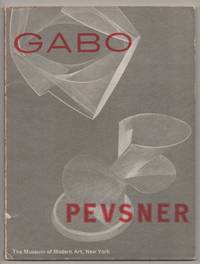
1948ref. 195846New York: The Museum of Modern Art 1948. First edition. Softcover. Joint exhibition catalog for these two brothers who were both Russian artists. Features Herbert Read's essay "Constructivism: The Art of Naum Gabo and Antoine Pevsner" along with biographies of the two men by Ruth Olson and Abraham Chanin. Includes numerous black and white illustrations. A very good copy in wrappers with some slight wear along the spine and some other minor wear. Internally a clean copy. The Museum of Modern Art unknown books
1947ref. 157481N.p.: N.p. 1947. Vintage reference photograph from the 1947 film noir. An amateur prizefighter's desire for fortune and fame leads him to join a corrupt boxing syndicate led by an unethical promoter. Widely considered one of the finest boxing films ever made with a strong screenplay by noted screenwriter Abraham Polonsky who would later face blacklisting in Hollywood as a result of the HUAC trials. 10 x 8 inches. Near Fine. Grant US. Olive Films 452. Selby US. Silver and Ward Classic Noir. Spicer US. N.p. unknown books
1947ref. 156219N.p.: N.p. 1947. Vintage reference photograph from the 1947 film showing actress Marlene Dietrich playing the zither. Stamp of photographer Whitey Schafer on the verso. Based on the 1946 novel by Jolán Földes about a British soldier who escapes from the Gestapo during World War II by posing as a gypsy. Shot on location in Bend and Corbett Oregon. 8 x 10 inches. Near Fine. N.p. unknown books
1996ref. 156549Northridge: The Center for Telecommunication Studies / California State University 1996. First Edition. First Edition. SIGNED by Abraham Polonsky on the title page. The first publication in book form of the screenplay for Polonsky's 1948 key film noir "Force of Evil" based on Ira Wolfert's 1943 novel "Tucker's People" and starring John Garfield. Fine with no dust jacket as issued. The Center for Telecommunication Studies / California State University unknown books
1963ref. 175938New York: The Jewish Museum 1963. First edition and first printing. Hardcover. 63 pages. Published in conjunction an exhibition that ran October 6 through Decemer 8 1963. Preface by Alan R. Solomon. Introduction by Richard Meier. Features essays by Dr. Abraham Kampf Rabbi Raphael Posner along with statements by Orthodox Conservative and Reform rabbis on the architecture of the synagogue and statements of the architects as well. Includes numerous black and white images and illustrations of synagogues in New York New Jersey Illinois and Michigan. A near fine copy in paper covered boards with printed labels affixed to the spine and front panel with some minor wear. No dust jacket as issued. An attractive example of the much less common hardcover issue of this catalog which was designed by Elaine Lustig. The Jewish Museum unknown books
1977ref. 146208N.p.: N.p. 1977. Fourth Draft script for the 1977 film. With a single manuscript ink notation on the front wrapper's right top corner. Based on the 1977 novel by Colin Forbes about a defecting Russian general who collaborates with an American secret agent to expose KGB spies throughout Europe by luring them onto a train headed west. Director Mark Robson and actor Robert Shaw died of unrelated heart attacks within months of the film's release making "Avalanche Express" a final film for both. Set and shot on location in Germany England Ireland Italy and the US. Tan titled wrappers noted as FOURTH DRAFT on the front wrapper dated December 30 1977 with credits for screenwriter Abraham Polonsky. Title page present dated December 30 1977 noted as FOURTH DRAFT with credits for screenwriter Abraham Polonsky. 115 leaves with last page of text numbered 113. Xerographic duplication rectos only. Pages Near Fine wrapper Very Good plus with tearing on the front wrapper binding bound with two gold brads. N.p. unknown books
2019ref. 169792New York: Marlborough Gallery 2019. First edition. Softcover. Exhibition catalog for a show that ran February 5 through March 2 2019. Includes with the covers 10 color illustrations and a list of previous exhibitions. A near fine copy in stapled wrappers with some very minor wear. Marlborough Gallery unknown books
1974ref. 147951N.p.: N.p. 1974. Draft script for the 1974 play which premiered at the Booth Theatre on May 5 1974 for 177 performances closing on October 5 1974. Annotations in manuscript pencil on title page and on cast page for "Ravenswood" the first of the two one act plays in "Bad Habits" listing names adjacent to the characters. Two one act comedies the first is "Ravenswood" set in a sanitarium catering to rich "unglued" patients in which Dr. Pepper treats his patients by encouraging them to indulge in bad habits. The second is "Dunelawn" also a sanitarium where Dr. Toynbee treats his patients with a magical drug which inhibits any "urges." Blue Studio Duplicating Service vinyl titled wrappers with credits for playwright Terrence McNally. Title page present with credits for playwright Terrence McNally. 135 leaves with last page of text numbered 62. Mimeograph duplication rectos only. Pages Near Fine wrapper Near Fine bound with two gold screw brads. N.p. unknown books
2019ref. 171163Zurich Switzerland: Galerie Haas 2019. First edition. Softcover. 51 pages. Exhibition catalog for a show that ran April 26 through June 15 2019. Text in English and German by Erika Schlessinger-Koltzsch. Includes a few color and numerous black and white illustrations. A fine copy in wrappers. Uncommon. Galerie Haas unknown books
1947ref. 145154Beverly Hills CA: United Artists 1947. Vintage linen backed keybook photograph of cinematographer James Wong Howe actress Lilli Palmer and members of the crew on the set of the 1947 film noir. Manuscript annotations on the verso. Considered by many to be amongst the best boxing films of all time as well as one of the great 1940s noirs. "Body and Soul" tells the story of a man who became a successful boxer to support himself and his mother after his father is killed but who realizes that he has slowly lost his integrity somewhere along the way. Winner of an Academy Award and nominated for two others. Shot on location in New York City. 10 x 8 inches. Near Fine. Grant US. Selby Canon US. Silver Classic Noir. Spicer US. United Artists unknown books
2018ref. 161910Zurich Switzerland: Galerie Haas 2018. First edition. Softcover. 57 pages. Exhibition catalog for a show that ran May 2018. Printed in an edition of 1350 copies. Text in English and German. Includes numerous illustrations. A fine copy in wrappers. Uncommon. Galerie Haas unknown books
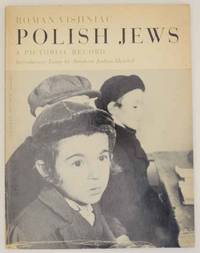
1972ref. 159043New York: Schocken Books 1972. First edition thus. Softcover. Vishniac's survey of the Jewish communities of Eastern Europe. Introductory essay by Abraham Joshua Heschel. Includes numerous black and white images. A very good copy in wrappers with some creasing to the base of the front cover and some other minor wear but internally a clean copy. Schocken Books unknown books
1970ref. 147145New York: Kennedy Galleries 1970. First edition. Softcover. Exhibition catalog for a show that ran February 14 through March 8 1970. Essay by Allen Leepa. Includes 31 illustrtations with 16 in color. A very good copy in stapled wrappers with some minor wear. Kennedy Galleries unknown books
1981ref. 139640New York: Kennedy Galleries 1981. First edition. Oblong softcover. 12 pages. Exhibition catalog for a show that ran March 24 through April 10 1984. Includes 12 color illustrations. A near fine copy in stapled wrappers. Kennedy Galleries unknown books
1972ref. 139626New York: Kennedy Galleries 1972. First edition. Softcover. Exhibition catalog for a show that ran October 19 through November 4 1972. Includes 23 color and black and white illustrations. A near fine copy in stapled wrappers. Kennedy Galleries unknown books
1985ref. 135071Washington DC: The Film Company / Public Broadcasting Service PBS 1985. Original Press Kit for the 1985 documentary. With a transcript of the program and a 32-page companion guide featuring facts about Herman Melville's life and work articles on Melville and a selected bibliography. This documentary tracks the personal and intellectual adventures of Herman Melville. Narrated by John Huston the film includes readings and commentary by F. Murray Abraham Robert Penn Warren Alfred Kazan and other notable writers and critics. Arthur Unger with The Christian Science Monitor reviewed the film in 1985: "Directed written produced and photographed mostly by Robert Squier a unique and dedicated artist himself. Mr. Squier has accomplished an inspired film about a writer and his writing which manages to combine the song of poetry and the zing of adventure with the shock of psychological recognition. not merely a labor of love; it is a probing and incisive study of how a man and his work interact with the environment physical and emotional. Utilizing real locations top literary scholars and a delicate sense of time and place with a minimal amount of reenactment Mr. Squier's film records the paradoxes in Melville's life his sense of hopelessness his disgust with brutality his agonizing search for religion his intellectual resolve his determination to survive personal disasters."not afraid of deep questions.'' Companion guide 32 pages transcript 36 pages and promotional letter from the publishers advertising a videocassette of the film rental $75 purchase $350 house in a dark green folder with silver titles and blind-stamped design. Near Fine overall. The Film Company / Public Broadcasting Service [PBS] unknown books
1954ref. 132689Burbank CA: Warner-Pathe / Warner Brothers 1954. Eight vintage British front-of-house cards and 2 black-and-white double weight still photographs from the 1954 UK release of the 1954 US film. Distributor rubber-stamps on the versos of 2 stills black-and-white. A Yankee sea captain Lancaster finds himself stranded after a mutiny on an island where the financial potential of cocoanut excites him and the mysterious wealth of the island beguiles him. 8 x 10 inches. Very Good plus with pinholes at the top edge color stills 2 color stills roughly trimmed at the top edge staple holes to 2 black-and-white stills and light creasing to the extremities. Warner-Pathe / Warner Brothers unknown books
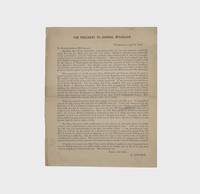
1864ref. 376854Np 1864. Broadside 9-3/4x8-3/4 inches. Remnants of prior mounting on verso small separation at horizontal fold repaired with tape. Broadside 9-3/4x8-3/4 inches. Rare broadside or handbill printing of the famous telegram sent by Abraham Lincoln to General George B. McClellan early in the Civil War expressing his frustration at McClellan's unwillingness to engage the enemy during the Peninsular Campaign and urging him in no uncertain terms to attack the Confederates. Lincoln uses a combination of reason force assessment and strategic reasoning in an attempt to draw McClellan into the fight famously concluding "you must act." This small broadside was published either in an effort to galvanize the public into pressuring the always reluctant McClellan to engage Confederate forces under General Joseph E. Johnston or perhaps as a campaign piece for the Election of 1864 to remind voters of McClellan's failures as a leader. Six months following its stinging defeat at the Battle of Bull Run the Union Army was reorganized trained and reformed into the Army of the Potomac by Major General George B. McClellan. After four months of training and reorganization however McClellan had done little more with his troops than run drills and reviews. In December 1861 President Lincoln took matters into his own hands and proposed the Peninsular Campaign March 1862 - July 1862 against Johnston's Confederate forces in which the Army of the Potomac would use a flanking attack in the nearby Occoquan Valley to capture Johnston and his army. McClellan rejected Lincoln's plan in favor of his own which consisted of a flanking movement much further south without leaving enough troops behind to protect Washington. Although Lincoln eventually acceded to McClellan's plan he held back the First Corps of the Army of the Potomac under the command of General McDowell for the protection of Washington. McClellan's plans were thwarted by Johnston who had in the interim moved the Confederate forces further south causing McClellan to march his men all the way to Yorktown deep in the Virginia peninsula. Instead of mounting a direct attack against the 17000 Confederates near Yorktown with his massive contingent of 70000 Union soldiers McClellan always overestimating Confederate forces and always fearful of failure took the safer route and laid siege to Yorktown which allowed Johnston to move his whole army down to Yorktown in opposition. In an April 7th telegram to Lincoln McClellan firm in his belief that he was always outnumbered by the Confederate forces complained that Lincoln held back too many troops for the protection of Washington which hamstrung his efforts for a successful campaign. In the present telegram to McClellan composed on April 9 Lincoln patiently responds: "Your dispatches complaining that you are not properly sustained while they do not offend me pain me very much." Lincoln continues "After you left to begin the Peninsular Campaign I ascertained that less than 20000 unorganized men without a field battery were all you designed should be left for the defense of Washington.This presented or would present.a great temptation for the enemy to turn back from the Rappahannock and sack Washington.My explicit directions that Washington sustained by the judgment of all the commanders of corps should be left secure had been entirely neglected. It was precisely this that drove me to detain McDowell." Lincoln refutes McClellan's belief that he did not have enough troops by using McClellan's own troop estimates obtained from the Secretary of War to argue McClellan into action stating that when "the whole force which has gone forward to you is with you.I think it is the precise time for you to strike a blow." Lincoln patiently tries to convince McClellan of the consequences of his inaction: "the enemy will readily gain on you; that is he will gain faster by fortifications and re-enforecments than you can by re-enforcements alone" and forcefully concludes "And once more let me tell you it is indispensable to you that you strike a blow." Lincoln then shows his brilliance as a judge of character addressing McClellan's fear of failure by holding up the public consequences of his inaction: "The country will not fail to note - is now noting - that the present hesitation to move upon an intrenched sic enemy is but the story of Manassas repeated." Then knowing by experience of McClellan's personal defensiveness Lincoln concludes in the words of Lincoln biographers John G. Nicolay and John M. Hay "with as much consideration and kindness as a father would use towards a querulous and petulant child." He ends his telegram writing "I beg to assure you that I have never written you or spoken to you in greater kindness of feeling than now nor with a fuller purpose to sustain you so far as in my most anxious judgment I consistently can. But you must act." Ultimately the Peninsular Campaign failed and the Army of the Potomac withdrew from the Virginia Peninsula in July 1862. By November of 1862 Lincoln frustrated with McClellan's lack of initiative on the field finally removed him from command and replaced him with General Ambrose Burnside as commander of the Army of the Potomac. Lincoln would later encounter McClellan as his Democratic adversary in the Presidential election of 1864 easily defeating him. OCLC lists just six copies located at New York Historical Society University of Delaware Abraham Lincoln Presidential Library Boston Athenaeum Library Company of Philadelphia and the Huntington Library. A rare and important printing of one of Lincoln's most famous messages of the Civil War. Nicolay John G. and John Hay. Abraham Lincoln: A History New York: The Century Company 1890 Volume 5 p.362 unknown books
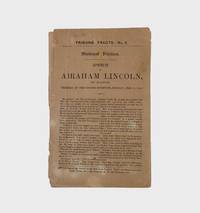
1860ref. 376855New York: Office of the New York Tribune 1860. First edition Monaghan's first issue. 1 2-15 1pp. With New York Tribune ads and subscription terms on verso of the terminal leaf. 8vo. Stitched self-wrappers toning. First edition Monaghan's first issue. 1 2-15 1pp. With New York Tribune ads and subscription terms on verso of the terminal leaf. 8vo. This address made at the Cooper Institute in New York on February 27 1860 catapulted Lincoln into the public eye and made him a viable presidential candidate. Indeed many historians have considered it the key to his success in the 1860 election and it is probably the most important speech Lincoln made after the Gettysburg Address and his inaugural addresses. The Cooper Union address was months in preparation; Lincoln was fully aware of its importance in moving himself from a regional favorite son to a viable national candidate. In the event some 1500 people including many prominent political figures attended on a snowy new York evening. The speech divides into three major parts. In the first Lincoln addressed the spread of slavery arguing that the framers of the constitution had been opposed to it and that the Federal government could regulate the question. In the second he argued that the Republicans were not a sectional Northern party and attacked the threats of southern Democrats to secede if the Republicans should win the election. Finally he addressed his fellow Republicans calling on them to act carefully and do "nothing through passion and ill temper.Let us have faith that right makes might and in that faith let us to the end dare to do our duty as we understand it." The Cooper Union speech was a resounding success. Horace Greeley described it as "one of the happiest and most convincing political arguments ever made in this City. No man ever made such an impression on his first appeal to a New York audience." Greeley quickly issued the speech in the form of this "Tribune Tract." It includes a final page of advertisements for other Tribune publications. The speech was later widely reprinted and made Lincoln nationally famous. This printing differs from other editions by its inclusion of a speech by James Doolittle Senator from Wisconsin and the message of Samuel Medary Democratic governor of the Kansas Territory vetoing the Kansas abolition bill. "The Cooper Union address tested whether Lincoln's appeal could extend from the podium to the page and from the rollicking campaigns of the rural West to the urban East. Cooper Union held the promise of transforming Lincoln from a regional phenomenon to a national figure. Lincoln knew it and rose to the occasion" Harold Holzer Lincoln at the Copper Union: The Speech That Made Abraham Lincoln President. Monaghan 50 Office of the New York Tribune unknown books
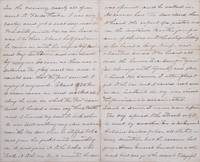
1865ref. 376410Montauk Montauk Navy Yard Wash D.C. 1865. 4 pp. 8vo. Slight soiling and minor tears along old folds otherwise in very good condition. 4 pp. 8vo. ".About 10:25 P.M. a man came in and walked slowly along the side." A remarkably clear and dramatic eyewitness account of the assassination of Abraham Lincoln from a naval surgeon who was close to the President's box at Ford's theater on that fateful night of April 14 1865. In this letter to his brother written the night after the assassination while the details were still fresh in his memory Dr. George B. Todd surgeon aboard the U.S. "Montauk" at anchor in the Navy Yard that day recounts the terrible event with a clarity of observation one might expect of his profession-a rarity among confused eyewitness accounts. The text of Todd's letter one of only 7 eyewitness accounts written within 24 hours of the assassination reads: "The few hours that have intervened since that most terrible tragedy of last night have served to give me a little clearer brain and I believe I am now able to give you a clear account up to this hour. Yesterday about 3 P.M. the President and wife drove down to the navy yard and paid our ship a visit going all over her accompanied by us all. Both seemed very happy and so expressed themselves - glad that this war was over or so near its end and then drove back to the White House. In the evening nearly all of us went to the Ford's Theatre. I was very early and got a seat near the President's private box as we heard he was to be there. About half past nine he came in with his wife a Miss Harris and Major Rathburn and was cheered by every one. As soon as there was a silence the play went on and I could see that the "pres." seemed to enjoy it very much. About 10:25 P.M. a man came in and walked slowly along the side on which the 'pres.' box was and I heard a man say "there's Booth" and I turned my head to look at him. He was still walking very slow and was near the box door when he stopped took a card from his pocket wrote something on it and gave it to the usher who took it to the box. In a minute the door was opened and he walked in. No sooner had the door closed then I heard the report of a pistol and on the instant Booth jumped out of the box onto the stage holding in his hand a large knife and shouted so as to be heard all over the house - 'Sic Semper Tyrannis' "so always with tyrants" and fled behind the scenes-I attempted to get to the box but I could not and in an instant the cry was raised 'The President is Assassinated.' "Such a scene I never saw before. The cry spread to the street only to be met by another 'So is Mr. Seward.' Soldiers had gone. Some General handed me a note and bid me go to the nearest telegraph office and arouse the nation. I ran with all my speed and in ten minutes the sad news was all over the country. Today all the city is in mourning nearly every house being in black and I have not seen a smile. No business and many a strong man I have seen in tears. "Some reports say Booth is a prisoner others that he has made his escape but from orders received here I believe he is taken as a mob once raised now would know no end. I will not seal this until morning and I may have some more news. "April 24th. "I have had no time to write until now as I have been a detective. We have now 7 that are implicated. Why don't you write Love to all George" Several important facts regarding the movements of both the President and John Wilkes Booth are recorded here: 1 This appears to be the only eyewitness account of the President's inspection of the "Montauk" earlier that afternoon. 2 Todd's account of Booth's interaction with the "usher" sitting outside the President's box "took a card from his pocket wrote something on it and gave it to the usher" is especially intriguing and reveals not only something of Todd's powers of observations but also his proximity to the assassin immediately before the shooting. Todd alone among eyewitnesses notes that the "usher" first took the card from Booth then went into the box and that a short time later the door opened and Booth went in. In fact Good finds only 7 other eye-witness accounts of the Lincoln assassination as early as April 15-most of these witnesses record little or nothing regarding the events before hearing the shot itself and none of them noticed Booth's interchange with the usher who was in fact Lincoln's valet Charles Forbes. There are three other accounts by eyewitnesses which partially corroborate Todd's observation of the Forbes and Booth interchange-but they were written much later than Todd's. 3 Todd's observation of the time he spotted Booth moving toward the box "about 10:25" corresponds to Good's own conclusion that Booth fired the fatal shot close to 10:30 PM. According to James Swanson MANHUNT p. 419 "the exact time of Booth's shot cannot be fixed . Booth may have shot Lincoln as early as 10:13 or as late as 10:30" Todd's account - again one of the freshest and most reliable weighs heavily in favor of Good. 4 Todd by his own account played a role in alerting the nation by telegraph. 5 Although he doesn't mention it as a surgeon of the ironclad Montauk Todd was also probably present at the autopsy of John Wilkes Booth on Thursday April 27 in the gun room of his ship. Indeed in an article in the February issue of the Baltimore and Ohio Magazine 1926 where the letter was first published and reproduced Todd is reported to have been "one of the surgeons who performed the autopsy." That as well as the fact that the other prisoners were being held on board the ironclad "Montauk" and "Saugus" may explain his cryptic remark near the end ". I have been a detective .". Todd actually mailed the letter on April 30 3 days after the autopsy and may very have participated in the actual investigation of the captives aboard the "Montauk." AN EXTRAORDINARY AND UNIQUE RECORD OF ONE THE NATION'S GREAT TRAGEDIES. Published from a copy in the State Historical Library of Wisconsin in Timothy S. Good WE SAW LINCOLN SHOT U. of Miss. 1995; with the mistaken date of April 30 1865 unknown books