27 519 résultats
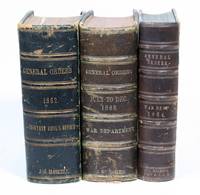
1862réf. 2923Washington D.C.: War Department 1862. Calf marbled boards. Very Good. FIRST OBTAINABLE PRINTING OF THE PRELIMINARY EMANCIPATION PROCLAMATION setting a date for the freedom of more than three million enslaved in the United States and reframing the Civil War as a fight against slavery. Issued by the War Department to regimental commanders in the field during the Civil War in the week after the completion of President Lincoln’s official manuscript version. Contained is a set of three volumes of General Orders covering the full year 1862 July-Dec 1863 and the full year 1864. History of the Emancipation Proclamation: “The proclamation has been called by responsible persons one of the three great documents of world history ranking with Magna Carta and the Declaration of Independence” – Eberstadt “From the first days of the Civil War slaves had acted to secure their own liberty. The Emancipation Proclamation confirmed their insistence that the war for the Union must become a war for freedom. It added moral force to the Union cause and strengthened the Union both militarily and politically. As a milestone along the road to slavery’s final destruction the Emancipation Proclamation has assumed a place among the great documents of human freedom” – National Archives Following the Seven Days Battle and General McClellan’s retreat from the Peninsula at the end of June 1862 President Lincoln realized that there would be no early end to the war and found himself “as inconsolable as it was possible for a human to be and yet live.” Anxious for news from the army and needing to escape the constant interruptions at the White House he frequently visited the telegraph office in the War Department building to await dispatches. It was during one such visit early in July that he asked the chief of the telegraph staff Major Thomas Thompson Eckert for some paper to “write something special” and began the first draft of the Emancipation Proclamation completing it in a few weeks. Lincoln had long hoped to resolve the slavery issue through a congressional act of emancipation compensating slave owners for their loss of “property” but that approach was roundly rejected by representatives from the border states leaving the President who had decided upon the necessity of emancipation with a presidential proclamation as the only option. The extraordinary document he conceived would announce the liberation on January 1 1863 of all slaves in those states still in rebellion against the Union and promised compensation to slave owners in those states that returned to the fold before that time if they adopted “immediate or gradual abolishment of slavery.” This proclamation would be followed by a final proclamation issued on the 1st of January identifying those states still in rebellion and confirming the liberation of all slaves therein. On Tuesday July 22 Lincoln presented his draft to the Cabinet telling them that he had resolved firmly upon the course of action it specified and asking them not for advice but suggestions. The only observation he had not anticipated came from Secretary of State Seward who proposed that it might be best to wait for a military victory before issuing the Proclamation as it could otherwise seem like “the last measure of an exhausted government.” Immediately recognizing the wisdom of the suggestion Lincoln held back. On September 17 after an anxious wait of nearly two months he received the victory he needed at the bloody Battle of Antietam. Completing his final draft Lincoln presented it to his cabinet for refinement on September 22. Following the meeting Seward took the amended draft with him to the State Department where a formal manuscript copy was made then signed by Lincoln and Seward. The formal official “Emancipation Proclamation” was of course issued on January 1 1863 the day it became the law of the land. Printing History: This printing in the War Department’s official “General Orders” is the fourth printing overall but realistically the first obtainable printing. It is preceded by: -The first printing Eberstadt #1 a small three-page circular intended for distribution within the government and to the local press likely printed on September 22. At the time that Charles Eberstadt published his study of the Proclamation 1950 he was able to locate only one copy which he himself owned and as nearly as we have been able to determine no other copies have come to light since then. -The second printing Eberstadt #2 may be a phantom printing. Charles Eberstadt was not able to locate a copy but he inferred its existence from the standard State Department practice of printing a folio edition consisting solely of the text of the proclamation followed by another printing consisting of the text of a letter of transmittal from the Secretary of State as well as the text of the proclamation. While there may be a copy of Eberstadt #2 in the National Archives as he speculated it is not recorded in their online catalogue nor have we been able to find a copy in any other online catalogue including OCLC the Library of Congress and the Abraham Lincoln Library. -Eberstadt’s third printing is of legendary rarity. It consists of Secretary of State Seward’s one-page letter of transmittal addressed “To the Diplomatic and Consular Officers of the United States in foreign countries” and the text of the proclamation. Eberstadt located a total of only five copies in institutions at the Library of Congress the National Archives Yale the Clements Library and Brown. OCLC does not record any additional copies nor is it recorded in Monaghan. There has been one copy at auction $400000 in 2021 and that was described as the only copy in private hands. -The present copy General Orders No. 139 is Eberstadt’s fourth printing of the Preliminary Emancipation Proclamation dated in print on September 24. Eberstadt surmises that this field order printing could have been accomplished as late as September 29 or 30. Although it may have been printed in as many as 15000 copies it is very rare in commerce likely due to the ephemeral nature of the printing and distribution. Additional General Orders and Provenance: The three volumes once belonged to John G. Haskell A.Q.M. Chief Quartermaster and contain the General Orders for the year 1862 July-December only for the year 1863 and for the full year 1864. John Gideon Haskell 1832-1907 was a resident of Kansas and joined the Union Army when the war broke out. He enlisted with the 14th Kansas Volunteer Cavalry Regiment and later served as Assistant Quartermaster General of Kansas as quartermaster of the Third Kansas and the Tenth Kansas Volunteers as Captain and Assistant Quartermaster on the staff of General James G. Blunt and as Chief Quartermaster of the Army of the Frontier. After the war Haskell was named official state architect and worked on the state house the capitol the State University and more. In addition to the preliminary Emancipation Proclamation the three volumes also contain the Acts of Congress on many other subjects including pay discharge recruitment handling of troops etc. Washington D.C.: War Department Adjutant General’s Office 1862-64. Three volumes. Small octavo contemporary three-quarter brown morocco two volumes with cloth boards one with marbled boards. Some rubbing and wear to bindings pencil notations on endpapers with collation and highlighting certain orders and some internal pages. Dampstaining to general title of 1862 volume; internal text and Emancipation Proclamation generally fine. RARE AND IMPORTANT. References: Charles Eberstadt. “Lincoln’s Emancipation Proclamation.” New York: 1950. War Department unknown books
1834réf. 5037Half brown morocco; ruled raised bands marbled boards. Mouradgea d'Ohsson was a Swedish historian and diplomat of Armenian descent. This important work is a large expansion of his 1824 publication which was the first serious study of Genghis Khan. Kenneth Meyer Setton A History of the Crusades notes "among the general histories of the Mongols d'Ohsson remains unequaled. Avowedly or tacitly most later works rely on it." Two folding genealogical charts; large 1824 folding map of Asia in the thirteenth century to rear of volume four. Previous owner's bookplates removed from front pastedowns. A nice wide-margined set many pages yet uncut in a sound period binding.; lxviii452; 651; 6241; 774.; 8vo 22 x 15 cm; All shipments through USPS insured Priority Mail. Freres van Cleff hardcover books
1663réf. 41874Nuremburg: Heirs of J. & W. Endter 1663. 8vo. 6 3/16 x 3 3/4 inches. xiv 998 xl pp. Title in red and black engraved frontispiece and 42 plates 7 folding. Early ownership signature on front pastedown. Early 18th-century lengthy manuscript commentary referencing passages on Brahmins from a work by Johann Albrecht von Mandelslo 1616-1644. Contemporary vellum First German Edition of one of the earliest European accounts of Hinduism in Southern India by a missionary who worked in Palicatta Coromandel for ten years from 1630 enlarged by supplementary accounts of Asian African and American religions not included in the Dutch and French editions. Abraham Roger was a Dutch missionary and linguist who spent a significant portion of his career working in India under the Dutch East India Company VOC. He was stationed in Pulicat a trading hub on the Coromandel Coast of South India where he worked among the Tamil speaking population. His experiences as a missionary coupled with his interest in local culture prompted him to document Hindu religious practices and beliefs culminating in this notable work. First published in Dutch in 1651 and translated into German in 1663 it is one of the earliest and most significant works by a European exploring Hinduism in South India. Roger's approach was distinct in its attempt to understand and accurately portray Hinduism a religion he sought to comprehend despite his missionary objectives. His work stands out for its translations of Hindu hymns and descriptions of temple rituals and he drew much of his knowledge from his close collaboration with local Brahmins reflecting a relatively objective tone compared to other European writings of the period. Despite his Eurocentric and missionary perspective Roger was unique in that he did not entirely dismiss Hinduism but rather engaged with it to create one of the earliest detailed European accounts of the religion. Sabin 72603; JCB III p. 92; Ackermann V 1273; Landwehr VOC 65. Heirs of J. & W. Endter unknown books
1931réf. 1398681New York: Dodd Mead & Company 1931. Hardcover. Octavo 520 pages. In Fair condition. Spine is black with gold print. Boards in black cloth; fraying to spine caps and corners blemishes/shelf wear short tear to front hinge cocked spine. Text block has intermittent spine breaks. Illustrated: b&w frontispiece portrait and plates. Newspaper reviews and clippings affixed to endpapers. NOTE: Shelved in Netdesk Column S. 1398681. FP New Rockville Stock. Dodd, Mead & Company hardcover books
1961réf. 1398194London New York Toronto: Abelard-Schuman Limited 1961. First Thus Edition. Hardcover. Quarto 46 pages. In Good plus condition with a Good dust jacket. Spine beige with black lettering. Exterior has moderate wear including some instances of chips to the head/tail edges age toning to the spine/edges and slight soiling. Clipped front flap. Slight age toning to the jacket interior. Boards have mild wear including faint sunning and light edge wear. Text block has modest wear including slight age toning to the edges with slight offsetting to the end papers. Illustrated. First thus edition. NOTE: Shelved in Locked Annex Quarto and Folio Case. Oversized books. Additional postage necessary for expedited/international orders. Economy International shipping unavailable due to size/weight restrictions. For international/expedited customers please inquire about rates. 1398194. FP New Rockville Stock. Abelard-Schuman Limited hardcover books
1974réf. 333481Princeton: The Pyne Press 1974. Hardcover. xii 132p. an unusual coffee-table item printed to the usual selling-point specifications: large 10x10 inches check presswork on glazed alkaline paperstock check soundly hardbound and jacketed check & check and worth opening check again. In this case amid a plethora of weirdly familiar curiosities recognizable because soon developed further is shown in doublespread colorphoto an invention by none other than Abraham Lincoln patent applied for with scale model in 1849 of a "New Improved Manner of Buoying Vessels Over Shoals" see index. Also find a number of early Thomas Edison efforts some of which took commercial form. Book is hardbound in white cloth boards gilt and enclosed in the dust jacket. Book itself is fine all around the dj is a little edgeworn: sound clean and unmarked in any way. The Pyne Press hardcover books
1523réf. 53327Venice: Daniel Bamberg 1523. Daniel Bamberg unknown books
2009réf. 51666New York: Tor 2009. Second printing. Hardcover. Fine/fine. Octavo. 445 3pp. Pictorial dust jacket with dark green spine lettered in whit over green boards with blind stamped front cover and gilt lettered spine. Illustrated with a fictionalized map of Africa. Signed on the title page by the editor and 4 of the 6 writers. A fine as new copy. In 1946 an alien virus that rewrites human DNA was accidentally unleashed in the skies over New York City. It killed ninety percent of those it infected. Nine percent survived to mutate into tragically deformed creatures. And one percent gained superpowers. Tor hardcover books
réf. 50735New York: Hebrew Publishing Co ND. Fine. 5 vols. each vol. for one book of the Pentateuch. Blue cloth with gold lettering on spine and front cover. Hebrew text of the Pentateuch with the commentary of Rashi accompanied by English translations of the text and Rashi. Includes footnotes explaining Rashi's use of midrashic sources. Aramaic Onkelos translation also on each page. A useful entry tool for the study of Judaism. Text in Hebrew Aramaic and English. A very good set with later acetate dust wrappers. This work was meant to provide as literal a translation as possible of both the biblical text as well as the rabbinic commentary. . Hebrew Publishing Co unknown books
1965réf. 50810London: The Soncino Press 1965. First edition. Large octavo. 2 volumes. xv 1 ix 1 400; vi vi 401-845 1pp. Index. Housed in brown slipcase lettered in white. Light tan dust jackets lettered in maroon over deep red cloth title blind-stamped on front board gold lettering on spines. Joints of slip case sound but with some rubbing. Slipcase has nicely protected the two volumes. Aside from a hint of unavoidable age toning to the spines of the dust jackets this a fine set. The fifteen minor tractates of the Babylonian Talmud for the first time translated into English in their entirety with Introduction Commentary and an extensive Index. The Soncino Press unknown books
1951réf. 48163New York: Rabbi E. Abraham Printed by Saphrograph Co. 1951. Hardcover. g to vg-. Quarto. 4 19 leaves double-sided and interleaved with illustrated plates 2 52-87 double-sided leaves 1. Blue buckram with blind-stamped ruling and gilt lettering on the covers. Gilt lettering on the spine. This edition of the Passover Hagadah is comprised of a reproduction of the illustrated manuscript Haggadah originally created by Rabbi Moses ben Nathan in 1816. Added to the Haggadah is the text from "Ma'ase L'Melech" a collection of sayings and scriptural interpretations of various past Chassidic Rabbis here applied to the text of the Passover service. The interleaved illustrations include lithographic reproduced images in black after the original images and a double-sided leaf containing b/w reproductions after images of past Rabbis. Text throughout in Hebrew with separate English-language cover and title page at the rear of the book block. Binding with light bumping and rubbing to the extremities. Interior with some staring at the gutters of a few pages as well as some sporadic water staining to some pages throughout. Book block still fairly tight overall. Previous owner's inscription in Hebrew on the front free endpaper. Binding in very good- interior in good condition overall. Hebrew title: הגדה של פסח מעשי למלך Authors: משה בן נתן הכהן. ××‘×¨×”× צבי יעקב Publication: × ×™×•Ö¾×™×רק ×ª×©×™×´× References: Yudlov 4287. Rabbi E. Abraham [Printed by Saphrograph Co.] hardcover books
1994réf. 47133Stuttgart: Anton Hiersemann 1994. Facsimile edition. Hardcover. Fine condition. Duodecimo. 8 8 142pp. Original light green cloth with white and green lettering on cover and spine. Frontispiece. Decorative headpieces and initials historiated endpieces. Each chapter with b/w reproduction of emblem. From the series "Rarissima Litterarum" reprints of rare original works from the 16th to the 18th century. Edited by Gerhard Dünnhaupt Vol. 1. The powerful and eloquent preacher Abraham à Sancta Clara was born in 1644 under the name Ulrich Megerlein in the village Kreenheinstetten in Baden-Württemberg. After learning Latin in Meßkirch he went to the Jesuit school in Ingolstadt and later to the Benedictine school in Salzburg. At the age of eighteen he joined the Augustine barefoot order and after the novitiate he preached in Maria Stern near Taxa in Bavaria. Leopold I. of Austria called on him to become the court preacher. Here he experienced the great plague and the siege of the Turks two events that made his name inerasably connected to the city of Vienna. As only few others he understood the troubles and woes of the people and became a legendary preacher. Facsimile reprint of the rare book of emblems representing a paraphrase of the Lauretan Litania. Each invocation of the Litany of the Blessed Virgin Mary opens with an emblem. The title relates to Abraham's work in Maria Stern Bavaria. The original work was published in 1680 in two versions a Latin version printed in red and black and a German version both penned by Abraham à Sancta Clara. The facsimile at hand is a reprint of the original German version. Anton Hiersemann hardcover books
1967réf. 47476Jerusalem: n.p. Sifriyah le-mahshevet Yiśraʼel 1967. Reprint. Hardcover. g to near fine. Octavo. 104pp. 2. White cloth over tan paper boards with black lettering on the front cover and the spine. Modern reprint of the original 1852 Frankfurt edition of Solomon ben Labi's Hebrew translation of Abraham ben David ha-Levi's aka. Abraham ibn Daud aka RABad ca. 1110-1180 philosophical work ha-Emunah ha-Ramah. The original work written in Arabic in Mediaeval Spain as Al-akidah al-Rafiyah The Sublime Faith was Ha-Levi's attempt to integrate Aristotelianism into Jewish thought. This edition contains only the Hebrew translation found in the 1852 edition and does not include the German translation by Simson Weil however there is a reproduction on the original German title page in gothic script at the opposite end of the book block. Published as part of the series Sifriyah le-mahshevet Yiśraʼel. Text in Hebrew. Binding with light rubbing to extremities. Bottom of front cover abraded. Ex-library copy with bookplates and ink stamps on the interior covers and title pages. Binding in good interior in near fine condition overall. Hebrew title: ספר ×”××ž×•× ×” הרמה :” ”×”×ž×‘×™× הסכמה בין ×¤×™×œ×•×¡×•×¤×™× והדת. n.p. [Sifriyah le-mahshevet Yiśraʼel] hardcover books
réf. 37867Warsaw: NP n.d. Softcover. g. Octavo. 4 page folded pamphlet. Orange label with black text tipped on the cover titled "Objasnienie" Explanation. The publication offers an explanation of Genesis 49:1 in which Jacob offers his sons a prediction of the end. Basing himself on the 15th century biblical commentator Isaac Abarbanel R. Abraham Kupfersztoch's father took each letter from the verse and produced a prophecy about a world war in which the Russians English Serbians French Italians and Romanians fight against Germany and Turkey. Germany would invade and defeat Russia Poland would gain its independence and the Jews would return to Israel. This process was done in a similar fashion to modern day biblical interpretations known as the "Bible Code". This brand of apocalyptic prophecy was influenced by Abarbanel who read Daniel as predicting an apocalyptic war between Christians and Muslims. Kupfersztoch's prediction was made in 1905 and it appeared to be on its way to fulfillment with the beginning of World War I. His empathy for Polish nationalists is quite striking as it goes against the common view of Polish-Jewish relations as being uniformly negative. Text in Hebrew and Polish. Some marking in pen and underlying in crayon. Overall in good condition. Abraham Isaac Kupfersztoch aka Kupperstock Poland - 1940 Berlin the author was an eccentric Hassidic Rabbi originally from Warsaw. He aided Germany during World War I by providing secret plans of the layout of Russian defenses. His reasons for doing this were based both an personal animus he harbored towards the Russians for executing some of his students years earlier and also likely in connection with this prophecy. As a consequence of his actions during the war he was granted German citizenship. He lived in Berlin and operated a Yeshiva there up through the Nazi period. He was even given financial support from the government and amazingly was one of an extremely rare class of Jewish citizens to have actually been given protection from anti-Semitic actions and persecution during the period. An extraordinary story reports that his yeshiva was in fact guarded from violence during the infamous Kristallnacht by a squad of SS members. Upon his death of natural causes in 1940 his students were subsequently no longer shielded from the Holocaust and were sent to concentration camps. NP unknown books
1892réf. 39555Lemberg: U.W. Salat 1892. First edition. Hardcover. g- to vg. Quarto. 88pp. Rebound in blue half cloth over light-blue paper covered boards. Beautifully illustrated title page. Contains three books of legal discussions: 1. Sefer Mavo Ha-Shemesh 2. Sefer Ha-Ta'arovot and 3. Sefer Mishmeret Ha-Shabbat. The first book deals with matters of time in the Jewish calendar the second is dedicated to mixtures of fabric and food and the third describes the observance of Shabbat. Text in Hebrew. Binding with minor staining and wear along edges. Title page with minor chips along foredge foxing and staining and several inked name stamps of M. L. Landau Breslau. Sporadic inked name stamps in margins. Block with age-toning and sporadic foxing throughout. Binding in overall very good interior in good- to good condition. U.W. Salat hardcover books
1710réf. 37844Frankfurt a. M. 1710. First edition. Hardcover. fair to g. Folio. 1 leaf 4 leaves 99 leaves 114 leaves 9 leaves 13 leaves 1 leaf. Contemporary brown leather with blind tooling along the border and spine as well as raised bands. Blue edges. Illustrated title page with image of a swan. Head and tail pieces. Commentary on the Talmud that elucidates contradictions within the text. Author makes use of gematriot based on his name. Text printed in double columns with talmudic text in regular script and author's comments in Rashi script. Source notes on side margins. Text in Hebrew. Significant peeling and scratching to leather boards. Bottom edge torn. Tail of spine mostly missing. Some misnumbering to leaves. Leaf 5 was bound after the fact. Name of previous owner on front endpaper. Heavy foxing to leaves. Overall in fair to good condition. hardcover books
1867réf. 34315Lemberg: Micheal Wolf 1867. Hardcover. fair. Octavo. 31 110 pp. Rebound brown cardboard with black adhesive on spine. Title page in Hebrew and German. A critical examination of the most important passages of the Talmud yerushalmi. Abraham Krochmal the son of the philosopher Nahman Krochmal greatly influenced Hebrew reading public as perhaps the most eminent Biblical critic in that language. Includes an acrostic poem that features Abraham Korchmal's name. Edgewear and slight tearing on binding. Bumped corners. Remnants of white sticker on spine. Front endpaper slightly stained and rippled. Slight foxing and toning throughout interior. Binding in fair condition interior in good condition. Text in Hebrew. Micheal Wolf hardcover books
1946réf. 35768New York: Machmadim Art 1946. Hardcover. g. Signed. 4to. vii unpaginated. Original red cloth with gold lettering on cover. A collection of 39 charming charcoal and pen drawings depicting Jewish life in the early 20th century by the famous Russian-American Jewish artist Abraham Walkowitz. Includes an English pamphlet by Isaac Lichtenstein which discusses Walkowitz's style and places him within the context of early modernist art. A powerful look into a now lost world that ranges from market place dealings to rabbis with Torah scrolls. This book was printed what after the Holocaust and can thus be seen as part of the beginning of the process of memorializing European Jewry. Text in Yiddish. Inscribed by author on front free endpaper. Some wear to spine and edges. Binding loose but still intact. Overall in good condition. Machmadim Art hardcover books
1969réf. 36237New York: Ktav Publishing House Inc 1969. Hardcover. g-. 8vo. Original blue cloth with embossed label and gold lettering on spine. A selection of articles published by the American Jewish Quarterly. Includes articles by Salo W. Baron Arnold Wiznitzer Abraham G. Duker Robert Gordis Bernard D. Weinryb J. D. Eisenstein and Jacob R. Marcus. Vol. I: The Colonial Period; Vol. II: The Early Republic; Vol. III: The Emerging Community; Vol. IV: The Era of Immigration; Vol. V: At Home in America. Includes numerous photographs and plates. Some wear to covers. Staining and rippling from water to lower corner. Some pages stuck together. Overall in good- condition. Ktav Publishing House, Inc hardcover books
1936réf. 36160Warsaw: Literarishe Bleter 1936. Hardcover. g. Duodecimo. 4 392 pp. Red buckram with blind stamped border and gold lettering on spine. Map of Erets Israel/Palestine on frontispiece. A Zionist work in Yiddish touting Jewish success in Palestine in building settlements and industry. Wear on top and bottom spine. Abraham Revusky was a leader within the socialist Po'alei Zion movement which advocated that Jews retake the land of Israel through agriculture. Slight tear on top edge of binding. Writing on free front endpaper by previous owner. Edge toning throughout interior. Small stain on fore edge. Binding and interior in good condition. Text in Yiddish. Literarishe Bleter hardcover books
1899réf. 34573Warsaw: Meir Jehiel Halter 1899. Second edition. 8vo. 88pp. Blue half-cloth over black pebbled cloth. A Zionist tract by one of the founders of the religious Zionist movement. This work was first published in 1891 and is a collection of pro-Zionist statements by rabbis. This Text in Hebrew. Corners worn. Head and tail of spine bumped. Some age toning and rippling to leaves. Overall in good condition. Meir Jehiel Halter unknown books
1923réf. 33347New York: Va'ad Ha-Nosad Li-Hashlemet Ha-Sefer 1923. Second edition. Hardcover. g. Complete 5 volume set. 4to. Original green cloth with gold lettering on spine. Comprehensive encyclopedia of names cities countries and animals and plants found in the Bible Talmud and Midrash. This work was put together by the noted early twentieth century Jewish scholar Abraham Hayyim Rosenberg. Text in Hebrew. Heads and tails of spines bumped. Volume 5 binding split but still intact. Overall in good condition. Va'ad Ha-Nosad Li-Hashlemet Ha-Sefer hardcover books
1986réf. 33615Cincinnati OH: The Hebrew Union College 1986. First edition. Softcover. g. Small quarto. 84pp. Original printed wrappers. This remarkable tribute volume was published in honor of the 90th birthday of Professor Jacob Rader Marcus the preeminent historian of American Jewry. Moderate rubbing and creasing on wrappers. Wrappers in overall good- interior in very good condition. The Hebrew Union College unknown books
1988réf. 32188Cincinnati: Hebrew Union College 1988. Second edition. Hardcover. vg. 4to. Unpaginated. Blue cloth with gold letters on front cover and spine. Endpapers have a reproduction from Maimonides' Mishnah Torah. The work produced by the Society of Jewish Bibliophiles offers a visual analysis of the views of Moses Maimonides and Israel ibn al-Nakawa on the different categories of charity. Each statement is headed by a corresponding illustration. Includes an introduction by Dr. Abraham Cronbach who also provided the translation for the texts based on a previous article of his. In near fine condition. Hebrew Union College hardcover books
1701réf. 33078Fulda 1701. Hardcover. fair. 4to. 185 leaves. Black cloth. Red edges. Illustrated title-page with Moses and Aaron on the sides and David killing Goliath at the bottom. Commentary on selections of the Zohar and other kabbalistic texts by Mordacai Ashkenazi published with the aid of his teacher Abraham Rovigo. These two kabbalists were both secret followers of the messianic claimant Sabbatai Sevi. Despite Sabbatai's conversion to Islam in 1666 and death in 1676 many of his followers continued to believe in him and worked to spread their particular heterodox brand of Judaism in defiance of the rabbinic establishment. As cover for his Sabbatian agenda Ashkenazi claimed that “Eshel Avraham” was simply a new interpretation of the Kabbalah based on his prophetic dreams. Ultimately this book is an important example of the success of the early eighteenth century Sabbatian underground to print books under the nose of the rabbinic authorities before it came out into the open with the printing of Nehemiah Hayon's “Migdal Oz.” Text in Hebrew. Backstrip missing but the book is still intact. Bottom corner chipped. Title-page torn and bottom strengthened. Slight worming to front leaves. Overall in fair condition. Steinschneider 4299:1. Samuel Wiener Bibliotheca Friedlandiana 991. hardcover books