28.049 Ergebnisse
1926Best.-Nr. 11504Chicago: Morris Briggs 1926. FIRST SEPARATE EDITION. Original stiff paper wrappers. First separate edition #1/25 copies printed. The recollections of a boy who grew up in Springfield originally printed in Century Magazine. Though this book has neither publishing information nor imprint Monaghan suggests Morris Briggs had it printed in 1926. Monaghan 2853. [Morris Briggs] unknown
1936Best.-Nr. 142510150071Black Cat Press 1936. Hardcover. Good. 0x0x0. Hardcover. NO DUST JACKET. Pages are clean and unmarked. Covers show light edge wear with rubbing/light scuffing. Binding is tight hinges strong.; 100% Satisfaction Guaranteed! Ships same or next business day! Black Cat Press hardcover
1936Best.-Nr. 1848536Black Cat Press 1936. First Edition. Hardcover. Used-Very Good. Red cloth. Octavo. 161 pp. From a limited printing of 300 copies. Mild shelf wear to boards some discoloration to spine. Altogether a copy in Very Good condition. Black Cat Press hardcover
1936Best.-Nr. L072672Black Cat Press 1936. First Edition. Hardcover. Very Good. 8vo - over 7¾" - 9¾" tall. Slight sunning and fading to spine; slight rubbing and browning to covers chiefly to edges; slight internal browning to edges. 161 2 pages. Editor's introductory note; essays by R. Gerald McMurtry and 9 others; includes bibliographical references chiefly for the last essay 'Abraham Lincoln's Favorite Poem' by M. L. Houser. Monaghan #3529; one of 300 copies the entire edition with design and typography by Norman W. Forgue and printed under the supervision of Nathaniel Roth; bound by Brock & Rankin; completed in August 1936.Decorative Title Page & Headpieces brown/black. Black Cat Press hardcover
1903Best.-Nr. 12435n.p.: Printed for Private Distribution 1903. FIRST EDITION. Prospectus laid-in. Original printed wrappers 32 loose caricatures housed in publisher's quarter-cloth portfolio with paper cover label and cloth ties portfolio soiled and chipped and lacking some ties; prospectus soiled and chipped. Text unopened. Caricatures all in nice shape. First edition of this scarce set. Wilson 1865-1949 was a prominent journalist and author. His interest and research made him a recognized Lincoln scholar. These caricatures were reprinted a number of times later in the twentieth century. Monaghan 1429. Printed for Private Distribution unknown
1916Best.-Nr. 12448New York: Privately Printed 1916. Original boards head of spine chipped; ex-libris with the usual markings previous owner's signature. Foreword by Meserve. Facsimile of letter. Includes a photograph of Lincoln and one of Ellsworth printed from the original negatives in Meserve's collection. First edition with a foreword by Meserve. Facsimile of Lincoln's letter of condolence to the parents of his friend Colonel Ephraim Elmer Ellsworth the first officer killed in the War of the Rebellion. Includes a photograph of Lincoln and one of Ellsworth printed from the original negatives in Meserve's collection. One of 250 copies printed for the Quill Club. Monaghan 2258. Privately Printed unknown
1913Best.-Nr. 12450New York: Isaac Markens 1913. FIRST EDITION. Original printed heavy wrappers with red string tie wrappers soiled with a couple tiny tears. First edition number 100 of 100 inscribed by Markens. A complete review of Lincoln's Gettysburg Address written on the occasion of the fiftieth anniversary of its delivery. Monaghan 2096. Isaac Markens unknown
1864Best.-Nr. 23084New York: Sold at 13 Park Row and at all Democratic Newspaper Offices 1864. 8pp caption title disbound a bit of blank margin wear Good. At head of title: 'Document No. 12.' This Democratic Party campaign pamphlet portrays President Lincoln as an incompetent military strategist who perpetually "interfered with General McClellan both when he was general-in-chief and afterward when he commanded the brave Army of the Potomac." Worse Lincoln has "The Taint of Disunion." He not McClellan the Democratic presidential candidate supported the Jeffersonian right of revolution in a speech during his single term in Congress. He and other "ultra abolitionists" are the "original secessionists and disunion men." George McClellan wants the rebel States to return to the Union but Lincoln's policies render that impossible. Lincoln "regards the States as dead and gone. He magnifies and strengthens the position of the Richmond dynasty" by seeking to negotiate "only with Jefferson Davis." Monaghan 326. Not in LCP. Sold at 13 Park Row, and at all Democratic Newspaper Offices unknown
1864Best.-Nr. 54101New York: printed by Thomas R. Dawley 13 Park Row and at all Democratic Newspaper Offices 1864. 8vo. 8 pp unpaginated. bound into mostly blank volume. Half-calf over marbled boards marbled endpapers raised bands on spine red black & gilt morocco spine labels minor scuffing wear to corners still VG copy from the library of noted New York City book collector Thomas Bell with his bookplate designed by Nancy Barnhart on front pastedown who was noted for his impressive library devoted mostly to Americana with many titles on Lincoln and sold at Anderson Galleries Auction in 1917. First edition of this scarce Democratic Party Copperhead influenced presidential campaign pamphlet perpetuating the complaints of mistreatment by Democratic candidate and former Civil War general George B. McClellan. This piece appears to have been published at the height of the Cold Harbor campaigns by the Union Army under command of Lieut. General Ulysses S. Grant which were suffering heavy casualties and significant blows to northern morale during the Civil War. The opening letter from President Lincoln denotes his complete confidence in Grant for the 1864 campaigns. In contrast McClellan has presented all of the attempts by Lincoln to encourage move troops and override orders from General as commander of the Union Army. In addition the Democratic ticket under McClellan wanted to negotiate with the Confederates immediately and place the agreement before the voters. Subsequent Documents included further charges against President Lincoln’s arbitrary arrests corruption and frauds Republican opinions about Lincoln and more. Dawley was self-styled as the Publisher to the Million and established himself at 13 and 15 Park Row as the “cheapest printer in the world” whose most successful Civil War publication was the best seller Incidents of American Camp Life. See: Nicolay & Hay Complete Works of Abraham Lincoln Bibliography No. 271; Philip R. Bishop Princes May Compete For But Only Huntingtons Can Buy Endpapers 2012 pp. 14-16. (printed by Thomas R. Dawley) 13 Park Row, and at all Democratic Newspaper Offices, hardcover
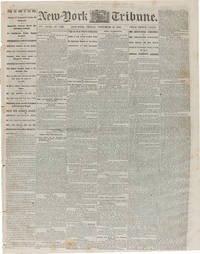
1863Best.-Nr. 56893New York. November 20 1863. The Gettysburg Address Published in New York the Day After the Event The complete issue of the New-York Tribune printing the Gettysburg Address on the morning of November 20 1863 the first possible date of the speech's printing. The previous day Lincoln delivered his great address at the dedication of a cemetery on the Gettysburg battlefield four months after the bloody and pivotal conflict that turned the tide of the Civil War in favor of the Union. Lincoln's speech was preceded by an address from Edward Everett the most famous orator of his day. Everett's speech took between ninety minutes and two hours to deliver and today is largely forgotten. Lincoln's speech delivered in only a few minutes stands as a supreme distillation of American values and of the sacrifices necessary for the survival of liberty and freedom. Much controversy surrounds the circumstances and content of the address as it was actually delivered at Gettysburg. The words spoken in the speech differ in the versions appearing in newspapers and the text which appeared in Washington several days later published as The Gettysburg Solemnities and known in only four copies which is now taken as the closest version to Lincoln's final intent because of its correspondence to the known manuscript versions. Interestingly and according to Carbonell the text of the first appearance of the speech in book form published a few days later as An Oration Delivered on the Battlefield of Gettysburg Monaghan 193 is taken largely from this New-York Tribune printing. As it appears here the address corresponds closely to the transcription printed in the same day's edition of the New York Times with slight variations in punctuation and capitalization e.g. "Four score and seven years ago our fathers brought forth on this continent a new Nation." in the Tribune versus "Fourscore and seven years ago our Fathers brought forth on this Continent a new nation." in the Times. The address is printed on the first page at the bottom of the fifth column running to the top of the sixth. Significantly it notes the five places during Lincoln's speech where applause broke out thereby providing an important historical record of the reception of the speech as it was delivered by Lincoln. It is noted that the conclusion of the speech was met with "long continued applause" and that "three cheers were here given for the President and the Governors of the States." Lincoln's speech is preceded by the opening prayer of the Rev. Thomas H. Stockton and followed by Everett's speech which occupies the rest of the sixth column and the vast majority of space on page two. War news occupies the other column space on the front page. Together with examples from other newspapers of November 20 1863 this issue of the New-York Tribune represents the first appearance of any version of the Gettysburg Address in print although at some variance with the version Lincoln eventually disseminated. The exact order in which the morning editions of November 20 were printed is practically impossible to determine at this point and as Carbonell states "will almost certainly never be known." Rightfully so Carbonell includes all November 20 morning newspaper printings of the Gettysburg Address as his first entry with no priority. Suffice to say this is as early a printing of one of the foundational documents of American life as one can ever encounter. "Lincoln's speech composed on the train on the way to Gettysburg and written down according to tradition on scratch-paper and the backs of envelopes comprised ten sentences and took only a few minutes to deliver. From the first words—'Four score and seven years ago'—to the last—'that government of the people by the people and for the people shall not perish from the earth'—it is immortal one of the supreme utterances of the principles of democratic freedom" - PRINTING AND THE MIND OF MAN. A handsome copy of this rare and important document. Large folio newspaper. Disbound from a volume. Minor chipping along spine edge. Trimmed closely along top and bottom edges likely when previously bound in a run of the newspaper. One soft horizontal center fold. Withal very good. A perfect candidate for display. CARBONELL 1. GROLIER AMERICAN 100 72 ref. STREETER SALE 1748 ref. PRINTING AND THE MIND OF MAN 351 ref. HOWES E233 ref. MONAGHAN 192 ref. Paul M. Angle "Four Lincoln Firsts" in Papers of the Bibliographical Society of America Vol. 36 no. 1 First Quarter 1942 pp.13-17. For an outstanding analysis of the structure and importance of the Gettysburg Address see Garry Wills Lincoln at Gettysburg New York 1992. unknown
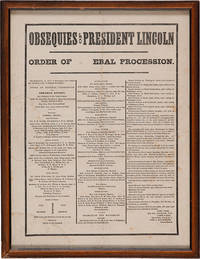
1865Best.-Nr. 55213N.p. but almost certainly Springfield Il. ca. May 3 1865. The Program for Lincoln's Official Funeral Procession in Springfield on May 4 1865: The Saddest Day in American History Likely a proof copy of the exceedingly rare broadside announcing the funeral procession for President Abraham Lincoln in Springfield in early May 1865. Struck down by assassin John Wilkes Booth on April 15 1865 Lincoln's body lay in state in the White House on April 18 and a ceremonial funeral service took place in Washington D.C. around noon on April 19. Two days later President Lincoln's casket was loaded on a funeral train headed for Springfield Illinois stopping at Baltimore Harrisburg Philadelphia New York City Albany Buffalo Cleveland Columbus Indianapolis Michigan City and Chicago before arriving in Lincoln's adopted hometown early on the morning of May 3. At this time Springfield's population numbered around 15000 but Lincoln's funeral train pulled into a town swollen with over 100000 visiting mourners. Immediately upon arrival Lincoln's coffin was transferred by hearse to Representatives' Hall inside the Illinois Old State Capitol. For the next twenty-four hours from about ten o'clock in the morning on May 3 to the same time the next day about 75000 mourners were allowed to pass by the open coffin of the slain president to pay last respects. According to the present broadside President Lincoln's funeral procession left the Old State Capitol "on Thursday the 4th Inst. at 10 o'clock a.m. precisely." The funeral party of over 10000 people then turned right on 7th Street to pass by the Lincoln family home and then right up Cook Street to proceed past the Governor's Mansion before heading north to Oak Ridge Cemetery. This broadside printing of the order of the procession for Lincoln's Springfield funeral was probably printed the afternoon of May 3 or possibly even the morning of May 4 the day of the funeral. Surrounded by a heavy black band the broadside lists all the persons and units involved in the procession along with their places and the rules for the day. The entire procession was divided into eight divisions with Gen. Joseph Hooker acting as Marshal in Chief. The first three divisions of the military escort represented all the elements of the Army and Navy. After them came the attending clergy and Lincoln's attending physicians. Next was the casket itself the only wheeled vehicle in the procession with the pall bearers to each side followed by Lincoln's horse and then the immediate family. Three more military divisions followed interspersed with government officials ambassadors and state officials followed by delegations from Springfield and other Illinois towns. Next were representatives of various organizations delegations from colleges lawyers doctors and the press Masons Odd Fellows and firemen all interspersed with two more military divisions. The final segment of the funeral procession was designated for "Citizens at large" and "Colored Persons." The broadside gives directions for locations for the forming up of each group. Only marshals were allowed to be on horseback; all others walked. Bands were under the direction of the Committee on Music. Other particular directions follow including regulations for the colors of the various scarves worn by the marshals. The text of the document ends with directions to keep the streets through which the procession passes "clear from sidewalk to sidewalk." This broadside must have been widely distributed to assist the mourners in Springfield but like all such ephemeral pieces few copies have survived. OCLC locates only six at Indiana University the Abraham Lincoln Memorial Library the Boston Athenaeum the Chapin Library at Williams College the John Hay Library at Brown University and the Library Company of Philadelphia. The latter location also attributes the place of printing to Springfield. There is also a copy at the Library of Congress and a copy formerly owned by noted collector James Copley and previously sold by this firm. The present copy is likely an early printer's proof of the broadside as it lacks the first three letters of the word "FUNERAL" in the title. The Library of Congress copy is also likely a proof with its variant title omitting the words "ORDER OF." Both copies also lack the letter "e" in "Order" in the first sentence of text. These errors speak to the haste and stress under which this broadside was surely produced perhaps the day before or the very morning of the day when America's greatest president the Savior of the Union and Illinois' favorite son was laid to rest in a city teeming with seven times its own population in attendance. A remarkable and moving document reflecting a moment of national grief perhaps only approached by the John F. Kennedy funeral and memorializing the day when America's first assassinated president was solemnly committed to the earth. Broadside 12 x 9 inches. Printed in three columns edged with a printed black border. Old folds center vertical fold with some separation. Moderate staining. Still very good. Framed. OCLC 5023077 79462381. unknown
1865Best.-Nr. 12453Boston: William V. Spencer 1865. FIRST EDITION. Original printed wrappers lightly soiled crease to rear wrapper. A near fine copy of this scarce pamphlet. First edition of this poem one of 250 copies printed. Samuel Greene Wheeler Benjamin 1837-1914 was a prolific writer and artist. He was appointed ambassador to Persia and served there between 1883-1885. Monaghan 399. William V. Spencer unknown
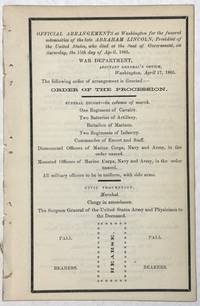
1865Best.-Nr. 42319Washington D. C. 1865. Caption title as issued. War Department Adjutant General's Office. April 17 1865. Single leaf folded to 3 1 blank pp. Disbound separating at the spine old stitching holes. Printed mourning border with diagram of hearse and pallbearers. Signed in type at the bottom of page 3 by Assistant Adjutant General W.A. Nichols. Except as noted Very Good. This scarce document prints the official arrangements for Abraham Lincoln's Washington D.C. funeral. The program lists participating military units; names the Senate House Army and Navy participants in the procession; family relatives "The Delegations of the States of Illinois and Kentucky"; governmental officials from the President on down. A printed diagram displays the hearse and pallbearers. The procession's route is described beginning "precisely" at 2 o'clock P.M. on Wednesday April 19th after "conclusion of the religious services at the Executive Mansion." The procession began with the firing of guns from St. John's Church City Hall and the Capitol and the ringing of church bells throughout Washington Georgetown and Alexandria. Monaghan 654. OCLC 10408587 13 as of July 2026. unknown
1864Best.-Nr. 36792Ohio 1864. Broadside ticket listing Union Ticket candidates for elections in 1864 beneath illustration of the American Flag. Several candidates are listed for "Supreme Judge" plus candidates for Secretary of State Attorney General Comptroller of the Treasury Board of Public Works; and for Congress John A. Bingham. Some edge wear text complete horizontal fold. Good. unknown
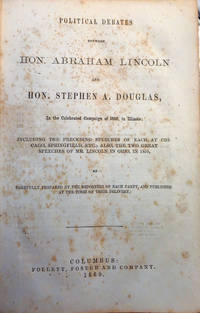
1860Best.-Nr. 022510Columbus OH: Follett Foster and Company 1860. First Edition. Hardcover. Front endpaper lacking top third; pencil writing on front endpaper and blank as well as rear pastedown; light to moderate foxing heaviest to title page; gilt on spine a little dull but readable. Very Good. Early issue. Publisher's brown blindstamped cloth; iv - ads iv 268 pages. These public debates over slavery are perhaps the most consequential campaign debates in American history. The first speech in the volume is Lincoln's famous "House Divided" speech of 17 June 1858 in Springfield IL. HOWES L-338; NEW HOWES L 339 "b": "Historically the most important series of American political debates." Follett, Foster and Company hardcover
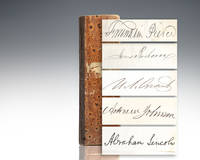
1877Best.-Nr. 1465621877-1880. Unique 19th-century autograph album containing the signatures of six American presidents fifteen senators several cabinet members and governors including Abraham Lincoln Ulysses S. Grant James Buchanan and Franklin Pierce. Narrow quarto bound in one quarter period dark brown cloth over stiff marbled wrappers the autograph album is a repurposed 19th-century caucus record dating from ca. 1870. The caucus book is alphabetically tab-indexed and filled out in ink voters are tracked by their name with caucus results appearing in the back. Although this is labeled “Ward 5” in the first page the term "Ward" was flexible in its usage. This could have been for a Ward election precinct caucus legislative congressional or state convention caucus. The autographs are mounted over the caucus records in their respective alphabetical tab. Also mounted at front are 6 printed pieces of 19th-century ephemera. The autograph album was assembled between 1877 and 1880 and can be dated by a contemporary pencil note that John Sherman had transitioned from the Senate to be Secretary of the Treasury. From the collection of a Mr. Boyd a 19th-century Ward politician in the upper Midwest Minnesota or Wisconsin. The Presidential autographs are primarily clipped from Presidential appointments and include: Abraham Lincoln James Buchanan Ulysses S. Grant Andrew Johnson Franklin Pierce and Rutherford B. Hayes. In very good condition. A very rare and unique collection. hardcover
1863Best.-Nr. 35588Auburn N.Y. 1863. Broadside 8" x 12-1/4". Very Good. Congressman Pomeroy of Auburn who represented New York in Congress during the Civil War years and early Reconstruction has high praise for Colonel Clark serving on the staff of General Banks and recently wounded in the advance on Port Hudson. In the earliest days of the War during the Baltimore disorders he "mingled during the day and following night with the populace and rioters gathered all possible information and on the following morning returned to Washington and laid the information before the military authorities. Communications with Annapolis being cut off he accepted the hazardous position of bearer of dispatches from the War Department to Gen'l Butler and of the seventeen messengers sent on that mission was the only one who succeeded in reaching his destination without arrest and that was accomplished only by a night march on foot of twenty-five miles in a country with which he was unfamiliar and by swimming the Patuxent within sound of the voices of the enemies sentinels." OCLC 768761257 1- Allen Cy Pub. Lib. as of November 2025. unknown
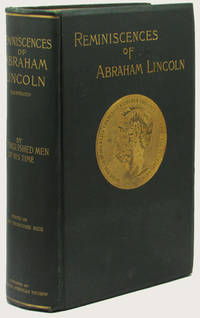
1888Best.-Nr. 34892New York: North American Publishing Company 1888. Early Printing With portrait frontispiece and 27 full-page illustrations throughout including many facsimiles of Lincoln autograph letters and manuscripts. Thick 8vo original polished green cloth gilt lettered on the spine and upper cover and decorated on both covers with gilt emblematic devices. lxix 13656 pp. A handsome copy bright and with little evidence of wear or use with some overall evidence of age the binding tight and strong the text-block clean. Reminiscences of the President by distinguished men of the time. There are contributions by Ulysses S. Grant Frederick Douglas Henry Ward Beecher Walt Whitman Cassius Clay and many others. A touching tribute to the 16th President of the United States. North American Publishing Company hardcover
1888Best.-Nr. 32325New York: North American Publishing Company 1888. Early Printing With portrait frontispiece and full-page illustrations throughout including many facsimiles of Lincoln autograph letters and manuscipts. 8vo original polished green cloth gilt lettered and decorated on the spine and covers with emblematic devices. lxix 13656. A good copy with some wear and evidence of age and use to the extremities of the binding. Reminiscences of the President by distinguished men of the time. There are contributions by Ulysses S. Grant Frederick Douglas Henry Ward Beecher Walt Whitman Cassius Clay and many others. A touching tribute to the 16th President of the United States. North American Publishing Company hardcover
Best.-Nr. 24234NP ND. Two identical plates each measuring 2.5" x 2.75" and mounted side by side on yellow cardboard backing measuring 6.75" x 3.25". Very Good. unknown
1915Best.-Nr. 302030First edition. Octavo. Frontispiece portrait after Brady of Lincoln and Tad. Dust jacket unclipped. Fine fresh. 102 pages. No signatures or bookplates. Little, Brown, and Company hardcover
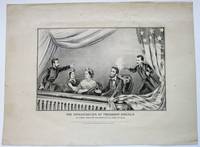
1865Best.-Nr. 37441New York: Currier & Ives. 152 Nassau Street 1865. Lithograph print oblong 13-1/2" x 18." Uncolored depicting Booth shooting Lincoln in the back of the head Mrs. Lincoln Miss Harris and Major Rathbone sharing the theater box with him. Minor dusting in the margins. Very Good plus. A related print by Currier & Ives lists the names of the occupants in the theater box. See 165 Eberstadt 460. This variant does not list the occupants' names. "This lithograph records the shocking moment when Abraham Lincoln was shot by John Wilkes Booth. As a famous actor Booth had free access to Ford's Theatre and had gone there to collect his mail on April 14 when he learned of the president's intention to attend a play that evening. Booth was the leader of a group of pro-Confederate conspirators determined to prevent the South's defeat and when Robert E. Lee surrendered to Ulysses S. Grant on April 9 they decided to kill Lincoln and other key Union leaders hoping to destabilize the war effort and allow Confederate armies still in the field to rally. Major Henry Rathbone who rises at left to restrain Booth was subsequently stabbed but survived. Lincoln died the next morning" The MET online. Currier & Ives Gallery C0291. Not in Reilly. Currier & Ives. 152 Nassau Street unknown
1908Best.-Nr. 12433Philadelphia: George W. Jacobs & Co. 1908. FIRST EDITION. Half paper and cloth boards soiled tips bumped otherwise very good. Top edges gilt others uncut. First edition of this book-long poem number 251 of 300 copies. Monaghan 1642. George W. Jacobs & Co. unknown
1618Best.-Nr. 71449San Francisco:: The Flag's Evening Dispatch April 16 1865. single sheet folded to form four pages. Light horizontal crease is neatly reinforced with tissue; slight use at edges. . Folio. Two small engraved illustrations. Mourning borders throughout. Nearly the entire newspaper is devoted to assassination news including "A Wail for President Lincoln" written for the Flag's Dispatch. The Flag's Evening Dispatch, unknown
1865Best.-Nr. 80642New York:: Derby and Miller 1865. First edition. later 20th c. attractive rebinding in quarter gilt-lettered morocco and cloth sides. Bookplate or pocket removal on rear pastedown; no other institutional indicia; clean tight and sound. 8vo. With a Steep Portrait and other Illustrations. To Which are Added Anecdotes and Personal Reminiscences of President Lincoln by Frank B. Carpenter. Derby and Miller, hardcover