28 131 résultats
1865réf. 80642New York:: Derby and Miller 1865. First edition. later 20th c. attractive rebinding in quarter gilt-lettered morocco and cloth sides. Bookplate or pocket removal on rear pastedown; no other institutional indicia; clean tight and sound. 8vo. With a Steep Portrait and other Illustrations. To Which are Added Anecdotes and Personal Reminiscences of President Lincoln by Frank B. Carpenter. Derby and Miller, hardcover
1864réf. 12446Philadelphia: T.B. Peterson 1864. FIRST EDITION. Original printed wrappers lacking rear wrapper; front wrapper lightly chipped and soiled some occasional scattered foxing. Still a very good uncut copy. First edition of this scarce wrapper issue. Monaghan 366. T.B. Peterson unknown
1866réf. 80753Springfield MAss.:: Gurdon Bill 1866. First edition. publisher's embossed leather. Spine a bit faded; leather scuffed at extremities; tight and sound. Contents fine. 8vo. Illustrated from engravings. Gurdon Bill, hardcover
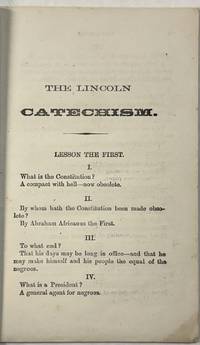
1864réf. 42194New York: J.F. Feeks Publisher 1864. Stitched. 46 2 publ. advts. Original printed wrappers the front wrapper and title page illustrated with a grotesque caricature of a Negro's face. Very Good plus. An unusually disgusting anti-Lincoln campaign document capitalizing on northern racist sentiments. Lincoln is called 'Abraham Africanus I'. His Emancipation Proclamation is ridiculed; the shifting focus of the War from a struggle to preserve the Union to a crusade against slavery is condemned; and the expansion of executive power to curtail civil liberties is denounced. The text includes "questions and sarcastic answers intended to defeat Lincoln" Monaghan. "What are the Ten Commandments Thou shalt have no other God but the negro. Thou shalt make an image of a negro and place it on the Capitol as the type of the new American man." "Strongly opposed to the election of Abraham Lincoln" Sabin Feeks the publisher was a Copperhead closely aligned with Chauncy Burr and other northern publishers of pro-slavey material. New York was "home to vigorous defenders of slavery who viewed African Americans as inferior and warned that abolition would hurt the nation's economy. Both sides took advantage of New York's role as center of publishing and the arts using the city's printing presses theaters and music halls to advocate for an end to slavery or for white supremacy" online Mus. of the City of New York ABOLISHING SLAVERY. FIRST EDITION. Monaghan 324. Bartlett 2734. Sabin 41204. J.F. Feeks, Publisher unknown
1908réf. 12383Philadelphia: Biddle Press 1908. Illustrated with line drawings and initial letters. Board-backed ring calendar with red cloth hanger; light edgewear. A ring calendar for the hundredth anniversary of Lincoln's birth with a leaf for each week of the year and events from his life on every page. Monaghan 1637. Biddle Press unknown
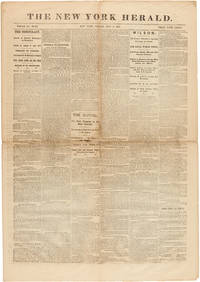
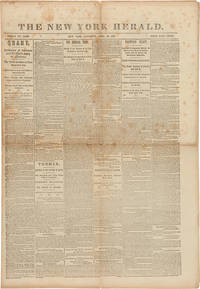
1865réf. 31223New York. May 5 1865. The main news in this edition concerns the ongoing events in the assassination of President Lincoln. A long story from Springfield Illinois reports on the arrival of the funeral procession and there are several stories about the pursuit of the conspirators in the President's murder. One story calls Jefferson Davis "a fugitive from justice with a price set on his head as an assassin." Another long piece brings news from the South as military action in the Civil War winds to a halt. The last page is taken up by an account of the Irish Independence movement and a profile of "Fenians at Home and Abroad." Large folio newspaper. Split along fold with loss to a few words. About very good unopened. unknown
1865réf. 31127New York. April 29 1865. The assassination of President Lincoln on April 14 1865 came on the same day Gen. Joseph Johnston of the Confederacy contacted Sherman to discuss the suspension of operations under similar terms granted to Lee. The present issue of THE NEW YORK HERALD treats both events with an account of Johnston's actual surrender under desired terms along with a relation of the progress of Lincoln's funeral train across America. The previous day the President's body was in Cleveland on the 29th the body was in Columbus. A poignant slice of America at the close of the Civil War. Large folio newspaper. Tanned moderate foxing old folds. Very good. Long E.B. THE CIVIL WAR DAY BY DAY pp.675-76684. unknown
1865réf. 102320Newspaper 16" x 23" uncut six columns of text 8 pp. Folded at center some tears and a little loss of text at center fold but not significant other chips tears and folds mostly at extremities normal aging and darkening uncut and center pages probably never read; good or better for a newspaper and still very presentable. Dated April 21 1865 this paper covers events of the Lincoln assassination Most of the front page and part of the last page are dedicated to Lincoln's death. The Herald discusses the eminent capture of John Wilkes Booth and gives an updat on Secretary Seward"s condition. The paper also carries a story on the conspiracy to kill Lincoln and an arrest made in Baltimore. The Herald gives a clear picture of a nation in mourning and the large crowds that turned out for a final viewing of the late president. An important piece of American History.
1865réf. 102321Newspaper 16" x 23" uncut six columns of text 8 pp. Folded at center some tears and a little loss of text at center fold but not significant other chips tears and folds mostly at extremities some aging and browning a little uneven darkening uncut and center pages probably never read; good or better for a newspaper and still very presentable. Dated April 26 1865 this paper covers events relating to the Lincoln funeral. The Herald reports that 750000 stood in silence during the funeral procession and that there were many disappointed mourners who didn't get a chance to join the 150000 that had a chance to make it to view the body. The paper gives details about the funeral procession and the final church services for the slain president. An important piece of American History.
1917réf. 11520n.p.: n.p. 1917. Facsimile broadside in wrapper folder; light soiling and edgewear to wrapper otherwise fine. One of 75 copies printed and signed by H.E. Barker. Facsimile of a very rare broadside published by Herndon as a rebuttal to attacks that he gave mis-information to Lincoln biographers in regard to the speeches between Lincoln and Douglas in 1854. Monaghan 2313. [n.p.] unknown
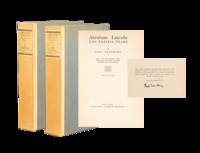
1926réf. 6332New York: Harcourt Brace and Company 1926. First edition. Near Fine. Number 22 of 260 copies printed on Dutch Charcoal Rag Paper numbered and signed "Carl Sandburg" by the author. Two octavo volumes 9 1/2 x 6 3/8 inches; 241 x 161 mm. xvi 480; vi 482 pp. Bound in publishers cream buckram over blue boards spines with printed paper labels blue endpapers top edge gilt others uncut. Spines very slightly darkened otherwise a near fine partially unopened set complete with the publishers duplicate labels at the end on each volume. Abraham Lincoln 1809-1865 was the 16th President of the United States and remains one of the most seminal figures in American History. During his tenure which was cut short by his assassination in 1865 he saw the country through the Civil War and stewarded Emancipation. Carl August Sandburg's 1878-1967 biography The Prairie Years traces the early part of Lincoln's life and the formation of a man who would go on to be president up until his move to Washington. Sandburg would also publish additional volumes covering Lincoln's war years. Hailed as a voice of American Sanburg would win one of his three Pulitzer Prizes for this compelling biography. Monaghan 2877. Near Fine. Harcourt, Brace and Company unknown
1860réf. 85724Chicago: Charles Leib 1860. Very Good. Four-page newspaper. A couple of small holes various brown spots and other bits of minor wear A campaign newspaper for Abraham Lincoln in the Presidential Campaign of 1860. We note a half-column story on the front page of this issue that accuses Senator Douglas of being a Roman Catholic -- a charge based partly on the fact that Mrs. Douglas was a Catholic as were their children -- probably an effective charge in largely Protestant mid-19th century America. Our brief research suggests that Douglas was neither a Catholic nor a formal member of any other organized religious group. The purpose of another half-column story on the front page was to make it clear that Lincoln had publicly condemned the actions of John Brown and did not object to Brown's execution. Charles Leib the editor was a political operative with an unclear background who had previously edited a Democratic campaign newspaper on behalf of the Buchanan campaign in 1856. Leib served briefly as an Assistant Quartermaster in the Union Army before heading to New Mexico probably in 1863 and died there in 1865 at the age of 38. Charles Leib unknown
1864réf. 82099New York:: National Union Executive Committee 1864. Creased where folded vertically and multiple times horizontally; some minor use to edges and a few tiny losses at folds; very attractive. . 11-1/2 x 8-3/4 inches. A Lincoln re-election broadside setting forth in detail and contrasting The Chicago Platform proposing "immediate efforts be made for a cessation of hostilities" and The Baltimore Platform "quelling by force of arms the rebellion." National Union Executive Committee, unknown
1864réf. 12394Philadelphia: Union League of Philadelphia 1864. FIRST EDITION. Wrappers disbound; light soiling and toning. First edition of this scarce pamphlet published during the 1864 elections in support of re-electing Lincoln as President. Monaghan 359. [Union League of Philadelphia] unknown
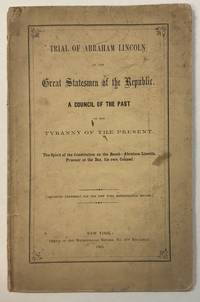
1863réf. 40887New York: Office of the Metropolitan Record 1863. Original printed wrappers. Stitched. 29 1 blank 1- advertisement for 'The Washington Despotism Dissected' 1 blank pp. Light wear and fox. About Very Good. The Metropolitan Record whose Prospectus is printed on the rear wrapper calls itself "an unswerving opponent of fanaticism in every form and an advocate of constitutional liberty and the rights of the citizens against despotic usurpation." This pamphlet is "A mock trial wherein Lincoln was charged with treasonable intent purposes and designs and of having committed among other unconstitutional acts the following: 'Declared War against Sovereign States under pretence of repossessing himself of certain forts and other property; arresting citizens without process of law; suppressed liberty of speech; stopped publication of certain newspapers; placed the military power above the civil power; overthrown State Sovereignty; forced unconstitutional acts through Congress.' At the conclusion of the trial the Court addressed the 'Criminal' as follows: 'You have been tried and found wanting. You have been given the opportunity of saving a nation but you have stabbed it to the heart. You have converted your country into a despotism'." Eberstadt. "Quotations from Lincoln and others selected to discredit his administration" Monaghan. A second edition was printed in 1867. Sabin Monaghan and LCP do not collate the advertisement at page 31. FIRST EDITION. 111 Eberstadt 332. Monaghan 252. Sabin 41234. LCP 10399. Office of the Metropolitan Record unknown
1865réf. 106884Newspaper 18 1/2" x 25 1/2" seven columns of text 4 pp. Folded at center another more subtle middle fold probably removed some chips tears and folds mostly at extremities some aging and browning a little uneven darkening ; otherwise about very good. Dated April 21 1865 this paper has several stories on the Lincoln assassination on the second and third pages of the newspaper. The articles include stories on the courage and determination of Secretary Stanton rewards posted for the capture of Booth and a nation in mourning. There is also a short report on the condition of Secretary Seward. Some interesting coverage of a national event in a local newspaper.
1865réf. biblio4Newspaper 18 1/2" x 25 1/2" seven columns of text 4 pp. Folded at center another more subtle middle fold probably removed some chips tears and folds mostly at extremities some aging and browning a little uneven darkening ; otherwise about very good. Dated April 21 1865 this paper has several stories on the Lincoln assassination on the second and third pages of the newspaper. The articles include stories on the courage and determination of Secretary Stanton rewards posted for the capture of Booth and a nation in mourning. There is also a short report on the condition of Secretary Seward. Some interesting coverage of a national event in a local newspaper.
1992réf. 110281AB1992. Chicago University of Illinois Press 1992. 16 x 24 cm. 154 pages. Original Hardcover with dustjacket in protective collector's mylar. Excellent condition with only minor signs of wear. Includes for example: The Chicagos of Nelson Algren and Studs Terkel / Saul bellow: Chicago versus the Great Books / Jane Addams's Lincoln / Carl Sandburg's Lincoln etc. etc. hardcover
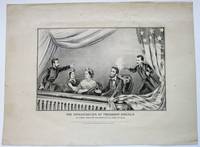
1865réf. 37441New York: Currier & Ives. 152 Nassau Street 1865. Lithograph print oblong 13-1/2" x 18." Uncolored depicting Booth shooting Lincoln in the back of the head Mrs. Lincoln Miss Harris and Major Rathbone sharing the theater box with him. Minor dusting in the margins. Very Good plus. A related print by Currier & Ives lists the names of the occupants in the theater box. See 165 Eberstadt 460. This variant does not list the occupants' names. "This lithograph records the shocking moment when Abraham Lincoln was shot by John Wilkes Booth. As a famous actor Booth had free access to Ford's Theatre and had gone there to collect his mail on April 14 when he learned of the president's intention to attend a play that evening. Booth was the leader of a group of pro-Confederate conspirators determined to prevent the South's defeat and when Robert E. Lee surrendered to Ulysses S. Grant on April 9 they decided to kill Lincoln and other key Union leaders hoping to destabilize the war effort and allow Confederate armies still in the field to rally. Major Henry Rathbone who rises at left to restrain Booth was subsequently stabbed but survived. Lincoln died the next morning" The MET online. Currier & Ives Gallery C0291. Not in Reilly. Currier & Ives. 152 Nassau Street unknown books
1860réf. 85724Chicago: Charles Leib 1860. Very Good. Four-page newspaper. A couple of small holes various brown spots and other bits of minor wear A campaign newspaper for Abraham Lincoln in the Presidential Campaign of 1860. We note a half-column story on the front page of this issue that accuses Senator Douglas of being a Roman Catholic -- a charge based partly on the fact that Mrs. Douglas was a Catholic as were their children -- probably an effective charge in largely Protestant mid-19th century America. Our brief research suggests that Douglas was neither a Catholic nor a formal member of any other organized religious group. The purpose of another half-column story on the front page was to make it clear that Lincoln had publicly condemned the actions of John Brown and did not object to Brown's execution. Charles Leib the editor was a political operative with an unclear background who had previously edited a Democratic campaign newspaper on behalf of the Buchanan campaign in 1856. Leib served briefly as an Assistant Quartermaster in the Union Army before heading to New Mexico probably in 1863 and died there in 1865 at the age of 38. Charles Leib unknown books
1865réf. 12437New York: Athenaeum Club 1865. FIRST EDITION. Original printed purple wrappers lightly chipped with sun fading to the front wrapper. Unopened. First edition. One of five hundred copies printed. It contains addresses by T. Bailey Myers Parke Godwin George P. Putnam and others and a poem by Henry T. Tuckerman. Monaghan 379 variant. [Athenaeum Club] unknown books
1865réf. 11541New York: Athenaeum Club 1865. FIRST EDITION. With engraved frontispiece portrait. Original printed purple wrappers housed in a quarter-calf portfolio rear joint splitting; chipping and soiling to wrappers with some splitting at the folds still a very good copy of this large fragile item. First edition number 46 of 50 large paper copies. Monaghan 379. [Athenaeum Club] unknown books
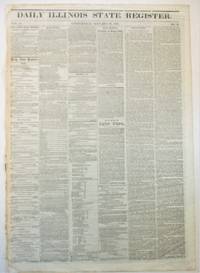
1861réf. 39392Springfield: Charles H. Lanphier 1861. 4 pp. Folio. 16-1/4" x 23-1/2.". Lightly chipped blank inner edge. Each page printed in six columns each separated by a rule. Very Good. The Register no friend of Abraham Lincoln was a Democratic Paper supporting the Crittenden Compromise. Reporting on State and National issues the Register notes "The Crittenden Resolutions have strong friends but the ultra republicans will not take them." Lincoln had insisted that his allies hold firm against Crittenden's Compromise. The Register rebukes Lincoln for his famous declaration that "the Union could not endure permanently part slave and part free." Developments in the fracturing Union are reported. Lincoln had been elected President nearly three months before the appearance of this issue. His inauguration would occur five weeks later. Paid advertisers include John McClernand and John Stuart who advertise their legal services in the first column of page 1. The large number and variety of advertisements for an array of medical complaints about four columns are surprising- - and a little disturbing. This issue also reports an incident involving the John Brownites at Boston who were snubbed by British Lord Brougham after inviting him to attend a convention discussing the abolition of slavery. Charles H. Lanphier unknown books
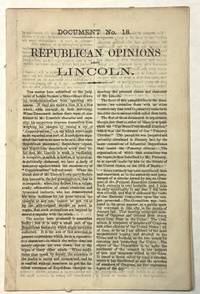
1864réf. 42090np. 1864. Caption title as issued. 16pp printed in two columns per page. Stitched Very Good. This unusual item a Democratic Party campaign pamphlet is a compendium of "Derogatory Republican statements concerning Lincoln's capacity compiled for the campaign of 1864. The Pomeroy circular Fremont's letter of acceptance the Wade-Davis manifesto" Monaghan. It is a forceful reminder of the low esteem in which Lincoln was held during 1864 until Atlanta fell to the Union in September. FIRST EDITION. Monaghan 349. Sabin 70036. unknown books
1862réf. 100336Newspaper folio unbound 8pp. Dampstained browned at edges with some foxing early owner's ink stamp on top margin some small tears and chips along edges and a little creasing. Still in decent shape overall. This is one of the earliest printings of the Emancipation Proclamation which was issued on September 22 1862. The Emancipation Proclamation declared freedom for all slaves in any Confederate state that didn't return to the Union by January 1 1863. Although this executive order did not actually free a large number of slaves it set the stage for the freedom of all slaves. Coverage of the Emancipation in this newspaper begins in the middle of the first page. This newspaper article represents important coverage of a very significant event in American History. archives government exhibits emancipation website books