28.034 Ergebnisse
1915Best.-Nr. 302030First edition. Octavo. Frontispiece portrait after Brady of Lincoln and Tad. Dust jacket unclipped. Fine fresh. 102 pages. No signatures or bookplates. Little, Brown, and Company hardcover books
1933Best.-Nr. 226729Chicago Chicago Book & Art Auctions 1933. 1933. First edition. 8vo. Foreword by Franklin J. Meine. Bibliographical references. Original stiff tan wrappers stamped in black. 66 pages. Very good. Catalogue of 531 Lincoln related items for "unrestricted public auction" June 14-15 1933. 1st Edition. Soft cover. Very Good. Chicago, Chicago Book & Art Auctions [1933]. paperback books
1865Best.-Nr. 12378Philadelphia: John E. Potter 1865. FIRST EDITION. With engraved frontispiece. Gray pebbled cloth decorated in gilt some light wear especially to corners some chipping to head and foot of spine. Aside from a few minor smudges to first couple of pages interior is very good. First edition. An in-depth biography of Lincoln with emphasis on his political career. It contains excerpts from a number of speeches and shorter messages. Interesting as to the contemporary ownership inscription. Monaghan 466. John E. Potter unknown books
Best.-Nr. 305687New York McGraw-Hill Book Company 1951. First edition. 8vo. 1 page preface by the author. Illustrated. Dust jacket unclipped; short tear; small chip to back panel; few nicks. Very good. 418 pages. No signatures or bookplates. 1st Edition. Hardcover. Very Good/Very Good. New York, McGraw-Hill Book Company [1951]. hardcover books
1899Best.-Nr. 12434n.p.: n.p. 1899. FIRST EDITION. Bound in half morocco and marbled boards; light creasing and soiling. Judd Stewart's copy with his bookplate. Very good. First edition of this inspirational address. Monaghan 1254. [n.p.] unknown books
1926Best.-Nr. 11504Chicago: Morris Briggs 1926. FIRST SEPARATE EDITION. Original stiff paper wrappers. First separate edition #1/25 copies printed. The recollections of a boy who grew up in Springfield originally printed in Century Magazine. Though this book has neither publishing information nor imprint Monaghan suggests Morris Briggs had it printed in 1926. Monaghan 2853. [Morris Briggs] unknown books
1913Best.-Nr. 12450New York: Isaac Markens 1913. FIRST EDITION. Original printed heavy wrappers with red string tie wrappers soiled with a couple tiny tears. First edition number 100 of 100 inscribed by Markens. A complete review of Lincoln's Gettysburg Address written on the occasion of the fiftieth anniversary of its delivery. Monaghan 2096. Isaac Markens unknown books
1916Best.-Nr. 12448New York: Privately Printed 1916. Original boards head of spine chipped; ex-libris with the usual markings previous owner's signature. Foreword by Meserve. Facsimile of letter. Includes a photograph of Lincoln and one of Ellsworth printed from the original negatives in Meserve's collection. First edition with a foreword by Meserve. Facsimile of Lincoln's letter of condolence to the parents of his friend Colonel Ephraim Elmer Ellsworth the first officer killed in the War of the Rebellion. Includes a photograph of Lincoln and one of Ellsworth printed from the original negatives in Meserve's collection. One of 250 copies printed for the Quill Club. Monaghan 2258. Privately Printed unknown books
1908Best.-Nr. 12433Philadelphia: George W. Jacobs & Co. 1908. FIRST EDITION. Half paper and cloth boards soiled tips bumped otherwise very good. Top edges gilt others uncut. First edition of this book-long poem number 251 of 300 copies. Monaghan 1642. George W. Jacobs & Co. unknown books
1903Best.-Nr. 12435n.p.: Printed for Private Distribution 1903. FIRST EDITION. Prospectus laid-in. Original printed wrappers 32 loose caricatures housed in publisher's quarter-cloth portfolio with paper cover label and cloth ties portfolio soiled and chipped and lacking some ties; prospectus soiled and chipped. Text unopened. Caricatures all in nice shape. First edition of this scarce set. Wilson 1865-1949 was a prominent journalist and author. His interest and research made him a recognized Lincoln scholar. These caricatures were reprinted a number of times later in the twentieth century. Monaghan 1429. Printed for Private Distribution unknown books
1946Best.-Nr. 12569n.p.: n.p. 1946. Lithographic print of a pencil and charcoal drawing of Abraham Lincoln signed in pencil by Woolf. Protected in a matted portfolio and tissue guard. Light soiling. Near fine. Samuel Johnson Woolf 1880-1948 was a famous portrait artist whose subjects included Mark Twain Winston Churchill and other famous performers writers and politicians. His work is represented in collections of the Metropolitan Museum of Art and New York Public Library among many other museums and has been exhibited all over the world. He also published numerous interviews for the New York Times Magazine each accompanied by a portrait of his subject. [n.p.] unknown books
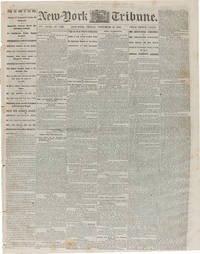
1863Best.-Nr. 56893New York. November 20 1863. The Gettysburg Address Published in New York the Day After the Event The complete issue of the New-York Tribune printing the Gettysburg Address on the morning of November 20 1863 the first possible date of the speech's printing. The previous day Lincoln delivered his great address at the dedication of a cemetery on the Gettysburg battlefield four months after the bloody and pivotal conflict that turned the tide of the Civil War in favor of the Union. Lincoln's speech was preceded by an address from Edward Everett the most famous orator of his day. Everett's speech took between ninety minutes and two hours to deliver and today is largely forgotten. Lincoln's speech delivered in only a few minutes stands as a supreme distillation of American values and of the sacrifices necessary for the survival of liberty and freedom. Much controversy surrounds the circumstances and content of the address as it was actually delivered at Gettysburg. The words spoken in the speech differ in the versions appearing in newspapers and the text which appeared in Washington several days later published as The Gettysburg Solemnities and known in only four copies which is now taken as the closest version to Lincoln's final intent because of its correspondence to the known manuscript versions. Interestingly and according to Carbonell the text of the first appearance of the speech in book form published a few days later as An Oration Delivered on the Battlefield of Gettysburg Monaghan 193 is taken largely from this New-York Tribune printing. As it appears here the address corresponds closely to the transcription printed in the same day's edition of the New York Times with slight variations in punctuation and capitalization e.g. "Four score and seven years ago our fathers brought forth on this continent a new Nation." in the Tribune versus "Fourscore and seven years ago our Fathers brought forth on this Continent a new nation." in the Times. The address is printed on the first page at the bottom of the fifth column running to the top of the sixth. Significantly it notes the five places during Lincoln's speech where applause broke out thereby providing an important historical record of the reception of the speech as it was delivered by Lincoln. It is noted that the conclusion of the speech was met with "long continued applause" and that "three cheers were here given for the President and the Governors of the States." Lincoln's speech is preceded by the opening prayer of the Rev. Thomas H. Stockton and followed by Everett's speech which occupies the rest of the sixth column and the vast majority of space on page two. War news occupies the other column space on the front page. Together with examples from other newspapers of November 20 1863 this issue of the New-York Tribune represents the first appearance of any version of the Gettysburg Address in print although at some variance with the version Lincoln eventually disseminated. The exact order in which the morning editions of November 20 were printed is practically impossible to determine at this point and as Carbonell states "will almost certainly never be known." Rightfully so Carbonell includes all November 20 morning newspaper printings of the Gettysburg Address as his first entry with no priority. Suffice to say this is as early a printing of one of the foundational documents of American life as one can ever encounter. "Lincoln's speech composed on the train on the way to Gettysburg and written down according to tradition on scratch-paper and the backs of envelopes comprised ten sentences and took only a few minutes to deliver. From the first words—'Four score and seven years ago'—to the last—'that government of the people by the people and for the people shall not perish from the earth'—it is immortal one of the supreme utterances of the principles of democratic freedom" - PRINTING AND THE MIND OF MAN. A handsome copy of this rare and important document. Large folio newspaper. Disbound from a volume. Minor chipping along spine edge. Trimmed closely along top and bottom edges likely when previously bound in a run of the newspaper. One soft horizontal center fold. Withal very good. A perfect candidate for display. CARBONELL 1. GROLIER AMERICAN 100 72 ref. STREETER SALE 1748 ref. PRINTING AND THE MIND OF MAN 351 ref. HOWES E233 ref. MONAGHAN 192 ref. Paul M. Angle "Four Lincoln Firsts" in Papers of the Bibliographical Society of America Vol. 36 no. 1 First Quarter 1942 pp.13-17. For an outstanding analysis of the structure and importance of the Gettysburg Address see Garry Wills Lincoln at Gettysburg New York 1992. unknown books
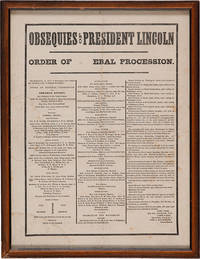
1865Best.-Nr. 55213N.p. but almost certainly Springfield Il. ca. May 3 1865. The Program for Lincoln's Official Funeral Procession in Springfield on May 4 1865: The Saddest Day in American History Likely a proof copy of the exceedingly rare broadside announcing the funeral procession for President Abraham Lincoln in Springfield in early May 1865. Struck down by assassin John Wilkes Booth on April 15 1865 Lincoln's body lay in state in the White House on April 18 and a ceremonial funeral service took place in Washington D.C. around noon on April 19. Two days later President Lincoln's casket was loaded on a funeral train headed for Springfield Illinois stopping at Baltimore Harrisburg Philadelphia New York City Albany Buffalo Cleveland Columbus Indianapolis Michigan City and Chicago before arriving in Lincoln's adopted hometown early on the morning of May 3. At this time Springfield's population numbered around 15000 but Lincoln's funeral train pulled into a town swollen with over 100000 visiting mourners. Immediately upon arrival Lincoln's coffin was transferred by hearse to Representatives' Hall inside the Illinois Old State Capitol. For the next twenty-four hours from about ten o'clock in the morning on May 3 to the same time the next day about 75000 mourners were allowed to pass by the open coffin of the slain president to pay last respects. According to the present broadside President Lincoln's funeral procession left the Old State Capitol "on Thursday the 4th Inst. at 10 o'clock a.m. precisely." The funeral party of over 10000 people then turned right on 7th Street to pass by the Lincoln family home and then right up Cook Street to proceed past the Governor's Mansion before heading north to Oak Ridge Cemetery. This broadside printing of the order of the procession for Lincoln's Springfield funeral was probably printed the afternoon of May 3 or possibly even the morning of May 4 the day of the funeral. Surrounded by a heavy black band the broadside lists all the persons and units involved in the procession along with their places and the rules for the day. The entire procession was divided into eight divisions with Gen. Joseph Hooker acting as Marshal in Chief. The first three divisions of the military escort represented all the elements of the Army and Navy. After them came the attending clergy and Lincoln's attending physicians. Next was the casket itself the only wheeled vehicle in the procession with the pall bearers to each side followed by Lincoln's horse and then the immediate family. Three more military divisions followed interspersed with government officials ambassadors and state officials followed by delegations from Springfield and other Illinois towns. Next were representatives of various organizations delegations from colleges lawyers doctors and the press Masons Odd Fellows and firemen all interspersed with two more military divisions. The final segment of the funeral procession was designated for "Citizens at large" and "Colored Persons." The broadside gives directions for locations for the forming up of each group. Only marshals were allowed to be on horseback; all others walked. Bands were under the direction of the Committee on Music. Other particular directions follow including regulations for the colors of the various scarves worn by the marshals. The text of the document ends with directions to keep the streets through which the procession passes "clear from sidewalk to sidewalk." This broadside must have been widely distributed to assist the mourners in Springfield but like all such ephemeral pieces few copies have survived. OCLC locates only six at Indiana University the Abraham Lincoln Memorial Library the Boston Athenaeum the Chapin Library at Williams College the John Hay Library at Brown University and the Library Company of Philadelphia. The latter location also attributes the place of printing to Springfield. There is also a copy at the Library of Congress and a copy formerly owned by noted collector James Copley and previously sold by this firm. The present copy is likely an early printer's proof of the broadside as it lacks the first three letters of the word "FUNERAL" in the title. The Library of Congress copy is also likely a proof with its variant title omitting the words "ORDER OF." Both copies also lack the letter "e" in "Order" in the first sentence of text. These errors speak to the haste and stress under which this broadside was surely produced perhaps the day before or the very morning of the day when America's greatest president the Savior of the Union and Illinois' favorite son was laid to rest in a city teeming with seven times its own population in attendance. A remarkable and moving document reflecting a moment of national grief perhaps only approached by the John F. Kennedy funeral and memorializing the day when America's first assassinated president was solemnly committed to the earth. Broadside 12 x 9 inches. Printed in three columns edged with a printed black border. Old folds center vertical fold with some separation. Moderate staining. Still very good. Framed. OCLC 5023077 79462381. unknown books
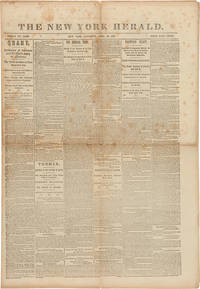
1865Best.-Nr. 31127New York. April 29 1865. The assassination of President Lincoln on April 14 1865 came on the same day Gen. Joseph Johnston of the Confederacy contacted Sherman to discuss the suspension of operations under similar terms granted to Lee. The present issue of THE NEW YORK HERALD treats both events with an account of Johnston's actual surrender under desired terms along with a relation of the progress of Lincoln's funeral train across America. The previous day the President's body was in Cleveland on the 29th the body was in Columbus. A poignant slice of America at the close of the Civil War. Large folio newspaper. Tanned moderate foxing old folds. Very good. Long E.B. THE CIVIL WAR DAY BY DAY pp.675-76684. unknown books
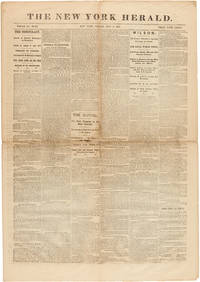
1865Best.-Nr. 31223New York. May 5 1865. The main news in this edition concerns the ongoing events in the assassination of President Lincoln. A long story from Springfield Illinois reports on the arrival of the funeral procession and there are several stories about the pursuit of the conspirators in the President's murder. One story calls Jefferson Davis "a fugitive from justice with a price set on his head as an assassin." Another long piece brings news from the South as military action in the Civil War winds to a halt. The last page is taken up by an account of the Irish Independence movement and a profile of "Fenians at Home and Abroad." Large folio newspaper. Split along fold with loss to a few words. About very good unopened. unknown books
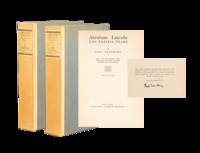
1926Best.-Nr. 6332New York: Harcourt Brace and Company 1926. First edition. Near Fine. Number 22 of 260 copies printed on Dutch Charcoal Rag Paper numbered and signed "Carl Sandburg" by the author. Two octavo volumes 9 1/2 x 6 3/8 inches; 241 x 161 mm. xvi 480; vi 482 pp. Bound in publishers cream buckram over blue boards spines with printed paper labels blue endpapers top edge gilt others uncut. Spines very slightly darkened otherwise a near fine partially unopened set complete with the publishers duplicate labels at the end on each volume. Abraham Lincoln 1809-1865 was the 16th President of the United States and remains one of the most seminal figures in American History. During his tenure which was cut short by his assassination in 1865 he saw the country through the Civil War and stewarded Emancipation. Carl August Sandburg's 1878-1967 biography The Prairie Years traces the early part of Lincoln's life and the formation of a man who would go on to be president up until his move to Washington. Sandburg would also publish additional volumes covering Lincoln's war years. Hailed as a voice of American Sanburg would win one of his three Pulitzer Prizes for this compelling biography. Monaghan 2877. Near Fine. Harcourt, Brace and Company unknown books
1907Best.-Nr. 774Paris, Paul Geuthner, 1907, in-8, br., VIII-80 pp.
1975Best.-Nr. 257911New York: American Theatre Press 1975. Magazine. 52p. includes covers 5.5x9 inches articles bios program ads very good original run program for the Broadway production digest magazine in stapled pictorial wraps. Playbill for the original Broadway run starring Rita Moreno Jack Weston & Jerry Stiller as well as F. Murray Abraham George Dzundza and Stephen Collins. Ran from January 20 1975 to January 4 1976. American Theatre Press unknown books
Best.-Nr. 23602Amsterdam, Guillaume et Jean Blaeu, (1644). Un feuille sur papier vergé fort, 570 x 485 mm, marque de pliure au centre (petit renfort de papier de 3 cm en bas), coloris d'époque (Texte français au verso). Rares rousseurs.
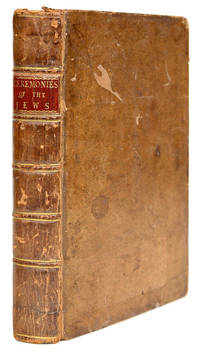
Best.-Nr. 94056London Printed for J. Wilcox 1738. . First edition 8vo 20.5 x 13 cm; xiv 96; 291 7 pp.; contemporary polished calf gilt contrasting red morocco lettering-piece early inked initials letters and shelfmark to front pastedown nineteenth-century ink inscription to rear pastedown; slightly rubbed with a small chip to head of spine and some light scuffing to boards one or two paper-flaws to page numbers small hole to I2 barely touching a single character of text occasional mark light damp-staining to rear endpapers else a very crisp and clean copy. The earliest translation to English of the Jewish prayer-book. This comprehensive and occasionally rather critical study of Jewish life and practices is dominated by the first English translation of any part of the Siddur the definitive Jewish prayer-book. Translated by Abraham Mears under the pseudonym of Gamaleil Ben Pedahzur according to Roth an apostate member of the English Ashkenazi community it was intended as an exposition of Judaism rather than a service book but in providing phonetic translations of the Hebrew title of each prayer Mears explicitly promotes its use 'to Beginners in the Hebrew Tongue' and 'all Persons that resort to the Synagogues'. The transliterated Hebrew title for each prayer is found in the margins enabling the curious non-Hebrew reading Christian to attend and follow a synagogue service. The transliteration of the Hebrew characters provides a clue as to how Hebrew was pronounced in the eighteenth-century Ashkenazi community of London. The book was not intended for liturgical use but rather for scholarly readership so it is not in effect a prayer-book. It reflects the growing interest in Judaism on the part of non-Jewish Englishmen of the eighteenth century. ESTC T86072; Roth B8:6. London, Printed for J. Wilcox, 1738. hardcover
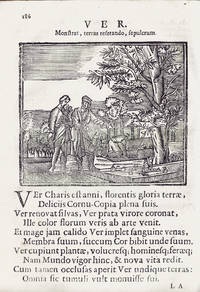
1717Best.-Nr. 1164° mm 230x168; ll. 6 pp. 400. Woodcut frontispiece and 100 emblematic woodcuts each approx. 105×120 mm. Contemporary vellum binding. Small restorations to the title page and pp. 353–54. Overall a fine copy. First edition in Italian the original title: Huy und Pfuy der Welt 1707. A very interesting richly illustrated book by the Augustinian preacher Abraham a Sancta Clara https://en.wikipedia.org/wiki/Abraham_a_Sancta_Clara. The treatise is a kind of iconographic and textual compendium intended for use by the popular preacher. Its format of emblem commentary 'favola' enables a constellation of homiletic exempla to be committed to memory in keeping with a very ancient rhetorical and visual tradition cfr. L. Bolzoni La rete delle immagini. Predicazione in volgare dalle origini a San Bernardino da Siena Torino 2002. "One of the greatest orators Germany has ever produced. People flocked to hear him drawn by the power and vivid clarity of his speech by the inexhaustible wealth of his wit and by the impartial severity with which he denounced the vices of all social classes. He poured his whole being into everything he said. Endowed with extraordinary creativity and inventive originality Abraham blended into his imaginative style fables short stories anecdotes erudite quotations witty sayings colourful and sometimes trivial wordplay sudden asperations personal recollections and vivid genre sketches with flashes of true eloquence—passionate fiery and vibrant. Even when he wrote he stood so to speak at the pulpit and saw his audience before him face to face" L. Bianchi. Per Gio. Parone
Best.-Nr. 012864Berkeley Bern Porter by the Packard Press 0 In-8 Cartonnage éditeur
Best.-Nr. 5097612° gebonden in 4 geheel perkamenten bandjes 24 598 12 10 659 22 12 588 12 16 750 16 pag. Geillustreerd met 2 uitslaande gravures van het interieur van de zaal in deel 2 en 3. In deel 2 enkele gecorrigeerde pagina's toegevoegd. Deel 4 bestaat uit twee gedeelten met tussengeplaatste titelpagina. unknown
Best.-Nr. 107936London The Nonesuch Press 1926. . Limited edition number 117 of 1050 copies on Dutch rag paper; large 8vo; portrait on title page reproduced from an engraving manuscript page written in French tipped in occasional slight browning to fore-edge; original brown cloth over bevelled boards red title label with gilt lettering endpapers browned overall a very good copy. Abraham Cowley was one of the first English poets to use the Pindaric ode form. The Mistress his popular collection of love poems was originally published in 1647. Dreyfus 34. London, The Nonesuch Press, 1926. hardcover
Best.-Nr. 42612Au Locle, chez Sam. Girardet, père, lib., 1792. Un volume in-8° divisé en 4 parties, 164 p. -16 pl.; 189 p. - 4pl.; 114p.-10 pl.; 95p. - 2 pl.; 6-[2] p. Reliure demi-veau marron.