(Lincoln, Abraham)Biblio.com

28.140 resultados
1865ref. 236784Boston: Printed by Order of the City Council 1865. 1 vols. 8vo. Original pebbled bevelled cloth. Fine. 1 vols. 8vo. Includes speeches by Mayor of Boston Lincoln Senator Charles Sumner the eulogy Charles G. Loring A.H. Rice and Richard Henry Dana Jr pp. 56-61. BAL 4465 Printed by Order of the City Council unknown
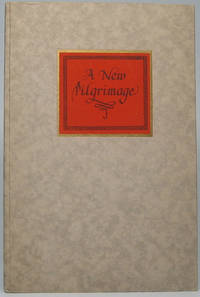
1923ref. 14412London: Savoy 1923. Hardcover. Small 4to. Grey paper over boards with gilt-edged paper label. 18pp 3pp. Tipped-in frontispiece. Near fine. First edition of this handsome production on fine paper. History of the famous Lincoln Room at the Savoy Hotel. G.D. Macdougald sculpted the magnificent Lincoln bust depicted on the frontispiece and unveiled when this room -- at which many historic events involving Herbert Hoover Winston Churchill and other notables took place -- was officially openedunveiled. MONAGHAN 2656. Savoy hardcover
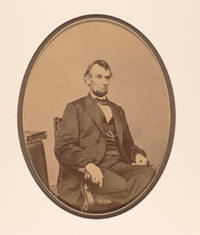
1863ref. 32820640Mammoth albumen print 17 ½ x 22 in mounted oval gilt-rule mat. Retouched vignetted enlargement. A few spots some toning. Very good condition. This famous "Gettysburg portrait" with Lincoln looking directly into the camera was made just days before he delivered the Gettysburg Address on November 19 1863. A giant of American photography Alexander Gardner is credited with introducing the large-format Imperial portrait to the United States while working as a staff photographer for Mathew Brady. Gardner left Brady's employ in early 1863 and his studio quickly rivaled Brady's for the quality and extent of its war and portrait photography. Gardner first photographed Lincoln as president-elect while working for Brady and he went on to take Lincoln's portrait more than any other photographer. Lincoln sat for Gardner on several occasions usually visiting his studio on Sunday to avoid crowds. Lincoln sat for this splendid portrait on Sunday November 8 1863. His private secretaries John Hay and John Nicolay joined him. Hay noted in his diary that "We had a great many pictures taken … some of the Prest. the best I have seen." This print emphasizes Lincoln's head and shoulders enlarging them to a size rarely seen. The gilt-ruled paper mat is characteristic of the 1860s and 1870s with this style of mat being popular during this period. Moses Rice subsequently had access to Gardner's negatives and routinely signed his prints with his name suggesting that Gardner himself made this enlargement. He died in 1882. The photography session of November 8 1863 also produced the mammoth portrait we offer for $95000. That photograph and the present are among the only early mammoth Lincoln portraits we have ever encountered. This is the only mammoth example of the famous Gettysburg portrait that we have seen. Ostendorf O-77
1941ref. 320873New York: Newhouse Galleries 1941. Presentation manuscript accomplished by Paul Hessemer for Newhouse Galleries illustrated with a photographic portrait of the painting. With typed letters signed from E.J. Rousuck to Allan P. Kirby and a contemporary copy of a letter to John Hay Whitney offering the portrait. With the original label from an 1869 exhibition of the painting at the Pennsylvania Academy of Fine Arts. 4to. Bound in full blue morocco lettered in gilt silk endpapers. Presentation manuscript accomplished by Paul Hessemer for Newhouse Galleries illustrated with a photographic portrait of the painting. With typed letters signed from E.J. Rousuck to Allan P. Kirby and a contemporary copy of a letter to John Hay Whitney offering the portrait. With the original label from an 1869 exhibition of the painting at the Pennsylvania Academy of Fine Arts. 4to. An elaborate brochure for the sale of this important portrait offered to Allan Kirby and John "Jock" Hay Whitney just days before Pearl Harbor. Newhouse Galleries unknown
1918ref. 251096London: Sidgwick & Jackson Ltd 1918. First edition. 1 vols. 8vo. Red boards paper spine label. Spine chipped with loss else VG. Bookplate of T. Fytton Armstrong John Gawsworth. First edition. 1 vols. 8vo. This was the play that made Drinkwater famous and his success was followed by other historical plays such as Mary Stuart Robert E. Lee etc. Inscribed on title-page "With malice toward none with charity for all it is for us to resolve that this antion under God shall have a new birth of freedom.A.L. p. 71 written out for John Gawsworth John Drinkwater August 1932." John Gawsworth's Copy. Sidgwick & Jackson, Ltd hardcover
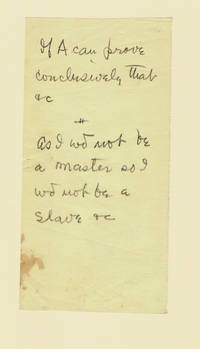
ref. 101254Very good. - Over 20 words in pencil by Carl Sandburg quoting Abraham Lincoln on 6-7/8 inch high by 3-1/2 inch wide yellow onion skin paper. The words here abbreviated by Sandburg from Lincoln's speeches "If A can prove conclusively that &c / # / As I wd not be a master so I wd not be a slave &c" were used in the libretto for Aaron Copland's "Lincoln Portrait". There is an indentation from a paper clip along the left edge as well as some minor staining to the bottom left. Very good. Among other sources Aaron Copland drew on Lincoln's quotes from Carl Sandburg's biography of the President. Sandburg was the narrator for the first performances of Copland's "Lincoln Portrait".
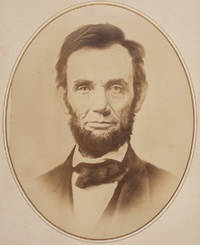
1864ref. 42820809Oval albumen print 8 x 6 in. original printed mount trimmed at bottom removing caption signed "BRADY & CO. PHOTOGRAPHERS." Browning and offsetting to mount light toning to image. Very good. Matted and framed. The classic Brady $5 bill photograph. This celebrated portrait the basis for the five-dollar bill engraving used for most of the 20th century is one of seven poses taken by Anthony Berger at Mathew Brady's Washington D. C. studio on February 9 1864. The most prolific photographer of Lincoln Brady himself did not actually operate his cameras during the war years instead training and employing men like Alexander Gardner and his successor Anthony Berger who took this picture to operate the camera. Lincoln's son Robert Todd Lincoln declared this famous portrait to be "the most satisfactory likeness" of Abraham Lincoln. Mathew Brady Gallery
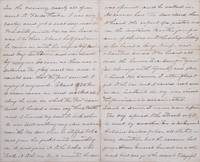
1865ref. 376410Montauk Montauk Navy Yard Wash D.C. 1865. 4 pp. 8vo. Slight soiling and minor tears along old folds otherwise in very good condition. 4 pp. 8vo. ".About 10:25 P.M. a man came in and walked slowly along the side." A remarkably clear and dramatic eyewitness account of the assassination of Abraham Lincoln from a naval surgeon who was close to the President's box at Ford's theater on that fateful night of April 14 1865. In this letter to his brother written the night after the assassination while the details were still fresh in his memory Dr. George B. Todd surgeon aboard the U.S. "Montauk" at anchor in the Navy Yard that day recounts the terrible event with a clarity of observation one might expect of his profession-a rarity among confused eyewitness accounts. The text of Todd's letter one of only 7 eyewitness accounts written within 24 hours of the assassination reads: "The few hours that have intervened since that most terrible tragedy of last night have served to give me a little clearer brain and I believe I am now able to give you a clear account up to this hour. Yesterday about 3 P.M. the President and wife drove down to the navy yard and paid our ship a visit going all over her accompanied by us all. Both seemed very happy and so expressed themselves - glad that this war was over or so near its end and then drove back to the White House. In the evening nearly all of us went to the Ford's Theatre. I was very early and got a seat near the President's private box as we heard he was to be there. About half past nine he came in with his wife a Miss Harris and Major Rathburn and was cheered by every one. As soon as there was a silence the play went on and I could see that the "pres." seemed to enjoy it very much. About 10:25 P.M. a man came in and walked slowly along the side on which the 'pres.' box was and I heard a man say "there's Booth" and I turned my head to look at him. He was still walking very slow and was near the box door when he stopped took a card from his pocket wrote something on it and gave it to the usher who took it to the box. In a minute the door was opened and he walked in. No sooner had the door closed then I heard the report of a pistol and on the instant Booth jumped out of the box onto the stage holding in his hand a large knife and shouted so as to be heard all over the house - 'Sic Semper Tyrannis' "so always with tyrants" and fled behind the scenes-I attempted to get to the box but I could not and in an instant the cry was raised 'The President is Assassinated.' "Such a scene I never saw before. The cry spread to the street only to be met by another 'So is Mr. Seward.' Soldiers had gone. Some General handed me a note and bid me go to the nearest telegraph office and arouse the nation. I ran with all my speed and in ten minutes the sad news was all over the country. Today all the city is in mourning nearly every house being in black and I have not seen a smile. No business and many a strong man I have seen in tears. "Some reports say Booth is a prisoner others that he has made his escape but from orders received here I believe he is taken as a mob once raised now would know no end. I will not seal this until morning and I may have some more news. "April 24th. "I have had no time to write until now as I have been a detective. We have now 7 that are implicated. Why don't you write Love to all George" Several important facts regarding the movements of both the President and John Wilkes Booth are recorded here: 1 This appears to be the only eyewitness account of the President's inspection of the "Montauk" earlier that afternoon. 2 Todd's account of Booth's interaction with the "usher" sitting outside the President's box "took a card from his pocket wrote something on it and gave it to the usher" is especially intriguing and reveals not only something of Todd's powers of observations but also his proximity to the assassin immediately before the shooting. Todd alone among eyewitnesses notes that the "usher" first took the card from Booth then went into the box and that a short time later the door opened and Booth went in. In fact Good finds only 7 other eye-witness accounts of the Lincoln assassination as early as April 15-most of these witnesses record little or nothing regarding the events before hearing the shot itself and none of them noticed Booth's interchange with the usher who was in fact Lincoln's valet Charles Forbes. There are three other accounts by eyewitnesses which partially corroborate Todd's observation of the Forbes and Booth interchange-but they were written much later than Todd's. 3 Todd's observation of the time he spotted Booth moving toward the box "about 10:25" corresponds to Good's own conclusion that Booth fired the fatal shot close to 10:30 PM. According to James Swanson MANHUNT p. 419 "the exact time of Booth's shot cannot be fixed . Booth may have shot Lincoln as early as 10:13 or as late as 10:30" Todd's account - again one of the freshest and most reliable weighs heavily in favor of Good. 4 Todd by his own account played a role in alerting the nation by telegraph. 5 Although he doesn't mention it as a surgeon of the ironclad Montauk Todd was also probably present at the autopsy of John Wilkes Booth on Thursday April 27 in the gun room of his ship. Indeed in an article in the February issue of the Baltimore and Ohio Magazine 1926 where the letter was first published and reproduced Todd is reported to have been "one of the surgeons who performed the autopsy." That as well as the fact that the other prisoners were being held on board the ironclad "Montauk" and "Saugus" may explain his cryptic remark near the end ". I have been a detective .". Todd actually mailed the letter on April 30 3 days after the autopsy and may very have participated in the actual investigation of the captives aboard the "Montauk." AN EXTRAORDINARY AND UNIQUE RECORD OF ONE THE NATION'S GREAT TRAGEDIES. Published from a copy in the State Historical Library of Wisconsin in Timothy S. Good WE SAW LINCOLN SHOT U. of Miss. 1995; with the mistaken date of April 30 1865 unknown
1865ref. b32167New York: New York Times 1865. First Edition . Unbound. Near Fine. The complete original New York Times announcing the first news reports on the assassination of Abraham Lincoln. This copy is in near fine condition and not previously bound. There is slight wear at the center of the first page where two small slits appear with almost no loss of text. This is a well-preserved copy of a key historical newspaper in American history. Quite rare. New York Times unknown
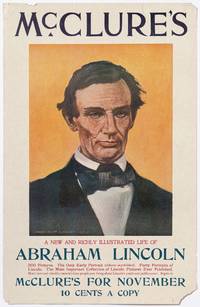
1895ref. 517161New York: McClure's 1895. Unbound. Very Good. Publisher's promotional broadside. Illustrated from a portrait of Lincoln by Corwin Knapp Linson. Measuring 12½" x 19½". Several small chips and edge tears one longer closed tear at the top edge affecting the title but stopping short of the image bright and very good. A handsome publisher's broadside announcing the publication of "A New and Richly Illustrated Life of Abraham Lincoln" in McClure's magazine. The serial will publish 300 pictures the only and previously unpublished early portrait of Lincoln and "much new and valuable material from people now living about Lincoln's youth and public career. McClure's unknown
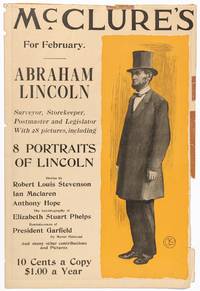
1896ref. 458433New York: McLure's 1896. Unbound. Good. 15" x 22". Illustration of Lincoln by Corwin Knapp Linson. Remnants of tape from old matting with a few small chips at the margins a good only example. also advertises stories by Robert Louis Stevenson Anthony Hope and others. McLure's unknown
ref. 553031 vols. 9 x 6 inches framed to 17 x 14-1/2. Two chips lightly scratched. Glued in wood frame. 1 vols. 9 x 6 inches framed to 17 x 14-1/2. unknown
1866ref. 375831Washington D.C.: John H. Littlefield; Wm. Terry Printer 1866. Photograph by John Goldin of Littlefield's painting on printed mount. Image 5 x 9 1/2 in.; mounted to 11 x 14 in. Faint toning to mount; fine. Photograph by John Goldin of Littlefield's painting on printed mount. Image 5 x 9 1/2 in.; mounted to 11 x 14 in. A published photograph of Littlefield's hyper-realistic Lincoln death-bed painting each figure meticulously rendered from photographs. Littlefield studied law under Lincoln in 1858 stumped for him in his Presidential bid and was rewarded with a position in the Treasury Department. After Lincoln's death Littlefield invented this tableau of twenty-five people ranged around the death-bed including Vice-President Johnson Surgeon Charles Leale and Mrs. Lincoln. "The artist used photographs as models for the twenty-five people gathered in the death room but his profile of the dying Lincoln shows a first-hand acquaintance" Ostendorf LINCOLN'S PHOTOGRAPHS p. 279. John H. Littlefield; Wm. Terry, Printer unknown
1866ref. 238120Washington D.C.: John H. Littlefield; Wm. Terry Printer 1866. Photograph by John Goldin of Littlefield's painting on printed mount. 1 vols. Image 11 1/2 x 18 3/4 in.; mounted to 19 x 24 in. Soiling to image vertical crease large chips to bottom of mount not affecting image or legend; good. Photograph by John Goldin of Littlefield's painting on printed mount. 1 vols. Image 11 1/2 x 18 3/4 in.; mounted to 19 x 24 in. A published photograph of Littlefield's hyper-realistic Lincoln death-bed painting each figure meticulously rendered from photographs. Littlefield studied law under Lincoln in 1858 stumped for him in his Presidential bid and was rewarded with a position in the Treasury Department. After Lincoln's death Littlefield invented this tableau of twenty-five people ranged around the death-bed including Vice-President Johnson Surgeon Chalres Leale and Mrs. Lincoln. "The artist used photographs as models for the twenty-five people gathered in the death room but his profile of the dying Lincoln shows a first-hand acquaintance" Ostendorf LINCOLN'S PHOTOGRAPHS p. 279. Provenance: Harper Family John H. Littlefield; Wm. Terry, Printer unknown
1866ref. 238011Washington D.C.: John H. Littlefield; Wm. Terry Printer 1866. Photograph by John Goldin of Littlefield's painting on printed mount. Image 8 1/2 x 13 3/4 in.; mounted to 13 x 17 in. Faint toning to mount; fine. Photograph by John Goldin of Littlefield's painting on printed mount. Image 8 1/2 x 13 3/4 in.; mounted to 13 x 17 in. A published photograph of Littlefield's hyper-realistic Lincoln death-bed painting each figure meticulously rendered from photographs. Littlefield studied law under Lincoln in 1858 stumped for him in his Presidential bid and was rewarded with a position in the Treasury Department. After Lincoln's death Littlefield invented this tableau of twenty-five people ranged around the death-bed including Vice-President Johnson Surgeon Charles Leale and Mrs. Lincoln. "The artist used photographs as models for the twenty-five people gathered in the death room but his profile of the dying Lincoln shows a first-hand acquaintance" Ostendorf LINCOLN'S PHOTOGRAPHS p. 279. John H. Littlefield; Wm. Terry, Printer unknown
1863ref. 292206No place: no publisher 1863. Softcover. Near Fine. First edition. Stitched self-wrappers. 16pp. Slight age-toning very near fine. Anti-Lincoln campaign material issued by pro-Fremont Republicans including a long statement by Ben Wade and Henry Winter Davis. no publisher] unknown
1865ref. 235590Boston: Oliver Ditson & Co 1865. First edition front wrapper without portrait of Lincoln appearing in later issues. Engraved title and piano score; 5 pp. 1 vols. Folio. Loose as issued; split along spine with some chipping to extremities. First edition front wrapper without portrait of Lincoln appearing in later issues. Engraved title and piano score; 5 pp. 1 vols. Folio. Donizetti died 17 years before Lincoln having gone mad from syphilis. His Funeral March gained a measure of recognition in America after it was performed during Lincoln's funeral ceremonies. It is a heavy solemn piece in a minor with droning octaves in the bass a haunting chromatic figure in the middle register and a lyrical upper voice. see Barret Sale Lot 693; Stern Collection of Lincolniana Oliver Ditson & Co unknown
ref. 51614San Francisco: Wallace Kibbee & Son n.y. Paperback. 4to. Heavy stock printed tan folder. Near fine. First and likely sole printing of this finely printed folder printed in commemoration of the 127th anniversary of Lincoln's birth which thus dates this undated item to circa 1936 with the famed text on front wrapper and inner leaf containing an introduction at the bottom of which Kibbee signs large and bold in brown ink. Colophon at rear notes this edition limited to 380 copies -- though he rarely signed the inner leaf. Unusual and seldom seen. Kibbee 1888-1972 was a noted California printer and type designer. Wallace Kibbee & Son paperback
1864ref. b21811New York 1864. First Edition . Disbound. Very Good. COMPLETE AND ORIGINAL ISSUE NOT A REPRINT. A RARE HISTORICAL DOCUMENT. Wrinkling and wear to spine where disbound and some foxing. Of special note in this issue is the "Latest Portrait" of Lincoln with his two secretaries Mr. NIcholas and Mr. Hay p. 373. Lincoln looks surprisingly young in this portrait but as usual his face shows a whistful gaze. Cover story on the "Great Central Fair in Philadelphia" with 1/2 page illustration of the fair buildings on Logan Square. More illustrations by A.R. WAud of the Army of the Potomac including a center-fold drawing "The Struggle for the Salient Near Spottsylvania Virginia May 12 1864." Also Chp. XXVI of "Quite Alone" by George Augustus Sala. Two illustrations on Sherman's campagin in Georgia fill a page "Sherman's Advance--General Logan's Skirmishers Advancing Toward the Railroad at Resaca May 13 1864" and "Sherman's Advance--Poistion of Osterhaus's Division Logan's Corps. on Bal Hill Mary 14 18640-Shelling the Railroad at Resaca" both by Theodore R. Davis. unknown
1905ref. 327084Chicago: Illinois Central Railroad Company 1905. 200 copies this is one of Fourteen Copies Printer's Edition By Permission #6. illustrated throughout with photogravures of Lincoln documents in the ICRC collection. 4to. Full pebbled limp pebbled black morocco with gilt stamping on upper cover "Compliments of the Illinois Central Railroad Company." Laid into full orange cloth dropbox with gilt stamp "Collection of Foreman M. Lebold. 200 copies this is one of Fourteen Copies Printer's Edition By Permission #6. illustrated throughout with photogravures of Lincoln documents in the ICRC collection. 4to. Provenance: Lou F. English this copy presented by Walter J. Gunthorp to Lou F. English.; Foreman M. Lebold lettering to clamshell box Illinois Central Railroad Company unknown
1949ref. 327086Chicago: Chicago Illinois Midland Railway Company 1949. Folio. Framed and glazed total dimensions 795 x 718 mm. Folio. Chicago Illinois Midland Railway Company unknown
1941ref. 244867New York: Duell Sloan and Pearce 1941. First edition Number 5 of a special edition signed by the author on the half-title. Illustrated throughout. 160 pp. 1 vols. 4to. Quarter brown pebbled morocco and cloth. Fine copy in open-faced slipcase some wear to slipcase. First edition Number 5 of a special edition signed by the author on the half-title. Illustrated throughout. 160 pp. 1 vols. 4to. Duell, Sloan and Pearce unknown
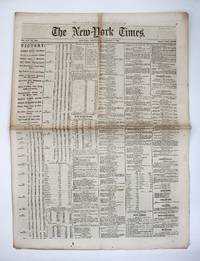
1864ref. 369148New York 1864. 8pp. Oblong folio. Central fold with small fading else fine. 8pp. Oblong folio. Reads on left column in part: VICTORY! Glorious rsult Yesterday. Election of Lincoln and Johnson. Terrible Defeat of McClellan." Haedlines show a little editorializing even then. unknown
1864ref. 369149New York: The New-York Times 1864. 8pp. Oblong folio. Central fold elae Fine. 8pp. Oblong folio. The New-York Times unknown
1860ref. b40650New York 1860. First Edition . Disbound. Near Fine. Complete original disbound newspaper in near fine condition. unknown